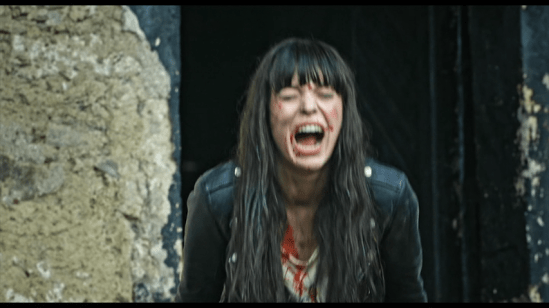
Former pin-up model Virginia “Ginny” Smith lives a solitary life on the street of a quiet Buffalo, New York suburban neighborhood. Her modeling past was prosperous, posing erotically with curves similar to that of pin-up queen Bettie Page, up until a newer, thinner model named Chloe undermines Ginny’s magazine spread career. Feeling abandoned, physically tortured, and seeking revenge throughout the years, Ginny eats up the competition from thin, to the fake, and to the virginal…literally! Sal and his mentally instable wife Debbie move in next door to Ginny. Soon after, Debbie suspects that her elder neighbor might be up to no good as people go into Ginny’s house but never come out. Chalking up her suspicions to psychosis, Sal ignores Debbie’s accusations until he mysteriously perishes in a car accident. Now nothing can stop Debbie from investigating into Ginny’s cold blooded habits.

“Model Hunger” is the long awaited directorial debut from long time scream queen and B-movie horror icon Debbie Rochon that publicly displays the dementedness clinging to the inner walls of her brain. Helming from off the screenplay penned by “Seed 2” producer James Morgart, Rochon quickly denotes the position of anti-supermodel figure, turning the thin, the snooty, and those who encourage that sort of behavior into nothing more than a gloppy stew of human chow. “Model Hunger” parodies the serious nature of young women whom go to extreme lengths of imitating the model beauties of today, but the film isn’t a clear-cut horror-comedy per say; instead, the genre of a bizarre cannibalism life style or social commentary revenge film might better suite the self-centering tone.

The premise most definitely classifies as a film Debbie Rochon would personally headline; Rochon personalized “Model Hunger” to her taste, but this time, Rochon’s sister-in-horror, Lynn Lowry (George A. Romero’s “The Crazies”) headlines as the vengeful, cannibalistic Ginny Smith. Lowry puts the hot in psychotic with a Southern Belle twist, delivering a memorable performance as a cougar-gone-cannibal and her character scores much of the Morgart screenplay dialogue that is overwhelmingly philosophical and ranting compared to a more downplayed principal character in the film’s third horror star – the veteran Tiffany Shepis. Shepis is Debbie next door and though that sounds like a title of a boorish 70’s porn, Debbie struggles with being burned out from a psychosis state that results in plagues of nightmares and prescribed pills. Aside from maybe the pill popping, nothing about Debbie’s persona brings to mind a porn starlet.

Contrary to a pair prominent female actresses who bring talent and experience from cult films such as “Tromeo and Juliet” and “Shivers” and a highlight of co-stars including the wonderful Michael Thurber (“The Sins of Dracula”), Brian Fortune (“Game of Thrones”), Carmine Capobianco (Psychos in Love) and “Chainsaw Sally’s” Suzi Lorraine casted ironically as a voluptuously large television host of “Suzi’s Secret,” the James Morgart script just couldn’t pull all the talent together. Points of unfocused storytelling noticeably stemmed from the first few scenes involving uncouth and dolled up cheerleaders practicing their routine, receiving their fundraiser packet, and going door-to-door soliciting. These segments run a natural course of supposedly setting up Lisa Dee (cheerleader Missy in the film) and Samantha Hoy (cheerleader Katie in the film) as the film’s leads. The squad practice could have been completely omitted and the story would have worked just the same without bamboozling the main players Lowry and Shepis. The script drags to a slow drift during the second act by not proceeding with much character progression other than Ginny slaughtering snared victim-after-victim to fill her icebox of superficial-inspired characters.

Honestly, the expectation of graphic violence had a sky high bar set upon the shoulders of Debbie Rochon’s inaugural film, but the special effects violence was unusually tame to a point, containing nothing too new and too extreme until near the finale that involves a naked Jehovah Witness and a medical grade scalpel. Aside from the lack of gross gratuity, the effects were borderline choppy; a prime example to consider would be the obvious rubber baseball bat, wielded by Ginny, that sprung forward and backward, like something out Looney Toon’s ACME company, when striking against an object, but “Model Hunger” was riddled, subtly throughout, with equipment flaws such as equipment shadows in scenes and a continuously shaky camera.

Wild Eye Releasing’s unrated DVD is presented in a widescreen format with a Dolby Digital 2.0 audio mix. Aside from some awkward framing and a bitrate issue that causes a bit of blotchiness, the digital camera video looks good for the most part with an audio mix from “Friday the 13th” composer Harry Manfredini that’s well balanced. The director commentary, in the bonus features, is a highlight of the extras with Debbie Rochon letting you into her creative side of her film. The commentary is accompanied with deleted scenes, music video, an interview with Aurelio Voltaire, a Babette Bombshell short, trailers, and an Easter Egg! Overall, the underlining point is clear of reverse body-shaming in a very Hatfield versus McCoy scenario and Debbie Rochon, for her cherry-popping film, creates a solid horror entry that displays it’s quality scars and hiccups which the film, nor Rochon, apologizes for and that’s a filmmaker, and actress, I can get behind.
Shower with an Evil Portal! “Curtain” review!

Unable to cope working as a hospice nurse, Danni begins a new life in a new apartment after separating herself from a server downhearted state while living with her uncle Gus. As Danni settles into her degrading new job involving saving the whales and into her small apartment, she begins to decorate her home, starting with hanging a simple shower curtain. However, as soon as she exits the bathroom, the shower curtain vanishes and so begins the mystery that leads to the discovery that she’s now part of secret order to protect The Gate, a passage way that can be used to give birth to the vilest evil. With the tireless help from her co-worker Tim, the two set off to stop The Gate from potentially destroying Dani’s life…or the world.

Movies like “Curtain” are the reason why I enjoy writing about them so very much. One tiny event, an event anyone would think couldn’t be turned into a full feature film, snowballs through the pages of a script and that script is presented to us by independent filmmakers Carys Edwards, writer, and Jaron Henri-McCrea, writer and director, of “Curtain.” The 74-minute film revolving around shower curtains being sucked into the bathroom tile opens with a seemingly distraught individual on an empty subway car, rambling and shaking after a reoccurring and thunderous dream that doesn’t make sense at that moment. The film’s hook comes early, sucking us into this man’s life when we learn he’s duck taped his bathroom door shut. He’s tensely afraid of the small enclosure to where one goes for unburdened release whether to drop a load or get cleaned up, but as the man decides to cut away the tape and opens the door to proceed in hanging a curtain, he unintentionally sets the stage for our heroine, Danni.

Solid performances all around by the cast. Danni Smith, portraying her namesake character, conveys a strong, defiant character even in the wake of her depressive struggle. Her characters goes through complete denial of the curtain eating bathroom, shutting down Tim, played by Tim Lueke, almost instantly when he’s curiously goes berserk of the possibilities of what to gain from this phenomenon. Tim Lueke does amazing work displaying a naïve activist and we discover the character’s humbleness through his naïveté, making him a likeable, standout character whose has motives that semi trump his passions when Danni is concerned. I really liked Martin Monahan and his Pale Man character, a blind gatekeeper, if you will, trying to protect the realms The Gateways portals. Monahan worked with director Jaron Henrie-McCrea previously, headlining Henrie-McCrea’s comedy-thriller “Pervertigo,” and the Indiana native takes a backseat, co-starring role that packs a memorable punch, leaving an everlasting mark of solemn and death.

If you haven’t noticed already, Henrie-McCrea has an affection for Alfred Hitchcock films. Between “Pervertigo,” a slight play of words from Hitchcock’s “Vertigo” starring James Stewart, to this film entitled “Curtain;” the shower curtain is an iconic set piece for Hitchcock’s more popular film “Psycho.” The Columbia University alumnus Henre-McCrea knits his own pattern into the Sci-Fi Horror film that is “Curtain,” subtly building-in comedy elements amongst the characters and not so much surrounding the situation. The young director has an eye for cinematography and bringing substance from the scene to the forefront as the director blends suspense, terror, comedy, and sadness, meshed together so intricately it’s seamlessly composites all genres that’s shot in some particular tight locations. The comedy stems from only certain characters such as the crass Preston The Super or Willy the homeless, paint can sniffer.

Much of Henrie-McCrea’s shock value spurs from intense close ups, as you’ll see in this articles screen shots. Quick, loud, and in your face scares or disturbances that’ll cause eye-popping jumps effectively note “Curtain’s” tone. This technique is very familiar with Evil Dead’s Sam Raimi and does bear a resemblance to a staple of 80’s horror with an Italian-like synth score by Adam Skerritt to match. Creature and special effects are briefly shown to obscure the possibility of detecting flaws (perhaps) and also to suggest that less is more, leaving more for the mind to fill out the horror’s of what you just saw. No scenes are left lingering on the horrific moments as much of “Curtain” is story centric, focusing on the mystery of The Gateway.

Frightfest presents the Icon Studio’s “Curtain” on DVD this July 18th in the UK. The DVD will be released in a gorgeous 2.35:1 anamorphic widescreen with a solid Dolby Digital 5.1 audio mix and an accompanying 2.0 stereo mix option. The DVD includes a film introduction, an presentation commentary, and an entertaining making-of featurette. I can’t comment too much on the audio and video since a DVD-R was available for screening. “Curtain” has a particular taste of comedy that’s favorably dry and on-point synced well to the horror mystery engulfing the genre. Director Jaron Henri-McCrea becomes a force to be reckoned with paired to the talented actors Danni Smith, Tim Lueke, and Michael Monahan. “Curtain” is everything that’s right with horror-comedies and nothing short of excellent independent filmmaking.
Trek Through Evil and Witness the Three-Eyed Giant! “Triclops” review!

Fighter pilot Captain Glenn Edwards goes missing in the mysterious and off-limits Amarok Crater. After a month of speculation and military red tape, Glenn’s brother, Tom Edwards, and Glenn’s fiance, Samantha, take the high risk of hiring a washed up, drunkard Carlton Denning, a pilot dumb enough to fly under the radar and into the hidden entrance of the forbidden zone to locate Glenn. The trio find themselves in the company Riley, a henchmen for Denning’s unforgiving bookie, who tags along to ensure Denning returns safe and sound to repay his debt. Their crash landing in the middle of Amarok Crater gives them no choice but to search for the lost Glenn, but as their stay prolongs, ancient carnivorous creatures, mutated from the Crater’s radioactive meteorite, emerge from the Crater’s caverns and fissures, including a three-eyed giant hellbent on obtaining a lady friend.

B-movie director Brett Piper is back with another outrageously entertaining drive-in theater film classically titled “Triclops.” Reusing props from the director’s last film, a monstrous crustacean rampage film titled “Queen Crab,” and casting familiar faces from the movie as well, Piper conjures-to-scribe a lost world, a concocted story of various films inspired by the gilded age marvels of movie magic. Practically funded with the quarter-sized lent in their cobwebbed lined pants pockets, Piper meticulously implements the nearly forgotten practice of blending mattes and composites with the strategic use of small-to-medium sized models in order to form a world based on a mutated genesis.

“Triclops” resembles 1966’s “One Million Years BC,” sans a stunning Raquel Welch, spliced brilliantly with the mythological appeal of Desmond Davis’s 1981 adventuring odyssey “Clash of the Titans” with a modern setting backdrop. Even though Welch is not in this particular stop-motion journey, a equally exquisite Erin Waterhouse takes center stage as the film’s protagonist Samantha whose on a quest to discover exactly what happened to her fiancé Glenn. Samantha’s determined to get to the crater, find Glenn, and get the hell out of Amarok Crater. What she didn’t plan on was her cohort, Glenn’s brother Tom, undermining her search and possible rescue for his own underlining intentions to become rich and famous off the unexplored and mysterious territory.

Waterhouse has a range that doesn’t wane, weaving through angst and fear without ever settling on a love interest. Waterhouse opposites Matthew Crawley in his first major role, a dual role, in Tom and Glenn. Did I mention that Tom and Glenn are twins? To round off the adventurous assemblage are Ken Van Sant and Richard Lounello whom are reunited as a team from Brett Piper’s “Queen Crab.” The cast’s dynamic attempts to homage the reactions of the classics; a long moment of shock and bewilderment glazes over the characters’ eyes as they stand in awe of the creatures before them. “Triclops” isn’t a vicious creature feature where a scantily cladded woman runs through the thicket, screaming her lungs out while a snaring beast ferociously tracks her down.

The script feels a bit loose with much of the dynamic between Glenn, Tom, and Samantha goes awkward into oblivion after many hints to outer-relationship throes. Ken Van Sant’s character, Dennings, portrays the unlikely hero. When we first meet Dennings, he’s a blackout drunk with a sarcastic pie hole who just happens to know how to fly a plane. His dealings with a money shark fizzles as badly as Samantha and Tom’s supposedly fling. Even when Riley, played by Richard Lounllo, tags along to keep an eye on Dennings, the animosity goes into flight and disappears into the lost land of Amarok Crater, or perhaps the ration from the Crater not only evolves the physical appearances, maybe their inner soul mutates into their antagonistic selves.

“Triclops” can be discovered on DVD-R courteously of Alpha New Cinema and purchasable at Oldies.com. The region free disc contains a runtime of 80 minutes with bonus features including outtakes and bloopers and fantastic commentary track with director Brett Piper, Ken Van Sant, Erin Waterhouse and producer Anthony Polonia that’s pure water cooler comedy as well as an inside the creation of his modern day classic. The DVD-R video aliases a fair amount with some blotchiness in more darker corners of film, but the sepia coloring feels natural due to the sci-fi tribute content and the soundtrack is clear with no pops or hissing in the dialogue, which prominently sets the stage in the forefront. Brett Piper has once again brought cinematic history back to a world filled with millennials with their noses-glued to iPhones screens and Playstation consoles. “Triclops” is a 50-ft tall film on a 5-ft tall budget and worth every penny of admission.
Evil Lives Within the App. “I-Lived” review!

Seeking solace in his app-review video blog is the only part of Josh’s life that’s going well while the rest of his young life is a constant struggle. From the nasty breakup with his girlfriend, Genny, to a three month lapse in paying rent and all the while his mother battles a terminal condition, internally Josh desperately seeks help. As one part mobile application critique assignment and one part a way to help possibly boost his life situation, Josh accesses a new self-help app called “I-Lived” where inputting goals by the user are examined by the app that responds with step-by-step instructions on how to achieve the user’s goals. As Josh follows the app’s advice, his life begins to feel anew with his mother miraculously better, he obtains a new position at a major marketing firm, and he gains a gorgeous vixen girlfriend, but as Josh keeps using the app, the more the advice aggressively turns malicious and sticks him into a web of misconduct, pain, and murder that’s hard to break from, according to the app’s user contract agreement.

“I-Lived” is a 2015 technology horror film from “P2” and “Maniac” remake director Franck Khalfoun that rummages pieces and parts familiar to that of John Flynn’s 1994 film “Brainscan” and integrates them into the wish-gone-wrong films, the “Leprechaun” series, of the 1990s sans Warwick Davis’s mischief hellion. The comparisons aren’t intended to thwart “I-Lived’s” originality. To the contrary, Khalfoun has embarked on an eye-opening concept, ran with it alongside co-visionary Brian Breiter, and spun the Silicon Valley mobile applications into devilish, life ruining soul suckers. I know what I’m talking about it; I see apps, such as the Facebook app on my wife’s tablet, leave users mindless and obsessed everyday. We all want to believe technology was created to upscale our way of life for the better, but the vastness of possibilities stemmed from the engineered science can entomb, consume, and definitely doom us. Khalfoun slightly parodies the online reviewer (gee, thanks) with overzealousness and video editing creativity all the while dreaming of making the big bucks off internet, an infinite place where everybody’s opinion calls home.

This film also marks the first time Franck Khalfoun hasn’t collaborated with “High Tension” and “Horns” director Alexandre Aja on a horror film. Khalfoun proves he can stand alone, writing and directing a flashy, intensely disturbing and creative horror film sprinkled with moments of comedy cast forth by lead actor Jeremiah Watkins in an usual role. Watkins owns the turn on-off switch, laughing in the face of poverty and humility then, in an instant, being firm and cold once consumed with the “I-Lived” app that has a hand around his neck. With a solid storyline pace and on point performances by Watkins, Sarah Power, and Chris Mena, “I-Lived” clicks and drags obsolete modern day tech horror movies toward the trash bin icon.

Khalfoun and his crew perfectly edited scenes together to create a live streaming visual while also intentionally implementing story lined easter eggs that’ll be explained later in the film. Not all is peachy with “I-Lived” as I thought the ending was a bit underwhelming with a side of “eh.” The expectation to divulge more information was requisite to explain exactly what’s going inside the tormented mind of Josh; instead, the finale’s visceral image sears faintly into our mind’s eye. Also, quite a few characters are spent without development; examples lie with Josh’s former girlfriend, Genny, who makes brief interjecting initial appearance and with his best friend Bobby who takes a turn for the worse. Both characters came to a complete and sudden stop, hitting a wall after turning a pivotal corner and left lingering in limbo as to their fates.

To further immerse your movie experience, the “I-Lived” named app was actually created and is now available on Google Play and Itunes for download. The app is pure marketing genius, campaigning along with the movie as a video playback device. When you watch “I-Lived” through the app, it will send you timed messages and clues throughout the duration of the film, taking complete control over your phone’s speakers, vibration, and flashlight features. However, from the reviews I’ve read, the app sounds moderately successful, but the snazzy idea might be worth checking out. In all honesty, “I-Lived” doesn’t require marketing ploys to engage an audience; in fact, the thrill of seeing what the app will have Josh do next is well worth the price of admission. Who needs voices in their heads when an app on their phone can instruct them on who to kidnap or kill? GPS guides us into the middle of lakes or the center of gangland and, yet, still we follow. Same principal, only more contractually diabolic.

UK home entertainment distribution company Second Sight releases “I-Lived” on DVD July 11th or to catch the film early, “I-Lived” will be available for download on June 27th and on-demand July 4, just in time for the fireworks. I’m not able to properly critique the audio or video qualities as the disc delivered was a burned screener, but if the attributes are on par with the DVD, the video and audio appeared very sleek and clean, not being a rushed mess slapped together in a matter of days of post production, with an eclectic soundtrack from alternative artist Mathieu Carratier to hip-hop performer R.A. The Rugged Man. “I-Lived” epitomizes the phrase the ghost in the machine with reverberating terror that’ll make have you thinking twice about the next app downloaded.
The Unofficial and Evil Sequel! “2 Jennifer” review!

After the success of writer-director James Cullen Bressack’s “To Jennifer,” a sequel begins to shape from the mind of aspiring filmmaker Spencer. Spencer’s quest is to locate the perfect, the one-and-only, Jennifer actress, who must bare the birth name as well. With a trip to Los Angeles and the help from his former high school buddy Mac, Spencer has quickly lined up a handful of potential Jennifers in hopes of one of them becoming his leading lady. Spencer and Mac finally decide on Jennifer Pope, a young actress who has yet to see the original film. Everything seems to be on track, but a dark cloud lingers overhead, slowly developing upon a hidden secret that’ll take the sequel “2 Jennifer” to the next deranged level.

Hunter Johnson’s directorial debut hits the home entertainment market three years after Bressack’s iPhone shot suspenseful thriller “To Jennifer” in 2013 courteously from Psykik Junky and MVDVisual. Johnson, who also dons the role of the film’s star, Spencer, writes and directs the official sequel about the unofficial sequel to “To Jennifer.” You got that? Bressack tags along as executive producer with the Sector 5 distributed indie horror, which is also shot on cellphone cameras and small digital cameras, co-starring David Coupe as Mack and Lara Jean Mummert as the film’s namesake – Jennifer. To throw in a couple of familiar and iconic horror actresses to legitimize “2 Jennifer,” “Deadly Revision’s” Dawna Lee Heising and “Sleepaway Camp’s” Felissa Rose make cameo appearances that are strategically satirical.

Now, I haven’t yet sat down to view James Cullen Bressack’s “To Jennifer,” even though I do own a copy. However, the sequel can and does stand alone as a separate body of work, an entity that doesn’t need to crutch or leech itself from the original movie. “2 Jennifer” sets up the necessary information in the prologue with numerous faux interviews, one of them being Dawna Lee Heising, needed to convey to comprehend any sort of background in order for blind buy viewers who don’t know that “2 Jennifer” is a sequel (or viewers like me who haven’t yet watched the original, but is aware of it’s existence) to proceed with a voyeuristic tale of disturbing macabre.

The story starts off slow. With the artificial interviews designed to construct a clean and clear enough picture of Bressack’s original film, super fanatic Spencer then jumps into camera view to fulfill Bressack’s wish, as seen from the last interview segment, of a brand new filmmaker tackling a followup to his hit film. Spencer seems like a normal joe, cultivating crew, equipment, locations, and talent that sizes him up to be a gung-ho participant for his Jennifer horror story. While Spencer dedication is unwavering, his underlining intentions are hard to surface and, eventually, something isn’t quite right with Spencer. Mack senses turmoil, but doesn’t grasp the full picture either. As Spencer start to unravel is when the tale begins to pick up a dangerous and unpredictable amount of steam, energizing a massive, ominous train of horror and lunacy that funnels down a twisted tunnel of reality disconnecting tragedy.

The acting overshot the mark of realism by a hair over the margin. For a film that’s shot digitally on phones and handhelds, a more natural performance needs to be approached and all the acting conveyed nothing short of very staged. Staged in a good way as the acting wasn’t terrible, but far from it. The affect just didn’t fit the mold. Hunter Johnson performed troublingly naturalistic with his transmogrified character whereas David Coupe profusely oozed of trained actor. Even Bressack’s semi-small role of himself perceived overly rehearsed with the director portraying to be coked out of his mind and joyfully intoxicated in the midst of his small party of fraternizers and partakers of substances.

Sector 5 distributes the original LAHorror.com “2 Jennifer” film through local cable providers and pay-per-view services come this August. The 90-minute film sent to me was a burned screener disc copy and won’t have the audio or video qualities critiqued for obvious reasons. Bottom line is to give Hunter Johnson’s “2 Jennifer” a go, especially if you’re a fan of the first film. The characters develop nicely with their niceties getting their throats cuts in a jaw-dropping, gut-checking ending that’ll sure to please every gore fan.