An EVIL Assassin Battle Royale! “Mean Guns” reviewed! (MVD Visual / Blu-ray)

“Mean Guns” on MVD Rewind Collection Blu-ray! Purchase Here!

A Crime syndicate mid-level enforcer named Vincent Moon invites professional hired killers and syndicate affiliates to a new, urban-centric prison constructed by the organization the day before grand opening.  The reason for this elaborate invitation is simple:  all those invited have betrayed the syndicate in one way or another and are brought into the locked down prison to battle royale to the death.  The rules of the competition clarify no one will leave the premises, unless being gunned down by a rooftop sniper is acceptable to them, and three contestants must survive the game to claim the prize, the prize being a three-way split of ten million in cash.  As guns, ammunition, and melee weapons are dumped onto the battle grounds, a scramble ensues, and factions are made with 6-hour clock to kill nearly everyone in sight to live and be rich or to be slaughtered by Vincent Moon.  However, there’s no honor amongst thieves and thugs and the rules bend in a rigged high-stakes game of kill-or-be-killed.

The late director Albert Pyun was an ambitious, fast-paced, and prolific director who dominated the late 1980s through much of the 1990s with eclectic, science-fiction action.  The “Cyborg” and “Nemesis” writer-director severed the line between reality and the alternate that brought science fiction to a more grounded realism, such as we see in the aforementioned films, mostly because Pyun was always short on funds and short on time to deliver a final, finished feature.  With his 1997 actioner “Mean Guns,” Pyun severed into another layer on the existential plane and took hold of different kind of alternative reality, one that is plagued by an all-powerful crime syndicate that has its insidious hands in everything, even in the personal and professional lives and secrets of its own employees and hired contracts.  Andrew Witham wrote the script that was produced by longtime Pyun collaborating producers Tom Karnowski (“The Sword and the Sorcerer,” “Cyborg”) and Gary Schmoeller (“Hong Kong 97,” “Omega Doom”), together the trio founded Filmwerks which became the production company under “Mean Guns.” 

Pre-“Law & Order: SVU,” which would define his career in the film and television industry, rapper Ice-T worked himself in from behind a mic to in front of a camera mostly beginning in the 1990s with “New Jack City,” an urban gangster film that matched his on stage musical presence and starred opposite Wesley Snipes (“Blade”), Chris Rock (“Jigsaw”), and Mario Van Peebles (“Jaws:  The Revenge”).  Ice-T found cult status in more pulpy thrillers with exploitation “Surviving the Game” as a homeless man hunted down by a group of rich sport hunters and playing a post-apocalypse beast in the graphic novel adapted “Tank Girl,” but his gangster persona had stuck with him, leaving him the legendary rapper seemingly encircled in the same kind of urban gangster films. This is the case with “Mean Guns” as he portrays a philosophical, upper-level syndicate criminal Vincent Moon spearheading a game of wetwork for the unscrupulous wetworkers associated with his organization.  Not the most prolifically dialogued or screen timed role, Ice-T does what he can to bring Vincent Moon into the fold of much more colorful characters.  “Highlander’s” Christopher Lambert receives co-top of the bill as a psychotic assassin looking to atone for a careless sin.  Lambert is wonderfully unhinged while calculating as he integrates his “Highlander” sword skills and maniacal grin into his character of Lou, who through flashbacks had accidently killed a child on one of his hits and retrieves his biological daughter for an abusive stepfather to start life anew.  More pragmatic is Lou’s rival Marcus, stoically portrayed by Albert Pyun regular Michael Hasley (“Dollman,” “Nemesis 2”).  Together, Lou and Marcus must team up, along with the coldhearted D. (Kimberly Warren, “Blast”) and syndicate accountant turned informant Cam (Deborah Van Valkenbugh, “The Warriors’), to survive against the fray of likeminded killers.  “Mean Guns” cast fills out with Tina Cote (“Nemesis 2”), Thom Mathews (“Return of the Living Dead”), Yuji Okumoto (“Robot Wars’), Jerry Rector (“Vampire’s Kiss”), James Wellington (“The Evil Inside Me”), and introducing Hunter Doughty.

Like many of Albert Pyun’s caffeinated action films, “Mean Guns” is the epitome of vehemently slick dipped in a 90’s glaze of an alternative, unchecked free-for-all of bad hairdos, trench coats, and guns.  Lots of guns in a pre-computer-generated muzzle flash with real recoil and really bad, but good, one-liners.  What’s more surprising about this Pyun is that, unlike his previously mentioned films, “Mean Guns” is virtually bloodless albeit the shoot’em up melee violently lays waste to nearly 100 bad guys.  Pyun integrated a liberal use of blood squibs in his other guns-blazing and contentious conflicts, but “Mean Guns” takes a step back to a less severe tile like “Unkind Guns” with a comically coated film pulled straight out of a cheesy graphic novel.   For example, a combatant, thinking they just scored the briefcase full of millions, finds their head aflame and their face covered in black powder loony toon style after the opened briefcase explodes offscreen.  These moments provide a reality check to the already outlandish, yet highly entertaining, every man for himself game of death made willingly subjectable by its limited principals and Pyun style action. 

Getting ready to kill for this new Blu-ray of Albert Pyun’s “Mean Guns.”  The MVDVisual release, a part of their MVD Rewind Collection, is presented in a 2.35:1 aspect ratio, AVC encoded onto a 1080p, high-definition BD50.  Pyun and director of photography George Mooradian, who collaborated on many of Pyun’s films, such as “Cyborg” and “Nemesis” as well as standalone projects with “Bats” and “K-911,” utilized a spherical lens with steep drop-offs around the edges of the frame, almost looks like everything around the left and right sides should be falling.  IMDB states anamorphic lens but judging from the complete focus of the background and the severe oval-like nature of the frame, I’m leaning toward a spherical lens. For vast landscapes where length is nearly limitless, a spherical lens would be ideal to unify depth and main focus but since confined to a prison interior, compact hallways are squeezed in beyond a reasonable limit and often side-stance characters are warped in frame.  Details are generally fine with the hi-def pixel count that translates skin tones naturally pleasing with a few moments of corrective coloring aside from the occasional red hot temperature flashbacks that bath everything in color-varied reversal exposure.  The transfer isn’t perfect either with a couple of noticeable damage blips on the 35mm print.  The uncompressed English LPCM 2.0 stereo is a mambo-ladened, bullet-whizzing, melee-skirmishing, and depth-exacting design that’s well balanced and layered.  Dialogue remains free of audible blights and courses prominent throughout.  Optional English and French subtitles are available.  Special features, including an Albert Pyun introduction that’s encoded into the Play Film as well as the bonus content and to which had to be shot well before his death judging by the appearance of his rather healthy person in the video, includes an audio commentary by the director, a new interview with producer Gary Schmoeller, a new interview with executive producer Paul Rosenblum, and a new interview with composter Anthony Riparetti..  The original theatrical trailer is also included. I’m always elated to see the MVD’s throwback package design and the 59th Rewind Collection release continues the theme with a cardboard slipcover in mock disrepair with a corner edged torn and exposing the corner of a VHS tape cassette. Not to forget to mention the designed rental stickers to heighten the effect. Underneath the slipcase is a clear Blu-ray Amaray case with reversible cover art, each side promoted with a scaled down poster art bordered and backgrounded with a similar coloring shade. Inside, the disc is smartly pressed with a VHS-façade while the insert side has a mini-folded poster of the primary cover art. The region free release comes rated R and has a runtime of 104 minutes, which when watching the feature one can see perhaps some cuts were made for timing. Perhaps, Pyun had a longer version and had to edit and cut down for time.

Last Rites: A romping mayhem, “Mean Guns” is ballistically ceaseless and entertaining, if not also the touchstone of 90’s cheesy action, and is presented well here with in the latest, and greatest, MVD Visual Rewind Collection Blu-ray.
“Mean Guns” on MVD Rewind Collection Blu-ray! Purchase Here!

Backyard is Spacious, Green, and has an EVIL Portal to the Underworld! “The Gate” and “The Gate II” reviewed! (Via Vision / Blu-ray)

Better Hurry! Amazon Has a 20% Coupon for This Very Release! Limited to 1500 Copies.

The Gate

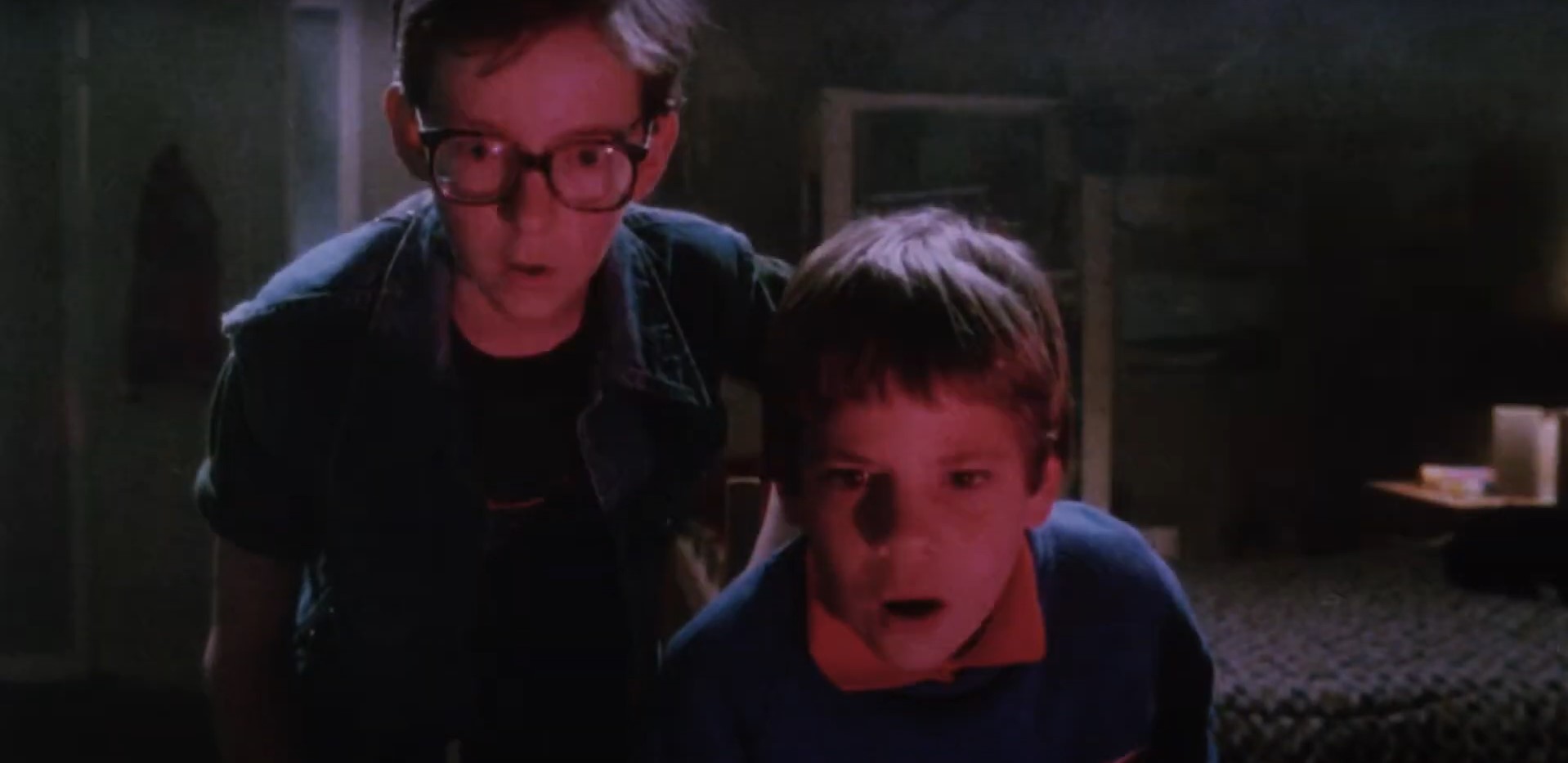
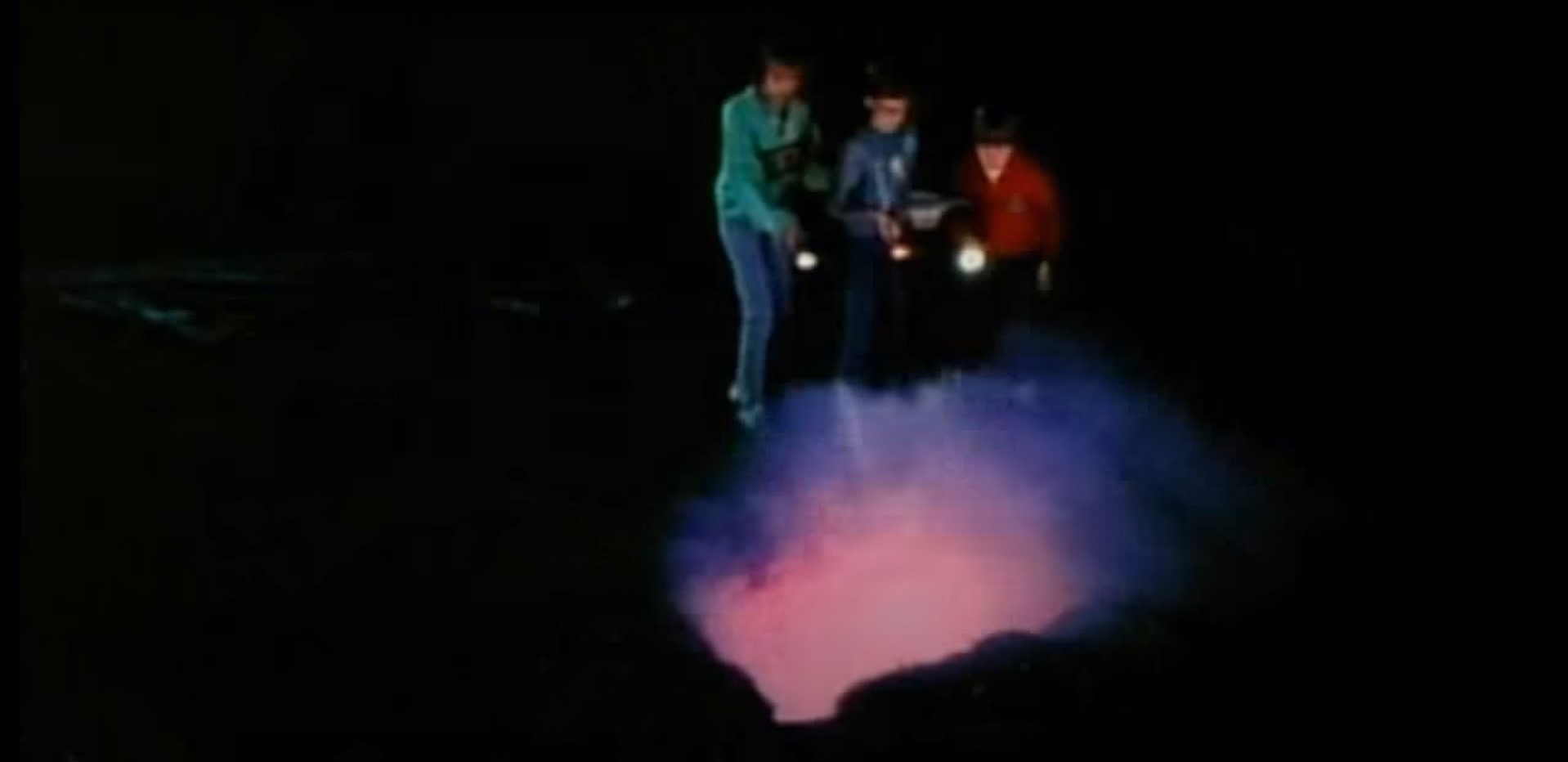
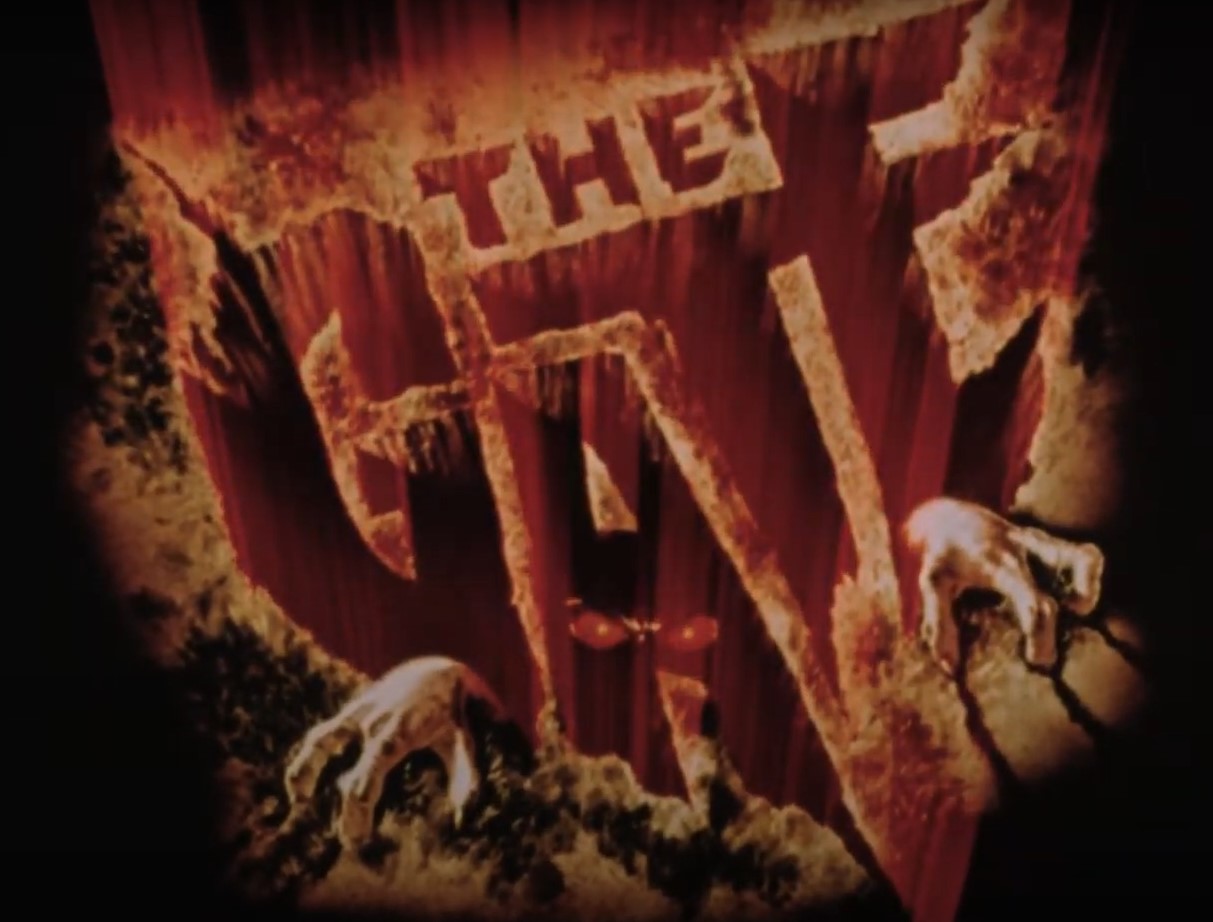
A severe storm brings down Glen’s treehouse, leaving a giant hole in his background.  Discovering what looks to be precious geode rocks, Glen and his friend Terry continue to dig hoping to strike larger, more valuable, geodes.  When they come upon a sizable rock, breaking it open unveils a crystalized liner of colorful minerals as well as a strange gas that unearths an incantation to open a gate to the underworld.  With Glen’s parents gone for the weekend, he, his teenage older sister Al, and Terry must somehow reverse the opening of the gate but demonic-serving, pint-sized minions hunt down a pair of human sacrifices in order to unleash their powerful demon master, an old God reemerging from being locked away from Earth for billions of years.  Serving the night is a fight for their very lives as the minions use their cunning tricks and supernatural powers to deceive the home alone kids into traps in order for there to be Hell on Earth. 

Created in mind to appeal to children with the limitless possibilities of a child’s imagination, “The Gate” caters to a wide audience of all ages.  Hungarian-born Director Tibor Takács and American-born writer Michael Nankin bring out of the shadows the scary corners of a young mind into the light with a demonic tale, a portal from another plane of existence, and a theme of growing up and being accountable in a context of taking head on a doomsday event without mommy and daddy.  The 1987 released Canadian production, shot mostly around Ontario, is the first of two “The Gate” films under the studio flag of Alliance Entertainment.  Presented by New Century Entertainment, as one of the company’s limited credits, “The Gate” is produced by fellow Hungarians in Andras Hamori, who went on to produce fellow Canadian filmmaker David Cronenberg’s “eXistenZ,” and “Quest for Fire” and “The Wraith’s” John Kemeny.

The Gate II:  The Trespassers

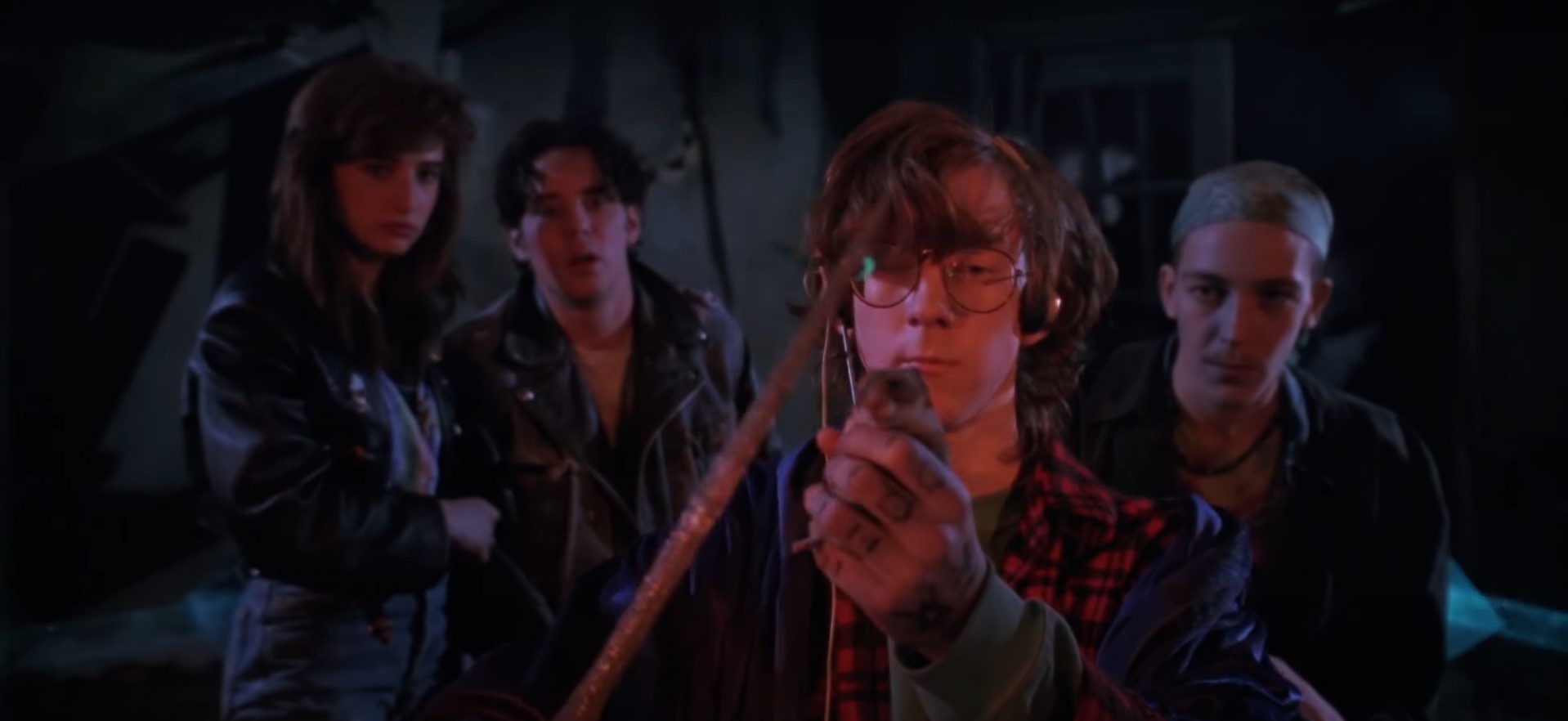
Five years after narrowly surviving near Hell of Earth, Terry’s obsession to return to Glen’s abandoned and dilapidated home and resurrect the demonic powers of wish granting stems from his jobless father’s dwindling livelihood, drinking himself into a stupor every night at the bottom of a bottle.  With equipment powered to project his incantations and protect him from evil, Terry is about to begin his summoning when interrupted by three teens led by bad boy John who mostly ridicules his fixation until one of the pint-sized minions comes out of the shadows and is quickly gunned down by John.  The injured minion self-heals and is captured for wish granting exploitation but when the wishes turn into a disastrous chimera, Terry soon realizes that his summoning has not just been answered for selfish motives, but it also re-opened the portal for three power demons to transmogrify from within him and his friends. 

The success of “The Gate” sought the fast tracking of a follow-up story produced within two years’ time after that spoke a different tone and came in a different approach to the nightmarish content and the age of the kids.  Takács and Nankin reteam for “The Gate II:  The Trespassers” who, at the authoritative behest of executive powers, had to take the fantastical lining of a child’s imagination to more extreme measures that evolved the original film’s grotesquely saturated PG-13 rating into a lighter, water downed R rating, removing a good chunk of the viewer base from a theatrical run.  The 1990 released venture was also shot at some of the same sets in Ontario Canada as the first film with Alliance Entertainment returning as producing studio and Vision International presenting to the world.  Andras Hamori and John Kemeny also return as producers.

Doesn’t take the understanding mechanisms of rocket science to discern “The Gate’s” cinematic victory.  Demons were all the rage in 80’s from Italian eurotrash to American grindhouse and why shouldn’t the Canadians get into the action?  Special and makeup effects, in themselves, are tremendously impressive, as aspect we’ll go thoroughly more into later in the review.  Yet, the one golden ticket area that deems “The Gate” as an unsullied hero of PG-13 horror is the unaccompanied children misadventure narrative coupled with, or maybe elevated by, good dialogue sanctioned by even better performances.  The 80’s saw scads of children in danger storylines that either had no responsible adult in sight or the adult party was the adversarial danger.  “Explorers,” “Adventures in Babysitting,” “E.T.,” and, one of the biggest examples of all, “The Goonies,” caddied the action-adventure and thrills-and-chills long game for the better part of the 80s decade and “The Gate” teed up on the opportunity, bringing together a trio of varying degrees of adolescents to go toe-to-toe with an ancient evil in what would have been seen as a no-win situation.  In his feature film debut, the barely teenage Stephen Dorff (“Blade”) lead the trio as the highly impressionable and model rocket enthusiast Glen, the youngest of the cast to be the one to save them all, including big sister Al, played by Christa Denton, and best friend Terry, played by Louis Tripp.  Tripp would go on to be principal lead in the sequel that veered away from the fantastically supernatural misadventures of innocence into a more older teen intrinsic narrative that no longer saw the world warp through youthful eyes.  While Tripp segues seamlessly in his role, he finds himself in new territory as the heavy metal and demonology aficionado sparks potential romantic interest in Liz (prolific voice actress Pamela Adlon, “Vampire Hunter D:  Bloodlust”) and is seized by arrogant bullies with two pot smoking hooligans Moe (Simon Reynolds, “P2”) and John (James Villemaire, “Zombie 5:  Killing Birds”), both instances a premiere example of the raw rite through to adulthood.  Again, “The Gate II” keeps adults at an arm’s length away, forsaking youth the challenge of cleaning up their own mess.  Both films fill out their respective performances from Kelly Rowan (“Candyman:  Farewell to the Flesh”), Jennifer Irwin (“Another Evil”), Deborah Grover (“Rated X”), Scot Denton (“Murder in Space”), Carl Kraines (“The Slayer”), and Neil Munro (“Murder by Phone”).

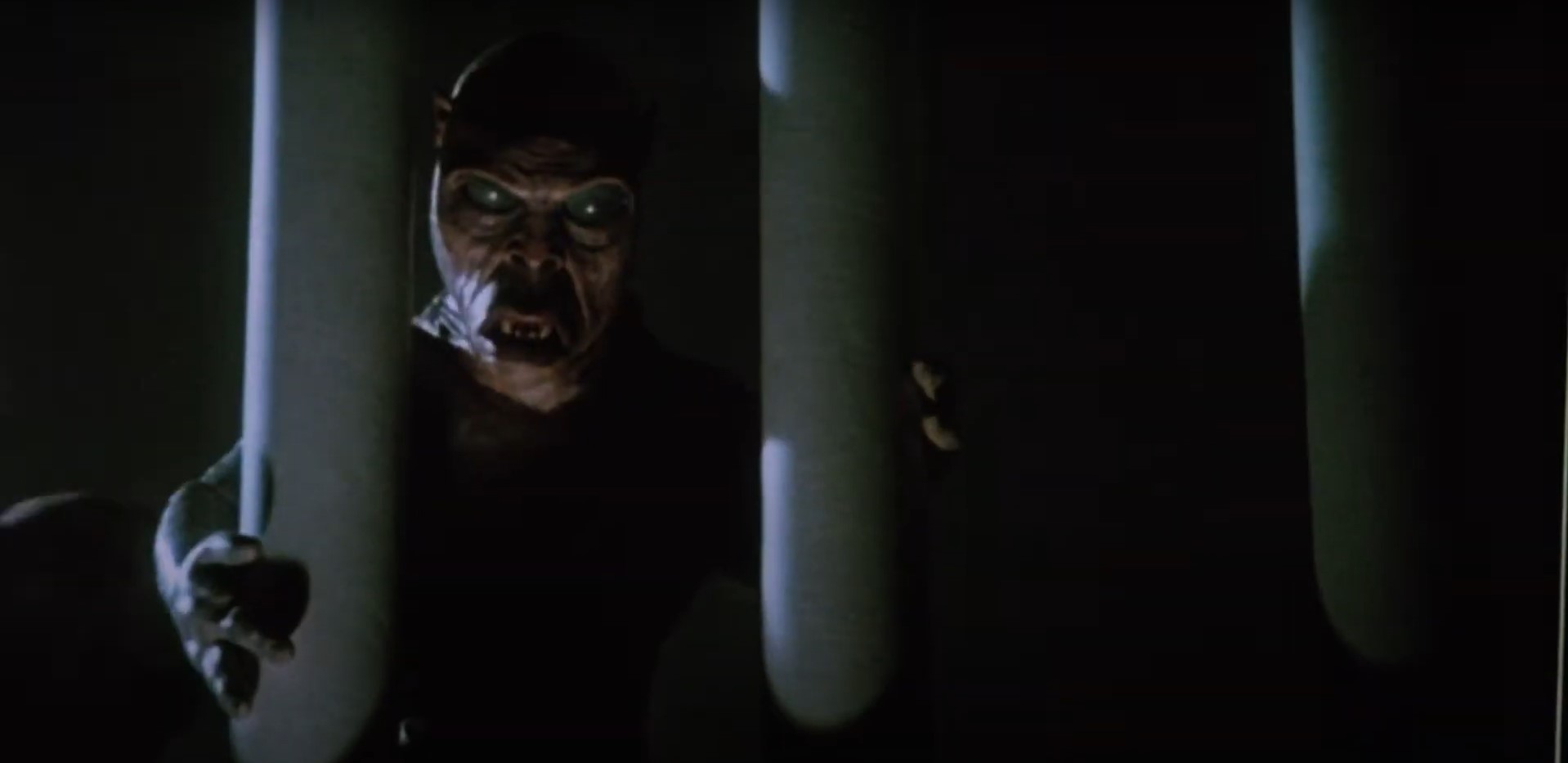
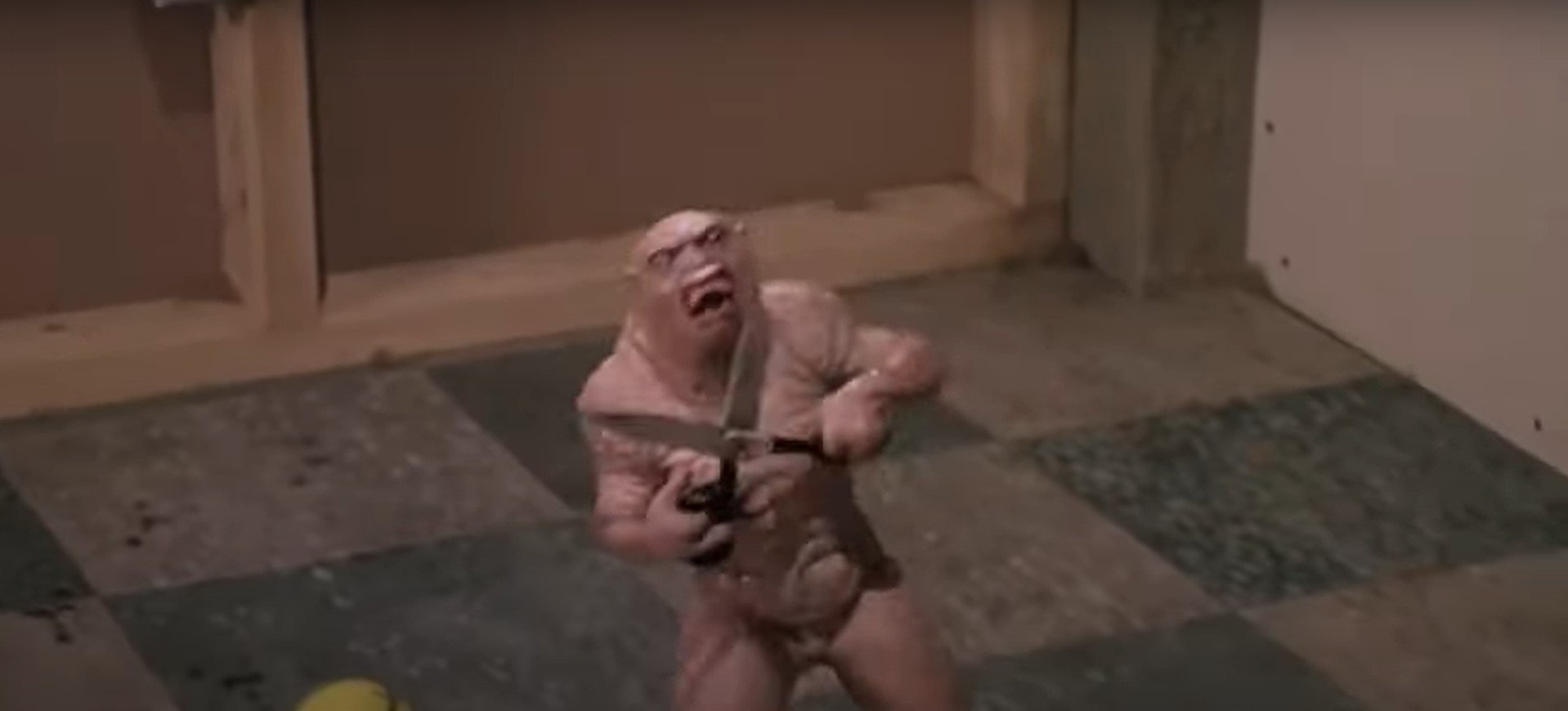
Special effects by the team of Randall William Cook, Craig Reardon, and Frank Carere couldn’t have pulled off an ambitiously suburban horror hyper focused inside Glen’s home any better.  Fashioning mind-bending illusions that are still marveled at to this day, Cook’s forced perceptions eliminates mostly the use of stop motion tactics for the miniature sized minions, replacing the rigid effect with a more lively physical man-in-suit option that smooths out the actions, attributing the creatures idiosyncratically with not only depth of perception to contrast sizes but also shot in a faster camera speed compared to which the seemingly normal sized actors would have to slow down their performances to become level with the creature.  The whole process is crazily multifaceted and mind-boggling effective if pulled out in great detail and “The Gate” team does so, twice, in face, between the two films, with Reardon’s fleshy creature designs enhancing the hideous zeal in the bulbously decaying Workman zombie and even in Reardon’s blamelessly slapped together endgame demons for the ordered change of a quickly surmised climax in the sequel.  As a collaborating unit, the special effects crew pulls off seamless transitions in what is captivatingly pure eye-candy of movie magic.  The stories themselves, especially in “The Gate,” are enchanting, full of mysterious and unpredictability, and stretches the imagination beyond the confining limit as we’re led to inevitable showdown only to be pleasantly accosted on the optics.  The sequel has a rougher go with the story as the narrative feels like a wound-up toy twisted tight to the threshold only to be released spinning in all different types of directions that ultimately lead to an exhausted stopping point. The stark contrast between the two films doesn’t offer a lot of subsequential continuity in narrative and even in some areas of the special effects but the silver lining in that last statement can be a sigh of relief in not receiving a rehashed product sought to recap or repeat off the back of the original’s success. Instead, “The Gate II” begs to be separated to be its own entity and does so while being a homage to the practical illusions that sparks awe, joy, and terror!

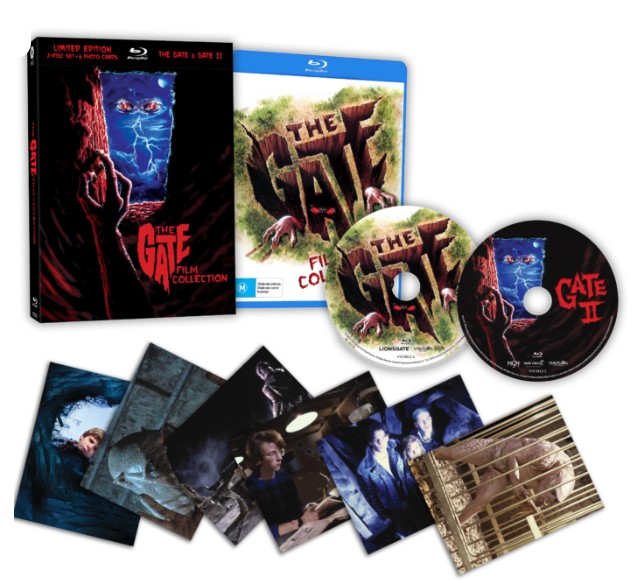
If looking to physically own both “”The Gate” and “The Gate II” in one deluxe package, the Australian based distributor Via Vision has set the bar high with their 2-disc, numbered limited edition, Blu-ray collector’s set. Both films, shown in a widescreen 1.85:1 aspect ratio, are AVC encoded with a high-definition, 1080p resolution on a BD50 (“The Gate”) and BD25 (“The Gate II”) and we’ll come to the reasoning to that split later on. Shot on 35mm and scanned into a 2K print, not many details are noted about what film negative or other print element is scanned to 2K but most of the bonus content on this particular release is Vestron produced, leading to believe the same Vestron print is also used here. Between the two pictures, “The Gate II” has a better saturated image whereas the original film almost seems ungraded with a slight gray concealer that somewhat mutes the hues. The forced perception shots are seamless yet are also delineated nicely that curves into a believable and pleasing symmetry without an inkling of divisional depths. Skin tones are natural looking and textures, such as practical prosthetic masks and molds, score high in all the nooks and crannies of the folds and surface level haptics. The English encoded tracks include a lossy DTS-HD 2.0 stereo codec on “The Gate” and an uncompressed, lossless PCM 2.0 stereo on “The Gate II.” These sole options provide suitable stereophonics without significant compression issues, other than “The Gate’s” minor fidelity data loss, or original source damage or technical gaffs, such as hissing or popping. Dialogue design sees the “The Gate” come out on top over the course of layering and projecting atmospheric augmenting. I don’t get that same sense from “The Gate II” that modulates the dialogue with a redounding heavy-handed echo effect in locations it does not make sense for reverberations. “The Gate” has English and Spanish subtitles with the sequel reduced to just English subs available. “The Gate’s” greater format capacity holds most of the special feature cards with a number of duplicated Vestron produced bonus content, including two audio commentaries: commentary one with director Tibor Takács, screenwriter Michael Nankin, and special effects designer/supervisor Randal William Cook and second commentary with Cook again along with his f/x crew Graig Reardon, Frank Carere, and Bill Taylor. Composer Michael Hoenig and J. Peter Robinson discuss the score with selected isolated tracks to enjoy, a conversation between Takács and Cook in The Gate: Unlocked, Craig Readon in an interview about creating the pint-sized creatures in Minion Maker, an interview with co-producer Andras Hamori From Hell it Came, an interview with actor Carl Kraines aka The Workman aka Terry the Demon The Workman Speaks!, an interview compilation from the local Toronto talent involved Made in Canada, a 2009, archival retrospective look and discussion from Reardon and Cook at their monstrous being handiwork From Hell: The Creatures & Demons of The Gate with Randall William Cook and Craig Readon, a 2009, archival retrospective look and discussion with director and writer Tibor Takács and Michael Nankin The Gatekeepers, a vintage making-of featurette, teaser and theatrical trailers, TV spots, and storyboard and behind-the-scenes galleries. In what is a David and Goliath size imbalance, “The Gate II” special features ultimately will not trump with smaller disc capacity and the lack thereof content but the second disc sequel does contain a new, 2023 audio commentary by Tibor Takács and film historian Jarret Gahan as well as a documentary with Takács, Nankin, and Cook Return to the Nightmare: A Look Back at The Gate II that discusses how and where the film strayed off the intended course, an interview with make-up effects artist Craig Reardon From the Depths, the theatrical trailer, and retain video promo. Via Vision’s limited-edition packaging is another world chic and cool with a rigid sleeve box and a lenticular “The Gate II” front cover art. Slipped inside from the right is a single Amary Blu-ray case with a center stationed second disc attachment. While the front cover on the sleeve box showcases the sequel cover, the Amaray’s reversible cover sports the original “The Gate” cover art with a Glen still image and film cast/crew credits on the other side. Also inside the sleeve box are six fully colored glossy photo cards! Both films are Australia certified Mature for moderate violence and moderate course language and have a runtime of 84 minutes (“The Gate”) and 93 minutes (“The Gate II”). The Via Vision release is region B locked (note: the release did play on my region A setting).

Last Rites: Digging a hole to open “The Gate” and the contradistinctive sequel unburies a pair of underrated underworld-creeping-toward-the-surface 80’s phantasmagorias, a regular doomsday fait accompli with children standing between Hell of Earth and saving the world, and what better wait to see the world potentially burn to the ground than with a beautiful new Blu-ray collector’s set from Via Vision!

Better Hurry! Amazon Has a 20% Coupon for This Very Release! Limited to 1500 Copies.

Expectations Lead to EVIL in “The Cool Lakes of Death” reviewed! (Cult Epics / Blu-ray)

Set in the early 1900s, Hedwig’s childhood is filled with love, wealth, and innocence, but when her mother dies suddenly at the hands of typhoid, life turns complicated as death, draconian religious teachings, and an uncompassionate home clouds Hedwig’s mind on what exactly her relationship with men and with God should look like.  Punished for self-pleasure and scolded for her belief in fantasies, Hedwig enters adulthood as a conformist seeking to marry a well off man and have children in what was supposed to be the perfect union that reveals in sexuality the secret to marriage.  Prim and proper on the outside but a child on the inside, Hedwig misjudges her affairs with men and indulges in a pretense relationship with them.   When she finally finds happiness with a renowned pianist and the two have a child together, Hedwig’s hold on reality snaps as the child dies a few days later, sending the once elegant Hedwig into a tailspin of unhinged mental stability, drug addiction, and prostitution. 

“The Cool Lakes of Death” is the adapted film based off the Netherlands novel from the dual profession novelist and psychiatrist, Frederik van Eeden, entitled Van de koele meren des doods, which closely translates to “The Deeps of Deliverance,” a psychological period piece and melodrama with themes on the antiquated God-fearing expectations of a 19th century young woman, the solidity of marital unions, and a woman’s sexual liberation.  “The Cool Lakes of Death” is the follow up directorial from “A Woman Like Eve” director, Nouchka van Brakel,” off a screenplay written also by Brakel and co-written with Ton Vorstenbosch.  The exquisite tragedy of a woman submerged in societal misconceptions of love that can’t be forced and the mutuality of pleasures is yet another Dutch production from producer Matthijs van Heijningen and his company Sigma Film Productions, who have overseen a handful of Brakel films including “The Debut” and “A Woman Like Eve.”

Understanding the mixed emotions of a young girl in the throes of self-discovery, with a pinch for the dramatic flair, Renée Soutendijk gives a prismatic performance, glistened in a stringent social dogma, of hope and pity.  The Netherlands actress, who had the role of Miss Huller in the 2018 “Suspiria” remake, the inundated Hedwig, friends call her Hetty, who has inexhaustible amount of hope in her search for passion, but insurmountable roadblocks and obstacles corrupt Hetty’s mental processor.  Soutendijk’s elegance has a soft innocence to it, a naïve virtue that contrasts bleakly against the subtle and not so subtle influencers of Hetty’s life and Soutendijk really opens our eyes when Hetty’s full blown crazy in a clear and precise moment of snapping her rationality like a dried and brittle twig.  The performance digs at you and Brakel exploits the worst (good cinematically) parts of Hetty’s break that has her be a wild, naked woman thrashing, spitting, and puking in a locked room of a psyche ward, injecting needles into her arm night after night after selling her body to unscrupulous men, or even stuffing her newborn baby into a duffel bag and heads off to sea to search for her husband Gerard, a subdued, appearance concerned gay man that never cared physically for Hetty, played by Adriaan Olree in his debut performance.  Hetty comes across two other lovers; one a flyby and compassionate artist Johan (Erik van ‘t Wout), who would have matched her passion, but not her social status, and, eventually, she finds much of what she seeks in a renowned concert pianist Ritsaart (Derek de Lint, “When A Stranger Calls” remake), who refuses to admit their relationship in fear of scandal and ruin of his career.  Along the way, Hetty listens more to her blinded heart than she does her logical mind when intaking sound advice from advocates of her wellbeing as Ritsaart’s best friend Joop (Peter Faber, “A Woman Like Eve”), her best friend Leonora (Kristine de Both), and a hospital nun (Claire Wauthion) attempt to steer her toward a happier existence. 

I really can’t get enough of Hetty unable to secure her ideal happiness.  That might sound a little inconsiderate but what is a perfect relationship?  Brakel explores how an sought ideal can turn into a damaging expedition for the white whale.  Instead of being the ill-fated, hellbent Captain Ahab, Hetty’s land based monomaniacal drive of fairytale love becomes her ultimate downfall, sinking her deeper into the depths of despair, loneliness, and a cataclysmic separation from reality.  Gerard wasn’t perfect because he secretly longed for men, Johan didn’t have the right social stature for a lady of her status, and Ritsaart kept their love hidden below the public eye.  There’s a quite a bit of feminism loitering around in that last statement with a touch of selfishness to no fault of Hetty’s and all circulate back to some sort of suppression whether it’s sexually or emotionally umbrellaed by patriarchal doctrine, discourse, and discipline.  The culture toxicity is so severe that the older generation of women are beguiled by it’s power to be controlling others themselves under the thumb of a male-dictated society as we see in Hetty’s Governess in tattling on her pupil’s every move to her wimp of a widowed father.  “The Cool Lakes of Death” is a beautiful disaster in almost a sing-songy narrative delivered by director Nouchka van Brakel’s mighty delicate touch. 

For the first time in North America and single in a trilogy of Nouchka van Brakel releases from Cult Epics, as well as in a trilogy boxset, the 1982 downcast drama “The Cook Lakes of Death,” arrives on DVD and Blu-ray home video.  The New 4k High-Def transfer is scanned from the original 35mm negative with an impeccable and nearly blemish-free restoration.  The film is presented in the European matted widescreen, 1.66:1 aspect ratio, with plenty of good looking natural grain and a softer image in the trashy romance first act then to a harsher, grittier quality during the time of her ruin under the eye of Theo van de Sande who ventured from the Netherlands to the U.S. later in his career and worked on Joe Dante’s “The Hole,” “Little Nicky,” and “Blade.”  A couple of whip pans into deep focus shots enrich the production, a technique that has served Sande in his later work.  The Dutch language DTS-HD Master Audio 2.0 lossy audio is as good as this title will ever see without an actiony framework.  Dialogue is completely discernible with well synched English subtitles.  A few pops in the span but no major damage to the audio to speak about in length.  Soundtrack has barrier moments of muffled penetration.  Not too many special features to touch upon with the theatrical trailer, a poster and sill gallery, a 1982 newsreel unearthed from the Polygoon Journal archive, and a reversible Blu-ray cover. “The Cool Lakes of Death” is young and naïve adolescence transitioning into womenhood only to be tripped up every step of the way; Hetty’s eager to blossom turns to withering as the underdog in life’s kennel and Brakel’s purificatory rite of passage beautifully disembowels hope and dreams in a dreamy fashion until finding faith in life come full circle, well almost, in commencing with both feet standing into adulthood.

“The Cool Lakes of Death” on Blu-ray Home Video at Amazon.com

The Myth. The Legend. The Evil…. “Leatherface” review!


Texas 1955 – the pride of the Sawyer family was not their tattered farm, but a bloodline taste for something else – callous murder and a penchant for human flesh. Verna Sawyer sought to instill that pride into her children, especially her youngest, Jed, but when Hal Hartman, hard nose local Sheriff, learns that his daughter becomes victim of the Sawyer’s suspect nefarious carnage, he executes the law to his advantage, deeming the Sawyer house unfit for children and removes Jed from his labeled degenerate mother Verna. Ten years later, a group of teenage patients escape a mental hospital, kidnap a young nurse, and reek bloody havoc in their voyage to Mexico in an attempt to elude the very same lawman who put them away, but this time, Hartman isn’t adhering to the law, straying off his moral compass to pursue a vengeance mission against unprincipled youth that’s personally driven by Jed and the Sawyer family. Once the embattled Hartman catches up with his prey, a series of gruesome events lead to the creation and the construction of one of the most notorious killers Texas will ever see.

I love a good origin story. There’s something to be said about understanding the commencement of character, to be in the shoes of a long running icon, and to be able to sympathize with their story no matter how atrocious. Directors Alexandre Bustillo and Julien Maury’s 2017 “Leatherface” does just that with the film’s own origin enlightenment on how the chainsaw wielding, human skin mask wearing psychopath came to fruition inside a home of unspeakable brutality and influenced externally by a unforgiving society. From a script penned by Seth M. Sherwood, “Leatherface,” serving as a direct prequel to Tobe Hooper’s “The Texas Chain Saw Massacre,” briefly touches upon the preteen years to setup the catalytic road trip from hell, birthing a monster in a time of adolescence and if part of a legacy spanning over forty decades inspired by Ed Gein, the real life human skin wearing and notorious serial killer, then you damn well know “Leatherface” has to be genetically predisposed to be ultra-violent drenched in blood splatter. The French filmmaking duo, who’ve helmed 2007’s “Inside” and had directed the “Xylophone” segment in “The ABCs of Death 2,” nail the dark and gritty tone that not only breathes a gassy and exhaust fumed life into a massive flesh-ripping chainsaw, but also inflicts heartlessness across the story board into a heartfelt homage to the characters and to the story fathered by Kim Henkel and the late Tobe Hooper, both of whom were attached as executive producers.

Over the years, many actors have held the mammoth power-drive cutting tool in their hand that’s ready to chip away at flesh such as Andrew Bryniarski (“The Texas Chainsaw Massacre” 2003 remake), Bill Johnson (“The Texas Chainsaw Massacre 2”) and, most famously, Gunnar Hansen, the original Leatherface. However, I’m not going to divulge who the pubescent Leatherface is in the story because the film plays out as a who out of the group of degenerate teens is the son of Verna Sawyer, even though you can easily obtain the information in a simple click and search on Google. Instead, Sam Strike, James Bloor, and Sam Coleman portray the three escapees who are accompanied by an equally insane sociopath in Jessica Madsen and an eagerly novice kidnapped nurse by Vanessa Grasse. Amongst a sea of English actors are a pair of vets to shepherd the young cast and be the embattled bookends to the dawn of an icon. Lili Taylor (“The Haunting”) and Stephen Dorff (“Blade”) face off as Leatherface’s mother, Verna Sawyer, who butts horns with a longstanding sheriff, Hal Hartman, with a steadfast vendetta against the Sawyer family. Christopher Adamson (“Razor Blade Smile”), Nathan Cooper (“Day of the Dead: Bloodline”), and Finn Jones (“Wrong Turn 5: Bloodlines”) co-star.

Usually with a pair of directors, two different styles spawn to an end result. With Bustillo and Maury, styles merge into a seamless effort of elegant wonders. Each shot emerges a purpose to the story whether it’s painting an image of the Sawyer’s death house to pulling a one-eighty with characters, the filmmakers ability to combine each element into a single story, that has such a close knit cult following, and still manage to cinematically pull off the atmosphere, the grit, and the gory carnage of a Texas Chain Saw Massacre film is impressive. Cinematographer Antoine Sainer, whose worked previously with the directing duo on the “The ABCs of Death 2’s” segment “X,” has the ever so poised eye that’s able to well-round and solidify Leatherface’s terror tenor, particular exampled in a foot chase scene through a moonlit forest, smoke bellowing out of a growling chainsaw, and a tattered young girl bawling, screaming, and fleeing for her life from a deranged masked killer whose huffing, snarling, and growling during the pursuit.

Lionsgate Home Entertainment presents the Millennium Films produced “Leatherface” onto Blu-ray + Ultra-violet combo disc, a MPEG-4 AVC encoded disc with a 1080p resolution and presented in a widescreen, 2.38:1, aspect ratio that displays the Bulgaria landscape in a yellowish-brown, Texas-like backdrop. Details are noticeably fine that exquisitely reveal the death and destruction of the Sawyers and those who unfortunately surround the family. The English DTS-HD Master Audio 5.1 track evenly distributes and consistently a range of engrossing fidelity, ambient, and dialogue layers. Bonus material includes a play feature with an alternate ending that’s less superior in contrast to the final product, deleted scenes, and a behind-the-scenes making of that includes brief interviews with directors Alexandre Bustillo and Julien Maury, actors Sam Strike, Stephen Dorff, Lili Taylor, and others, and goes behind the scenes in creating the tone and style of “The Texas Chain Saw Massacre” while implementing their own vision. “Leatherface” forces the unsavory and unpleasant down the throats of TCM fans, jamming an attempt to exposition a futile chance to a destined maniac of cannibalistic proportions and manages to mix up the Tobe Hooper’s weathered franchise with a barbaric bruiser of a tale.

“Leatherface” on Blu-ray! Buy it here, today!

A Nightclub Owner is One Evil Bloodthirsty Bootlegger! “Bloodrunners” review!

vlcsnap-00012
In 1933, the heart of prohibition-era regulation, a corrupt Southampton, New Jersey police department shakedown the illegal alcohol distilleries and bootleggers, forcing establishments to cough up payment for police protection. Chesterfields, the hip new brass club in the sleepy town, falls into the sights of enforcement officers, an alcoholic with post-war issues, Jack Malone and his partner Sam, who want the club owner, a ruthless black bandleader named Chester, to pay for his establishment’s booze sales and bootlegging, but Chester, and his conspicuously strange henchmen, are more than just bootlegging booze runners. The nightclub is a front for a vampire den that’s draining, bottling, and shipping the blood of Southampton residents and master vampire, Chester, operates the business with his human associate, Victor Renfield. An invasion of bloodsucking gangsters seep into the affairs of not only Jack Malone’s baffled police department, but also into the resident brothel that homes Jack’s longtime beloved lover, Rosie. Only Jack, the deranged town priest, and Willie, a boy caught in the middle, stand in between the corrupt, yet still innocent, souls of Southampton and the terrorizing dark forces that scratch at the town’s door.
vlcsnap-00014
Hybrid genre film “Bloodrunners” blends a spin of classic tale vampirism with early 20th-century gangsters that concocts a bad batch of cinematic bamboozlement. Filmed in West Chester and Marcus Hook, Pennsylvania, director Dan Lantz, who helmed adult film star Alexis Texas in “Bloodlust Zombies,” does construct a marvelous speakeasy, prohibition-era world out of the greater Philadelphia region’s most popular and historical locations. From the period piece costuming to the acquisition of an antique 1921 Ford Model A car, Lantz’s ability to build a story around such facets on pocket-sized finances that help bring 80 years past back to the present can certainly compete with settings of many big-budgeted Hollywood productions. Being a previous recent resident of West Chester, the landscape was convincingly alien to this reviewer. Co-star Michael McFadden co-wrote the script with Lantz and, together, they input a girth of 1920s to 1930s terminology and slang into a script that can’t quite coherently string along a narrative that works under cut and dry filmmaking involving anemic mains characters.
vlcsnap-00017
Alongside McFadden, the “Law & Order: SVU,” or rather from one of my personal favorite films from 1994 entitled “Surviving the Game” co-starring Gary Busey and Rutger Hauer, star Ice-T takes on being a master, bootlegging vampire when he’s not busting heads of pedophiles on the streets of New York City. Ice-T maintains a hip hop persona that doesn’t translate well toward the 1930’s, but the legendary gangsta rapper has kept the hip hop schtick throughout this career and never in a hundred roles, eighty-seven credited roles to be exact, would I imagine Ice-T to break from a moneymaking image. Like his co-star, McFadden comforts himself in familiar roles that pigeonholes his career made up of authoritative figures such as cops or gangsters with examples including being a gangster in Fox’s hit television series, the Batman spinoff “Gotham” and also portraying the notorious real life gangster, Jimmy Hoffa, in the upcoming Tigre Hill film “American Zealot.” Then, there’s Philadelphia native Peter Patrikios. Patrikios’ phenomenal take on the iconic Renfield character is a break in the monotony highlight, reviving Renfield back to a sophisticated right hand man instead of a relapsing bumbling aid for his master’s whims of daylight chores and being more memorable than the “Bloodrunners'” main headliners. Airen DelaMater, Chris James Boylan, Julie Elk, Kerry McGann, Jack Hoffman, John Groody, and Dan McGlaughlin round up “Bloodrunners'” roster.
vlcsnap-00020
When attempting to examine “Bloondrunners'” vampiric special effects, only this descriptive phrase comes to the forefront of my mind: “Bloodrunners” pits vampire gangsters against crooked cops in a “Matrix” styled, slow-motion action-horror. While that sounds rather exciting, selling these particular creatures of the night didn’t enlighten a firm stance that the modern vampire is alive (well, technically undead) and well. Instead, the Dan Lantz and Michael McFadden story stays the routine course that fills the overstuffed and out of control vampire barrel that desperately requires genre damage control from the first moment a scofflaw vamp enters the scene. Vampire action films haven’t been popular since “Blade,” unless adapted to television as in the case of FX’s “The Strain,” and “Bloodrunners” doesn’t fit the bill, boozing in as a blasphemous contemporary day vampire film.
vlcsnap-00015
Paoli, PA based production company Impulse-FX delivers Dan Lantz’s latest schlock horror “Bloodrunners” with Speakeasy Films releasing the film out to the world and landing on retail shelves March 7th. The trailer held promise with vigorous action stamina, but, in the end, just turned out to be a well-edited trailer for an action-horror-thriller that needed a touch of stability in the story. Portions of the story are deemed absolutely unnecessary to motivate the characters or are place mats interjected to connect characters, such as Jack Malone’s encounter with a specific German vampire who just coincidently happens to be one of the henchmen in Ice-T’s vampire gang. The Speakeasy Films dual format 2-disc, Blu-ray and DVD combo, presents the film 1080p widescreen 1.85:1 aspect ratio in which the Blu-ray is on a AVC 26Mps disc. The image was a bit shaky under the compression, fizzing at times, more so during darker scenes, that outlined compression artifacts that remarked upon lighter shades of grey and black. The English Dolby Digital 5.1 track is fine through the 95 minute runtime. Jack Malone’s raspy gangster voice doesn’t become muddled and Ice-T’s epic hip hop swag comes through without even a hitch. The soundtracks fades in and out quite a bit over the LFE, during the “Matrix” slow-motion, that leaves much unbalanced when the soundtrack becomes warranted. Bonus features are nice, including a gag reel, deleted and extended scenes, filmmakers commentary, and an official trailer. In conclusion, “Bloodrunners” teeters on the edge of being a full bodied beverage that never really carbonates into a high-alcoholic contestant in being a good, modern day vampire thriller.

Watch “Bloodrunners” on Amazon Prime!