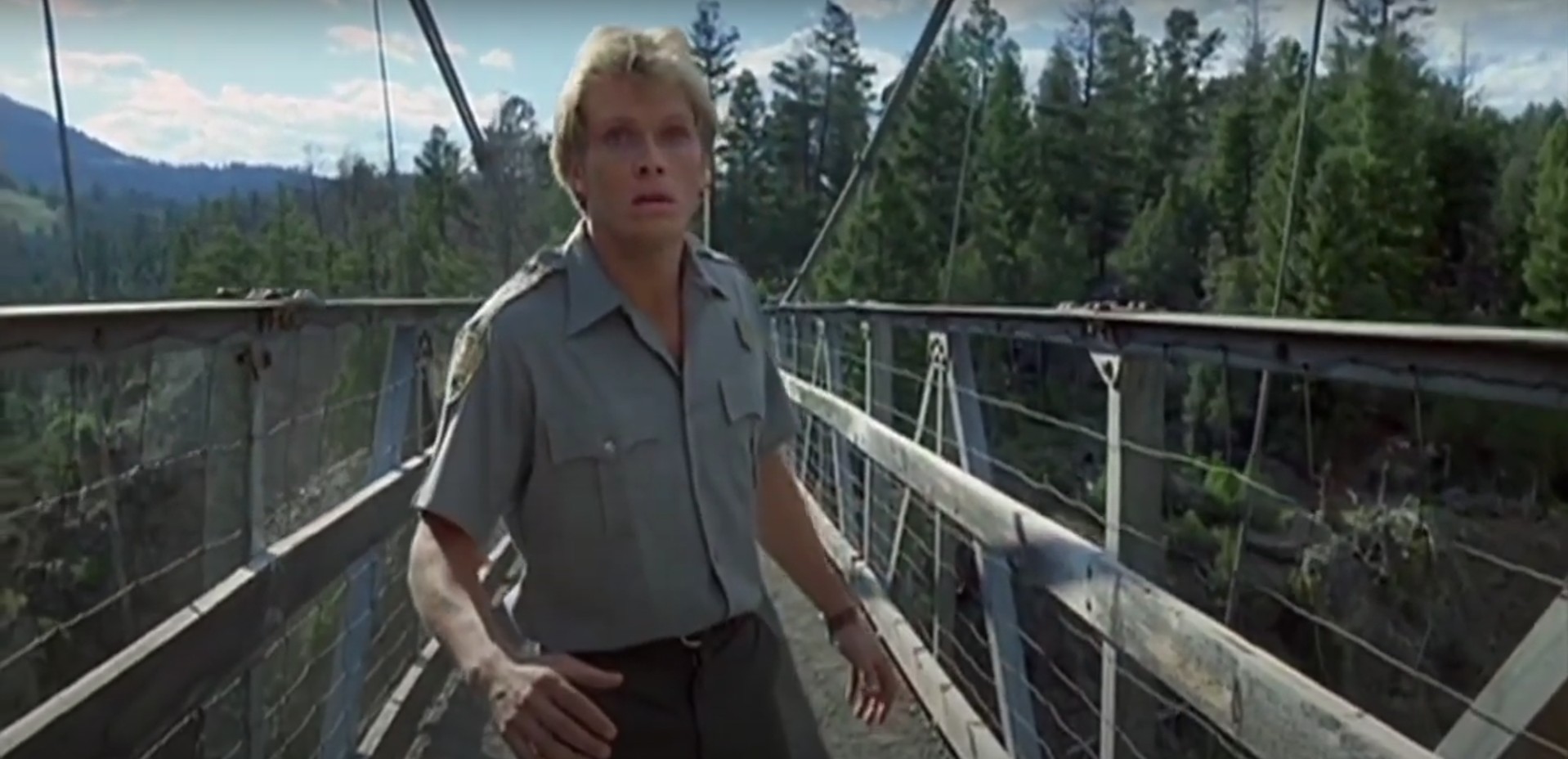
Who Would Have Thought Something So Tiny Could Create So Much EVIL! “Cannibal Tick” reviewed! (SRS Cinema / Blu-ray)

Get Bit by the “Cannibal Tick” Blu-ray! Now Available!

Jeb believes his late father’s purloined gold is stashed underground in his densely wooded backyard.  What’ Jeb unearths is not gold, but barrels of chemicals Jeb believes to be just as valuable.  What Jeb doesn’t know about the pinched drums is the ooze inside leaking from them turns the local tick population into diseased carriers, transmitting a sickness upon biting their hosts and transforming the hosts into ravaging flesh eaters that continue to spread the disease with one single bite.  All hell quickly breaks loose amongst a sleepy backwoods around Big J’s outdoor food truck until a retired vampire hunter, Alec, turns his skillset onto the zombified undead when twin brother Roscoe becomes patient zero.  Big J’s famous menu items pig dicks and beer won’t save the rustic hillbillies from a fast-spreading contagion but one kilt wearing son of a bitch aims to take on all of them with a help of local and his vampire slaying colleague.  

If Lyme disease wasn’t already bad enough, chemically diseased ticks being the parasitic harbingers of the zombie apocalypse might just be the worst.  Like a premise straight out of Valve Corp.’s Half-Life series, co-directors Ross Carlo and William Long’s low budget, running zombie-comedy film, “Cannibal Tick” will leave more than just a bull’s eye symptom in its bloody, outrageous wake.  Mostly derivative from other running undead features, the 2020 feature length film is the debut and first collaboration efforts of the Eastern Ohio-Western Pennsylvania filmmaking duo with Long running solo in penning the screenplay of rednecks running rampantly through a serious case of tick-induced rabies.  “Cannibal Tick” is a production of indie companies Poo House Productions located in Youngstown, Ohio and of William Long’s Dark Long Productions of Northern Cambria, Pennsylvania.  William Long and Ross Carlo retain the producing credits as well as taking on principal characters as per standard in the microbudget, everybody-pitches-in productions.

In the spirit of low-budget creativity, Ross Carlo (“Rotten, Welcome to the Freak Show”) accepts his dual role fate playing twin Scottish brothers Roscoe and Alec.  Carlo invests himself into the accent while getting physical when the ticking timebomb explodes and all zombie hell unfolds in the armpit of Nowheresville, Pennsylvania.  His presenting of Alec and Rosco couldn’t be more different but still oddly the same as Alec’s has more of an interesting background as a retired vampire hunter visiting his brother, or rather just dozing off on Roscoe’s couch.  Roscoe, on the other hand, is purely just a boondock alcoholic without much of anything else going on other than the next pint and a handful of used tissues from his personal pleasuring.  William Long (“The Devil’s Wasteland”) also has a role in the film but just one as the gold feverish Jeb looking for his late pop’s buried treasure.  Jeb’s quiet nature is not imposing and he’s terribly forgetful or just doesn’t listen to his wife but neither scenario is really relevant to the story, much like most of the carrier scenarios and backgrounds other than Alec’s vampire killing skills translating over to zombie dispatching.  So many characters are quickly tossed into the mix of a 73-minute story that they’re unfortunately not well fleshed out nor provided enough substance to even instill an impression upon and what they reduce to is simply just fodder for the carnage for the sake of a high body count.  John Catheline (“Deadly Numbers”) is and plays a forlorn former wrestler Curtis lost in beer and solitude for his prime fight days and has become a local mechanic, Maurandis Berger (“Chronicles of a Serial Killer”) and Sheneefah Johnson (“3 A.M”) are a black married couple who find themselves broken down in a white hick town, and Lena Devinney and the late Jimmy Barber Sr. (“Deadly Numbers”) are the couple who arrive at the wrong place, wrong time as they drive up to Big J’s for some pig dick and beer.  The aforesaid descripts don’t go any further with no progressive dynamism that usually establishes either a love or hate development with audiences.  “Cannibal Tick” also feeds upon Greg Bailey, Allison Devinney, Donnie Lawrence, Tene Gossard, RahZhee Emmaunel, Lisa Dapprich, Iesha Guzzo, Jana Ferris, and Michelle Dominique Buxton to be bigger in the slaughter and in the slaughtering. 

“Cannibal Tick’s” concept is sound – a tick becomes affected by a barrel of leaking toxic chemicals that causes their bite to inject the zombie creating substance directly into the bloodstream.  Yet, the problem is there is only one scene with a tick bite and the Rosco-Long production goes from interesting to run-of-the-mill zombie chaos with zero principal protagonist power.  Another knock down is the substandard traits of an extreme indie production that relies heavily on the character captivation and special effects caliber to be successful in a demanding market driven by those factors.  The former has been touched upon in great detail, but the special effects pull ahead as Michelle Dominique Buxton, who not only has a character role but is also the special effects makeup artist, is able to pull off a few interesting prosthetic monster looks as well as a decapitation death that in all honesty is really well done in framing and effect.  While the solid zombie carnage infects survivors left and right with a ferocious appetite, the narrative then evolves with Jeb’s direct ooze contact, transforming him into some similar to a zombie king that sets up “Cannibal Tick” to a potential sequel in the future.  However, that sequel hasn’t crawled its way to fruition just quite yet.

The blood thirsty arachnid with a zombifying bite buries itself onto a new Blu-ray release from SRS Cinema.  The AVC encoded, mastered 720p resolution, 25 gigabyte BD-R with the purple underbelly.  While typically unusual for a Blu-ray to be in standard definition, SRS Cinema’s certainly no stranger to their films being filmed in 720p, thus the format, but video, as well as audio, suffer quality buckling, especially when encoded onto a one-time writable disc that has its own technical limitations.  “Cannibal Tick” sees quite a bit of those technical woes in its compression codec from banding, splotchy macroblocking, and loss of overall finer details.  Many of the action scenes are done at night with little lighting and decoding struggles with delineation and details, especially when the use of commercial filming equipment was used.  The film is at least presented in a widescreen 1.85:1 aspect ratio.  The English audio isn’t written or displayed on back cover, but this does render through the receiver output as an uncompressed 2.0 mix that channels a dialogue and ambience stream through to another channel of a stock score.  Obvious lack of refinement housed in a lower bitrate captures less isolation efforts on the dialogue, leaving disruption to run interference that spike and subdues pitches and tones, but the dialogue strength has solid recorded quality from a well-placed boom.  Other than that, there’s not a good dynamic range other than zombie growl and gurgle to give “Cannibal Tick” a semblance of audio body.  Special features include raw footage of behind-the-scenes of stunt sequences and makeup effects without narrative context, the original trailer, the official SRS trailer, and trailers of other SRS Cinema catalogued films.  The standard Blu-ray contains original artwork of a large, translucent, yellow tick overtop a blood smeared, presumably, zombie woman that speaks greatly to and has intrigue appeal of an ultra-indie film.  With a runtime of a little over an hour, marking at 73-minutes, SRS Cinema’s release comes region free.

Last Rites: Ultra low-budget, rough-and-ready, and imitative in a rustic sense, “Cannibal Tick” drains interest and captivation with the film’s throwaway moonshine characters caught and released in the throes of a backwoods zombie outbreak.

Get Bit by the “Cannibal Tick” Blu-ray! Now Available!

EVIL is a Game Invented by Child and Ran by Clones! “Terminus” reviewed! (Blu-ray / MVDVisual Rewind Collection)

“Terminus” is a Win for the Rewind Collection! Buy it Here!

Super genius boy Mati programs an artificial intelligence RV known as Monster to trek through adversarial armed forces infested territory in a long-haul driving competition to reach Terminus where the winner will receive their weight in gold.  The Doctor, a mad cloning scientist who created the child, aims to subvert the government with Mati’s and the rest of his “unborn” clones under the malicious intentions of his superior named Sir.  When the lone driver Gus, an American woman competing in the game, is imprisoned and subsequently murdered by a ruthless Major after Monster unusual malfunction, Gus is able to pass along the Monster’s accessibility password to her inmate and lover Stump, a compassionate, for-the-people rebel against the military cruelty.  For his love for Gus and to do what’s right, Stump reluctantly joins Monster and a slaved orphan girl to finish the game while the boy genius Mati observes innocently from Terminus, but Doctor and Sir have other plans to use their clones and Monster to subvert government control.  

As you can tell from the synopsis alone, the French-German coproduced, science fiction dystopian actioner “Terminus” makes about as much sense as jumping out of an airplane without a parachute – an exhilarating ride without any understanding from a safety cushion.  Director Pierre-William Glenn, who was born at the height of Nazi-occupied France in 1943, helms the dystopian, futuristic picture from a script cowritten between Alain Gillot, Glenn and Patrice Duvic’s modifications, and Wallace Potts addition of English dialogue.  Glenn, whose main profession is a cinematographer, with a prior 1987 select filmography including “Death Watch,” “The Murdered Young Girl,” and “Wheel of Ashes,” removes his eye from the camera viewfinder to being incorporated into all aspects of the production for one of his first feature length films.  Anne François produces the film that was shot much in the landscapes and studios of Bavaria and Hungary under the European coalition of production companies of Initial Groupe, Les Films du Cheval de Fer, Films A2, CBL Films, and Cat Productions.

The script calls for and delivers color characters in a science fictional scope of subversive intentions, mad science, lone wolves, flawed good guys, mysterious pasts, unjustified brutality, and other varietal traits that run the gamut in this wild and untamed neo-revenge and sense of duty narrative.  For Pierre-William Glenn, he likes to color outside the lines, shading layers with precise measure to flesh out their nature, such as with Stump, a bleeding heart, anti-violence, maverick unwilling to see the impoverished and innocent violated by authoritative rule, played by French rock-n-roll singer and actor Johnny Hallyday.  Stump’s story stretches from how he lost his hand to his reasoning for joining the fight for Terminus unlike his companion Gus embodied by a notable American actress, “Indiana Jones and the Lost Ark’s” Karen Allen.  Gus’s is specifically pointed out as American, perhaps only in the U.S. cut, but her background or reason why she plays the game is ultimately lost or never provided in the cryptic conversations she has with stump during their incarceration intimacies.  We don’t even know why Gus is finitely taken out of the game by the callous Major (Dominique Valera) by either the eluding to the Major’s men gang-raping her or just severing her legs.  Again, very cryptic.  Allen co-headlines with the then up-and-coming “Das Boot” breakout star and Berlin, Germany born Jürgen Prochnow donning three roles, beginning with the head villain and red kimono-cladded Sir and his two clowns, the boy-genius creating “Doctor” and his more brutish field task rabbit Little Brother.  “Robocop 2’s” Gabriel Damon plays whiz kid Mati, designer of the game and of Monster whose being manipulated by Sir as a guinea pig for a super army of super smart clones like himself.  Julie Glenn, daughter of director Pierre-William Glen, brings up the rear as slave girl Princess.  While Julie is no princess Leia joining the rebellion, the young actress is kept mostly quiet without much dialogue to give the gradually important character silent with only a couple of defining narrative moments that save the day.  

“Terminus” has the componential makings of a surreal science fiction fantasy with a “Mad Max” tarpaulin overtop a “Flight of the Navigator” dominant core involving an A.I. Monster truck as a sanctioned, and calculating, entity guiding a path through the onslaught of roll caged government vehicles that drive about as good as Stormtroopers shoot.  Clones are at the precipice of usurpation and the international game of drive hard and fast becomes a ploy for the genetic deception, but Glenn can never really harness that energy at the heart of “Terminus’s” well-built special effects, fascinating characters, set locations and production designs that evoke a failed, if not futile, future.  The oppression angle loosely holds the yoke while Sir and his clones barely scratch the surface of being the true villains lurking in the shadows.  Instead, much of “Terminus” is contained around Stump and Monster’s fostering trust and solidifying the key connection between Mati and Princess and what they mean to a semisoft society.  “Terminus” is terribly lighthearted despite the story’s ugliness which is fleeting at best and audiences will not be confident in what they’re watching that have been intended for general audiences or restricted to an age limit as it all depends on which version, either U.S. or European, is viewed. 

Landing as the 66th release on the MVD Rewind Collection sublabel, “Terminus” provides two varying versions on a new Blu-ray release.  The AVC encoded, 1080p high-definition, BD50 is a collaborative release between MVDVisual and Multicom with a spectacular visual palette from a 2K scan of the original 35mm negative.  There are two cuts of the film both presented in different aspect ratios based on country.  The European Director’s Cut exhibits in the Eurpeaon 1.661 and incorporates back into the story all the edited violence and expands upon scenes with more context and accents by a whole 32 minutes, clocking in a total runtime of 115 minutes, comparatively to the U.S. version’s severely cut 83 minutes and is scene re-edited sequences.  The European Director’s Cut is slightly more compressed horizontally whereas for US audiences is more vertically but there’s no overall image loss other than the cuts themselves.  Grain appears and appeases healthily with little-to-no damage on a softer, lower contrast that brightens details but retains good textural value, especially around facial and skin features with equally organic tones.  Both cuts come with a LPCM 2.0 Stereo mix; however, the Euroean Director’s Cut is strictly French with optional English subtitles while the US Version is English with optional English subtitles.  Fun fact:  Both cuts are of the same film but two different shoots as because due to financial obligations and marketing, production had to principal shoot the same scenes in two different languages and thus is why if it looks like Karen Allen’s mouth appears to be saying the French words, she is actually speaking French.  However, both dialogues are a product of ADR so there’s some dyssynchronous between image and dialogue.  Even Monster’s voice is changed radically between the two films with a more computerized squeaky female (or child) voice in the Euro-cut and a hip-hop and slang crafted male voice that’s less robotic.  Both features handle the Stereo about as well as any front-loaded sound output could but a little more power in this track could go a long way with the explosions, crashes, and visual effect audio bytes being less emphasized and underfoot of the dialogue differences.  Encoded special features include a new video interview with Jürgen Prochnow on the film and growing up in the German/US industries, a new We All Descent – The Making-of Terminus featurette that sees interviews with Pierre-William Glenn’s now adult children Vincent Glenn and Julie Glenn, the latter had the role of Princess in the story, and archival, French dialogued, English-subtitled interviews with the director.  A photo gallery and the original theatrical trailer round out the extras.  The MVD Rewind Collections continues to provide the never-old, always-awesome faux retro encasement with a cardboard o-slipcover with artificial poster wear imagery of an illustrative composition of Johnny Hallyday, Jürgen Prochnow, and Karen Allen and a VHS sticker as the cherry on top.  The reverse cover of the primary, inside the clear Amaray case, has more colorfully alternative and little more kid friendly cover art and the disc is pressed with the plastic grooves of a VHS tape.  An unlikely reviewed PG rated release has region free capabilities to be played across the globe. 

Last Rites: Neither cut of “Terminus” outlines a clear-cut picture, but that ambivalence dotes cult and spurs disarray in parallel function that urges more from a story that wanes to the very end. At least the new MVD release is exceptional!

“Terminus” is a Win for the Rewind Collection! Buy it Here!

Fulci Turns Back Time to Bring EVIL Back from the Dead! “The House of Clocks” reviewed! (Cauldron Films / Blu-ray)

“The House of Clocks” Delivers Time as an Illusion. Blu-ray now available!

An isolated Italian villa becomes the looting target for three thieves looking for an easy score.  Villa residents, an elderly couple, are tricked into letting them into their estate adorned with elegant clocks of all shapes and sizes but as the plane unfolds it goes awry when the imposing grounds man arrives and both homeowners are killed.  Yet, the villa owners were no saints and no ordinary couple as soon as the husband’s heart stops, the clocks begin to move counterclockwise and that’s when the peaceful villa turns into a strange nightmare where time goes in reverse and those short and long dead come back to life with wounds miraculously healed as if it never happened.  As time continues to reverse, the thieves find themselves trapped inside the house and on estate grounds being hunted down by the merciless grounds man, but the skeletons in the elderly couple’s closet will soon resurrect and be thirsty for vengeance.

“The House of Clocks” is the Lucio Fulci made-for-TV movie that never saw the light of television programing.  Deemed too gory and violent for public broadcast, Fulci’s 1989 Italian film, to which he created the concept for and the screenplay treated by the duo team of Gianfranco Clerici  of “Cannibal Holocaust” and Daniele Stroppa of “Delirium,” was shelved for many years until it’s eventual home video release because, as you can tell just from the high-powered Italian horror names attached to the project, the finished film would certainly frighten those general audiences with easy turn-of-the-knob and bunny ear-antenna access.  Also known natively as “La casa nel Tempo,” was a part of a four-film horror special surrounding a theme of the houses of doom and was a production of Dania Film and Reteitalia production companies with “You’ll Die at Midnight” and “Delirium” producers Massimo Manasse and Marco Grillo Spina serving as executive producers.

The film initially opens with Maria, the nosy for her own good housemaid, discovering two rotting corpses ostentatiously displayed in the villa’s chapel.  Why Maria (Carla Cassola, “Demonia” and “The Sect”) decides to snoop around is not explained but the act does start a chain events, leading up to elder Villa owners in Sara Corsini and her clock obsessed husband Vittorio, played by the role age appropriate Bettine Milne (“The King’s Whore”) and Paolo Paoloni (“Cannibal Holocaust”) in a lot more makeup and prosthetics to make him appear as an older man.  As mysterious senior citizens go, Milne and Paoloni are the malevolently cryptic under a façade of geniality, possessing and maintaining the corpses of their niece and nephew they’ve murdered in order to keep their wealth.  The backstory between the two pairs has vague clarity but there’s enough to keep the pistons pumping toward the crux of why the uncanny time about-face.  While, again, no sense of explanation on why time reverses, we’re under the assumption Paolo is essentially Father Time, a personification of the time concept represented as an old, bearded man with an hour glass and a scythe to represent a span from life to death.  When thieves Paul (Peter Hintz, “Zone Troopers”), Tony (Keith Van Hoven, “Black Demons”), and Sandra (Karina Huff, “Voices from Beyond”) put an end to the Corsinis, that is when time stops and reverses itself, affecting the once dead to return back to life, and creating a nightmare scenario for now three trapped thieves under the chase of not only the Corsinis but those also killed by the Corsinis as their deteriorating bodies rejuvenate into active flesh and bone as well as flesh and blood.  “The Beyond” and “Zombie’s” Al Cliver rounds out the principal cast and the overall cast with his menacingly evil, Corsini’s jack-of-all-trades grounds man with a scarred over eye and a double barrel shotgun to hunt down the thieves.

“The House of Clock’s” is quite an interesting concept without a durably designed reason for all the madnesses.  At its core, three thieves home invade an older couple for their valuable objects and accidently kill them in the process when the standoff goes bad.  With that oversimplified version of events, a hellish cog in the pocket watch gearbox links the old man’s ticker with the tons of tickers that adorn his villa home, causing a chain reaction of turn back the clock proportions to which audiences never receive a proper understanding and while this may bother a sample size few, most will find the story too weird, gory, and trepidatious tense to care in what becomes a fair-game free-for-all against all characters who don’t have an ounce of virtue.  The lot of thieves, schemers, and murders are all trapped inside time’s ill-reverse affect without a sign of slowing down and while it might seem advantageous at first for some, as time continues to revert, the worse the situation becomes as old adversaries emerge from their graves and tombs.  Fulci’s visualized gore also emerges through with the fantastic effects by Guiseppe Ferranti, including a high right through the crotch impalement.  Ferranti would also be behind the effects for two other the house of doom television movies.

“The House of Clocks” may not have been safe for television but for a new Cauldron Films Blu-ray, the Lucio Fulci film fits right in and comes in the nick of time!  Restored from a 2K scan of the 35mm film negative, the AVC encoded, 1080p high-definition, BD50 offers a visually invigorated, audibly astounding, and special features saturated release that presents Fulci’s lesser known and once previously shelved work!  Presented in a European widescreen 1.66:1, color saturation is beyond reproach with a beautifully natural grading that pops textures and objects right off the screen, adding density and tangibility to each.  Disc capacity affords the codec compression with no artefact issues in the reproducing of the encoded image that nearly replicates an ideal exhibition and appearance of a made-for-TV movie, especially in the macabre moment where extra slimy ooziness of the decaying corpses or the perforation of the servant’s crotch area is as clear as clear can get without misinterpretation.  Skin tones aren’t flared and are naturally set within a healthy, though smoother, grain layer.  The release comes with two audio mixes – a PCM English 2.0 mono and a PCM Italian 2.0 mono.  Both tracks are produced from ADR and have been scrubbed with no issues of hissing or crackling.  There’s a brilliant touch of echoing within the estate to create reverberations and a range, open quality to the exterior dialogue.  Vince Tempera’s synth piano is a ticking measure of modified vocals and integrated milieu elements with a organ tone like quality that’s ghoulishly soft.  English subtitles are optional on both mixes.  Special features include a handful of new interviews from behind-the-camera with cinematographer Nino Celeste Lighting the House of Time, composer Vince Tempera Time and Music, first assistant director Michele De Angelis Working with a Master, FX artist Elio Terribili Time with Fulci, as well as unmentioned archival interviews with actors Paolo Paoloni, Al Cliver, and Carla Cassola.  There’s a parallel audio commentary with film historians and critics Eugenio Ercolani, Nathaniel Thompson, and Troy Howarth who regularly step in to commentate on Italian horror.  Graphic artist Matthew Therrien designs an illustrative composition artwork, pulling inspiration from the film’s most iconic and chaotic moments, while Eric Lee designs the titular logo sitting pretty dead center.  The reverse side of the cover art displays a rotting hand still from the movie.  The 19th title has a clear Amaray that houses a cropped version of the front cover image pressed onto the disc, which is region free, uncut, and has an 83-minute runtime.

Last Rites: Most people wish they could turn back time. For Lucio Fulci and his penchant for beyond death, going counterclockwise in “The House of Clocks” is more frightening and deadly as time can’t be owned and controlled. Simply put, there’s just no stopping the sands of time, forwards or backwards, for the past will catch up to you and the future is mercilessly uncertain.

“The House of Clocks” Delivers Time as an Illusion. Blu-ray now available!

Luther the Berserk has EVIL Plans in the Bayou! “The Naked Witch” reviewed! (VCI / Blu-ray)

A string of horrific murders of beautiful women becomes the study of a six-person team of paranormal researchers who head down to the Louisiana swamplands surrounded by notorious superstition and urban legend for once being the home of witchcraft.  One of the researches, Tasia, is a sensitive, a highly psychic receptive woman and student of team leader, Dr. Hayes, to sense the area’s extrasensory waves thought to be behind the murders, especially the ones of a satanic ritualized nature.  On the isolated island, encircled by swamp and gators, a powerful Satan acolyte known as Luther the Berserk seeks to spellbound Tasia to complete his coven of witches and evokes the help of Jessie, a haggard crone with the ability of mind control over those with sensitive abilities.  One-by-one, the researchers are being picked off for the blood ritual and it’s up to the survivors to stop Luther before it’s too late.

A bold psychotronic of the 1960s, “The Naked Witch” has a tingly macabre aura about it that’s not swinging, swanky, nor is it groovy.  Also known primarily as “The Witchmaker,” there’s a thick circumference of dread and darkness surrounding the William O. Brown written-and-directed picture.  Brown’s sophomore film behind the 1965 “One Way Whaine” comedy about Hawaiian babes and bank robbers is a stark 180 degrees four years later that showcased the filmmaker’s range from laughs to terror on the cusp of the early days of the Satanic scare.    “The Naked Witch” has also been reissued as “Witchkill,” The Witchmaster,” and “The Legend of Witch Hollow” and while Brown’s film goes by many monikers, one thing is for certain is the film was shot partially on location in the mucky swamps of Louisiana during exterior locations whie the remaining interiors were in a Los Angeles studio.  The U.S.A. made film was produced by Brown with L.Q. Jones serving as executive producer and released independently under LQ/JAF Productions.

Personally, horror films like “The Naked Witch” that were produced through the 1950s and into the 1960s always share mixed feeling that can only be described as from “the content is revolutionary for Americana horror post-World War II cinema” to “the stiff, exposition acting just doesn’t work with the grim nature of the ahead of its time story,” and as Marty McFly once said back in 1955, “I guess you guys aren’t ready for that yet.”  There’s nothing inherently bad about “The Night Witch’s” acting other than the lack of emotional weight from the troupe needed to lift up and be on the same level as the story that includes hanging half-naked women upside, slitting their throats, and drinking their blood out of chalices in a coven on satanic confluence.  “Revenge is my Destiny’s” John Lodge is the exception that goes against the stagey type of stilted acting grain as lead satanist apostle Luther the Berserk, flashing devil hand gestures and acting like a wild man in his ravaging role that’s ambitiously true to character and subtly perverse in blood and in lust. The same passion portrayal of character is not extended the principal leads of “Green Acres’” Alvy Moore and “Deep Space’s” Anthony Eisley playing a pair of opposing scientists – Moore as the more supernaturally open-minded Dr. Ralph Hayes and Eisley has the rigid in rationality Dr. Victor Gordon.  Their conflict of beliefs creates another subplot satellite that abides by superstition and lore as well as the division it produces, a decent representation of the overall contrarianism inside people as a group, then you have Tasia, a medium struggling with her powers being pulled in two different directions.  The European heritage and Canadian born blonde knockout Thordis Brandt steps out of the saucy side role and into one of her more prominent performances as the Sensitive who is manipulated by Luther’s unholy powers over the coven.   The coven and researcher cast rounds out with Shelby Grant, Tony Benson, Robyn Millan, Burt Mustin, Warrene Ott, Helene Winston, Carolyn Rhodimer, Larry Vincent, Patricia Wymer, Del Kaye, Diane Webber, Valya Garanda, Gwen Lipscomb, Nancy Crawford, and Sue Bernard. 

“The Naked Witch” is not as graphic as one would assume with such a scandalous, provocative title.  Again, you must remember, the film is originally titled “The Witchmaker.”  Yet, for a 1960’s horror, William O. Brown’s satanic sorcery picture is too advanced for the era’s mostly puritanical audience.  I’d even go as far as saying “The Naked Witch” borders the line between the foggy and gloomy atmospherics and set productions of Gothic Hammer and the ever-close-to-the-edge designed no nudity or graphic death coverups of an early Russ Meyer production sans the zany cartoon sounds and the rapid-fire editing.  An abundant of dread hangs in the air of starched collars and secretary skirts that conjures more than just the Devil’s presence in the bayou but a heavy dealt hand of a no-win situation full of desperation and death.  The story itself evolves from the brutal, ritualistic killings of strung up and stripped naked young, beautiful women to a more focused objective of converting Sensitive Tasia into a full-fledged witch that completes Luther’s coven and resurrects his master for a diabolical Hell on Earth.   The broader strokes of “The Naked Witch’s” narrative places the fate in the hands of a group of students and naïve ignoramuses playing catchup to what’s really happening under their noses.  Of course, alarm bells never go off and panic never really sets in for the group of survivors after each death in what is more like an aw-shucks and move on reaction.  Granted the team is stuck on the island for a few days with no way to call for help but that doesn’t mean being not proactive or being crippled by fear doesn’t have a place amongst them and in the story, especially missing opportunities within the researchers to turn on each other by way of Luther’s manipulating witch, Jesse, who herself has her own drastic motivation with a blood ritual that make her young again. 

“The Naked Witch” is fairly cladded with atmosphere and ghoulish intentions instead of the mentioned nudity but the new VCI 2-Disc Format Blu-ray and DVD release provides the bare essentials with a restored 35mm archival print into 4K-UHD scan.  Presented in a widescreen 2.35:1 aspect ratio, the grading is rich and overall image and details look pleasing with depth in most scenes and grain is era appropriate appeasing.  Skin tones shade a little more toward orange but maintain within spec but on the higher end of a RGB.  The print has sustained some damaged with a slew of scratches, dust and dirt, and cell burns peppered throughout and can be a nuisance but nothing terribly critical to warrant narrative loss or a complete loss of viewing pleasure.  The English Dolby Digital Mono track offers little to try and immerse viewers into the swampy bayou and that’s a real shame since visual elements are detailed.  There’s minor background noise is palpable but not distinct to warrant attention.  Dialogue and the Bolivian born and “The Town that Dreaded Sundown’s” Jaime Mendoza-Nava’s gypsy-esque and minor key brass and percussion score are the heavy hitters in this presentation.  Dialogue has insignificant hissing and crackling but as a whole, the track comes over clean enough to firm pass well over grade.  Option subtitles are available.  The only encoded bonuses are a 2024 commentary track by film enthusiast and artist Robert Kelly and a poster gallery that include not just “The Naked Witch” but other 60’s horror pictures.  VCI’s standard Blu-ray incasement has one-sided still picture and illustrated compositional artwork that roughly produces the madness incarnated with the DVD on right and the Blu-ray on the left inside, individual pressed with images from the front cover.  The region free disc has a runtime of 99 minutes and the film is rated R.

Last Rites: “The Naked Witch” has no skin in the game in its necromancy ways but finds the fog of dread easy to become lost in with interesting characters and a ghoulish witch and ritual vise gripping it on both ends on a verge of being something more.

“The Naked Witch” on Dual Format DVD/Blu-ray from VCI!

With Fame Comes Absurd EVIL Exploitation. “A Tale of Sorrow and Sadness” reviewed! (Radiance Films / Limited-Edition Blu-ray)

Limited Edition Blu-ray of “A Tale of Sorrow and Sadness” Now Available!

To compete against a rival fashion magazine who found profound success after hiring a famous gymnast as their spokesmodel, an ambitious fashion company sees potential in amateur golfer Reiko Sakuraba with her beauty, grace, and a decent enough golf game.  The only problem is Reiko has not won a championship.  The fashion company representative and Reiko’s sport’s columnist writer/manager/boyfriend Miyake strike a deal to get intensely train and mentally exhaust Reiko to be the best by the next tournament.  When Reiko outperforms the tournament’s veteran players, she instantly becomes a fashion icon and celebrity that leads to her own show for the magazine, photoshoots, and a large house in the middle of the suburbs.  Miyake’s aloof behavior continues even after Reiko’s success and while he drives her back home, he hits-and-runs a woman form the neighborhood who blackmails and guilts Reiko into letting her into the rich and famous lifestyle.  Reiko’s mental health slowly declines as pressures mounts.

“A Tale of Sorrow and Sadness” is a tale of how the sudden rise of fame and fortune can quickly lead to world of hurt through inexperience, obsession, misguided love, abuse, and the day-to-day tasks that can even burden even the most common person.  The story also represents a dichotomy between fame and the mundane.  The 1977 Japanese surreal drama is helmed by Seijun Suzuki, a filmmaker once blacklisted by the head of Nikkatsu Studios after his film for the company, “Branded to Kill,” was deemed terrible by Nikkatsu execs, and rode the filmic bench for nearly a decade until his theatrical release of the Shochiku Ltd. Released production that allowed him the freedom for artistic expression.  Also concisely known as “A Tale of Sorrow,” the Suzuki picture is written by Atsushi Yamatoya based off manga by Ikki Kajiware and produced by Yoshiki Nomura, Kenzo Asada, and Tokuya Shimada.  

Yoko Shiraki steps into the tragic golf-cleated shoes of golfer-turned-spokesmodel Reiko Sakuraba who finds herself unknowingly being exploited as object of marketable objectification.  What’s interesting about Sakuraba is she’s totally alone amongst other adults in a real cutthroat and cruel way through her trajectory of success.  In the fashion world, the magazine representative behind the concept (Masumi Okada, “The Living Skeleton”) only wants her for her beauty and success, her boyfriend Miyake (Yoshio Harada, “Lady Snowblood 2:  Love Song of Vengeance”), and even an once starstruck housewife, Kayo Senba (Kyôko Enami, “Killer Whale”) who was struck by Miyake’s car and resents Reiko’s, blackmailing her way into the superstar golfer’s life by forcing her hand to relinquish all from her worldly possessions to her mind, body, and soul.  Shiraki gifts Sakuraba the fault of inability to say no with her innocence and naivety ravaged and exploited beyond the point of no return and beyond repair but Sakuraba clings to dear life, perhaps even sanity, because of tone person that too only reacts negatively around her but since their blood reaction is thicker in the watery connections manipulating her, Sakuraba’s hand is forced to do much all of the golfing and modeling hell for her adolescent younger brother Jun (Tetsu Mizuno), a smart yet reclusive boy with off screen aggression getting into fights with school bullies stemmed likely by his sister’s constant absence.  Sakuraba’s not only a slave to external obsessions of success, image, and greed but also a slave to internal obsessions with Mikyake who deprives her of the most basic primal needs for financial gain and for manipulative control.  Kôji Wada, Shûji Sano, Noboru Nakaya, sao Tamagawa, Tokie Hidari, and Jô Shishido co-star.

“A Tale of Sorrow and Sadness” is Seijun Suzuki’s tour de force return to feature films.  A linear narrative speckled with surrealistic doses creates an unsettling and bizarre atmosphere of strongarm manipulation on the unassertive character of Reiko Sakuraba.  Her raw talent is mined and minced without much consent and pushed past mental exhaustion and collapse in what is an all too true theme surrounding the early television era of celebrity branding with esteemed figures being puppets for large scale companies in order to sell their promoted products.  Money, image, and success steer the helm without any due remorse to the elegant centerpiece of the room, driving Suzuki’s social commentary to extreme levels of misappropriation of a human person with feelings and ambitions of their own.  Instead, Reiko’s meekness is measured by Suzuki’s fabricated milieu of mistreatment represented partly in a behavioralism of semi-surrealism – Miyake’s stoic aloofness, Senba’s brazen hijack of Reiko’s fame and wealth, and even Jun’s withdraw and reclusion are all good archetype of strange conducts illegitimizing Reiko as person.  She’s dehumanized so much so she stops whatever little rationality she had to begin with and becomes a vessel of command that allowed those around to walk all over her.  Suzuki’s suburban reach toward fame theme is satirical for “A Tale of Sorrow and Sadness’s” thin blanketing of dark comedy and the filmmaker often accentuates the moments with elongated sequences, randomized bits of eccentricity, and highly stylized contrasts of sex and violence as well as commercially sensationalized imagery versus Stepford wives’ expectations.

A bleak absurdist dream, “A Tale of Sorrow and Sadness” becomes rightly a part of the Radiance obscure, high level lineup with a new, limited-edition high-definition transfer Blu-ray release.  The AVC encoded, 1080p, BD50 receives the high definition transfer from the Shochiku Corporation, who currently distributes a fair amount of Anime and since “A Tale of Sorrow and Sadness” is adapted from a Ikki Kajiware’s Manga, the film fits right in, and is presented in by Radiance in the original aspect ratio of a widescreen 2.35:1.  Radiance’s image quality surpasses expectations as visually bold in a wide variety of contrasting colors, especially in primaries of yellow and reds juxtaposed against achromatic shades of brilliant whites and deep blacks.  The original print is beyond pristine with virtually no dust, dirt, scratches, or any kind of visual impediments in what appears to be a well-preserved 35mm reel.  Skin tones appear naturally organic and textures pop in their specific fabrics inside an overlay of natural stock grain for that bare-faced aesthetic of clear based film strip.  The Japanese uncompressed mono PCM audio, again, surpasses expectations with a diverse mix through a single output that creates excellent note individualism rather than an indistinct amalgam.  The omitted compression codec provides the original audio framework comfortably upholding against the test of time without a flurry of issues in the single layer.  Hissing, popping, crackling and other types of interference are kept either suppressed or to a bare minimal in another pristinely kept transfer.  ADR dialogue clearly affixes to the images with synchronous efforts being no worse compared to other films of the era out of Japan.  The newly improved English subtitles render without error, are compositionally more-or-less within syntax range of translation, and pace nicely throughout.  Special features include a new audio commentary by film historian and author Samm Deighan, a new interview with assistant editor Kunihiko Ukai, and the film’s trailer.  The clear Amaray case contains Sam Smith commissioned artwork on an obi-strip included reversible sleeve – primary cover composition is of a live still of exhausted Reiko Sakuraba lying next to a bunker with a spirally title font and the reverse cover is more NSFW with a partially nude Reiko with boyfriend Miyake portrayed in soft, dreamy glow.  The white and red disc is pressed with eye-pleasing contrast and the inserted 31-page color booklet provides cast and crew credits, essay “Sorrow, Sadness, and the Sweet Smell of Excess” by Radiance regular contributor Jasper Sharp, an archive essay “The Realisation of a Seijun Sizuki Film” by Atsushi Yamatoya, and the Blu-ray acknowledgements. “A Tale of Sorrow and Sadness” Radiance Blu-ray has a runtime of 93 minutes, is unrated, and since Radiance is a UK boutique label, collectors and film aficionados will get the best of both worlds with a region A and B playback.

Last Rites: Seijun Suzuki’s return to theatrical feature films with “A Tale of Sorrow and Sadness” is a remarkable comeback for the ages and the decade interruption didn’t even cause a missed step for his artistic expression of exploitation and consumerism control ruining young, raw talent which is a clear-cut archetype of sorrow and sadness.

Limited Edition Blu-ray of “A Tale of Sorrow and Sadness” Now Available!