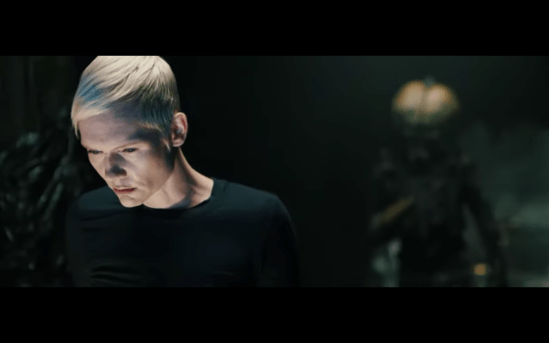
A Talking Black Lab with EVIL Red Eyes Target Children. “Where the Dead Go to Die” reviewed! (Mountain Oddities Home Video / Blu-ray)

“Where the Dead Go To Die” Now Lives on Blu-ray!

The first story in a disturbing 3-part omnibus tale concerns a little boy named Tommy.  Constantly at each other’s throats, Tommy’s troubled  parents don’t burden him down in their mini bickering wars and abusive verbal tirades where he becomes the passive aggressive fodder for each of them to shell the other with, but when Labby, a talking, red-eye dog proclaiming to be a messenger of God’s word, tells Tommy to kill unborn brother because he’s the antichrist, Tommy’s world is turned upside down when Labby murders both parents and the unborn child in the name of God.  In another story, a man steals liquid memories by killing people and extracting an intoxicating substance from their memory glands to inject them into his own body.  One particular liquid memory of a dying prostitute sends him through a warped nightmare of the underworld, one where he may never return to normal.  The last story focuses on a mask-wearing deformed boy named Ralphie, whose Siamese twin brother’s face protrudes out of the side of his face, and his infatuation with schoolmate and neighbor Sophia.  When trying to impress Sophia by relating to her father, Ralphie learns the father records VHS tapes of Sophia being molested by older men and is coerced to partake in an act Sophia is an unwilling participant.  At the behest of Labby, what Ralphie does next will put a fatal stop to the madness that surrounds him and his soulmate crush. 

In the same clunky spirit of crude early 1990’s computer generated imagery or in the early days of the original Playstation graphics, Jimmy ScreamerClauz’s “Where the Dead Go to Die” fully embraces the ungainly graphics in a 3D world of unimaginable horror where kids and demons intersect with wretched results.  The 2012 omnibus reflects three short narratives from ScreamerClauz and combined into one seriously screwed up tale, orchestrated by deal brokered wit Unearthed Films’s Stephen Biro who was sent two of ScreamerClauz’s short films – “Tainted Milk” and “Liquid Memories” – and challenged, or maybe even championed, ScreamerClauz for a third to build toward, and the eventual release of, a feature length product.  With the challenge accepted, the full-time musician and 3D animation artist succeeded with an unforgettable story that’s pure evil at heart and a surreal kaleidoscope of ghastly phantasmagoria.  ScreamerClauz not only writes, directs, and composes the film he also produces under the Draconian Films and Chainsaw Kiss production companies.  

As it has been already established Jimmy ScreamerClauz wears many hats in his production, we can add another with his voice acting of the demonic, fireball-eyed dog, Labby and along with the director’s voiceover participation, other genre actors and filmmakers are casted to voice one, or possibly more than one, of the crudely animated, disturbingly souled characters.  “Subject 87” director, “Reality Bleed-Through” actor Brandon Slagle tackles a double voiceover with the memory addicted man as well as Sophia’s sleazy abusive father.  As Sophia, the once upon a time softcore horror actress Ruby Larocca (“Witchbabe:  The Erotic Witch Project 3,” “Dr. Jekyll & Mistress Hyde”) has real innocent palpability up against Slagle’s aggressively toned, VHS-recording, and peeping perve that is her in character daddy.  Larocca also voices the mysterious advice-giver with the Lady in the Well and as the dying Hooker in the arms of the serial killer-for-liquid memories Man.  Another multi-voice player in the film and who also had a stint in the sex and violence category is Joey Smack with a string of strangler themed films (“Vampire Strangler,” “The Masked Strangler,” “The Bizarre Case of the Electric Cord Strangler, etc.,”).  Smack extends himself into a child and parent performance as the deformed Ralphie in “The Masks That the Monsters Wears” and Tommy’s dad in “Tainted Milk” that gives provides range albeit the quintessential grown man mimicking a child’s voice unmistakableness in the cracking high voice.  Much like Larocca, there’s something pleasant in seeing names like Linnea Quigley (“Return of the Living Dead,” “Night of the Demons”) and Devanny Pinn (“Nude Nuns with Big Guns,” “Bloodstruck”) be credited to voice because that takes the focus on their physical appearances and gives them a chance to actually be seen, or rather heard, with their dialogue performance.  In this instance, Quigley and Pinn embody the rancid maternity of Sophia and Ralphies’ mothers respectively.  “Where the Dead Go to Die” rounds out the cast with more B-movie actors in Trent Haaga (“Terror Firmer,” “Killjoy 2:  Deliverance from Evil”) as Ralph’s ashamed dad as well as Carlos Bonilla, Victor Bonacore, and Joshua Michael Greene. 

How a filmmaker chooses and utilizes his brand of CGI landscape is how that filmmaker’s film should be judged in the gelling of those areas, in my opinion.  “Where the Dead Go to Die’s” crude 3D animation is the intended result from Jimmy ScreamerClauz’s choice in conveying his short story narrative, but that intention won’t stop audiences and critics from browbeating and disparaging the film.  Yet, if accepting the former viewpoint and watch with understanding eyes through that recognition lens, “Where the Dead Go to Die” is one messed up and horrifying dystopia accentuated by the animation that gives each chapter more weight toward wretchedness and wrongdoing, gelling with tremendous intent to scramble the proverbial innocence with demonic forces and human perversions.  Some of the ideas and concepts swirling around ScreamerClauz’s head and make it into the three tales were just images he thought were visually neat but that speaks loudly on the dark mindset of creativity and many of those images are now temporally seared, scarred permanently into our long-term memory lobes.  Granted, tale transitions and recycling back to their sole connection with each other route into choppy territory at best, creating a windy, bumpy road in braiding the three chapters together under a single umbrella of animation style and storytelling, but “Where the Dead Go to Die” is a poignant and throbbing like touching a raw, exposed nerve through gouged muscle and tissue.  Every inch of surreal, sawtooth imagery is like a knife twisted into our virtuous side because upon closer look at Jimmy ScreamerClauz’s story containing children being hurt is only separated by the mere stylistic choice of cinematography. 

Out from the distribution shadows of Unearthed Films and in the hands of adult animation distributor Mountain Oddities Home Video, also in partnership with MVDVisual, for a new Blu-ray release, one we haven’t seen since Unearthed Films released the DVD and Blu-ray in 2012.  The first of two initial releases from Mountain Oddities Home Video, the Blu-ray comes AVC encoded, 1080p high-definition release, on a BD50 packed with extras.  Being mostly rudimentary 3D animation installed into a complexity of kaleidoscopic imagery, critiquing the quality is beyond our control but the compression is amply successful with no artefacts to note and the colorful saturation and grading levels provide an enriched, amalgamated dough of diabolic devil-bread, presented in a 1.78:1 widescreen aspect ratio that’s more compromised to its now out of print Unearthed Films counterpart from more than decade earlier.  Two English audio options are available:  a DTS-HD 5.1 surround sound and a DTS-HD 2.0.  At home audio recordings outside the sound barrier studio boxes are not as refined, capturing mic interference and hissing as well as the differences in varying audio volumes that don’t match between interacting characters in the same scene, creating that unshared space and gap.  Dialogue is unimpeded and clear and ScreamerClauz’s original gloomy-looming score fuels the deep morosity and malevolent themes.  English subtitles are option available.  Extras include a director’s commentary track with Jimmy ScreamerClauz, deleted scenes, an online video-conference interview with ScreamerClauz hosted by Quality Violent Cinema, behind-the-scenes featurettes of snipped dialogue recordings and interviews, including Linnea Quigley, Youtuber Diamanda Hagan’s video review of ScreamerClauz’s animated shorts “The Scuzzies,” and the director’s short film catalogue with “The Scuzzies” (that includes commentary), “Labby vs Mr. Pickles Rap Battle,” “Clinical Sodomy,” “Affection,” “Mutwa,” “Reality Bleed-Through Remix.”   Mountain Oddities Home Video’s Not Rated release is listed as the uncut version with a 95-minute runtime available with region free playback. 

Last Rites: An adult animation pushing the envelope with taboo themes involving kids and when you mess with kids, the public taste goes sour, but “Where the Dead Go to Die” swirls surrealism with poignant acting and strange fever dreaming amongst the basic, albeit creepy, animation.

“Where the Dead Go To Die” Now Lives on Blu-ray!

A Little Blow Evokes the Curse! “Cocaine Werewolf” reviewed! (Cleopatra Entertainment / Blu-ray)

Snort “Cocaine Werewolf” Up! Purchase Here!

A haughty and unpleasant stock trader taking an Uber to a late-night business meeting stumbles upon a drug deal gone bad.  Monstrously bad.  A werewolf intrudes into the exchange, killing three people and biting the trader on the shoulder.  Stumbling into the nearby woods disoriented and with a pocketful of cocaine, his desire to relieve the pain from his shoulder as well as to escape the nightmare of being lost and confused in the woods lies within the white as snow narcotic housed on his person, but every time he takes a nasal hit, his addiction curses him into becoming like the wolf that attacked him.  Happening across a film crew shooting a microbudget horror film and having no clue what’s happening to him, he partakes with the director’s cocaine habit that fuels his inner beast to come out and hunt them down one-by-one to rip them to shreds high on nose candy. 

Much the same way the farcical “Sharknado” gave birth to a few analogous action-horror spoofs with similar ridiculously punned titles, such as “Clownado” or “Lavantula,” that combines a vilified thing with one of the many wraths of mother nature, 2023’s “Cocaine Bear” too began the same conceptual nonsense that spewed out “Attack of the Meth Gator,” “Cocaine Shark,” and now, we’re treated to the next level of hopped-up creatures with “Cocaine Werewolf.”  Helmed by longtime microbudget horror filmmaker Mark Polonia, under the Polonia Bros. Production banner, and penned by first time screenwriter Tyger Torrez, the 2024 horror-comedy cuts the werewolf’s bane with powdery coke, spiraling the legendary lycanthrope into a stimulated frenzy of blow.  “Camp Blood’s” David S. Sterling of Sterling Entertainment funds the in-and-around Wellsboro, Pennsylvania-shot project with fellow producers Ford Austin (“Dahmer vs. Gacy) and Cleopatra Entertainment’s Tim Yasuni and Brian Perera (“Frost,” “The Black Mass”) serving as producer and executive producer. 

Returning to the schlocky world of penny-made horror is Brice Kennedy who has reconnected with Mark Polonia since “Razorteeth” and “Splatter Beach” from 2007.  Shortly after Mark’s brother, John Polonia, unexpectantly died in 2008, Kennedy returns to the in front of the camera scene in 2024 after a lengthy hiatus of 17 years.  Kenney takes the lead role of the cocaine addicted stock trader bitten to become a rampaging werewolf with a proclivity for nose blow.  The West Virginia native never lost a step in those 24 years of off camera with a smooth slip into an obnoxiously crass stock trader jostled to wander the woods and to be anxious to get to the next snort of his pocket narcotic.  Kenney plays on a fraction of the rubber masked werewolf, with Mark Polonia and others donning the snarling molded and faux hair stitched latex, but we don’t know or can’t tell which portion of the man-wolf Kenney portrays.  Brice carries much of the story until he meets the film crew halfway, through the muck of drug deals gone sour between actors James Carolus and Titus Himmelberger of “Sharkula,” a pair of unlucky drivers behind the wheel of their cars in Michael Korotitsch (“Motorboat”) and Marie DeLorenzo (“Sister Krampus”), and two hunters, from James Kelly (“Sharkula”) and Jeff Kirkendall (“Motorboat”) suspicious of the recent mauling deaths of their neighbors and find themselves way over their head with the animal that’s causing all the carnage.  Principal position shifts from being solo to a shared introduction of the film crew, exploring satire of making a low-budget, independent horror movie about a hackneyed clown slasher (Noyes J. Lawton, “Virus Shark”) chasing two girls through the forest.  Those two females leads, Jamie Morgan (“Motorboat”) and Greta Volkova (“The Last Frankenstein”), get put through the trope wringer with lesbianism tendencies and gratuitous shower nudity, not to also neglect mentioning being damsels in distress from a killer clown, and become centrically the focus toward heroine, aka the final girl, as the cocaine werewolf infiltrates their small band of filmmakers.  Hot on the savage beast’s trail is Ken Van Sant (“Virus Shark”) as the local sheriff baffled by what’s tearing people apart.  If you couldn’t tell already, the cast is comprised of Mark Polonia regulars, those who have worked together on numerous projects, and have a kind of inner circle rapport with each other from the various Mark Polonia Bros. productions and this also includes Cody Losinger, Tim Hatch, Yolie Canales, and Alyssa Paige that rounds out “Cocaine Werewolf.”

I had promised myself after reviewing “Motorboat” dismally, I would stay away from another Mark Polonia production but because of my personal philosophy and prejudge avoidance policy of not researching and previewing films before watching them for critical analysis, I burned myself into Mark Polonia’s world once again.  I was duped in part of Cleopatra Entertainment being partnering producers and the distributing label as they’re becoming well known for release moderately subpar horror product and have their own entourage line of actors, actresses, and filmmakers, such as Devanny Pinn and Brandon Slagle, with notable B-movie guest stars like William Shatner (“Star Trek”), Vernon Wells (“Commando”), and Udo Kier (“Blood for Dracula”) in some of their releases.  Additionally, I absolutely enjoyed “Gun Woman’s” Kurando Mitsutake from print-to-film manga adapted “Lion Girl” that recently saw the physical media light.  Unfortunately, I did not get the same pleasure out of “Cocaine Werewolf” under Polonia’s formulaic filmmaking and while Polonia does apply some effects techniques, mostly off-kilter visual f/x such as the added cold breath, the blood spurts, or the swirling faces that indicate human-to-wolf transition, but there isn’t a consistency to them and doesn’t blend into “Cocaine Werewolf’s” whole tone in what is more of a convenience choice rather than a unifying or connective element.  “Dead Ant” and “Psycho Goreman’s” Josh Wasylink’s werewolf mask design would be any kid’s Halloween wet dream in what has pretty remarkable detail contrasted against the microbudget.  Granted, there are not pneumatic or hydraulic components to the constant mask but a little blood here, a little blood there, and some glowing red eyes and you got yourself a damn good-looking, classic-feeling werewolf. 

From Cleopatra Entertainment, the film division of music label Cleopatra Records, comes “Cocaine Werewolf” onto an AVC encoded, 1080p high-definition, BD25 Blu-ray. Frequently lacquered in a CIG haze, the ungraded image manages to retain a solid definition of sharp detail presented in an anamorphic 1.85:1 aspect rato. This can be good and bad for the image quality that while really creates delineation around textural clothing and the ample foliage it can also really expose to a fault and emphasize the rubbery inanimate mask along with the large cut out eyes, blackened with dark makeup to try and make the mask and the actor seamless. Depth is fine and medlied across multiple locations and the color range has natural, varied pop, diffused into the smokey trope atmospherics and angled up and key lit cinematography by Paul Alan Steele. Blacks are slight washed but not crushed or with significant banding. Like most Cleopatra Entertainment releases, the soundtrack overwhelms enough of the other audio layers in this English language LCPM Stereo 2.0 that it slightly takes of the edge of the impact, but the lossless quality awakens the snarling, growling werewolf noises and the dialogue is amply consistent throughout that even the Gothic rockabilly score from The 69 Cats doesn’t fully immerse viewers solely in the band’s dark melodiousness. Bonus content includes a Mark Polonia commentary, which the director is usually pretty good about supplying and supporting for most of his work, an image slideshow, and the trailer plus trailers for other Cleopatra Entertainment releases. Physical attributes of the conventional encased Blu-ray include an uncredited but insane Red Riding Hood inspired illustration on the front cover. There is no reverse side of the cover nor are there any inserts included in his release and the disc is pressed with the same front cover image. The unrated Blu-ray comes region free and has a runtime of 80 minutes.

Last Rites: “Cocaine Werewolf” is better than most of the contemporary Mark Polonia body of work, but the heart-pounded effects of his laced comedy-horror is not addictive enough to produce the euphoria to warrant another line hit, leaving this derived werewolf indie in withdrawals.

Snort “Cocaine Werewolf” Up! Purchase Here!

EVIL Ted Bundy is “The Black Mass” reviewed! (Cleopatra Entertainment / Blu-ray)

“The Black Mass” on Blu-ray Can Be Ordered Here!

Based off a slice of Ted Bundy’s murderous impulse-driven life, the notorious American serial killer’s escapes from the upper West Coast and lands him residence in Tallahassee, Florida in the moderately warm winter of 1978.  As he picks the pockets of those around him, scrounging up what little cash he needs to survive on, Bundy urges grow to kill grow more intense.  He begins to stalk a nearby university sorority house that’s buzzing with potential prey.  As works out a plan to attack, his good looks and impeccable charm make him desirable around women and men alike, offering opportunities that tend to fizzle out before they can begin, and when his need to spill blood agitates him excessively, he starts to creep out those around him by glaring out them and making off-the-cuff shrewd comments.  With his options declining rapidly, Bundy decides to take advantage of the sorority house’s broken backdoor lock and set in motion a night that will forever live in American infamy. 

For her feature length film debut, scream queen actress Devanny Pinn takes on one of the most vile villains ever to walk the Earth in her biographical horror “The Black Mass.”  The “Song of the Shattered” and “Frost” actress and producer brings a headspace perspective to Ted Bundy committed at least 20 confirmed murders between 1974 and 1978.  The true crime thriller named after what one of the victims described Bundy’s attack on her as simply as a black mass before being bludgeoned.  Brandon Slagle (“Song of the Shattered”) and Eric Pereira (“The Locals”) collaborate on penning the script.  Slagle directed Pinn in the 2022 element horror and survival feature “Frost” and now it’s Pinn to take a stab at the director’s chair with a Slagle screenplay, pun intended.  Pinn coproducers her film alongside Michelle Romano (“Night Aboard the Salem”) and Cleopatra Entertainment’s Tim Yasui (“Frost,” “The 27 Club”) under the production banners of Jaguar Motion Pictures (“Dead Sea”) and Roman Media (“Millwood”).

The main focus in the feature is of the titular character, “The Black Mass,” that is Ted Bundy, almost seeing what he sees through his eyes of skulking and morbid fantasy.  Played by British actor Andrew Sykes, the centrically focused character is experienced not directly through his eyes but over his shoulder, peering from behind as if audiences are accomplices to his murderous wake.  Sykes performs well in a nearly voiceless role that does more lurking than talking but Sykes’s worked up frustration clearly surfaces and erupts out of Bundy when strapped for cash and has a tremendous itch that needs to be scratched as his wishy-washy path to do good crumbles from under his footing.  As the main focal point, no other character really comes close to a lead principal.  The sorority girls are introduced in mass and jump from sister-to-sister individually conversating routine and tales of the day-to-day within the college student context with roles from but not limited to Lara Jean Mummert-Sullivan (“2 Jennifer”), Brittney Ayona Clemons (“Twisted Date”), and Alex Paige Fream (“Into the Arms of Danger”).  Yet, Pinn’s storytelling purpose is paradoxical with the whole story flowing through the perspective of Ted Bundy with his prey hanging mostly in the peripheral and not emanating the warm and fuzzies of sympathetic, relatable characters, but at the end of the film, there’s an acknowledging tribute for the victims who we really know nothing about from the narrative, creating an acute pivot from the killer’s personal bubble.  “The Black Mass” rounds out it’s relatively large passing-through cast with Chelsea Gilson, Susan Lanier, Eva Hamilton, Sarah Nicklin, Elisabeth Montanaro, Mikaylee Mina, Jennifer Wenger, Grace Newton, Devanny Pinn, and with cameos from Lew Temple (“The Devil’s Rejects”), Jeremy London (“Alien Opponent”), Lisa Wilcox (“A Nightmare on Elm Street 4:  The Dream Warriors”), Kathleen Kinmont (“Halloween 4:  The Return of Michael Myers”), and schlock movie veteran Mike Ferguson.

“The Black Mass” is the perfect example of style over substance.  While the story is formatted around Bundy’s outlook, there’s not a significant amount of edification for his warped mindset.  Some backstory leaks through his beseeching phone conversations with ex- or current girlfriend Liv, a phone voiceover presumingly based off the real Bundy girlfriend Elizabeth Kendall, that teeters the appearance of his humanity side as he talks about his addictive struggles and trying to walk a straight line, but any kind of sympathy is quickly tabled without an ounce of provision, likely for his inclination to lie for advantage and exploitation’s sake.  Pinn only teases the inexplicable morose and ghastly gears that rotate inside Bundy’s head, spurring a single blood-drenched daydream of a girl pulling off her skin in the shower, and erotically enjoying it immensely.  The scene feels sorely out of place amongst the rest of reality-grounded narrative that resorts to a cut-rate version of Bundy’s devolving surrounding is fleeting patience and feign niceties.  What’s appreciated mostly about “The Black Mass” is Pinn’s ability to work the camera in not revealing too much of a modern-day society by maintaining that closeup distance behind Bundy and only really showing what needs to be seen for a late 70’s biopic.  Costuming, production design, and vernacular are appropriate for the era as well.  Coming back to the proximity around Bundy, there’s a purposefulness in not showing his full face or looking at him from the front that keeps the particulars of his image in an effective, if not slightly scary, enigma albeit the other characters’ brief descriptions of him in conversation do provide a rough picture of him. 

MVD Visual distributes the newest cinematic Bundy biopic from Cleopatra Entertainment. The AVC encoded, high-definition 1080p, BD25, presented in a widescreen 2.39:1, has welcoming veneer, splashed with a 70’s color scheme saturation, and is graded with a middle-of-the-road or slightly darker color palette. Sufficient capacity and compression encoding offers a clean, sleek digital image without artifacts and with the ample attention to minor era details where possible and Noah Luke’s fill and back-lit cinematography when things get really dark, as in sinister, that snappy image presentation is key. The English language options are a lossy Dolby Digital 5.1 and a PCM 2.0 stereo renders a clean, balanced mix between dialogue, ambience, and dialogue with less suppression on the PCM audio if you’re looking for a lossless option. The setting sounds are nicely immersive compared to the limited and concise framing, opening up the world audibly rather than visually. No technical issues with the digital audio on neither front; however, depth and reality checks are missed marks as all the dialogue doesn’t abide by spatial awareness; when the sorority sisters are talking indoors or from afar while Bundy lurks outside the house, or from a distance, spying on them, all the dialogue is unobstructed and too prominently clear for natural conventions. Bonus features include an image slideshow and the feature trailer. Ancillary content includes other trailers for Cleopatra films with “Frost,” “The Ghosts of Monday,” “The Long Dark Trail,” “What the Waters Left Behind: Scars,” and “Lion-Girl.” Released in a traditional Amaray Blu-ray case, “The Black Mass” sports a Dimension-like front cover, dark and full of characters. No insert or tangible content inside and the disc art mirrors the front cover. Cleopatra’s region free Blu-ray comes unrated and has a runtime 82 minutes.

Last Rites: Devanny Pinn quarterbacking her first feature film with an à la mode Ted Bundy portion, an interpretative taste of his absolute madness, doesn’t faze the long-time scream queen actress and producer who takes on the subject head on, but the overall concept does need tweaking in the area of purpose that can be easily conquered with more practice.

“The Black Mass” on Blu-ray Can Be Ordered Here!

Hypothermia is EVIL’s Coldest Best Friend. “Frost” reviewed! (Cleopatra Entertainment and MVD Visual / Blu-ray)

Get the Bluray and Soundtrack for “Frost!”

Seeking to reconnect with her estranged father, Grant, after five years, pregnant Abby drives up the mountainous rural cabin.    Though not the warmest welcome she was expecting with the sudden pregnancy announcement dropped into her father’s lap, the two manage to find common ground and connect again while reliving memories of Abby’s mother.  Their threadbare bond sparks an impromptu finishing trip to the local creek and as the begin to open up a little more with each other, their car accidently runs off the road and declines down a gradual mountain decline before becoming wedged in a thicket of tree branches.   Abby, stuck in the passenger seat facing a steep cliffside dropoff, is trapped and injured.  As Grant goes for help up the mountain, a severe storm rolls in bringing harsh weather and freezing temperatures down upon Abby who desperately tries to keep warm and prays to not go into early labor before emergency rescue can come to her aid. 

Snowy winter thrillers can be harrowingly exciting as much of the plot is fused with the icy and treacherous environment that make lives at stake higher. The snow and the ice become threatening characters and when combined with, at times, a more conventional and concentrated story antagonists, foreseeing path for survival can often feel frigidly impossible. There’s little room for error, there’s little room for warmth, but there’s always an unpredictable heap of bone-chilling snow as far as the eye can see and the elements are only but nature’s natural attributes man has yet to confidently conquer. “Frost” plays into mother nature’s strength when squalling down below freezing wind and snow upon a woman trapped in her own car. The 2022 released, Brandon Slagle (“Attack of the Unknown”) directed “Frost” goes for the jugular in a woman versus nature survival suspenser penned by frequent Slagle aide-de-camp Robert Thompson. The “Aftermath” and “Crossbreed” screenwriter adapts “Frost” from a story by “From Jennifer” writer-director James Cullen Bressack. Shot during the winter in the San Bernardino mountains, “Frost” is produced by the film’s star Devanny Pinn and Cleopatra Music’s Vice President Tim Tasui under the bankroll and production support of Bressack’s JCB Pictures, Inc., Snow Leopard Entertainment, Sandaled Kid Productions, Multiverse Cinema, and Cleopatra Entertainment founders Brian and Yvonne Perera along with Pinn’s co-star Vernon Wells and The Asylum’s Jarrett Furst serving as associate producers.

“Frost” fits into the solo survivalist subgenre category and only characterizes with three actors and a trained wolf. At the tip of the cast spear is independent film producer and broad-brush horror actress and filmmaker Devanny Pinn (“Nude Nuns with Big Guns,” “The Dawn”) in the principal role of Abby, a woman seeking to rekindle her relationship with her reclusive father living in the mountains because of her pregnancy. Genre legend actor Vernon Wells (“Innerspace, “Commando”) opposites Pinn as Abby’s estranged father who’s happy to see his daughter but feels initially threatened by the pregnancy announcement. Understanding the dynamic between Abby and her father was easy as we’ve seen this type of teetering relationship before from a slightly rebellious, new age child returning home to find familiarity with a widowed and waning parent. Pinn and Wells pull off the several stages of reconnecting from the heated exchanges to the sappy moments of loss to the unexpected joy the two characters can bring out of each other, but what’s more difficult to comprehend is the source material. What causes the father and daughter to divide in the first place and how does that division’s role play out in the perilous predicament of an isolating car crash during a severe winter storm? For the sake of critique, one could say that their dissolving disputable divisiveness ends in irony as if the cosmos ultimately pulls them a part in a fitful storm of rage. Wells does what he can to make the initial crash scene comforting while exuding a positive outcome, but the veteran actor appears blank to severity, especially as a woodsman father soon to be a grandfather. Much of “Frost’s” edge of your seat trepidation is shouldered upon Devanny Pinn to take reins of providing the emotional embattlement against the unforgiving weather elements and animal food chain. Armed with nothing more than the dwindling car’s battery to provide heat and a charged lighter as well as whatever lures and first aid accompaniments in her father’s tacklebox, a rather lightly dressed, nearly to term pregnant Abby is pinned to her seat, backed to the edge of a cliff, and must face the cold and wolves until her father retrieves a rescue party. Pinn does what she can to fill in a quivering battle between life and death with a story that’s heavily reliant on a cigarette outlet to ward off a snarling wolf and can burn through seat belts in a single charge. That’s independent move magic for you, folks!

Any kind of solo act surrounding a single location, remote at that, with no other actor or other mobile organic object to feed off and bounce off its energy is a difficult task to undertake, especially on a hyper cost-efficient production.  Slagle’s “Frost” is certainly not immune to the difficulties and the filmmakers, and his crew and cast are well aware of the challenges to make the survival thriller engaging despite fluffing and padding the story with filler clichés and needless setup.  The production and location value are comparatively impressive against the limitations of the budget with a practical and computer-generated encroaching tundra of snow, ice, and wind that can insidiously invade a cold snap into the viewers bones, creating that intended atmospheric of a hell freezing over complete with the teeth of a hungry wolf, a biting rime, and deadly falling icicles.  More obvious than what perhaps Slagle and creative team realize is that “Frost” relies terribly on the shocking climatic scene, a scene so unimaginable and so appalling that it hits all the right gut-checking spots, but the setup to the scene and all the trials and trepidation Abby has to endure doesn’t quite mesh with a well-rounded plight that usually cradles an emotional pull string for the viewer to continuously root for and support those in the thick of the predicament.   Honestly, that heaviness for empathy never provides the emotional weight toward the character and never sparks that flame of hope to keep us warm and fuzzy on the inside to then quickly be extinguished by merciless mother nature. There’s also the plausibility of survival and the way that survival instinct is applied that makes “Frost” too far-fetched to be a strong contender in the subgenre. At near subzero temps, Hypothermia can set in in under an hour. In “Frost,” three days of severe snowstorm pummeling has past, segued by scene time stamps, before Abby becomes a popsicle and is delusional. I’m pretty sure with almost nothing to eat and very little warmth, Abby would have expired in under 48 hours. Yet, the 72-hour mark becomes the most chilling, literally and figuratively, in “Frost’s” invigorating third act snack that’s more abominable than it is nutritional!

Cleopatra Entertainment, the cinematic subsidiary of Cleopatra Records delivers a 2-disc Blu-ray set for Brandon Slagle’s icy thriller “Frost.” Presented in a widescreen 2.35:1 aspect ratio, the 91-minute film has a crisp, lively picture compressed without much to complain about. Banding issues are held to barely any and the details don’t whiteout during the wintery whiteout, leaving key delineations to be present in bold contrasts, especially during the severe snowstorm scenes. Foliage looks thick and green before for the storm with a lot of good textural details on the impaling branches that perforate the car and Abby. The English language 5.1 surround mix conveys the problematic sound design issues that have been consistently found in many of Cleopatra’s releases. Mostly in regard to the dialogue tracks, the dialogue tracks pick up static and other minute ambient noise during microtonal intervals, creating an unwelcoming and stark contrast with a dialogue mix that cuts obviously cuts in and out between character speak and isn’t simultaneous with the score. However, much like with other Cleopatra releases, the score is production and distributor company’s best trademark with a full album including music from various artists, such as L. Shankar, Big Electric Cat, Terry Reid, Rick Wakeman, and amongst others. The 2nd disc, an audio CD, contains the 15-song soundtrack. Other physical noteworthy aspects of the release include the double-sided cover art – one filmic and the other CD listing with both include different variations of the front cover as well as a translucent Blu-ray snapper cast that adds to the snowy theme. Software bonus features include only the theatrical trailer and a still gallery slideshow. Exposure to “Frost” is deep freezing frills for most of the picture but if able to withstand the coldshoulder of cliches, the mare peaks with a blood-filled and tasty horrific morsel that makes the frippery first half worth the wait.

Get the Bluray and Soundtrack for “Frost!”

EVIL is Out For Blood! “Attack of the Unknown” reviewed! (Gravitas Ventures / Digital Screener)

A Los Angeles SWAT team raids a syndicate congregating big narcotics deal that leads to the arrest of the local high profile drug lord named Hades.  In transporting Hades into federal custody, massive alien ships suddenly loom over the city, beginning a merciless extraterrestrial invasion that forces the close knit SWAT team, Hades, and a handful of low on the totem poll federal agents to take shelter at an inmate detention center housing dangerous criminals as everyone outside, fighting for their very lives on the streets of an ablaze metropolis, are swarmed and killed by tentacle spearing, blood sucking aliens.  Running low on ammo, cut off from any kind of rescue, and aware that an attack on them is imminent, the survivors must band together to plan their continuous survival and understand what the aliens want from them before being raided for their blood.

“Independence Day” meets “Assault on Precinct 13” in the blood marauding mayhem of the alien invasion action film “Attack of the Unknown” from writer-director Brandon Slagle (“House on Manson,” “The Dawn”) based off a story by producers Michael and Sonny Mahal of the Mahal Empire production company. The American made, Los Angeles and Las Vegas shot Sci-Fi embattled entanglement labors an intensive visual effects heavy bombardment that bares an unbiblical similarity of the David versus Goliath parable.  Instead of using stones and a slingshot to bring the formidable giant down, gunfire and hand-to-hand combat serve as the nearly useless weaponry of choice against these spacemen, with a slight inspiration of H.R. Giger’s biochemical flare, searching for the junkie’s high of medicinal hemoglobin.  Alongside the Mahal Empire, the company behind the artistry of supernatural-sins, “Art of the Dead,” Spicy Ramen Productions (“Murder Van”), FilmCore (“Clownado”), and Blain-Y-Bootleg Films also stick their producing tentacles into the narrative that entails expropriation of human blood by otherworldly beings.

“Attack of the Unknown” reunites “Art of the Dead’s” Richard Grieco and Tara Reid once again in a non-scene sharing feature, but, this time around, Grieco lands the lead role of Vernon, a long-in-the-tooth cop going through a brutal divorce, going through cancer, and must be the person to save during the invasion…wait, what? Yes, forget the women, children, and possible any other last hope for mankind, Vernon, through the eyes of his SWAT brethren, becomes early on the favorite for survival, but only later into the story does the fact of Vernon’s fatalistic, cancerous blood is the cure for dominion dominance, something that should have been noted when Vernon is labeled as must live. Grieco’s austere soul for Vernon disposes a man without a care or is unpredictable and while the role is overall solid, Grieco is a bit theatrical with the performance. On the short end of the stick is Tara Reid whose barely in a folklore tale told by Hades as a severely brief conclusion on why these malevolent space invaders have landed on planet Earth. Former “Hellraiser: Revelations'” cenobite, Jolene Andersen, and typecast bad guy, “Strangeland’s” Robert LaSardo, without an alternative, had the most intrigue without having a lick of depth with their characters. Andersen is the only female SWAT member, Hannah, with an unexplained connection between her and Vernon other than being colleagues, but Hannah is a bit of a Jane of all trades able to hold her own in a humbling kind of way, making her more likable. On the other hand, the mysterious temperament challenges us to figure out what LaSardo kind of person is Hades; obviously named after the lord of Hell, the drug kingpin isn’t devilish in the least and has the tendency to be more of a stubborn and angst tween. The cast list is huge but the main players involved rounding out the cast list is Douglas Tait, Robert Donovan, Paul Gunn, Mouine Omari, Clay Trimble, Gerardo de Pablos, King Jeff, and, not forgetting to mention as Featured Dancer #1, adult actress Tasha Reign.

Slagle has to reign over and rein in the slew of competing talents and the story’s first act of an indeterminate direction. When the narrative finally settles upon the alien encircled detention center with the survivors’ back against the wall, a harried subplot with two, nearly off the clock San Fernando cops encountering a crashed ship in the desert on the outskirts of town is pushed aside; instead of a smaller, parallel story alongside the SWAT’s predicament, the two cop encounter becomes a bookend story that feels sorely out of place and sheepishly wrapped up. Another out of place aspect, an unfillable character arc within the core story, is with an out of element survivor, a vlogger from Texas, who is the only unqualified defender against an attack and supposed to be on this tangent of earning his “got your back” badge (anyone from Texas, the Alamo state, should know a thing or two about a last stand), but by the time the vlogger musters the courage to shoot back at the bloodsucking tentacles during an elevator escape, the moment is way too late and way too underwhelming to make an impact, leaving his presence wasted amongst a motley crew of rough and tough officers and criminals. Luckily, the Mahal production has plenty of capital to go around to render a bolstering blend of practical and visual effects that tags “Attack of the Unknown” as Slagle’s Michael Bay attempt of a Sci-Fi action film. The visual effect composites are verisimilar in comparison to big budget Hollywood and the practical work, whether be with the fleeting gruesome deaths (ripping off the crown of the head scene was pretty nasty), the alien spacesuits, and the alien’s classic bug eyes and small mouth, harped back on a throwback science fiction alien attack sans the ray gun trope.

For an indie production, “Attack of the Unknown” has a palpable core story with promising visuals that has invaded all major VOD platforms this past August courtesy of Gravitas Ventures. The A/V qualities will not be reviewed due to the digital screener provided, but just to comment on the rigors of budget films, the depth perception issues in the composited effects and the sounds effects not always necessarily syncing properly with the action (i.e. explosions), cold cocks us back down a peg that “Attack of the Unknown” is an indie film. The music score is provided by Scott Glasgow (“Hatchet III”) and the shots are provided by Michael Su, who I thought garnished really neat scenes with smoke and brilliant light. Bottom line, “Attack of the Unknown” just ekes out being entertaining enough but the space vampire’s ground assault traverses a rocky road of dry performances and unfocused bearings that cultivates earnest dramatics progressing into one ginormous space ship-sized cliché.

Available to Rent on Amazon!