There’s Growth in the Darkest of EVIL Pacts. “Vulcanizadora” reviewed! (Oscilloscope Laboratories / Blu-ray)

Catch “Vulcanizadora” on Blu-ray from Oscilloscope Laboratories!

Friends Derek and Marty trek through the Michigan forest to get away from their life’s problems, stopping occasionally to dig up previously stowed away porn magazines, camp around a fire and in tents out in the open air, enjoy swimming in the fresh waters of nearby lake, and videotape themselves setting off small fireworks.  As Derek enjoys life’s little moments out in the wild with his best friend, Marty’s intentions are more focused on their unspoken pact, the whole reason for their journey through isolated wilderness.  The closer they walked toward to their journey’s terminus, Marty’s determination to finish what they started becomes more rabid whereas Derek has second thoughts with fear projecting out of his nervous habits.  When one of them doesn’t return home, tremendous guilt submerses the other into self-liability as he tries to make right and to make amends for what happened between the two friends alone in the wilderness.

Vulcanizadora.  A Spanish dictionary word for tire shop or also the heat-treating process of crude rubber to improve durability.  It’s also the title of Michigan native Joel Potrykus’s written-and-directed, 2024 dark comedy drama that relates, in a way, to both English definitions of the word.  Potrykus began his directing career in comedy back in 2012 with “Ape,” a black comedy about a struggling comedian-turned-pyromaniac, and from there the residing Grand Rapids filmmaker has hovered in the bleak and comedic mingle continuing with the ill-fitted paranoia of “Buzzard,” fortune obsessed mysteries of “The Alchemist Cookbook,” and “Relaxer” that takes audiences, or at least those who lived through the experience, back to the Y2K apocalypse scare for one man’s quest to conquer the Pac-Man videogame.  “Vulcanizadora” is a produced by Hannah Dweck and Theodore Schaefer of Dweck Productions, Matt Grady of Factory 25, and Ashley and Joel Potrykus under Sob Noise Productions. 

Joel Potrykus co-stars in his own feature story alongside Potrykus film regular Joshua Burge in their first collaboration since 2018’s “Relaxer,” marking their fourth project together.  Potrykus plays the incessantly hyperactive Derek, a babbling, balding, and large goatee rocking fun seeker eager to show Marty a good time on their walk through the woods despite the grim preconceived end game.  Marty’s a direct opposite of Derek with solemn character and intensive tinkerer putting up with Derek’s nervous ways but also impatiently awaiting their determined fate.  Potrykus constructs a fascinating and fantastic preluding invisible wall with the intention of blocking both Derek and Marty’s past and chiseling out piece-by-piece under casually cryptic conversation, we can begin to learn what motivates their pact with hints of property destructive transgressions and life disaffirming unhappiness.  There’s never clearcut cause upfront or even into the second act and that naturally leaves the last act to unravel the unfortunate circumstances around what makes Joel and Marty tick, and their friendship acutely grows stronger with compassion and genuine regard despite the other’s permanent absence.  The story primarily and innately focuses on the buddy duo, that appears under the guise of the arbitrary mundane with one-sided indulgence in Derek’s childlike Incessancy and quiet Marty’s tongue-biting abiding of his friend’s then unknown stall tactics, but the narrative opens up and expands upon “Vulcanizadora’s” world as one of them reinstates themselves back into their personal misery, a smalltown society of unscrupulous lawyers, browbeating and demented fathers, challenging ex-wives, and intimidating authoritative figures casted with Bill Vincent, Sherryl Despress, Scott Ayotte, Dennis Grants, G. Foster II, Jaz Edwards, Melissa Blanchard, and introducing Solo Potrykus. 

A slow burn of melancholy, “Vulcanizadora” is masked depression at its worst with voiceless victims that work out an ill-fated end on their own.  “Vulcanizadora” is also about friendship despite the seemingly lopsided larking and crestfallen relationship between Derek and Marty, who often feel more like diamagnetism than having a connection while on their passage through the woods.  Potrykus’s story, and subsequent exhibition of the tale, depicts an all but true tragedy of feeling the impact of loss, especially in the context of underappreciated and compassionate feelings for someone else.  While the other friend is around, complacency is the devil’s active ingredient in dividing our human connection as the thought is both being alive together or dead together would be constant, and even more so when that connection is with a person who might be the best person in the world to them but just can’t see underneath the film of one’s own miscontent.  When not around, being separated makes the heart grow founder and the reality of loss sets in.  Potrykus highlights those forlorn facets in the third act surrounded by nothing of life’s hardships and unusual bombardments, which to be fair was brought upon by past transgressions of invincibility, which involve a process similar to vulcanizing, hence the title, and the knowledge that it’ll all over soon.  Yet, there’s also a sort of vulcanizing of the friendship elasticity and durability even in post-“breakup” of the friendship to create an everlasting peace with all the bad that’s happened.

Oscilloscope Laboratories, an indie label curating the filmic curiosities, releases “Vulcanizadora” to Blu-ray home video with an AVC encoded, 1080p Hi-Def resolution, BD25, presented curiously in an European widescreen 1.66:1aspect ratio, a standard proportion display you usually would primarily see in 1960s-1980s Europe with a slightly boxed and bordered matte.  A satisfiable picture for a character-driven slow burn aimed to build and destruct to build again a relationship between two friends during a time of individualized darkness is not a picture of perfection where certain areas inside the forest are out of focus and indistinct, such as the blending of orange and brown leaves on the ground in very long shots while capturing the principals traversing through.  Likely more of an issue with the cinematography than in compression because Potrykus uses 16mm to evoke a richer texture, “Vulcanizadora” is not a high-powered, action-packed thriller or sensational visual drama to be affected by it’s off-and-on focus.  Details are generally better around close-to-medium shot textures, skin tones appear organically accurate, and there’s decent depth of field inside a naturally limited color range.  There are some good close ups that do deviate, such as in a gorier graphic shot that impales more intrusive grain into the cell, in what is perhaps a limitation of 16mm zoomed in.  There are often indiscernible blips in the film stock because of its newer production but the grain, when not extended, is organic with an enriching natural aesthetic.  The English DTS-HD 5.1 surround sound is more than enough to cover all audio aspects from a precisely clear and clean dialogue to a Sasa Slogar’s sound design of comping operatic harmonies of soprano Maria Callas with the rough heavy metal soundscape of the Brazillian band Sepultura.  Dialogue retains in the forefront even in long shots when characters are at far points in the scene denoting an omission of depth in what is mostly a medium-to-close shot narrative.  English subtitles are optionally available.  Joel Potrykus, Joshua Burge, and cinematographer Adam J. Minnick provide an audio commentary track parallel to the feature with a making-of “Vulcanizadora,” deleted scenes, the theatrical trailer, and Potrykus’s short film, “Pets” to fill out the special features.  Oscilloscope Laboratories release comes in a clear Viva case with an unsettling yet telling death and video image in its cyborg-esque edge cover art and a reverse cover honed-in on a still image of the two protagonists.  Disc comes company typical pressed with the company logo large and in charge at the center and film title hovering over top.  The not rated release has a runtime of 85 minutes and is suitable for all region playback.

Last Rites: Few will relish in Potrykus’s “Vulcanizadora’s” slow-and-steady tragedy of deep depression and the crawling out of the fiasco unfolded, self-dug hole to find some sliver of peace and comfort in doing one right thing for a friend.

Catch “Vulcanizadora” on Blu-ray from Oscilloscope Laboratories!

An EVIL Drug That Can Cure Your Crabs and Boil Your Insides! “Private Blue” (SRS Cinema / DVD)

“Private Blue” is on the case! DVD Now Available.

A new drug is on the streets of Edmonton, Alberta.  Call Shrink, the drug can produce a massive high and contains a high level of antivirals that can cure any sexually transmitted disease, but there’s a side effect.  If taken in a single excess amount, the drug can boil your insides, leaving nothing left.  The Edmonton police are stuck on the case with no leads and to make progress on the fast-moving drug epidemic that has now claimed the life of a daughter of a prominent sports booky, the department hires Tony Blue, an ex-cop now private investigator who can use unconventional means outside the scope of police authority to get the needed information, such as where Shrink is being peddled and produced.  Working down the vine, Blue runs through the hierarchy from street pushers to the manufacturing kingpin, a brusque and brutish strip club owner named Wanda who will stop at nothing and will not let anyone get in her way to fill the streets with her deadly, venereal disease-curing drug.

A comedic spin on the 1980’s lone wolf cop-thriller, “Private Blue” immerses itself into every trope manageable inside its indie budget with business in the front, party in the back mullets, bad guy chases and beatdowns, and a smoke-filled and color gel-brightened assortment of atmospheres that propagates the cop film neo noir aspects.  The accountable party behind this crass cop caper are a pair of brothers, Devin and Robert Burkosky, based in Edmonton, Alberta, Canada.  The brothers produce, write, direct, and one-half star in what is their sophomore feature film behind the 2018 comedy-horror “Load Shark Massacre” that’s about a murderous loan shark who bites off more than he can chew.  Continuing the trend of drugs, violence, and psychotronic absurdities, “Private Blue” is an extension of their creative effort into crime action with a horror edge but with this time, they add a science-fiction element straight out of the boondocks of left field.   The feature is produced under the Burkosky company, Beechmont Entertainment. 

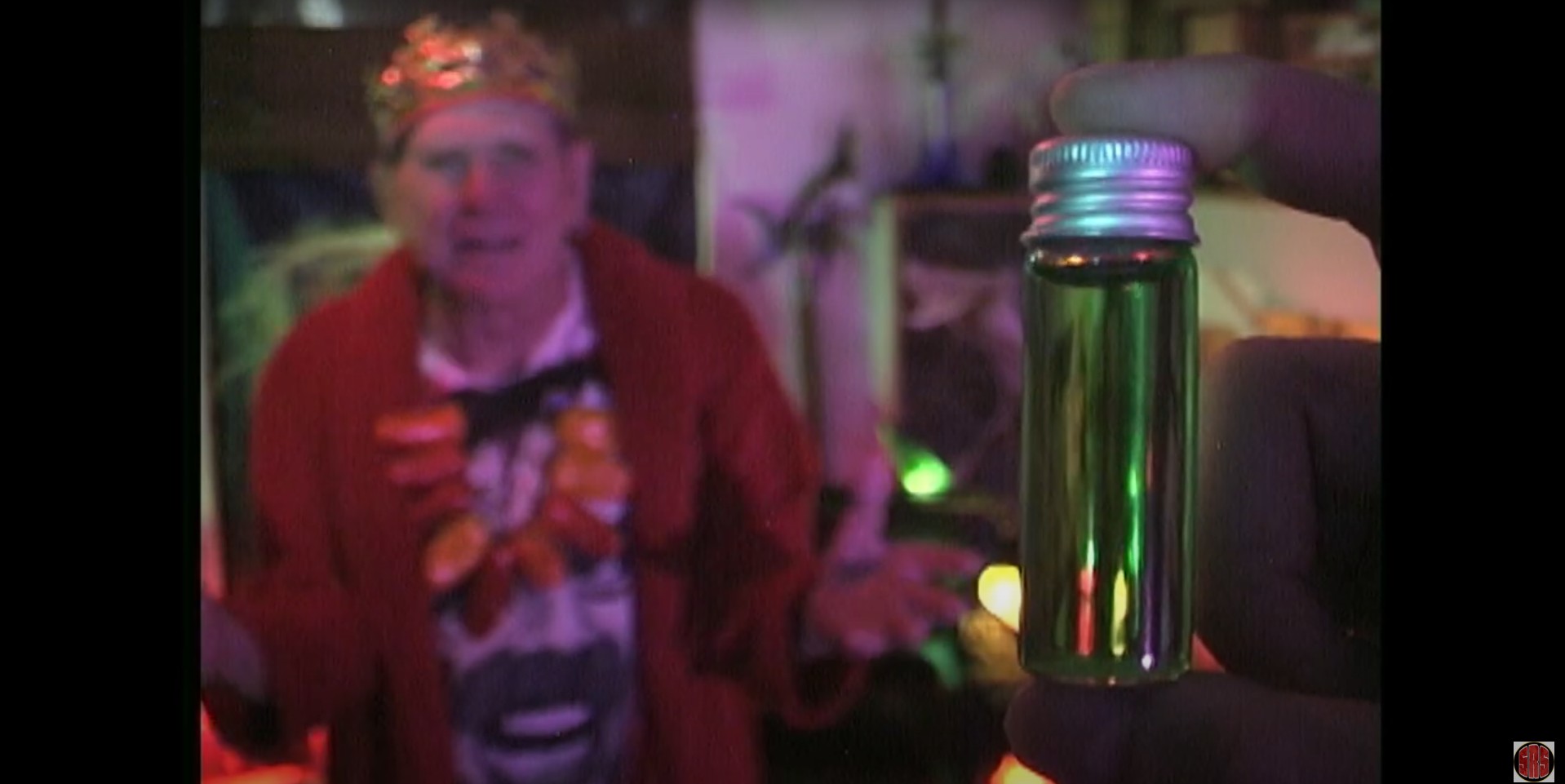
Robert Burkosky jumps into the titular role of “Private Blue” as a wisecracking and arrogant Tony Blue, an expelled detective because of his purloining of the evidence locker for his own needs, but Blue is a great chase-down detective, if not the best with his quick wit and adept situational skillset that makes him valuable.  Burkosky hams up Blue’s cocky attitude and Miami Vice-lite dress with linen blazer overtop a white tank top, sporting aviator glasses, and flaunting a greasy-looking mullet to accentuate the arrogance and confidence.  Opposite Burkosky is Moira MacKinnon as the larger-than-life adult industry head honcho and criminal mastermind Wanda who’s behind the manufacturing and distribution of the Shrink drug.  Having had a role in the Burkosky’s debut feature “Loan Shark Massacre” and was recently in their last film, the 2025 “Heat Score” that’s currently in post-production, MacKinnon’s a Burkosky go-to regular and her performance in “Private Blue” is perhaps my personal favorite with the Rita from “Power Rangers” voice and cackle and a maniacally expressed face as she bulldozes people into what she wants, no matter friend or foe.  “Private Blue’s” colorful cast doesn’t end there as there’s plenty of outrageous personalizes that are typical of a Burkosky brothers production, such as Tommy Grimes in drag playing the role of a female assigned stripper named Candy, Wolfgang Johnson as a low-level, guitar-playing, drug pusher, and Rod Wolfe as an older, mid-level dealer who wears various peppers around his neck like a necklace.  Dean Lonsdale, Ian Rowley, Dave Qurik, Kaley Leblanc, Jesse Hicks, Arielle McCuaig, Christian Stahl, and Brandi Strauss fill out the cast.

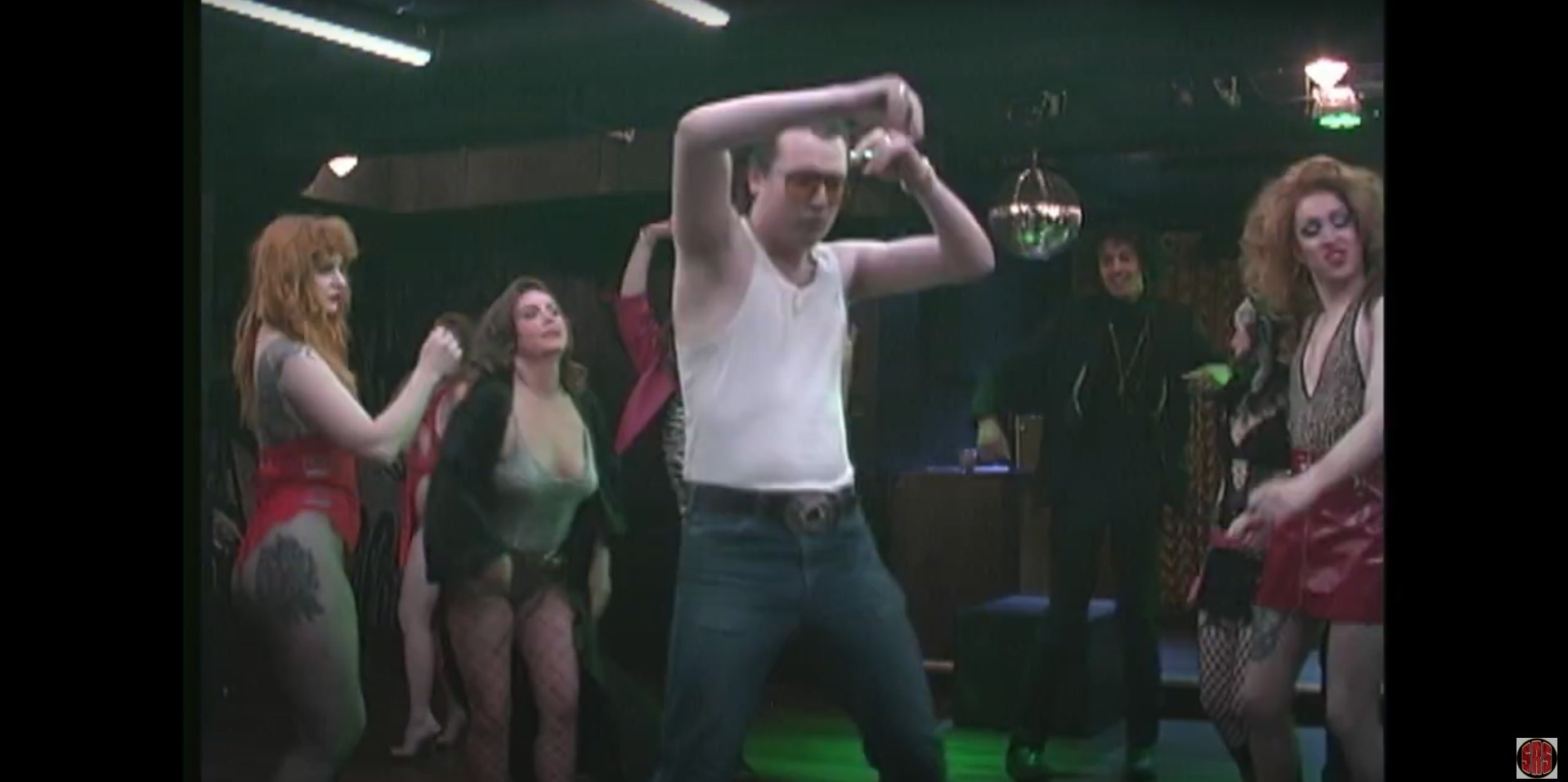
For what the Burkosky’s try to achieve in churning out “Private Blue” as a throwback of hard-boiled sleuth work, there’s success is select areas.  One of those successful portions is the phenomenally pastiche 80’s soundtrack by Robert Burkosky and the general aesthetic of the said decade with smoke-filled room illuminated by the gel lighting.  Wardrobing occasionally lands in the same era but there’s really no set point in time the story takes place but rather a mishmash of decades.  Devin and Robert, the latter quickly establishing himself as nearly a one-man show for the entire production, are competent editors that make “Private Blue” an easily digestible narrative.  What’s not easily digestible are the jokes that, for the most part, land flat.  The colorful characters do indeed entertain in their ineloquence and idiosyncrasies, but the script lacks that gut punch humor.  Instead, the script is riddled with fart gags, which personally I’m not a terrible fan of its audiological stink, and the jokes continue periodically throughout in every, or every other, scene of just randomized farting when a character sits, squats, or actually flatulates purposefully as a way of gag-inducing defense.  While most jokes don’t jive in jest, there are a handful that do, such as Tommy Grimes convincing our sexuality as dolled up sex worker Candy or Robert Burkosky’s lengthy slow-motion dance scene with a bunch of strippers at Wanda’s club.  Hilarity, as well as spurts of graphic violence, continue through whenever the story perversely changes course and mostly for the better. 

“Private Blue” is on the case.  Or, rather, is inside the case of an DVD Amaray with the release from ultra-indie underground label SRS Cinema.  The MPEG-2 encoded, standard definition 420p, DVD-R with the purple underbelly has a less-than-desired picture quality that’s par for the course with SRS Cinema.  Yet, all the sub-def eyesores are not terribly off-putting thanks to some decent camera equipment and know-how by the Burkoskys.  The palatable image has a flat grading only targeting contrast during it gel-lit scenes and the film is presented in 1.33:1 full screen that’s shot-on-videotape with uniform moments of interlacing.  Imaging produced is a result of a macro lens, encompassing even less within the standard framing and providing a flatter field that loses a bit of the depth.  The LPCM stereo mix that offers an ample dialogue track and range of audio layers that create a fair separation.  Robert Burkosky’s soundtrack epitomizes the balance between the layers when amplifying to make it the star of the scene.  Gun shots, thrown punches, and, even to an extent, the fart gags find the relative right level within a campy mix.  English captioning is available on this DVD.  Special features include a paralleling director’s commentary track, a blooper and outtake reel, the film’s trailer, and other SRS Cinema trailers.  SRS Cinema’s physical copy is standard fair but does showcase a blue-hued illustrative artwork that’s appealing and accurate with the same, but cropped, design pressed on the disc.  The 96-minute film comes not rated and is region free.

Last Rites: A debased tribute to the hard-boiled 80’s cop actioner, The Burkosky Brothers “Private Blue” has potential to be a great accolade of the subgenre as well as be funny but falls short with an overuse of pass gas gags and its inability to surpass that tenor.

“Private Blue” is on the case! DVD Now Available.

A Man Looking for Answers Finds EVIL in Tijuana Instead! “Cursed in Baja” reviewed! (Anchor Bay Entertainment / Blu-ray)

Jeff Daniel Phillips’s “Cursed in Baja” on Blu-ray!

Ex-narcotics cop Pierlli is now a formerly incarcerated, rehabilitated man after suffering a mental breakdown from discovering the love of his life dead during a drug-fueled, kidnapping ordeal that sent him spiraling rogue.  Listless under medication and dragging his feet through the motions of a low paying maintenance man and janitorial job, Pierlli is contacted by his lover’s wealthy, depressed and dying parents to investigate and track down the disappearance of their grandson.  Reluctant to fall back into psychological swirl of pandemonium, he agrees to the case that leads him to Mexico despite the grandfather’s warnings of unsavory unlawful dealings with criminals .  After a few interviews with the grandson’s known associates, gathered by previous detectives who have since disappeared, he’s able to locate the now young man, living in cohabitation with a peculiar pair of outlying summoners who sacrifice the unwelcomed to a native beast of the land, a vicious chupacabra.

Out from under the cinematic and musical thumb the Rob Zombie rockabilly show, Jeff Daniel Phillips emerges with a project his shocking rocking collaborator and friend is not attached to in any way, shape, or form.  “Curse in Baja” is Phillips’s sophomore feature-length film in over a decade since the 2009 jailhouse thriller “Convict,” starring Kevin Durand, and too like his debut film, Phillips also provides the screenplay for the 2024 film that’s described as crime noir meets surrealist horror from Los Angeles to Tijuana.  “Curse in Baja” is a Camp Lee and Indigo Vision production with Kent Isaacs coproducing with Phillips as well as having a role and the revitalized Anchor Bay Entertainment execs Brian Katz and Thomas Zambeck supplying financials in support to release the movie on home video, co-presented with Traverse Terror, a company we’ve seen light of recently and covered films with “Bag of Lies” being the most recent.

Phillips not only produces, writes, and directs, he also stars as the troubled Pierlli, opening up his introduction in a non-linear fashion under a character self-describing, self-loathing voiceover narration revolving around the woman he fell for, hinting at her forlorn fate, his own transgressions stemmed for lost, and how belittled his once formidable self has become after being released from prison.  Inner monologuing picks up here-and-there where narrative leaves off in a quasi-glint of personal elucidation about the characters and situations he finds himself amid, troubleshooting his own inners demons that could destroy him if he goes down the rabbit hole of grief again.  Yet, besides Pierlli’s vague thoughts and descriptions, characters brought not the fold have a prefabrication establishment that’s already patched them into narrative blanket and, for audiences, understanding these characters and see where they piece into the noir pie becomes very dense and chewy, tough to work out their role because much of the backstory is loaded into the chamber before viewers can digest everything mentioned in Pierlli’s opening narration of elongated events.  Jim Storm (“Trilogy of Terror”) and Constance Forslund (John Carpenter’s “Village of the Damned”) are tragic-saturated grandparents who will do anything to find their grandson, but their subtle persona richness filled with terminal illness, alcoholism, grief stricken, and a sordid past is greatly deprecated by little involvement in the rest of the story and their unexplained bad history in the network of how things came to be how they are now.  Instead, their retained lawyer (Mark Fite) has more skin and dialogue in the game of tracking down the grandson, played by the front man Finnegan Seeker Bell of alternative rock band Love Ghost in another character that’s spotty being sensical.  Kent Isaacs as a chupacabra keeper, Jacqueline Wright as a dancing evoker of the beast, Jacely Fuentes as a double dipping girlfriend, and Jose Conejo Martin as a Mexican music mogul and hardcore gangster, too, had shapelessness around defining themselves in character to serve what is a fever dream of past guilt and present lore clashing into a surreal tailspin from Pierlli’s visceral viewpoint.  The only character I could truly make sense and understand is “Re-Animator’s” Barbara Crampton’s short-stint warden role. 

I get “Cursed in Baja” is an indie production with nearly a zero-dollar budget and limited, on-hand advantages.  I get Jeff Daniel Phillips has a knack for the obscure, the off-putting, and the odd.  I get horror is subjective and you make what you get out of it.  With all that being said, “Cursed in Baja” doesn’t speak to me on a level I can fully appreciate, understand, or decipher through the opaque narrative stuck in its own adrift design.  Aspects of the nonlinear course and often repeating multiple same scenes doesn’t beat one down into following along but there’s also a rhythm that does denote Pierlli’s neurosis.  Though chaotic at times, Marc Cohen’s editing captures Pierlli’s agitational anarchy that plagues his nightmares and splits his reality seemingly down the middle of an already drug-and-crime fuel Mexicali affair the ex-con and lawman tries desperate not to repeat, but like any good sage person will tell you, we’re all given the opportunity to repeat dooming ourselves and relive past mistakes.  That’s Pierlli’s Pandora’x box and his Achillies heel, no matter how much he attempts to deflect himself out of the physically crippling investigation, he must sally forth again to find answers for the love he let down.  If he doesn’t, that do-nothing stagnation will ultimately destroy him faster.  I’m sure there are merits to Phillips’ first feature in over a decade, but “Curse in Baja” is all over the place, missing key interlocking points of the nomadic concepts to cement better coherency when switching gears between genres.

Anchor Bay’s third film of the first three releases released by the revitalized company by Brian Katz and Thomas Zambeck, “Cursed in Baja” receives exclusive at-home video rights with an AVC encoded, high-definition 1080p, BD25. The single layer is all this story requires with low-impact, mostly psychological thriller that relies heavily on Marc Cahon’s overlapping fade in-fade out and rough-cut, around-again editing to shoulder the burden of entertaining with Pierlli’s meandering mental melancholy. The compressed image quality provides no qualms for a standard, under-bedazzled indie production in widescreen 1.78:1 aspect ratio. Color saturation varies depending on toggling contrast levels, likely a result of the when-we-can shoot scenes methodology of low budget films. Blacks are not as deep as desired but there’s no signs of artefacts in the void and that suppresses any of kind of resentment toward a lighter shade of the grayscales darker side. The audio comes with an English Dolby Digital 5.1 surround mix. Though lossy, the format retains consistency in a rather heavily vague gumshoe of exposition with not too much crime centric and chupacabra chomping bytes to make or break the fidelity. Dialogue is clean in voiceover as well as in-scene with a favorable soundscape under Vaaal’s eclectic clouded haunt of industrial and discordant string. English subtitles are optional. Special features are limited to feature length commentary by Jeff Daniel Phillips and a making-of featurette with Phillips walking through a shooting location and discussing his ventured process. The Amaray case sports a grindhouse cover art character compilation with no other physical attributes included. The 80-minute, unrated feature is encoded with region free playback.

Last Rites: Jeff Daniel Phillips’s personal stick-and-glue “Cursed in Baja” works to a point off of the auteur’s ambition and who’s in his back pocket network of talented friends eager to lend their niche or locations to create noir delirium a la mode.

Jeff Daniel Phillips’s “Cursed in Baja” on Blu-ray!

All You Need to Protect You From Everything is a Pile of EVIL Socks! “Crust” reviewed! (Anchor Bay / Blu-ray)

Sean Whalen’s Debut “Crust” Now on Blu-ray!

Vegas Winters is a famous washed-up child actor now working at a laundry mat. Depressed from having been exploited during his career years, Vegas’s problems continue as an unkempt, middle-aged man still enamored with an ex-girlfriend who can’t stand the sight of his growth impotency and the news of his show’s revival that stirs up the past’s unwelcomed hubbub. Day-in and day-out, Vegas does the laundry mat rounds, collecting lost socks for his own personal use, whether be for blowing his nose, cleaning a blood lip, or masturbating into for his daydreaming fantasies, until one day the poor schlub is beyond humiliated and sheds a tear into his pile of used and unwanted collection of socks that turns the heap into his own personal protector he calls Crust. Murdering all who emotionally hurt or threaten Vegas, Crust becomes his best pal who has to vie with Vegas’s drunkard business partner and friend as well as his newfound girlfriend who’s infatuated with him.

Sean Whalen is one of the more underappreciated side characters in the last 30 years.  You know the face, but you may not know his extensive filmography.  Most of us horror fanatics adore Whalen in what was likely one of East coast born actor’s most notable roles from early in his career as the wall-crawling, good-hearted, inbred child named Roach from Wes Craven’s “The People Under the Stairs.”  From that film in 1991 to today, Whalen has run the genre gamut as a supporting actor in “Tammy and the T-Rex,” “Waterworld,” Rob Zombie’s “Halloween II,” as well as Zombie’s “3 From Hell” and a slew of other films, made-for-TV movies, and popping up in television series, including the U.S. version of CBS’s Ghosts pilot which I’m still sorely peeved he no longer continued the basement-dwelling, leprosy ghost role.  Now, we’re seeing a whole new side to our favorite side actor who steps into the lead principal role and, also, writes-and-directs his first feature length film with the 2024 comedy-horror “Crust.”  The indie film is cowritten with Jim Wald and is a production between Mezek Films, Moonless Media & Entertainment, Wicked Monkey Pictures, Stag Mountain Films, and the LLC, Crustsock Productions, supported by a crowdfunding campaign that generated nearly 100K dollars from over 600 backers.

A personal project for Whalen, “Crust” came to fruition as an allegorical metaphor for his own depression after a divorce and he plays Vegas Winters, a former child actor who left the industry after the success of his show due to those around him mistreating him or forgetting about him once the show success wore off.  Gloomy-faced, disheveled, and suppressively lethargic and explosively frantic when called for, Vegas is the epitome of depression while co-running a bland laundry with an alcoholic Russ, played by another horror-friendly, long-time supporting actor in Daniel Roebuck (“Final Destination,” “Terrifier 3”).  Audiences will feel for Vegas and his ultimate wish to be left alone as he sends his blood, sweat, tears, and amongst other bodily fluids, into the leftover socks of strangers, but audiences will also be delighted in his return to fervor materialized by a spur-of-the-moment, quirky laundry mat dance routine with his newfound cute-and-cuddly, stiff-sock creature, Crust. Like Daniel, Nila is too entangled in Vegas’s sticky-sock situation as his from-afar admirer turned quickly cemented girlfriend, played by Rebekah Kennedy (“Two Witches,” “Traumatika”), and there ensues the conflict when friend and girlfriend don’t know where they place or stand alongside a sock-monster. Roebuck and Kennedy manage to fiddle the strings of being the irresolute and concerned while not being a total antagonist to Vegas, who himself might not be 100% the hero of the story. “Crust” rounds the big hitting cast with “Sleepaway Camp’s” Felissa Rose and “Ferris Bueller’s Day Off’s” Alan Ruck along with William Gabriel Grier, Charles Chudabala, Ricky Dean Logan, Shawntay Dalon, and Zoe Unkovich.

Divided into laundry themed chapters, “Crust” is all about the depression and the stagnation that it entails. The creature Crust is that imaginary hope or need fabricated to pull one out of its depths and talons as a protector and a friendly companion to retreat into when the world around is threatening with a difficulty level of hard. Vegas is bombarded with down-in-the-dumps missiles being reminded of an unpleasant past, an ex that continues to belittle him, and an escape from reality that soon becomes an invasion of privacy. Whalen’s decision to shoot in black and white is a conscious one that eliminates colorful distractions to keep story focus around the characters, driving down the narrative nail into Vegas’s episodic progress that deepens to deprecating d, depths, and to keep blemishes with Crust’s marionette-ways to a bare minimum. That’s not to express that Crust is a mealy patchwork of loose socks and back felt for eyes. Crust construction might be simple in design but effective in applied personification with emotional swings, eyebrow moods, and hand gestures despite the obvious movement limitations that require multiple shots and cuts at different angles to sell its tearful autonomy and aggressive nature to protect. Remember, “Crust” is a comedy-horror with emphasis on comedy and while Whalen’s directorial debut comedy is fettered by a lighter shade of black, there’s a waving playfulness about it, such as Whalen and Crust’s spontaneous choreography, that provides a wake from the satirical black humor and completely submerge the story in surrealism with laughs and heart-wrenching moments.

One of the first, and hopefully many to come, titles a part of the initial Anchor Bay Entertainment revival by Umbrelic Entertainment cofounders Thomas Zambeck and Brian Katz, “Crust” hits the Blu-ray market with distribution assistance from MVD Visual.  The AVC encoded, 1080p high-definition, BD25 has the work cut out for it with the black-and-white presentation that allows for a better decoding bitrate, hovering around easily a high-20 Mbps.  Monochromic anamorphic widescreen 1.78:1 aspect ratio exhibits cleanly, clearly, and classically in a consistent contrast that balances situational light and shadow where appropriately.  Textures are dullened without color but the picture is crisp without showing fuzziness or compressed without blocky or bandy issue.  Not listed on the back cover, my player detects an English Dolby Digital Stereo 2.0 track.  More talkative than taking action, “Crust” delivers a fine digitally recorded dialogue track through a lossy Dolby compression that while isn’t as an exact replica, it is clear. Yet, dialogue’s separated from the pack, isolated from the caricature ambience of a laundry mat that has settles on a single wash or dryer sound, the exaggerated sounds of exterior paparazzi, and minor action sounds reach the upper audio layer hemisphere, diffusing into virtually the same foreground plane as dialogue rather medium-to-near range background in what is more of a production stemmed, Foley incorporated audio design.  Blu-ray’s bonus features include a Sean Whalen feature length audio commentary track, a Los Angeles premiere Q&A with Sean Whalen, Rebekah Kennedy, Daniel Roebuck, Felissa Rose, and William Gabriel Grier along with Crust puppeteer, Lisa Hinds, and two short comedies about Dorothy post-Wizard of Oz by many, many tragic years of alcoholism, sex, and delusional state of poor Dorothy, written and played by Whalen in “Dorothy:  50 Years Later” and “Dorothy 2:  The Bump and Run.”  Anchor Bay’s releases standard fair within a traditional Amaray case with the image of Whalen, or rather Vegas, the sock-monster Crust, and a trail of speckled blood in a back-and-white laundry mat with no tangible inserts and the same image pressed on the disc but digitally rearranged.  The region free release has a runtime of 102 minutes and is not rated.

Last Rites: Depression sucks, but “Crust” doesn’t in its sticky sardonic theme told simply in genericisms and broad grayscale strokes. Whelan’s first feature is first rate farce with fantastic puppet work and a Whelan, himself, best at self-deprecating his image for what’s good of the story, which is a morsel of his own.

Sean Whalen’s Debut “Crust” Now on Blu-ray!

Etiquette over EVIL Shot in Super 8! “Kung Fu Rascals” reviewed! (Visual Vengeance / Blu-ray)

Kung Fu Rascals Kicking Butt on Blu-ray!

Chen Chow Mein expertly steals an ancient tablet from the evil overlord Bamboo Man from Ka Pow whose plan is to seek complete and total dominion with the tablet stone.  Chen regroups with this acolyte pupils, Reepo and Lao Ze, to visit an old wise man for translation of the tablet’s mysteries and follow it’s mapped out quest that’ll lead them to glory over the land’s malevolent beings, but the Bamboo Man from Ka Pow will not let their journey be so easy by dispatching head minion Raspmutant the Mad Monk to hire the corrupt Sherriff of Ching Wa County and his two apprentices, Dar Ling and Ba Foon, as well as summoning the monolithic Neo Titan to stop them at all costs.  Always training their Kung-Fu etiquette, the trio embark on a journey through a land filled with evil ninja henchmen and must fight together to finish the journey.

Sculptor and creature effects guru Seve Wang might be best known for his work on some of the genre’s most memorable and favorite characters, such as designing the final extraterrestrial jungle hunter of John McTiernan’s “Predator,” created the Mohawk Spider Gremlin in Joe Dante’s “Gremlins 2:  The New Batch,” and sculpted the failed Ripley clones in “Alien Resurrection” amongst other notable cult and blockbuster films.  What you might not know is that Steve Wang had also directed, incorporating too his special effects and sculpting talents behind the camera in a debut feature, a homage to the Kung-Fu and Kaiju genres, titled “Kung Fun Rascals.”  Wang also cowrote the 1992 film with another special effects artist and actor Johnnie S. Espiritu (aka Johnnie Saiko) of “Hell Comes to Frogtown” and “Aliens vs. Predator:  Requiem.”  Wang self-produced the film after a series of short films to gain financial backing for a feature-length production.

On any self-produced, independent film, the cast usually wears multiple hats.  “Kung Fu Rascals” was no different as writer-director-producer-caterer-sculptor-and etc., Steve Wang also starred as Chen Chow Mien, an expert Kung-Fu fighter who steals a pivotal stone tablet from the Bamboo Man of Ka Pow, one of the many roles played by Ted Smith.  Wang and Smith are friends, and that age-old motif of a friend casted film holds very true for “Kung Fu Rascals,” comprised of mostly the director’s friends, who are also special effects and makeup artists, to accomplish his dream of branching out into a different field in filmmaking.  Johnnie Saiko is also one of those friends and is one of the two actors in this Kung-Fu romp playing Reepo, the trio’s good-natured goofball stylized like a character out of a “Mad Max” movie garbed in black and with a standing mohawk.  The third that rounds out the team is Lao Ze from one of the few actors initially not a part of Wang’s friend pool in Troy Fromin (“Shrunken Heads”).  Quaintly and quietly inspired by the antics and approaches of “The Three Stooges,” the “Kung Fu Rascals” march to a different dynamic drum as quasi-foolish, good-hearted good guys acted with slapstick, sure-fisted parody against a hapless army of animal-flavored mutants and their master with a flair for villainy.  Along with that master villain role, Smith continues his trend of being the guy in the suit throughout the film by being a giant Kaiju Meta Spartan and hilariously plays out of the suit with Dar Ling, a queer flamboyant henchman alongside fellow henchmen and Chicken-style Kung-Fu fighter Ba Foon (Aaron Simms) as they add a sense of diversity and daffy under the leadership Les Claypool’s Sherriff of Ching Wa County.  Yes, the same Les Claypool from the band Primus.  The cast rounds out with Cleve Hall (“The Halfway House”) as an old wise, creepy, and slightly uncouth clairvoyant, Matt Rose as the wild-eyed torturer, Michelle McCrary as The Spider Witch, Ed Yang as the other Kaiju Neo Titan, Tom Martinek as the hoppy Frog guard, and Wyatt Weed (“Predator 2”) doing the devil in the details with every step as the fully anthropomorphic Pig fitted Raspmutant the Mad Monk.

“Kung Fu Rascals” is the tastier, punchier, made with more heart version of “Kung Pow,” and I don’t mean the Chinese spicy stir-fry chicken dish with hints of peanut and accompanied with vegetables and peppers.  For an independent, first-time feature on a budget, Steve Wang and friends sculps and fashions meticulous creatures from head-to-toe.  Not one latex ear, not one molded snout, and not one full-body outfit appears shoddy or cheap overtop encased actors who know what to do underneath all that masking makeup and rubber.  On top of that, the fight choreography, editing, and dimensional effects are high level pointing in all the right directions with interesting camera visuals and angles to turn a little production like “Kung Fu Rascals” into a fully-fledged feature that audiences of 1992 weren’t ready yet until Power Rangers explosively came onto the scene a year later.  Of course, there was “The Guyver” a year earlier, also from Steve Wang, but “The Guyver” was geared for a limited audience that blended science-fiction with gory elements.  “Kung Fu Rascals” settles at the other end of the spectrum with a more family-friendly façade with an homage to Asian cinema and medieval monsters.  “Kung Fu Rascals” might not have been made today being quite politically incorrect with its play-on-names, stereotypes, and white-washing Asians but in the end, it’s Kung-Fu etiquette is entertaining chop-socky. 

Visual Vengeance once again delivers.  A high-end presentation and package of Steve Wang’s “Kung Fu Rascals” finds Blu-ray gold with a high-definition release despite the film being shot in Super 8 film.  The AVC encoded, 1080p resolution, BD50 is presented in a 1:33:1 aspect ratio.  Super 8 is not peak definition or color saturation as the image is captured straight onto the celluloid, color and contrast in all, in a direct positive process that left hardly any room for cleaner reprocessing.  Scenes often look darker at a higher contrast on a lower, blockier resolution, decoding at a broad range of 8 to 25Mbps, and the editing, though keeping continuous fighting scenes seamless, fluctuates with surface finish inconsistency in shots that make some scenes appear dark in the daylight; this could also be result in the filming time-of-day.  Yet, the cinematography is excellent in capturing interesting visual angles and the lighting setup is stunning despite the unpolished Super 8.  Visual Vengeance continues to supply the technical disclaimer with the caveat of using the best possible source materials for their releases, including this director-supervised version of the standard definition master tape and original film elements, which had a few, very minor, linear scratches and dust/dirt speckles.  The English language Dolby Digital Stereo mix is quite sharp and clean that emulates the boxiness of Asian dubbing/ADR.  Thrown punches and kicks hit their audio marks with timed whack and thud Foley and the dialogue, through the cheesy and cheeky antics, suffers from no fidelity loss or reel damage.  I’m surprised how clean the track is with little-to-no static, crackling, or hissing. English subtitles are available though no listed on the back.  If looking for special features, Visual Vengeance has the definitive special features for the Steve Wang’s obscurity with a brand new feature length documentary The Making of Kung Fu Rascals containing interviews with cast and crew, two new feature-parallel commentary tracks with the first being the “Kung Fu Rascals” themselves, Steve Wang, Troy Fromin, and Johnnie Saiko, as well with composter-actor Les Claypool and actor Ted Smith and the second with film superfans Justin Decloux and Dylan Cheung, an exclusive reunion of the Rascals with a sit down conversation between Wang, Fromin, and Saiko, a Steve Wang and Les Claypool reunion, Film Threat editor Chris Gore interview on distributing the VHS, a behind-the-scenes video diary, the 30-minute “Kung Fun Rascals” Super 8 short film, the 9-minute “Code 9” Steve Wang short film, Film Threat video #6 behind-the-scenes article, film and behind-the-scene stills, and Visual Vengeance cut version of the “Kung Fu Rascals” trailer.  Visual Vengeance also has your physical needs covered, and no I don’t mean sexually, with a cardboard O-Slipcover illustrated with a new art design by Thomas “The Dude Designs” Hodge overtop the clear Blu-ray Amaray case.  The reversible sleeve contains two compositional, Asian cinema-homage illustrations that an eye-appealing.  Inside contains a 13-page, Marc Gras illustrated, official comic book adaptation, a 2-sided single sheet insert with a fourth artwork design and Blu-ray acknowledgements, a folded mini-poster of the primary Blu-ray art, and a Visual Vengeance rental stick sheet containing 12-rental theme descriptor stickers.  The unrated release comes region free and has a runtime of 102 minutes.

Last Rites: Phenomenal creature suits and makeup, a lost sense of irreverent, spot-on comedy, and butt-kicking Kung Fu, Steve Wang’s little-known picture is the poster child for satirical, independent comedy-action and a good time overall.

Kung Fu Rascals Kicking Butt on Blu-ray!