A Gnostically, Esoteric EVIL Acid Trip. “Archons” reviewed! (Syndicado / DVD)

“Archons” are Watching You.  You Can Watch Them on DVD!  Click the Cover to Purchase!

A once promising, up-and-coming rock trio struggles years later to exit the shadow of their only hit song. They embark on an acid-stimulated spiritual canoe trip down the meandering river pathways of British Columbia, hoping the creative juices will flow under the influence while connecting the native wilderness. Along the way, they pick up a beach camping super fan and continue their trek toward mapped out checkpoints and take a hit of acid at each stop. The drugs have seemingly taken effect in a strange, voyeuristic way as if someone, or something, is watching them at each campsite. The visions become terrifyingly vivid as a pair of humanoid creatures rummage through their gear during the night and survey them from afar no matter where the band are or how far they travel. To make the situation worse, the acid they’re ingesting might be the root cause that not only expands their mind beyond the brain’s limited scope but also grows a biological entity wriggling for more room space.

The influence behind Nick Szostakiwskyj’s “Archons” is something fascinatingly outlandish in what’s a simile to the Scientology handbook. Rulers of the realm, creators of the physical universe, guardians of the celestial heavens, architects of the kingdom of darkness, archons, as some historical cultural teachings would have it, rise above traditional and conventional spiritualities with an expanse and infinitude of spiritual knowledge as related to the Gnosticism belief system. For the Vancouver filmmaker, Szostakiwskyj adapts the ideology with a bad acid trip in his 2020 cosmic horror that was once under the working time, “Hammer of the Gods.” “Archons” is the third feature film for Szostakiwskyj and the second otherworldly horror following “Black Mountain Side,” a precursing complementor that also captures the spectacularly natural, yet ominous lit, Canadian terrain in the Winter opposite season compared to “Archons’s'” Summer. The independent Canadian feature is A Farewell to Kings Entertainment production and is produced by Szostakiwskyj with Cameron Tremblay and alongside with the now defunction A Farewell to Kings Entertainment executive producer team of Samantha Carly and Steve Kaszas, who are now in the leadership team of Alright Alice Productions, and James and Susan McDonald.

“Archons” is tightly casted with less than a handful of canoers being spied upon by the gnarly gatekeepers of the universe. The story surrounds the spiritual and drug-laced scull trip of Dog Sled, a three-piece rock band who have lost their creative mojo and star power momentum with a fickle music fanbase. Lead singer Mitchell Ashley-Hoffman doesn’t have the emotional range to synthesize great lyrics but has the vocals of a sway fans and is played with Kurt Cobain-esque and mellow concern by Josh Collins. Rob Raco and Samantha Carly play bassist and songwriter Eric and drummer Olivia, aka Liv, and the pair are more in tune with each other while Mitchell mind wanders and drools over the ride hitcher and tarry eyed fan, April (Parmiss Sehat). The Vancouver based cast have enough chemistry to be slowly dismantling as a band on the fringe of collapse with backdoor dealings from one of them aiming to go solo into the limelight and to hold secrets that lead to life-threatening consequences all in the name of spiritual retreat.  However, to the extent of the being followed, spied upon, and endangered by hostile creatures, the character concern level is too low as if apathy for interdimensional beings that at first were cloaked and now are full view is not at the top of the internal fear alarm list for any of them.  The situation is written downplayed and the subtle actions to understand what’s in front of them mutes the anxiety for the audience.  “Archons” rounds out the cast with radio voices, minor roles, and two archons with Billie-Rae Grant, Lauren Donnelly (“Viral”), Michael Dickson (“Driver From Hell”), Timothy Lyle (“The Revenant”), Cameron Tremblay, Nathaniel Gordon, Marc Anthony Williams (“Black Mountain Side”), and Quinton Boisclair (“Demonic).

“Archons” has this beautiful backdrop of British Columbia’s topographical nature in a panoramic view in a breathtakingly serene opening shot and continues the wilderness motif with a thick forest and a never-ending river that seemingly swallow a group clearly not in their usual element.  “Archons” also has a beautifully disturbing breadth of perception concept laced with drugs and the gnostic universe.  The cosmic horror element is not forced or over-the-top being wrapped and shrouded in ambiguous mystery that keeps audiences glued to the progression baby steps before coming to terms with a dropped veil that causes reactionary looks over your shoulder with every unexplainable sound not in view.  Szostakiwskyj is in no hurry to quickly build an underlayer reality that ties into a dualistic system of two worlds running parallel to each other and colliding when drugs produce the sneak peek behind the curtain.  What shouldn’t be seen is clearly bad for the protagonists’ health, much like drugs in themselves if abused, and Szostakiwskyj plays into that limitation of the mind as if the part the brain or the organism that allows to see it all overloads, or overdoses if you will, the network of tissue and neurons until it bursts outward like a Yellostone geyser in a spray of blood in what is a pretty neat and simple effect, one of the few practical effects by Geoff Ingeberg in this rather performance driven film, as well as a neat scene to behold while the group travels down river when the unexpected pop occurs.  “Archons” is open for a numerous of interpretations, leaving the possibilities endless, but we don’t exactly know where Eric the bassist obtained the snack baggie drugs, what the creatures are intently undertaking, or if the vague final scene is the aftermath of a horrible acid trip gone fatally wrong and has dislodged memories of events, jumbling them up to the point where nothing makes sense and leaves more questions than answers.  The story definitely ends with more desires in detail, delineation, and context but isn’t the less-is-more concept the bread-and-butter of cosmic horror where the unknown is the scariest part that makes us feel infinitely small knowing the world around us is infinitely bigger?

Splice into a new and startling reality with your own DVD copy of “Archons” courtesy of Syndicado Distribution. Stored on a DVD9, “Archons” is presented in a widescreen 2.39:1 that enhances the initial landscape shots in the opening scenes. From then on out, Cameron Tremblay’s cinematography sticks to eyeline mid-to-closeup framing with a here-and-there upward angle to inject foreboding if the scene calls for it. Despite being pitch black, the aphotic zones Tremblay creates without the use of artificial lighting or tinting day scenes provides a sobering and somber authenticity of young people being stalked in the woods. Syndicado stakes a larger storage capacity for a low-budget film and the result pays off despite the decoding 5-6Mbps rate with the blacks looking especially inky without an inkling of compression issues, such as banding or splotchiness that plague darker scenes. The cooler color pallet digs a little more into bleak atmospherics, but there are warm pops of the BC bush with lime green leaves. The English Stereo 2.0 challenges to be more potent than it should be as the quiet and desolate trek the nature should incite more directional channels for a sound design that relies on the rustle of branches and the creatures’ low gutturals off in the distance and in an undeterminable bearing. What’s essentially a bare bones release, the region 1, clear cased DVD comes with the theatrical trailer on a static menu that also includes chapter selection. “Archons” is unrated with a runtime of 88 minutes. A low-key cosmic horror with eye-opening chills, “Archons” is cabbalistic cinema for the selective few who will understand it but does harp on the relatable proverb of with seeking fame comes a price.

“Archons” are Watching You.  You Can Watch Them on DVD!  Click the Cover to Purchase!

EVILs Make Difficulties in Finding God. “Agnes” reviewed! (Magnet Releasing / Digital Screener)

Blemished man of the cloth, Father Donaghue, and a neophyte are summoned to perform the holy rite of exorcism on a possibly possessed nun, Sister Agnes.  Disadvantaged and forced by his own scandal, Father Donaghue is ordered by the local Bishop to oversee the matter before they ship him overseas to avoid further disgrace upon the Church, but the skeptical priest, who has performed many exorcisms in the past, has never once believed he was casting out a demon but, rather, relieving a guilty, tormented soul seeking divine forgiveness.  When the priests confront Sister Agnes, the situation is violent, wily, and unlike any possession Father Donaghue has ever seen before.  The incident casts doubt over Sister Agnes’s friend and fellow nun, Sister Mary, who leaves the convent to try and live on her own and find God in the real world her own way, but a little bit of Sister Agnes has seemingly rubbed off onto her. 

You gotta have faith, sang once by pop-rocker and songwriter George Michael (and Fred Durst, if want to go that route) and though Mickey Reece’s “Agnes” doesn’t necessarily croon a rebuttal, the Oklahoma City born filmmaker surely splits hairs with a formidable blockade that advocates the crisis of faith cinematic model with layered horror.  The “Climate of the Hunter” writer-director’s latest quasi-horror-comedy and full-throttle religious drama questions the validities of finding God on a personal level with a divergently cut screenplay co-written with frequent script partner John Selvidge, whose current post-production penned time-warping horror entitled “Wait!” coming next year.   “Agnes” is filmed in the heartland of America inside Reece’s home state of central Oklahoma and is a reteaming of Mickey Reece and producer Jacob Snovel of Perm Machine with Greg Gilreath and Adam Hendricks’ Divide/Conquer (“Black Christmas” 2019 remake, “Freaky”) as the production companies and is first feature presentation for Molly C. Quinn, Matthew M. Welty, and Elan Gale’s QWGmire Productions.

One-third of the head of QWGmire is also the “Agnes” leading lady as Molly C. Quinn, who doesn’t play the titular character, plays Mary, a nun and friend of the possessed plagued Agnes (Hayley McFarland, “The Conjuring”) with a tragic background that ambiguously parallels a similar path to the mother of Jesus, also named Mary for all you non-Christians out there.  Mary is tender, quiet, and self-effacing but determined to pave her own way without the means of charity, especially those of the unsavory-favor nature, and consulting God for answers.  Quinn is perfect to shoulder Mary’s innocent disposition and does carry her naïve meekness throughout up until Mary’s gradual decline toward her faith that turns the sweet and innocent young woman into a pragmatic doubter, spurred by Agnes’ sudden otherworldly turn from devout to impiety that becomes more than what meets the eye.  However, in kicking off Reece’s film, one would have thought the exorcism of Agnes would emphasize more heavily on Father Donaghu (Ben Hall, “Minari”) and soon-to-be priest Benjamin (Jake Hororwitz, “Castle Freak” remake), but despite the involved build up of Father Donahu’s sordid past that conflicts with the Church and his struggles with the exorcism, Reece and Selvidge ultimately do, in what feels like, a pulling of the plug on a storyline that followings in the footsteps of “The Exorcist.”  That is, in my opinion, the downfall of “Agnes’” story in elimination of really interesting character arcs right in their girthy throes, leaving audiences hanging on Father Donaghu, grocer owner/low-end gangster Curly (Chris Sullivan, “This is Us” and “I Trapped the Devil”), ostentatiously swaggering Father Black (Chris Browning, “Let Me In”) and even the titular character Agnes fails to flesh out fully.  Rachel True (“The Craft”), Zandy Hartig, Bruce Davis, Chris Freihofer, Ginger Gilmartin, Mary Buss, and “Guardians of the Galaxy” and “Suicide Squad’s” Sean Gunn as a standup comedian and Mary’s love interest.

“Agnes” loosely follows a couple of Catholic patroness saints in Agnes and Mary derided in a contrary sense.  Agnes, the virgin martyr in Catholic veneration, opposes the Church in the film with flashbacks of her embracing an indulgent life along with her sexual insults that’s uncouth for the patroness saint of pure little girls.  Mary’s a little more recognizable with a previous, ambiguous account of her child’s death (aka Jesus Christ?).  Plus, there’s the religious imagery, amongst others in the film, of Mary with bleeding eyes as an analogous to the weeping statues. Reece blatantly shows most men and women of the cloth to be unorthodox Orthodox Catholics from Father Donaghu’s troubling allegations to the mocking head priests. Mother Superior throws around her superiority amongst the convent nuns and even the Bishop, who doesn’t ever say a word in his brief scene, appears smug and high and mighty with his stature, letting his assistant communicate (and excommunicate) all the ugly business. Only a non-priest, training to be ordained, in Benjamin is the only innocent, infallible Christian who captures the humble essence of God and the only one who can capable in rejuvenating Mary’s faith. “Agnes” is all about doubting faith whether be by demonic possession, the loss of a child, all forms of corruption, and more, but Mary keeps striving, struggling, and searching for that spiritual lifeline amongst seedy and unscrupulous faithless charlatans slowly poisoning her to be the same. However, the “Agnes” story divides too sharply leaving the acute crisis of faith to be nearly lost in translation and is practically a wandering spectrum of identity that’s roughly craft glued together by Reece.

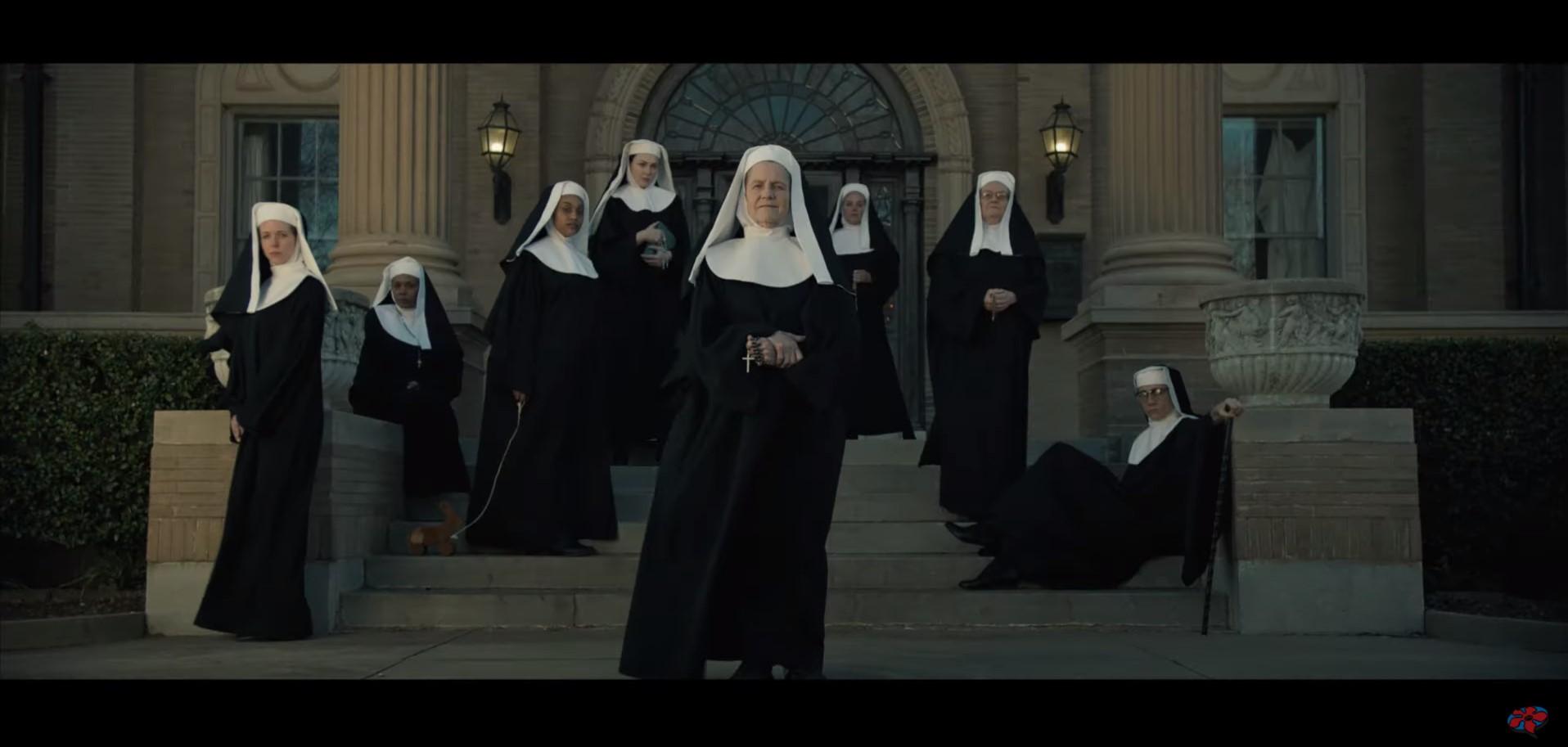
Some may see the film’s poster and excitedly expect Nunsploitation but the reality of “Agnes” digs at the hypocrisy of people and the endless search for faith. What it’s not is the sexual exploitation or sadomasochism of chaste nuns. Give Mickey Reece’s horror-comedy drama “Agnes” a faithful shot come it’s December 10th theatrical release from Magnet Releasing, a subsidiary of Magnolia Pictures. “Agnes” has a runtime of 93 minutes and presented in a 2.55:1 aspect ratio. Typical of any Mickey Reece film, his melodramatic horror-comedy fits into his oeuvre of talking head cinema so leave expectations of brooding and atmospheric milieus at the door for more realistic, down-to-Earth scenes, which is a bit surprising since the cinematographer behind “Hellraiser: Judgement” and “Children of the Corn: Runaway,” Samuel Calvin, has an eye for unhallowed aesthetics. Calvin does produce some perfectly poised shots with the flock of nuns and the ever slightly deviant angle to sharpen a scene. No bonus features were included with the digital screener nor were there any bonus scenes during or after the credits. “Agnes” floats on a haphazard timeline of dark, melodrama comedy for a desperate need of faith against the immense heartache, the crudely selfish, and the absence of morality all of which incessantly imposes upon the good to assimilate.

EVIL is in the Waiting Room. “Host” reviewed! (Second Sight Films / Blu-ray Screener)

Six friends, locked down due to COVID-19 quarantine restrictions, hold a séance with a medium over a video chat platform.  With some skeptical of the astral plane practice and connivingly mock the ritual without aware of the consequences, they unwittingly call forth a false spirit under the guise of their seemingly harmless mockery.  In short, a malevolent demon crosses over their spiritual internet connection plane, attaching itself to their domicile surroundings.  Unable to break the connection to the spirit world, surviving a night that was supposed to shoulder quarantine boredom with excitement and booze has beleaguered the friends with a night of undisclosed deadly terror.

When online game night during quarantine life goes horribly wrong in Rob Savage’s “Host.”  The UK bred survival tech-horror is the sophomore feature length film from Savage who co-wrote the cast sundered script with Gemma Hurley and Jed Shepherd, who has previously collaborated with Savage on the director’s short films, “Salt” and “Dawn of the Deaf.”  “Host” plays into being a film of the moment, shot entirely over the pandemic lockdown with unconventional production direction conducted through video chat platforms with each actor pent-up performing in their own personal abode and being subjected to wear multiple crew hats to avoid spreading COVID-19 from face-to-face interactions.  Despite the severe limited enforced by the threat of infection and the local governmental mandates, the film received hefty financial backing from horror’s most prolific streaming service Shudder after director Rob Savage pulls off a video chat prank with colleagues and friends of him checking out a mysterious sound in his antic and seamlessly interlacing a jump scare clip from Jaume Balagueró and Paco Plaza’s “REC” that scared the bejesus out of the unsuspecting participants to his prank.  “Host” is a production of Shadowhouse Films. 

“Host” stars five real life friends, aspiring actresses in the London area looking for work that has become frighteningly scarce in the pandemic’s wake, and they’re joined by a sixth, the outlier male to join the virtual hangout session.  To add authenticity to the circumstances, each actress has their parent-given (or stage-made?) names incorporated into the film, heightening the illusion of a friend being ripped apart by a demonic entity, especially if a sly Rob Savage redacts much of the script to keep his actors in the dark in certain scenes to garner real reactions.  Haley Bishop, who has worked previously with Savage on “Dawn of the Dead,” spearheads the nighttime gathering for a little séance fun, to stave boredom with her closest friends, with prearranged invitations to Jemma Moore (“Doom:  Annihiliation”), Emma Louise Webb, Radina Drandova, Caroline Ward, and Edward Linard, who is the only one of the six not to use his actual name and goes by Teddy.  Each character provides a slight unique viewpoint that integrates into the story nicely, such as Jemme’s jokester and cavalier attitude, Caroline’s bracing for the supernatural consequences, Radina’s distracted relationship troubles, and Teddy’s wild and carefree persona.  “Host” rounds out with minor co-stars enveloped into the séance chaos, including Alan Emrys, Patrick Ward, Jinny Lofthouse, and “Double Date’s” James Swanton as the malevolent spirit.

Cyber and social media horror has no leverage to be groundbreaking horror anymore as a handful of these subgenre jaunts slip into our visual feeds every year in the last decade and “Host,” on the surface, might perpetuate the long line of outputted tech horror in an overcrowded market.  However, “Host” has a beauty about it that doesn’t reach into capitalistic territories like the ill-conceived “Corona Zombies” from Full Moon or the Michael Bay-produced “Songbird” about sustaining love in the time of dystopian pandemic and, instead, redefines how tech horror not only uses innovated methods in creating movies during lockdown but how the knuckle white and teeth chattering terror is perceived in the reinvention of the ominous presence that has found its way through the fiber optic cables and into our cyber lives not in the context of a social media obsessed society but in a quarantine-forced one that brings a whole unique set of isolation fears and complications.  While the characters try to form a much desired human interaction the best way that they can through internet video chats, they’re also connected by the spiritual circle that has engulfed the apart, but together, connection, sparking a palpable atmosphere of mass fear together.  Audiences will be pulled into this fear being visually privy to Haley desktop screen, that’s not quite tipping into the found footage field, as she helms control of the video chat that quickly spirals into a Zoom-screen of death as one-by-one each friend succumbs to the unwittily summoned demon.  Rob Savage has reformed the tech horror genre much like George Romero had revamped the zombie on not so much a social commentary level, but vitalizing new life into it, making “Host” a game-changer in horror. 

While I wasn’t lucky enough to review Second Sight Film’s Limited Edition Blu-ray Boxset of Rob Savage’s “Host,” dropping today, February 22nd in the United Kingdom, housed in a rigid slipcase with illustrated artwork from Thomas Walker with an original story outline booklet, new essays from Ella Kemp and Rich Johnson, and 6 collectible art cards inside, I was graciously provided a BD-R that included the film as well as the bonus content.  The region B, PAL encoded, just under an hour runtime film, clocking at 57 minutes, is nearly shot entirely on Zoom that melds in the position of negative space inside tightly confined camera optics and plays right into the hands of dark spots that the optics can’t entirely define, leaving the space void in a blanket of inky black.  From video to audio, the sound design meshes the natural auditory blights that would conventionally spoil audio tracks for the sound department, but Savage and Calum Sample found the mic static or the distorted or near cancelation of sound during a high pitched screams added elements of grounded fear rooted by technology to where people can relate to when having their own video chat technical difficulties during meetings or such while also playing into the theme with funny face filters, augmented backgrounds, and the bells and whistles of the platform. Second Sight’s slew of special features for this limited edition boxset includes exclusive commentaries with director Rob Savage, producer Douglas Cox, and the cast, cast interviews about their individual takes on the film, a behind-the-scenes feature, Rob Savage’s group prank video that sowed the seed for the film, the same prank done on a single individual, Kate, Rob Savage’s short films – “Dawn of the Deaf” and “Salt,” the actual Séance held by the cast, crew, and a real life medium, a British Film Institute Q&A with the director, Gemma Hurley, Jed Shepherd, Douglas Cox, Haley Bishop, Brenna Rangott, and Caroline Ward, and an evolution of horror interview with cast and crew. The best horror movie of 2020 now has the best release of 2021 from Second Sight Films; “Host” logons to be the heart clutching video call from hell.

Own “Host” on Limited Edition Blu-ray Boxset from Second Sight Films by clicking the poster!

Watch William Shatner Shell EVIL With Explosive Munition! “Devil’s Revenge” reviewed!


Obsessed in locating a relic that has cursed his family for generations, archeologist John Brock desperately searches the cave his difficult father’s dispatches him to to locate and destroy the artifact that has plagued his lineage. His last expedition kills a man and John begins to question his father’s ranting and whether a curse actually exists, but when a mysterious accident sends him to the hospital, horrifyingly devilish visions nearly kills him in the unconscious state. As he snaps back to reality, John is hellbent on ridding the relic’s clinging evil and his family joins him for one last expedition to the cave that’s also a portal to hell and the Devil is waiting for him.

The above synopsis sounds terribly convoluted for such a rectilinear plot of the William Shatner story of demonic spelunking entitled, “Devil’s Revenge,” from 2019. The “Devil’s Domain” and “Halloween Pussy Trap Kill! Kill!” director, Jared Cohn, tackles the position’s obstacle of frustrations working with a rumored overly difficult Shatner as well as flushing out a cohesive story suited strappingly as can be on establishing a hell bound narrative with little backstory mythology from a script by Maurice Hurley, a writer on “Star Trek: The Next Generation.” What’s unusual is Hurley isn’t credited at the end or on the backcover of the Blu-ray and it’s a project he supposedly collaborated with Shatner up until his death in 2014 at the age of 75. Luckily, Cohn’s on the record saying Shatner was professional and precise, a true credit to his skill. “Star Trek” does become a constant motif not inside the frames, but more behind the camera with the cast, including Shatner, and Hurley who is the creative parent of one of outer space’s biggest nemesis, The Borg. “Devil’s Revenge” is a far cry from the final frontier, seizing on the border fringes of the underworld that seeps above ground.

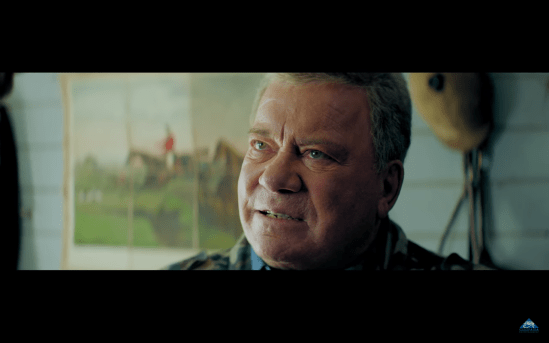
Trekkie fans will appreciate the Captain Kirk star’s uncharacteristic doomsday pessimism and grand finale grenade launching that turns demons into canon fodder. Shatner is a savage as John’s fanatical father, bombarding his grown, near middle-aged, son with constant disappointment and disparagement that becomes one source of John’s (“Blood Lake: Attack of the Killer Lamprey’s” Jason Brooks) dire motivations to risk his family inside the gaping mouth of the netherworld, a questionable and ill-advised move especially when death is evident. Brooks is a career television and TV movie actor who can settle right into a third rate production with ease without batting a condemnatory eye lash. While Shatner and Brooks’ one-sided family role quibbles over languishing curses and John’s inability to man-up for the situation goes into the hilariously bad category, the second “Star Trek” star, Jeri Ryan from the “Voyager” series, lands a subdued role as John’s foot mat wife who just goes with the punches without making too much of a wake serving as John’s better half and reasonable conscious. Ryan and Brooks’ on-screen relationship is a supposed marital one, but the chemistry just isn’t present and wanders into questionability with their relationship status. The script’s backstory on John and wife is obliquely exposed through exposition without any of the visual depth and discharge of fleshing out a better dynamic for Ryan and Brooks to work with in building their characters. The remainder of the cast list includes Ciara Hanna (also from “Blood Lake: Attack of the Killer Lamprey”) and Robert Scott Wilson (“American Fright Fest”) as John’s college(?) aged kids who add little substance to the narrative.

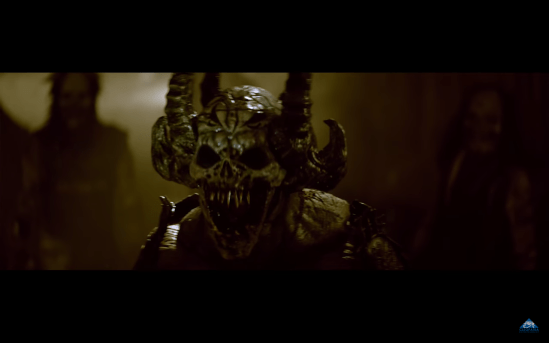
Without a better way of putting this, there’s much to demerit against “Devil’s Revenge.” The concept is sound: a disarrayed and browbeaten archeologist must locate an evil transmitting relic from destroying his family with a everlasting demonic curse. Sounds good, right? Combine that with Shatner blasting demons to smithereens with a multi-barrel grenade launcher, the potential for a solid and fun viewing experience would be a no-brainer. However, what’s sold is the made in China version of what’s being marketed. Hard to imagine Maurice Hurley’s, the man who helped re-pioneered space exploration and developed The Borg adversaries, script was so out of whack and had gone into various limp curvatures that I don’t expect all blame should point to him for the posthumous misstep as the direction is emphatically coarse and incoherent of too many ideas without any connective tissue much unlike boldly going where no man has gone before. In fact, many filmmakers have gone this route before by taking all sense of a rounded script and dissolving it the way Cohn does. The path Cohn ultimately takes is to splice loads of unnecessary and repetitive flash backs into the story to try and retain into viewers over and over again the events that conjured hell’s minions to surface. I’m sure we saw the same scenes at least five or six times from beginning to end, even during the opening credits. There’s also a looseness about how this curse attaches itself to John’s family from long ago that inexplicably goes without being conveyed and we find ourselves asking, why these people? What have they’ve been suffering through all these years? What makes them important? The curse seems rather recent rather than historic and for John’s family legacy to go uncharted just poses too many unanswered questions. What’s fundamentally right is Inan, the head demon, who represents the best parts of the “Devil’s Revenge’s” netherworld rock and roll presence with a large and ghastly humanoid with blank, fiery eyes and a protruding clasping mouth and the visual effects surrounding Inan are pretty good despite their some minuscule glossy bad aftertaste. An aftertastes that extends into Shatner using the grenade launcher with the goofiest of detonations in an unrealistic distance between him and his targets without so much of a single piece of shrapnel grazing his well postured gun-toting stance.

MVDVisual distributes “Devil’s Revenge,” a Cleopatra Entertainment production, onto a region free, special edition Blu-ray and soundtrack CD combo. The Blu-ray is presented in a widescreen, 2.78:1 aspect ratio, in a BD-25 with a 1080p transfer. “Devil’s Revenge” implores more than the natural lighting used through much of the 98 minute runtime and while natural lighting isn’t a flaw in any sense, Ryan Broomberg’s cinematography falls flat, uninspired that doesn’t represent well the presentiment eventualities past, present, or future. Technically, “Devil’s Revenge” isn’t soft around the details albeit minor banding in closer quarters of the cave. Practicality versus the computer imagery really do go head-to-head between Vincent Guastini’s (“Art of the Dead”) special effects and the visual effects team of Eric Chase (“The Black Room”) and Mike Rotella (“The Predator”). The detailed rubber body suits and the composited explosions akin to the military hellfire creatures were bombarded with in monsters movies from the 50’s are of the campy independent film culture and purgative of any expectations of the Devil actually making good on revenge. The English language Dolby Digital 5.1 surround sound audio is not as lossy as the usual Cleopatra Entertainment Blu-ray releases and certainly regales with the theatrics of a William Shatner monologue (can’t you tell I love me some Shatner). Range and depth are concurrent appropriate with each other and dialogue is clean and clear. Surprisingly and rarely does a Cleopatra Entertainment releases goes without a soundtrack intertwined with the score that contracts their signed artists from parent company Cleopatra Records; instead, we receive a brooding industrial score composed by Jürgen Engler, co-founder of German punk band “Male” and “Die Krupps,” which can be gorged on as the film’s coveted silver-lining. Luckily and conventionally for a Cleopatra special edition release, an un-cursed 13-track CD of Jürgen Engler’s score accompanies the feature Blu-ray. That being the height of the special features, other bonus material includes a picture slideshow and theatrical trailer. “Devil’s Revenge” won’t shudder your bones to milky pigments of sawdusts and will likely strikeout with fans, as perhaps the Devil’s actual revenge for portraying him so ill-conceived. Still, I suggest checking out the Jürgen Engler’s gnawing and insidious industrial score, a gleaming highlight for sure.

Check it out for yourself! “Devil’s Revenge” on Blu-ray.

Get Evilly Animated! “Awaken the Devil” review!

output_ex2oit
Brothers Todd and Vernon Dopple are a pair of homeless drifters in New York City. To beat the cold city weather, they take shelter in an abandoned run-down building only to stumble into a dark and dank Devil worshipping den where vicious demons, tortuous succubi, and a psychological terror have chosen the brothers in order to re-awaken the Devil.
vlcsnap-2015-03-23-20h10m13s250
“Awaken the Devil” is not a fast-paced, on-the-edge of your seat demonic thriller and, you know what, that’s okay. Director Daniel Falicki’s combination of live-action and overlapping animation marks some spectacular rotoscope-esque filmmaking, think “A Scanner Darkly” or “Waking Life”, that looks really cinematically neat on screen with unique visual effects especially of the hovering demonic succubi. Without the animation, I fear that “Awaken the Devil” would suffer greatly from the film’s slow, but not too terribly slow, pace as the characters do a lot of wandering around the city without any direction until the day ends and the night begins. Luckily, we’re stuck with entertaining and passionate actors.
vlcsnap-2015-03-23-20h08m54s224
The two main actors, Jason Roth as the wheel-chair bound mute Vernon and Matt Simpson Siegel as his drug addicted and cynical brother Todd, sold us hard on their performances. Roth delivers a powerful silent performance and uses remarkable versatile facial expressions that goes above and beyond the budget of this film. Siegel is given loads of dialogue (nature of the beast when you’re character’s brother lacks a voice box) and sometimes resembles more of a rambling rant about his historical envious and predominantly jealousness, sometimes melancholic, of his brother. However, the dialogue is much more than just words on paper and the film revolves around this dialogue between the two brothers creating an underlying layer that is deeply involved than just some mindless succubi leaching the life of two homeless souls.
vlcsnap-2015-03-23-20h11m02s229
Overall, I would recommend at least one viewing of this Sector 5 and Rotomation Studios film. Just beware than after the first five minutes of great introductions and musical track from The March Violets, you might want to be doing something else between then and when run-down building. Don’t be discouraged; “Awaken the Devil” is a well edited, well directed, and well animated film that is unique and certainly haunting.
vlcsnap-2015-03-23-20h13m17s43

Nudity Report

Audria LarsenSee-through breasts – Audria Larsen is the first succubus that enters the scene and latches itself on to Todd. Audria’s scene is brief, but as she’s floating above Todd, there is a quick glimpses of her chest through a see-thru top.  She’s also involved a “ghost” sex scene with Todd where she cowboy rides him until she reveals her true self. Audria Larsen is a burlesque/circus art model for Model Mayhem under the moniker Vivacious Miss Audacious and Larsen is also fairly good at hula-hooping and suspension which she tackles on a little bit in the film.  It’s a sexy scene, but there rotoscope animation makes it a bit murky to full grasp Larsen’s assets.