EVIL Surfs the Fresh Powder. “Shredder” reviewed! (Ronin Flix / Blu-ray)

“Shredder” on Blu-ray at Amazon.com

Mount Rocky Summit ski resort has been closed and abandoned for years because of the tragic death of a young skier at the hands of intoxicated snowboarders not following the resort’s rules.  Years later, a group of snowboarders sneak onto the resort property to snow surf the untouched slopes despite the local’s steep warnings of a haunted mountain and an easily influenced sheriff’s waning attempt to remove them from trespassing.  The snowboarding teens should have heeded the ominous warnings as a masked skier dressed all in black begins a massacre on the mountain, brutally killing the ignorant and reckless snowboarders one-by-one for defying the resort and lift safety guidelines and rules.  Before realizing what was happening, accusations and panic set in as trust and survival become key to surviving a total gnarly wipeout. 

“Shredder” – no, I’m not talking about master Oroku Saki aka The Shredder, high leader of the criminal ninja syndicate known as the Foot Clan and main antagonist for the Pizza-loving crimefighters, the Teenage Mutant Ninja Turtles.  The “Shredder” that I’m referring is the unheeded 2001 slasher from writer-director Greg Huson and co-written by Craig Donald Carlson.  “Shredder” is every bit the essence of the late 90’s slasher-dash made in the early 2000s with a pop-punk soundtrack, radical attitudes, and an incorporated extreme sport built-in to stand out amongst the others in the genre with its snowboarder and skier themed horror model.  Filmed in and around the Silver Mountain Ski resort in Kellogg, Idaho and known as Jason Z and Ski Weekend in other parts of the world, “Shredder” comes during a slasher renaissance that began with Wes Craven’s game-changing “Scream” designed to plant the killer in plain sight and keep the audience guessing and analyzing who just might be the masked murderer blazing the bunny slope. Idahoans Rory Veal (“Lover’s Lane”) and Geof Smith (writer of “DeepStar Six”) produce the cult feature distributed direct-to-video by MGM.

Though “Shredder” is a campy horror-comedy, the feature does take itself rather seriously and the actors soak themselves into their stoked, stoner, and sex-driven characters of a variety volitions. Scott Weinger, the voice actor whose claim to fame is being the original voice of Aladdin in Disney’s 1992 animated “Aladdin” and its various sequels and spinoffs, finds himself on the opposite side of the spectrum in a not-so-kid-friendly film about a skier who axes, beheads, hangs, and stabs inappropriate snowboarders to death. Weinger plays the lead principal character as the lead on a leash boyfriend, Cole, with a veil that keeps him from seeing his trollop rich girlfriend Kimberly Van Arx, played by Lindsey McKeon (“Indigenous”). Weinger and McKeon wear their roles well enough to feel Cole’s good guy mold, his hero of character, being cuckolded by Lindsey’s wondering eye and brazen attempts to sleep with the hot European hitchhiker Christophe (Brad Hawkins, “From the Dark”). Kimberly Van Arx isn’t the only lady sex cuckoo for Christophe as Kimberly’s friend Robyn (Holly Towne) slathers on the seduction by hanging out of her clothes for much of the interior scenes. Much of the flirtation and hanky-panky is fairly overboard to the point that even the imbedded amateur cam-recording videographer and virgin Skyler (Billy O’Sullivan but credited as Billy O) becomes involved and handsy with another trespassing skier outside of their group who takes a shine to him instantly. Now, you can’t have an early 2000s slasher film without the token druggie and that role Peter Riggs (“Roulette”) as Kirk, professional snowboarder testing out new boards to dislodge himself as number two snowboarder in the world. Individually, the characters a fine. Together, the cast creates a body of personalities to sympathize and hate and also not bog down what’s really a mediocre-made slasher with decent gore. “Shredder’s” cast rounds out with Juleah Weikel, Candace Moon, Ron Varela, and Seth Reston.

When I say mediocre-made, I mean script sets up characters to die arbitrarily. There’s no means to their ends and the majority of the kills are as quick as a snowboarder finishing a run down the slalom. That’s not to say that “Shredder” doesn’t bring the gore with an opening and an ending that’ll make you lose your head or just become shredded skier meat in a giant snow grinder truck that has entertainable yet questionable visual effects results. What’s admirable about “Shredder” is the production doesn’t skimp out on landscapes and ski equipment to sell the whole winter resort theme. This partly becomes why “Shredder” is a cult horror hit with skiers and snowboarders. Doesn’t hurt that the filmmakers were able to utilize the Silver Mountain Resort complete with ski lift and lots of fresh snow for the spliced in shots of snowboarding runs with character stand-ins. Alongside the postmodern human and the cliched tropes lies the mystery maniac just waiting to be exposed in a coda showdown with the final girl or boy, but the problem with “Shredder’s” obscurity is its very transparent. Designed by force to misdirect our attention to a potential person was poorly crafted and made Cole seem foolish when he struggles to make a case about the killer’s identity with no foundation to stand on. Instead, Huson and Carlson write in a minor role that quickly evolves into the unmasked major player but unlike “Shredder’s” predecessors, such as “Scream” or “Urban Legend,” picking out the killer is made-easy and takes the fun out narrowing out the suspects. There’s plenty to like about “Shredder” – motley crew of characters, solid kill scenes, and Holly Towne checking the nudity box – but the cult worthy film definitely deserved to go direct-to-video as an average archetype of the subgenre.

Hit the sanguinary slopes with “Shredder” now on a 1080p, high-definition Blu-ray from Ronin Flix, Scorpion Releasing, and distributed by MVD Visual. Presented in a widescreen 1.85:1 aspect ratio, the AVC encoded BD25 has softer details that are not amply delineated but are suitable as a lot of light bounces off the snow and washes away some of the depth. Far and near exterior landscapes are breathtakingly immersive in the scale and textures and the interior scenes are kept dark and claustrophobic with only dancing flashlights and fires to light the anxiety mood. I find fascinating that in early 2000s, 35mm celluloid film was still be used here and the transfer appears to have weathered any kind of wear or aging, granted we’re only talking about two decades worth of time passed. There’s light, natural grain with some white speckled moments here and there that don’t affect viewing and no real issues with compression on the lower storage disc that maintains bright color, blacks, and an overall stabilized picture. The Blu-ray comes with a single audio option, an English DTS-HD 2.0 master audio, that manages appropriately an ample amount of output through the dual channels. All tracks are rich and robust with dialogue clear, clean, and audible, a punk rock soundtrack that underscores and supports the exterior snowboarding runs with vitality, and a plentiful range of sound effects that might have been better suited with more defined depth. Optional English subtitles are available. Special features include a brand-new interview with actress Lindsey McKeon that chiefly and briefly goes through her career up until now, a brand-new audio commentary with director Greg Huson, outtakes aka deleted scenes, and the original theatrical trailer. The physical features include the traditional Blu-ray snapper case with illustrated artwork by Devon Whitehead with his trademark style of the main villain looming overhead a chaotic mixture of scene depictions. The 86-minute, region A encoded release is rated R for violence, gore, sexuality, language and some brief drug use. Not a downhill yard sale as one would expect and if you happen to be not a regular mountain adrenaline junkie, director Greg Huson does helm a fairly resilient and agreeable masked slasher with a winter avocational theme.

“Shredder” on Blu-ray at Amazon.com

Dan Stevens. The New Face of EVIL? Freakin’ Love It! “The Guest” reviewed! (Second Sight Films / BD-R Screener)

Recently hospital discharged combat soldier David Collins visits a fallen brother in arms’ family, The Petersons, to convey their son’s last moments of love for his family.  Taken immediately in by the grieving mother, David stays for a few nights at the Peterson home, quickly befriending the family of four with his military “yes ma’am” charm and good looks.  When a string of accidental and homicide related deaths begin to flare up in what’s typically a quiet rural town, eldest daughter, Anna, suspicions turn to David.  As Anna digs deeper into David’s past, nothing can stop the elite special forces soldier from taking steps to protect his identity and his mission, even if that means turning the Petersons’ hometown into a deadly warzone. 

One part action, one part slasher – Adam Wingard’s “The Guest” is a hot take on the infiltrator horror subgenre.  The “Pop Skull” and “You’re Next” director, who went on to helm the epic clash of the two biggest creatures in all of creature feature history with this year’s “Godzilla vs. Kong,” directed “The Guest” to challenge the slasher narrative with an atypical, slightly campy, American indie thriller with an unanticipated and surprising twist that’s more than just your run-of-the-mill snapped war-traumatized soldier gone shell-shocked rogue.  The script reteams “Dead Birds’” writer Simon Barrett with Wingard for their eighth collaboration that pits all the story’s action into the rural confines of an unnamed small town in America while the actual shooting location takes place in New Mexico.  “The Guest” is a production of the UK based HanWay Films, which also oversaw the production of Wingard’s “You’re Next,” and Snoot Entertainment of the zomedy “Little Monsters” from the producing management team of Keith and Jess Wu Calder.

To put things simply, Dan Stevens is scary good.  The “Downtown Abbey” star plays the titular troublemaker and, now, I will never look at Matthew Crowley the same way again.  Stevens trades out the proper aristocracy of British English with a slight American English Southern draw, a heavily used trope portrayed with U.S. troops in cinema, but Stevens does more than just talk-the-talk.  The Surrey born actor who once played the Beast in Disney’s live-action version of “Beauty and the Beast” plays a different kind of monster that’s akin to a wolf in sheep’s clothing with David, adorning his physically fit character with a clandestine depth in his ambiguous background and sociopathic tendencies that makes him very much a mysterious maniac much in the same fashion as iconic slasher villains.  Trying to stop David’s undermining reign of controlled carnage is Anna Peterson, played by Maika Monroe (“It Follows,” “Independence Day:  Resurgence”).  Ana’s a levelheaded, yet rebellious, teenager adverse to being told what to do to much of her parents chagrin from dating a pot dealer to her objection in David’s stay with them.  Monre puts angsty effort behind Anna Peterson’s eyes, but the character herself is rather flimsy willing to put her trust in an unsponsored secret organization agent, “John Wick” films’ Lance Reddick, and his request to get into his car urgently without hesitation, but has a difficult time swallowing at her own pace her dead brother’s fellow soldier even with the stamp of whole heartily approval from her parents and little brother and photographic evidence of her brother’s relationship with David.  Yet, Barrett’s openly oblivious characters play into the slasher/thriller campiness of accepting everything at face value without ever an inkling of doubt.  Perfect examples of this would be 3/4th of the Peterson family: the mother (Sheila Kelley, “A Passion to Kill”) trust him with handling routine tasks like picking up her son from school or laundry, the father (the great supporting actor Leland Orser, “Alien:  Resurrection,” “The Bone Collector”) trusts him with personal secrets, and even the school outcast brother (Brendan Meyer, “The Color of Space”) desperately believes David is his friend.  Tabatha Shaun, Joel David Moore, Ethan Embry, Chase Williamson, and Steven Brown co-star.

Pulling loads of admiration and inspiration from the “Halloween” franchise, “The Guest” not only rocks as an action thriller but also mimicking a retrograded slasher in a subgenre slapped with a label I like to call the infiltrator subgenre.  David Collins is no mindless, walking and not talking, killing machine like The Shape, but instead gains trust, backdoors problems, and has the quick confident moves to see the job through with hand-to-hand combat and other more visceral merciless methods.  Barrett and Wingard purposefully leave much to the imagination with David’s past, turning what would usually outcome as frustrating ambiguity for an essential character to more of an enigmatic antagonist allure similar to the way we don’t have a clear-cut motivation why Michael Myers or Jason Voorhees shish kabob horny teens without a second thought.  Sure, there are sequels that try to enlighten reasons, such as being pure evil, but abstract is not concrete.  Same with “The Guest” with a control spoon feeding of just enough backstory to wet one’s thirst for more on David’s ruthless sociopathic behavior.  David’s also a very likeable with the impression that his good deeds done in violence speaks to a justice-driven character, but what’s brilliant about David, and enhanced profoundly by Dan Stevens, is that when he does kill someone in cold blood for this first time, the impact is tremendously unreal because it’s unexpected and off brand from the Barrett and Wingard’s buildup of him being a standup and do-what’s-right soldier.

Second Sight Films invites you to be their guest for their limited edition 4K Ultra Hi-Defintionand Blu-ray of Adam Wingard’s “The Guest” that hit retail shelves this month on October 25th.  The stunning makeover of this cult favorite, limited to 5,000 copies, offers a brand new color grading for both formats supervised by Wingard with 4K UHD presented in Dolby Vision HDR.  Since a BDR was provided, commenting on the exact audio and video quality of the release isn’t possible, but rest assured, knowing the care and attention Second Sight Films put into their releases, “The Guest” will surely not overstay it’s welcome in the image and audio department.  The film has runtime at 100 minutes and a UK 15 certification; however, there is much more to this 3-disc release that includes the film’s 80’s inspired soundtrack on a compact disc.  Special features include new Adam Wingard and Simon Barrett commentary plus an archive commentary track from the two filmmakers, a new interview with actor Dan Stevens The Uninvited Guest, a new interview with actress Maika Monroe A Perfect Stranger, a new interview with Wingard and Barett By Invitation Only, a new interview with producers Keith and Jessica Wu Calder Producing the Guest, a new interview with director of photography Robby Baumgartner Light and Fog, a new interview with production designer Tom Hammock Lightning Strikes, a new interview with composer Steve Moore The Sounds of The Guest, and deleted and alternate including an outtake gag with optional director commentary.  With this limited release comes a rigid slipcase with new artwork by Adam Stothard, 160-page booklet with new essays by script to screen storyboards and extracts, behind the scenes photos, Wingard’s soundtrack notes, and new essays about the film, and, lastly, 6 collector’s art cards. In a time when modern horror desperately needs a solid sequel, “The Guest” is a good candidate with it’s captivating villain with so much story still left to tell. Hopefully, Second Sight Films’ irrefutable powerhouse release will ignite step-taking action amongst the rumors.

Grab it fast!  Liminted Edition “The Guest” on 4K UHD and Blu-ray Now at Amazon.com!

May the EVIL Be With You! “Star Wars: Episode IX – The Rise of Skywalker” reviewed! (Disney / Blu-ray)


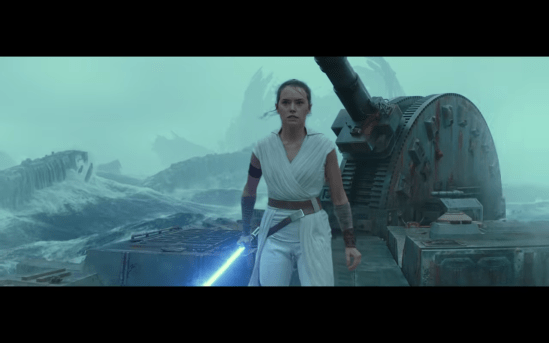
The rebellion suffers lost after lost against the oppressive First Order and news that the evil Emperor Palpatine lives casts an even larger shadow of fear and hopelessness across the galaxy. As Fin and Poe Dameron continue running small strikes against imperial targets, Rey finalizes her training as a Jedi with the help of Princess Leia, but as Kyle Ren discovers the Sith coven and the existence of Palpatine, his desire to search and track down Rey grows stronger before releasing a new First Order fleet of Star Destroyers with the capabilities to destroy entire planets. The Force pulls at Rey, guiding her to face her most difficult challenge: the truth about her parents and lineage. Rey faces crossroads that will determine whether she will continue to fight for good or cave into her anger and fear that’ll inevitably lead to the dark side.

Star Wars? What is Star Wars doing being reviewed on a blog that mainly covers the schlocky low-budget horror scene and the occasional obscure and weird Sci-Fi arthouse film? And the fact that “The Rise of Skywalker” is a Disney film makes this writeup the first ever Disney review for ItsBlogginEvil. No, don’t fret. I’m not selling out my love for the gore, scream queens, and pint-sized productions for the mondo-glitzy, big budget Hollywood epics nor am I making a soft right turn into bloodless PG-13 commercial commodities, but, and this is a big atypical but, “Episode IX” needs to be heard from those outside on the fringes. “Episode IX” is perhaps the darkest film of the cross-generational saga alongside “Revenge of the Sith,” or at least a close second, and, so it be, Disney was gracious enough to provide us a Blu-ray review copy of the J.J. Abrams grand finale to an adventure that has trekked through 40 plus years of galaxy-conflict, saw countless different alien species, gave us more pew-pews than we could ever hope to hear, three different versions of Anakin Skywalker, and the phantasmic super powers of what is known as the Force, all of which is encompassed by a fascist, utilitarian power. Co-written with Abrams is “Argo” and “Justice League” writer Chris Terrio from a story co-written also by “Jurassic World’s” Derek Connolly and Colin Trevorrow.

“Episode IX” begins with Kylo Ren (“The Dead Don’t Die” and “BlacKkKlansman’s” Adam Driver) discovering a pyramid shaped device that’ll Mapquest his way to find the secret Sith location where a familiar evil figure from the past returns and has built a gigantic fleet over the last three decades. This time around, Kylo Ren’s less of a toddler in the throes of brain development as he’s embattled with guilt and choice. Adam Driver does nail the performance with solemnity in his last performance as the son of Leia and Han Solo. The story’s heroine, Rey (Daisy Ridley), is also facing internal conflict with self-discovery as the prospect of knowing who she is sets her on a quest to discover her ancestry and what she might find might blur the sides of good and evil. The young actress who had a number short films and one horror title under her belt (“Scrawl”) before skyrocketing into “Star Wars” mythology returns to Rey as a Jedi hot off the Leia training course and thrusted immediately into the Force’s subconscious dark star, shielding her from the truth for fear of what may come of it. While Ridley shines, the Rey character sprints from, at this point in the Saga, point M to point Z, jettisoning much of the internal grappling to a mere blip on the ship’s internal sensors. Rey also feels entirely infallible, thrusting her character beyond the limits of mortality by completely overshadowing not only Kylo Ren, but also Emperor Palpatine. The other two new to the “Star Wars” crew, Poe (“Ex Machina’s” Oscar Isaac) and Finn (“Pacific Rim: Uprising’s” John Boyega), received similar shaft treatment of reworked characters from the original trilogy, possessing nothing new to offer. Poe a watered down version of Han Solo, a hot shot pilot who doesn’t understand the concept that together him and his fellow rebellious friends can defeat anything that stands in front of them; Lando Calrissian had to educate him with a bit of heart-to-heart exposition. However, Finn is perhaps the biggest undercooked character who has an inkling of Force within him that always simmers to the surface, but nothing is definite, nothing’s explained, and nothing is provided to perhaps the best known minority character in all of “Star Wars” behind Lando. Lastly, and I know the character write is up long and might be a little drawn out, Abrams really botched Carrie Fisher’s Leia that worked in awkwardly unused footage of the Princes/General from previous films. The simple and bland rhetoric used when Leia’s having a “conversation” with Rey is nearly painful to stand as Rey pours from an emotional spigot and all Leia can be, responsively, is cold, blank, and superficial. Mark Hamill, Anthony Daniels, Naomi Ackie, Domhnall Gleeson, Richard E. Grant, Lupita Nyong’o, Joonas Suotamo, Kelly Marie Tran, Billy Dee Williams, Ian McDiarmid, Harrison Ford, and Greg Grunberg co-star.

I adore “Star Wars” as much as the next nerd who grew up between the first and second trilogy. The blending between science fiction, westerns, and samurai tropes speaks volumes on how engrained George Lucas made space come alive with larger-than-life gusto that appeased not only fans of space adventure and wonders, but also fans saturated inside the spaghetti westerns and those with an affinity for Akira Kurosawa films. Those genre bending tactics really brought the film community together to appreciate the novelly detailed miniatures that came to life and the eccentric, sometimes outlandish, characters like Han Solo, Jabba The Hunt, Boba Fett, and Leia in that scantily-clad slave girl bikini. Yet, “Episode IX” irks me, irks me hard, as the once innovate “Star Wars” has been placed into a bingo ball spinner to have it’s originality called out once again in one ginormous homage to see, again, the Emperor, who seems very high and mighty upon his throne of Sith muscle, pitted against a ragtag team of good doers and their champion quasi-Jedi who has to make a between benevolent freedom or a junta power. That’s not to say that “Episode IX” is a total sham of a finale. Fans will receive the totality of a “Star Wars” film complete with light saber clashes, space battles, and the beautiful, yet sometimes violent, different worlds that ships can hyper speed to in seconds. The visual and practical effects are bar-reached and awe-inspiring by means of thousands of ships clustered together, the dim-lit bars crowded with varied character creatures, and the speeders racing through canyons and sandpits become heart-pounding thrill rides of excitement. The introduction of new characters, like the amiable and smile-evoking bot technician Babu Frik, the former Poe co-spice trader and survivalist Zorii Bliss, and another ex-Storm Trooper, Jannah, forms that similarity bond with Finn, are new blood that delight when on screen. Yet, these new characters are shamefully underused as minuscule support that garners only a speck of adoring fandom but little else to the story’s plotline.

“Star Wars: The Rise of Skywalker” comes home with a 2-disc Blu-ray and Digital Code release, sheathed inside a rigid slipcover, presented in 1080p, full high definition, widescreen, 2.39:1 aspect ratio. Video is top shelf quality of everything a “Star Wars” film should be with colors and details galore that are arranged purposefully and perfectly to aesthetically please a contrast against the bleakness of space. The extensive line textures are seriously sharp and along with the vast special effects professions who model, shape, and digitally imprint the liveliness into the work, but there are instances, such as on the Sith home world, where the visual effect of an arena filled with distantly scoped blurry Siths dampens the moment of Rey’s endmost consignment. It looked and felt cheap and didn’t properly convey’s Rey’s loneliness against all odds. The lossless English language 7.1 DTS-HD Master Audio caters to every pew-pew blaster sound, every ship zipping through space with an engine-like exhaust, and every electrical discharge of a light saber humming in the throes of dual. The dialogue, and Chewbacca’s guttural growls, are effervescently prominent with a natural tone and not commingled by the other tracks, making “Episode IX” some of the best sound work to date in any “Star Wars” film. Capping off the Saga soundtrack with the familiar John Williams robust overtone and coursed throughout an engaging orchestra that moves in synth with story’s dynamics. The bonus feature disc includes an over two-hour documentary entitled “The Skywalker Legacy,” a full length feature of orgasm supplementary regarding “The Rise of Skywalker” and diving deep into the mythos of “Star Wars'” history. Other bonus material includes the mechanics of creating a speeder chase on the Pasaana world, shooting in Jordan to utilize it’s dessert location to create an alien planet, exploring the D-O ship that’s new to the franchise, an interview with Warwick Davis who returns to “Star Wars” to once again don an Ewok character along with his son Harrison, and a cavalier look at the otherworldly creatures and highlighting those who play the part of these beings. For many, the book of George Lucas’ “Star Wars” has been closed as the final episode completely arcs the Skywalker story. Yet, for a few who wish to explore more, “Star Wars” is sought to be an open to a means for other characters to be explored, such as with The Mandalorian,” and, just maybe, that cute Babu Frik. “The Rise of Skywalker” exited in a cliche fashion, a warp drive to an already established and tiresome rehash of circumstances, while only supplying a healthy demand of star power and intense action inside a rapturous package overflowing to the brim with too much content and too little substance.

Complete the Saga! Amazon has “The Rise of Skywalker” on Blu-ray+Digital!

Oscar Wilde’s Not-So-Evil…”The Canterville Ghost” review!


An ambitious physics professor Hiram Otis obtains a research grant that requires him to study in England, pulling his wife, daughter, and two young boys from their Indiana home into a strange new world. In an age of obsolete aristocracy, the Otis family is able to afford rent at the grand Canterville Hall, a legendary castle with an infamous tale of death and suspicion that also might have resulted in being an affordable estate for the American family. Legend records have it that the lord of the castle, Sir Simon de Canterville, had subsequently killed his wife due to his obsessions and became the victim of his wife’s family spiteful vengeance by being chained to a dungeon cell. For 400 years, Sir Simon remained in that cell and his ghost haunts Canterville Hall, but despite their beliefs in the supernatural, the physics professor and his wife can’t see the ghost and only their teenage daughter and two young boys are able to witness him roam the halls, haunting those who live within the castle walls.

Every once and awhile, we’ll thoroughly review a light-hearted fantasy, horror, or sci-fi film and since we’re hot off the heels of the review for Wes Craven’s “Summer of Fear,” the made-for-television train might as well keep chug-chug-chugging alone with the 1996 TV movie adaptation of the Oscar Wilde novella, “The Canterville Ghost.” Distributed by ABC, the Sydney Macartney (as Syd Macartney) directed and Robert Benedetti teleplay written installment tries to differentiate itself and standout amongst a plethora of adaptations that span across the globe, but the American Broadcast Company, a subsidiary of the great and powerful Disney, aimed to separate from the masses by adding star studded power and the result brought a rejuvenation to the ye old tale over two decades ago.

The big name headliner is none other than Captain Jean-Luc Picard himself, Patrick Stewart, two years after his 7-year stint on Star Trek: The Next Generation. Stewart, who co-produced the film, adds his theatrical flair and is absolutely brilliant shaping drama monologues into dense thickets that define Sir Simon de Canterville’s ghost, but there’s an issue; the problem doesn’t lie with Patrick Stewart, but with how Benedetti’s teleplay expos from the story as a continuous, if not slightly jumbled, stream of old English that just feels like rambling. To alleviate that strain is Stewart’s co-star Neve Campbell to add a softer, glassy-eyed touch to the story with a pinch of plain jane American girl insecurities, characterized in Wilde’s story as Virginia Otis. Perhaps in the beginning portion of the height of her career, Campbell finds herself between “Party of Five” and hitting scream queen status as Sydney Prescott in “Scream,” but the “Wild Things” actress wasn’t that sultry or that chased in “The Canterville Ghost” who only took upon an annoyed teenage girl persona, wishing her life was back in America up until the mysterious spirit of Sir Simon de Canterville allured a spark into her dull life. Alongside Stewart and Campbell, Daniel Betts, Ciarán Fitzgerald, Raymond Pickard, Cherie Lunghi, Donald Sinden, Joan Sims, and the late Edward Wiley, who died shortly before the film’s premiere, costar.

Going into “The Canterville Ghost” was nothing short of knowing nothing other than the fact the Patrick Stewart and Neve Campbell were in the lead roles of a Disney backed, family film and to be completely honest, Macartney’s vision completely underwhelms. Along with the verbose nature of the script-to-teleplay alterations, the magical supernatural portions are inarguably cheap, even for television. The simple superimposing of Sir Simon de Canterville offered no stimulation as the the two scenes just didn’t splice together well to seamlessly make the grade. Firecracker explosions and party store cobwebs dilute even thinner the already slim pickings of special effects that top when Virginia Otis crosses over into a dense fogged ghostly realm thats chopped, cropped, and edited with such disorganization, the entire scene feels more lost than Virginia trying to escape the other side back to the living.

Sydney Macartney’s “The Canterville Ghost” is presented for the first time ever on Blu-ray courtesy of the U.K. distributor Second Sight Films. The Blu-ray is presented in the Academy ratio of 1.33:1 with 1080p resolution on a MPEG-4 AVC BD 25. Second Sight’s release will have the best looking version of this film, if the quality is anything like the screener sent to me, with a strong color palette, minor digital noise, and rich in great detail; so detailed in fact that the blemishes on Neve Campbell and Daniel Betts can be seen. The English DTS-HD audio track is lively, but not entirely boastful with more thematic and dramatic elements. Dialogue track is clean and clear and the score by “Dead Heat” and “Tremors” composer Ernest Troost augments his fairy tale rendition into the mix. Bonus material includes new interviews with director Sydney Macartney and producer-writer Robert Benedetti. Second Sight’s presentation of Hallmark Entertainment’s “The Canterville Ghost” has strong Blu-ray technical potential, but despite the big names of that time period and a visually stimulating setting, the fantastic adventure through a cursed ghost’s melodrama and a bored young girl’s tenure of self discovery unfortunately didn’t rivet with excitement or wonder, losing steam with it’s important message that life is more than being in a bubble of stagnant disappointment and guilt.