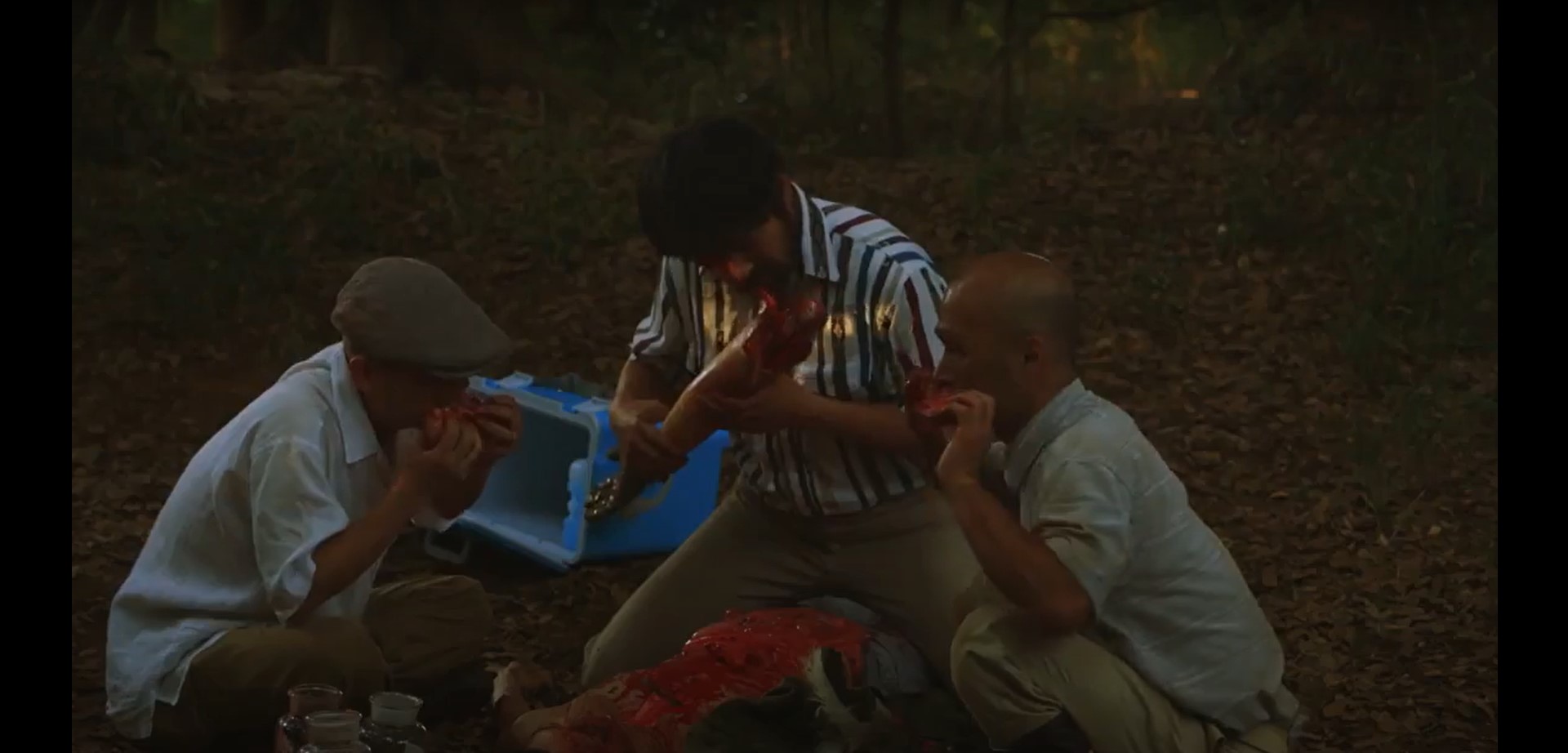
Primitive cannibals sexually violate a brother and sister by a campfire ritual while feasting on entrails. A family in the throes of hatred and forbidden incest is torn apart between death and mercy. When these two powerful moments spur friction amongst the family, blood and betrayal runs like an unstoppable torrent. Animalistic urges take over and neither brother, sister, or father are safe from the cannibals or each other in a landscape of barren and sociopathic madness. Who will survive and come out on top of the internal upheaval when bloodlust is at its highest?
“Sangre Para la Carne,” or for the single-lingual, English-comprehending audiences, “Blood for Flesh,” is the 2019 ultraviolent and in your face gore-and-shock short-feature film from Mexican director Alex Hernández. Though completed in 2019, “Blood for Flesh” gains traction into the at-home market three years later, finding distribution on multiple independent physical media distributors as well as video streaming services. In his debut directorial, which doesn’t list the filmmaker as the screenwriter but is likely the architect of its abstract, Hernández caught the eye of another extreme auteur in “House of the Flesh Mannequins” and “Xpiation” director Domiziano Cristopharo and Italian-based TetroVideo to lift “Blood for Flesh,” fitting right into TetroVideo’s cache of erotic and extreme horror, into production and home video distribution. Shot in the arid depths of Tlaxcala, Mexico, labeled the epicenter in internationally trafficking female sex slaves to the United States, “Blood for Flesh” deluges itself with more unsavoriness, produced by Porfirio Hernández and Rodrigo Tellez Pérez.
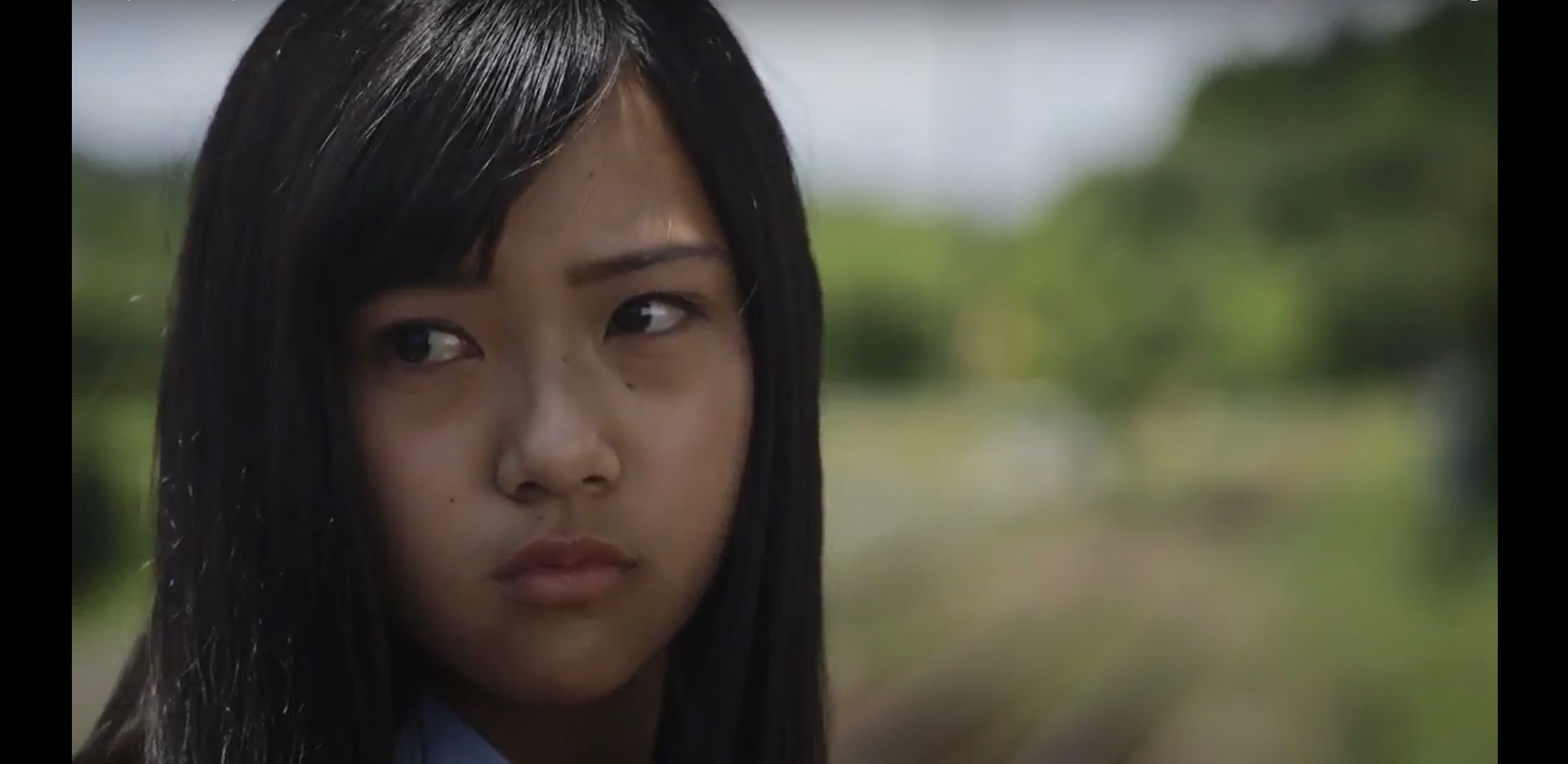
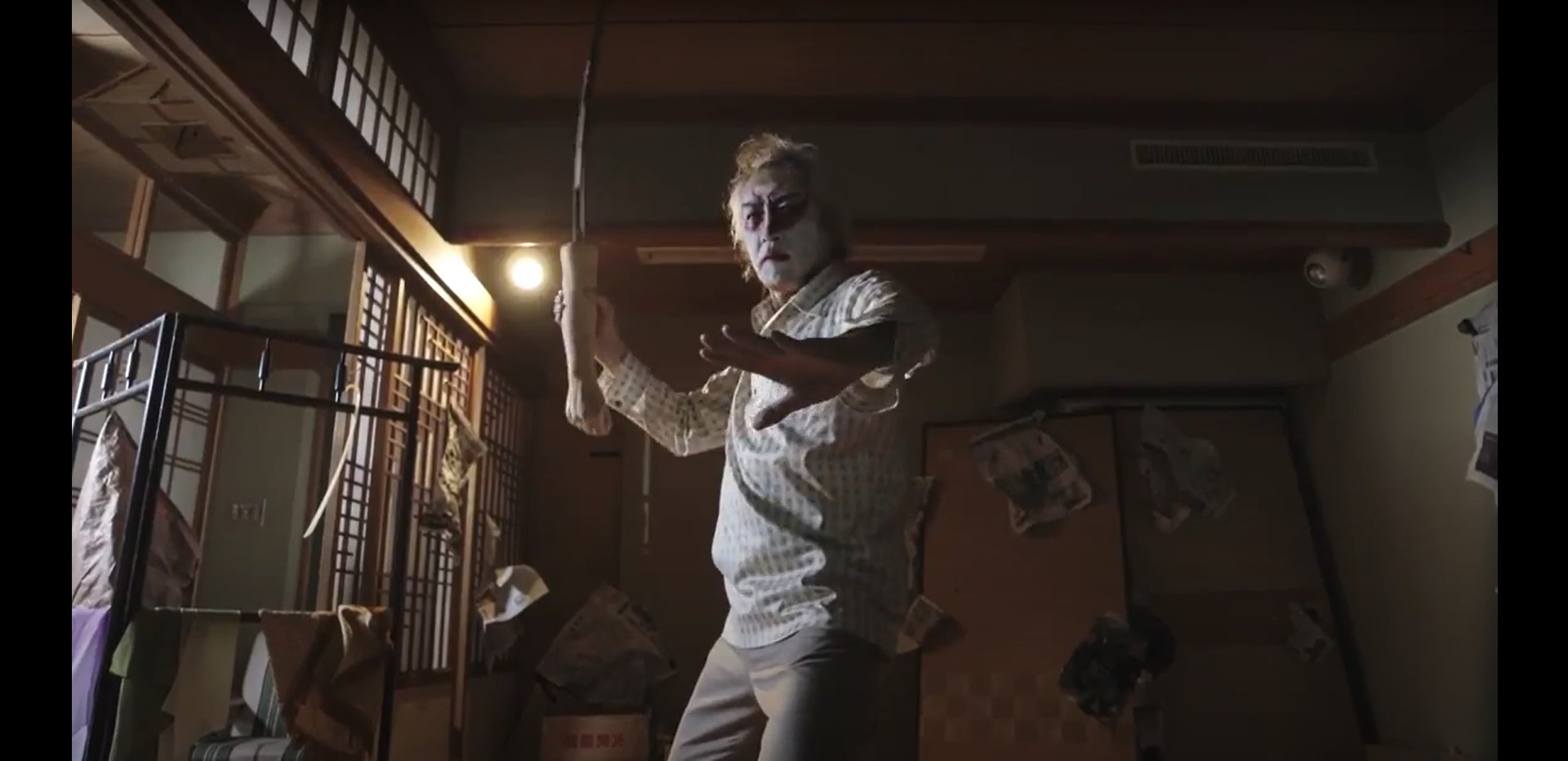
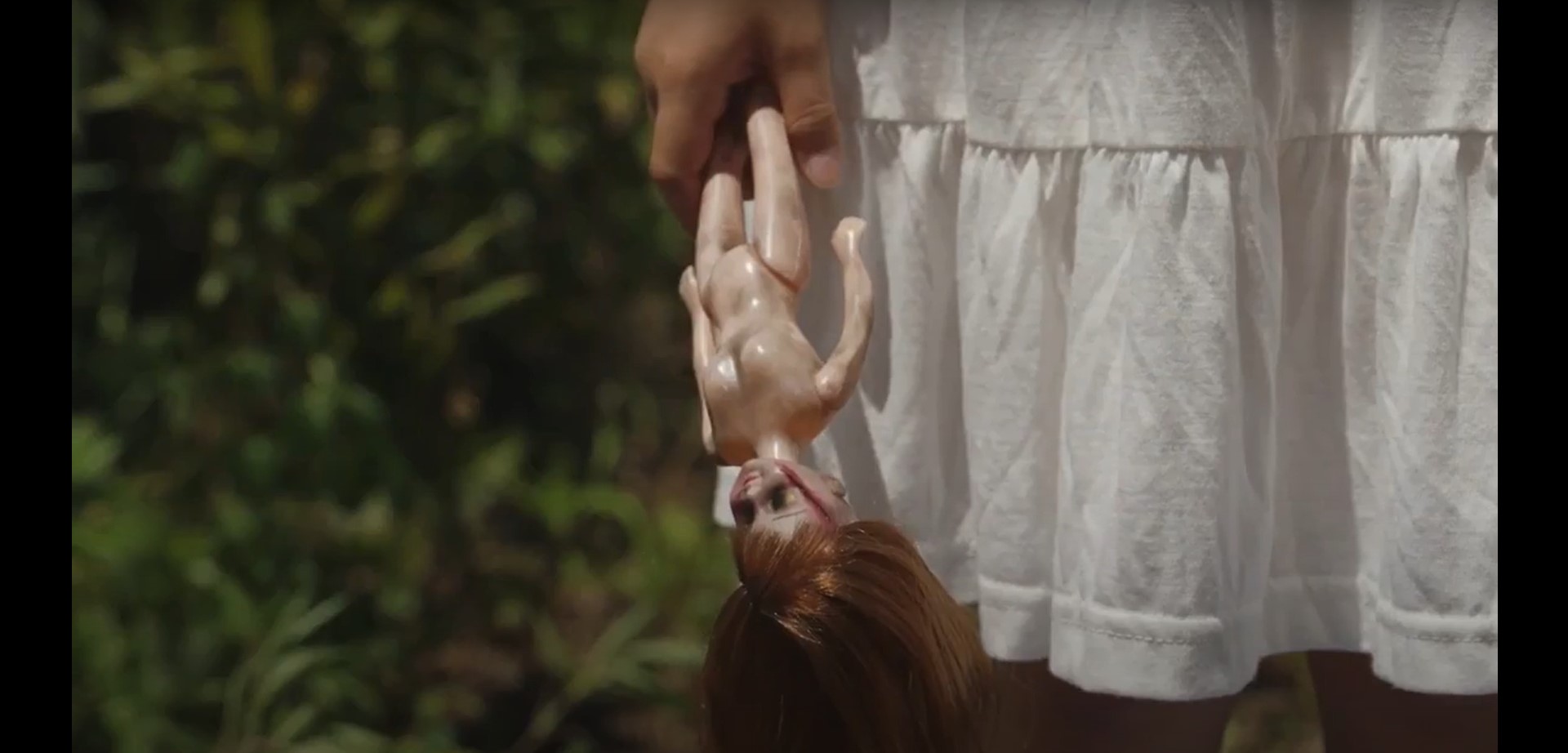
To put it simply, “Blood for Flesh” is madness of unchecked immorality and to make something this deranged, Hernández would have needed a likeminded cast small enough to pull off callous scenes of rape, torture, and merciless death as well as aberrant scenes of incest surrounding three members of a truly messed up family. Beginning with the patriarch who is only know as the Father, played by Juan Manuel Martínez, whose subsequently becomes the violently persecuted by his own spawn after groveling at his daughter’s feet in a moment of bawling seeking forgiveness. Bound and gagged, beaten, and hung upside, the Father receives no mercy from his children and there’s no real revelation to why he’s become a subject of torture. Brother (Luis Navarro) and Sister (Erika López) fashion a complex relationship of courtship and collusion. As the Brother notes more than once in a divulging of truth the longing for his sister and his regretful reluctance in continuing the mistreatment of his father, its the Sister who seemingly has the upper hand, the hypnotic spell, over her love stricken brother and as Hernández dives into Sister’s unhinged scenes, especially where she marks her face and body with makeup, we come to realize that Sister just might not be right in the old cabeza. Now, how the cannibals – played by Christian Camara, Daniel Cruz, Enrique Diaz Duran, Aldo Palacios, and Marisela Plaza – fold into the family’s unraveling is a bit of a mystery but I’d like to think their naked savagery represents the rupture and hate between family and the cannibalism is kind of this dog-eat-dog mentality to come out on top by exploiting the other.
No matter which way you slice it, no matter how sharp the blade divides the skin, the muscle, the meat, or the bone, making sense of “Blood for Flesh” will never, ever happen as the almost an hour runtime feature, setup into chapters, is a bundle of biting brutality possibly representing a wide variety of real-world complications. The non-linear structure formulates no sensical path from beginning to end as you’re plopped right into the family’s madness from minute one and though I’m no stranger to undisguised abstract art in indie film, I can usually piece together to symbolic impressions or the weave a clear justification for most scenes in arthouse horror. With “Blood for Flesh,” I’m about as lost as a 5-year-old in a mall whose wander off from his inattentive shopaholic mother perusing the hot deal clothes racks at JCPenney’s the day after Christmas. I watch as Erika López strip away her clothes and her character’s mortality in every scene, I ponder and consider Juan Manuel Martínez’s Father’s compulsive reactions to seek forgiveness as well as to be vindictive toward his off-color and off-their-rocker offspring, and I am beguiled by Luis Navarro’s need to be inside his sister and, yet I feel nowhere near grounded to “Blood for Flesh’s” message if there is even one to be grounded to. Maybe we’re not supposed to connect with such corrosive content in what’s supposed to be just purely unabated shock content to rock the core of typicality. The cannibal scenes seem to be just an object of the director’s fascination with the ugly side of tribal horrors in a stereotyped rendition that depict them as nothing more than basal beasts that take what they want without an out of compassion and my mind continues to lean toward that high degree of barbarism to equate to a family built upon by hate, loathing, and individual interests.
“Blood for Flesh” could have easily fit in the catalogue of other extreme and underground horror labels, but this experimental purge of images and sins has found a home at SRS Cinema on the company’s Nightmare Fuel banner DVD distributed by MVD Visual. The single layer, region free, and unrated DVD is presented in a widescreen 1.85:1 aspect ratio that decompresses content around 5-6 Mbps, hovering around par for the course when considering DVD picture quality. Generally, the cinematography is bleak, like it’s content, with muted coloring or shot in the dark to avoid any colorful hues. Only when stark red filters are used, which is only one or two scenes, is when color unloads in every inch and corner of the frame. There’s some aliasing and banding in certain scenes that cause momentary distortion that make it hard to delineate exactly what you’re looking act – is it an open and bloody slit or gash or is a cheeseburger? That’s always a fun game to play. The Spanish language audio tracks come in two formats – a PCM Stereo 2.0 and a Dolby Digital 2.0. The PCM is, again, muted with a lack of robust quality the Dolby Digital has much more vigor in all the sub-tracks. Unfortunately, the pieced together soundbites lack creativity and are poorly spliced together that continuously drop off in an instant on the backend. The forced English subtitles synch okay and are captioned well. Bonus features include a filmmaker’s commentary track, interviews with the cast that come with awful Spanglish translations, and the film’s trailer. If Domiziano Cristopharo saw something unique in Alex Hernández, I have yet to see it as I’m not sold on the director’s fringe horror film that aims to just be randomize acts of violence for 59 minutes.
Charlene anxiously awaits the return of girlfriend Simone who has been away on a photoshoot. Today is their anniversary and Charlene wants everything to be perfect by creating a lovely evening together for just the two of them in their New York City apartment. As the night progresses and still no sign of Simone, despite her flight landing hours ago, Charlene begins to worry but her phone suddenly malfunctions and her apartment front door jams, locking her inside with no way out. To make matters worse, the outside is blacked out from something covering her widow to where no light can penetrate and she can’t see anything exterior. Throughout the night, voices and shadows slowly surround her, dark silhouettes stand motionless in her storage basement and outside her jammed door, and the video calls with her mom and friends turn to an unnerving end as it seems Simone nor anybody else is coming to recuse her. Intermittent flashbacks of her at the beach and a neighboring voice are her only company that menacingly mess with Charlene’s mind as she quickly realize that something is terribly wrong.
If you’re looking for a compact, close-quartered, psychological barrel of scutter apprehension and fear, I wholeheartedly believe filmmakers Emily Bennett and Justin Brooks have what you need to inject that tar black cathartic dread right into your emotionally hungry veins with their latest film “Alone With You.” Born and bred out of strict COVID times, “Alone With You” is the 2020 filmed mind-torturing, hell in a cell shot inside Emily Bennett’s NYC apartment during most of the shoot, using telecommunication technology to invite other actors into the spatial bubble and interact with the main lead without physically being on set. We’ve seen a ton of other COVID-created content over the past two years, but “Alone With You” definitely shines as not only isolating madness but also a fear of disconnect in reality, mental struggles over brittle relationships, and an illusionary life stemmed out of disenchanting circumstances. “Alone With You” is written and directed by Emily Bennett and Justin Brooks as their first feature film and is produced by “Underworld: Awakening” actor Theo James and Andrew D. Corkin of the 2019 created production label, Untapped.
With a small indie feature film during pandemic pandemonium, the odds the cast and crew are downsized, probably meagerly paid, and limited by the pandemic-stricken environment and lack of funds. “Alone With You” is just that film because at the principle lead is none other than Emily Bennett, one of half of the directing duo. Bennett, who has a solid acting career with even a role alongside “The Devil’s Rejects’” Bill Moseley in the “House of the Witchdoctor,” gets cozy in her own two story apartment that suddenly becomes an ensnarement of unveiling and disturbing truth. Bennett hits every level of descension without an immediate belief that something isn’t right with her surroundings. Charlene takes multiple gradual hits of paranormal punches and Bennett executes her fear with great poise without any lopsidedness to give away too much too early that can sometimes kill momentum before the spookiness starts to really get good. Through flashbacks and video calls, other actors interject moments of levity, different sides of tension, and, frankly, break up the Bennett monotony and from those brief moments, we get a sense of who Charlene is and a slither piece of her backstory. The amazingly talented “Bliss” and “VFW” actress, Dora Madison, plays Charlene’s inebriated-uncouth friend Thea over a cell phone video call, zooming in is Charlene’s rightwing mother played by the ever versatile and extremely lovely Barbara Crampton, and, lastly, Emma Myles, in an unrecognizable role in contrast of a greasy haired addict and former Amish turned inmate performance in “Orange is the New Black,” is the always beyond arm’s length away love interest Simone.
What I like most of about “Alone With You” is the atmospherics of being in your safe, cozy place that has instantly turned in a prison of peripheral moving shadows, an invasion of privacy, and, most frighteningly of all with most millennials, none of the modern technology is working properly. The story design feels extremely pushed toward a wash, rinse, and repeat cycle with no other areas in the apartment to explore other than the handful of main rooms and so we’re constantly in the bedroom, then living room, then front door, then basement, and then repeat for most of the 1 hour and 22 minute runtime but do you know what happens with that? Bennett and Brooks strategize and outline the snowball of bad feelings inside the ominous compact, starting small and working up to a cacophony of madness to where Charlene is literally moving back and forth between truth and deception induced by being scared to shivers of her own apartment’s clad and taken for granted discomforts, such as the front door sometimes being stuck or the crying lady neighbor who you can hear clearly through the air register. “Alone With You” fiddles with the theme of disconnection. Here you have Charlene, a small town girl who moves into the big city, has discovered her sexuality, and has found a vocation that suits her to which all this change go against her mother’s approval, and she feels strongly attached, like an extension of herself, to girlfriend Simone and as the story progresses, we get the sense that not everything is lovey-dovey between the two and Charlene’s dependent world is slowly being severed. Simple, yet effective, “Alone With You” is an undoing nightmare of personal happiness, a sentiment we all share and relate to during height of the pandemic.
Now, we all suffer in Charlene’s insufferable loneliness and disconnection with the “Alone With You” DVD home video courtesy of Dark Star Pictures. The region 1, dual layer DVD is presented in a 2.39:1 aspect ratio of standard 480p resolution definition, but the DVD image renders nicely on screen with digital sharpness unaffected by any compression issues, especially with much of the space saving special effects coming in practical and mostly done in the editing room. The video calls vary in quality which is pleasantly dispersed to the appropriate electronic devise, i.e. television, phone, etc. Details are clearly there but only slightly softer around the edged delineation. Two audio tracks are available with an English language Dolby Digital 5.1 and a stereo 2.0, but the 5.1 track is an allocating alicorn for a low-budget DVD. Shawn Guffy and Nicole Pettigrew’s sound design is meticulously on point and on cue with every synchronous audio nudge to point Charlene in the right direction for another round of dread. The varying levels of the Phil Mossman’s soundtrack adds a blended flavor of melancholy and fear. Dialogue output renders clearly and cleanly with no issues. English SDH subtitles are available. DVD comes stocked with special features including a blooper reel, a bit of a waste of space on the deleted scene reel that doesn’t add much to either the character or story, a lengthy and in-depth filmmaker and cast interviews, a behind-the-scenes featurette of Emily Bennett and Justin Brooks remarking on the struggles of feature filming around their apartment during COVID spikes, and a director commentary with the duo. “Alone With You” has a heavy artsy side to it that can leave viewers wandering for answers but if pieced together, if paying close enough attention, the correlation between the story in the camera and the life behind the camera are really not terrifyingly different. One just happens to be more of a representation hyperbolized with terror of a crashing down reality than the other.
In a small lakeside, mountain town, a violent rape of a young woman paralyzes her into complete shock, shutting down her power to speak, and spiraling her into a withdraw. Newly appointed Sheriff Sylvia Carlsen has a personal stake in the case as the woman is a close and dear childhood friend. The nature of the rape puzzles law enforcement and frightens the small community after evidence of soil and worms are discovered around the scene of the crime and inside the victim. When another of her close friends is violently rape the same way, Carlsen’s painful recollection of a dark secret involving her and her friends reagitates a dormant fear and familiarities between her past and the rapes appear to me more than just coincidences. As the attacks continue, the toll on her mounds and a series of erratic behavior incidents put into question her judgement but that won’t stop her digging into her own case of issues.
Have you ever come across a zombie revenge thriller where the decomposing undead, recently fresh from a risen unmarked grave, stuck his worm (no, that isn’t an euphemism) into a hapless female victim? While not explicitly depicted in what sounds like a niche fetish of the subfloor adult film industry, the image of soil and creepy crawlers inside the vaginal cavity is very real in director Michael P. DiPaolo’s “Daddy” where daddy issues can be extremely violating and gruesomely decaying all in the same rotten breath. The “Requiem for a Whore” and “Transgression” filmmaker writes and directs the 2003 SOV-shot style, back from the grave indie production, at one point in time was called under the working title of “Rigor Mortis,” hailing from the Albany proximate Averill Park, New York and was self-funded and produced by DiPaolo and Christopher K. Philippo (“Motor Home Massacre”) under DiPaolo’s production label, Black Cat Cinema.
The actresses to be symbolically lubricated with the Earth’s muck are played by four friends, who just happen to be all blonde as if blondes run together like a pack of wino Golden Retrievers. In her first feature film, not a television role, is principal blonde number one Selia Hansen as the frequently boozing, causal sex engaging, newly appointed sheriff, Sylvia Carlsen. Hansen plays the hot-headed Sheriff eager to prove herself but is shredded emotionally by the violent sexual assault against her friends – Leslie (Katherine Petty), Jamie (Cynthia Polakovich, “Date with a Vampire”), and Allison (Bevin McGraw, “Arachnid”). Other than BFF Leslie, there isn’t too much discourse between the good friends and if is conversing between them, the topic of conversation is about the rapes, leaving the groups’ tightly knit friendship barely tethered to Carlsen’s burdened shoulders. Ravaging the community’s blond population is the titular rapist and to avoid obvious spoilers, I will refrain from divulging the attacker’s reason for stalking Sheriff Carlsen and her male unaccompanied friends. In what is perhaps the biggest role of his scarcely career, Aaron Renning lurks around like deviant, tongue-wagging Uncle Fester complete with chrome dome and a dirty dinner jacket grimed with earth and wiggly worms. Renning’s performance has it easy with zip for dialogue and a penchant for being a raving manic with a libido in hyperdrive. The performance bares no crass crudeness as it’s very to the point without revealing the point – if you get my point. Actors following up from Michael P. DiPaolo’s “Transgression” is David Shepherd as the town’s Doctor Vance and Marc St. Camille as the pushover Deputy Richie Dagg. Yet, the most interesting casted member is John Karyus. The “Poultrygeist: Night of the Chicken Dead” to “Big Freaking Rat” B-horror Karyus plays the Sheriff’s ex-husband who’s always peeping and is eager to inform his ex-wife something important but doesn’t ever receive the chance to, marking his scenes utterly pointless.
“Daddy” issues is right. DiPaolo strikes up grave retribution with a zombie degenerate harboring a message, one that I can only hope is accurate, is suppressed emotional trauma can be haunting, if not deadly, when not dealt with its beleaguering demons. However, “Daddy’s” undercurrent is more grossly sweeping and pungent with corrosive, misguided outcomes. Instead of battling trauma, DiPaolo’s depiction of Carlsen’s alcoholic abuse and fleeting affairs coupled with nightmares of the past also speaks illy toward guilt and feeling guilty over an irreversible criminal act done for the right reasons, in self-defense, nonetheless, sets the wrong tone. The finale also doesn’t set well with the fact that DiPaolo inflicts no escape from one’s rapist, no comfort in the knowledge of their death, and that their lives hang in the very balance, targeted by a demented vision. Demented, that’s definitely how I would describe DiPaolo’s serial rapist zombie flick that’s not terribly terrifying as it is one’s twisted filmic folly into incest and inevitable topple of repossession of oneself. “Daddy’s” acting is often stiff and forced, on the cheap effects offer up fake and live worms and a gray palette zombie perv, and the handheld SOV-style camera work from DiPaolo himself is like a fly buzzing around the room at times. “Daddy’s” beyond the dead vindictive nature is only abated by the number of topless blondes being subjected to dry humping in this ill-judged, undead-to-bed fiasco.
Of course, it only makes sense that SRS Cinema would release something to the likes of “Daddy” onto DVD home video. SRS Cinema loves nearly everything shot-on-video, nihilistic, zany, and unconscionable content. Sex and death sells and SRS Cinema has a long history of delivering good on that brand of promise while also luring unsuspected victims, I mean viewers, with exceptional retro-cover art that’s vibrant and detailed in all things macabre. The region free DVD has an aspect ratio of 4:3 and a runtime of 83-minutes. Shot with a videotape camcorder, image quality is about what you expect with an immense amount of interference during night shots and compression artefact issues rampant throughout, especially during black and white flashbacks, but the image is essentially discernible which makes DiPaolo’s use of only natural light more impressive. The English language mono track is hit-or-miss depending on the camcorder’s mic placement with faded hissing to throw another curve back at you. There are moments when the ambience is exquisitely sharp in fidelity and edit, such as the blaring police siren or a car suddenly passing into frame for jump scare effect. Bonus features include a commentary track with Michael P. DiPaolo, a behind-the-scenes featurette with DiPaolo narrating upon how he accomplished more of the difficult and complicated scenes, the feature trailer, and SRS film trailers. Interesting concept piledriven by its creepy subtext, “Daddy” continues to be aversive with a tagline “He comes after bad little girls!” splayed on the front cover that leaves cringed induced wrinkles on my face every time I cerebrate the underground film. In the same breath, I know and love SRS Cinema’s unwavering nihilism, standing admirably behind Michael DiPoalo’s incestuous and rapey, unfatherly film without second guessing commitment.
Sylvia Kristel. A name that is synonymous to eroticism. Kristel paved the way in mainstreaming seductive romances of softcore exploits, helping to elevate the provocative genre out of the depths of sleaze and into a more exotic trashy novel for the big screen. In her titular role in the “Emmanuelle” franchise coursed an arousing path of sexual freedom, uninhibition, and became the sumptuous and worldly window in private fantasies. Playing the role for nearly two decades didn’t stop Kristel from other high profile and lucrative projects with an array of filmmakers as well as her roles pre-“Emmanuelle” that molded the Netherlands actress into a sexual icon rather than object of male fantasies. Cult Epics acquires four films – “Playing with Fire,” “Pastorale 1943,” “Mysteries,” and “Julia” – that even though didn’t have Kristel set as a principal lead still showcased her range within the constraints of a minor, but certainly not insignificant, performance.
“Playing With Fire”
In a madcap Paris where sex trafficking is something of a sport, a wealthy French banker learns his daughter has been kidnap and threatened to be tricked out or burned alive if the kidnappers’ ransom isn’t paid. Quickly learning that another woman has been mistaken for his daughter, a wave of relief bestows him to be cautious about future attempts on his daughter’s safety. The banker hires a private detective to protect his loveliest of assets, offering to escort her to a local safehouse with the promise of sanctuary, but the P.I. is operating incognito being really one of the leaders of a surreal and lavish brothel who now has the banker’s beautiful daughter in his possession. Or is it her who possesses him?
Unlike any other exploitation-comedy you’ve likely ever seen, the 1975 released “Playing with Fire,” aka “Le jeu avec le feu,” is a wacky deep-dive of surrealistic sex trafficking from French writer-director Alain Robbe-Grillet whose obsession with prostitution rings and other filmic eroticism pursuits extends back within a decade later with “L’Immortelle,” aka “The Immortal One,” and “Successive Slidings of Pleasure.” A French production of Arcadie Productions, Madeleine Films, and Cinecompany, “Playing with Fire” masters the avant-garde art of making light of a grim topic that results in a pull of emotions. Robbe-Grillet draws out the shocking aspects of sex slavery while also encouraging a smirk or a chuckle at the whimsical characters and shooting techniques weaved throughout a burlesque narrative. Robbe-Grillet also plays with the theme of dualities with a number of the principal characters having two or more versions of themselves: Philippe Noriet plays not only the banker father Georges de Saxe but also a voiceless sleaze erotically interacting with the banker’s daughter in a very Freudian concept between father-daughter relations. His daughter, Carolina (Anicée Alvina), disguises herself as the thin-mustached private detective to thwart future any attempt at an abduction and there’s also the identity mishap with the similar looking woman mistakenly kidnapped by the ringleader. Leading us into Jean-Louis Trintignant as the ringleader Franz constantly in a revolving door switch-a-roo façade into the private detective. The presence of duality doesn’t stop being a present throughout, continuing with the banker’s butler who is also a whorehouse patron without affirmation that they’re the one and same person. Before their illegal banishment in the mid-20th century, Brothels were widely dispersed throughout Paris, but not until the Nazi occupation absorbed the houses of ill-repute that seared a bad taste of deviant humiliation and sordid disgust into the mouths’ of the French populace and Robbe-Grillet taps into that once time of unrest by splicing in a pair of isolating scenes of goose-stepping Nazi soldiers with one of the moments garmenting Anicée Alvina in uniform and marching in the ranks, suggesting a more sinister subplot afoot in the storyline. Kristel plays one of the women snatched by Trintignant’s efficiently devious Franz with virtual a voiceless performance in what’s only a symbol of strength and beauty that sets perversion ablaze as she’s taken through the motions of essentially onboarding her into slavery whoredom. “Playing With Fire” can be at times difficult to keep up with the Alice in Wonderland-like surrealism and the character dualism but persists unwaveringly with a multi-faceted narration of deceit, eroticism, and comedy full of perversions and random outbursts akin to satirical skits that make this film unpredictable yet enjoyable to behold.
Pastorale 1943
During the Nazi occupation of the Netherlands, a quaint Dutch farming village lives day-to-day alongside soldiers and German sympathizers known as National Socialists (NSB) to the Nazis, traitors to their fellow Dutch countrymen. When the Nazis learn of and round up all the dissidents and Jewish heritage people living in hiding on an adjacent, ferryboat island, a small band of unorganized resistant fighters determine the local pharmacist, a NSB member, to be the Nazi collaborator responsible for the treacherous leaking of information because his son impregnates an island village girl, teetering toward the fascist movement when mocked by her peers for her involvement with the pharmacist’s son. Inexperienced in the execution of traitors, the bungling resistance fighters learn just how difficult planning a murder can be when their scheme falls apart in a small village where everybody knows everybody.
On this second of four Sylvia Kristel features is the Spieghel Filmproductiemaatschaappij of “Pastorale 1943” which makes more prominent the Nazi regime, is set with a backdrop of a Nazi occupied Netherland town and has a cameo role of young and dashing Rutger Hauer (“Blind Fury,” “The Hitcher”). Netherland writer-director Wim Verstappen, whose had a few titles released previously from Cult Epics, such as “Obsessions” and “Blue Movie,” develops a script out of the World War II drama novel from author Simon Vestdijk with black comedic undertones and a tinge of corrosive sexuality and released the film in 1978. Pastorale, or Pastoral, refers to the typically calm and idyllic country life which the complete opposite in 1943 Netherlands with all of Europe and East Asia engulfed in war; however, this story takes place in its own corner of the world with a mini, damn near microscopic, war waged between the Nazis occupation along with domestic NSB collaborators and the inhabitants resisting against the encroaching fascism that has plagued revenue crops and instilled an authoritarian culture, such as mandating the teaching of the German language to students in Dutch schools. Kristel’s involvement with Verstappen’s “Pastorale 1943” is about as much as her involvement in “Playing With Fire” with a minor role that’s still a keystone piece to the narrative. She plays Miep Algera, a local schoolteacher disparaged by her neighbors and colleagues for having romantic relations with a Nazi officer, but has she really fallen for the officer or is she secretly conducting counterintelligence for the resistance? “Pastorale 1943’s” two-part story plays heavily embroiling and embroidering characters in the first half to the point of instituting a cornerstone character but when the narrative pivots, to the darker side of implied Nazi exterminations and the fumbling through the execution of a rightfully innocent man, Verstappen homes in on Frederik de Groot as the artist Johan Schults whose Germanic surname causes him much strife amongst his Dutch brethren but to prove himself, Schults takes charge, along with an equally green execution squad of resistance politicians, to murder the NSB collaborator, a local pharmacist Poerstamper (Bernard Droog). The Academy Award submitted “Pastorale 1943” can be light and funny then turn quickly on a dime into wartime darkness and director Wim Verstappen’s vision pops with epic World War II fascism atrocities, confined to one part of the world and without the explicit voyeurism of genocide.
“Mysteries”
After the strange suicidal death of a man named Karlson, Johan Nagel arrives to the coastal town where the death occurred. Immediately, Nagel stands out from the supercilious eccentric residents with his mustard yellow suit and fur coat, dispensing small cigars and money to everyone and every service as if they were infinite, and exhibits his own brand of strange behavior, especially with amorous feelings between two women and an unlikely friendship with a dwarf who has accepted his neighbors’ belittling jabs for humorous pleasure. As his behavior declines, Nagel’s presence unravels the coiled, seemingly impenetrable, barriers around his friends, his enemies, and his romantic pursuits that reshape their properties for the better at the dangers of his own sanity and life.
Finally, we’re at a point in the Sylvia Kristel collection where the titular star is in a lead role with this demolition of concrete idiosyncratic personalities melodrama entitled “Mysteries” from Dutch filmmaker Paul de Lussanet, based off a novel “Mysterier” by Knut Hamsun, with Sigma Film Productions as the production company. Kristel plays the steely Dany Kielland who becomes the infatuation of Nagel in an oppositional performance beautifully deranged and conducted by Rutger Hauer. The hot-and-cold and on the brink of frustration relationship between Kielland and Nagel is as resolved as an unfinished breakfast left to waste and void of complete nutrition as both characters digest morsels of desire only to explode in a frenzy of loathsome disgust in an unsavory, brittle dynamic only Hauer and Kristel could produce on screen. The other love interest involved, yet hardly feels as such until the last half hour, is an aged and more humble Martha Gude portrayed by “Last Night in Soho” British actress Rita Tushingham complete with a poor-looking frosty-colored wig. Kielland and Gude represent the two-side of society – rich and poor respectively – stuck mastering a stanch stance of an indeterminate state that Nagel barrels into and knocks down the status quo, like a bowling ball to ten pins, for the better of the coastal town. None of what Nagel does seemingly makes any sense and that’s very true to Hamsun’s novel in the unconventional, and probably unintentional, methods of Nagel’s erratic influence. “Time Bandit’s” David Rappaport debuts in his first feature film as Grogard, an achondroplasia character bulled by most of the town’s residents due to his disorder. Grogard anecdotally tells the story as “Mysteries” narrator, as if reading straight from Hamsun’s novel, the recollection of Nagel’s dichotomic behavior and, at the same time, Nagel also being a mentor, protector, and a friend that pained Grogard to watch his friend whither to death in fit of emotional exhaustion. “Mysteries” borders arthouse cinema, adaptive faithfulness, and pristine melodramatic performance that sound good in theory but not always translate well to the screen, leaving more of a perplexing impression on the whole purpose of rendering Knut Hamsun’s novel into film in the first place.
“Julia”
Every year, Patrick departs his boarding school for a short holiday with his father and relatives at his grandmother’s idyllic lakeside house. While riding the train en route to his grandmother’s, he encounters an older, yet beautiful, blonde woman inside the passenger carriage car and before he can firm up courage to act upon his sexual brimming hormones, the blonde is swept up by an older gentleman right from under his nose. Come to find out, the blonde woman is actually his father’s girlfriend in a completely open relationship when it boils down to sex. Anxious about his own insecure sexual appetite, Patrick finds himself surrounded by the perversions of his family and friends, leaving the young man hesitant and nearly impotent in bedding the woman he actually cares about, a longtime friend Julia who lives next door to his grandmother.
On the heels of “Emmanuelle,” Sylvia Kristel follows up with another licentious freedom film in Sigi Rothemund’s “Julia.” Also known as “Summer Girl” or “Die Nichte der O,” the German production from the Lisa-Film company is the earliest film on the 1970s collection with a release in 1974 and is the only other screenplay on the collection next to “Playing with Fire” that is not adapted from literature. Instead, “Julia” is a wild romp ride of young sexual exploration and the anxieties that accompany it from an outlandish and witty script by Wolfgang Bauer. “Julia” might not be based off a book, but the story is certainly an unapologetically open book about the insignificance of virginity, polyamorous affairs, lesbianism, voyeurism, and the sexual rite of passage into adulthood with the young and naive principal Patrick, or Pauli as credited, played by the late Ekkehardt Belle who passed away in January of this year. Opposite Belle, Sylvia Kristel obviously dons the titular role of Julia. Inexplicably voluptuously different from the other three films on the collection, Kristel radiates a sexual aurora perhaps infected by proxy of its release soon after “Emmanuelle” as Kristel obvious branches out to more sensible dramatic roles rather than the decor of a German sex comedy such as “Julia” that galvanized by its free-for-all eccentric caricatures including an operatic, overweight, and perverse uncle Uncle Alex (Peter Berling, “When Women Were Called Virgins”), a highly aggressive lesbian in Aunt Myriam (Gisela Hahn, “Devil Hunter”), the house maid Silvana who Myrian seduces with whipped cream and has piano-top sex (Christine Glasner), and his polyamorous father Ralph (Jean-Claude Bouillion, “The Sextorvert”) and girlfriend Yvonne (Teri Tordai, “She Lost Her…You Know What”). Comparatively flimsy next to “Emmanuelle” as a sexual journey and coming of age film but “Julia” is a hot-to-trot sex comedy with funny bits as well as sultry naught bits too.
Beautifully curated for the first time ever release in the United States of all four films is Cult Epics’ “Sylvia Kristel: 1970s Collection” on Blu-ray and DVD. The 4-disc, uncut Blu-ray, which was provided for coverage, is region free, limited to 2500 copies, and perfectly packaging to extol praise upon the robust early career of Sylvia Kristel. Presented in European widescreen 1:66:1 (with the exception of “Playing with Fire” which is displayed in an anamorphic 2:35:1), each film is newly scanned in 2K from the original 35mm elements as well as been restored. Transfers for the most part are exquisitely pristine, each harboring their own mise-en-scene mélange, but some are better than others with “Mysteries” sitting at the bottom rung of showing slightly a few more scratches and one-or-two single frame damages that flame up through the reel briefly. “Julia” also has minor scratches, but that’s really the extent of the issues with the image quality on this restored visual released with a rich color palette and textures redefined for a better palpability. Compression issues are virtually non-existent and there are no tinkering enhancements or cropping used to skirt transfer limitations. I am in awe of the audio output of the 1920kps bitrate, transmitting the highest audio quality possible for each release through either DTS-HD Master Audio 2.0 or a LCPM 2.0. Dialogue clarity comes through cleanly with French in “Playing with Fire,” Dutch and German in “Pastorale 1943,” and German in “Julia.” “Mysteries” sounds a bit muddle sometimes due to the consistently background popping interference, but the Dutch language still pulls through strongly and discernibly. Each film comes with optional English subtitles. Special features are aplenty with audio commentaries by Tim Lucas, Jeremy Richey, and Peter W. Verstraten, new and vintage interviews and promotional footage with cast and crew on ‘Playing with Fire,” “Pastorale 1943,” and “Mysteries,” a poster and still gallery on each release, and original theatrical trailers. Outside the disc contents, the collection’s rugged cardboard boxset housing unit consists of a 4-disc snapper case with vintage-still collage cover art, a 40-page illustrated booklet with color pictures and an essay on all four films written by Jeremy Richey, and a cover art poster by Gilles Vranckx. Total runtime is 429 minutes, enough to get your Syliva Kristel fill and then want more…much more. The “Sylvia Kristel: 1970s Collection” lauds the actress’s versatility of performances and ability to work with any director from any country and fans who love “Emmanuelle,” or of just Kristel, will undoubtedly fall in love with this Cult Epics comprehensive look at the Dutch icon’s outermost filmography.
Two killers are employed to do what they do best, to make a snuff tape. Brokering the deal is Brand, a middleman serving on the behalf of a unknown client and relaying the job’s details to his contracted filmmakers. The casted stars of their next production is a young pregnant woman who works at the home for the disabled and one of the residents, a 15-year-old deaf-mute girl who can’t utter a single sound due to her extreme incapacitated condition. Pretending to be making a documentary about the disabled, the two killers were able to gain the women’s trust, easily drug them, and move them to a secluded location where the sadistic torture and affectionless murder show begins.
Straight torture and gore with no cinematic style or undertone depth is not every moviegoers preferred cup of tea. For this gore hound, I can take it or leave it but would enjoy the darkest recesses of human sadisms and fantasies more if something was more germane to the reason for gore, but as far as Juval Marlon’s “Snuff Tape Massacre” is concerned, what you receive is a single perspective propelled by unsympathetic maliciousness, nihilism, and a taste for that metallic sweetness of blood. The Germans are fairly well known for their insensitive, uncouth, and extreme films from the likes of directors Olaf Ittanbach and Jörg Buttgereit. Does Juval Marlon have the blood and guts to be on the same level? His written and directed 60-minute independent feature, also known as “Stermgewehr,” (“rifle” in German), aims to be a gruesome shocker under Marlon’s own befitting Beheading Films banner.
Obviously, none of the following names will be a part of a familiar, household cast fixture. These types of gorging gore films usually have a small and conversant with each other cast of at approximately a hand full of willing actors and actresses to possibly mar, or better yet castrate, their acting aspirations with needless disturbing content that’s ironically overstated as well as understated. “Snuff Tape Massacre” has a total of five members in the cast and out of the five members, only one uses a first and last name. The others go essentially dark with their real or full names anonymous to the world because who would ever in their right mind want to be associated with a movie about a snuff film? Thomas Goersch is the only full name credited and the only actor who a respectable credit list. However, Goersch has had many publicly and critically panned low-rent features with “The Curse of the White Woman,” “Bloody Shadows,” and “Poltergeister Experiment” being just some of his most recent samples that fallen into the depths of unsalvageable dumpster fires (and this has perked my darkly morbid and unusual curiosity in bad, bad movies!). As businessman Brand, Goersch never gets his hands dirty, leaving the role and his name unscathed and to leave all death-dealings to his hired hands in a pair of automaton teenage terminators including the head Snuff Filmer (Navarro) and his unnamed companion on the trail of blood. At least Goersch has a bit of Bill Zebub underground star power in Germany, Navarro exists only in this film as the one of the two mostly shaded and masked killers who kidnap actresses Tanja and Maria V. to exploit. The ruse surrounding the kidnapping leaves what ever little effort there was to be, to make the ordeal more engaging and exciting, was left back on Brand’s phone call as the Snuff Filmer’s plan to be pseudo-interviewers for a documentary goes off without a hitch. Maria V. does find as an interviewee of a second-year social worker enthusiastic about helping but her fellow co-kidnappee in binds Tanja literally serves as a second body to humiliate, torture, and execute by two desensitized individuals that isn’t a far stretch from their rigid performances as high and tight killers.
The crux of the problem with “Snuff Tape Massacre” is that the movie is just too long. Right now, you’re sitting there, reading this, cross-eyed by confusion, and thinking to yourself, “Steven, didn’t you say this was a 60-minute movie?” The answer is, yes, I did say that, but Marlon’s previous work, of similar extreme fetishisms, have been short films and “Snuff Tape Massacre” feels very much like a short film that’s been mishappened by a rack, stretched beyond its limits to where the possibility of being recognized for what it is, an orthodox gore and shocker, no longer factors into the equation. Scenes run too long and are over kneaded to the point of losing its impactful rise. For instance, when the young 15-year-old mute-deaf girl is being threatened by the Snuff Filmer’s automatic rifle barrel as he stuffs it into her mouth in an unspoken, simulated act of fellatio, the scene drags on for minutes upon minutes. As aforementioned, “Stermgewehr” in Germain is rifle and so these scenes should have some significance importance but overall feels juvenile and executed with poor time management. Marlon obviously doesn’t have two Nickels to rub together to fund this film, using old compact, pocket-sized digital cameras to record the varying levels of video and audio quality, but the one thing us gore hunds can appreciate is the gore. We can certainly tell a fake leg, arm, and even penis when one comes on screen and “Snuff Tape Massacre” is not exempt from using more-so than obvious inner details with no arterial or vascular details whenever a leg or arm is chopped (or even sawed) off with a dull hatchet, but what can be admired is the seamless look of the leg and the arm to the actresses. We’re not talking about a mannequin’s appendages or a plastique digits here when the dragged-on interview has finally wrapped, and the real raw material begins with decent prosthetics and blood pumping mechanisms that squirt blood longer and for the duration. The most effective effect is dick-hole jab stuck on repeat until the snuffer hits what we all presume is the back off the prosthetic piece but in the back of our mind, we’re really thinking bone. It’s a crotch-grabbing, leg-crossing, dick mangling moment no guy will ever forget.
SRS Cinema is well-known for bringing schlocky shockers to the table under the guise of really fantastic and detailed artwork for the banner’s DVD covers. “Snuff Tape Massacre” is no exception here as Juval Marlon’s film is juicy enough to make the company’s Nightmare Fuel line with an unrated and extreme release presented in widescreen 1.85:1 (16:9) aspect ratio in a lower resolution of 720 pixels (due to the compact digital cameras). Though unable to tell what cameras are being utilized, there are two different cameras are being used based on the vast difference in picture compressions with one looking stronger and more detailed than the other. The onboard microphone for the English language dual channel stereo mix is a lossy MPEG audio format that really takes a hit with the inconsistent background noise and electronic interference with a straight hum throughout when Marlon’s industrial sampler score is not substituted for sole audio dominance. Like many other SRS titles, the only special features included are SRS trailers for their catalogue unless you count the aforesaid artwork design of an illustrated half-naked bathtub victim with eyes of kitchen knife-stricken terror as part of the special features package – see below. “Snuff Take Massacre” is considerably low for a repeat viewing, but there are enough scenes that will undoubtedly make you recoil and squirm and that, my gory compadres, is worth the sole price of admission.