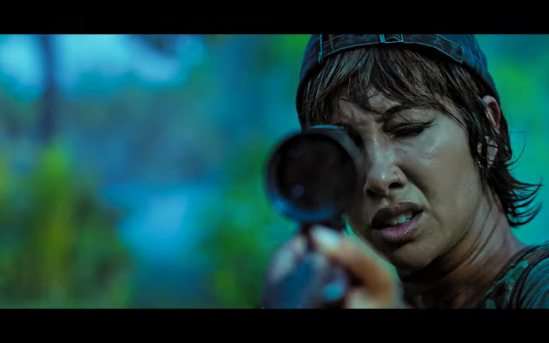
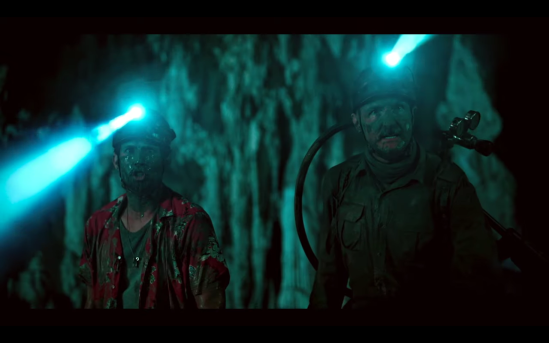
The EVIL Experiments of Dr. Frankenstein’s Great, Great Grandson in “The Hideous Bog Monster” reviewed! (Cheezy Movies / Digital Screener)

Fouke, Arkansas is a small town about to have big problems when a maximum security hospital maniac escapes and now roams loose in the woods.  Disguising himself as the infamous hairy bog creature of local lore, the lunatic embarks on a killing spree, massacring the local game hunters, and collecting their dead corpses for the unholy experiments of Dr. Frankenstein, the fourth generation heretic from a long lineage of conducting evil scientific practices.  Together, the lunatic and Dr. Frankenstein plan to use a stolen ancient Vatican book, not meant for the eyes of man, for his sadistic work of defilement, but a supernatural warrior, an elite team of Vatican assassins, and the local yokels seek to join forces to stop evil at all cost. 

Backwoods horror has never been more backwards when trying to absorb James Baack’s escaped lunatic killing, Satanic cult worshipping, slasher-esque aping, demon slaying, rootin’-tootin’ “The Hideous Bog Monster” released in the most backwards, backlogged, backache year of the global pandemic of 2020.  By now, you’re probably thinking you’ve never seen so many backs in one sentence in all your life, but James Baack, who wrote and directed the 2020 film, is no stranger repeating himself at the helm of homemade schlock and title pulpy horror as the filmmaker has made a career behind the 70’s-inspired horror entitles, such as “Dracula’s Orgy of the Damned” and “Werewolf Massacre at Hell’s Gate.”  “The Hideous Bog Monster” is a production of Baack’s Chicago-area centric The Great Lakes Artists Group, using the Arkansas folklore of the Fouke Monster of Boggy Creek as a foundational backdrop for more sinister practices, shot in nowhere near Arkansas, but all over tarnation in Illinois.

Movies similar to “The Hideous Bog Monster” usually involve a tightknit troupe of cast members that have performed in some way, shape, or form in previous James Baack productions in a kindred melting pot of close friends and family members.  Tina Boivin is one of those actresses who has had a role in every James Baack film to date.  This time, Boivin braided her red hair and hiked up her booty shorts resembles a redneck version of Dave Thomas’s Wendy in Sally Bell, a foul-mouth, uncouth, hayseed maiden caught in the mix of all hell breaking loose in and around Boggy Creek.  Sally Bell is joined by her equally unsophisticated friend, Flunky (James Baack), and the elite Vatican hitwomen, The Sisters of St. Tommy Gun, to do the Lord’s work with disparate to the story planetary names in Sister Saturn (Bianca Baack), Sister Venus (Jenna Aboukamar), Sister Jupiter (Tanya Raz), and Sister Mars (Suzy Streske).  As what seems like a climatic clash of a good versus evil showdown, the action is sorely subdued to little excitement, exhilaration, and enthusiasm to the spirited adversaries who are eager to destroy, but barely use the zapping powers, automatic rifles, submachine guns, and hand-to-hand combat blades they’ve been so graciously armed with and, instead, Baack weaponizes only the wit of Sally Bell to verbally assault otherworldly demons. Hasn’t the filmmakers heard of sticks and stones will break my bones, but words will never hurt me? Depth is also lacking behind the eyes of every one-time use characters, especially in Herbie Savages’ deranged killer dressed up in a Spirit Halloween bought gorilla outfit to exude his insanity and obsession with the Bog Creek monster. The remaining cast rounds out with Andrew Baack, Wendy Pierson, Kandace McVickar, Steve Galayda (also producer), Nicholas Baack, Evan Pierson, Tom Ziellienski, and Pete Alessi as Dr. Frankenstein.

“The Hideous Bog Monster” follows no rhyme or reason story structure that ultimately feels, at every possible angle, very arbitrary coming to ahead. Paced like a slug riding a sloth dragging it’s long-nailed feet through the strong winds of category five hurricane, a resembling randomizing character generator also creates pop up characters adding to the enigmatic puzzle dish of cryptic and longwinded exposition and then disappear in the blink of an eye in a fueling the flame to only be quickly extinguished in a heap of plot-choking smoke moment. Between pillaring principle leads are the Witch, Lumpy, the Apprentice, and even Dr. Frankenstein, who exceed the amount of allotted strain in following these half-built story arcs, causing a major slow down of the story progression. Partnered with run amuck scenarios that have little-to-no links of connective tissue also dampens the likelihood of seeing “The Hideous Bog Monster” from beginning to end without feeling either confused on just about everything thrown at the audience, hoodwinked by the decently illustrated poster art, or exhausted to the point of surrender in keeping up with James Baack’s four-letter word spouting clunker. Much like many urban legend spun horror films, the Fouke Monster has had about the same amount of butchered luck down the cinematic avenues as Big Foot and there have been better films, such as “The Legend of Boggy Creek” in 1972 to “The Legacy of Boggy Creek” in 2009, inspired by the nefariously elusive swamp creature since the mid-70’s after it’s so-called sighting in Fouke Arkansas.
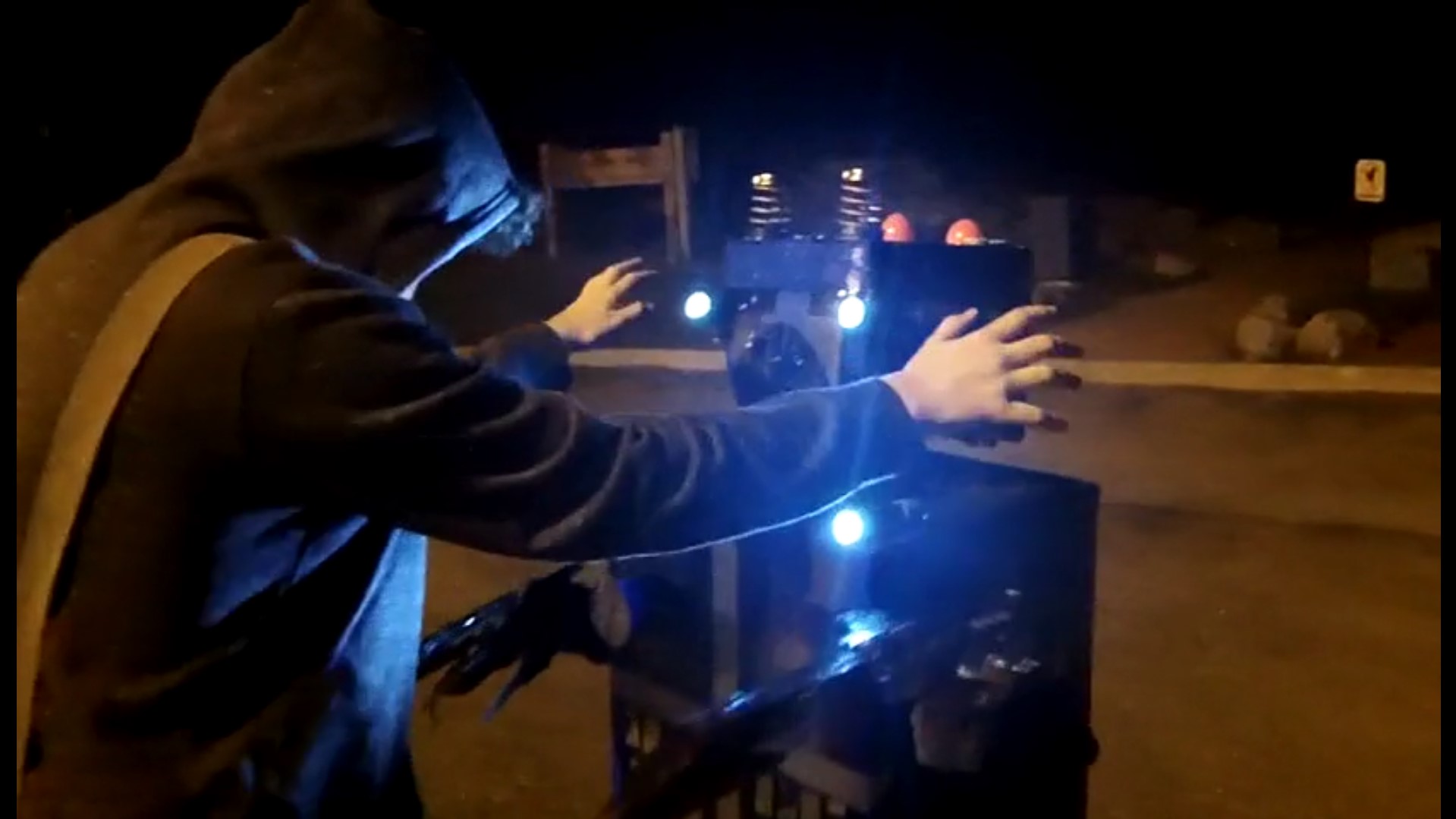
Another small town is on a trope-laden path to terror as “The Hideous Bog Monster” set to be unleashed upon us all in 2021 on DVD courtesy of Cheezy Movies (aka Trionic Entertainment). The region free, 110 minute runtime release will be presented in a widescreen, 16:9 aspect ratio, and will be not rated. While I can’t comment on the DVD’s audio or visual components due to the digital screener provided, the SOV-esque of “The Hideous Bog Monster” shimmies barely into the said style made popular in the low-budget 80’s and 90’s horror scene, capturing crudely the video recordings of creative horror filmmaker and despite poor output quality, regardless of a digital screener or not, but Baack was able to garnish some respectable eerie shots like the opening of the film of a young boy wondering through a desolate trailer park on a foggy day. What happened to the young boy after being chased by the phony bog monster? Nobody knows and nobody explains what happens, what’s going on, or where’s things are going as gaps continuously riddle holes in James Baack evil has come back to small town America in a slap-happy slap-comedy horror squeezed dry of terror, but pumped full of unfunny hillbilly rhetoric.Another small town is on a trope-laden path to terror as “The Hideous Bog Monster” is set to be unleashed upon us all in 2021 on DVD courtesy of Cheezy Movies (aka Trionic Entertainment). The region free, 110 minute runtime release will be presented in a widescreen, 16:9 aspect ratio, and will be not rated. While I can’t comment on the DVD’s audio or visual components due to the digital screener provided, the SOV-esque of “The Hideous Bog Monster” shimmies barely into the said style made popular in the low-budget 80’s and 90’s horror scene, capturing crudely the video recordings of creative horror filmmaker and despite poor output quality, regardless of a digital screener or not, but Baack was able to garnish some respectable eerie shots like the opening of the film of a young boy wondering through a desolate trailer park on a foggy day. What happened to the young boy after being chased by the phony bog monster? Nobody knows and nobody explains what happens, what’s going on, or where’s things are going as gaps continuously riddle holes in James Baack evil has come back to small town America in a slap-happy slap-comedy horror squeezed dry of terror, but pumped full of unfunny hillbilly rhetoric.


Purchase “The Hideous Bog Monster” on DVD by Clicking the Poster!
EVIL is Undead…And Rides a Shark! “Sky Sharks” reviewed (Umbrella Entertainment / DVD)

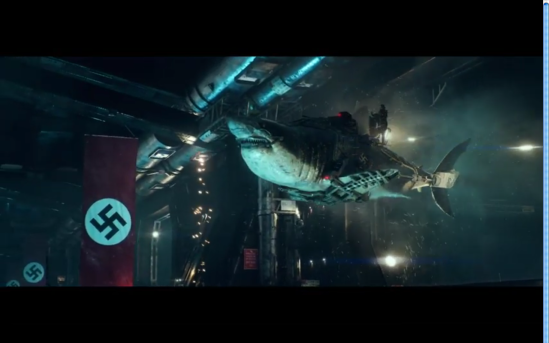
Former Nazi scientist Dr. Klaus Richter’s past has finally caught up with him after 70 years when a clandestine German laboratory, disguised as an aircraft-battleship hybrid, thaws from behind a globally warmed sheet of frozen ice and rock, releasing Dr. Richter’s regenerated legion of undead Nazi super-soldiers piloting genetically engineered flying battle sharks complete with guided missiles alongside their razor sharp jaws.  Loyal to the Third Reich, the sky sharks continue their master race patronage with a blitzkrieg in the skies, attacking commercial aircraft, boarding the cabins, and slaughtering every last person on board before crashing.   Now contractually working for the U.S. Government as the biggest name in technological advancement, Dr. Klaus, with the help of his two daughters, has a plan to nullify the sky sharks’ defenses to make them vulnerable to his latest newest experiment in warfare, Dead Flesh, under the guidance of his fellow covert government agency heads.

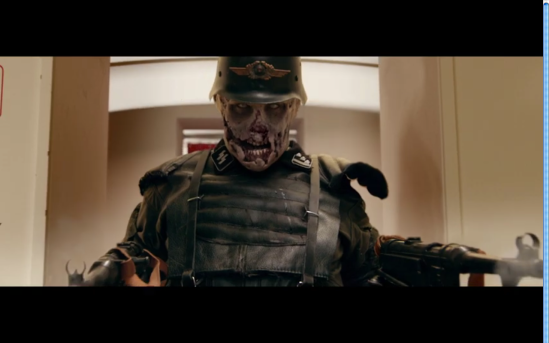
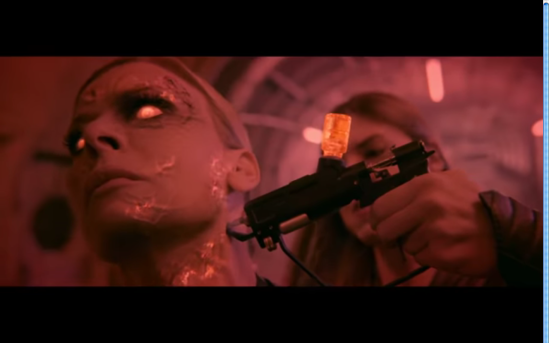
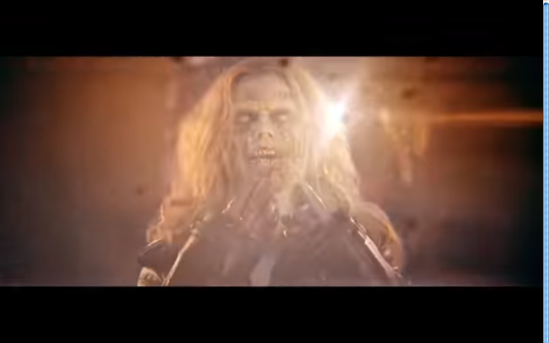
Apex predators of the waters are now apex predators of the skies in Marc Fehse’s ridiculous, frenzied, and utterly mad ultra-violent Nazi-exploitation, “Sky Sharks.” Soaring through the heavens soaking fluffy white clouds with blood, the Carsten Fehse and A.D. Morel co-written film took off virally in 2020 with the promise to the internet, especially horror fans, of zombified SS soldiers mounted standing on humungous Great White, Hammerhead, and Megalodon jet-propelled sharks. Fehse’s team delivered. “Sky Sharks” has not one single serious bone in all it’s cartilaginous gory-glory body in what’s Fehse’s second film behind the 1999, straight to video, “Mutation” involving the what-if factor of a surrealistically free reigning and sadistically unbridled Nazi force hellbent on winning World War II no matter how many lives needing to be sacrificed for the sake of the Führer’s dominion. The Germany-made production is a Fuse Box Films and Fantom Films.

“Sky Sharks” is studded with cult stars, but those studs pop out mostly after the carnage-laden opening scene of passengers on a commercial flight being ripped to shreds by undead super-soldiers hog-wild about killing. Robert LaSardo (“Strangeland”), Lynn Lowery (“Model Hunger”), Tony Todd (“Candyman”), Diana Prince (“The Last Drive-In with Joe Bob Briggs”), Mick Garris (director of “Critters 2”), Dave Sheridan (“Scary Movie”), Amanda Bearse (“Fright Night” ’85), Asami (“Gun Woman), Naomi Grossman (“American Horror Story” franchise), Lar Park-Lincoln (“Friday the 13th Part VII:  The New Blood”) and “Mortal Kombat’s Shang Tsung himself, Cary-Hiroyuki Tagawa, make an appearance in some minor way, shape, or form, but since “Sky Sharks” is a German production, much of the cast is geared toward German and Austrian actors with Thomas Morris spearheading the lead role of the inverted mad scientist, Dr. Klaus Richter, a centenarian mastermind behind the birth and, hopeful, destruction of his monstrous airborne jaws of death experiment.  The role itself isn’t very exciting that refrains Morris to be nothing more but a talking head who recounts his failed World War II and Vietnam resurrection serum to turn the tides of war.  While Dr. Richter has immense blood on his hands from a long and rich background, the present day Richter has lackluster appeal and Morris doesn’t provide much zest either.  More complexities reside in Richter’s two tech-savvy and kickass daughters, Diabla and Angelique.  Their signifying names alone provide some foreshadowing of events, but the close sisters are boots on the ground with their father being the eye in the sky; yet, Diabla and Angelique have been kept in the dark from their father’s horrid past that factors little into parting ways from being daughter’s little girls.  Blonde beauties Eva Haberman and Barbara Nedeljakova successful roles in Germany and the U.S. include “Hostel” and the sci-fi tele-series “Lexx,” but their blind obedience to the patriarch roles downscales any moments to shine individually as free thinking agents of good.  Any other character factored into “Sky Sharks’” whiplash narrative come and go without a single ounce meaningful impact becoming background noise for the fray. There’s not even a singular villain to speak of as a focal point to direct a challenger against forces of good.

As much as the concept excites me on an obscurely dysfunctional level, a real telling tale of who I am as a person, who also praises “Snakes on a Plane” as cult candy, “Sky Sharks” has atrocious issues with pacing and story quality.  The opening scene sets up what to expect of gore drenched Nazis yoking back on genetically mutated sharks, zipping through high altitude to acrobatically infiltrate commercial planes for complete and total annihilation of every passenger onboard.  Tickles me in all the right places.  Yet, the sky sharks’ unveiling background whizzes past right into death from above world apocalypse, skipping keynote details resolving the giant warship beached on the Antarctic ice.  Fehse decides to redirect our focus with a bunch of explicit violence and sex and while that’s all nice and good…really good…the misdirection can’t coverup the necessities needed for a good story even if the story is absolutely bonkers. The visual effects are not distinct from the ream of shark-sploitation films that have become popular over the last decade in a cheaper slaved effort to capitalize on the majestic beasts of the sea…who sometimes mistake a surfer for a sea lion. The flying sharks swim in a stiffly pattern and move inorganically through their uncharacteristic ecosystem as they rocket in a school of steampunk nightmares. Not all visuals fall short of satisfaction when they’re appropriately blended with practical effects. Under that hood of tangible horrors is “Iron Sky: The Coming Race’s” Martin Schäper and, the legendary, Tom Savini, who we haven’t seen special effects work from since 2012’s “Death from Above” (an also fitting title for killer sharks in the sky). Schäper and Savini bring it with blood. Each plane sequence, there’s two of them, exhibit different deaths with each one more outrageous than the next. My favorite is the inverted periscope through a guy’s cranium and having a looksie at the screaming, bloodied passengers. “Sky Sharks” is, literally, an over-the-top scream of slice’em and dice’em fun.

Cresting through the blue yonder and painting the sky blood red is the deadliest gang of shark riding Nazi’s to ever grace a cinema platform in “Sky Sharks,” coming to DVD in Australia, no stranger to large, deadly sharks, courtesy of Umbrella Entertainment in association with Raven Banner. The NTSC encoded, region 4, rated R release will present the film in a widescreen 2.35:1 aspect ratio. “Sky Sharks” is a turbulent wonderland of rustic computer generated visual effects with a Marco J. Riedl and Olaf Markmann cinematography, typifying a clashing style, of keeping actors tightly in focus to sell a futuristic fluorescent environment. A few scenes give a sense of layered paper mâché sitting in front a green screen as the forefront images seemingly pop out of their backdrops. The English and German Dolby Digital 5.1 surround mix falls victim to an overpowering score of a weak dialogue track that washes key pieces of exposition that might explain more as the scenes fleet away in the rushed paced 103 minute runtime. Aside from a brilliantly detailed DVD cover robust with a glowing eyed, half-decaying Nazi soldier as centerpiece amongst flying, weaponized sharks and Robert LaSardo and Lynn Lowry cameoing off to the left side with a half-naked female warrior on the right, the DVD has no bonus features included. After the credits, a fake commercial for “Sky Frogs,” starring that half-naked female warrior I just mentioned, is a satirical happy ending full of even worse, 80’s caliber, visual effects worlds and frogs. Though not at the top of the food chain being one of the grossly ostentatious and shoddily visual effects films ever, the mindless, search and destroy, crudeness of “Sky Sharks” chums our oceans of entertainment with some of the bloodiest fun we’ve seen in a long time from a Nazisploitation.

Own Umbrella Entertainment release of “Sky Sharks” on DVD! Click the poster!

The Dying Baltic Traditions Live in the Ashes of EVIL. “Cult Girls” (Umbrella Entertainment / DVD)

The pagan Cult, the Golden Path, remains nearly all that is left of the ancient practice as Lithuania becomes one of the last countries to be converted to Christianity in the late 14th century.  Led by an archaic, yet powerful, goddess named Ragana, the Golden Path promises to flourish once again with the power of death, reincarnation, and control through sordid misdeeds.  When Dalia and her two young sisters become prepped for a ritual of an important role in the cult, potentially leading them down the path of sex and sacrifice, a traitorous follower helps the sisters attempt to escape their emmeshing fate as the police raid the Golden Path compound ensuing a firefight that leads to the death Ragana and Dalia’s getaway, but her sisters are kidnapped and held captive by the remaining cult members.  Years later and riddled with guilt, Dalia must know what happened to her sisters and she tracks down a death metal cultist, Moloch, who seemingly has a connection to Golden Path, with the help of Samoth, a black metal fanatic, but Moloch forestry hermit lifestyle cuts off Dalia and Samoth from the rest of the world and the convicted arsonist against all things Christianity may have more up his sleeve than what meets the eye.

With a title that sounds like an all-girl goth band from the grunge era of the 1990’s, or maybe even more so from the “Scooby Doo” franchise (Hex Girls anyone?), “Cult Girls” summons the actuality of being an acute quasi-historical and dark fantasy thriller hailing from the Ozploitation capital of the world, Australia.  “Cult girls” is the second, non-documentary film from “The Matrix’ inspired “Narcosys” director, Mark Bakaitis, who directed, wrote, and edited his the multi-location sophomore film that has on location scenes from not only in Australia, but also in Lithuania, at the notable Hill of Crosses landmark, and in the indiscernible urban locations of Germany.  Bakaitis serves as producer alongside executive producer Douglas Kaplan of the diverse arts platform production company, All Edge Entertainment, based in Santa Monica, California. 

The Australian production casts an American to star as Ragana, the brood matriarch destined to rejuvenate Golden Path’s permanence, with “V’s” very own Jane Badler.  Badler brings an international presence to the feature and isn’t a stranger to films from the down under.  With the actress’s soul-seducing cutting eyes and demonic empress allure, the New York born Badler exacts Ragana’s clutching strength as an underground Pagan seeking unlimited decadent power.  However, Badler is overshadowed by the timorousness of Dalia whose polar opposite presence is granted a more favorable chunk of screen time.  Finnish born Saara Lamberg plays the humbled Dalia, living her life out of a covenant while searching out the cult that once almost stitched her into the sew of sleazy affairs to unearth the whereabouts of her younger sisters.  Dalia’s a bit of a dull principle with no substantiated efforts in finding her siblings and it isn’t until Samoth stalks her one night, recognizing the Golden Path’s symbol tattooed on her wrist and offering his manhunt services to find the expelled Moloch, an exaggerated black metal anti-Christianity anarchist in a saturating performance by Albert Goikhman.  In the middle, masked brutes, half naked women, and, fallen by the waist side, Dalia’s sisters in standalone plot point narratives that, as far as story structure goes, does nothing to motivate the narrative other than be an ostentatious aesthetic of locations and debauchery.  “Cult Girls” rounds out the cast with Tony Markulin (“MurderDrome”), Algias Karazija, Dean Kirkright, a handful of Bakaitis’s family, and Simay Argento, a distant relative to Dario Argeno playing a Cult Auntie in the film.

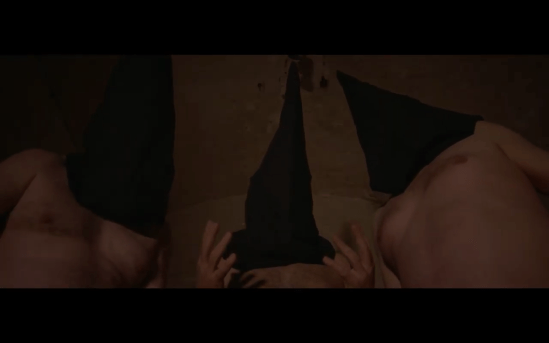
“Cult Girls” borders being avant-garde of an unfiltered auteur’s will in a mesh of artistic polishes and prose dialogue, but the film slides into being more of an 83 minute music video over staying it’s welcome and drudges through a repetitive stylistic cycle to an almost nearly unwatchable extent.  Yet, “Cult Girls” somehow manages to retain attention despite the chewy acting and it’s ambling story that hits a dam wall of uncertainly of where the script should head. Bakaitis shoulders the story for modern Gothicism tapped with half naked occultist, sometimes bathing in blood, and a plague of nightmare imagery that director of photography Trent Schneider tunes into well with noir vitality despite being the cinematographer’s debut feature film, but through the shiny exterior of a handful of solid mise-en-scene work, “Cult Girls” numbs the impact of the soul corrupting Pagan syndicate, that may or may not be shrouded with supernatural foundations, and the anti-Christian propaganda with half-baked violence from geriatric men, masked with Dia de los Muertos style masks, able to be kingpins of an untouchable prostitution ring façade for their occult sacrifices in broad public without a bat of an eyelash.  Granted, prostitution is likely legal in Germany and Lithuania so authorities might turn a blind eye, but brothels are a convenient opportunity for police investigations. “Cult Girls” treasures the fact of Lithuania’s languishing heritage without being overly filmic heresy by blending in shaded sleaze and death, but there lies no story in Dalia’s unenthusiastic search for her sisters in a much more preacherly themed death metal horror that confuses cult with religion.


Apocalyptic reincarnations and traditional folklores collide in Mark Bakaitis’s “Cult Girls” on DVD now from Umbrella Entertainment. The Australian release is a single layer DVD with region 4, PAL encoded format, presented in a widescreen 2.40:1 aspect ratio. Trent Schneider’s keen eye captures a grim fairytale surface of black magic masochism and, at the same time, breathtaking in the pure nature scenes, but the imagery is mostly in devoid of richer color that lingers around a bluish-gray monochrome tone and struggles with hazy details, especially around facial features, that smoothly fuzz over. The English, German, and Lithuanian Dolby Digital 5.1 surround sound mix battens down with shiplap genres of traditional Lithuania folk and modern metal from composing sound designer Erin McKimm, implementing the traditional songs of Lithuania sung by the Melbourne-Lithuania community singers, The Lost Clogs. Industrial action fills in every nook and cranny of the remaining score with decent range and depth of ambiance. While the dialogue is prominent and clear, there are spelling errors and tiny text issues with the English subtitles when the narrative lands in Germany and Lithuania. The DVD’s bonus features includes audio commentary, making of featurettes with cast and crew interviews, Bakaitis’s short film, “Mercy Kill” that serves one of the founding themes for “Cult Girls,” and music videos directed by Mark Bakaitis. For an Australian film, “Cult Girls” will feel more worldly, unlike anything else that comes out of Australia, and have partisan propaganda against Christianity, but in the end, the insidious Pagan evil, on the precipice of resurrecting, wearies on, like a tireless sermon of doom.

Burt Gummer Neutralizes EVIL Graboids in “Tremors: Shrieker Island” reviewed! (Universal 1440 Entertainment / Digital Screener)

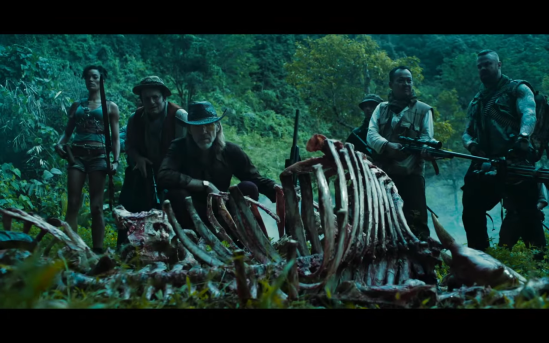
A wildlife preservation maintains categorizing and tracking of native elephants, but when one of the company’s philanthropist turns his private island, just across the water from the preservation campsite, into a game reserve for apex predators, nothing will stop him from wagering the thrill of the hunt on expensive, top-of-the-line game.  That is until the graboids he’s illegally bred and genetically modified starts to hunt the wealthy trophy gamers back, especially when the Precambrian lifeforms metamorphize into the fast-spawning shriekers.  With an island full of graboids and shriekers that contributed to already one death, graboid expert and arms enthusiast-survivalist, Burt Gummer, is tracked down and brought out of retirement to once again battle his longtime killing machine adversary.  With no munition weapons, an obstinate playboy’s maniacal urge to hunt the fierce predator, and the most powerful of the graboids bred on the island able to wriggle underneath the sea floor between land masses, Gummer and a team of preservationists must band together to stop the graboids from being an invasive and unstoppable species. 

From an icy Canadian landscape in “Tremors:  A Cold Day in Hell” to the tropical beaches of Thailand, “Tremors:  Shrieker Island” is the seventh feature film in the Tremor’s 30-year franchise.  Heading straight to video on Blu-ray, DVD, and Digital, including Streaming and VOD platforms come this October 2020, the subterranean monster action-comedy is steered by serial sequel director Don Michael Paul, who directed the last two “Tremors” installments, off a Paul script co-written with Brian Brightly that set sights on expanding the graboid footprint even farther East and surrounded by the seas of Thailand, further more distancing itself from the dust bowls of Perfection, Nevada and Mexico into new and unexplored terror-itories.  Universal Pictures’ off-shoot subsidiary banner, Universal 1440 Entertainment, and Living Films serves as the presiding production companies. 


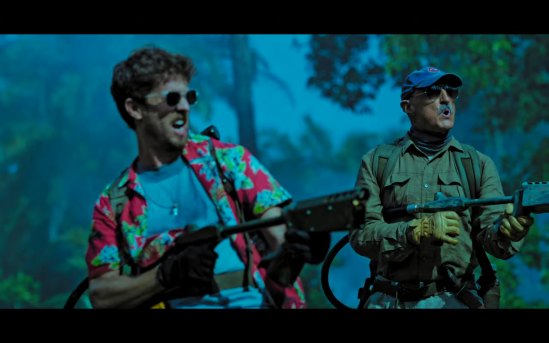
The smart-mouth, quick-wit, arms-toting Burt Gummer has become, dare I say it, the Ash Williams of the Tremors’ franchise as a perpetually dragged back hero into monstrous circumstances to battle graboids and their offspring on land, air, and in the pits of hell of the innate underground habitat.  Aside from Bruce Campbell, there are not too many heroes in a genre that usually has a villainous backbone and so Michael Gross is the longest lasting reoccurring actor, spanning now 30-years, to return as an original hero who first encountered and killed the bastard creature who “broke into the wrong God damn rec room” in Perfection, Nevada.  Gross, now gray with a few more wrinkles sporting his iconic Gummer mustache, fits into the military-esque attire under his ball cap to square off alongside a ragtag team of unprepared, unqualified, and novice graboid hunters in Jon Heder (“Napoleon Dynamite”), Jackie Cruz (“Orange is the New Black”), Caroline Langrishe, and Richard Brake (“31”).  Heder fills in for the Jamie Kennedy role of Burt Gummer’s son, Travis, from the two previous installments and though Travis is mentioned briefly, the character’s presence is extended through Caroline Langrishe as Travis’s mother and preservation camp leader.  Heder and Langrishe complete that entangled trio that has been a trope present in nearly all the Tremor Films, starting with Val McKee, Earl Basset, and Rhona LeBeck, battling side-by-side to overcome the odds.  Cruz and Brake offer a serious side dish of badass on a polar opposite spectrum.  Jackie Cruz as Freddie, an entrenched team member of elephant tracking, is the Latina MacGuyer and is a weapon in herself that only someone like Burt Gummer would fully appreciate while Richard Brake, with his trademark sinister smile as obsessed game hunter Bill, relishes the role, pulling a watered down, PG-13 version of his typical bad guy motif from the more violent-venomous Rob Zombie films.  However, a minority of characters fall through character development cracks, such as Anna played by the up and coming Cassie Clare (“Death Race 4:  Beyond Anarchy”).  The archery expert Clare is a pertinent show off with a bow and arrow and is Bill’s right hand, but the Anna, under Cassie’s muscular thin frame and ironclad persona direction, has an inclined built up that goes to naught as she’s snubbed-shoved to a lesser role without having a significant impact in the latter half.   The reverse can said for Heder’s Jimmy character with first impressions of a top class scientist with lower class ambitions; yet, in an instant, Jimmy becomes a battle-worn graboid and shrieker killer while more experienced hunters, especially one wielding a mini gun, have less of a handle on the situation. 

While it’s neat and cool and nostalgic to see graboids and Burt Gummer back in action, much like the disconnect with lopsided arch able characters left to be graboid-fodder, “Tremors:  Shrieker Island” falls short of earlier predecessors, replacing personal filmmaking style over story substance.  For one, graboids just haven’t been the same since going from practical applications to computer imagery since “Bloodlines” on that has radically evolved the creatures from a less-is-more model to a complete overhaul of their veneer, resembling the dark and slimy man-eating tentacles of “Deep Rising,” and as well an overhaul of the creature mechanics that lead graboids to leap out of the ground and into the air like a flying fish, spiraling and twisting back into their dirt environment.   The graboid burrowing irks me as well as the ground explodes 10-15 feet up into the air in a blatant uses of detonating charges by the effects team to create the earthworm moving effect instead of just a perpetual hump and collapse of the ground that’s more of a menacing effect. Nuances run amok, causing subtle points of frustration in how Paul’s direction is really more a passive glance than a serious absorption of the franchise. Meandering people on the ground when they fully well know graboids are attracted by movement, half the film scaled back to slow motion to accentuate big money explosions, and the mother of all graboids able to target Burt Gummer for a mano on monstro showdown are just more examples of the charmless details in, what is, a palpable comedy with Earth dwelling monsters. “Tremors: Shrieker Island” is the equivalent of “Jaws: The Revenge;” the story may not make sense, but watching gigantic monsters cause mortal destruction is pure creature feature bliss.

What may be Burt Gummer’s last ride (or so they said in the last film), “Tremors: Shrieker Island” tunnels onto Blu-ray, DVD, and VOD come October 20th, 2020 and soon to be streaming on Netflix shortly after. The BD50 Blu-ray will feature an anamorphic widescreen, 16:9 aspect ratio, with an English language DTIS-HD Master Audio 5.1 while the DVD9 is presented in a widescreen 16:9 with a Dolby Digital 5.1 surround mix. Both formats will include optional English Dolby Digital 2.0 as well as a dubbed French, and Spanish DTIS Digital Surround 5.1 with a slew of option subtitles: English SDH, French Canadian, French European, and Latin American Spanish. Since the film was reviewed on a digital screener, the A/V aspects will not be critiqued. The exclusive bonus features listed on all physical and VOD include a Burt Gummer narrated “The Monster of Tremors” that gives you everything you need know about the diabolical monsters, “Tremors Top 30 Moments” that hone in on 30 years worth of scenes that provide laughs, Burtisms, and some of the most gory moments in graboid history, and, lastly, “The Legend of the Burt Gummer” that focuses on the iconic graboid hunter character told by his persona creator himself, Michael Gross. Richard Brake, once again, nails the villain, Jackie Cruz stuns as a resourceful Gummer-ite, and Michael Gross fleshes out one more commando swashbuckling Burt Gummer in the zany seventh installment of the unstoppable “Tremors” franchise.

Pre-order Tremors: Shrieker Island on Blu-ray/DVD/Digital!

EVIL Does a Little Bathhouse Wet Work in “Melancholic” reviewed! (Third Window Films / Blu-ray Screener)

On nights when a humble Japanese bathhouse is supposed to be closed for business, the lights remain illuminated, gleaming off the crimson covered ceramic tiles of Mr. Azuma’s bathhouse floors as body’s soak in a pool of blood.  The proprietor, Mr. Azuma, is in severe financial debt to Yakuza boss Tanaka who turns his meager business into a nightly slaughter house to dispose of Yakuza opposition or those just on the syndicate’s bad side.  When Tokyo University graduate, Kazuhiko, applies for a job as an attendant to see a girl who regular attends the bathhouse, the reserved model employee becomes enthralled with the disposing and cleaning up of the corpses, working alongside a couple of professional hitmen, Matsumoto and Kodero, but when the job he’s so passionate about requires him to be more hands on with the assassination assignments and the endless pressure from the Yakuza bares down on his colleagues and friends, Kazuhiko’s radical plan to eradicate the woes of his newfangled position just might mean his very life. 

Seiji Tanaka’s self-esteem building and identity attaining crime drama, “Melancholic,” might not reside as absolute horror, but any film involving the Japanese Yakuza is an unpredictable, Machiavellian expo worthy of every second.  Originally titled in Japan as “Merankorikku” or “メランコリック,” writer-director Tanaka retains a bloody disposition of the historically violently depicted Yakuza-storied narrative, but is asymmetrical with a converging love affair, complementary conflicting the dark and light with clarity of the centric character’s unintended double life into the criminal enterprise of cleaning a bloody bathhouse.  Based off Seiji Tanaka’s short film of the same title, “Melancholic” mops up as an immersive black dramedy from Seiji Tanaka as the filmmaker’s first credited feature film produced by One Goose production in association with Uplink and JGMP.

The story concentrates most of the effort around Kazuhiko, a graduate of the prestigious Tokyo University who doesn’t have a good job and lives with his pampering parents, fitted by Yoji Minagawa as a social misfit living on the outskirts of the Japanese mantra of diligence and integrity.  Minagawa bores out Kazuhiko’s diffidence, chocking up his damp disposition to the indecisions toward his future, that forces other characters to influence his choices, such a former high school classmate in Yuri with an effervescent performance by “Tag’s” (“Riaru onigokko”) Mebuki Yoshida.  Yuri’s infectious affection for Kazuhiko and her regular attendance at the bathhouse encourages Kazuhiko to apply and become hired for a cleaning attendant position alongside a blonde, and undereducated in comparison, counterpart in Matsumoto (Yoshitomo Isozaki), but to Kazuhiko’s surprise, his overqualified ego is shattered when he discovers that the bathhouse is a Yakuza place of execution and those all around him are more experienced in that trade, detonating a plume of black comedy, work place haughtiness that Kazuhiko has to balance with his personal relationship growing with Yuri.  Most of the exchanges are straight forward and culturally inflection heavy, especially when dire moments rear their heads, but some more compassionate and delicate scenes rouse through the overt inflections with Minagawa and Yoshida at the helm of their blossoming onscreen romance, adding to the stark contrast to the opposing narrative. Stefanie Arianne, Makoto Hada, Yasuyuki Hamaya, Takanori Kamachi, Hiroko Shinkai, Masanobu Yada, Keiji Yamashita, and Yuti Okubo fill out “Melancholic’s” cast.

“Melancholic” is a rather odd title integrated into the briefly pensive struggles of Kazuhiko to an intrinsic network of assassination gunplay and backstabbing knavery, offering little profound sadness and despair and more shrewd hostility when those in charge ask for an inch but take a mile out of the personnel pool. For a Yakuza film, Tanaka’s bath and butcher story has barely a budget to entertain technical action sequences in tight spaces, but the action is kept taut and intense and despite the lack of a Yakuza presence, with only one single boss representing an entire faction, the transposing of Kazuhiko’s personal and professional stations washes away much of budgetary concerns down the drainpipe as an irresistible curiosity to see how our hero softly stumbles through a sudden confluence of the two repelling paths will play out. Most audiences will overlook the comedy for a countless reasons as “Melancholic” up plays into the satirical rigors of the Japanese sullen humor. The fact that that the subject matter is also about mercilessly murder people in a bathhouse will undoubtedly pigeonhole the film with pre-labeled genre. Tanaka slips in gallons of subdued irony ripe for the complex circumstances hazardous to all bathhouse employees and their pryingly oppressive management.

The award winning Japanese film (aggregated wins from multiple Eastern Asian film festivals) “Melancholic” arrives onto a dual format DVD/Blu-ray from UK distributor Third Window Films, a loyal provider of extreme Asian cult and horror. Since the Blu-ray was a screener, the A/V aspects won’t be reviewed in it’s entirety and the specifications weren’t provided with the screener. Ryô Takahashi’s cinematic vision brings out the beauty in simplification without being ostentatious with camera angles or relying heavily on tint boxes; yet, the blend of steady cam and handheld tilts to the one side with the jitteriness of the handheld seizing the stage. Bonus features were included on the screener, including a behind-the-scenes of a documentary-style shot look at moments before, during, and after takes, a Q and A panel with the cast and crew, and the “Melancholic” short film. Seiji Tanaka’s breakthrough bloodbath, “Melancholic,” sounds more despondent than the dismal thought of a cold shower on a freezing day, but the heated ferocity rite into adulthood keeps this Japanese dramedy warm with tension and cozy with vortex humor.v

Purchase “Melancholic” on Blu-ray / DVD!