Under Hypnosis, You’ll Do Anything For EVIL! “Vampire at Midnight” reviewed! (MVD Visual / DVD)

“Vampire at Midnight” is now on DVD!

Gripped by a serial killer dubbed the Vampire Killer, Los Angeles is on high alert as not one single piece evidence could be recovered from the more than a dozen crime scenes where women’s’ necks are ripped to shreds, their bodies are drained of blood, and their corpses dumped for police to discover.  With detectives baffled, cowboy cop Roger Sutter is ordered by the reckless antics-frustrated Captain to stay away from case but when Roger follows a lead that lands in his lap, two people wind up dead and the killer slips through his grasp, the captain suspends him from the force.  Focusing all his energy into a newfound romance with apartment complex neighbor and aspiring pianist Jenny Carleton, Roger finds himself back onto the killer’s trail when his time with Jenny goes from special and exciting to acutely avoiding his every advance.  Roger suspects the Vampire Killer behind Jenny’s sudden change in behavior.  Unofficially back on the case, the off-duty Los Angeles homicide detective finds himself in the middle of the Vampire Killer’s ritual to seduce Jenny into his coven as one of his blood brides. 

The maverick cop versus the serial killer narrative “Vampire at Midnight” is the 1988 investigative thriller with a horror edge from editor-producer Gregory McClatchy (“The Great American Girl Robbery,” “Terror in the Aisles”) in his first, and only horror credited, feature length directorial.  Also, lesser known as “L.A. Midnight, “Hypnos” or “Murder at Midnight,” the entrancing, modern vampire script is penned by “Danger Zone II:  Reaper’s Revenge” writer Dulany Ross Clements from a story by fellow “Danger Zone II” collaborators Jason William (actor in “The Great American Girl Robbery” and “Flesh Gordon”) and Tom Friedman (“Time Walker”).  Skouras Pictures served as the production company and the theatrical distributor with Friedman and Williams also in a producing capacity.

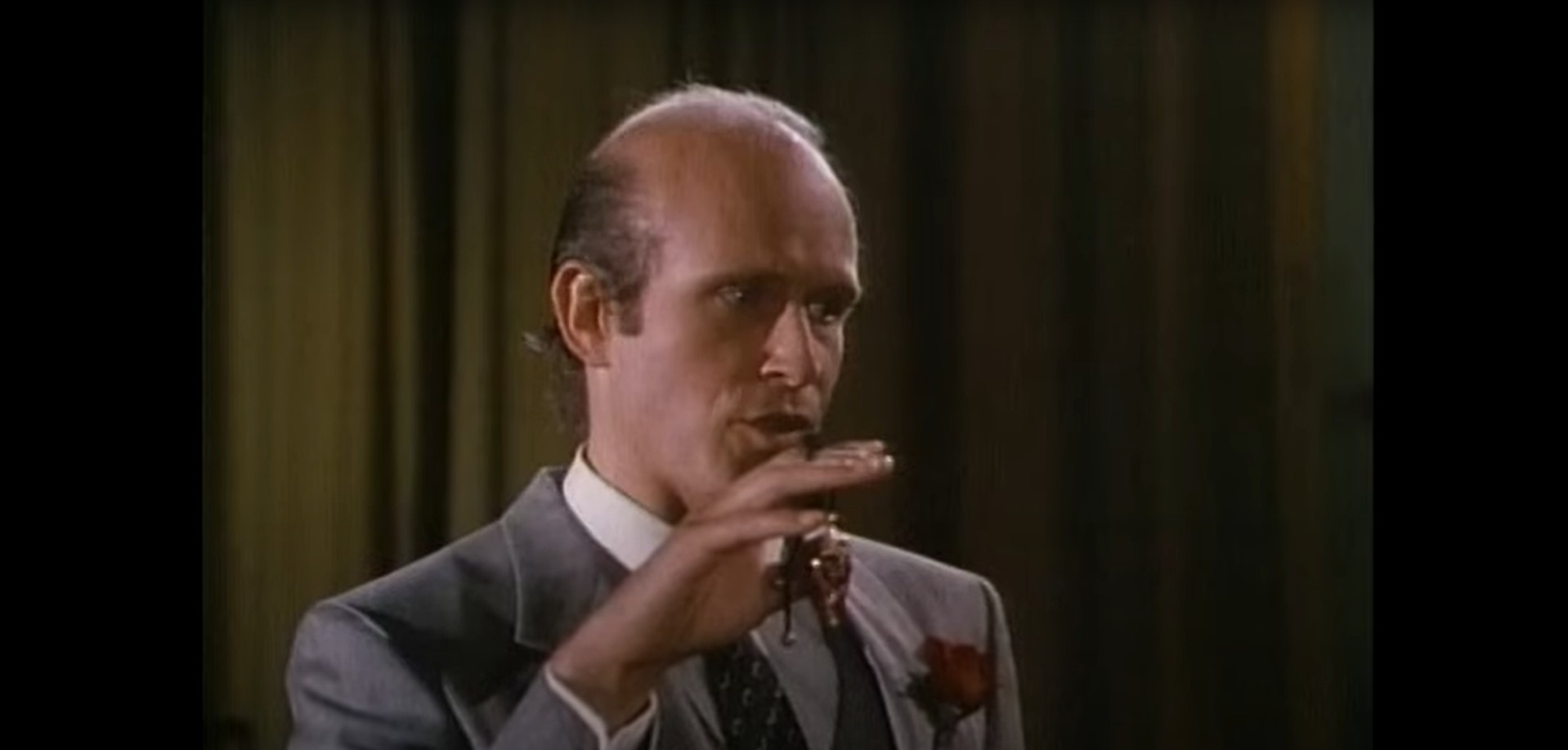
Much like with his lead kidnapper role in “The Great American Girl Robbery,” as well as other skin-a-matic films like “Alice in Wonderland:  An X-Rated Musical” or “Flesh Gordon,” producer, conceptual storyteller, and principal star Jason Williams puts himself into the rough-and-rugged hero to get the girl, or girls, half naked in his arms.  As unorthodox method cop bending procedure to get results, Williams molds handsome homicide detective Roger Sutter to the quintessential trope of a good cop doing everything he can to get the job done, even if that means skirting around lawlessness.  Roger is pitted up against pure vampiric evil who welcomes the lawlessness under the façade of a doctor of hypnotism specializing in unleashing clients’ frustrating mental blockages in their careers and goals.  Argentine-born Gustav Vintas has the physical look of a sophisticated villain (see “Lethal Weapon,” “Verne Miller,” and “Midnight”) with his stage 6 receding hairline and foreign accent and “Vampire at Midnight” also fits the bill with Dr. Victor Radikoff, a smooth talking and charming manipulator who can literally hypnotize his clients into anything, such as serving their necks up to his fangs or be beguiled assassins.  Caught in the middle is aspiring pianist Jenny Carlton, Roger’s beautiful blonde neighbor turned girlfriend turned slave to Radikoff’s hypnosis powers.  Jenny is played by the one-and-done feature film credited Lesley Milne in a rigid performance that’s critically subsided by her well-defined figure, one of several to go topless alongside “Saturday the 14th Strikes Back’s” Jeanie Moore, “Hollywood Chainsaw Hookers’” Esther Elise, and “Angel III:  The Final Chapter” Barbara Hammond.  The film rounds out with Christopher Nee, Robert Random (“Toke”), Jonny Solomon (“Peephole”), Ted Hamaguchi, Richmond Shepard (“Simon, King of the Witches”), and Ceclia Kaye (“Don’t Be Afraid of the Dark”).

“Vampire at Midnight” is the modern vampire film that tries to blend the old tropes with the new folds.  The malevolent Dr. Victor Radikoff has the menacingly creepy charm and suavity of Bram Stoker’s tale of Count Dracula flirting up against Max Schreck’s appearance as the horribly grotesque Count Orlok in the F.W. Murnau’s bastard film, “Nosferatu:  The Symphony of Horror.”  While the latter may just be an opinionated statement or judgement on Gustav Vintas’s physical naturality, not to say Vintas is grotesque or horrible looking at all, but rather his physical characteristics are atypical of the master vampire, resembling more closely to the baseline Nosferatu with a receding hairline, slender stature, and a uniquely contoured face. Being set in Los Angeles, the gothic qualities that instill fear, dread, and medieval facets from Dracula origins are all but lost, but you must remember, this isn’t Dracula.  This is Dr. Victor Radikoff, the prestigious hypnotist of the affluent, and that speaks true to the hip city of angels setting full of funky-sexualized interpretative dancing and late-night comedy standups as well as fitting into the budget to keep the indie film costs low for the sleek new take of the vampire trope to freshly entertain late 80s audiences.  However, “Vampire at Midnight” doesn’t go plot unscathed with the first act leaning heavily into L.A. paralyzed with Vampire Killer fear and the cops nervously on edge and disheartened by the lack of evidence and leads; the atmosphere felt more despairing and darker with the killer staying one step ahead and a body count slowly rises upward.  Then, the tone shifts slowly from a tough terrorizing case to crack to Roger’s incessant hard-on for a rather focused and naïve pianist.  The case only becomes interested in again when Roger receives a happenstance call in and he’s back in the saddle of his cowboy cop antics until he’s not again, being, in my opinion, unjustifiably suspended for shooting down a suspect trying to kill him and the suspected Killer getting away.  It’s as if the police, as well as the media and the public perception, left the case to fizzle out while the relationship between Roger and Jenny builds up for the sole purpose of being broken by, again, happenstance in Radikoff’s chance meeting with Jenny at a socialite party where she’s hired to play piano.

Arriving onto a MVDVisual DVD, this obscure hypno-vampire gem is entranced with new life.  Unfortunately, however, the new release is not a technically impressive one with its 720p resolution and pillar box 1.33:1 aspect ratio in regard to video.  The MPEG2 DVD5 handles the compression without a substantial hitch.  Other than the lower resolution that creates some blurry/fuzziness, here are no seemingly other issues in the codec, such as macroblocking, or banding.  Blacks retain its void inkiness even inside the confines of a lower contrast, but the grading is nonexistent that results in flat coloring and little life in the range spectrum.  The film has a shot-on-video look, but the transfer is rendered from a 35mm print digitized with little touchup for DVD.  The original print has only minor imperfections, a brief scratch here and there, but no major damage to note.  The English language Dolby Digital 2.0 Mono doesn’t elevate the new release either.  Dialogue isn’t terribly feeble, but it definitely isn’t robust through the single channel where depth doesn’t have an influence.  The overall quality of the recording is not bad with a clean presentation that’s layered in an expertly designed arrangement; big kudos should go to editor Kaye Davis and sound mixer Vic Carpenter who enrich “Vampire at Midnight’s” filmic posture as the two do competently dance together between the audio and video editing.  English subtitles are optionally available.  MVD’s standard release is bare bones without special features.  The standard DVD Amaray sports the beautiful gothic and blood dripping poster as the front cover; however, the backside contains three out of the five stills of Ester Alise, one involving Robert Random, and one with Random and Gustav Vintas and what makes the backside a curiously funny duck is the four blocked together stills are not from the film and were plucked directly from IMDB.com.  Instead, they are from different cult films starring Random and Alise, such as Alise’s “Hollywood Chainsaw Hookers.”  The disc is pressed with the same cover art image.  The rated R release is region free and has a runtime of 93 minutes.

Last Rites: Gregory McClatchy keeps this L.A. vampire picture in constant postulation with an unconscious red herring that’s stable until the very end, but the story pivot strains too far from its gritty and dark cop-chase-killer opening by focusing more on a love polygon of sex, deception, and true devotion, a swivel that puts a stake right in the heart of this 80’s exuberant story.

“Vampire at Midnight” is now on DVD!

White Space Men are the EVIL Captains of the Zombie-inducing Slave Trade and Intergalactic Fast-Food Industry! “Race War: The Remake” reviewed! (Wild Eye Releasing: Raw & Extreme / DVD)

Get Caught Up in the Middle of a “Race War: The Rmeake” on DVD

Drug dealer Baking Soda is feeling the peddling pangs of dropped traffic for his crystal pure PCP.  With no one buying his smack, he and his friend G.E.D. reside back home to drink with their close fish-headed friend Kreech and sleep off the day’s failure to try again tomorrow.  Their persistence to sell puts them on the radar of a white supremacy group vending a new drug on the street, the cause for Baking Soda’s drop in sales, but their product isn’t just going to get users high, it will turn them into flesh-eating zombie slaves.  When G.E.D. is kidnapped by the group, Baking Soda and Krrech have to run through the list of suspects – Jews, Hispanics, Chinese, and others – for the source of his sale woes and to rescue his friend, guns blazing if necessary or if unnecessary, but there may be more extraterrestrial motives that haven’t yet been unearthed. 

“Race War: The Remake” is a 2012 politically incorrect, ultra-offensive spoof comedy and blaxploitation horror from writer-director Tom Martino.  A Tom Savini school graduate, te special effects artist Martino (“Dead of Knight,” “Return to Nuke ‘Em High Volume 1,” “Doll Factory”) takes helm in the director’s chair for his debut in indie feature productions with one of the wildest, crudest, and tactlessly funny comedy-horrors I’ve seen since Troma’s “The Taint.”  Set in and around Houston, Texas and the greater surrounding area with guerrilla filming in locations such as the Houston Space Center and shooting with permission at the Darke Institute’s Phobia Haunted House, “Race War:  The Remake” doesn’t have an originating film despite the title in what is considered a spoof sequel – think of examples “Dude Bro Massacre III” and it’s standalone release or the non-existent second sequel between  “Thankskilling” and “Thankskilling III.”  Martino produces his own work under his outside of Houston-based company DWN Productions that doubles in making horror theme masks, busts, and props.

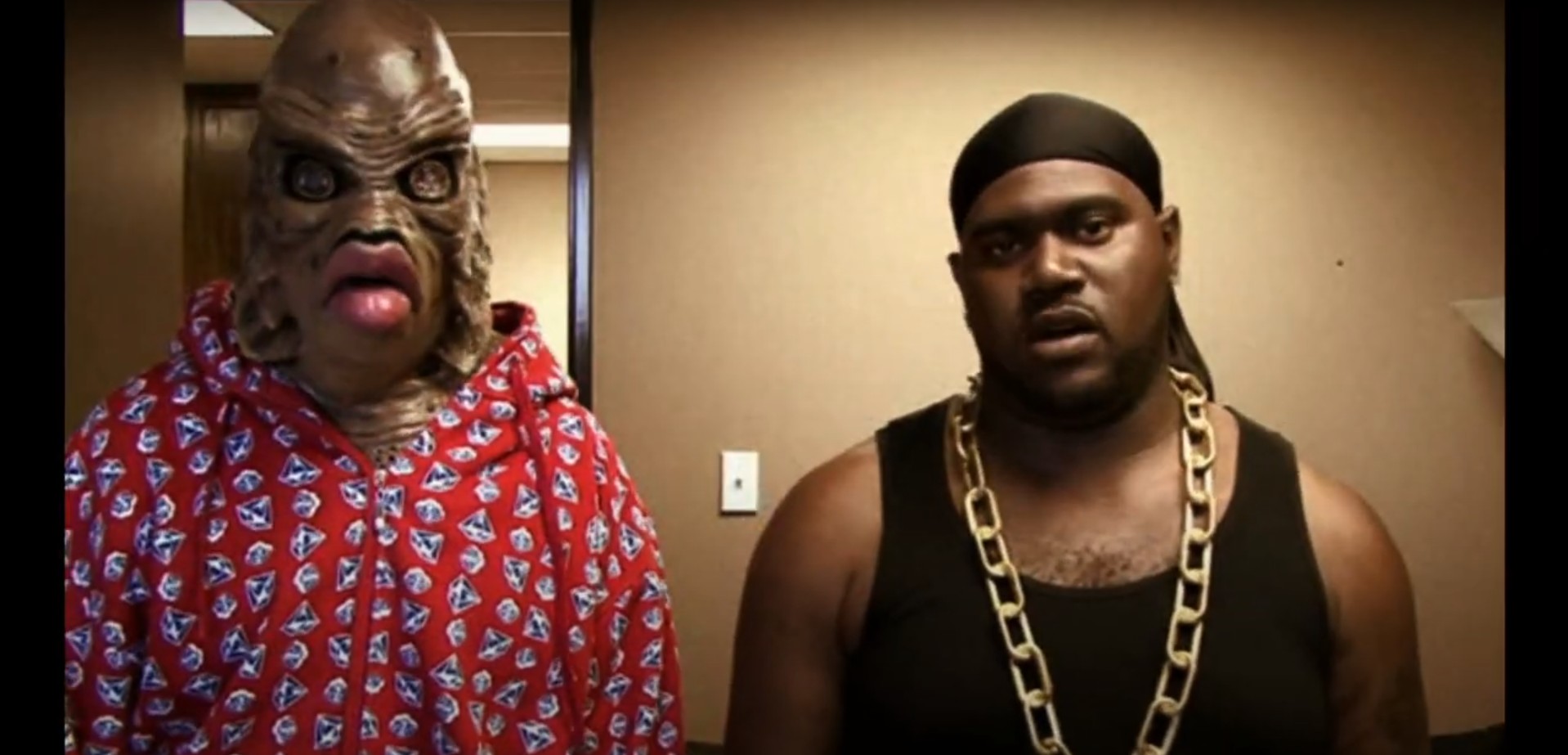
Thick-skinned actors comfortable with the narrative’s uncomfortable themes begin with Howard Calvert and Jamelle Kent as Baking Soda and G.E.D.  Calbert and Kent have become regulars in the Tom Martino catalogue of cast members for his more recent films and their humble beginnings in “Race War:  The Remake” proved their longevity to stay with the director, who is white, who wrote extensive race, gender, sexuality, and fart jokes in the context of a comedy-horror with cringy stereotypes and genuine tributes.  Calvert and Kent have great comedic timing to pull off all the zany editing, sound bites, and practical effects distaste Martino has flaming axe tosses at them to achieve his vision.  The two are joined by Danny McCarty, who would become another regular and be the visual effects supervisor for the film, dressed head-to-toe in loose-fitting urban attire to match the theme of Calvert and Kent’s black A-shirt and do-rags but his hands and face are masked to become the Creature from the Black Lagoon, aka Kreech.  Martino’s “Race War:  The Remake” isn’t just about the terrestrial races but intergalactic ones as well and we soon see that later on with the intentions of neo-Nazi white drug suppliers, led by Matt Rogers’ vulgarity in the horseshoe mustached Tex.  There are various other encountered gross stereotypes in the trio’s urban quest, such as a large nosed, greedy Jewish lawyer, Mexican luchador bodyguards, and a Pai Mei-esque Shifu speaking gibberish har har sounds and listing off popular Americanized Chinese dishes in attempt to be derogatorily funny.  With a film titled as “Race Wars:  The Remake,” the cast is mostly white and black actors poking uncouth fun with a big unconcerned and insensitive stick with Corey Fuller, Kerryn Ledet, Sam Rivas, and Coady Allen listed in the cast.

“Race Wars:  The Remake” isn’t funny, it’s stupid funny!  Having grown up in the 1980-2000s, consciously I might add, Martino’s politically incorrect and his brand of juvenile humor resonates with me, reminding me how cinema has become numb to the spoof humor.  Granted, Martino’s humor is over the top cutting, gross, and full of jest bigotry, traits that would trigger many in today’s sensitive awareness, and while cringy after a tasteless joke may result, there’ll likely be some a side of the mouth chuckle to go along with it.  On the opposite side of the spectrum, Martino tributes to references of certain popular culture icons, though slightly bastardizing some for laughs.  From Peter Jackson’s “Bad Taste,” to “Creature from the Black Lagoon,” to even “Mortal Kombat,” “Race Wars: The Remake” integrates the best parts of each these staples of pop culture and that gives his film a leg up on other offensive spoofs of the same crass caliber.  Th one negative story structure item to  highlight is the act one narrative takes a while to work the gears and get going as it attempts to setup the 40oz-drinking chumminess of Baking Soda, G.E.D., and Kreech but lags to a stagnant stall for hot second while still surround with the here-and-there gags, themed with G.E.D. homosexual tendencies and Baking Soda’s drug peddling woes on and off the streets, but once the antics pickup, there’s no stopping Martino and his filmic entourage from raining down an assault of insults. 

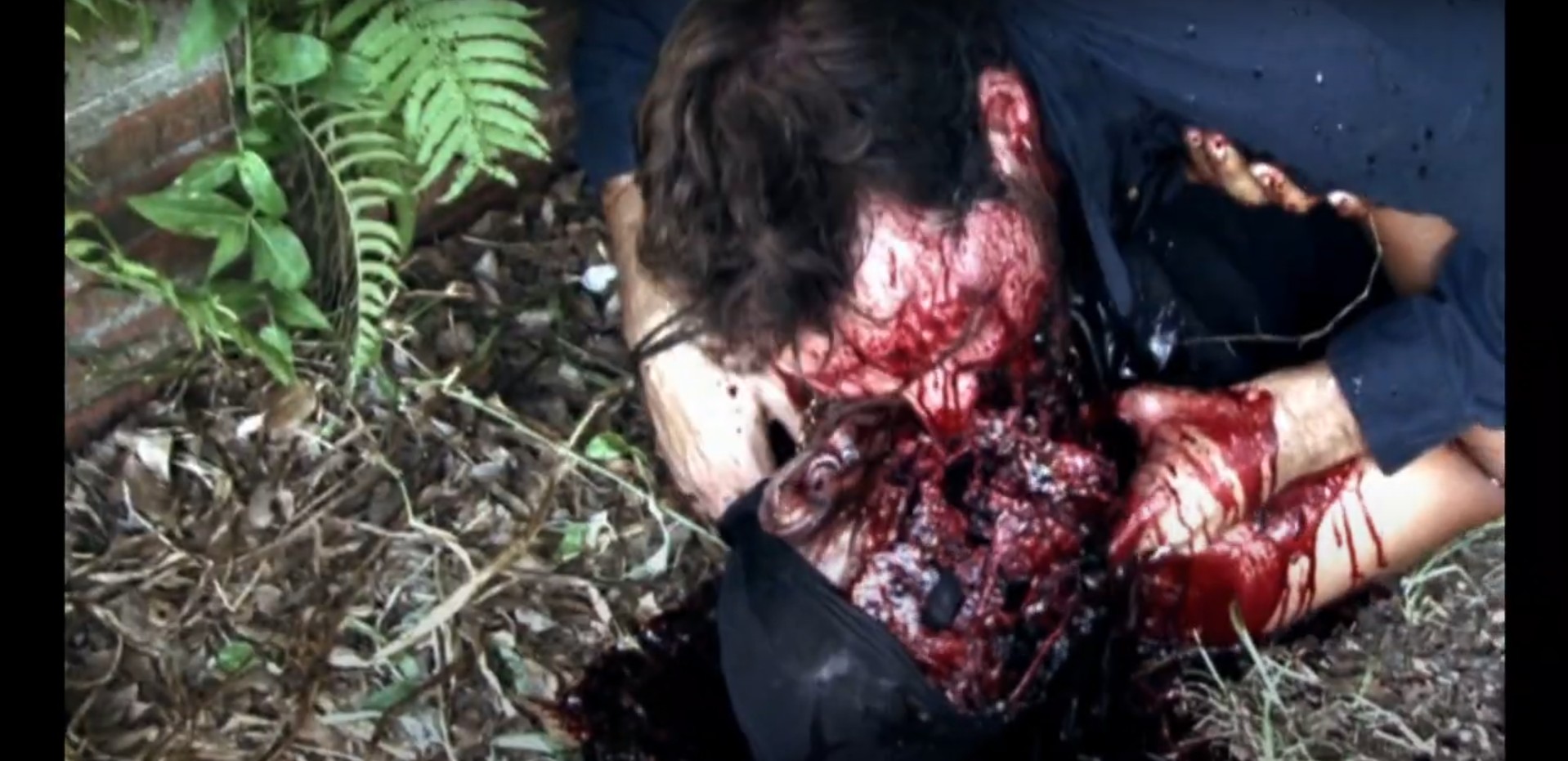
If you’re easily offended or put off by off-color race comedy, then Wild Eye Releasing’s “Race War:  The Remake” DVD is not for you!  For me, and those like me, unaffected by the type of uncouth spoof, Tom Martino’s debut is for you!  The Raw & Extreme sublabel’s DVD is MPEG2 encoded, 720p resolution, on a DVD5.  Presented in widescreen 1.78:1 aspect ratio, there is a breadth of visual presentation not confined within’ pillar and letterboxing but is stretched vertically that affects the already par level resolution.  Guerilla filmmaking also involves no production lighting and natural lighting is more than used here in Martino’s run around the Houston area, but one thing good about Martino’s naturally lit cinematography is its neutral set, avoiding under and overexposure.  The lesser used interiors have some tint lighting and key lighting to avoid total flat, dark outcomes but give the image a haze of hue, especially inside Baking Soda’s living room scene in the first act that sees a thin layer of red and green.  The English PCM Stereo has inconsistencies in volume.  Some scenes discern quieter than others because of the guerilla filmmaking constraints as well as just using commercial recording equipment.  However, the dialogue does land well enough for the jokes to hit and overlayed sound effects greatly lift the sound design where needed, such as with the Mortal Kombat video game sequence or with the array-spray of gunshots throughout and soundboard gag effects.  There are no subtitles with this release.  Included in the special features is Tom Martino director’s commentary, a gag/blooper reel, a behind-the-scenes reel of the gory moments, and Wild Eye Releasing trailers that include “Race War:  The Remake.”    The clear, ECO-Light Amaray DVD case houses stellar covert art illustration work by Belgium graphic artist, Stemo, with the inlaid narrative intensity and characters in collage.  The reverse side includes a gory still from one of the scenes.  The disc is pressed with the same front cover image but there are no other physical materials.  The unrated DVD runs for 95 minutes and is region free.

Last Rites:  Wild Eye Releasing re-unleashes another outrageous title on their Raw & Extreme label and the Tom Martino film is every ounce of the sentiment in it’s indie underground hokum of gore, racism, homosexuality, and aliens! 

Get Caught Up in the Middle of a “Race War: The Rmeake” on DVD

Midnight Showing of the Lost EVIL Tape Will Be the Last Thing You’ll Ever See! “Transmission” reveiwed! (Jinga Films, Danse Macabre, MVDVisual / DVD)

“Transmission” Transmitting to Your Television on DVD!

A Santa Mira elderly man sits in a dark room with a glowing television illuminating his silhouette.  As he channels surfs through the night, amongst what’s being broadcast over the airwaves is a bible-thumping televangelist, a children’s puppet show, an 80’s teen romance comedy, a live local news broadcast of a hostage situation and a documentary on the investigation of the disappearance of notorious cult horror film director Frank Tadross Roth pursued by his granddaughter Rachel and her boyfriend.  Going deeper into Ross’s disappearance through archived interviews with the director and crew, on set raw behind-the-scenes footage, and the examination of Ross’s quest for an obscurely treasured videotape by an occult group, the director’s pursuit of, and his eventual unearthing, of the tape become the push for his last and recently discovered film Transmission, thought to have been lost in a building fire after his suspected involvement of the film’s lead actress murder.  Going back and forth between the channel programs builds a sinister, terrible dread that will soon be revealed to terrorize all those glued to the set. 

Late night television has never been so bodingly evil!  Channel surfing transmits an anthological approach between mockumentary and found footage in this uniquely crafted scrolling of boob tube terror entitled “Transmission.”  The 2023 horror is from writer-director Michael Hurst, the English director behind a pair of franchise sequels in “House of the Dead 2” and “Pumpkinhead 4:  Blood Feud.”  His latest venture takes twist to a whole new level different from his repertoire of linear independent horror with backlot dark legend surrounding an occult obsessed horror filmmaker.  Hurst also produced the film, his first in over a decade since 2017 with Andy Hurst’s (“Are You Scared?,” “Wild Things: Foursome”), alongside other self-employed filmmakers with the How to Kill Your Roommates and Get Away with It” producing duo Robbie Dias and Pat Kusnadi.  New Blood Productions serves as the production studio.

“Transmission” traverses in guile under TV guide pretenses of local channels, channeling the horror through the back and forth of unsettling, televised channels that have a familiarity of broadcast shows – sponsor subsidized children shows, perfunctory local news, and black and white sitcoms – but there’s more than what meets the eye.  The film uses recognizable genre names to get the message across with “Sleepaway Camp’s” Felicia Rose in her most vanilla action news reporter role, “Scary Movie’s” Dave Sheridan as an over-the-top protective father caricature in a teen romance comedy, and “The Road Warrior’s” Vernon Wells at the center of the amassing occult suspense as the missing notorious horror director Frank Tadross Roth.  Over the years, Wells’ performance has tapered to a subtle crawl of expression as if the veteran actor is now just running through the motions of the everyday hired gig that’ll headline his name, unlike his former wide-eyed and eccentrically villainous roles in “Commando” and “Innerspace,” but “Transmission” suits his stern act portrayed in video flashback as an occult maniac and peculiar director gripped by the search of an arcane, dark sect’s perniciously videotape.   Spearheading the effort to track down the filmmaker is his granddaughter Rachel, played by Nicole Cinaglia (“Death House”) with an inexplicable character shifting of gears from curiosity and intrigue from the documentary to the frantic and fearful ramblings of a paranoid hostage taker in the new story stemmed by her findings surrounding her grandfather’s disappearance.  There’s potential gap there in the lack of development, or rather the lack of acknowledgement overall, with Rachel’s parents as it’s just a grandfather and granddaughter affair without the recognition of those in between.  There’s also a gap in Rachel’s attained information about the sect, the videotape, and her grandfather’s endgame as she seemingly has more knowledge about the insurmountable otherworld evil on the horizon but how she got there is a few clicks short to fully bridge.  Sadi Katz, Del Howison, Marcella Di Pasquale, Ben Kaplan, Hunter Johnson, Raymond Vinsik Williams, Jennifer Nangle, McKensie Lane, Jessica Cameron, Charles Chudabala, Michael Glenny, Christopher Bryan Gomez, Ruby Reynolds, Ben Stobber, Mark Schaefer, and Robin Hill fill out the channel surfin’ cast of characters.

“Transmission” has a neat story structure built upon components with the premise being a movie inside a documentary while amongst a flipping through the broadcast waves that coincide with another movie as well as television shows, podium preaching, puppet skits, etc., to which is then wrapped up inside and latched onto another movie, a metanarrative with a preamble setup.  The Roth directed Transmission, presented for the first time on Malvolia’s spooky late night show (an Elvira rip) is a space horror off-brand for the filmmaker that mirrors vaguely the reality outside the boob tube but told through the Rachel Roth investigative documentary that builds the timeline pieces while flipping back and forth between the late night movie and the documentary as well as the scroll through every other broadcastings of paralleling programming in what feels like an antiquated prelude to the cable guide button on a tube television with depicted content that resembles much like what programmed over-the-air decades ago down to the very staticky outlines of porn stars expertly doing their fleshy vocational craft in snowy pixelations.  The edited series of a varietal shows creates an erratic unsettlement with an atmosphere churning over the idiosyncrasy content of what’s eventually to spoil or come to chaos by Transmission’s, or rather ”Transmission’s,” twist ending and what a fairly good twist ending it is, even with the slightly ham-fisted acting, by pulling off misdirection as you think you know where the finale is heading but the forces of evil seep through with a backup plan. 

Jinga Films, Danse Macabre, and MVDVisual present “Transmission” onto a MPEG-2 encoded, upscaled 720p (but upconverted on my player but since this title is shot digitally the image appears fairly good to begin with), DVD5 and presented in a widescreen 1.78:1 aspect ratio.  As stated, imagine quality has a fair amount of detail and intended panache interference amongst a broad range of different aesthetic styles and gels through the varied televised broadcasts from static and grain filters to colorless sepia, to filming scenes on television screens, and to other mock-electrical afflictions inside a digitally shot story truck to intermittently snap normality and cause a rising fear of curiosity amongst the TV goers.  Throughout the picture, there were no noticeable true compression issues with the picture.  Some scenes felt slightly stretched by that I chalked that up to filmmaker style when rendering various programming for the narrative.  Though not listed which format is used, the player registers an English Dolby Digital 2.0 Stereo.  With imitating the perspective of someone watching television, audio tracks are distinguished with a flat concave that elevates the pitch but disperse through a single channel.  Emitting through a dual channel stereo, the audio can discern potently through, providing clarity.  When looking at the perspective, we’re either the old man watching the television or when inside the show itself watching from the fourth wall in and subsequently the strength and tone change often quite a bit, creating a rich depth when done correctly.  English subtitles are optionally available through the moving menu.  The DVD is essentially a feature release but there are other Jinga Film trailers that include, “Iconic,” “Tonight She Comes,” “The Protos Experiment,” and this film, “Transmission.”  The DVD comes in a standard single, push-lock, black DVD case with single-side cove art that I personally found gratifying when considering the film as it speaks to the abnormal and drawing glow of a brightly illuminated television in place of a head on top of the shoulders of an opened-armed cultist with a pleasingly red and black contrast.  The DVD is pressed with the same yet cropped image.  “Transmission” has a R rating (no singled-out rationales but there is some language and nudity), has a runtime of 74 minutes, and is region free for all players.

Last Rites: There are no mixed signals from “Transmission’s” gradual rise to impending cosmic doom with an exceptional Lovecraftian twist to nightcap this Michael Hurst channel-hopping and ominous occult production.

“Transmission” Transmitting to Your Television on DVD!

Business and Pleasured are Ruined by EVIL’s Obsession! “Tulpa: Demon of Desire” reviewed! (MVDVisual / DVD)

“Tulpa: Demon of Desire” Now on DVD!

Lisa Boeri is a career-driven businesswoman successful in locking down deals and achieving financial gains in a fast-paced, no-holds barred global market as she slaves away from dawn to dusk at the office, but when the sun goes down, Lisa releases the stresses of occupational hazards and her thirst for carnal desires at an exclusive, hidden-away nightclub where sexual fantasies range from BDSM to orgies while esoteric mystic and club owner Kiran trains her to release her Tulpa, an inner being of sensual self-exploration and freedom, through ecstasy elevating drugs.  When Lisa comes across printed news reports of her club sexual partners being brutally murdered by a serial killer, she must warn Kiran and her last partner before another body makes the press but Kiran isn’t too keen on making public private identifying information that goes against club rules and Lisa must do whatever it takes to investigate who and why would want to murder her intimate encounters. 

“Tulpa:  Demon of Desire” is a contemporary giallo from “Shadow” and “The Well” director Federico Zampaglione attempting his hand at the sordid Italian genre that has come to cult infamy over the past few decades with a regained revival and following on physical media.  Zampaglione co-wrote the script with father, Domenico Zampaglione, and Giacomo Gensini, the writing collective’s second collaboration behind the 2009 thriller “Shadow.”  Also known in Italian as “Tulpa:  perdizioni mortali,” the 2012 erotic giallo is a glow up of the everyday modern giallo that doesn’t try as hard as other productions that lean strictly toward being an homage to notable films and directors, “Nightmare Symphony” comes to mind as a compliment to Lucio Fulci’s “Cat in the Brain,” aka “Nightmare Concern” with a fairly identical storyline, rather than be self-serving toward its own identity within the subgenre context.  The producer behind Tinto Brass’s “Cheeky” and Zampaglione’s “Shadow,” Massimo Ferrero, returns to produce “Tulpa:  Demon of Desure” under his studio company Blu Cinematografica and IDF, Italian Dreams Factory.

At the center of a murder’s relentless focus is conservative promiscuous lead character, Lisa Boeri, played by Claudia Gerini who has had roles in Mel Gibson’s “Passion of the Christ” and Chad Stanhelski’s “John Wick:  Chapter 2” as well as reteaming with Zampaglione for his last film “The Well.”  Gerini’s versatility proves its worth in “Tulpa” as Boeri’s required to be business professional and quick witted and then is contrasted against her carnal rendezvous that’s no longer has in control of herself.  There’s a freedom from the business shackles that takes place but when her night world comes crashing down in a heap of bodies, Boeri finds herself unable to focus on anything else other than the lives of her anonymous sleeping partners.  Club owner Kiran (Nuot Arquint, “Shadow”) is a bit of an odd bohemian duck with his psychosomatic holistic spirituality and the biochemical, psychedelic drugs he pours into his clients’ drinks.  The rest of the Italian cast are a series of rotating characters that, unfortunately, don’t flesh out enough to warrant when becoming intertwined into a killer’s web with to note Ivan Franek (“T.M.A.”) as the last sex-partner to be a killer’s crosshairs and Boeri has to save, Frederica Vincenti as Beori’s envious coworker out for her colleague’s scandal, and Michela Cescon (“I Am the Abyss”) as Boeri’s best friend outside of work and play as well as Pierpaolo Lovino, Michele Placido (“The Pyjama Girl Case”), Giorgia Sinicorni (“Canepazzo”), and Piero Maggio (“The Vatican Exorcisms”) rounding out the rest of supporting company.

Zampaglione’s giallo attempt is coursed with suspense with a masked, gloved killer targeting a beautifully flawed woman complicated by her own sexual exploration and reach inside a world that’s viewed as taboo as it is tantalizing with sexual delight.  The director fashions Boeri’s alternative and secretive lifestyle as a self-harming vice, much the same way as illegal drugs or excessive alcohol, done in the shadows and hidden from friends and family.  There’s a moment in the midst of Boeri’s desperation search for her last partner’s name where an adversarial colleague learns of her sex club nightlife and aims to expose her, turning her private venture public through means of blackmail.  Eventually, more than one type of obsession over Boeri comes into play and the bodies pile up because of the unhealthy nature of the meddlesome and malevolent.  Though taut when tension bred from a killer whose maniacal plan involves and extends to a torturous and gruesome end against those hovering in Beori personal bubble, a couple of key catalysts are not cleared very well.  One of the individual obsessions over Boeri falters right at the end with a quick cut that doesn’t allow breathing room for comprehension of what went down and, perhaps one of the more complexing and important outliers that strays off the narrative from off the straight and narrow, a supernatural sign of power, perhaps the Tulpa force in practice, that gives the story a taste of Lucio Fulci giallo, such as “The Psychic.”  Yet this revelation of an ability receives lukewarm reception that cases the story’s drive into a wait-a-minute of mystical puzzlement. 

“Tulpa:  Demon of Desire” arrives onto DVD from MVDVisual in association with Danse Macabre and Jinja Films.  The upscaled from 720 to 1080p MPEG-2 encoded DVD9 is presented in a widescreen 1.78:1 aspect ratio.  Bathed in warmer tones of yellow, green, and red that often blend into a confluence of orange, Guiseep Maio’s noir dark veneer engages a sordid world of sophisticated sleaze and maniacal murder, creating a side-by-side dualism of Boeri’s day-and-night lifestyles.  Details are soft for this upscaled DVD as if the format slightly shimmers to keep focus on textures and delineations, the vibrant gel coloring for eliciting illicit behaviors doesn’t help either, but the release manages to produce a discernible image without the strain of compression issues and still convey Zampaglione’s visual aesthetic of a darker, viscus blood, heated shades of fervor, and a higher contrast to intensify shadows.  The English and Italian PCM 5.1 Surround Sound mix caters to the score and dialogue layers rather than creating worlds with ambience audio.  Though the dialogue is not listed as Italian on the DVD backside, there is a sizeable chunk of the dialogue in Italian with English subtitles, but the feature is mostly in a heavily accented English language.  The overall dialogue is clean without interference other than the accents and is prominently positioned, but still integrated in, amongst the other layers with a timed Francesco Zampaglione (last name incorrectly misspelled on the DVD back cover with missing the I in Zampaglione) and Andrea Moscianese exotically haunting score that works to not overpower the dialogue and plays into the sex-club and giallo themes  English subtitles appear to have no flaws and are paced well.  For a side note, I would suggest using the English subtitles to get through the Italian accents that can be challenging at times with certain actors.  Special features include a “Tulpa” behind-the-scenes featurette that interviews cast and crew, the official trailer, and two trailers for two other Federico Zampaglione productions – “Shadow” and “The Wall.”   The MVDVisual DVD release is a perfect example of less is more with a black background with a contrasting silver and intrinsically cracking Venetian mask and white logo with a blood-tipped spear.  The standard, region free, rated R release comes with no other physical or encoded attributes in its 84-minute runtime.

Last Rites: Honestly, a kill-focus blood overtakes the slim waist of sex in what’s supposed to be a blend of both motifs as the title suggests in”Tulpa: Demon of Desire,” but this modern-day giallo from those who did the niche subgenre the best, the Italians, is still worth viewing calories.

“Tulpa: Demon of Desire” Now on DVD!

Luther the Berserk has EVIL Plans in the Bayou! “The Naked Witch” reviewed! (VCI / Blu-ray)

A string of horrific murders of beautiful women becomes the study of a six-person team of paranormal researchers who head down to the Louisiana swamplands surrounded by notorious superstition and urban legend for once being the home of witchcraft.  One of the researches, Tasia, is a sensitive, a highly psychic receptive woman and student of team leader, Dr. Hayes, to sense the area’s extrasensory waves thought to be behind the murders, especially the ones of a satanic ritualized nature.  On the isolated island, encircled by swamp and gators, a powerful Satan acolyte known as Luther the Berserk seeks to spellbound Tasia to complete his coven of witches and evokes the help of Jessie, a haggard crone with the ability of mind control over those with sensitive abilities.  One-by-one, the researchers are being picked off for the blood ritual and it’s up to the survivors to stop Luther before it’s too late.

A bold psychotronic of the 1960s, “The Naked Witch” has a tingly macabre aura about it that’s not swinging, swanky, nor is it groovy.  Also known primarily as “The Witchmaker,” there’s a thick circumference of dread and darkness surrounding the William O. Brown written-and-directed picture.  Brown’s sophomore film behind the 1965 “One Way Whaine” comedy about Hawaiian babes and bank robbers is a stark 180 degrees four years later that showcased the filmmaker’s range from laughs to terror on the cusp of the early days of the Satanic scare.    “The Naked Witch” has also been reissued as “Witchkill,” The Witchmaster,” and “The Legend of Witch Hollow” and while Brown’s film goes by many monikers, one thing is for certain is the film was shot partially on location in the mucky swamps of Louisiana during exterior locations whie the remaining interiors were in a Los Angeles studio.  The U.S.A. made film was produced by Brown with L.Q. Jones serving as executive producer and released independently under LQ/JAF Productions.

Personally, horror films like “The Naked Witch” that were produced through the 1950s and into the 1960s always share mixed feeling that can only be described as from “the content is revolutionary for Americana horror post-World War II cinema” to “the stiff, exposition acting just doesn’t work with the grim nature of the ahead of its time story,” and as Marty McFly once said back in 1955, “I guess you guys aren’t ready for that yet.”  There’s nothing inherently bad about “The Night Witch’s” acting other than the lack of emotional weight from the troupe needed to lift up and be on the same level as the story that includes hanging half-naked women upside, slitting their throats, and drinking their blood out of chalices in a coven on satanic confluence.  “Revenge is my Destiny’s” John Lodge is the exception that goes against the stagey type of stilted acting grain as lead satanist apostle Luther the Berserk, flashing devil hand gestures and acting like a wild man in his ravaging role that’s ambitiously true to character and subtly perverse in blood and in lust. The same passion portrayal of character is not extended the principal leads of “Green Acres’” Alvy Moore and “Deep Space’s” Anthony Eisley playing a pair of opposing scientists – Moore as the more supernaturally open-minded Dr. Ralph Hayes and Eisley has the rigid in rationality Dr. Victor Gordon.  Their conflict of beliefs creates another subplot satellite that abides by superstition and lore as well as the division it produces, a decent representation of the overall contrarianism inside people as a group, then you have Tasia, a medium struggling with her powers being pulled in two different directions.  The European heritage and Canadian born blonde knockout Thordis Brandt steps out of the saucy side role and into one of her more prominent performances as the Sensitive who is manipulated by Luther’s unholy powers over the coven.   The coven and researcher cast rounds out with Shelby Grant, Tony Benson, Robyn Millan, Burt Mustin, Warrene Ott, Helene Winston, Carolyn Rhodimer, Larry Vincent, Patricia Wymer, Del Kaye, Diane Webber, Valya Garanda, Gwen Lipscomb, Nancy Crawford, and Sue Bernard. 

“The Naked Witch” is not as graphic as one would assume with such a scandalous, provocative title.  Again, you must remember, the film is originally titled “The Witchmaker.”  Yet, for a 1960’s horror, William O. Brown’s satanic sorcery picture is too advanced for the era’s mostly puritanical audience.  I’d even go as far as saying “The Naked Witch” borders the line between the foggy and gloomy atmospherics and set productions of Gothic Hammer and the ever-close-to-the-edge designed no nudity or graphic death coverups of an early Russ Meyer production sans the zany cartoon sounds and the rapid-fire editing.  An abundant of dread hangs in the air of starched collars and secretary skirts that conjures more than just the Devil’s presence in the bayou but a heavy dealt hand of a no-win situation full of desperation and death.  The story itself evolves from the brutal, ritualistic killings of strung up and stripped naked young, beautiful women to a more focused objective of converting Sensitive Tasia into a full-fledged witch that completes Luther’s coven and resurrects his master for a diabolical Hell on Earth.   The broader strokes of “The Naked Witch’s” narrative places the fate in the hands of a group of students and naïve ignoramuses playing catchup to what’s really happening under their noses.  Of course, alarm bells never go off and panic never really sets in for the group of survivors after each death in what is more like an aw-shucks and move on reaction.  Granted the team is stuck on the island for a few days with no way to call for help but that doesn’t mean being not proactive or being crippled by fear doesn’t have a place amongst them and in the story, especially missing opportunities within the researchers to turn on each other by way of Luther’s manipulating witch, Jesse, who herself has her own drastic motivation with a blood ritual that make her young again. 

“The Naked Witch” is fairly cladded with atmosphere and ghoulish intentions instead of the mentioned nudity but the new VCI 2-Disc Format Blu-ray and DVD release provides the bare essentials with a restored 35mm archival print into 4K-UHD scan.  Presented in a widescreen 2.35:1 aspect ratio, the grading is rich and overall image and details look pleasing with depth in most scenes and grain is era appropriate appeasing.  Skin tones shade a little more toward orange but maintain within spec but on the higher end of a RGB.  The print has sustained some damaged with a slew of scratches, dust and dirt, and cell burns peppered throughout and can be a nuisance but nothing terribly critical to warrant narrative loss or a complete loss of viewing pleasure.  The English Dolby Digital Mono track offers little to try and immerse viewers into the swampy bayou and that’s a real shame since visual elements are detailed.  There’s minor background noise is palpable but not distinct to warrant attention.  Dialogue and the Bolivian born and “The Town that Dreaded Sundown’s” Jaime Mendoza-Nava’s gypsy-esque and minor key brass and percussion score are the heavy hitters in this presentation.  Dialogue has insignificant hissing and crackling but as a whole, the track comes over clean enough to firm pass well over grade.  Option subtitles are available.  The only encoded bonuses are a 2024 commentary track by film enthusiast and artist Robert Kelly and a poster gallery that include not just “The Naked Witch” but other 60’s horror pictures.  VCI’s standard Blu-ray incasement has one-sided still picture and illustrated compositional artwork that roughly produces the madness incarnated with the DVD on right and the Blu-ray on the left inside, individual pressed with images from the front cover.  The region free disc has a runtime of 99 minutes and the film is rated R.

Last Rites: “The Naked Witch” has no skin in the game in its necromancy ways but finds the fog of dread easy to become lost in with interesting characters and a ghoulish witch and ritual vise gripping it on both ends on a verge of being something more.

“The Naked Witch” on Dual Format DVD/Blu-ray from VCI!