Tonight’s Next Guest is EVIL! “Late Night with the Devil!” reviewed! (Second Sight Films / Limited-Edition 4K UHD and Standard Blu-ray)

Check Out the Package on Second Sight’s Latest Limited Edition – “Late Night with the Devil!

In the golden age of late-night television shows, Jack Delroy was one of the hottest late-night comedians and talk show hosts of the early 1970s, only to be beaten out by inches by rival talk show host Johnny Carson every year.  By 1977, Delroy’s viewers and popularity on his show Night Owls was slipping after multiple failed attempts to revive the show’s viewership figures and to hit the number one spot for syndicated station UBL during sweeps week year after year.  That years Halloween episode, during the sweeps week, would promise to be one to be remembered when Delroy brings a medium, a magician-turned-magician promulgator, a paranormal psychologist, and her adopted subject, a young girl who was the last known survival of a Satanic cult.  While the lineup entertains the live audience and those viewers at home throughout the night as well as being excellent for the ratings game, Halloween thins the layer between the real world and the supernatural world and an awry demon summoning goes horribly wrong, caught on the station’s camera, and with Jack Delroy and his guests caught in the middle.

If you’ve never had the pleasure of seeing “100 Bloody Acres,” the 2012, underrated Australian comedy-horror has a fine entertaining balance of black humor, gore, and suspense.  The directors behind the little-known venture, brothers Cameron and Colin Cairnes, may not have moved the needle with their debut feature in Australia, nor globally for that matter, but their latest, a 1970s, found footage, period piece surrounding demonic catastrophe on live television entitled “Late Night with the Devil,” carries with it significance and growth, personally and globally.  Having also written the script, the Cairnes recreate a time period when television use to capture grotesque and jarring images to shock the masses in full, unbridled color through the whimsical lens of a late-night television show.  In a production company opening that seemingly would never end, “Late Night with the Devil” is a conglomerate effort from IFC Films, Shudder, Image Nation Abu Dhabi, Spooky Pictures, Good Fiend Films, AGC Studios, VicScreen, and Future Pictures and produced by Adam White, Steven Schneider (“Trap”), John Mulloy (“Killing Ground”), Mat Govoni, Derek Dauchy (“Watcher”), and Roy Lee (“Barbarian”).

In order for “Late Night with the Devil” to work, the Carines brothers needed a principal lead to understand what it means to be a charismatic and funny host of 1970s late night television.  They found niche trait in “The Last Voyage of the Demeter” and James Gunn’s “Suicide Squad’s” David Dastmalchian who is an adamant man of horror himself from genre scripts, articles, and comic books to being a horror themed host himself as Dr. Fearless hosted by Dark Horse comics.  Dastmalchian plays a different sort of host for the film, a quick-wit, neat as a pin, and handsome Jack Delroy who has lofty goals of elevating his show to the number one spot in the domestic market.  Early success drives Delroy who will do anything to outscore late night king Johnny Carson but when his wife (Georgina Haig, “Road Train”) falls ill and dies early, the ratings battle slows for Delory’s show until his return to try and revive glory with kitschy content.  Halloween 1977, sweeps weeks, proves to be a chance for Delroy and his manager (Josh Quong Tart, “Little Monsters”) to spice things up with phantasmagoric guests in Christou (Fayssal Bazzi), an arrogant former magician turned cynic (Ian Bliss, “The Matrix Reloaded”), and a paranormal psychologist (Laura Gordon, “Saw V”) and her adopted subject Lilly, the debut feature-length film of Ingrid Torelli.  Aside from Chicago-born Dastmalchian, the rest of the Australian production is casted natively and do an impeccable vocal mimicry of an American accent while stunning and convincing in their respective roles, especially for Torelli whose piercing blue eyes, rounded check line, and gently raspy voice gives her an uneasy accompaniment to her off-putting innocence that works to the story’s advantage.  The cast rounds out with key principal Rhys Auteri playing Jack Delroy’s quirky sidekick host Gus McConnell whose story progression trajectory borders the voice of reason ironically enough and without McConnell and Auteri’s spot-on depiction of host announcer and comedic adjutant, there wouldn’t be steady fidelity for those who grew up on late night TV.

Late night TV essence is beautifully captured with mock production set of a 70s television studio, acquired era garbs, costumes, and accessories, and performances that provide a real flavor for programming of that time, and I would know as I would obsessively glue my attention to Johnny Carson reruns at a young age in the 1980s to early 90s.  The Cairnes and director of photography Matthew Temple deploy a studio reproduction of a three-way camera system to unfold the carnage; yet the forementioned behind-the-scenes moments in between live-air tapings feels forced, unnecessary, and artificial to the story with a lack of explanation to who and why these in-betweens are being done.  The black-and-white scenes vary in cameraperson positions from behind the coffee and snack table, behind fake floral, or just right in their face that steals from the live-tape realism.  What then ensues when the demonic light beams from one of the guest’s split open head does redirect attention to the psychokinesis death and destruction and this removes those behind-the-scenes fabrications with a replaced personal, interdimensional Hell for Delroy, shot in a more conventional style outside the confines of found footage under omnipotent means.  Cameron and Colin’s part-documentary, part-found footage, and part-conventional efforts prologue the story with an out, one that sets up connections to link violence on a single character lightning rod with maximum collateral damage, and that lead up of information almost seems trivial but works to the advantage on not only the character’s background but also generates a real spark of juicy, full-circle, nearly imperceptible greed that comes with a cost. 

Second Sight Films knows a good movie when they see one and quickly snatches up the rights to release “Late Night with the Devil” on a limited-edition, dual-format collector’s set.  The UK distributor’s 4K UHD and Standard Blu-ray combo box comes with an HVEC encoded, HDR with Dolby Vision 2160p, BD66  and an AVC encoded, 1080p high-definition, BD50, both formats decoding at a refresh rate around 24 frames per second and presented in the three aspect ratios to reproduce 70’s era television ratios with a 1.33:1 and European ratio 1.66:1 as well as seldomly switching to a 2.39:1 widescreen for more down the rabbit hole sequences.  Much like the variety of aspect ratios, an intentional ebb and flow design between color and black-and-white draws demarcating lines from the colorful live tapings to the monochromic backstage footage after the live cameras stop broadcasting.  To help lift the period piece, three-way studio cameras film within a broadcast simulated fuzzy aberration, interlacing or analog abnormalities, and color reduction used to flatten out the vibrancy some, just enough to be perceptible, until the transcendental camera takes hold and the color because richer, glossier in a moment of unclear clarity.  Textures are often lost in the fuzziness but emerge better out of the backstage footage and the eye-in-the-sky scenes.  The lossless English language DTS-HD Master Audio 5.1 adds an eclectic charge to the mostly grounded television broadcast, rooted by a single set nearly most of the duration.  In frame band elements and instrumentation adds that upbeat and jazzier score denoting late night introductions and commercial breaks.  Vocals are often muffled when viewing the show on a screen and in depth but becomes more robust and clearer when switched to camera angle; this goes hand-in-hand with the dialogue which is clear and acute when needed.  The demonic presence can come off as artificial but still manages to work within the construct.  The range is impressive for a single setting that sees audience’s reactions and loop tracks, the hustle and bustle of backstage when off air, spontaneous combustion, sickening wrangling of bodies, and, naturally of course, a blazing beam of light.  English subtitles are optionally available for the hearing impaired.  With Second Sight’s limited-edition contents, you know you’re getting your money’s worth in exclusives.  Both formats include bonus features, which is surprising considering the UHD takes up a lot of space.  These features include a new audio commentary by film critics Alexandra Heller-Nicholas and Josh Nelson, a new interview with The Cairnes brothers Bringing Their ‘A’ Game, an interview with actor Ian Bliss Mind if I Smoke?, an interview with actress Ingrid Torelli We’re Gonna Make a Horror Movie, an interview with actor Rhys Auteri Extremely Lucky, a video essay entitled Cult Hits by Second Sight content creating regular Zoë “Zobo With A Shotgun” Rose Smith, behind-the-scenes, the making-of the Night Owls brassy band music, the SXSW 2023 Q&A panel with star David Dastmalchian and directors Colin and Cameron Cairnes.  Limited-edition contents come with a rigid, black slipcase of minimalistic but effective artistic work of Jack Delroy and the devil’s pitchfork complete with pentagram on the backside.  Inside the slipcase is a tall, media jewel case to hold both discs on each side, each represented with a story character in front of black backdrop.  A 120-page color book provides new essays by Kat Hughes, James Rose, Rebecca Sayce, Graham Skipper, Juliann Stipids, and Emma Westwood, plus storyboards, costume designs, and a behind-the-scenes gallery.  Lastly, there are six 5 ½’ by 7” character collector cards.  Second Sight’s Blu-ray release is hard encoded region B playback only but the 4K is region free with both formats clocking in with a runtime of 93 minutes and are UK certified 15 for strong horror, violence, gore, and language.

Last Rites: Once again, Second Sight Films clearly has their eyes on the prize and contributes to dishing out the best possible transfers and exclusives when considering physical media. Their latest, “Late Night with the Devil,” is no longer the host but the hosted with a tricked out limited-edition set best watched from under the sheets late at night and thoroughly enjoyed within its special features after the film credits roll.

Check Out the Package on Second Sight’s Latest Limited Edition – “Late Night with the Devil!

EVIL Packaged Fresh, Never Frozen. “Raw” reviewed! (Second Sight / Blu-ray)

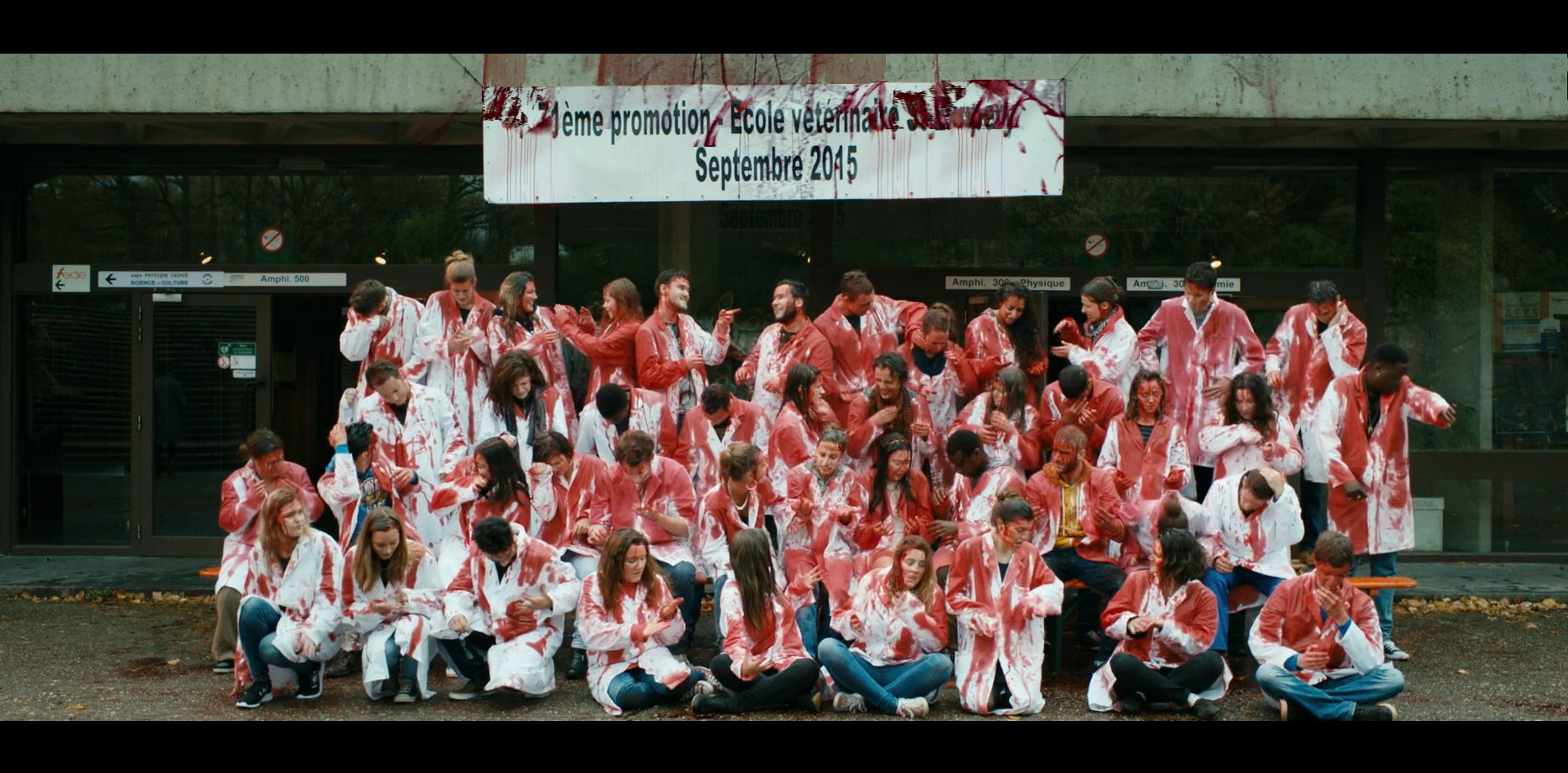
Brought up on a strict vegetarian diet by her parents, Justine became conscious that one swallow of meat down her gullet might start a chain reaction of life-threatening allergies. Her legacy acceptance into the prestigious Saint-Exupéry Veterinary School would have a set of challenges toward retaining that diet but her older sister, Alexia, who is still studying at the school and is also a vegetarian, would protect her from the intense hazing brought down upon the freshman class. When it turns out that Alexia gave into the temptations of peer pressure and egged her own to digest meat in a hazing ritual, Justine learns that her sister’s shielding won’t stand up against the forces of elder student pranks. From then on, a primordial animalistic behavior slowly transforms Justine from a quiet, awkward, and studious teenage girl into a party animal, an explorer of sexual awakening, and a herbivore whose slipping from her regime. Justine’s craving for raw meat digs deeper into the bone as the overwhelming need to consume human flesh spirals her down into an uncontrollable descent, turning the school’s exuberant hazing knaveries all the more dangerous.

Having been a meat eater all my life, the transition to vegetarian would be a hard-fought war that would likely shed years off my life just as much as eating a thick, juicy cut of a steak seasoned to perfection and medium cooked. After all, the human race is born with tapered canines that rip through the tough flesh and meat first and then pass along the now tendered feed to our molars, our mashers, that would handle the soft, chewy substance for an easy ride down toward our stomach. “Raw” takes that approach one step further, or maybe two or three steps further, by coupling the sudden discourse from meatless to meaty meals that expands into cannibalism with a coming of age and finding one’s place in life story that can be relatable to us all. The French film is written-and-directed by Julia Ducournau, who reprised herself with another body horror sensation with last year’s acclaimed “Titane,” and was shot at an actual veterinary school in Belgium, the University of Liège. Originally titled “Grave” before being upgraded to “Raw,” the film is a production from a conglomeration of studio labels, including the first horror production for Petit Film. Rouge International (“Murder Me, Monster”), Frakas Productions (“Sea Fever”), Ezekiel Film Production and Wild Bunch (“Martyr”) serve as a few of the film’s other coproduction companies with Jean des Forêts, Julie Gayet, Jean-Yves Roubin, Nadia Turincev, and Cassandre Warnauts as producers.

“Raw” is not your typical girl journeying through the trials and tribulations of normal self-discovery.  For this, you need not your typical girl to play centric character Justine.  Enters 16-17 year-old Garance Marillier, the Paris-born actress with an established bond on and off screen with director Julia Ducournau having debut her acting in Ducournau’s 2011 short film “Junior” as a tomboy going through a strange corporeal transformation.  Fun fact:  Marillier has been cast as a different Justine in all three of her collaborations with Julia Ducournau – “Junior,” “Raw,” and “Titane” since 2011.  Marillier soaks into “Raw’s” Justine with not only a transcending behavior pattern performance that takes the freshman from stifled to uninhibited, but the young actress also overhauls a complete body language transformation that sheds Justine’s meek skin, literally displayed on screen, for a more confident and abrasive veneer.  Ella Rumpf (“Tiger Girl”) receives Justine’s inexperienced blossom-hood with an the older, already initiated, sibling having been fostered by rambunctious peers to break the sheltering chains her parents had shackled with and just like true to life sisters, there’s contention.  The vehemence venom between them when they’re on bad terms on screen can stop one’s breath, you can hear a pin drop, yet you still understand their sisterly connection and love no matter how messed up a situation might be, especially when involving boys, such as the pansexual fluidity of Justine’s freshman roommate Adrien, played by Rabah Nait Oufella.  “Raw” rounds out the small cast surrounded by a slew of extras with Laurent Lucas and Joana Preiss as mom and dad.

Julia Ducournau has the body horror genre down to the molecular level.  It’s as if the filmmaker studied every film and playbook of David Cronenberg just from researching her various work credits that target to restructure and regress the human condition into something far worse and watching “Raw” unravel a symbiotic relationship between natural and unnatural human development blurs that line of what is considered to be normal so disturbingly good.  Exteriorly, we notice the changes and can almost set a clock to way our bodies react and change over time, biologically and socially, within the context of our environment.  Internally, a whole unexplored set of conditions apply to the unpredictable mindset of transfiguration and that’s where Justine paves an unfounded roadmap for her sudden kick from being a veggie lover to a flesh craver. “Raw’s” undoubtedly an allegory of a young girl’s pubescence and coming of age into her own from, essentially, being on her own exploring her sexuality and exploring new interests as is such with going into university. Ducournau casually strolls through Justine’s drama and tension as much of the body horror overwhelms our morbid curiosity but her angsty complications, still very much underlined even being overshadows, retain a constant line of parallelism in a symbolic reality. Delicate touches of indelicate gore really spice up “Raw’s” entrenching story not for the faint of heart as well as vegetarians.

Hot off the heels of their now out of print limited edition release of “Raw,” Second Sight Films offers a second, standard release on Blu-ray home video. The UK label offers a single disc packaged, region B encoded, BD-50 of a 1080p, high-definition, 2.40:1 aspect ratio presentation, listed at running an average frame bitrate of ~24Mbps. Highly accurate on its bitrate average, the image is well diverse in discerning details without an ambiguous scene or spot in sight. The color often feels muted, dreary, like one long continuous overclouded day that presents an everlasting feeling of dismay. Yet, that isn’t all cinematographer Ruben Impens has to offer with arthouse framing of disturbing imagery and an opening freshman party scene that takes us through the cramp pockets of sweaty, half-naked partygoers in one lengthy, single shot that expels just about everything Justine will face at her time in veterinary school. The French DTS-HD 5.1 master audio superbly distributes the audio tracks with just right levels to accommodate each scene. If there’s a noisy, bass blaring party, the score rightly takes over and the dialogue takes a muted backseat but still clear and intelligible – or so I believe since I don’t understand French, but I can make out the syllables and inflections. Otherwise, dialogue is king and clear alongside an eclectic soundtrack of English indie rock and experimental tracks as well as Jim Williams guitar and industrial synth trek across that’s beautiful and, simultaneously, disconcerting disharmonic. If you missed out on the limited edition, don’t bite yourself as the standard edition as plenty of extra features, including an interview with actress Garance Marillier The Girl Can’t Help It, an interview with producer Jean des Forêts Making Ends Meat, an audio commentary by film critic Alexander West, an audio commentary with director Julia Ducournau and critic Emma Westwood, an interview with Ducournau A Family Affair, the featurette Raw A Votre Gout with Ducournau and Emma Westwood, a conversation between Ducournau and critic Alexandra Heller-Nicholas Quick Bites, a genre matters panel discussion, an Australian premier introduction and post screen Q&A with Ducournau and Kier-La Janise, and a handful of deleted scenes. The film runs at 99 minutes, comes with well synced English subtitles, and is certified 18 for strong gory images and injury detail. Taste “Raw’s” unseasoned, unadulterated, pure and simple line of hidden truths and manifesting urges that once crossed there’s no turning back as the person you once were, is no longer akin to an impossible burger but a fully tendered hunk of mouthwatering meat freshly cut and ready to sink your teeth into.

Evil’s Crimes Against Nature Will Not Go Unpunished! “Long Weekend” review!


Peter coerces his begrudging wife, Marcia, to forgo the luxurious hotels and chauffeured holidays for a long weekend of camping on a remote beach in Australia. An enthusiastic Peter packs the jeep with thousands of dollars worth of outdoor gear, including a surf board, a spear gun, and a hunting rifle. Marcia loathes the outdoors, can’t stomach the very thought, and she lets Peter know her distaste of his plan every other second while on holiday. Yet, this trip for them isn’t just a routine getaway, but, instead, a trip to get away from the swinging friction of close and very intimate friends, to rekindle their relationship, and save what little is left at a frayed string. The already awkward and complaint-riddle holiday turns from bad to worse when nature looms a foreboding shadow over the estranged couple, unleashing one ill-fated omen to the next that checks their nonchalant attitude toward nature with eco-radical discipline.

“Long Weekend” is an eco-horror film by “Innocent Prey” director Colin Eggleston. Alfred Hitchcock, perhaps, birthed the horror subgenre with his 1963 film “The Birds” that led to such films as “Day of the Animals” and “Grizzly.” Nearly 15-years later, Eggleston hones in on his inner Hitchcock by expanding the background on why nature turns cold and unsettlingly supernatural like. Working off a powerfully detailed and haunting script by “Razorback’s” Everett De Roche that circles around two characters like a hungry vultures, Eggleston vitalizes De Roche’s script with a paper to screen bleak, unsettling imagery on a monumentally minimalistic scale. “Long Weekend” could be considered a Hitchcockian film, and most likely is, but can stand firmly by itself as an extension on how mother nature can be a bitch when push comes to shove.

Two characters and the wilderness. That’s all “Long Weekend” boils down to on brass tacks, leaving two actors on the line to act off each other and off of the ominous presence that has fully engulfed them on an isolated stretch of beach and shoreside forestry. “The One Angry Shot’s” John Hargreaves tackles the conceited Peter with a full-bodied combination of heedless gusto and desperation that Hargreaves can seamlessly become lost in Peter’s self-worth. The Sydney born actor is paired with an English actress by way of Briony Behets from the 1980 film “Stage Fright,” a film also co-written by Colin Eggleston. Behets’ Marcia epitomizes the stereotypical enigma that men all think is the inner workings of a woman’s brain; Marcia is hot and cold with fleeting moments of passion for Peter, yet ready to kill him in the next scene. Behets converts the baffling intertwinement of Marica’s energy and channels it well into the dynamic that is their failing marriage.

What’s really special about Eggleston and De Roche’s film is the overloading symbolism. From subtle to simple, “Long Weekend” has the money betted on working on an underlying moment-to-moment, scene-to-scene in each act; a method tirelessly schlepped through with many modern features of today. Using non-threatening animals, such as a small possum and a sea cow or dugong, to be part of a menacing force driving the ominous presence across the narrative just sets the feng shui mindset of an unadulterated evil genius. Instead relying heavily on a physical entity, Eggleston heavily coincides creature imagery with the use of audible creature cues, whether a baby-like wail in the distance or the overpowering cacophony of animal growls and sneers, to invoke panic, fear, and paranoia to divide the already fragile pair into an atomic disaster of their undoing. “Long Weekend” will overshoot some viewers as piecing the puzzle together can be a slow and long process, but one aspect is certain, the off-camera animalistic stare has a powerful affect.

Second Sight delivers the ozploitation classic, “Long Weekend,” onto Blu-ray home video for the first time in the UK this November. Unfortunately, a review DVD-R disc was provided for this critique and audio and visuals components will not be covered. Bonus material was included on the review disc with audio commentary with executive product Richard Brennan and Cinematographer Vincent Monton, an Umbrella Entertainment produced panel discussion with film historians Lee Gambin, Alexandra Heller-Nicholas, Emma Westwood, and Sally Christie, Uncut “Not Quite Hollywood” interviews with Briony Behets, Vincent Monton, and Everett De Rocha, an extensive still gallery with an John Hargreaves audio interview, and original theatrical trailer. “Long weekend” is man versus nature at it’s best with sheer, unrivaled terror in a quaint eco-horror thriller package with a powerful message that nature will seek extreme judgement against Mother Earth criminals.

Beer, Guns, and A Giant Crocodile! This is One Helluva Evil Ozploitation Film! “Dark Age” review!


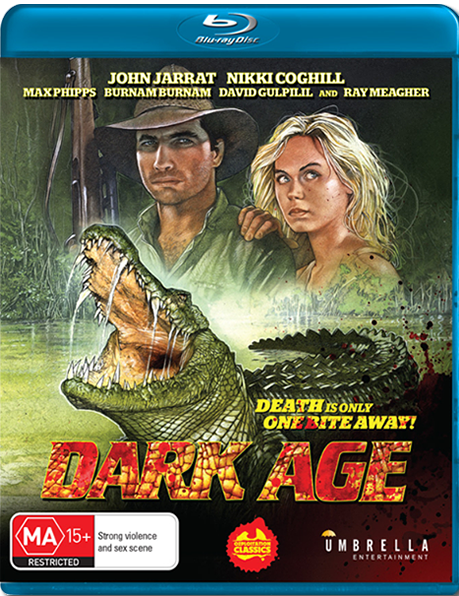
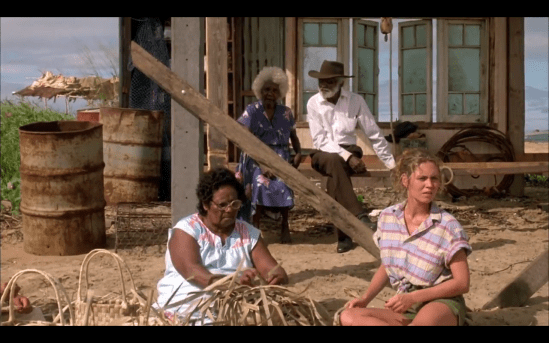
In the Australian outback, a prehistoric and ginormous crocodile has surfaced in the wake of mankind’s gentrification of the wilderness land. Between ambushing crocodile poachers and snatching little Aborigine children from off the river shore, the ancient saltwater hunter has become the hunted as park ranger and crocodile preservation expert Steve Harrison has been assigned to kill the beast, but the local Aborigine tribe holds the killer croc sacred, calling it Numunwari, an ancient, spirit carrying crocodile that has embodied the bones and souls of ancestral aborigine. Together, Harrison and local tribe leader Oondabund must find a way to stop the chaos without terminating the Numunwari while combating drunken poachers and a rattled ranger chief looking to abruptly end public fear. With the enthusiastic help of Harrison’s ex-lover, Cathy Pope, the three devise a dangerous plan to sedate the massive croc and transport it to a secluded habitat before death rears it’s ugly head once again.

Arch Nicholson’s “Dark Age” is the Australian “Jaws” equivalent, introducing a massive crocodile that puts the fear of the murky rivers into the hearts of audiences much like a giant great white shark did for the ocean beaches. “Dark Age” is a raging adventure with a delicate undertone about nature fighting back against an aggressive, occupying force called man, especially the white man, who kills without cause, who plagues without consciousness, and whose power instills a reactionary fear to kill. A single, monstrous crocodile embodies and symbolizes the essence of an entire habitat, chomping through flesh and doing a death roll to make known that nothing can stop nature or as “Jurassic Park’s” Dr. Ian Malcolm so eloquently put it, “Life, uh, finds a way.” Nicholson’s film, from the novel of Grahame Webb novel Numunwari, isn’t solely a man versus nature horror despite marketed as one; instead, “Dark Age” unveils more the cruel side of human nature that’s more Machiavellian than nature running its course.

“Wolf Creek” star John Jarrett, who I better know from “The Odd Angry Shot,” stars as the conflicted park ranger and crocodile preservation expert Steve Harrison. Jarrett’s more convincing a maniac outdoors man than a crocodile conversationalist, but the iconic Aussie convinces us all that being in between two opposing sides is no easy task with this willingness to do what’s right on both sides. Nikki Coghill portrays Steve Harrison’s love interest, Cathy Pope, and Coghill is a dominating female lead by, not only being the only prominent female character, but with her striking ability to overpower Jarrett in scenes and with her also very striking beauty that comes to peak in a fleshy sex scene with Jarrett. The second most recognizable face behind Jarrett is aborigine descendant David Gulpilil. Most Stateside filmgoers may recall Gulpilil’s long locks and distinctive facial features from Crocodile Dundee in a ceremonial Aborigine dance alongside Paul Hogan. In “Dark Age,” Gulpilil plays Adjaral, son of Aborigine tribe leader Oondabund played by Burnham Burnham. “The Howling III” actor acts as a spiritual liaison between the crocodile and the white man world and Burnham Burnham’s childlike presence onscreen makes the actor very memorable and likable. Ray Meagher, Max Phipps, Jeff Ashby, Paul Bertram, and Ron Blanchard co-star.

There have been many installments and versions of crocodile leviathans. In fact, in It’s Bloggin’ Evil’s last review, Sion Sono’s Tag, there’s a dream sequence of a giant crocodile gorily snapping down upon a Japanese schoolgirl with blood spraying everywhere. While the scene is graphic, eye-catching, and notable, the croc was a mockery of reality with disproportionate jowl and a flimsy design that’s more cartoonish than substantially factual. Kuddos to the monster effects and long time visual effects artist Roger Cowland for constructing a frightening behemoth of a crocodile. Though slightly stiff in some scenes, Nicholson camera placement exhibits just enough to warrant a shortage of breath whenever the crocodile goes in for the kill or stalks a prey with the round eyes popping just above the water’s surface. This effect is masterfully executed by the late director who didn’t feel the need to be gratuitously gory with the death scenes that are modest, intense, and sheerly practical.

Yet to be on DVD or Blu-ray in the U.S.A., the good blokes over at Umbrella Entertainment release ultra-rare “Dark Age” for the first time hi-definition on Blu-ray as part of Ozploitation Classic series presented in a 1080p widescreen, 16:9 aspect ratio, format. The image looks clean without any noticeable enhancements, distortions or print damage with only some heavy noise in the darker scenes. The Dolby Digital 2.0 audio track is just as perfect with clarity in the dialogue, a pulsating synthesizing score, and fine fidelity and range. No hissing, popping, or any other noise annoyances were detected. Umbrella unleashes a slew of bonus material includes an audio Commentary with Actor John Jarratt and Executive Producer Antony I. Ginnane, a Bicentenary with Bite: Revisiting “Dark Age”, panel discussion with film historians Lee Gambin, Alexandra Heller-Nicholas, Emma Westwood and Sally Christie, and Uncut Not Quite Hollywood Interviews with John Jarratt and Antony I. Ginnane which are tremendously enlightening about the film’s birth and concluding reactions. There’s also a 1986 documentary entitled Living With Crocodiles with Grahame Webb, author of Numunwari, trailers, and an image gallery. Forget “Rogue.” Forge “Lake Placid” Lets even forget “Dinocroc!” Umbrella Entertainment’s “Dark Age” is the ultimate formidable 90-minute action-horror with trembling induced fear and adrenaline produced thrills accompanied inside a hi-definition release packed to the razor sharp teeth with extras.