
The Demon Concubine Is After the EVIL Power of Demon Summoning Upon Earth! “Saga of the Phoenix” reviewed! (88 Films / Limited Edition Blu-ray)

Own “Saga of the Phoenix” on Blu-ray from 88 Films!

For 660 years, Ashura, the Holy Virgin of Hell, has used her powers to resurrect demons from the underworld.  With the help of virtuous fighters Lucky Fruit and Peacock from the spirit realm, has renounced her temperamental intentions to use her powers for evil ever again and live beside the mortals under the warmth of sunshine.  When she accidently summons demons on Earth, Ashura is brought before Master Jiku and the Divine Nun to access the damage and reign judgement.  They sentence her to live in cell of the relaxed Buddha for all of eternity, but she persuades them one chance to live amongst the humans for seven days, just enough time to live under and enjoy the only thing she wants, the sun.  The Demon Concubine has a different plan for Ashura.  Seeking her demon resurrection powers, the Demon Concubine aims kill her but with the help of Lucky Fruit, Peacock, and her new human friends, Ashura will battle against the Demon Concubine and her demonic forces. 
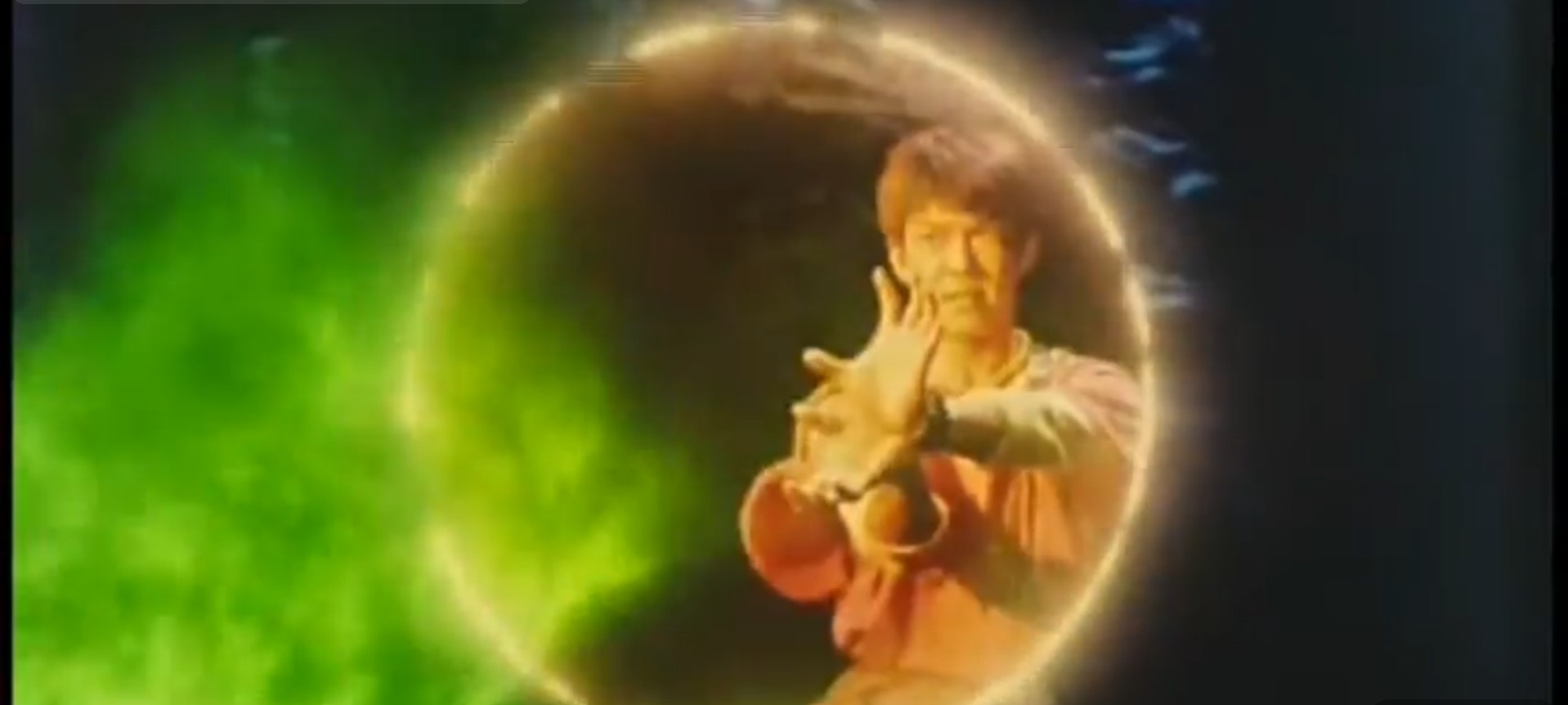
“Saga of the Phoenix” is the Golden Harvest produced, 1989 released sequel following quickly behind the 1988 released “Peacock King.”  Based off the Japanese manga “Peacock King” written by Makoto Ogino from 1985 to 1989, the action-fantasy film was codirected by returning “Peacock King” director Ngai Choi Lam (“Riki-Oh: The Story of Ricky,” “The Cat”), aka Lam Nai-Choi, and newcomer to the series Sze-Yu Lau (“Forced Nightmare,” “My Neighbors are Phantoms!”) with “Game of Death” actor Biao Yuen stepping away from writing the follow-up and be more involved on the acting by returning to one of the main roles from “Peacock King.”  The script is from a confluence of Japanese and Hong Kong screenwriters, initially scripted by Japanese manga adaptation to television screen writer Hirohisa Soda and then adapted by Tsui-Wah Wong, You-Ming Leung (“Once Upon a Time in China”), and Sau-Ling Chan, none of whom were involved in “Peacock King.”  Hong Kong’s cult and genre film product Lam Chua (“Erotic Ghost Story, “A Chinese Torture Chamber Story”) serves as producer on the Golden Harvest and Paragon Films Hong Kong-Japanese coproduction. 
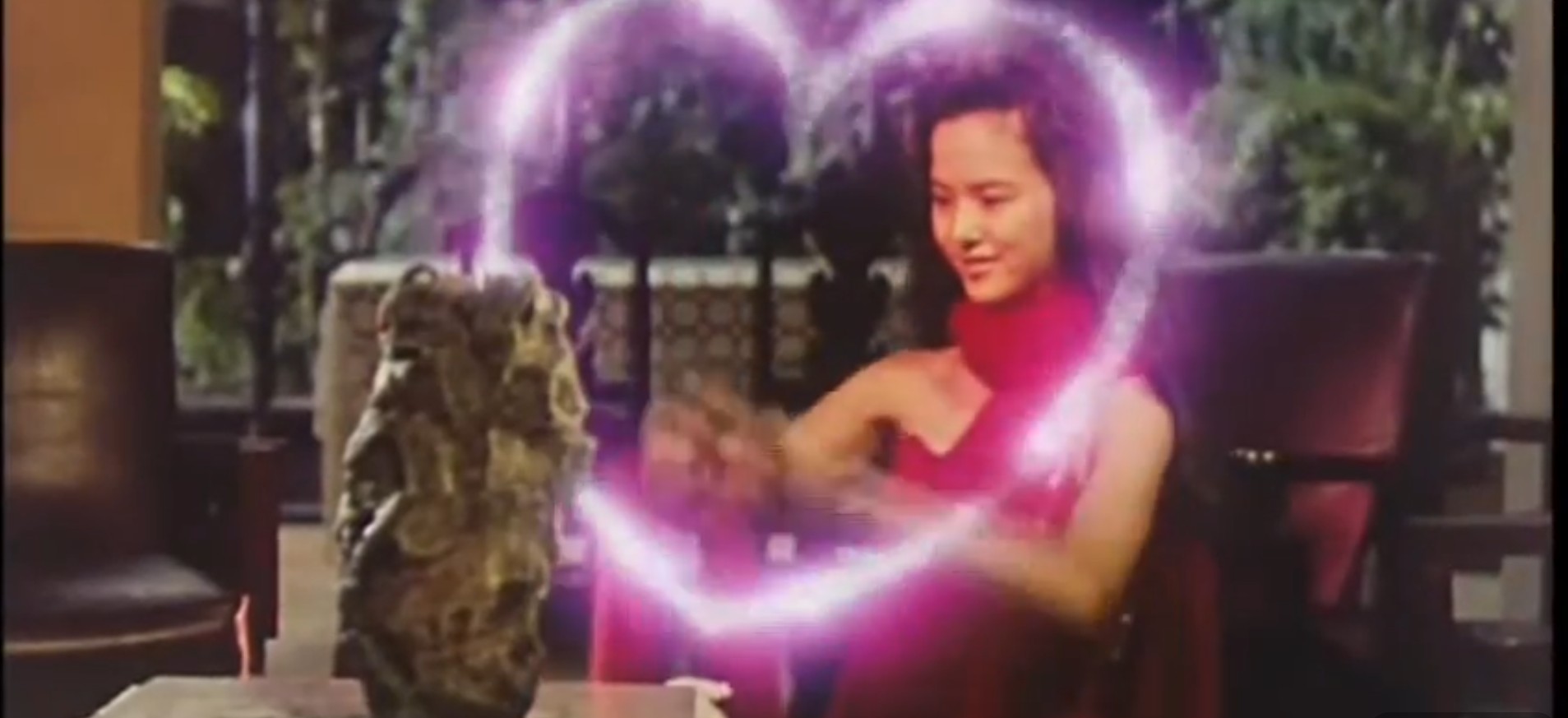
Gloria Yip returns as the Holy Virgin of Hell, Ashura.  Having never seen “Peacock King,” I’m not sure what type of temperament Ashura donned in a role where the character seems like one of the main antagonists according to the synopsis, but for “Saga of the Phoenix,” Ashura is joyful, childlike mischievous, and humble and is the center focus between the forces of good versus evil.  Als returning is Biao Yuen, but not in his screenwriter role.  Yuen, known for starring alongside female martial artist and star Cynthia Rothrock in “Righting Wrongs,” reprising Peacock, a fierce spirit realm guardian who befriends Ashura along with fellow guardian Lucky Fruit, played by Hiroshi Abe (“Godzilla 2000”) who replaced Hiroshi Mikami from the first film.  Much of Yuen is taken out of the story while being in frozen captivity by the Demon Concubine, leaving Abe and Yip to better struggle one-on-one connecting in the human world, facing human problem, and accessing the threat from the Demon World.  Yip’s candid antics exact the innocence of a young child like making snarky faces when corrected or obsessing over trivial things like sunshine, and especially when Ashura befriends a small, gremlin-like troll or creature named Tricky Ghost and holding it like a favorite stuffed toy, and this leaves Abe to be the role model, or the parental guardian if you will, stoic in stance and a reasonable thinker for his character.  It all comes off as silly until Ngai Suet and the Demon Concubine enters the frame.  The “The Ghost Ballroom” actress Suet takes on the evilly empowered role armed with seven demon subjects to do her bidding, such as trying to kidnap Ashura, and Suet runs with the role caked in a pale makeup, high pointy eyebrows that open up her eyes, and shoulder-padded dark dress.  Embroiled in the spirit world clash are two mortal siblings in Chin (Loletta Lee, “Mr. Vampire Saga IV”), who saves unintentionally saves Tricky Ghost, and her mad scientist brother Tan (Shek-Yin Lau, “Resort Massacre”) who finds himself in bitter rivalry with Tricky Ghost’s mischief ways spurring some comic relief into the fantastical brew and they represent the workable relationship between man and godlike individuals.  “Zatoichi” series actor Shintarô Katsu is in the role of Master Jiku, “Carmen 1945’s” Yûko Natori is the Divine Nun, and Noriko Arai (“Death Note”), Megumi Sakita (“Bodyguard Kiba”), and Yukari Tachibana (“The Scissors Massacre”) as the three nun warriors to round out the Hong Kong-Japanese cast.
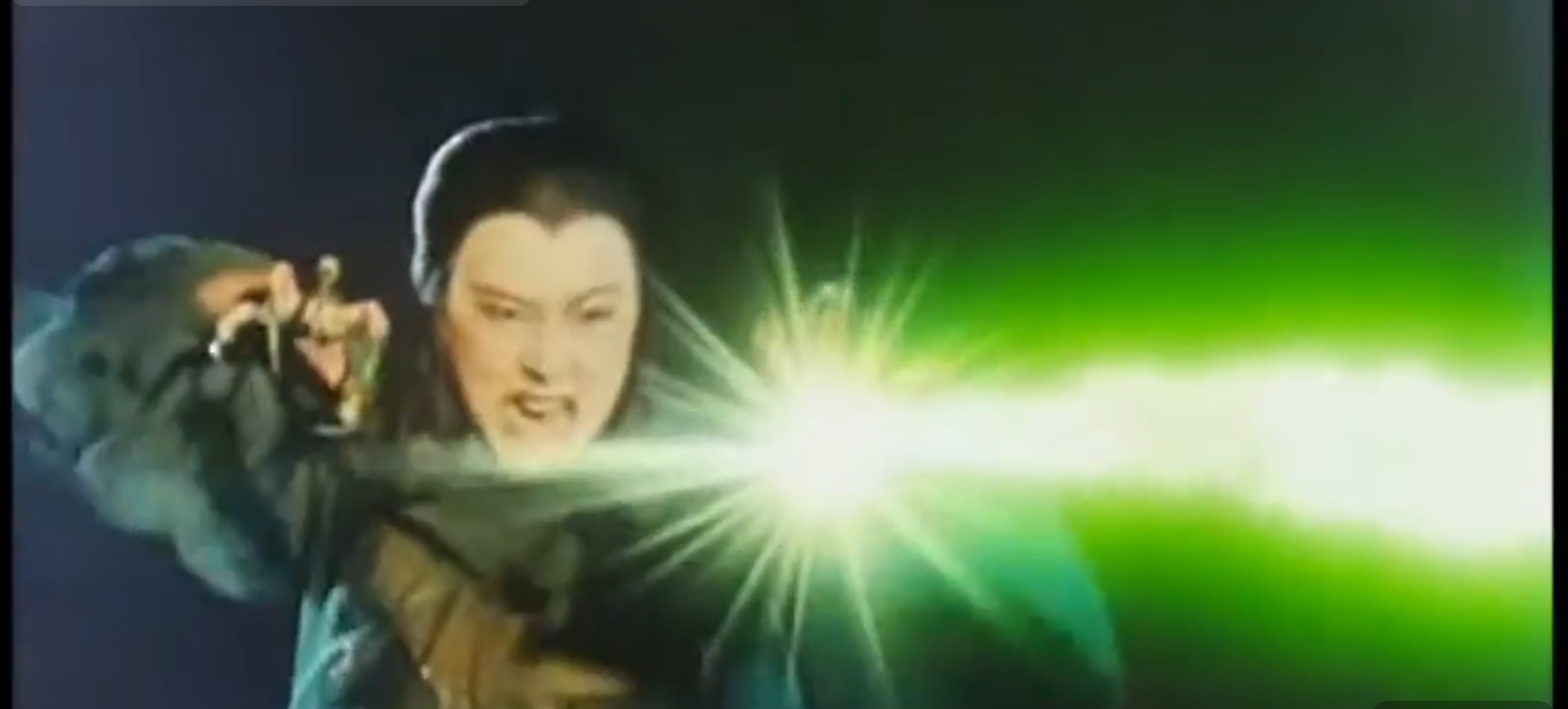
If you’re familiar with director Lam Nai-Choi, then it comes no surprise to you the kind of practical effects juggernaut “Saga of the Phoenix” can become and, in the end, doesn’t disappointment.  Choi often overscales the effort of tangibility, bringing unbelievable imagination and larger than life objects to manifestation without much, if any, assistance from computer generated imagery, and in the late 1980s, that technology wasn’t exactly perfected to what modern cinema sees today with skilled visual artistry and the introduction of artificial intelligence that’s on the verge of possibly shoving itself into the actor pool once the kinks are worked out.  In “Saga of the Phoenix,” the palpable physical presence involved is mostly at the finale third act where good versus evil face off between Ashura, Peacock, and Lucky Fruit and the ravenously aggressive Demon Concubine, the latter transforming like a Power Ranger Megazord into a gray-skeletal winged creature large enough to tower over the heroes and wide enough to swallow them nearly by three times.   Of course, this is not to say there hasn’t been other practical effects along the way which include demons inhabiting dragon statues, high wire acts of characters soaring during fight sequences, and the little mischievous imp, Tricky Monkey, from being a manipulated puppetry that weirdly reminisces Jim Henson’s “Labyrinth.”  The painted optical tricks to render color bolts of energy weaponry are a nice classic touch toward a pop of color as well as creating the inherent superhuman element of the principal players.  For someone going into “Sage of the Phoenix” headfirst without having seen or any knowledge of “Peacock King,” room for the film to standalone is rather thin but not egregiously reliant on the first film.  There’s a bit of recapping at the begging with narrative voiceover and get some clue-ins about the past from the dialogue but there’s still quite a bit unexplained, such as Ashura’s behavior fabled to be a powerful demonic necromancer who has somewhere along the way had a change of heart and we’re not privy to why.  That sense of uncertainly never really goes away through the comedy, action, and laser-firing, high-flying martial arts sinew, that something is innately missing from the story that’s saturated with wuxia themes. 
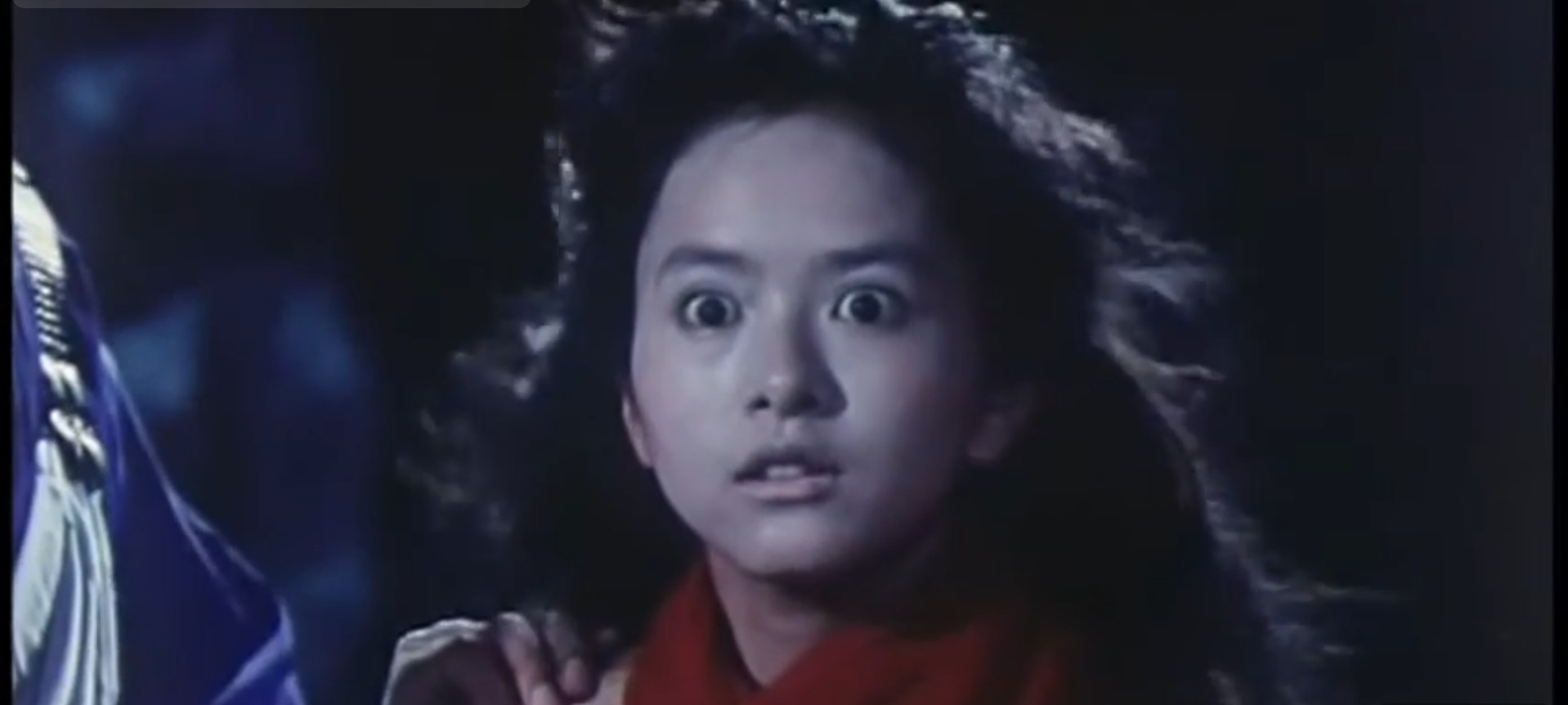
If looking to increase your bicep’s muscle mass, 88 Film’s limited-edition Blu-ray is weighty with content and it’s only one disc!  The AVC encoded, 1080p high-definition resolution, BD50 is encoded with a cherished updated 2K restored transfer from the original 35mm negative that looks unquestionably majestic on screen.  Vibrant and diffused evenly colors, high decode rate, and flawless textures, there’s nothing to dislike about this release, visually technical.  Deep in the color range and Chi-Kan Kwan’s sundry cinematography that offers vast length shots and a warm neon haze of blue and magenta through tint or gels, with a matted golden peacock rising against the monstrosities of the demon world, “Saga of the Phoenix” resurrects an aesthetic only Lam Nai-Choi could manifest from pure imagination.  The original negative is virtually pristine with no signs of damage or wear to note, nor any compression issues to note.  The uncompressed PCM Cantonese 2.0 mono offers a forward heavy diegetic sound that separate each layer favorably diversified. Clean and clear ADR make for easy discernability, capturing every bit of dialogue despite the post-production mis-synchronous acceptance. Laser action, creature roars, and other detailed measured sounds really give “Sage of the Phoenix” body, depth, and range that makes it an overall A/V highlight amongst its wuxia genre counterparts that tend to omit the smaller particulars of a scene. English subtitles pace just fine and are errorfree in a UK text. Most of the heavy lifting is done by the physical presence of the 88 Films Blu-ray that’s housed in a rigid slipbox and sheathed in a cardboard O-Slip, both containing new arranged illustrated artwork by R.P. “Kung Fu Bob” O’Brien that’s takes the true elements from the film and places them on the cover in a sure-fire canvas of what to expect. The clear Amaray cases also has O’Brien artwork as the primary cover art with the reverse side featuring the original Hong Kong poster art. Along with the O-slipcover, other limited-edition contents include a two-sided collectible art card and a 40-page illustrated book with color pictures and essays from Andrew Heskins (From Panel to Screen) and David West (The Japanese Connection), along with featured Japanese cover art Kujakuoh-Legend of Ashure. If the physical properties were not enough, the encoded content, available on the LE and Standard Edition, will bring this set home as it details with an audio commentary by Hong Kong Cinema Experts Frank Djeng and F.J. DeSanto, alternate footage from the Japanese cut of the film, executive producer Albert Lee discusses the international distribution plan from Golden Harvest Sage of Golden Harvest – The International Connection, an image gallery, and the original trailer. The 88 Films release is unrated, has region A and B playback, and has a runtime of 94 minutes.

Last Rites: Wuxia movies like “Saga of the Phoenix” are no surprise to where John Carpenter found influence for “Big Trouble in Little China” and it’s the director Lam Nai-Choi who didn’t shy away from the difficulties and inauthentic problems of physical effects but the film has its own innate issues with story that downgrade from a saga to just being an epic picture with winged creatures, bright energy blasts, and a lovely Gloria Yip succumbing to age, and status, regression with her Holy Virgin From Hell role.

Own “Saga of the Phoenix” on Blu-ray from 88 Films!

A Prince’s EVIL Plan to Gain the Throne Meets High-Flying, Kung Fu Rebel Resistance. “The Lady Assassin” reviewed! (88 Films / Blu-ray)

“The Lady Assassin” LE Blu-ray Now Available!

Emperor Ching’s health is rapidly declining and before his death, he challenges his 14 princes to find the best candidate to rule of his kingdom.  Ultimately, the 4th and 14th princes are vying for the throne but embark on different moral paths that set them starkly apart.  Fourth Prince Yung Cheng will lower himself to any ignoble scheme worth gaining him the throne while the 14th Prince, who might be weaker in strength, would be a better, more compassionate, ruler for the people.  When Yung Cheng plots an assassination against the 14th Prince, his plans are foiled by the prince’s skilled bodyguard Tsang Jing, the greedy Prince takes an alternate route to the throne by conning Han loyalists, who feel the Manchu clans have treated them unfairly by abusively restricting their power and fortune, into a plot to steal the Emperor’s royal decree of announcing the new Emperor and forging his name into the document.  By this very deception, Yung Cheng is announced Emperor and turns his back on the Han loyalists who joined forces with Tsang Jing and Han rebel Si Nang to end his dishonest rule over both the Hans and the Manchus.

The eclectic Shaw Brothers produced fantastical fights, high-flying stunts, and a story interweaved with deception, death, and melodramatics in the immersive period of dynastical China with the film “The Lady Assassin.”   Filmed in Hong Kong, the film is written-and-directed by acclaimed action filmmaker Chin-Ku Lu at the height of his career.  “The Black Dragon” and “Holy Virgin vs. The Evil Dead” director delivers a deluging epic of sensationalized kung fu interspersed with a usurping back-and-forth story of cutthroat politics and deceit and the minority that attempts to dethrone villainy with punitive justice, the only kind of justice ancient China knew to dish.  Mong Fong (“Killer Constable,” “The Mad Monk”) produced the feature with Run Run Shaw serving as executive producer.

One would think the title being “The Lady Assassin” would focus on a solo female kung-fu killer aimed to strike ruthlessly in a clandestine caper, but most of the story’s principal shoulders have an equal share burden amongst a deep protagonist cast of characters.  Leanne Liu plays the titular assassin Si Niang, a Han rebel whose father (Ku Feng, “Erotic Ghost Story,” “Vengeance of a Snowgirl”) is head dissident number one against the Manchu leaders, and the “Bastard Swordsman” and “Hong Kong Playboys” actress doesn’t become introduced into the story until about midway through as much of the Prince-on-Prince, good-vs-evil, tale is spearheaded by those vying throne-seekers with much emphasis on their guards, assassins, and the skilled in Kung Fu company they keep.  Tony Liu (“Fists of Fury”) and Mok Siu-Chung (“Nightmare Zone”) are respectively the evil scheming 4th Prince and the good-natured but weaker 14th Prince seeking the throne of their dying Emporor father (Ching Miao, “The Devil’s Mirror”) and the two give into their roles very efficiently, delineating a clear line where they stand in the grand scheme of the plot with the 4th Prince proactively trying to destroy any chance others may have at the throne with the 4th keeps in the shadows and avoids conflict; the latter heavily emphasized by a lot of do-nothing from the 4th Prince’s character.  A great deal of the first two acts relies heavily on Tsang Jing’s honorable service to the people who showed him kindness.  “Zu Warriors from the Magic Mountain” actor Norman Chui imposes impeccable fighting ability and timing but is strangely engrossed by his character’s life to serve those who he owes and we’re not talking a purse debt or for saving his life but rather a loyalty aspect for kindness, morality, and justice that contrasts against Min Geng Yiu, played by Jason Pai Piao, who initially is introduced as an upstanding citizen fighting against unethical behavior until his hypocrisy lands him greedily in the arms of a deceiving 4th Prince, twisting You to accomplish his bidding while he always subverts his lord with his own deceptive plans of power.  Backstabbings and desperate mesasures, along with stellar, high-flying, hand-to-hand and sword fighting, zip “The Lady Assassin” into another level of martial arts mania with a rounded out cast of Cheung King-Yu, Yeung Jing-Jing, Yuen Tak, Kwan Fung, Sun Chien, and Johnny Wang Lung-wei. 

Kung Fu films, especially in the 1970s through well into the 1990s, are a dime a dozen so what makes Chin-Ku Lu ‘s “The Lady Assassin” different from the rest?  One area to note is fight and stunt choreography that smooths the edges around the other contemporaries slower, less theatrical, routines with vigorous and diverse long sequences containing large quantities of combatants.  Usually, most fight sequences are limited to 1-on-1, 2-on-2, and maybe 3-on-3 or 3 or 4-on1 at most, but hordes of swords, staffs, and topographical anomalous landscapes, constructed on a stage of course, are seamlessly dynamic and meritoriously fast paced and thrilling, produced by the stunt work team of Yak Yuen, Kin-Kwan Poon, and Yung Chung.  The other area to note, and one that goes hand-in-hand with the stunt choreography in order for it to work, is Shao Kuang Liu’s editing, taking footage and just going to town with a series of cut and tapes and still coherently fashioning a continuous fight and flight, complete with pulley wires, despite its rapid strikes that might have some accelerated motion of the film.  What’s inherently captivating for “The Lady Assassin” can also be a tiring visual as the fights flare up brief plot points in between, the fights can feel a bit long in the tooth come the third act; however, the final showdown, a last ditch effort between the last of the Han rebels versus the 14th Print and his crazy-faced, hired gun Japanese martial artist levels up the violence that halves fighters horizontal and vertical.  The story’s an effort to keep up with as the continuous double crossing and changes of heart nearly blend together and too many assumed interpretations toward the fate of characters off screen can work the thinker double time, compounding the ambiguous clarifications profoundly. 

88 Films continues to restore-to-rejuvenize the Shaw Brothers extensive catalogue of Hong Kong produced eclectic films with the UK company’s latest high-definition scan of “The Lady Assassin” from the original negative and release the 45th title on a part of their 88 Asia line  Cleanly saturated and rich in beautiful coloring, the AVC encoded, 1080p, BD50, presented in the original widescreen aspect ratio 2.35:1, is a marvel to watch. The original print has been kept well-preserved with barely a flaw to note albeit a less than a handful rough tape cut or damage framed moments that are so insignificant that if you blink, you’ll miss them.  The vivid and vibrant mise-en-scene is a convergence of stark contrasts and itemized delineation that creates space and depth while also visually stunning, even with what I like to call peacock fighting, or showing off fighting.  Of course, there’s also tiger fighting, praying mantis fighting, etc.  The gain is naturally pleasing without being too thick or smoothed over.  Skin tones and gleams are natural and absolute with a sense of popping right off the screen.  The Cantonese 2.0 mono is post-production ADR but syncs well with not an egregious division between mouth movements and dialogue.  Dialogue is overall clean and clean with faint hissing here and there.  Chopsocky audio layers have clean hand and foot, leg and arm whacks and full-bodied swish and swing of sword and glaive swipes.  There’s not lucrative range with much else, specifically the ambient environment as all the audio design is done in post, with a few only a handful of moments, such as Tsang and Si Nang fishing or a few interiors fights implementing room objects require foley.  The soundscape is epically charged but not terribly memorable and there are quite a few fights that go without a score to provide the action effects more prominence.  The newly translated English subtitles are errorfree, do sync well, and keeps with the pace.  Special features include an interview with Kin-Kwan Poon conducted by Fred Ambroisine From Child Actor to Fight Coordinator as well as the film’s trailer and gallery stills. 88 Films’ houses the Blu-ray in a limited-edition glint of golden cardboard slipcover of new art featuring the titular assassin. The same image is primary Amaray cover art with the original poster art on the reverse side. In the insert, a thick, dual-sided folded poster of both cover illustrations rounds out the tangible elements. The Blu-ray is encoded with A and B region playback, is unrated, and has a runtime of 86 minutes.

Last Rites: A spectacle of soaring Kung Fu with a spruced-up restoration that makes “The Lady Assassin” that much deadlier in all its dynasty melodrama and game of thrones strife. One of the best Shaw Brothers offerings from the early 1980s!

“The Lady Assassin” LE Blu-ray Now Available!

Prepare Yourself for the Side-Splitting EVILS of Adultery. “Sex and Zen” reviewed! (Umbrella Entertainment / Blu-ray)

A Must-See, “Sex and Zen” is highly erotic and highly funny.

A wealthy educated man is arranged to marry the beautiful and sexually naïve daughter of a high scholar.  After persuading her sex being a cornerstone to a healthy marriage, she quickly concedes to his insatiable desires.  Yet, the man wants more and decides to venture out into world seeking passionate sexual escapades and when he happens upon a distinguished scoundrel, who’s good at swordplay, martial arts, and as a carnal adviser, the man is schooled about his insignificant manhood needing to be the size of a horse’s.  The obvious thing to do, transplant his penis with a horse’s.  The comical insanity pursues from then on out with the man falling for not only the brutish fabric maker’s wife, but also a bisexual noblewoman with a jealous lady lover.  When the scholar’s secret is found out, the jealous lover imprisons the man’s stay-at-home wife into prostitution, spearheaded by the seduction of the vengeful fabric maker posing as the house’s new gardener.  

Attuned to the same idea as war and peace, “Sex and Zen” is a delicate balance of control between the two and the dire consequences suffered if the sanctity of matrimonial fidelity is not respected.  Hailing from Hong Kong under the infamy of the Category III rating and with surprising staggering budget of approx. 4 million USD, director Michael Mak’s artfully erotic 1991 sex-comedy is by far one of the most entertaining of its genre ever to be produced into the world.  Michael Mak, the director of the three sequels following the “Long Arm of the Law” after taking over the franchise from his brother Johnny Mak, helms a script penned by “To Be Number One” writers Alexander Lee and Ying-Chiet Lee, based loosely off the drama-tragedy novel “The Carnal Prayer Mat” by Yu Li.  While definitely not a mirror dramatization of Li’s novel, “Sex and Zen’s” melodrama is in full-frontal effect with outlandish sex organ transferring and fiendish-flings and betrayals that make this slapstick an absolute riot.  Raymond Chow’s Golden Harvest (“Game of Death,” “The Man from Hong Kong”) and Michael Mak’s brother’s company, Johnny Mak Productions,” build “Sex and Zen’s” luxurious sets and wardrobe, bright with colors and backed by phenomenal talent. 

“Sex and Zen” is only as good in its absurdity as it’s actors and actresses and, fortunately, Lawrence Ng and Amy Yip, and amongst the others, infuse and imprint themselves to the carnally comically characters with pleasure.  Ng (“The Underground Banker,” “Madame Q”) plays the travelling sex alcoholic husband Mei Yeung-Sheng to “Erotic Ghost Story’s” Amy Yip character, Huk-Yeung.  Huk-Yeung is an in the closet nympho taught to be disgusted by sex from her father’s puritanical stance.  Though Ng. and Yip’s scenes are few, they sizzle as explorers of each other’s bodies with Ng portraying shameless lust for the flesh against Yip’s innocent purity.  When Mei Yeung-Sheng ventures out into the world seeking erotic flings, that’s when Kungfu superstar Lieh Lo (“Fiver Fingers of Death”) enters the fold as the famous masterful thief Choi Kun-Lun who not only steals from the rich and gives to the poor as a Robin Hood-esque martial arts bandit but also becomes the sexual advisor to a hapless Yeung-Sheng and his itsy-bitsy trouser snake problem.  Lo’s hilariously cavalier and unpredictable in his performance that offers a divergent against the constant yearnings to follow the graphic depictions of pornographic picture art.  The scholar becomes entangled with an abused fabric seller (Japanese-born actress Mari Ayukawa, “Groper Train Hurry Up and Come”) and, in consequence, the fabric seller’s husband Wong Chut, a ultra-physical ruffian played vigorously intensive by Elvis Tsui (“The Boxer’s Omen”), who has a vendetta against the scholar and has an affair with the scholar’s wife that leads to prostitution, frail health, and immense guilt in an parable about the misconduct of unchecked sexual liberties.  “Sex and Zen” rounds out with a solid cast in Hong Kong comedian Kent Cheng (“Dr. Lamb”), Isabella Chow (“The Nocturnal Demon”), Carrie Ng (“Angel Terminators”), and Feng Tien (“Fist of Fury”) as the Sack Monk who warns about lust-induced karma that pulls the story into a full arc.

“Sex and Zen’s” mighty price tag is beyond being obvious with elaborately detailed set designs and structures, equally elegant and era appropriate wardrobe and makeup, elevated stunt work that blends highflying Kungfu with softcore eroticism, a physical and omnipresent choreography, and a few complicated shots, especially the one involving the back-and-forth editing of above and below the surface of a steamy hot tub sexual assault-to-fantasy fornication.  The inexplicit story can be difficult to follow at times without much being conveyed to what the characters are doing, especially in the first act that jumps from a licentious Mei Yeung-Sheng debating with a temple-residing Sack Monk on the principles of polyamorous relationships, to the scholar fulfilling his engagement to and the slow deshelling into wanton exercises of the aristocracy daughter, to finally his sudden departure from her as he ventures out into the world for untamed carnal delights with strange women.  From that point, “Sex and Zen” becomes a little more cohesive and coherent, building upon the scholars need for a bigger penis at the suggestion of his newfound friend Choi Kun-Lun and bedding the wife of a loutish fabric maker while paralleling a forbidden lesbian love affair of two stepsisters without the meddlesome of man in the mix.  As Mei Yeung-Sheng and the lesbians’ paths collide, stiff and unforgiving karma catches up to each and every one of them with the welting sting of tit-for-tat cuckolding.  Yet, Mak’s depiction of the story is wilder than the slapstick and melee humor with a stark contrast of, or maybe a complete overshadowing all together of, the perversion of foreign sex toys.  From the hilt of a scroll brush to both ends of a golden flute (I’ll let that visual sink in)the women of “Sex and Zen” have a knack for insertion talents in this Hong Kong Cat III sideshow of debauchery and comedy. 

Coming in at #2 on Umbrella Entertainment’s Sensual Sinema label, “Sex and Zen” lands on a sleek Blu-ray home video from the Australian distributor. Presented in a widescreen 1.85:1 aspect ratio, the “Sex and Zen” Umbrella Blu-ray has impeccable full high definition, 1080p quality that pops right off the screen. The original 35mm transfer has a healthy amount of good grain and the colors lavishly seize control over every scene with a full-bodied range of hues. Blacks are inky and unaffected by any major artefact issues and the skin shades are poor-riddles and hair-laden in every since of the detail spectrum. Umbrella’s Blu-ray offers two audio options with a Cantonese 5.1 DTS-HD master audio with optional English dub or a Cantonese 2.0 Dolby Digital stereo with optional English dub. The dubbed-dialogue overlay is slightly asynchronous with the image, but there’s robust dialogue amplification centralized out of the five channels coinciding with isolating individual ambient sounds, such the swooshing of the swordplay or the chains clinking during acrobatic coitus. Special features are a little slim and of yore for a second title on a new sublabel, but the release offers an achieved, English-subtitled interview with director Michael Mak diving into the budget, working with the actors, and creating certain scenes. The theatrical trailer is also available on special features. The hot pink Sensual Sinema cardboard slipcover has a retro impression with various posters of the film on the slip and the snapper case surrounded by also a hot pink border. The film is listed as region B coded but played on my region free player without issue, runs at 95 minutes and is rated R+ for high level sex scenes. “Sex and Zen” is, by far, one of the best and most fetishized sex comedies ever produced and though a notorious Hong Kong CAT III production, the film is absolutely riotous and one-of-a-kind, deserving of praise from hedonistic crowds around the globe.

A Must-See, “Sex and Zen” is highly erotic and highly funny.