EVIL’s Imprint Doesn’t Like Your Friends! “The Girl Who Cried Her Eyes Out” reviewed! (MVD Visual / Blu-ray)

“The Girl Who Cried Her Eyes Out” Now Available on Blu-ray

Maddie’s reserved and loner behavior becomes frazzled when a promised small party in a wooded state park expands with invited surprised guests by best friend and roommate Kim.  What was supposed to be a gathering of letting lose with booze and drugs, tensions rise with Maddie at the center of it all.  A truth or dare game sends Maddie into the forest just after hearing a ghost story about a tragic young girl who haunts the woods, known as Caroline Woodsman, the girl who cried her eyes out.   When Maddie comes across an unsettling girl sitting alone on a bolder, she’s becomes marked by Caroline Woodsman’s spirit and all of her friends are in mortal danger.  After that night, they each are visited by the spirt and disappear, some found to have come to a tragic end, now Maddie and her friends that are left must find a way to stop the curse before Caroline takes them all. 

Inspired by J-horror’s folkloric Onryō subgenre, the vengeful spirit, “The Girl Who Cried Her Eyes Out” is an original American-made Onryō story with heavy influences from “Ringu” or “Ju-on”.  Fabrizio Fante and Debraoh Ricky were the top with the film is the feature length debut of co-writer and director Eugene John Bellida, known to dabble in the melancholic and horror affluent shorts with the tense-laden killer neighbor next door “Upstairs” in 2009 and the contemplative contra of an artist and a mental patient in “Empty Places” of 1999.  The move to a major, yet Independent, feature challenges Bellida to build and retain a taught and haunting tale, filmed in the wooded rural areas of Connecticut and released in 2024.  Like most notable vengeful spirit films, “The Girl Who Cried Her Eyes Out” has creepy children centerstage with a supernatural antagonist ready to curse the minding-their-business unfortunate who stumbles across them.  Deborah Rickey, Fabrizio Fante, and Aurora Athame produce the film for Bellida’s Mimage Pictures.

The characters are comprised of mostly black-garbed, rock-enthused, group of friends, if you can even call them friends because of the unsavory way they treat each other between the cheating on one’s significant other, the physical bullying, the mental bullying, the emotional bullying, the betrayal of trust, the leaving of friends behind, and other plenty more examples of anti-comradery that make this group highly unlikeable amongst an evil ghost child with no eyes.  Being a large cast of character is also detrimental to the narrative’s progression and success as there’s too many too many to pick off to pick off right in a slashersque horror.  A slew of off-screen kills takes over as the core mortality rate, leaving hardly any character confirmed dead or alive in what is mostly hearsay fate from another character.  The only time we know a character is in fact dead is when their ghost returns to play mind tricks on the living in a metaphorical medley of guilt.  Mari Blake’s feature film debut as the lead protagonist Maddie has her inexplicably marked by the urban legend ghost when she stumbles upon in the woods.  Blake’s angsty performance is akin to being an outcast, or the black sheep, amongst the character friends with a tie only to one friend, her roommate Kim (Suzanna Scorcia).  The sight challenged apparition Caroline Woodman whose powers are immense and reaching is played by “V/H/S/Halloween’s” Hallie Ruth Jacob and Woodman terrorize, in an arbitrary manner Maddie’s so-called friends that represent, in their own idiosyncratic way, the worst of friends with Cort (Jason Schlaman), Selene (Aleis Work), Jess (Kelsea Baker), Goose (Chandler Reed), Mikayla (Mikaela Seamans), Max (Mark Ashin), Nikki (Lisa Naso), Lindsay (Meena Knowles), Greg, Tyler (Meteu Bryan), and Landon (H.K. Moore).

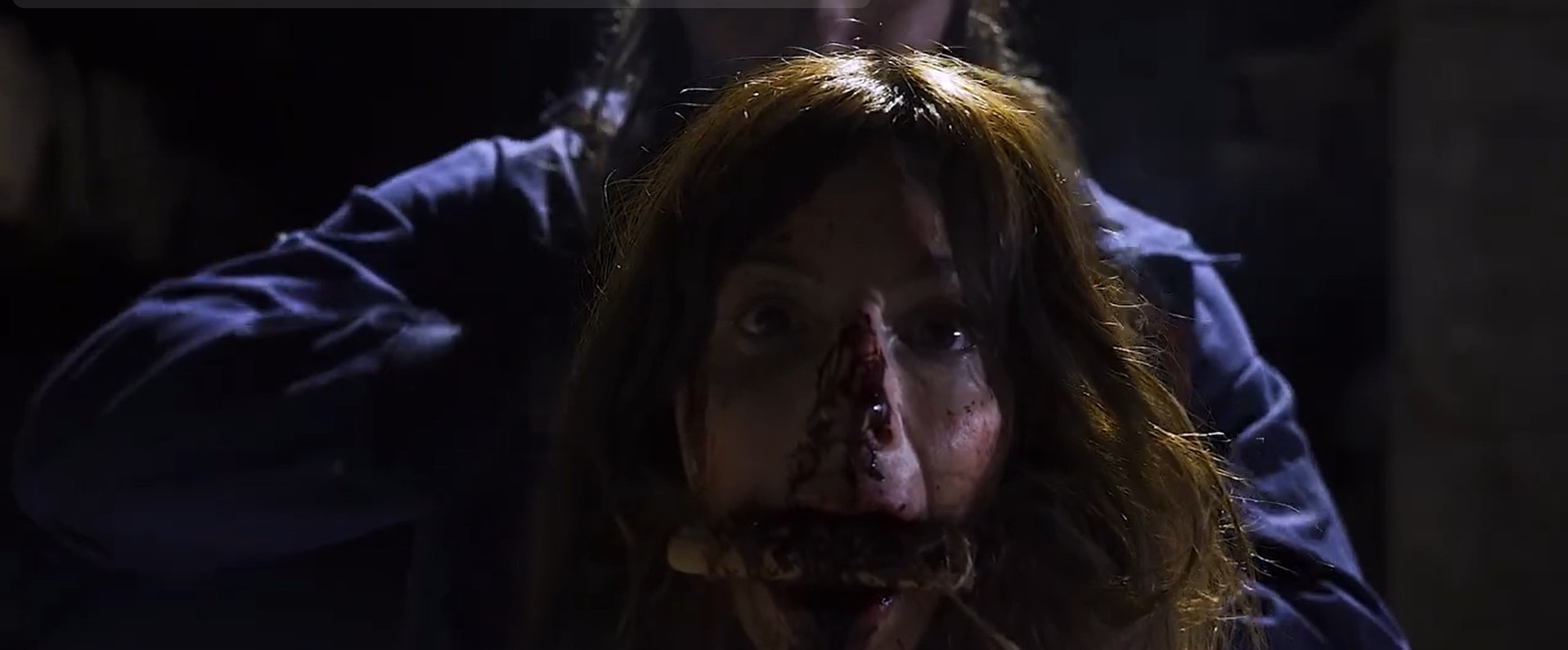
Bellida constructs a script that has an elimination process that not only literally purges the social toxicity out of one’s life, Maddie’s life, but also puts Maddie into a downward spiral with the vengeful spirit representing Maddie’s breaking psyche as she’s the only one who can see the ghost and hear the fabricated noises eats at her patience.  Maddie also experiences the friend dysphoria  as a trickster device by the spirit.  “The Girl Who Cried Her Eyes Out” is a solid supernatural chiller but lacks tethering to keep the rising body count closer to the chest and the imprinting curse laid upon Maddie is a bit ham-fisted as the campfire ghost story is literally told by another friend and then sanctioned shortly after by a mere lone walk through the woods.  There’s no story device that stirs up the conflict, it just happens. There’s no unearthed video tape, no discovery of bones, an cursed object, or some ancient spell spoken and without this spurring device that makes the woods instilled with evil, then this would happen to anyone but the woods, which is mentioned to be a state park, don’t come with a warning as surely others would have been affected by the apparitional affliction.  The tale of Caroline Woodsman serves loosely as such catalytic crux.  Considering the special effects, the budget limits the visuals as makeup effects take the lead with Caroline’s pale aura and the illusion of bloody eye sockets.  Quick editing and opportunity sound bites, coupled with performances, provide the ghostly impulses over the group which also seems premeditated with taking the sullied friends out one-by-one in an isolated fashion, an interesting course for a child spirt to take in order to pluck souls just to invite Maddie back to where it all started, the woods, where her troubling, friend-induced psychosis began.

MVDVisual conjures “The Girl Who Cried Her Eyes Out” to Blu-ray home video. The AVC encoded, 1080p Hi-Def resolution, BD25 exhibits the film in a widescreen 1.78:1 aspect ration. The codec has fair reproduction value of the digitally shot film with a dark-natural saturation scheme that favors more natural lighting than key lighting, even the woods scenes utilize a more translucent tint that offers muted illumination rather than bright as day illumination. Details are a bit fuzzy and less defined but delineation objects and subobjects more than most indie valued releases. There are arranged characters in background and foreground that create measured depth but the lack of color reduces range to mostly blacks and grays of an achromatic color palette. The English surround sound has a compressed, moderate pop with a clear dialogue track that varies in strength, often times the speech stamina goes below other character dialogue despite being in the same scene and on the same depth level of which they’re talking, suggesting a singular or stationary mic placement. There is also a second English audio option of a 2.0 Stereo and, personally, this was option had a better fidelity that didn’t suppress the strength without compromising depth and range. Special features include an audio commentary with director Eugene John Bellida and producer Deobrah Rickey, “Sick Sick Sick” short film by Fabrizio Fante, behind-the-scenes video clips, and a photo gallery. The physical release is pretty bare with a standard Amaray Blu-ray case with a blow up image of Mari Blake’s bloodied and tear-stricken face. The unrated Blu-ray has a runtime of 94 minutes and is region free.

Last Rites: A busy American Onryō clutters, “The Girl Who Cried Her Eyes Out” is stifled on its fair stab on the subgenre but the themes of rocky friendships and the true nature of people become diluted by the sudden deluge of little ghost girl wrath and her pick of the litter within a large group of toxic friends.

“The Girl Who Cried Her Eyes Out” Now Available on Blu-ray

The Demon Concubine Is After the EVIL Power of Demon Summoning Upon Earth! “Saga of the Phoenix” reviewed! (88 Films / Limited Edition Blu-ray)

Own “Saga of the Phoenix” on Blu-ray from 88 Films!

For 660 years, Ashura, the Holy Virgin of Hell, has used her powers to resurrect demons from the underworld.  With the help of virtuous fighters Lucky Fruit and Peacock from the spirit realm, has renounced her temperamental intentions to use her powers for evil ever again and live beside the mortals under the warmth of sunshine.  When she accidently summons demons on Earth, Ashura is brought before Master Jiku and the Divine Nun to access the damage and reign judgement.  They sentence her to live in cell of the relaxed Buddha for all of eternity, but she persuades them one chance to live amongst the humans for seven days, just enough time to live under and enjoy the only thing she wants, the sun.  The Demon Concubine has a different plan for Ashura.  Seeking her demon resurrection powers, the Demon Concubine aims kill her but with the help of Lucky Fruit, Peacock, and her new human friends, Ashura will battle against the Demon Concubine and her demonic forces. 

“Saga of the Phoenix” is the Golden Harvest produced, 1989 released sequel following quickly behind the 1988 released “Peacock King.”  Based off the Japanese manga “Peacock King” written by Makoto Ogino from 1985 to 1989, the action-fantasy film was codirected by returning “Peacock King” director Ngai Choi Lam (“Riki-Oh: The Story of Ricky,” “The Cat”), aka Lam Nai-Choi, and newcomer to the series Sze-Yu Lau (“Forced Nightmare,” “My Neighbors are Phantoms!”) with “Game of Death” actor Biao Yuen stepping away from writing the follow-up and be more involved on the acting by returning to one of the main roles from “Peacock King.”  The script is from a confluence of Japanese and Hong Kong screenwriters, initially scripted by Japanese manga adaptation to television screen writer Hirohisa Soda and then adapted by Tsui-Wah Wong, You-Ming Leung (“Once Upon a Time in China”), and Sau-Ling Chan, none of whom were involved in “Peacock King.”  Hong Kong’s cult and genre film product Lam Chua (“Erotic Ghost Story, “A Chinese Torture Chamber Story”) serves as producer on the Golden Harvest and Paragon Films Hong Kong-Japanese coproduction. 

Gloria Yip returns as the Holy Virgin of Hell, Ashura.  Having never seen “Peacock King,” I’m not sure what type of temperament Ashura donned in a role where the character seems like one of the main antagonists according to the synopsis, but for “Saga of the Phoenix,” Ashura is joyful, childlike mischievous, and humble and is the center focus between the forces of good versus evil.  Als returning is Biao Yuen, but not in his screenwriter role.  Yuen, known for starring alongside female martial artist and star Cynthia Rothrock in “Righting Wrongs,” reprising Peacock, a fierce spirit realm guardian who befriends Ashura along with fellow guardian Lucky Fruit, played by Hiroshi Abe (“Godzilla 2000”) who replaced Hiroshi Mikami from the first film.  Much of Yuen is taken out of the story while being in frozen captivity by the Demon Concubine, leaving Abe and Yip to better struggle one-on-one connecting in the human world, facing human problem, and accessing the threat from the Demon World.  Yip’s candid antics exact the innocence of a young child like making snarky faces when corrected or obsessing over trivial things like sunshine, and especially when Ashura befriends a small, gremlin-like troll or creature named Tricky Ghost and holding it like a favorite stuffed toy, and this leaves Abe to be the role model, or the parental guardian if you will, stoic in stance and a reasonable thinker for his character.  It all comes off as silly until Ngai Suet and the Demon Concubine enters the frame.  The “The Ghost Ballroom” actress Suet takes on the evilly empowered role armed with seven demon subjects to do her bidding, such as trying to kidnap Ashura, and Suet runs with the role caked in a pale makeup, high pointy eyebrows that open up her eyes, and shoulder-padded dark dress.  Embroiled in the spirit world clash are two mortal siblings in Chin (Loletta Lee, “Mr. Vampire Saga IV”), who saves unintentionally saves Tricky Ghost, and her mad scientist brother Tan (Shek-Yin Lau, “Resort Massacre”) who finds himself in bitter rivalry with Tricky Ghost’s mischief ways spurring some comic relief into the fantastical brew and they represent the workable relationship between man and godlike individuals.  “Zatoichi” series actor Shintarô Katsu is in the role of Master Jiku, “Carmen 1945’s” Yûko Natori is the Divine Nun, and Noriko Arai (“Death Note”), Megumi Sakita (“Bodyguard Kiba”), and Yukari Tachibana (“The Scissors Massacre”) as the three nun warriors to round out the Hong Kong-Japanese cast.

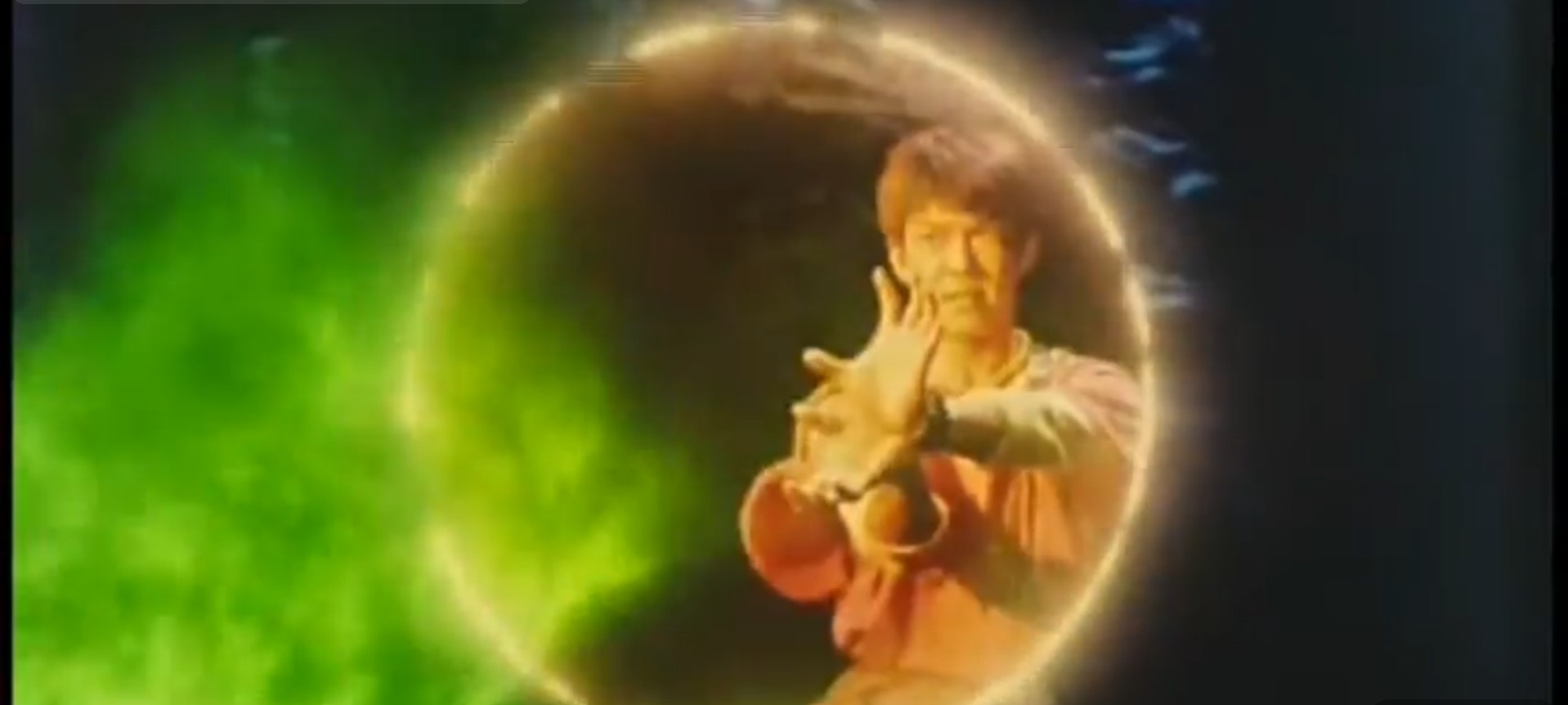
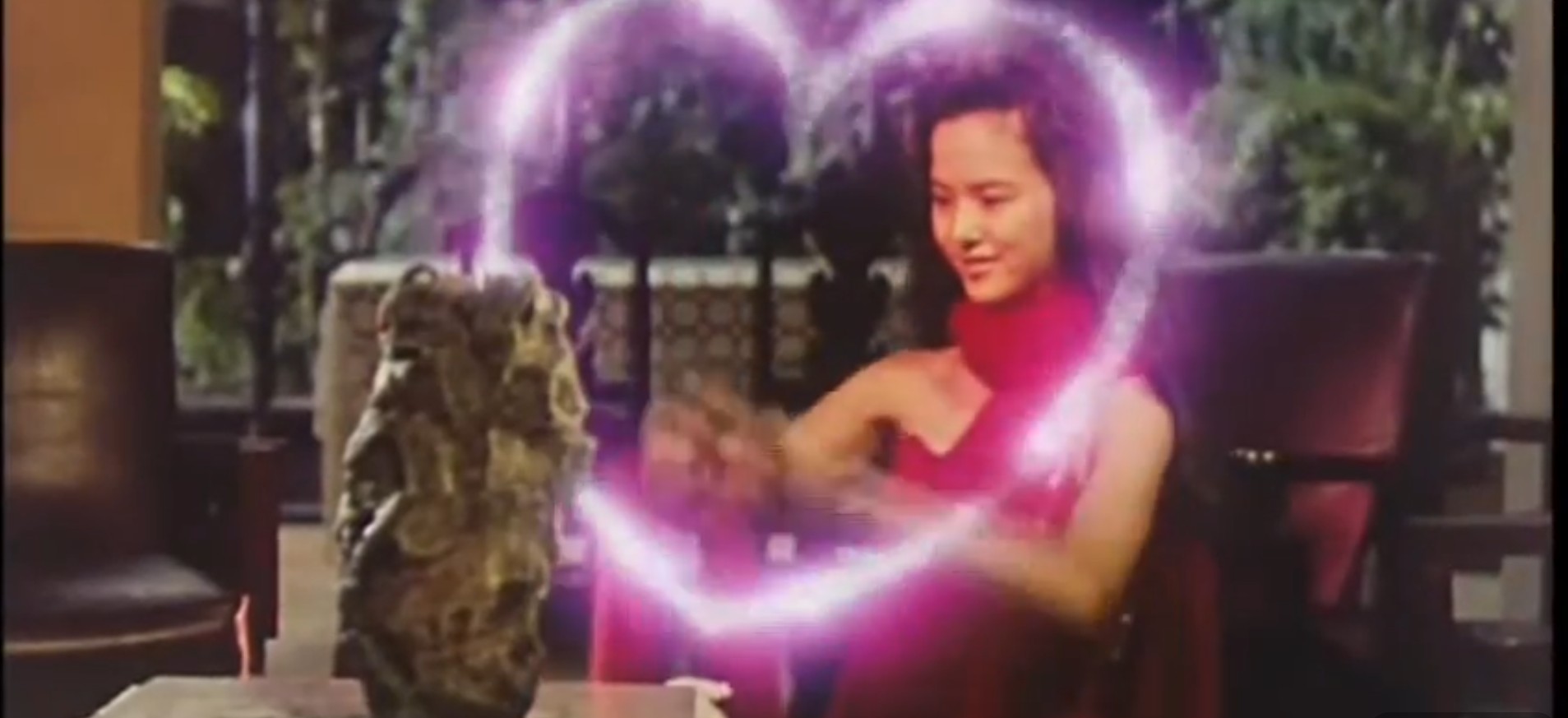
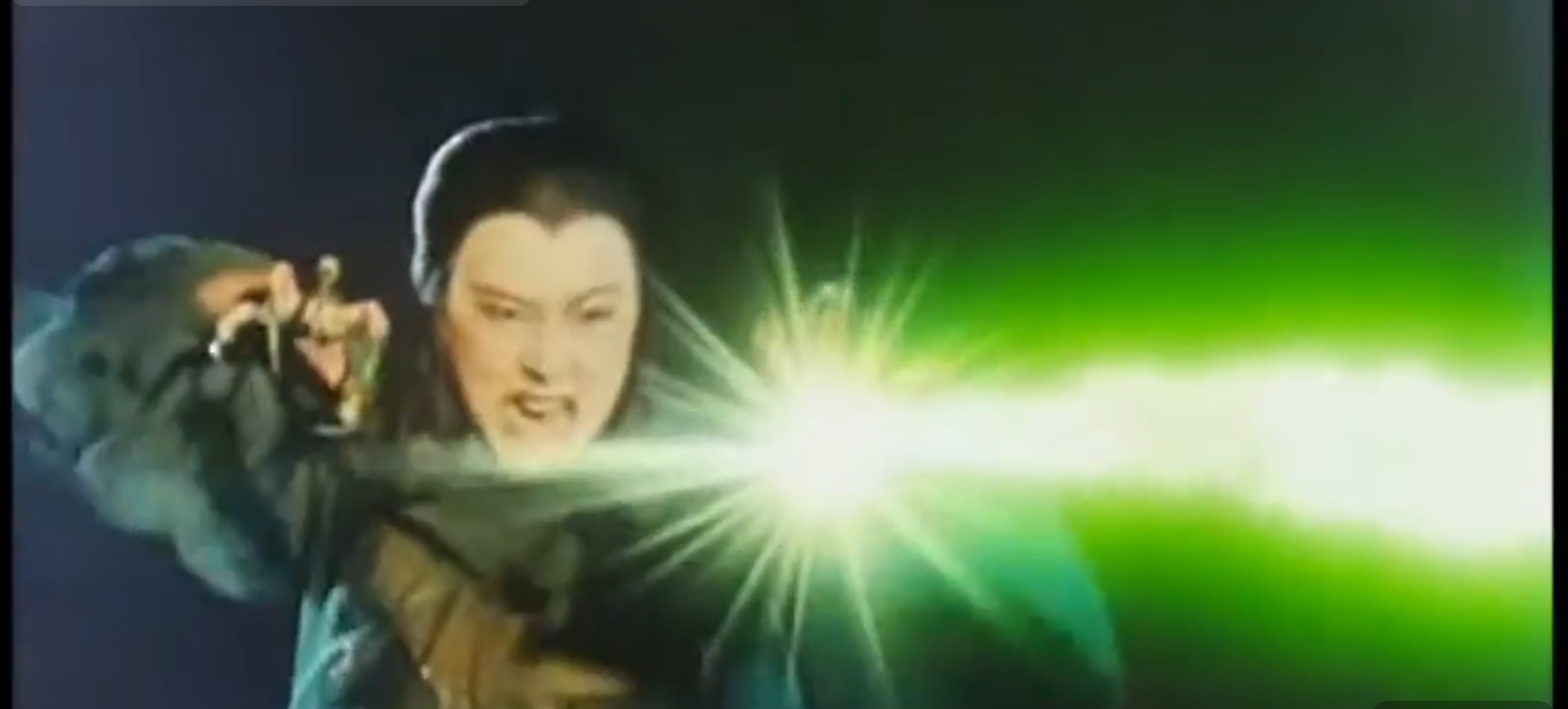
If you’re familiar with director Lam Nai-Choi, then it comes no surprise to you the kind of practical effects juggernaut “Saga of the Phoenix” can become and, in the end, doesn’t disappointment.  Choi often overscales the effort of tangibility, bringing unbelievable imagination and larger than life objects to manifestation without much, if any, assistance from computer generated imagery, and in the late 1980s, that technology wasn’t exactly perfected to what modern cinema sees today with skilled visual artistry and the introduction of artificial intelligence that’s on the verge of possibly shoving itself into the actor pool once the kinks are worked out.  In “Saga of the Phoenix,” the palpable physical presence involved is mostly at the finale third act where good versus evil face off between Ashura, Peacock, and Lucky Fruit and the ravenously aggressive Demon Concubine, the latter transforming like a Power Ranger Megazord into a gray-skeletal winged creature large enough to tower over the heroes and wide enough to swallow them nearly by three times.   Of course, this is not to say there hasn’t been other practical effects along the way which include demons inhabiting dragon statues, high wire acts of characters soaring during fight sequences, and the little mischievous imp, Tricky Monkey, from being a manipulated puppetry that weirdly reminisces Jim Henson’s “Labyrinth.”  The painted optical tricks to render color bolts of energy weaponry are a nice classic touch toward a pop of color as well as creating the inherent superhuman element of the principal players.  For someone going into “Sage of the Phoenix” headfirst without having seen or any knowledge of “Peacock King,” room for the film to standalone is rather thin but not egregiously reliant on the first film.  There’s a bit of recapping at the begging with narrative voiceover and get some clue-ins about the past from the dialogue but there’s still quite a bit unexplained, such as Ashura’s behavior fabled to be a powerful demonic necromancer who has somewhere along the way had a change of heart and we’re not privy to why.  That sense of uncertainly never really goes away through the comedy, action, and laser-firing, high-flying martial arts sinew, that something is innately missing from the story that’s saturated with wuxia themes. 

If looking to increase your bicep’s muscle mass, 88 Film’s limited-edition Blu-ray is weighty with content and it’s only one disc!  The AVC encoded, 1080p high-definition resolution, BD50 is encoded with a cherished updated 2K restored transfer from the original 35mm negative that looks unquestionably majestic on screen.  Vibrant and diffused evenly colors, high decode rate, and flawless textures, there’s nothing to dislike about this release, visually technical.  Deep in the color range and Chi-Kan Kwan’s sundry cinematography that offers vast length shots and a warm neon haze of blue and magenta through tint or gels, with a matted golden peacock rising against the monstrosities of the demon world, “Saga of the Phoenix” resurrects an aesthetic only Lam Nai-Choi could manifest from pure imagination.  The original negative is virtually pristine with no signs of damage or wear to note, nor any compression issues to note.  The uncompressed PCM Cantonese 2.0 mono offers a forward heavy diegetic sound that separate each layer favorably diversified. Clean and clear ADR make for easy discernability, capturing every bit of dialogue despite the post-production mis-synchronous acceptance. Laser action, creature roars, and other detailed measured sounds really give “Sage of the Phoenix” body, depth, and range that makes it an overall A/V highlight amongst its wuxia genre counterparts that tend to omit the smaller particulars of a scene. English subtitles pace just fine and are errorfree in a UK text. Most of the heavy lifting is done by the physical presence of the 88 Films Blu-ray that’s housed in a rigid slipbox and sheathed in a cardboard O-Slip, both containing new arranged illustrated artwork by R.P. “Kung Fu Bob” O’Brien that’s takes the true elements from the film and places them on the cover in a sure-fire canvas of what to expect. The clear Amaray cases also has O’Brien artwork as the primary cover art with the reverse side featuring the original Hong Kong poster art. Along with the O-slipcover, other limited-edition contents include a two-sided collectible art card and a 40-page illustrated book with color pictures and essays from Andrew Heskins (From Panel to Screen) and David West (The Japanese Connection), along with featured Japanese cover art Kujakuoh-Legend of Ashure. If the physical properties were not enough, the encoded content, available on the LE and Standard Edition, will bring this set home as it details with an audio commentary by Hong Kong Cinema Experts Frank Djeng and F.J. DeSanto, alternate footage from the Japanese cut of the film, executive producer Albert Lee discusses the international distribution plan from Golden Harvest Sage of Golden Harvest – The International Connection, an image gallery, and the original trailer. The 88 Films release is unrated, has region A and B playback, and has a runtime of 94 minutes.

Last Rites: Wuxia movies like “Saga of the Phoenix” are no surprise to where John Carpenter found influence for “Big Trouble in Little China” and it’s the director Lam Nai-Choi who didn’t shy away from the difficulties and inauthentic problems of physical effects but the film has its own innate issues with story that downgrade from a saga to just being an epic picture with winged creatures, bright energy blasts, and a lovely Gloria Yip succumbing to age, and status, regression with her Holy Virgin From Hell role.

Own “Saga of the Phoenix” on Blu-ray from 88 Films!

Fascist EVIL Takes on Freedom of Expression! “School in the Crosshairs” reviewed! (Cult Epics / Blu-ray)

“School in the Crosshairs” on a Cult Epics Blu-ray! Purcahse here at Amazon.

Yuka Mitamura is the smartest, most well-rounded student at her high school that’s embattled by a constant debate on whether physical edition and clubs are a necessary requisite for academic success, jeopardizing physical activities such has her best friend Koji’s Kendo club.  When Mitmura’s latent psychokinetic powers emerge, she struggles to cope with the change that’s out of her control and the new acquaintances with similar powers that show up in her life, such as with new female student Michiru Takamizawa whose sudden enrollment sees a quick rise in the ranks of school politics and sparks an insidious need for a totalitarian and fascist reign to control dissident and unapproved behavior within the school.  As an oppressive crack down on the total student body sparks a civil war amongst the students, Michiru and her mentoring demon Kyogoku aim to enslave the human race and it’s up to Mitamura, unknowingly Earth’s champion, to fight against the forces of evil. 

Adapted from the 1973 science fiction and fantasy novel “Psychic School Wars” by Taku Mayumura, “School in the Crosshairs” is every ounce those Japan famous hyper-intensity and colorfully assertive commercials with visual sparkle and great enthusiasm for their hawked products.  You know them well when they go internet viral.  The 1981 Japanese adaptation is helmed by Nobuhiko Ôbayashi, director of “Hausu” and “His Motorbike, Her island,” from no script but rather from Mayumura’s novel as script.  Keeping faithful to nearly the entire novel and adding Ôbayashi’s variegated touch, “School in the Crosshairs” is a flamboyant Earth invasion in its divisive influence of the study body, especially between the studious academics and physical clubs.  Also known as “The Aimed School” and “School Wars” elsewhere in the world, as well as titled “ねらわれた学園,” ”School in the Crosshairs” is produced by “Island of the Evil Spirits’” Haruki Kadokawa, who also produced our last Japanese reviewed title, the traumatically powerful and wonderfully performed “The Beast to Die,” under his company Kadokawa Haruki Jimusho.

“School in the Crosshairs” circles around principal character in film and in book Yuka Mitamura as she juggles her newfound powers.  Between feeling like a stranger in her body as well as the weird visitations of her powers and of the otherworldly figure with a cap and green skin and having to not only rebel against an authoritarian rule overtaking her high school but also to save all of the world from that said otherworldly and powerful figure, Mitamura’s plate is undoubtedly full for a teenage girl.  Hiroko Yakushimaru (“Sailor Suit and Machine Gun”) comes to the role as a teenage girl herself at the age of 16-17 years old by the time of principal photography and seizes the high school melodramatics with ease as the carefree smartest kid in school.  Yet, finding Yakushimaru a formidable character stemmed by her performance is not so easily rendered in an indifference projection toward her newfound abilities; Yakushimaru is unable to really compel audiences with body language or even in her dialogue on why the teen has to soul search cope when she discovers she’s different.  We get more out of Ryôichi Takayanagi (“His Motorbike, Her Island”) as the quasi love interest and Kendo club leader Koji as his kendo tournament matches and failings in academics that affect his beer story-owning family dynamics are heavily emphasized and given more weight against a floundering leading lady character with superpowers and uses those powers to put Koji in good standing amongst the Kendo culture with win-after-win.  Not until the world starts to unravel at the hands of fascist student leader and fellow telekinetic Michiru Takamizawa (Masami Hasegawa, “The Tragedy in the Devil-Mask Village”) and her despot leader, the manipulative demon Kyogoku (Tôru Minegishi, “Main Line to Terror”) in a technicolor brilliance of a cosmic showdown held within the interdimensional layers but even then the last gasp of defeat has lackluster strength after a mountainous buildup of dictatorship control and potential student civial war.  The cast fills out with Keiko Mitamura, Noriko Sengoku, Yûsuke Okada, Kôichi Miura, Hiromitsu Suzuki, Macoto Tezuka, and Kôichi Yamamoto.

Pushing a few of the acting and character flaws aside and off the table, “School in the Crosshairs” is essentially manga embodied by live-action film.  There’s stellar mass group choreography near the beginning when the clubs merge for a rush invite to encourage recruitment, there is an extravagantly caped character in green makeup and a white afro wig, and there’s the painted-on-cell colorization I’ve mentioned a few times already that really ups the fantastical sci-fi features of Mayumura’s novel with a director like Nobuhiko Ôbayashi unafraid to get deep with saturation and long in experimentation.  Themes on fear of individualism, forced conformity, friendship, and the rise up out from that powerlessness feeling for what’s right showcase through metaphorical fascism, akin to the likes of the evil Nazi Germany party with a fear mongering nationalist’s convincing motivational speeches and confidence commands that seduce the ears of the waning high school minority, the academic kids, seeking alternative solace and a way to regain control as they are not as popular in contrast to those in clubs.  The Nazi tropes don’t end there as rounding up nonconformists, Nazi-like uniforms, and even a modified heil make their way into the overall story and that’s the darkest part in “School in the Crosshairs” light and airy jeopardizing of innocence and individuality. 

Catching a glimpse of Nobuhiko Ôbayashi’s pre-“Hausu” filmmaking brilliancy is now as easy as catching “School in the Crosshairs” on a North American Blu-ray release from Cult Epics.  The dazzling high-definition and an equally impressive, supplemented release is AVC encoded onto a BD50 with a 2K transfer and restoration of the original 35mm print and presented in a widescreen 1.85:1 aspect ratio.  The “School in the Crosshairs” restoration visuals need to be seen to be believed in a newly graded touch up that offers a glassy darker side within the fascism themes and a richer color palette to make the hued pinwheel spectrum a living, breathing character between good versus evil.  The grain comes through naturally on nearly all scenes with some of the shadowy moments favoring less delineation through the consistent optical texture.  The composited effects are boldly vibrant inside a creative streak that’s idiosyncratic only to Ôbayashi and are implemented into the live scenes with precision that doesn’t make it awfully clumsy or clunky.  Cult Epics made sure to cover any and all viewer’s at-home audio setup with three Japanese language options:  an uncompressed LPCM 2.0 Stereo, a Dolby Digital 5.1 Surround Sound, and a DTS-HD MA 5.1 Surround Sound.  Each carry their own weight and attributes with the LPCM 2.0 and DTS-HD 5.1 similar in fidelity, but the DTS offers an expansive girth that fills in the left and right channels of interdimensional ambience with laser strikes and gameshow tonal keys.  Dialogue is constructed through ADR that carries a level and balanced layer field and holding its own against the fantasy ambient that sometimes rises to meet the dialogue decibel; however, dialogue is clean and clear without any issues in clairaudience.  Newly improved English subtitles are optionally availably.  The set is quite complete, and likely comprehensive, with the physical and encoded special features.  Film critic Max Robinson offers a feature parallel commentary track, Phillip Jefferies provides a video essay on Nobuhiko Ôbayashi’s body of work in Sailor Suits and Sound, an Ôbayashi film poster gallery, and the theatrical trailer.  Physically, the clear Blu-ray Amaray case keeps inside the reversible cover art with both sides featuring the Japanese poster arts and housing that package is the limited edition cardboard O-slip with a fantastic compositional design by Sam Smith.  Inserted inside is the back cover unlisted, 22-page booklet full of black and white as well as color adverts, feature stills, characters bios, and other writings but all in Japanese, no English.  The 90-mean feature comes no rated and is region free.

Last Rites: More so now than ever in the current political climate, freedom of expression endangerment is the critical theme for Ôbayashi’s “School in the Crosshairs,” a color melange of resistance against the forces of evil hard to differentiate looking like our friends, family, and the everyday student.

“School in the Crosshairs” on a Cult Epics Blu-ray! Purcahse here at Amazon.

EVIL Sinks Its Teeth into the Reach of the Worldwide Web! (Full Moon Features / Blu-ray)

“Death Streamer” Now on Blu-ray!

A trio of struggling horror video podcasters stumble across a dark web stream while content mining for their derelict house of God set macabre show Church of Chills.  When they stumble upon a bloodcurdling ritual of drugging women and man vampirically ripping out and feasting on their necks, the footage is all too real based on their research and investigation into the underground live streams that rack up thousands of views and subscribers.  Eager to piggyback off the streams’ success, the Church of Chills reveals the callous, artery puncturing content to the world.  The live streaming ancient vampire master, seeking sacrifices to bring the end of days upon the world, is none too happy with the intruders doxing his content that has amassed a large following and warns them with omnipotent power, sending the three into flight or fight for their very lives and the for the sake of the world.

As the famous chorus line from the legendary rock-n-roll band AC/DC once sang, If you want nudity, you got it!  Or was it blood?  Either way, Charles Band’s “Death Streamer” you get plenty of both!  The new tech, modernized vampire lurks from out of the classic, gothic shadows and becomes the next inspirational concept from the longtime, distinguished founder and filmmaker of Full Moon Entertainment and the “Trancers” and “Head of the Family” director, Charles Band.  The 2024 feature is written from Band’s concept into story detail and dialogue by Neal Marshall Stevens, the screenwriter behind “Thir13en Ghosts” remake “Hellraiser:  Deader” and who has since become a Full Moon staff writer with credits going from touching the “Puppet Master” franchise with “Blade:  The Iron Cross” to new content with “AIMEE:  The Visitor,” penned under Stevens’ pseudonym of Roger Baron as so too with “Death Streamer.”  Full Moon Entertainment’s Charles Band and Nakai Nelson produce their latest with a budget aid alley-oop by a crowdfunding campaign.

“Death Streamers” core cast has small but mighty with Aaron Michael McDaniel debuting in his feature film role as Alex Jarvis, the egocentric host of Church of Chills, and his two beautiful assistants in Emma Massalone as Edwins and Kaitlin Moore as Juniper struggling in a power dynamic over who has creative control over the show while staying financially afloat being unhoused living inside test in a defunct house of God.  Convincing audiences the trio of being adept and meticulous with computers and a video podcast is a hard sell when they live in popup tents and rariely leave the church grounds without much background other than short spats of the show’s brief history, but nonetheless, the three M’s – McDaniel, Massalone, and Moore – make their character emotions and pangs work to the story’s advantage rarther than have it feel like a detrimental free for all for the spotlight.  Creeping into that bright circle is the dark heart of vampire streamer Arturo Valenor, played Sean Ohlman.  The sex club proprietor, operating in the underground markets, drugs beauties with his own blood, rips their clothes off, and has his way sucking the lifeforce from their tender necks.  This dark web act is unearthed by the Church of Chills team and becomes the focal point for them to piggyback and drive-up subscribers with real life macabre only to be discovered and threatened by Valenor’s ever-present powers. Ohlman makes for a good hip vampire but doesn’t exact that gothic depravity of a classic bloodsucker in Valenor’s more erotically inclined sacrifices.  Only in the very showdown end do all four principals find themselves in the same scene together, previous working separately across the worldwide dark web or through Valenor’s giant floating eyes of foreboding.  Yes, floating giant eyes is pretty trippy and old school.  The rest cast constitutes as one half of Valenor’s vampiric acolytes with Chili Jean as the blood serving barkeep and Travis Stoner as the gimp-masked muscle and the other half half-naked Valenor victims in Llana Barron, Piper Parks, and it wouldn’t be a Full Moon Feature without an adult actress making an appearance with Maddy May going fully nude.

“Death Streamer” follows the same formula Full Moon has been following the last few years by pulling inspiration from the latest and greatest, perhaps even from the ugliest, flavor of the month cultural impact item has to offer.  2020 saw the release of “Corona Zombies” to bank off the pandemic, also from 2020 was “Barbie & Kendra Save the Tiger King” spun from the popular Netflix documentary of the same “Tiger King” title surrounding convicted felon Joe Exotic, “AIMEE:  The Visitor” featured sensationally the dangers of A.I. during the artificial intelligence concern of rise, especially amongst the arts industry, and, lastly, a slew of video content infused storylines as TikTok, Facebook Live, X Live, and many other platforms become an overconsumption of media with “Bad Influencer,” “Attack of the 50ft Camgirl,” and “Subscriber” being a few examples.  “Death Streamer” fits in the latter category as well by following a what seems to be an endless horizon of streaming content from music, to vidcasts, to live feeds in today’s highly consumable media world where everybody, and their brother, has streams to be viral.  “Death Streamer” using today’s tech to try and modernize the mythos of one of man’s longstanding lores, vampires.  Charles Band’s two-prong locations keep costs of the crowdfunded dollars down while pushing much of the cashflow toward effects, both practical with off-screen trickery and blood spurts, and compositional VFX that sees large floating eyes and thousands of chirping bats, as well as getting essentially all the female actresses at least to a bare-chested level with even one using her holy cross chest tattoo, nested right between her mammaries, as the final nail in the coffin for one unlucky, or maybe very luck, vampire with a death by a gratuitous emblematic exposure.  Hands down, “Death Streamer” has the best kill scene I’ve seen this year!

Be a subscriber to the end of the world with Full Moon Feature’s “Death Streamer” now available on Blu-ray. The AVC encoded, 1080p high-definition, BD25 seems adequate for the presentation flushed with warm red, blue, and green color filters. Details are sparse depending on the artistic alleyway inside Valenor’s club or inside his POV camera-specs, brighter the gels, lesser the finer points to the textures. The church setting, or the Church of Chills HQ, puts together a better angled lighting and a starker contrast by way of deeper shadows. Insignificant compression issues despite the single layer format but we’re not receiving the cleanest, most refined, looking picture image that’s presented in a 2.35:1 aspect ratio. Two English encoded audio outputs are both Dolby Digital compressed with a 5.1 surround sound mix and a dual channel 2.0 stereo. Not the strongest or dynamic reproduction of the original, raw audio as it suppresses the action and removes the multiple channel pathways, rendering over mostly in the front channels in what the listing is more 5.1 in name only. Dialogue comes over clean and clearly enough without a spark of obstruction and is layered above the environment as well as what’s usually an overpowering Full Moon carnivalesque or Gothic score. English closed captioned subtitles are available. Special features include a behind-the-scenes of the regularly archived and accompanying Videozone specials, the “Death Streamer” premiere held in Los Angele was cast, crew, and a few select Full Moon friends, such as Barbara Crampton, with a Charles Band pre-movie few words, and a lineup of Full Moon trailers. The standard release of the Blu-ray Amaray has a pulpy illustrative cover art of a bloodied mouth Valenor and his two acolytes splayed in red, blues, and purple. The region free release comes not rated and has a just above an hour runtime of 72 minutes.

Last Rites: As the vampire canon expands with age, new grooves are etched into the classical monster’s lineage tree and “Death Streamer” is a cyber-ghoul knot ready to leave its influential mark only to have its fangs nulled down and overshadowed by the all-powerful naked female figure in another fair-weather Full Moon Feature.

“Death Streamer” Now on Blu-ray!