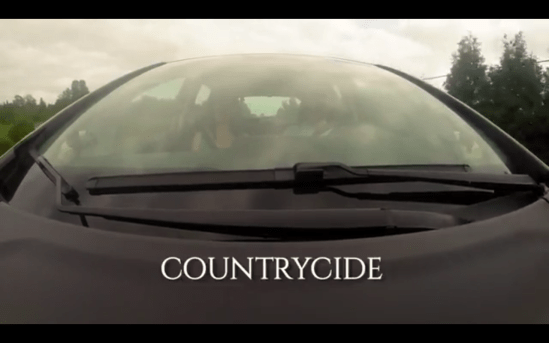
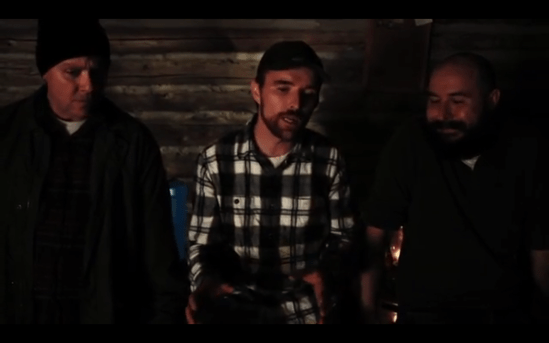
Big sister is getting married and Abby, forking over big money for a bridesmaid dress, can’t scrape together enough dough to afford a flight across country and to scratch off another option, Abby never learned how to drive a car dwindling Abby out of travel possibilities. In steps Mike, Abby’s tall and handsome close friend who does happen to know how to drive and, coincidently, has a car. Mike offers her a trip across the country as her plus one at the wedding. About 1/3 into the drive, exhaustion catches up with them, especially in Mike being behind the wheel 100% of the time, and without much money to spend on a motel room, the traveling duo think it best to set up camp in a stretch of wilderness. After speaking with a local government ranger, they set off to set up camp deep within the woods and as night approaches and the couple finally declare themselves hot for each other, Mike decides to return to the car for some supplies. Abby wakes up next morning realizing Mike has yet to return and in almost the same instance, she forgets where they parked the car. Wandering aimlessly through the thicket, a bear trap sinks its steely teeth into the fleshy siding of her ankle, leaving Abby hobbling alone through the woods with a hungry wolf on her trail to make matters worse. Miraculously, She’s saved by three men on a hunter’s retreat, but as they return with her to their isolated cabin, their suspicious behavior with an unwillingness to take the severely injured Abby straight to the hospital forces her to exit next morning while they stilled slumber and into an adjacent cabin where she discovers horror on a whole new level.

If the word homicide, or maybe even genocide, made sweet, sweet, angry love to the unwilling and scared word countryside, the abdominal “Countrycide” would be birthed into existence on this Earth and our congressional leadership would have legally prohibited it’s understandable abortion. Shepherding as a game foster parent is Canadian born, writer-director Brett Kelly and “Countrycide” will mark filmmaker’s third genre film through the criticism daycare of horror, following the cuddly-campy, Sci-Fi endearing “Ghastlies” and the diaper-shitting disaster that is the “Rise of the Black Cat.” A Gremlins-esques versus a super hero mess have come and gone to deliver “Countrycide” to our chop block that’s totally a horror-survival subgenre with a smidgen of exploitation and a complete lark even if unintentional.

Looking from an outward perspective, Abby is quite useless. Doesn’t know how to drive, doesn’t know where the car is, doesn’t know how to re-trace her steps out of the woods, and, yet, stammers into being a nucleus-downspout of magnetic chaos. Abby finds nothing but pure bad luck and Robin Hodge, inducted into her inaugural credited performance, bounces her saccharine chops off of various personas to become a disenchanted transfiguration character. Along for the ride is Joel Elliott as Abby’s quasi-boyfriend Mike whose emotional connection to Abby becomes decimated in a blink of an eye concluding no conclusive reason to care about his charming mug. He drives a car, cavalierly verbalizes his feelings for Abby, and then is erased from the pages as if a giant erasers literally came down and rubbed him out. Elliott has had roles in other Kelly films and so have these fellow co-stars that round out of the film: Peter Whittaker (“Raiders of the Lost Shark”), Andrew Galligan (“Ghastlies”), Trevor Payer (“My Fair Zombie”), and Lee Cyr (“Jesse James: Lawman”).

Kelly has a knack for campy-saturation and “Countrycide” splits the proverbial seams so much so that the film implodes into self-destruction, laughing manically at itself all the way to the end – funny, I didn’t initially categorize Kelly’s film was a horror-comedy, but therein lies the rub. Even textbook details, such as Abby sweaty and dirty in a fit of shock when a bear trap snaps onto her ankle, need to be illuminated. Another point to discuss is the overall pacing of the dialogue that drowns in over exposition of each event through the casts’ lips that often has a dubbed sensation. It’s like watching a giallo film from the 1970’s but where the synchronization designates more as a clumsy redneck slasher rather than an attractive murder mystery with a colorfully psychopathic adversary. Granted, swift gratuitous gore make the ushered in cut, a rock repeatedly bashed over a head or an giant log spear impalement, and that will please those gore hounds who sing the blood and violence anthem. As for the rough storytelling, characters, such as supposed hunters who hunt with single six-shooter revolver between the three of them, and the across the board acting by either unknowns or Brett Kelly staples, bad doesn’t quite describe “Countrycide’s” banal and bland vitality and must be watched, with a handle of Wild Turkey and a pack of smokes, to fully comprehend where the filmmaker was heading with his survival horror.

Wild Eye Releasing and MVDVisual go bumpkin hunting with “Countrycide” onto DVD home video. Presented in a widescreen format, “Countrycide’s” image condition is good, par for the course when considering other Wild Eye Releasing. Slight aliasing in more ariel shots, but the coloring is fine that’s perhaps on the denser contrast. The stereo sound mix, again, has that dub-like design that makes the actors sound like they’re in a studio recording their dialogue and thus isolates the vocals. Ambient track has foley written all over it with discernible focus on the twigs cracking and the birds chirping. Lets also no forget to mention to stock audio tracks of a wolf howl. There are no bonus features with this release. “Countrycide” woefully deserves a low end score, reeking up on an exploitation-survival horror by slapping together a poorly written script that cliche and trope-riddled, but being the Devil’s advocate enthusiast, “Countrycide” hit the next level in his carer even though that level might be still on the lower end of a split level, below grade.
Tag Archives: exploitation
Evil Wants To Profit From Your Death! “Red Room” review!

When Kyra awakes inside an unadorned room of the second floor of an isolated farm house, the woman, who last remembers herself walking to her car from an afterhours night club, finds her wrists and ankles bound together alongside two other women. The women, Lilly and Allison, have been locked inside the room for days, kidnapped the same way, and treated with an inhumane care that more-or-less maintains their physical beauty. Uncertainty questions their fates, but one thing is for sure, when their captors come to remove you from the others, like selected head amongst the cattle, and relocate you to the red room, that’s when the screaming starts and you’re never heard from again. Between the three captives, anger and fear struggle for common ground on a plan of desperate escape and with the iron grip of their abductors honed into their every move, Kyra’s determination to escape breeds sturdier when the possibility of death is more than likely imminent, but before their inevitable snuff, the red room holds sickening world-wide pleasures that anticipates their particular company.

Poised to be callously unsettling and keen to rip apart compassionate souls, “Red Room” hails from Ireland as a ghastly and shocking exploitation thriller from writer-director Stephen Gaffney. A production of Gaffney’s Deep Web Films and co-written with Erica Keegan, “Red Room” slides ever so covertly into the internet’s interlining of unspoken grisliness that exploits people for the darker desires of other people and Gaffney runs through the typical rational of the irrational abductions, such as sex trafficking, and though that’s certainly taboo enough to quench viewers with a powerful story in itself, the director taps a sex and death geyser a few filmmakers have reaped, perhaps more so retrospectively, the machiavellian benefits in finding a home in a rather thin genre with films that are akin to the plot, including works of malevolent personal satisfaction as such as in Dusty Nelson’s “Effects” or the investigated side that encompasses the snuff world in Joel Schumacher’s “8mm” starring Nicholas Cage.

The 2017 film thrills to inflict tortuous anticipation for what lies ahead of the tethered three women. Amy Kelly’s Kyra is the only colleen to be shown physically abducted and while Kelly maintains a fine performance as the strong female protagonist with no-choice-but-to-escape attitude, Kyra’s character arc has a confounding impact where Gaffney involves non-linear scenes into the story, providing the events leading up to her abduction and also other more linear scenes with her mother on the phone with the police irate with her disappearance, but none of those scenes had significant impact to Kyra’s predicament or motivation and felt out of place. Kyra doesn’t necessarily talk about her child much either, which is always a powerful motivator for anyone with a need to live. Instead of carrying on with Kyra’s needless background, Richard, played by John D’Alessandro, could have benefited from the excess framework capacity of how he became groomed by his stern father, a role fit for a cruel king by “Game of Thrones'” Brian Fortune, and how his calm, sensible, and business casual character admixed himself with various complex villainy, roles donned by JP Albuquerque and Rodrigo Ternevoy, and how they became a triad of high end brunette liquidators of sorts. The other two women with Kyra, Alison (Saoirse Doyle) and Lilly (Sohaila Lindheim) spread the reactionary affects in a petrified Alison and a realist in Lilly when contrasted to Kyra’s defiance, but Alison carries the crux of the story, the reason why there is a story, that falls right smack dab in the red room and, frankly, she becomes the star of the gritty show. “Red Room’s” tops out the cast with another “Game of Thrones'” star Eddie Jackson and Fiona Twamley Hewitt.

“Red Room” has been compared to “Hostel” with a plot that does walk a familiar path of a pay-to-die morbidity and that comparison is a fair assessment with the ancillary connotation that “Red Room” could be seen as an extension or a byproduct of Eli Roth’s sadist of a film. However, a microscopic obstacle provides just enough to dispute that claim, to whither back a formidable opponent in the game of who has the most visceral body of work, and that evidence lies in Gaffney’s creative style. The filmmaker, for lack of a better term, pulls punches, not delivering the full on aggression required to provoke and stimulate the masses. The scenes of gore are ghastly to a point and that’s not necessarily the issue that’s more so with the unravelling of their inhuman nature that doesn’t genuinely denote a persuasive emanation of their victims damnation. We see a little of spark with JP Alburquerque’s Andras who is clearly insane with an limitless immoral conscious whereas the others teeter about more of the business margins or struggle with a tough guy image.

From Stephan Gaffney’s Deep Wed Films in association with Sicario Pictures enters “Red Room” onto DVD home video from Breaking Glass Pictures. Presented in a widescreen, 2.35:1 aspect ratio, on a one-sided, doubled layered DVD9, the Canon C300 Mark II digitally shot feature cleanly and sharply provides quality throughout that falters occasionally with some choppy video speed controlling in the more extreme scenes. Color palette isn’t lush with brilliant hues, but with the darker tone of the film, the expectation of vividness lies more so with graphic content and adds to the value. The English language Dolby Digital 5.1 surround mix is meaty and balanced, strong enough to even tune uneducated ears to the Irish accents. The dialogue is rightfully upfront with fine range and depth with no issues on mic placements. Bonus features include a short and sweet radio interview with director Stephen Gaffney, cast interviews, test screen reaction with the finale climax, a director’s audio commentary, a single deleted scene, and a concept promo. Ireland makes a play for extreme horror with Stephen Gaffney’s “Red Room,” a twisted and a humanly fathomable thriller with a cold-hearted gape at the worst of human nature that lingers into the vast virtual and essential disconnect amongst online gawkers that will never face the exploitive repercussions of what wets their appetites as they sit behind computer screens.
Evil Sows With Others’ Body Fluids! “DIS” review!

Ariel Konk, A former soldier fleeing from his regrettable past, seeks refuge in an isolate cabin located deep in the forest, adjacent to a lagoon. Struggling to live off the land and coping with loneliness, the soldier marches on, exploring his new, secluded surroundings. His loneliness comes to an end when investigating the ruins of a dilapidating building structure, spotting a masked half naked female and as he pursues her, Ariel witnesses her voluntarily jump from the highest level of the opened air building. Wrought with anguish, Ariel attempts suicide only to be knocked out before he could pull the trigger on his rifle. He wakes up being chained to the wall with a mute, mask figure drugging him and extracting his blood and semen fluids as necessary nutrients for a nearby Mandrake garden. A practice that has been executed many times before Ariel’s arrival.

“DIS” is a bordering arthouse horror film from writer-director Adrian Corona (“Nariz Ioca”). A blend from a horror influenced literary poem and a mythological folkore, Corona crafts a lurid, hyperbolic story that pulls, as Cornoa describes as a prefix of sorts, from Dante Alighieri’s epic journey through hell told in Dante’s Inferno, using the City of Dis that’s described as a lower hell for sinners who’ve committed violent and fraudulent transgressions, and interlocks that inspiration with the archaic lore surrounding the Mandrake plant that involves superstitiously condemning those to hell after reaping the intensely narcotic plant with the human shaped root and that would, also superstitiously, scream when pulled. “DIS” is full of interpretative terror through the 61 minute runtime that’s virtually expressive. Corona provides little dialogue to his script, keeping most of the dialect scribal incased within flashback confines, and let his actors’ raw emotions and visceral eloquence provide the tale that’s peppered with moments of visual shock and cathartic abhorrence.

I’ve said it once and I’ll say it again, Bill Oberst Jr. is one hell of an actor. The upcoming Rob Zombie “3 from Hell” actor has become a prominent staple professional in the indie horror film circuit, tackling the bizarre, the inexplicable, and the most difficult of roles with such vigor and passion that his motivation is seemingly inhuman. Right up there with “Deadly Revisions,” “DIS’ tops or equals being one of the best performances of his career, from the perspective of this reviewers’ cache of Bill Oberst Jr films. There’s quite a bit of difficulty catching up to the man who roughly does, whether as a lead or as support, 10 films a year! As Ariel Konk, Oberst captures the essence of pain and anger that saturates the character’s own personal delirium and hell with his past mistake catching up to his self-battered soul. The faceless figure who opposites Ariel feeds off the ex-soldiers repugnant and guilt-riddled past actions in a seemingly perverse mission that’s actually mandated by the suspected demon’s Mandrake lot. The plants are held in a nursery for engendering creatures, but what kind of creatures exactly? Other demons from the seed of murdered vehement people?
Remaining cast include Peter Gonzales Falcon, “Prison Heat’s” Lori Jo Hendrix, Manuel Dominguez, and Anne Voitsekhova.

The casual viewer will inherently disavow the hour spent watching “DIS” due to a number of reasons, whether it’s Ariel wandering the forest for more than half the film, or dialogue is fairly infrequent, or the chaptered sequence of events don’t perfectly describe just what the hell is going, or, just perhaps, the motif of genital masturbation and mutilation is just too much to stomach. Either way, “DIS’s” traction will slip and only a few are willing to get dirty and push the story forward with open mindedness and artistic appreciation. Speaking of artistic appreciation, Rocco Rodriguez’s cinematography is a character upon itself. The top of a Cofre de Perote volcano in Perote, Veracruz, Mexico during principal photography has breathtaking visuals that Rodriguez captures exquisitely and becomes a backdrop against the coarse material. Outside is vivid, bright, full of life, but when in the belly of the rundown structure, the manmade confines are claustrophobic and crummy, infernally ablaze for ritual, much to the akin of Dante’s Inferno. Rodriguez, again, depicts lustrous imagery that assists in telling Corona’s nightmarish story and that’s a skill all can recognize.

MVD Visual and Unearthed Films present Adrian Corona’s enigmatic and surreal “DIS” from 1922 Films onto high definition Blu-ray. The region A release is presented in a widescreen, 1.85:1 aspect ratio, and has the near epitome of perfect with, again, Rocco Rodriguez stunning photography. The lighting really comes to the fold that upheaves the brilliancy in the textures, such as in the building’s illustrious graffiti, and dares to switch to black and white when appropriate. Skin tones are fresh looking and natural in colored scenes. Only a minor aliasing issue around Obsert flared up momentarily, but ceased going forward. The Dolby Digital 5.1 surround sound has forefront dialogue, but not a bit soft, especially with Peter Gonzales, that made following difficult. There was not enough examples of range or depth to necessarily comment as Oberst was essentially alone for much of the film. Bonus features include an explanation introduction by writer-director Adrian Corona, a behind-the-scenes featurette that exhibits three takes of two scenes, a wonky static menu Q&A formatted interview with Bill Oberst Jr., a short film entitled “Portrait,” still gallery, and Unearthed Films trailers. Bill Oberst Jr. is, basically, a one man show knitted into an Adrian Corona allegory of unknown terror through conduits of literary works and medieval folklore, making “DIS” prime real estate for viewers seeking a film as an open book toward abstract gardening.
Like Indie Horror and Want to Support Bloggers! Please Consider Purchasing this title from Amazon by Clicking Here! Thank you!!
The Evils of a Transgendered Occultist! “Miss Leslie’s Dolls” review

On a dark and stormy night after a school football game, a teacher and three students take shelter at a cottage adjacent to a cemetery. If the cottage wasn’t creepy enough, the sole occupant owner surpassed the bar. She calls herself Miss Leslie, a middle aged woman with an ill-fated story of her friend and mother’s fiery demise from long past and a quirky penchant for making life-size female dolls that set inside an illuminating shrine. Though they feel uneasy about the creepy surroundings, the visitors stay and get cozy, especially with each other, but Miss Leslie has ulterior, deranged motives. Her dolls are not just lifelike, they once were vibrant lives of women Miss Leslie sorely wanted to inhabit their feminine confines of youth and beauty from over the years, but now they are an undecomposable shells, encase in Miss Leslie’s special doll making brew to timelessly capture their lovely physiques. They are also beautiful, yet painful reminders of her failed attempts to transfer her essence into their adolescent bodies.

Every so often you come across a film with a gigantically absurd hard shell cover with the gooey insides of eye-rolling cheesiness and you just have to ask yourself, how in the world did something like this ever come to fruition!? Yet, somehow, someway, these productions of an oddball variety always have an intense allure about them and end up being just one of the coolest rarities to grace the glazed-over irises. Joseph Prieto’s “Miss Leslie’s Dolls” is the epitome of this very phenomena. “Miss Leslie’s Dolls” is an exploitation, nearly softcore porn, horror with a deranged killers with severe mental issues that range from communication with dead to, what can be now construed as antiquated, complications of gender identity. One of the last directed films from Prieto, who also helmed “Shanty Tramp” and “Savages from Hell,” also penned the screenplay alongside longtime collaborator and producer Ralph Remy Jr. The script reads like an insatiable bedside thriller novel, an object of complete obsession through the entirety and well long after being completed; “Miss Leslie’s Dolls’” has a rich gothic lining, a strong sexual appetite, and a timely LGTB subject that involves debate on mental illness or inherited gender orientation.

Not many actors performed in drag. Sure, there was Jack Lemmon and Tony Curtis in “Some Like It Hot” and there was even Anthony Perkins from “Psycho,” who some might go as far as saying that “Miss Leslie’s Dolls” might draw inspiration from with the whole mother fixation, but only a small faction of fans, especially in the genre, might know Salvador Ugarte. The Cuban born Ugarte has great poise as a woman imprisoned in a man’s body. Miss Leslie just isn’t a deranged killer in drag; the character has deep rooted issues stemming out of not only being a woman embodied incorrectly, but also seeded by an engulfing obsession with capturing beauty to obtain it for herself, an addition from a result of a permanent scarring left behind by Miss Leslie’s homicidal rampage in the character’s history. Ugarte has the mannerisms and the gait down so unerringly that’s the performance is downright creepy, but there was one aspect of womanhood that Ugarte’s masculinity couldn’t mask: his voice. The actor is horrendously dubbed, adding charm to the bizarre concept. Ugarte’s joined by “Little Laura and Big John’s” Terri Juston, Marchelle Bichette (“The Gruesome Twosome”), Kitty Lewis, and Charles Pitts of “Supervixens.”

Contrary to the above, “Miss Leslie’s Dolls” has some drawback. Though the characters might be entertaining and interesting, especially with the Bourbon obsessed and hot for teacher Roy and his terrible gangster accent or the fact that Ms. Alma Frost is a smoking hot, twenty-something year old prude teacher to her pupils who are practically the same age as her, they’re washed over with an aloof mentality, consequently looking past or just blatantly oblivious to Miss Leslie’s obvious male features, her inauspicious ramblings, and the fact she has a shrine of creepy and realistic dolls of women that fill the room with the smell like rot and death. Perhaps too busy running through the cemetery at night in skimpy bedroom garments. Yes, this does happen. On top of that, Miss Leslie harness of occult powers goes relatively unexplored, yet very much utilized as an important portion of the film near the last act. Despite being passively mentioned and rather undercut from more than most of the film, Miss Leslie’s occult mischief is plucked right from left field to further the enigmatic aurora of Prieto’s mystical exploitation.

Network proudly presents “Miss Leslie’s Dolls” on an UK 1080p Hi-Definition, region free Blu-ray home video, remastered from the original film elements once thought to be have been forever lost. The newly scanned transfer came from a surviving print and presented in the film’s original theatrical aspect ratio of 1.85:1. The restoration included detailed grain management, the automated and manual removal of dirt and damage, and the correction of major color instability, warp, and density fluctuations. (In full disclosure, Network sent me a DVD-R screener and that is what the following critique is based off of) Though in some frames there flares up some instability, from my perspective, the first act and half really came out well with the vivid, yet natural, coloring. However, once inside Miss Leslie’s basement, woozy blotchy moments of Leslie fiddling around makes the particular scene a bit off putting. The stereo mono track is fair for the 1973 film that has it’s share of distortions and editing pop faux pas, but the dialogue is fiercely prominent, despite the inherent awfully laid dub track, and equally well balanced with ambient tracks. There were no bonus material on the release. Transvestitism horror is quite a rare experience that always has a lasting impression, cerebrally popping visuals of grim visions commingling with the blood, the viscera, and the other supplementary violence. “Miss Leslie’s Dolls” deserved this Blu-ray release and Network did right by Prieto’s obscure grindhouse feature that will sear into your skull.
Mad Doctors, Evil Bloodsuckers, and Vengeance in “Lust of the Vampire Girls” review!

After painstakingly trying to argue to her boyfriend that he never hangs out with her drug abusive friends, the woman withdraws to her friends’ exclusive sanctum without telling him. Before he realizes what’s really at stake, the boyfriend learns that her friends are potential Devil worshippers that aim to practice human sacrifices, but little does he know that his girlfriend is beyond the dangers of a Devil cultist as she had unwittingly placed herself in the experimental hands of a mad Nazi doctor named Gunter and his serum produced harem of female vampires and loyal male acolytes. As the boyfriend attempts to infiltrate the cult incognito, he’s overwhelmed by the flesh-piercing, bikini-wearing beauties, but the eldest vampire, whose bored after years of being with Gunter and wants to find true love, spares the man’s life and instantly imprints herself onto him. She shows him that his girlfriend is no longer mortal and promises to be with him forever, but before he can commit, he first must destroy Gunter and his work before the evil scientist distributes a new serum that’ll be able to transform women and men into the upgraded superior race of blood-thirsty vampires.

There have been moments where horror enthusiastic filmmakers have embarked creatively on re-creating cult favorites or re-inventing that of the European, over-sexualized female vampire, Victor Matellano’s remake of Jose Ramon Larraz’s for instance, and most have come out on top with inspirationally faithful stories or portray the particular type of promiscuous vampire. Writer-director Matt Johnson takes a wooden stake stab at the complexities of the homage with “Lust of the Vampire Girls,” his feature film debut, and with a budget that’s resting on a minimalistic mishmash pot of a self and crowd-funded platter, the director runs with his sparsely written script with a vast amount of bodies able to fill a plethora of roles. Instead of mystical, fantastical, or ancient damned souls feeding on the hapless male sex, the “LofVG” story surrounds a Nazi madman injecting his serum into women over the years (No, that’s not an euphemism) which is Johnson’s modern day spin to the genre.

Nameless characters, aside from Gunter, shape the lineup of vampires and humans, starting with Victor Medina as the boyfriend. Medina’s performance further darkens the character whose an utter jerk lacking chivalry and a moral compass, but the actor is able to fulfill the boyfriend’s character arc as he tracks down, and express a figment of empathy toward, his estranged pretty girlfriend played by “Friend Request’s” Amy Savannah. The two battle against each other with petty ventures of, sometimes typically, relationship woes and Medina and Savannah reflect that rather well until coming entangled with Dave Nilson’s Gunter. Certainly fitting the part and wielding a passable German accent, Nilson comes off as power, arrogant, and invincible. In short, perhaps the most convincing performance in the entire film. Leading Gunter’s harem den of vampire girls is a the doctor’s oldest, yet ageless, subject, donned to the lovely Ashley Eliza Parker, whose eagerness falls just beyond the fumes of desperation. Rounding out the cast are Jeff Christiensen, Cherish Dawn, Mary Etuk, Jami Kelly, Flo Median, and Bri Northem.

“Lust of the Vampire Girls” might be billed as a homage to the 1960’s and 1978’s European exploitation, but as the film seeps into a quasi-level surrealistic state garnished with sexy female lasses in undergarments, very much reminiscent of the genre claimed to respect, the allure finitely founders and tilts more toward below a meager attempt that results in wince-worthy acting and female vampires perpetually hissing through their teeth. In the sequence of events, the beginning offers a small non-linear storyline that’s sorely misplaced starting with the pretty girl being lost only to be found by a vampire loyalist, then the boyfriend, surrounded by variously masked cladded acolytes, becomes a sleeper agent in Gunter’s psychosexual church of horrors, but then the couple are having an embattled conversation at a coffee house, and then, before we know it, we’re back at the church again – with, again, the perpetual hissing, underwear garnished, vampires in silky, see-thru robes. Overly sexualized female vampires are a very Eurotrash and the hazy environment is very reminisce of the LSD era, which Matt Johnson pulls off both fairly well, but the greats, like Jean Rollin or Jesus Franco, made them more captivating than just being mindless, eye-candy monsters with a very bad lisps.

Wild Eye Releasing and MVDVisual release Matt Johnson’s “Lust of the Vampire Girls” onto DVD home video. Image quality varies in a numerous shades of tint, but for the majority, there’s a soft glow to the entire stock and macroblocking during night scenes. The stereo track has an unbalance wit about it that’s unsavory in it’s lossy quality during the genre uncharacteristically progressive metal soundtrack and offers a cacophony during scenes of anger and scuffle. Bonus material includes “LotVG” trailer and storyboards. On the surface, Matt Johnson skimmed the exploitation genre the filmmaker was shooting for and whether intentional or not, the quality waivers from script to performance and then there are aspects that just don’t make since (like vampires wearing gas mask..?), but it’s an atmospheric A-to-Z low-budget horror film and nothing more.