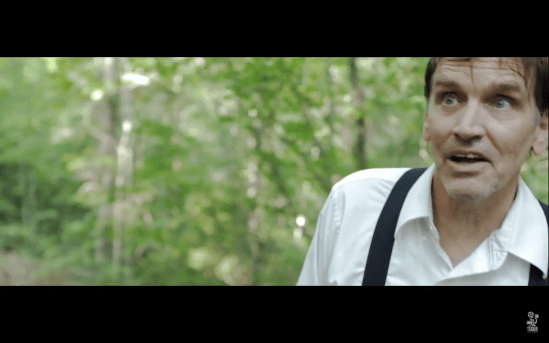
This Little EVIL Piggie Went to the Post-Apocalypse Human Meat Market! “Bullets of Justice” (The Horror Collective / Digital Screener)

The years following the third World War, America has been overrun by the Governments very own super soldier weapons project involving splicing the human genome with pig DNA.  The creatures, dubbed Muzzles, have occupied the country 25 years later and have turned the tables on the human species, capturing, breeding, slaughtering, and eating their packaged to serve meat.  When humanity created a toxin to combat the Muzzles, they inadvertently released a gas that sterilized the entire human population and the last of the human survivors have formed a resistance who aim to seek out and destroy The Mother, the continuous Muzzle breeder no man has ever seen, but is supplied large volumes of man meat in order to maintain Muzzle production.  The task to root out the mother’s trough of carnage falls upon Rob, a human bounty hunter working for the resistance, and his mustache sporting Raksha, who never loses a fight.  Together, Rob and Rahska butcher their way through a pigsty to locate and kill The Mother, but not every human shares their hope for mankind. 

“Bullets of Justice” is a hog wild, Bulgarian-made, bulldozing bloodbath of a post-apocalyptic exploitation may-ham from the warped (or genius?) minds of co-writers Timur Turisbekov and Valeri Milev with the latter sitting in the director’s chair.  Milev, who directed the 6th installment, “Last Resort,” of the “Wrong Turn” franchise, collaborates with first time filmmaker Turisbekov and pulled out all the stops in this outrageously funny, insanely gross, and eyebrow raising delicatessen of deprave cold cuts.  Initially considered as a pilot for a television series and later tossed around as a potential short film, “Bullets of Justice” found invigoration and traction as a feature length film from premise’ author Timur Turisbekov that led to a crowdfunding campaign on Indigogo to cover the remaining post-production costs of all the material shot by Turisbekov and his friends.  Zenit TT serves as the production company.

Blasting away sounders of swine, graced with the visual effects washboard abs, and is able to score tail of every single last human woman he comes across in this dog-eat-dog world, even his sister’s, is Timur Turisbekov as humanity’s last hope, Rob Justice – hence, “Bullets of Justice.”  Rob’s a stone-faced and skilled Muzzle gravedigger with a penchant for being one step ahead of everyone else and Turisbekov can act out the part of an untouchable 80’s action hero with relative ease complete with fancy fighting choreography  and a thousand yard stare and though the dubbing track is undesirable, it satirically plays into the black comedic satire of the man versus pig post-war consequence conflict narrative and there’s a score of characters with all sorts of dialect dubbing that doesn’t single out just Turibekov.  Rob’s sister, Raksha, stuns even with a stache on the upper lip of the darker attributes of Doroteya Toleva in what is perhaps her most memorable, if not most bizarre, performance that adds more of an aggressive balance to Rob’s stoic demeanor.  “Bullets of Justice” freely offers up plenty of nudity to go around from male full frontal to female full frontal though neither Turisbekov or Toleva bare them true selves as body doubles and movie making magic fill in the private parts, but there’s plenty of dirty, glistening in sweat, real skin from actresses, such as stuntwoman and actress Yana Marinova (“Lake Placid 2”) and the introduction of Ester Chardaklieva, to fill that authenticity void plus a few heftier and plump extras in the roles of slaughterhouse pig fodder.  What’s most frustrating about these quintessential apocalypse and ostentatious characters is that their development and arcs never, ever come to term of a poorly knitted post-production. I wanted to learn more about the antagonist with “the most beautiful ass,” Rafeal, played by male belly dancer Semir Akadi, I wanted to understand Askar Turisbekov’s General Askar betrayal, and even dive into what drove “Machete’s” Danny Trejo’s Godless dogma as a single parent to young Rob and Raksha in his small bit role. “Bullets of Justice” rounds out with Dumisani Karamanski, Alexander Ralfietta, Neli Andonova, Gregana Arolska, Svetlio Chernev, Dessy Slavova, and Doroteya’s twin sister, Emanuela Toleva, in a small dream role.

Being spurred as a potential television series or a short film, “Bullets of Justice” barely formulates a step-by-step story as the genesis of a surreally articulated full length embattlement with pre-scripted, pre-funded, and pre-shot scenes full of head turning high cost stunts, explosions, and with World War II replica weaponry (50 caliber, MP 40, STEN, etc) of already completed shots for a particular medium in mind, which was unfortunately not a feature. This is where post-production needed to step up to fill in the gaps, to muster visual segues, in order to piece the unsystematic scenes into a single unit of thought, but the second act inevitably goes off the rails as taut tangents snap like over tightened cable cords when Rob and Raksha team up to flush out The Mother and then one of the next scenes has Rob smack dab in the middle of being teleported, his future has developed the mode of travel through time and space, and while the viewer tries to interpret whether this is a dream or a style of the director’s auteur expression, Rob is actually teleporting to, well, we don’t really know where initially. Crucial backstory elements come whirling in to explain Rob trying to go back to the year just after the third world war to unearth where the mother might be hiding, but keeps missing the exact date. How Rob gets back to his own time is not known; Yet, these series of unexplained inconsistencies reap the benefits of such a gory good time that includes midgets firing submachine guns and dropping grenades out of the jetpack of a flying pig-man wielding a minigun on each arm – an entirely insane concept. Is “Bullets of Justice” a well-made, well-rounded film that would make your film professor proud? Probably not. Yet, here’s the kicker, a theory of mine that might explain everything. Rob Justice is actually daydreaming the entire degrading society where he is the lone savior of mankind, never missing a target, bedding all the women, idolizing a villain, and that end shot ties those concepts all together. Again, just a theory but it’s a damn good one.

A highly-recommended blood, sex, and pigs with machine guns exploitative romp and ruckus, “Bullets of Justice” overindulges with vice transfixing visual and imaginative dexterity that can now be experiences on multiple VOD platforms such Amazon Prime, Apple TV/iTunes, Google Play, Xbox, and Vimeo distributed courtesy of The Horror Collective (“Blood Vessel”). Orlin Ruevski’s cinematography is impressively expensive without actually costing an arm and leg with a well stocked cache of wide shots that capture the simulated war-torn world and girth of rural landscapes while simultaneously, through the use of low contrast and darker color tones, harness shots of grime and graveness of the Turisbekov’s pig-utter chaos that ensues. Combine Ruesvki’s expeditiously confident totalitarian style with the campy visual sfx from the Bulgarian based Cinemotion LTD, same visual effects company on “Tremors 5,” a rare and beautiful species of film emerges from the edge of rotoscoping to the go-big-or-go-home ludicrous-speed composites. Since this is a digital release, there were no accompanying bonus materials or scenes. With non-stop melees and a flavor for the tasteless, “Bullets of Justice” rattles along as a pure, uncut dystopian fantasy big on the pig and galore on the gore.


Must Watch “Bullets of Justice” on Amazon Prime!

Never Poke Isolated EVIL. “Darkness in Tenement 45” reviewed! (Wood Entertainment / Digital Screener)

In an alternate reality of the 1950s, the Soviet Union has obtained components for long range biological weapons that threaten United States’ borders.  New York City has been declared as a tangible target and the city is evacuated of all residents, but one tenement, number 45, remains occupied, boarded up by the frightened tenants to shield themselves from the biological threat and from a possible USSR invasion.  Cut off from the outside world and running low on food and supplies, the building’s owner, Felix, ventures outdoors to forage what’s left on the streets of NYC, leaving Martha in charge of the dilapidated building, the anxious children and the terrified adults.  Martha’s adolescent niece, Joanna, arrived just before the evacuation; a measure taken by Joanna’s mother due to her daughter’s “darkness” of violent outbursts, but Joanna’s darkness conflicts with Martha’s authoritarian leadership leading up to a faceoff between children and adults in already tense surroundings.

In August 2017, production finished on “Darkness in Tenement 45.”  In 2019, a Kickstarter campaign was launched to complete the post-production of the Nicole Groton written and directed psychological thriller based off fear and intimidation in the context of a Red Scare backdrop.  As her breakthrough feature film, Groton probably couldn’t have imagined that the release of her quarantine isolating and germ warfare agog could have coincided right in the middle of a current pandemic climate of self-quarantining anxiety and globally enforced lockdowns.  Yet, “Darkness in Tenement 45” can be viewed a sentiment of triumph in a time of actual worldwide darkness for a film with a crew that is comprised of primarily women and with a cast that favors the majority of dialogue roles also for women.  Groton supports her own cause by contributing as producer under her production label, A Flying Woman Productions, a North Hollywood, California based indie picture production company.

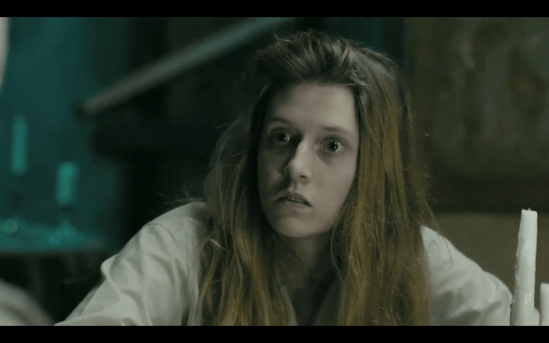
While there might be a contingent of characters that could easily be in the vying for lead, Nicole Tompkins is the discernible “darkness” descriptor in the “Darkness in Tenement 45” title.  The Texas-born actress has developed a little darkness of her own in her career corner being a principle lead in the 2018’s nightmares of the netherworld, “Antrum:  The Deadliest Film Ever Made” and also landing a voice role of one of survival horror’s most renowned heroines, Jill Valentine, in the remake of “Resident Evil 3” video game released this year.  Now, Tompkins scales the identity range as a damaged young woman sheltered in place from the elements of war only to be stuck as an afterthought amidst toxic authority that could endanger all tenants, creating a boiling tension culminating into a volatile climax with Martha, a role drenched with an unapathetic interest in children’s opinions, especially from the unstable ones.  Martha is played sardonically by “Blood of Drago’s” Casey Kramer with a seething disdain for anything that isn’t in her interest.  Overall, the performances and characters are grounded enough to development the story along it’s simple narrative lines, but not everything support character, who are supplemented with individual portions of the story pie, are well bloomed to sate their character.  For instance, Tomas, the youngest child of the building owner, Felix, has an undisclosed autistic side him and becomes obsessive with the breast of one of his older sisters, and while that plays out in Groton’s themes of partisan power when Tomas is given authority over his sisters from his venturing father, because of their innate Latina patriarchal culture, Tomas’s motivations fall short of really being dug out from the undercurrent context as an individual arc.  Same kind of broke off development can be said with Emmy Greene and Joseph Culliton’s characters as fellow adults who blindly follow Martha’s do-as-I-say mentality like lemmings toward their self-destructions.  The cast rounds out with a wide range assortment of children and adult actors that include David Labiosa (“The Entity”), Melissa Macedo (“Blood Heist”), Keyon Bowman, Marla Martinez (“Blood of Ballet”), and Anthony Marciona (“Invasion U.S.A.) who provides more of a 1950’s white man NYC accent true to the era.

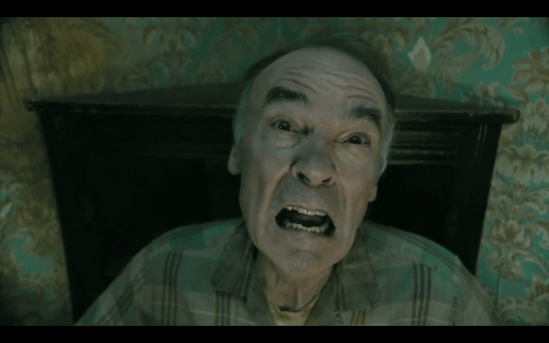
Revolving around the theme of isolation, “Darkness in Tenement 45” operates under the similar structure of John Carpenter’s “The Thing” by establishing a group of people cutoff from the rest of the world trying to survive a different kind of infection and the antagonist alien, represented as the darkness in Groton’s film, is the villain that tears the remaining survivors apart from the inside, metaphorically in the house instead of their bodies in this case.  “Darkness in Tenement 45” is by no means on tenterhooks or as a molecularly gruesome as John Carpenter’s classic re-imagining of an actual 1950s film, but the basic principles of the story present plenty of suspicion, hegemony, and stir craziness to go around, fueling the dreams and anxiety to Joanna’s snowballing psychosis redlining toward critical.  While I feel that the performances and wardrobe are not the best representation of the 1950s time period, the Caitlin Nicole Williams’ production design shoulders much of that responsibility.  Williams, who worked as the second unit production designer on the satirical-slasher “Dude Bro Massacre III”, creates a delineable vividness out of a bare bone lined tenement setting, appropriate for the depicted social class and period, while exuding the crude shiplap finish that fits the narrative, adding confinement and angst to the space.  “Darkness in Tenement 45” is Groton’s groundbreaking effort that dishes out this disorder of a safe haven in dismay; yet, the story pulls plot point punches that should have landed to knockout a more effective thriller that touches importantly upon the very livelihood and fate of each individual tenant in an alternate universe wartime backdrop.

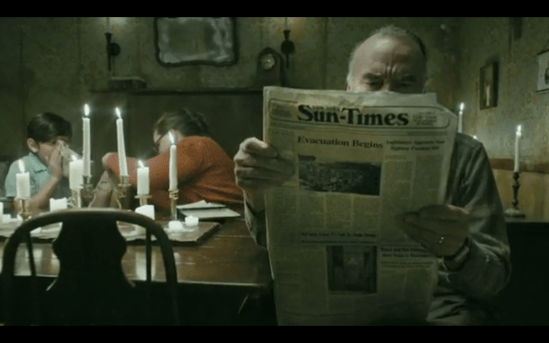
On the biggest day of every four years, as anxiety-riddled clouds loom over the entire nation as we all wait in the shadows with bated breath of who will be the next President of the United States of Election Day, Wood Entertainment has embraced another kind of tense darkness with their release of “Darkness in Tenement 45” onto various digital platforms, including iTunes; Amazon; Vimeo, Xbox, Google Play, iNDEMAND, FandangoNOW, and more. Continuing the praise of the female-led thriller is with the Carissa Dorson cinematography that deposits two shot styles of the conscious and subconscious. When awake, Joanna and the others are engulfed in a hefty, deep dark and light wood brown scheme that compliments the slummy environment of their tenement. When asleep, Joanna is rendered in a softer image to resemble the hazy or airy atmosphere of her dreams. This style is also complete with a medium scaled purple-pink tint often associated with the hallmark callings of a 1970s-1980’s foreign supernatural horror. Dorson never intertwines the two styles, giving clarity to Joanna’s conscious and subconscious state without going deeper into the character’s easily agitated and short fuse temperament, while also setting up some neatly framed shots that make things look bigger or more menacing than they appear, such as the overly boarded up entrance door or the candle lit supper table that becomes a point of contention. Flashes of incubus imagery and the dissonance of gearworks clanking around an unhinged mind give “Darkness in Tenement 45” a morsel of allure amongst the thematical discord of breaking the chains of restrained individualism and overprotecting those with a firm hand from self-harm and while the film might not be pitch perfect, the spirit is strong in the vanguard of female-driven filmmaking.

“Darkness in Tenement 45” now available for rent on Amazon Prime!

Father and Son Bring EVIL Down Upon a Tormented Detective in “Darkness Falls” reviewed! (Vertical Entertainment / Digital Screener)


Los Angeles detective Jeff Anderson has his perfect world turned upside down upon discovering his beloved wife dead of suicide in their apartment bathtub. Losing his bid for Captain and having his life be in utter shambles, Anderson becomes obsessed with lurking around incoming suicide calls on the CB radio, trying to make sense of his wife’s sudden reasoning to end it all. When a similar case produces a survivor from a familiar fate as his wife’s, Anderson learns two men are behind similar forged suicides stretched out over the past ten years against prominent women figures in and around the L.A. area. The detective spins a wild theory that has him following every lead to track down and stop the father and son serial killers without any backup from his local precinct, forcing his hand to choose whether to be a cop and uphold the law or seek lethal retribution for the woman he loved.

From French director Julien Seri comes “Darkness Falls,” a crime thriller released in 2020 that is entirely shot in English, a first for the French filmmaker who helms a script from the executive producer on “Starry Eyes” and “The Man Who Killed Hitler and Then the Bigfoot,” the Belgium native, Giles Daoust. Also produced by the Belgium, the film, that was formerly titled “Anderson Falls,” gorges on the detective exemplar of the prodigal crime fighter stripped down to next to nothing before regaining footing against the two experienced serial killers out to reduce the highly professional woman population with one bottle full of sleeping bills and one razorblade at a time. “Darkness Falls” is an exaggerated piece of nurture versus nature on systemic toxic masculinity seething under the guise of one man’s oppressed childhood from the abusive women in his life and then enlightening his son to his ways while the open minded, Renaissance man climbs back up the mountain toward redemption, not only for himself or his wife, but for all women being forced in a dual parental role. “Darkness Falls” is released under the production companies Koji Productions, Lone Suspect, and Giles Daoust’s Title Media.

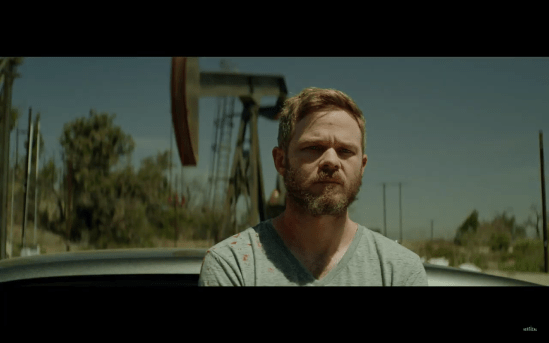
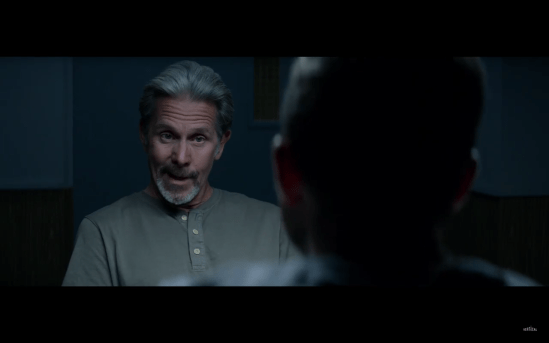
Despite the international production and filmmakers, the solid cast is compromised of familiar faces from respectable actors, starting with not-the-Elsa-“Frozen’s” Shawn Ashmore. Ashmore, who I considered to a steady part of any project – he’s phenomenal in Fox’s “The Following” with co-star Kevin Bacon, – finds himself in the shoes of a L.A. detective who has fallen by no cause of his own, but as consumed as detective Jeff Anderson is with proving his wife’s murder, Ashmore doesn’t sell Anderson’s convictions and doesn’t properly apply Anderson’s super sleuth talents to wade through the sea of angst and torment. Anderson’s also written poorly as a man who consistently lingers around suicide call-ins and has constantly has numerous visions and memories of his wife that serve little to her importance to him, serving more toward just being story fillers instead of providing a little more value to Anderson’s character. What attracted me more to “Darkness Falls” was Gary Cole as one-half of the father-and-son serial killer team. Cole takes a break from the Mike Judge and Seth McFarland humor to stretch his legs amongst the thriller genre, playing an unnamed dark toned character derived from hate, abuse, and the thrill of seeing women die. Cole’s performance is a step above Ashmore’s lead role, but still flat, flat to the point of almost monotonic pointlessness that doesn’t exalt his need to kill high profile women. “Darkness Falls” rounds out the cast with Danielle Alonso (“The Hills Have Eyes 2”) as a Anderson’s former partner turned police captain, Richard Harmon (“Grave Encounters 2”) as Gary Cole’s accomplice son, and the legendary Lin Shaye (“Insidious”) as Anderson’s mother.

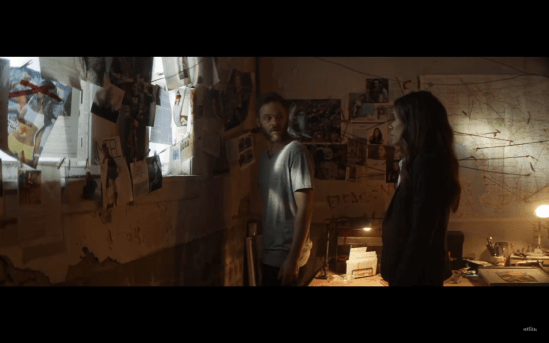
While “Darkness Falls” conveys a strong, if unintentional, message that grossly sheds light on the overstepping male view toward the idea of a successful woman, director Julien Seri missteps multiple times through the dramatics of a cop on the edge of the law and on the brink of despair while also not completely rigging out Gary Cole and Richard Harmon with more conniving wit, especially when their kindred reign of terror is well versed throughout the years. What fleshes out from Ashmore’s rolling on the floor and spitting shade performance at pictures of women on his crime wall trying to get into the head of the killers and Cole’s character who relinquishes freedom in sacrifice, even after a daring great escape from a botched crime scene that involved killing two cops in the process, is this weirdly uncharismatic collapse of a story from within the parameters of a well-established cast and premise. “Darkness Falls” barely pulls out a believable crime thriller that can only be described as vanilla, a term that stakes the heart terribly knowing that Shawn Ashmore and Gary Cole deserve so much better just from their lustrous careers and polar acting styles that don’t counterbalance the dynamics at all in this film. The original title, “Anderson Falls,” is fresher salt than the stale, rehashed title change of “Darkness Falls” to, perhaps, gain traction in a fruitless action of selling more tickets, adding even more vanilla flavor.

Releasing on VOD and Digital this month is “Darkness Falls,” an unrated release, courtesy of Vertical Entertainment. Streaming services such as iTunes, Amazon, Apple TV, Google Play, FandangoNow will carry Shawn Ashmore’s 84 minute sordid themed detective thriller as well as all major cable and satellite companies. Since this is a digital screener, the audio and video aspects will not be reviewed, but if running on digital and VOD, the presentation should be excellent provided that your internet’s not sluggish and a good connection is established. I will say that the score by Sacha Chaban is against the grain with a brawny anti-brooding soundtrack more suitable for intense action than stylish poignancy than ends in uninspired ca’canny. That’s also not to say it wasn’t a good score. There were no bonus material included with the digital screener and no bonus scenes during or after the credits. Sitting through “Darkness Falls” was tough to sit through as the anticipation for the morbidity level to increase with due pressure onto detective’s Anderson’s browbeaten shoulders for a hellish ride solving his wife’s untimely death was never sated, sputtering along as a halfcocked story with performances to match.

“Darkness Falls” available for rent on Prime Video!

EVIL’s Checkmate! “A Knight’s Tour” reviewed! (Terror Films / Digital Screener)


Set years inside the landscape of a post-apocalyptic world, a young locaiton scout named J.D. stumbles upon a hidden cabin after being severely injured during his travels. While catching his breath and notating the position of the cabin in his notebook, a man comes up behind him, armed with a hunting rifle and has it pointing at J.D.’s head. Playing cool and calm, J.D. relinquishes himself to the man’s every suspicion, even to the point of chaining himself inside a locked room, to ease the man’s fears. The next day, the man introduces himself as Henry and provides food and medical assistance when J.D. proves he doesn’t pose a threat. The two men begin to form a bound once the waters of distrust subside, providing Henry with much need and desire companionship and a place where J.D. can soothe his trekking feet, but when Henry’s paranoia bubbles to the surface and the feasible threat of a raiding group upon Henry’s quaint isolated cabin appears imminent, their newfound friendship will be tested.

In an unpredictable course that has been marked in our year of 2020, a pandemic has quickly spread through the most powerful and copiously stocked sovereign nations on Earth. Now, imagine if that same pandemic, ravaged the world’s population, and subsequently it’s resources, to the extent of lawlessness and death, leaving many question, lonely, and afraid and what that would do to their mental state. AMC’s “The Walking Dead” explores this pretty well through the course of the first few season until it just became a ebb and flow battle of the good versus the bad. However, writer-director Marvin Choi recaptures the core essence by exploring his vision of the apocalypse in “A Knight’s Tour,” where there’s more of a mighty, but small undercurrent of the unknown that overwhelms the brain’s rational thought process, affecting prosperous relationships and transforming them into a claustrophobic resistance of dangerously delusional episodes. The film, being released in 2020, is Choi’s first behind the camera and in the seat of the director’s chair, helming a script with a title based off a game played with a chess’ knight piece that has to tour every spot on a checkered chessboard within its allowed moving pattern, not to repeat a spot, and return back to its original point. “A Knight’s Tour” is also the Korean-American Choi’s graduate thesis at the California Institute of the Arts that saw supplemental fruition from fellow student-turned-producer Sara Razack and shooting was held on the Dominguez Ranch near California’s Lake Piru on a budget of $25,000 and released under Choi’s company banner, Fugitive Frames, a subsidiary of the Fugitive brand that also includes Fugitive Games, for videogame reviews that Marvin Choi plays, and Fugitive Photography for professional photos with partner John C. Velez.

The intimate production allows for the characters to unfold the story from the only two actors in performances that really saturate the frames with uneasy intentions and keep posterity uncertain outside cabin doors and beyond the safe haven thicket. Darnel Powell and Joseph Price star as J.D. and Henry in what would be their debut full-length feature film performances. Taking the roles head on, Power and Price relationship never takes a backseat during the entire 77 minute runtime. J.D. and Henry are rudimentary beings trying, in their own ways, to survive in what is now a collapse society; J.D. runs with groups, scoring out locations that might serve himself for refuge and, maybe, a bit of payment depending on the group whereas Henry shuts himself in after losing not one person but two people he’s cared about to death and the other reason is unknown during the chaos of the mysterious outbreak that cut society into grated chaos. Despite the subtle acquiescent approach to Henry’s disregard toward stranger-danger concept, Price plays into Henry’s strong silent type and can field and hold the switch out into Henry’s obtrusive and frantic visions of the past. Powell’s take of J.D. comes off a rudimentary and less of a bamboozler as suspect. J.D.’s smart, cunning, and experienced in the field and Powell plays into well enough, but not enough to actually sell the hustle or if there is even one. Dynamically, they’re not embroidered into the elaborate patterns of the knight’s tour, but more related to the chess match itself with sacrificing trust like pawns, able to diagonally out smart each other like Bishops, and exposing their true intentions like an unprotected King until they find themselves in a stalemate of unglued trust and friendship when designs are calculated and true self invokes pity.

“A Knight’s Tour” doesn’t feed into the thrills of a do-or-die, post-apocalyptic death heap as Choi carves out the materials for the ever fluid human disposition. Instead of junk cars revamped for destruction and pillaging carnage, Choi challenges the overglazed with violence eyes of audiences to determine the gambles set by the two leads, to extract the souls of J.D. and Henry, and watch them either become brittle or come to terms with a change of heart. What’s interesting about the two men, or more the structures of these two men inside the pages of the script, is there willing to quickly trust each other. At first sight, Henry has a rifle pointed at J.D., has the location scout chain himself inside a closet, and keeps the chain on him for a few days after. There are two sides to this coin soon after that first night. One, J.D. allows himself to be captured and subjected to Henry’s every called shot. J.D. even provides step-by-step exposition how he could have taken the rifle left on the table and shoot Henry in the back. J.D. is either a very honest and trustworthy individual or is trying to get on good terms with Henry, to observe his habits, and to get a better look at the loner’s stockpile for future taking. Two, Henry, though careful and precise, easily lets J.D. into his life, letting him out of the closet and able to roam around the cabin with the chain still around his ankle. Henry gives in into his desperation caused by loneliness, allowing himself to instantly attached to J.D. as if, and probably was, the only person he’s seen in a very long time. Much like the sequences of the game, “A Knight’s Tour” never retreads on the same path twice, proving to uphold the tension with a singular theme to chew on and comes out on top without any glossy doomsday bombardments that makes the blood boil with cathartic obliteration of each other.

“A Knight’s Tour” depicts the fragility and longevity of one’s inner thoughts sanctum while in a post-apocalyptic world and is feature debut from Marvin Choi, distributed by independent genre distributor Terror Films, and has made a noble run of the festival film circuit, including the Pan African Film Festival, DisOrient Asian American Film Festival, and Montreal International Black Film Festival. Set to release this month digitally, the roll out will include multiple streaming services for viewing pleasure, such as Prime Video, Tubi TV, Watch Movies Now, Google Play, and others. Since the product is a digital screener, the video and audio aspects will not be covered, but nothing obvious inherent seemed to disrupt the balanced, yet low-keyed audio mixes and 1.78:1 widescreen video presentation. There were no bonus features included or additional bonus scenes during or after the credits. Marvin Choi’s “A Knight’s Tour” will make a subtle impact across the indie film circuit with searing themes of manipulation, deterioration in solitude, and the games we play against each other for the advantage over our fellow man.

“A Knight’s Tour” on Prime Video!

Rock And Roll is the EVIL’s Music! “Dark Roads 79” reviewed! (Terror Films / Digital Screener)


Frontman Bobby Gray and his Southern rock band, Dark Roads, were supposed to be next big hit next to The Rolling Stones, but there fame and fortune started dwindling after some short-lived success. Barely surviving on a here-and-there gig in 1979, Dark Roads manager, Grace King, secures a secluded cabin in the woods for them to find their new sound before being dropped by their record label. Along with their female companions, chatty coach driver, their sensible roadie named Cash, and a handful of some hallucinogenic drugs, the trouble band members continue to squabble amongst themselves, especially more so against the vain and alcoholic Bobby Gray. Gray holds a terrible secret from his bandmates, a secret involving a pact he made with the Devil ten years ago and, now, the debt is due, placing the entire group in mortal danger…the price for fame and fortune.

Based loosely surrounding the tragic circumstances of the infamous 27 Club mythos, a moniker given for a collection of up and coming talented musicians who die unexpectedly and prematurely at the ripe young age of 27, “Dark Roads 79” incorporates into the fold the legendary tale of Blues musician, a 27 club victim named Robert (Bobby) Leroy Johnson, who sold his soul to the devil at a Georgia crossroads during midnight for to be the greatest blues musician, or so the story is told. The 2017 film is the fifth macabre picture from writer-director Chase Smith who co-wrote the film with documentarian filmmaker, Richard Krevolin, who no doubt kept the script on a historical accuracy path, as much as one supernatural storyline can stay on. “Dark Roads 79” is a production from Smith’s Georgia based independent filmmaking company, Spirit World Productions, and brought to viewers by “Old 37” executive producer “Jason Anderson” and co-executive producer Nicholas Frank Auger.

Already donning many hats, Chase Smith slips on one more broad brim and trashy cowboy mesh hat with Ian Cash, the level-headed, good natured roadie with a voice like an angel, but built like a Mack truck. Cash serves as narrator who sets up the story that swerves across the dotted line into spoiler territory just a tad, but Cash becomes the vehicle that brings the viewers up to speed on the legend of Bobby Johnson and the rise and fall of the Dark Roads, like a cowboy quick connect in case you needed help in establishing that Dark Roads’ success hinges on a fatal pact with the Devil himself. While Cash may seem like the focal point of the story, there’s a split with lead singer Bobby Gray (David A. Flannery, co-star from a few of the homoerotic thriller series “1313”) whose vanity flushes Dark Roads’s stardom down the toilet. Cash and Gray go toe-to-toe many times and Smith’s emits formidable tough guy appearance on screen while Flannery impresses with a complete loathsome veneer. Neither Smith or Flannery make top bill however as long as “Devil’s Rejects” Bill Moseley has a show stealing bit role as the wicked tongue Christian, Caretaker Williams. Moseley’s short, catchy tune of “Boys and Girls they’ll make some noise. They’ll all be burning in Hell” is a classic, archetypal Bill Moseley character idiosyncrasy. Though Moseley’s scenes are short, they’re definitely sweet and rememberable. “Dark Roads 79” rounds out with “Creature Feature’s” Austin Freeman, Lance Paul, Libby Blanton, and Chance Kelley alongside April Bogenshutz (“Attack of the Morningside Monster”), Jessica Sonneborn (“Never Open the Door”), Jennifer Masty (“Rabid”), Eddie George, Ramona Mallory (“Piranha Sharks”), and co-writer Richard Krevolin as the bands’ chatty driver, Thomas ‘Motormouth’ Jones.

“Dark Roads 79” is categorically a a mystery slasher with a supernatural edge that tinkers with blending lore and the theme of lost good times and friendships despite how unfriendly and uncouth they might be, but Smith and Krevolin purely tiptoe around the keynote of terrible, yet sense of family, camaraderie, failing to capture the coherency of the melancholic essence due to loss and despair built upon years of cathartic criticism, distrust, loathing, and continuous bickering between best buds. In fact, the band and it’s entourage displayed little love if it wasn’t under the influence of some drug, but we must remember that the narrative is told through the perspective of roadie Ian Cash who believed in the band, and, in so, believed in each band member albeit their merciless fair share of busting his balls. The editing, cuts, and transitions are, perhaps, some of the most interesting with “Star Wars”-like wipe transitions that effectively heightened as a hallmark of the swanky 1970s era and the emotion-extracting lingering shots, such as with the handheld super 8 cam that roams the room of an abiding jovial moment in time, capture more of the tender times between the group of bitter and weary druggies, alcoholics, and vain temperaments. Unfortunately, the positives do not outweigh the negatives with a scatterbrained and predictable story that comes off as another failed spawn of the 27 Club urban legend and shaves off the emotional baggage with cheap kills and too many unfulfilling characters.

Make a pact with the Devil himself by watching Chase Smith’s “Dark Roads 79” that’ll debut on stage with a wide digital release by the end of May from genre distributor, Terror Films. No set date has been announced. The film will be hosted on multiple digital platforms, such as TUBI TV, Google Play, Prime Video, ITunes, and various other streaming options. Since “Dark Roads 79” will be a digital release, the video and audio specifications will not be reviewed as it’ll be different for all personal devices, but I will note that some minor portions of the dialogue elements were echoey at times. The original soundtrack has strength behind it with Southern Rock tracks by Black Mountain Shine, Mark Cook, Benton Blount, and HK Jenkins, who composes the single “The Road You’re Going Down,” written by Chase Smith, for the film’s official music video. There were no bonus features with the digital screener. “Dark Roads 79” has the necessary ingredients of a backwoods-frat party gone awry slasher except with Southern Rock, but this Georgia based production is tuneless and tone deaf as it stutters through the Devil’s network of deadly deals.