One Man Takes on the EVIL Australian Crime Syndicate! “The Man from Hong Kong” reviewed! (Umbrella Entertainment / Blu-ray)

“The Man From Hong Kong” on the Ozploitation Classics Blu-ray from Umbrella Entertainment!

A newly formed Australian narcotics unit busts up a major drug deal that lands a crime syndicate pusher into the custody of the authorities.  The pusher, low on the totem pole of a larger drug organization, speaks no English and with the inexperience of the Australian unit, Hong Kong special branch inspector, Fang Sing-Leng, is requested for interrogation interpretation and be the escort of extradition back to the pusher’s native Hong Kong residence, but while in custody, the pusher is gunned down by an assassin.  Sing-Leng thrusts himself into Sydney’s criminal underworld the Hong Kong way, leaving a trail of destruction in his solo-takedown of formidable drug kingpin, Jack Wilton.
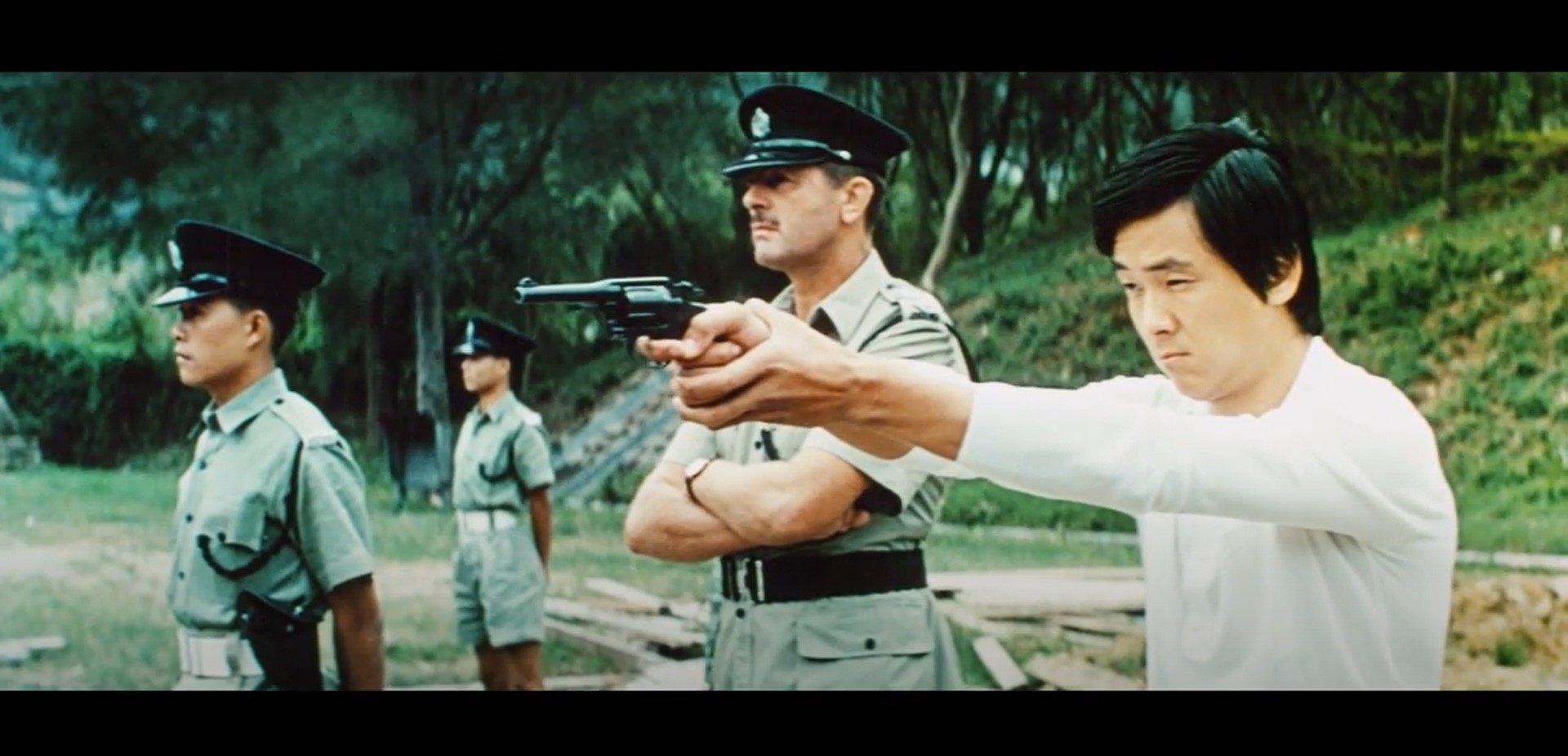
For film loving youngsters, would they know what cinema was like before green screens, motion capturing technology, and other computer imagery devices to create alien worlds and improbable fight sequences?  Would comprehending the idea that before the pre-implementation of these technological advances in film there was a just-do-it fortitude toward the physical and raw aspects of special effects and stunt work?  Those wee moviegoers’ heads would explode into itty-bitty chunks of brain matter by the very slight thought of a man jump kicking another man off a high-speed dirt bike without even one ounce of a tethered harness or helmet for safety.  Hazard upon dangerous hazard is what writer-director Brian Trenchard-Smith offers on the table from his debut martial arts film “The Man from Hong Kong,” the first martial arts film of its kind hailing out of Australia.  Trenchard-Smith’s working title “Yellow Peril” sought to sprinkle in between the high kicks and hyahs an amusingly intended, but greatly nearsighted, prejudice of the subtle racism in how Australian people viewed East Asia; however, Raymond Chow, the Hong Kong-side producer for this two-country co-production, ozploitation actioner, didn’t quite see the humor in “Yellow Peril” (and we don’t blame him).  Thus, “The Man from Hong Kong” title was born with some minor contentious distaste for its generic branding.  Trenchard-Smith’s The Movie Company Pty. Ltd (“Stunt Rock”) and Hong Kong’s Golden Harvest Company (“Sex and Zen”) served as co-productions, releasing the joint venture in 1975 with variable success across the globe.
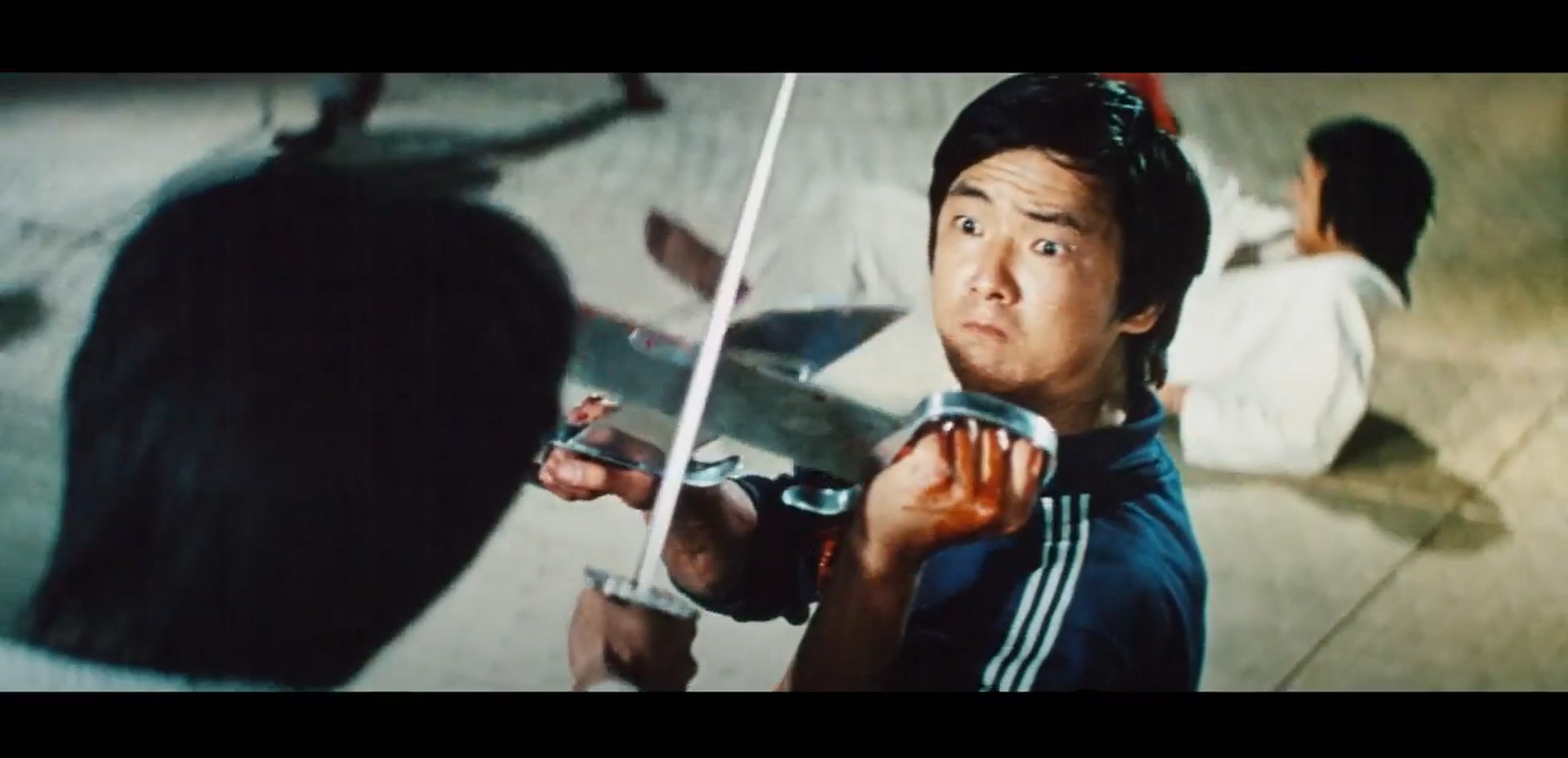
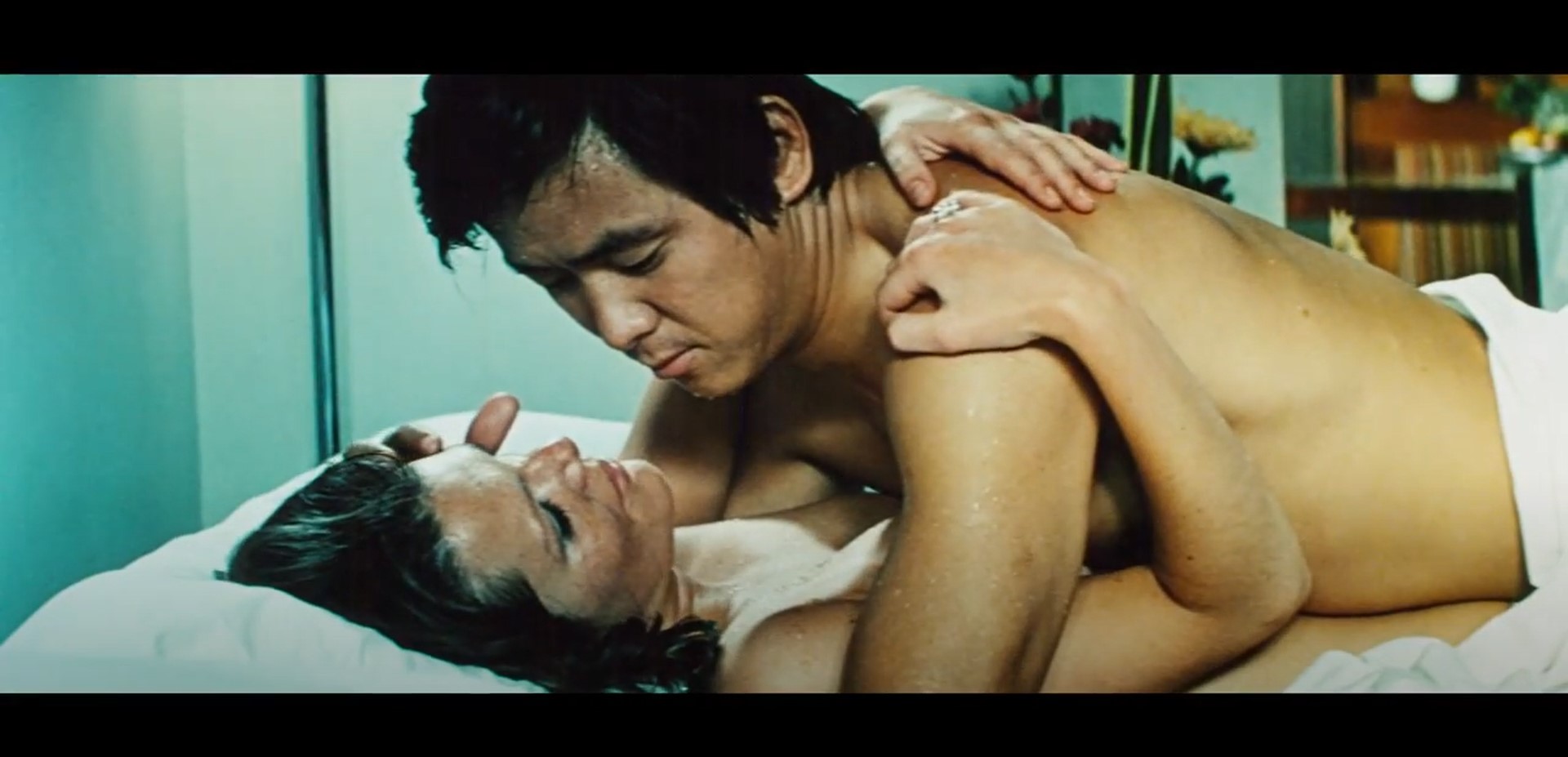
The first choice Brian Trenchard-Smith had in mind for the role of Fang Sing-Leng was mega-martial arts superstar Bruce Lee hot off the success of 1972’s “Fist of Fury,” 1972’s “The Way of the Dragon,” and 1973’s “Enter the Dragon.”  “The Man from Hong Kong” seemed to be a perfect segue into Lee’s next martial arts box-office hit that may have also reclaimed cinematic stardom for his soon-to-be co-star George Lazenby who fell into a blacklist slump after declining to reprise his 007 James Bond role from “Of his Majesty’s Secret Service.”  Unfortunately, and tragically, Bruce Lee suddenly died at the age of 32, leaving a void to fill not only Trenchard-Smith’s first film but also in the martial arts entertainment world.  In comes Jimmy Wang Yu, China’s former #1-turned-#2 after the quick rise of Bruce Lee.  The “One Armed Swordsman” series Wang Yu not only entrenches himself into the titular role at the behest of producer Raymond Chow as a suitable replacement, but Wang Yu also became Trenchard-Smith’s directorial counterpart of the Hong Kong shot scenes and the fight sequences, the latter being superbly thrilling by Wang Yu and his stunt team’s dedicated skillset to make the showmanship look authentic and bruising.  The extended chase through the streets of Sydney and into a no holds kitchen brawl with legendary stunt man Grant Page (“Stunt Rock”) is one of the best one-on-one rundown combat arrangements of its era.  Lazenby’s an effective villain with his towering height, broad build, and Tom Sellick mustache and has the ability to choreography not-so-half-assed kung fu, meeting and matching Wang Yu’s on screen moves without looking dopey or forced.   Australia’s film industry was so small at the time, there are number of recognizable actors mostly from the “Mad Max” series with the likes of Hugh Keays-Byrne (“Mad Max,” “Mad Max:  Fury Road”), Frank Thring (“Mad Max Beyond Thunderdome”), Roger Ward (“Mad Max”) in key or notable performance roles along with Bill Hunter (“Mad Dog Morgan”) and a pair of titular character love interests in Rebecca Gilling and Rosalind Speirs.
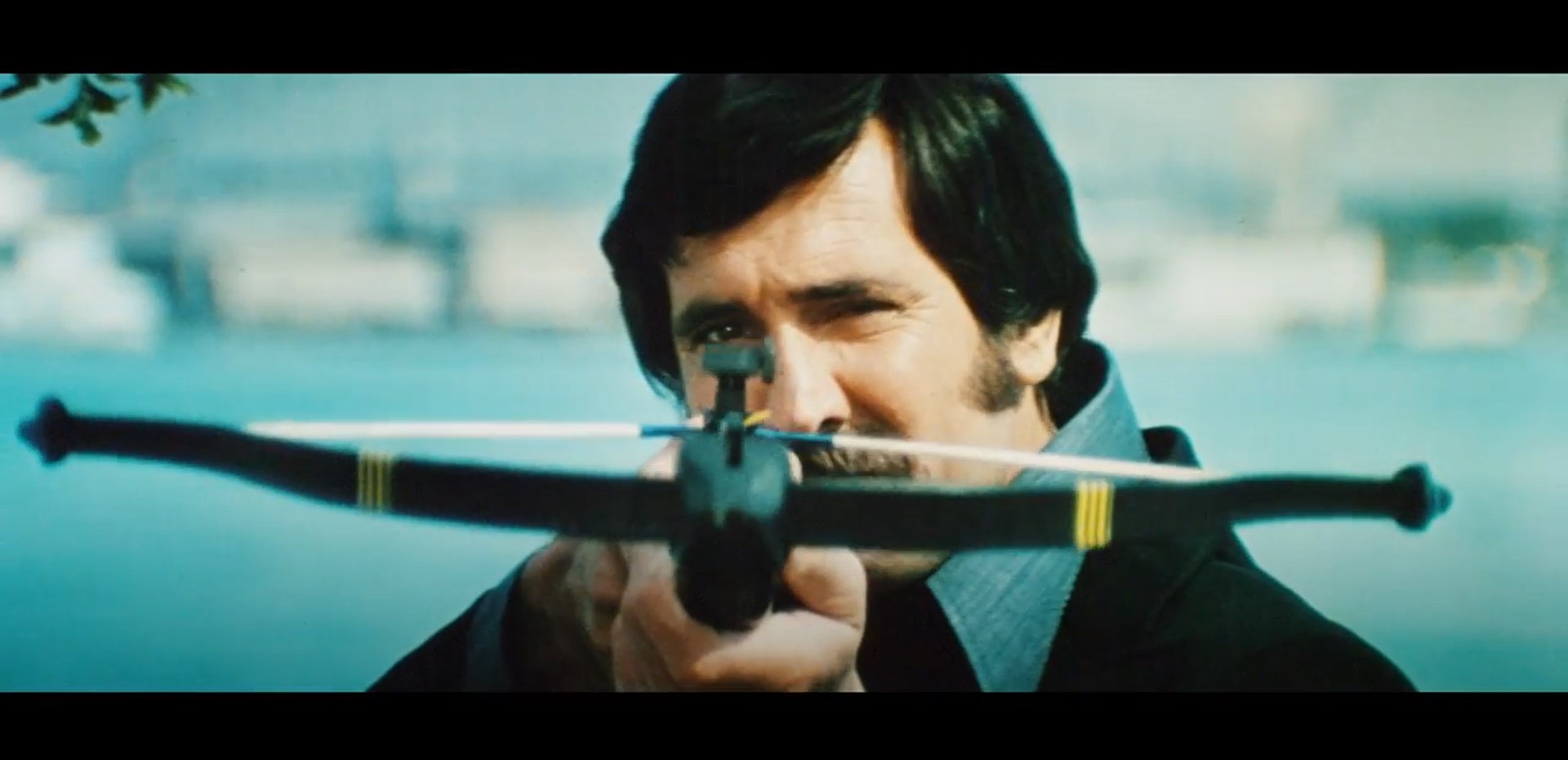
When judging a martial arts film, one critiques the hand-to-hand or melee weapon play contests, scrutinizing every punch thrown and kick taken, for complexity and believability.  If it looks real, it sure as hell feels real when conveyed from off the screen and to the audience.  Though “The Man from Hong Kong’s” scenes feel a little airy, pulling punches slightly too perceptibly, the choreography is quick and exhibits naturally enough through a variety of action and locations, including on top of Australia’s famous tourist attractions Ayers Rock for a wham-bam, drug sting and bust opening with a great-looking and thrilling car explosion shot that nearly takes the camera man’s head off with an unplanned, detonation jettison of a spinning car door toward the camera crew.  Those sorts of risky stunts are prevalent throughout that lends to “The Man from Hong Kong’s” enthralling physicality tone with Trenchard-Smith and his team’s wiliness to learn as they go in their death-defying acts.  The film is a tour de force of stunts, ranging from car chases, glider flights, skyscraper plunges, and an unforgettable kitchen skirmish with real melee weapons kneaded into its very fabric, with a Dirty Harry hero whose more of an anti-hero lawbreaker than the villains he’s up against by specializing in China’s miscreant brand of investigative police work. 
Perfectly suited as number 9 on the spine of the Umbrella Entertainment’s Ozploitation Classics banner is Brian Trenchard-Smith’s “The Man from Hong Kong,” now released on a region free, 2-disc AVC encoded Blu-ray.  Presented in a widescreen 2.35:1 aspect ratio with full 1080p, high-definition resolution, Umbrella has pulled out all the stops to release the best transfer to drool over.  Subtle vertical scratches here and there have no standing impact on viewing and the distinguished color palette is quite good and natural-looking for a film from nearly five decades ago.  There is a healthy amount of positive grain from the 35mm film stock, but the compression never comes into an issuance of sacrificing the quality, leaving darker scenes appearing bright and visible without the effect of enhancement or zealous contrasting.  My only substantiated gripe is with the subtitle cards that, in a way to not have to redo the English subtitles for the Mandarin dialect, the original frames were seemingly kept in and the image reverts back to a lesser quality degree.  Two audio options are available, an English-Mandarin language DTS-HD 5.1 Master Audio and a lossy DTS-HD dual channel.  Umbrella’s kbps output erratically fluctuations between 2400-3400 but even with the rollercoaster ups-and-downs, “The Man from Hong Kong” still had a robust action track and the dialogue came through discernibly clear.  Only goofy aspect about the audio is “Game of Death” and “Bloodsport’s” Roy Chiao’s English dubbing of Jimmy Yang Yu who obviously knew English or knew how to act like he knew English by watching his mouth articulate the native vernacular.  Umbrella also pulls out all the stops for the special features department in this limited to 3000 copies 2-disc set with the second disc a CD soundtrack arranged with Noel Quinlan funk-rock score and the main Billboard topping opening theme “Sky High” by the band Jigsaw.  Also included is a 2001 audio commentary from director Brain Trenchard-Smith, actor Hugh Keays-Byrne, and stunt director Grant Page, an all-new(ish) interview with Grant Page from 2008 entitled Real!Quick! pulled from Mark Hartley’s ozploitation documentary “Not Quite Hollywood,” extended interviews with the director, executive producer David Hannay, cast members George Lazenby, Roger Ward, and Rebecca Gilling, cinematographer Russell Boyd, 2nd unit cameraman John Seal, and first assistant director Hal McElroy from the same Hartley documentary, Trenchard-Smith’s 50-minute documentary “The Stuntmen,” a 75-minute “Kung Fu Killers” TV special directed by Trenchard-Smith and featuring Grant Page and George Lazenby, behind the scenes footage, opening night press conference footage, various and alternate  trailers and promos including a HD theatrical trailer, a cardboard slipcover with new illustrated design, and a reversible Blu-ray case cover art that also lists all 23-tracks on the CD.  The special features runtime outshines the 106-minute feature with a slew of interviews; however, much of the interviews really harp over-and-over upon George Lazenby’s set-on-fire coat mishap scene and Jimmy Wang Yu before the camera rolls catching and eating dragon flies ahead of a kissing scene with Rebecca Gilling.  “The Man from Hong Kong” isn’t notable because it’s Australia’s first martial arts film.  It isn’t notable for the attempt of resurgence of a former James Bond actor or because of its robbed promise of the late Bruce Lee.  What makes “The Man from Hong Kong” important to the film industry as a whole is its precursor value for being the example of a cast and crew to put life and limb on the line for the sake of motion picture art and be damn good at it.

“The Man From Hong Kong” on the Ozploitation Classics Blu-ray from Umbrella Entertainment!

Steamed Pork Buns Stuff With EVIL! “The Untold Story” reviewed (Unearthed Films/Blu-ray)

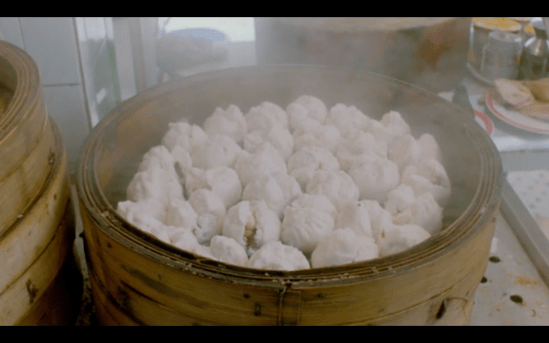
Wong Chi-hang brutally beats and sets fire to a fellow gambler who refuses to lend him money.  After destroying his identification card and creates a new look and identity, Wong flees Hong Kong before he can be hunted down for first degree murder and be served capital punishment for his crime.  For the last 8 years, Wong has lived and worked on the island village of Macau, running a small, but well-known, steamed bun restaurant, Eight Immortals Restaurant.  He receives inquisitive letters everyday asking about the whereabouts of the former owner, Cheng Lam, by Lam’s older brother on the mainland.  The letters force Wong to attempt manipulating lawyers into signing over the restaurant to him without Lam’s presence.  When the police discover dismembered limbs washed up on the beach, an investigation ensues that connects the body parts to a Chan Lai Chun, the mother-in-law to Cheng Lam, leading a small task force of blockheaded detectives to Wong’s restaurant where he becomes the prime suspect in the disappearances, but he won’t break so easily after being apprehended, unwilling to cooperate and confess to the whereabouts of the bodies of the vanished owner, his entire family, and a pair of workers.  Yet, what were exactly in those steam buns that made them so delicious?

Full disclosure.  I’m not too terribly familiar with Hong Kong’s rating system of Category I, II, and III, but I’ve more-or-less dabbled in the Category III (Cat III) horror and exploitation cinematic market, owning only a handful of these gruesome-and-sexually gratifying guilty pleasure full of sex, violence, and taboo concepts of titles such as “Riki-Oh:  The Story of Ricky,”  “The Chinese Torture Chamber,” and “Three…Extremes” and only “The Story of Ricky” has ever been popped into my player for recreational viewing.  Also, in my collection, is a Tai Sing DVD copy of Herman Yau’s 1993 crime-and-cannibalism graphic thriller “The Untold Story” and, frankly, I never opened it either, but when Unearthed Films sent me their new Blu-ray release to review, I’ll never be able to see chop sticks the same way again!  The eye-opening experience also screamed that I should definitely rip open and see those other films to quench my thirst for Cat III’s offensive opulence.  Based off a true story of the Eight Immortals Restaurant murders in 1985 around the Macau area, the nearly unwavering from the truth storyline parallels the Kam-Fai Law (“Dr. Lamb”) and Wing-Kin Lau (“Taxi Hunter”) co-written story in which a madman slaughters an entire family over a gambling dispute and runs their family business, the Eight Immortals Restaurant, until the police capture him, but Yau sticks more sensationalism to the already brutal notoriety surrounding the actual case with ground human barbecue steamed buns to tease with abhorrent flavor under the Golden Sun Films Distribution distribution of the Uniden Investments and Kwan Hung Films production.

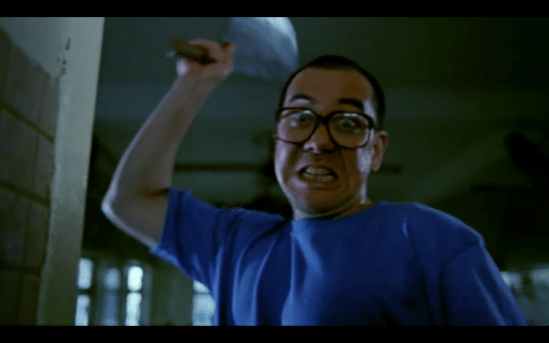
“The Untold Story’s” lead man in the shoes of the maniacal, rage-filled Wong Chi-Hang is “Ebola Syndrome’s” Anthony Wong who initially thought the script was greatly unattractive.  Little did he know that his performance would be so good, so osmosis with his wide-eyed lunatic stare through the luminating pixels of the television screen, that the role would honor him with a Hong Kong Film Award for best actor; Hong Kong’s equivalent to the best actor award for an Oscar in the States.   The “Hard Boiled” actor embodies a soul of frustration and anger to rise his character up to the demented level of nihilism and heartless exploitation that unforgettably scores being the face of “The Untold Story’s” cruelty.  Yet, there is a Jekyll and Hyde complex with Yau’s film that cuts the cynicism with a risible troupe of police officers supervised by Officer Lee (Danny Lee “The Killer”).  With a beautiful foreign woman, a blatantly announced hooker, always at his side and being the sharpest detective on the force, Lee’s a contradictory, authoritative commander meshing immoral principles and duty into one while leading a four-person squad of non-initiatives comprised of three rubbernecking men, craning their gulping jugulars toward Mr. Lee’s arm-candied gals, and one tomboy woman with an affinity for Mr. Lee who struggles with being taken seriously amongst her peers as an unenticing woman in cop’s clothing.  The officers’ western names are a slither of satire to poke fun at the nicknames of tough or macho cops go by in the States with Bo, King Kong, Robert, and Bull (respectively Emily Kwan, King-Kong Lam, Eric Kei, and Parkman Wong of “Dr. Lamb”).  The cast rounds out with Fui-On Shing and Julie Lee. 

“The Untold Story’s” embittered nihilistic violence, gratuitous rape and sodomy, and steamy, mouth-watering cannibalism leverages this Cat III film as tiptop horror exploitation from the far East.  If broken down more, director Herman Yau pins and sews together a liaising three act prong story of a horrid man’s attempt at deadly stability in society and a madcap group of officers, with a penchant for police brutality and coercing confessions, bumbling their way through clues that ultimately funnel into a blended third act of magnetizing the two sides together toward a satisfying, almost faithful, ending of “The Eight Immortals Restaurant:  The Untold Story’s” purloin and murder fiction and non-fiction exploit.  Yau spares no expense for gore, serving up a platter worth the splatter of some nifty chop’em up and grind their meat into the dough effects that’ll turn stomachs as well as heads and doesn’t exude as bargain basement quality; yet, just enough gore goes uncovered to tantalize without a full onslaught tarp covering the ground of disembodied limbs and floor-splattering entrails that boil down to an overshadowing character that detracts from the cast performances as such can accompany with the more extreme Asian horror catalogue.  There’s nothing gentle about the actions of Wong Chi-Hang, but the way he’s scribed to manifest spur of the moment carnage, stemmed by the most minute disputes, and the way Anthony Wong carries and maneuvers of a monstrous villain with ease takes an esthetical point to not stray away from his, or rather his victims’, story.  “The Untold Story” is, in fact, meta-exploitation fiction of non-fiction down to the very last tasty morsel. 

In what is perhaps the epitome of Hong Kong’s Category III film index, “The Untold Story” arrives onto high definition Blu-ray courtesy of the gore and shock genre label, Unearthed Films as part of the label’s Unearthed Classics line and distributed by MVDVisual. The well preserved, near flawless transfer is presented in a widescreen, 1.78:1 aspect ratio, and the picture is a vast improvement over the slightly washed previous DVD releases though favors a higher contrast resolution that ekes trading out the details for a brighter, softer film in an overall compliment of Cho Wai-Kee’s beaming cinematography. Whether in the police station or the restaurant, fluorescent lumens light up the scenes with a sterile-driven madness. The Cantonese, Mandarin, and some English 1.0 PCM audio track denotes, without surprise, the lossy quality doddering from age and antiquated equipment, but renders well enough without the imperfections of hisses, distortions, or any vocal impediments. The option English subtitles display without error with only the issue in their breakneck pacing when attempting to keep up with reading the subtitles and the rapidfire dialogue. You basically have to skim read. The special features include commentaries with star Anthony Wong and Herman Yau, the superbly dark and traditional film score isolated for audible pleasure, commentary with Art Ettinger from Ultra Violent magazine and Bruce Holecheck of Cinema Arcana, a Q&A with Herman Yau, a featurette of the history behind Category III films of Hong Kong Exploitation Cinema, a interview with Rick Baker entitled Cantonese Carnage, and Unearthed Film trailers. There’s also an two-page insert of Art Ettinger’s write up about Hong Kong cinema and “The Untold Story.” Resilient to the test of time, “The Untold Story” benchmarks a high point in High Kong exploitation cinema, recalls the tremendous feat of performance by Anthony Wong, and displays the sheer mastery of disciplined filmmaking from Herman Yau in this unforgettable gruesome black comedy.

Must Own Christmas Gift! “The Untold Story” on Blu-ray!

EVIL Doesn’t Care For Your Fame and Fortune! “The Lingering” review!


Young Dawa Wang and his mother live in a rundown mansion in 1980’s China. Dawa’s father labored in a wood factory over the course of a year, away from his family, and was supposed to return to celebrate in the New Year, but when he didn’t arrive, Dawa’s mother phones the factory to only find out that there was a landslide at the factory that drowned many of the workers. Not only does Dawa’s mother fear his father is dead, she suspects the house is haunted by his spirit on that very New Year’s Eve night. However, the presence was much more malevolent. Years later, Dawa, a young man, leaves home against his mother’s desperate wishes as their life of poverty drives him to seek solace in wealth, but when the news of his estranged mother’s demise, the now upcoming restaurant entrepreneur returns home to identify her body and to collect on a wealthy realtor offer on his childhood home. Dawa again comes face-to-face with the baleful presence, sparking the unravelling of a 30 year mystery.

Derrick Tao and Mak Ho Pong’s “The Lingering” is a Cantonese Hong Kong ghost story written by Edmond Wong {“Ip Man” franchise screenwriter) and the first penned worked by Zheng Dong. Originally titled “Ku Zak,” “The Lingering” marks a freshman film under the directorial duo of Pong and Tao who manage to scare up a rich atmospheric supernatural fright. Laced with Chinese traditions and catered to retain a more modernized kitsch, Tao and Pong have rendered great fluidity through the decades without the realization of a massive time gap between the two first and second acts; a relatively tough obstacle for any first time directors and the filmmakers manage to pull it off seemingly with ease and poise under Mandarin Motion Pictures productions, the company behind the money aggregating “Ip Man” flicks so there was money to toss at the ambitious auteurs.

“Keeper of Darkness” star Kai-Chung Cheung stars as the grown up and successful Dawa who salivates at the prospect of fame and with a lucrative restaurant franchise as his finger tips, Dawa will go as low to ignore his mother and sell her willed estate to further his prosperous image. Perfect for his role, Cheung challenges himself to be the arrogant and thoughtless whippersnapper many elderly quip about while they throw an angry fist in the air in some kind of protest. The character arch feels deserved with Dawa, going from a young innocent boy, to a bratty teen and young adult, to a successful and negligent son, and then reverting back to being the loving boy he once was; the stages were pleasant to behold and both performances, Cheung and the young child actor, did an excellent job at their respective roles. Cheung’s love interest counterpart is played by Anthena Chu, whose previous films included a couple of sequels, that must be mentioned here, were in the series realm of “Raped by an Angel.” Chu, a complete angel in “The Lingering” dons the role of Dawa’s well-off wife with well-off friends who offer well-off contracts to fund a well-off life for Dawa. While Anthena’s role is rather complimentary to Dawa that symbolizes poor and wealthy children can unite as one, her character flounders the rest of the way and becomes a hapless, if not second string, catalyst in Dawa’s rediscovery of love for his mother. Completing the cast around Cheung and Chu is Bob Yin-Pok Cheung, Fung Lee, Yao Tong, and Terry Zou.

From out the gate, “The Lingering” amps up the shadowy, spine-tingling specter action with an ominous roaming presence, a creepy kid, and a surplus of jump scares complete with an equal amount of braised pork dishes. The first act, set 30 years prior, is all about the pseudo scare with mounting music to, low-and-behind, nothing actually there to frighten the Cantonese out of you Westerners and, to give credit to Edmond Wong and Zheng Dong, a developing mystery enshrouds this mother and son of who exactly looms around the rustic Wang mansion. However, as the narrative progresses into Dawa’s older self, a man desperate to forget his roots, the mystery becomes a mystery more so when his family home becomes haunted by his own mother. At this point in the second act, “The Lingering” is up to two different spooks circulating the grounds like illuminating ghosts in Pac Man. By the third act, the whole haunt falls to pieces and an overwhelmingly forced theme is stuff down our throats about how us children should never forget about the sacrifices of our parents and how their love sustains them despite our affectionate inadequacies and equal rights – Dawa’s equal right to be rich – yeah, it’s a stretch, I know. The philosophy is sound but the execution irreverently chokes out the ghostly atmospherics in baffling fashion and a, for a comical effect, blue balls moment.

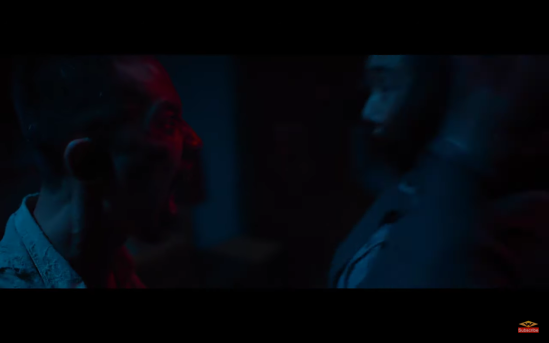
Sticking around on Blu-ray home video is “The Lingering” courtesy of Well Go USA Entertainment. The region A and widescreen, 16:9 aspect ratio, release teeters heavily on the tint scale with a over-saturating bluish hue, especially during night scenes or darker moments of plight, making defining the object in the mirror or in a brief photo capture difficult to define. Blue for sad as it’s saddening to lose a chunk of that goose bump atmosphere to over tinging. The Cantonese language 5.1 DTS-HD Master Audio is by far the reigning attribute of unfiltered bite tracks including a sparkly clear dialogue track, a formidable LFE score that’ll get the blood pressure up, and simple, yet effective, range and depth with the ghost house antics. Available are English subtitles that sync well, yet are more on the kindergarten-ish side of interpretation; almost as if audiences couldn’t comprehend comprehensive and/or complex sentence structures. Bonus features include the trailer and other Well Go USA Entertainment preview trailers. Clocking in at 87 minutes and more of an ode to parental sacrifices, “The Lingering” doesn’t stick around to neatly gift package to it’s audience an eloquent evil apparition feature as promised in the beginning that saw a 100 meter sprint into a tormenting zone that harrows a mother and son by a bloodied soul aimless in disposition, yet compelled to crucify the family.

[YOUTUBE=https://www.youtube.com/watch?v=AJhtkX0AyZI]

Own The Lingering on Blu-ray!

Meet the Evil Jade Executioner! “Red Nights” review!

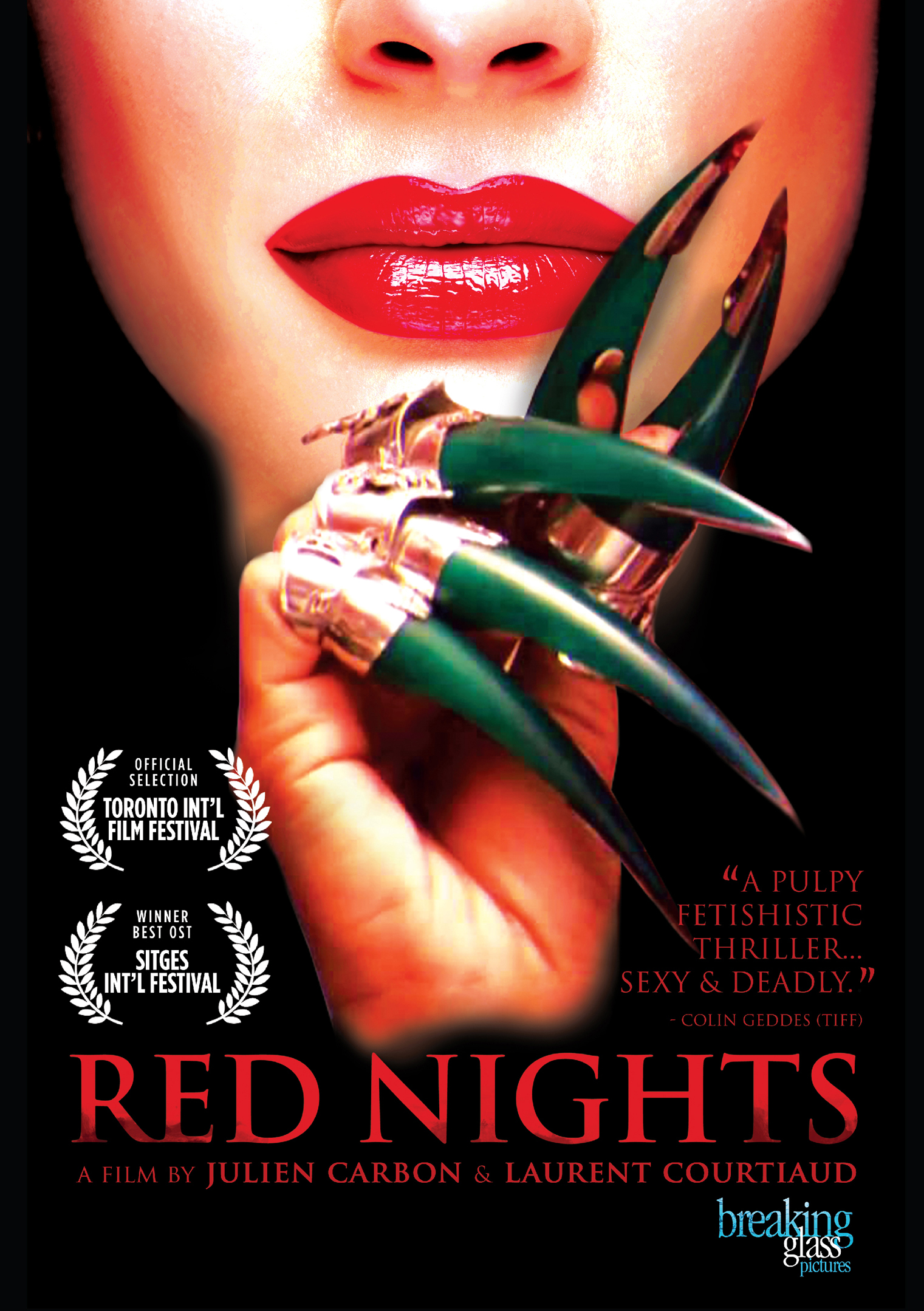
RedNights_SS_Front

“Red Nights” is not exactly a new film. Being released in 2010, the erotic, giallo-inspired, thriller has only been available for DVD purchase in the Belgium market while Germany has the sole blu-ray edition. With much anticipation, Philadelphia based company Breaking Glass Pictures will be bringing “Red Nights” to DVD in the States in all it’s suspenseful and bloody glory.

The ancient box of the Jade Executioner has become the fascination of everyone’s desires. From crooked politicians, to thieves, to sadomasochistic murderers, the box contains a poison that will increase your pleasure by ten fold while leaving you completely paralyzed and increase your pain by the same amount. This twisted tale with a sexual aura constructs a cat-and-mouse game between two femme fatales, Catherine – who just wants a giant pay day for the box and Carrie Chan – who wishes to use the poison for the ultimate pleasure from pain, while a Manau crime lord embarks on a mission to retrieve back his stolen antique box.
vlcsnap-2014-10-14-22h02m59s65
This is the first feature length film from French directors Laurent Courtiaud and Julien Carbon and while “Red Nights” looks beautiful on screen – the shot scenes remind me the Wachowski brother’s Noir film “Bound” – the story can be a bit loose and slow at first. The By the end of act one, “Red Nights” really pick up the pieces and the story of how Frédérique Bel’s character Catherine, a personal assistant to the crooked politician Savini, becomes snared in a web of deadly game with Carrie Chan – played by Hong Kong actress Carrie Ng – and in this game, minor players get a slow and painful death which translates very well to screen and relates very precisely to the character’s personas. Carrie is a sadist who can whip a dry martini while skinning you alive. Catherine is a bit more hesitant but her greed can force her hand to kill.
vlcsnap-2014-10-14-22h00m54s98
The gory effects are surprisingly realistic for a pair of visual effects crew members – Jam Abelanet and Bertrand Levallois – who don’t have much horror and thriller film credits behind their names. This goes hand and hand with how I described the first time directors and how the crew of “Red Nights” got it right the first time. Where the film lost me a many of times was the back and forth dialect of French, Chinese, and a little bit of English thrown in there for good measure. As much as I like a foreign film to use their native tongue, it’s hard to follow when a conversation between a Chinese actress who speaks in full Chinese and then the French actress retorts in full French. “Red Nights” would not make a good Rosetta Stone substitute.
vlcsnap-2014-10-14-22h02m08s71
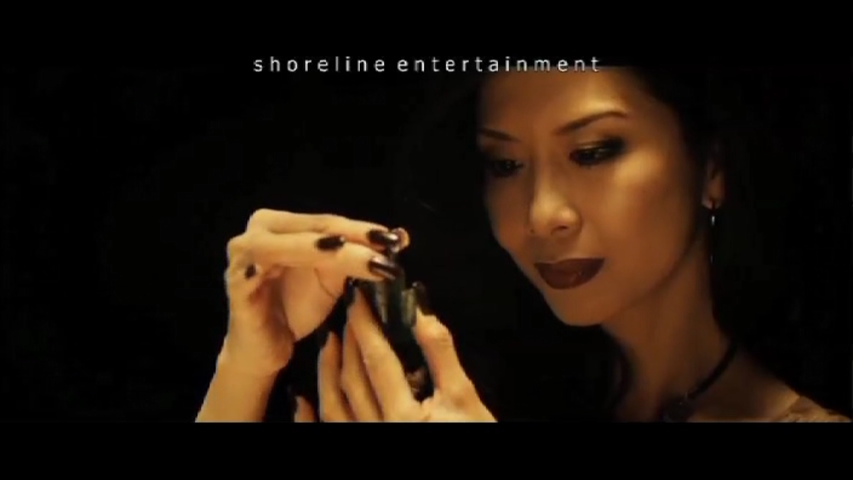
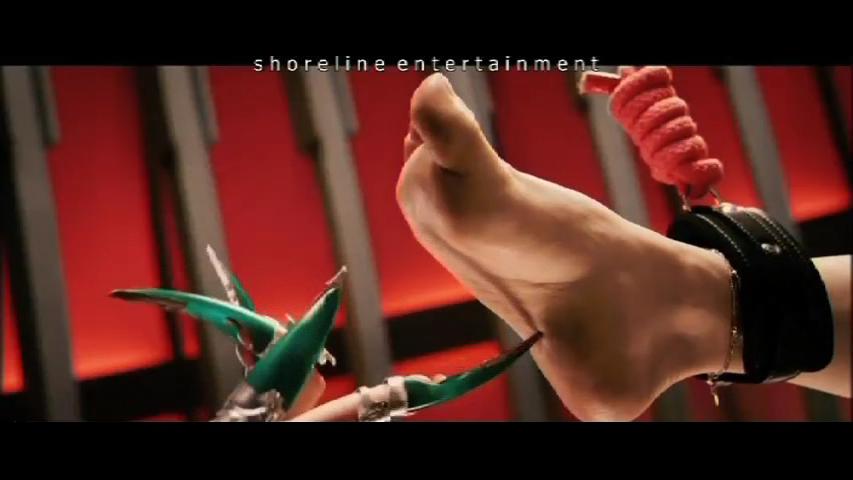
Carrie Ng creates a fascinating character in Carrie Chan, a respectable, world renowned perfume designer and model. Chan’s dark side involves tight leather, bondage ropes, and razor sharp metallic finger talons that shred skin like shredding a block of cheese. Carrie Ng is lustfully sleek and sexy with her bad girl image that suites her well. Frédérique Bel couldn’t compare to Ng’s prowlness nor clean good looks, but I have to give Bel credit for making her character Catherine a sneaky and aggressive go getter. Maybe the issue was in the script’s writing, but Catherine seemed to lack a lot of intelligence for being in a game that could cost her her life. Catherine trusted everyone too easily and let people go too quickly without any kind of punishment or pain.
vlcsnap-2014-10-14-22h00m22s28
While “Red Nights” won’t break the DVD retail shelf bank, I’m still glad Breaking Glass Pictures and Vicious Circle Films are releasing this foreign gem to the masses of ‘Merica. And while I appreciate every aspect of this film from the director’s inspiration of Giallo genre to the histories of Chinese folklore, I can’t see my country men going crazy over a Chinese girl with finger blades. However, the story for Carrie Chan might speak more to horror enthusiast in that the Jade Executioner’s poison is similar to the box in Hellraiser. The box is described to show you the pleasures of pain much like the poison in “Red Nights.” Lets also not forget that Japanese porn actress Kotone Amamlya and French actress Carole Brana do a bit of nudity as well – click to see my skin page here. Come Tuesday October 21st, DVD will be readily available for purchase, but why wait? Pre-order your copy of a unique thriller with hints of gruesome horror torture!