This Bundle of EVIL has a Dirty Diaper! “Baby Oopsie” reviewed! (Full Moon / Blu-ray)

“Baby Oopsie”  The Baddest Baby in Town on Blu-ray!

Who would have thought that playing with dolls could be deadly.  Sybil Pittman certainly didn’t think so as she hosts her internet streaming doll vlog showcasing her collection of pint sizes doll babies most of which Sybil has restored back to life…literally.  When a mysterious package arrives with the battered and stitched together head of Baby Oopsie, a severely bullied and neglected Sybil locks herself in the basement to work tirelessly on repairing Baby Oopsie’s head and mechanical body that includes, unbeknownst to Sybil, one special gear under a satanic spell to for collecting souls.   Baby Oopsie, the once pride and joy of Sybil’s restorations, has been resurrected from the toy junkyard and aims to claim the lives of Sybil’s tormentors to sustain it’s own diabolic animation.  When all of Sybil’s adversaries are eliminated, Baby Oopsie still requires lives to live and turns on Sybil’s friends and Sybil herself that becomes a battle to the death.

Full Moon knows how to run and market a good product that can last a lifetime and they continue to stroll through their finely tuned niche of deranged doll other pint-sized psychos to this very day with brand new produced features hitting the physical and streaming retain shelves in 2022.  Following the success of “Don’t Let Her In,” one of those new features aforementioned, is the return of the evilest rug rat known to infant kind, Baby Oopsie, from the “Demonic Toys” universe.  William Butler, who I fondly remember playing sweet country boy Tom being blown up and having his corpse feasted on in Tom Savini’s “Night of the Living Dead” remake, continues his long-standing tenure with Charles Band and Full Moon that began in 1986, under the Charles Band Empire Pictures company production and Stuart Gordon directed “From Beyond,” with a new written-and-directed feature “Baby Oopsie,” a concentrated, standalone spinoff of “Demonic Toys.”  This isn’t Butler’s first go-around with the go-go-ga-ga-gut your guts dolly as the filmmaker helmed “Demonic Toys 2:  Personal Demons” in 2010.  Charles Band and Butler produce the film with regular Full Moon executive producer Nick Blaskowski under the Full Moon Features in association with Candy Bar Productions.

Viral sensation the McRib Queen versus demonic toy Baby Oopsie. Stand up and character comedienne, Libbie Higgins, debuts in her first feature headlining role as Sybil Pittman, the repressed and intimidated vlogging doll queen living in abusive hell with tyrannical stepmother after the death of her beloved father. Higgins, who has an Onlyfans page for only $8 a month for all you obsessed fans out there, adorns a wig, glasses, and meme cat sweaters to get into the head of Pittman’s secluded world and where outsiders browbeat her into a reserved submission and wishful thinking only provides little comfort returning the hurt played out internal sadistic fantasies. For her breakout role, Higgins transcends her comedienne persona and into an anxiety-riddled outcast wretched by life’s punches and horror-struck by a doll that walks, talks, and kills like a macho-sadist. Before going head-to-head with the berserk Baby Oopsie (voiced by newcomer Jill Barlett), Sybil is caught between the devil and a saint with her brash, overbearing, stepmother played by Lynne Acton McPherson (“Improbus”) and the attentive and caring subletter played by Marilyn Bass, who tries very hard to be Full Moon sexy and skin-revealing without showing the camera too much. Her “best friend” Ray-Ray tips the scales toward believing in Sybil’s beauty and craft, befriending the doll queen despite her large radius of shunning those want to get closer to her, such as the mailman or the gardener, because of the depressive self-pity. Yet, Ray-Ray brings to the light and so does the actor who portrays the upbeat Hey Hunny sassy-mouth in TikTok and Youtuber influencer Justin Armistead. Armistead is magnetically chipper onscreen compared to Higgins story-obliged monotone placidness that balances out quite nicely the duo’s vanilla and peanut-butter-marshmallow swirl relationship. “Baby Oopsie” is full of character and characters, rounding out it’s smorgasbord of victims and supports with Diane Frankenhausen, Shamecka Nelson, Joseph Huebner, Michael O’Grady, Michael Carrino, Christopher J. Meigs, Tim Dorsey, and Josephine Bullock.

Set and filmed in Cleveland, Ohio at the proclaimed Full Moon estate, a 60’s-70’s anachronous house with many rooms becomes the playground setting for “Baby Oopsie,” the cast, and the crew. The location that reflects an era no longer modern, a dated obsoletism, to match Baby Oopsie’s classic and ideal bald-bald in a night gown form. However, normal Baby Oopsie also comes with that grotesque, malformed face that only a doll obsessed mother could love and would cause the toughest of horror fans to fear in their pants in on glance at the augmented representation of a human infant. It’s the creepy old doll look you definitely don’t want to see sitting in a dark corner blankly staring at you.  Of course, the special effects are not the classic Full Moon stop motion you see with the “Puppet Master” flicks as “Baby Oopsie” deals in tangibility with a bait and switch editing between the number of diverse molded Oopsie dolls created by special effects supervisor Greg Lightner (“Corona Zombies,” “Don’t Let Her In”) that include an open mouth and sneering face or a set of glowing eyes to provide a sense of evil.  Oopsie fits right into Sybil’s down on her luck story that is nicely compact and complete for an indie horror quietly but surely touches upon Sybil’s life in various key scenes, such as the gardener who hangs around because her father was much beloved or how much Sybil is despised at work between the dragooning, nitpicking, and strict boss and the snickering colleagues that look down at her.  Butler’s sweet-and-salty route delegates a fine line between her friends and foes that make the stakes clear when Oopsie decides impulsively to go off the bad-guy only rails. “Baby Oopsie” is far from cute and cuddly. “Baby Oopsie” is closer to being ugly and uncouth as the prime and pinnacle sequel of anthropomorphic toy horror in today’s Full Moon toy chest of films.

Spinoffs have become the new favorite amongst audiences, “Baby Oopsie” even pays a sideswiping jab to “Annabelle” of the “Conjuring” universe, and while we see a lot of spinoffs in television, the concepts and ideas are beginning to spill more frequently for filmgoing fans and, as such, “Baby Oopsie” is reborn onto her (or is it him? or it?) own Blu-ray home video from Full Moon Features. The region free, high-definition release, presented in a widescreen 1.78:1 aspect ratio, is the epitome of digital recording without much of a single critique or compression issue. Inundated with a more realism than stylism presence in front of the camera with the exception of a few edited in art renditions of satanic imagery, Butler and cinematographer Josh Apple apply a clean, high-resolution coating that undeniably very familiar to Full Moon’s repertoire. What’s also a motif straight out of Full Moon’s bag of goodies in the carnivalesque score. The Dolby Digital 5.1 surround soundtrack raises the volume on the Fred Rapoport and Rick Butler above a superseding level that swallows the English dialogue at times. You really want to absorb Jill Barlett’s vulgarities as Baby Oopsie but need to fight the soundtrack to do so during key moments when Oopsie’s profanity-laden Tourette like behavior kicks in. The release also comes with a second audio option with a Dolby digital 2.0 stereo. Bonus features include a behind-the-scenes featurette with cast and crew interviews on their experience making the film and poking fun at each other at times in a well-edited jest, a Videozone featurette that’s essentially a mini panel with producer Charles Band, director William Butler, and stars Libbie Higgins, Marilyn Bass, and Lynne Acton McPherson taking a break in the midst of filming to talk about their characters, to talk about the film itself, and for Band to plug his streaming service and new projects, there’s a mini-featurette All Dolled Up! that has Libbie Higgins in character, Justin Armistead self-recording in his bathroom, like on TikTok, and Baby Oopsie announce the winner and runner-up’s of a contest to win a Full Moon prize package. Bonus content rounds out with Full Moon trailers. The Blu-ray comes unrated, and feature has a runtime of 78 minutes. “Baby Oopsie” is not the addendum to the profane book of “Demonic Toys” but rather an extenuating chapter that opens the door for all the misfit and maniacal toys to one day have their own independent rampaging furtherance that are likely already drafted, budged, and ready to shoot at a moment’s notice.

“Baby Oopsie”  The Baddest Baby in Town on Blu-ray!

Caribbean EVIL is No Vacation. “Zombie Island Massacre” reviewed! (Troma Films / Blu-ray)

“Zombie Island Massacre” on Blu-ray here at Amazon.com

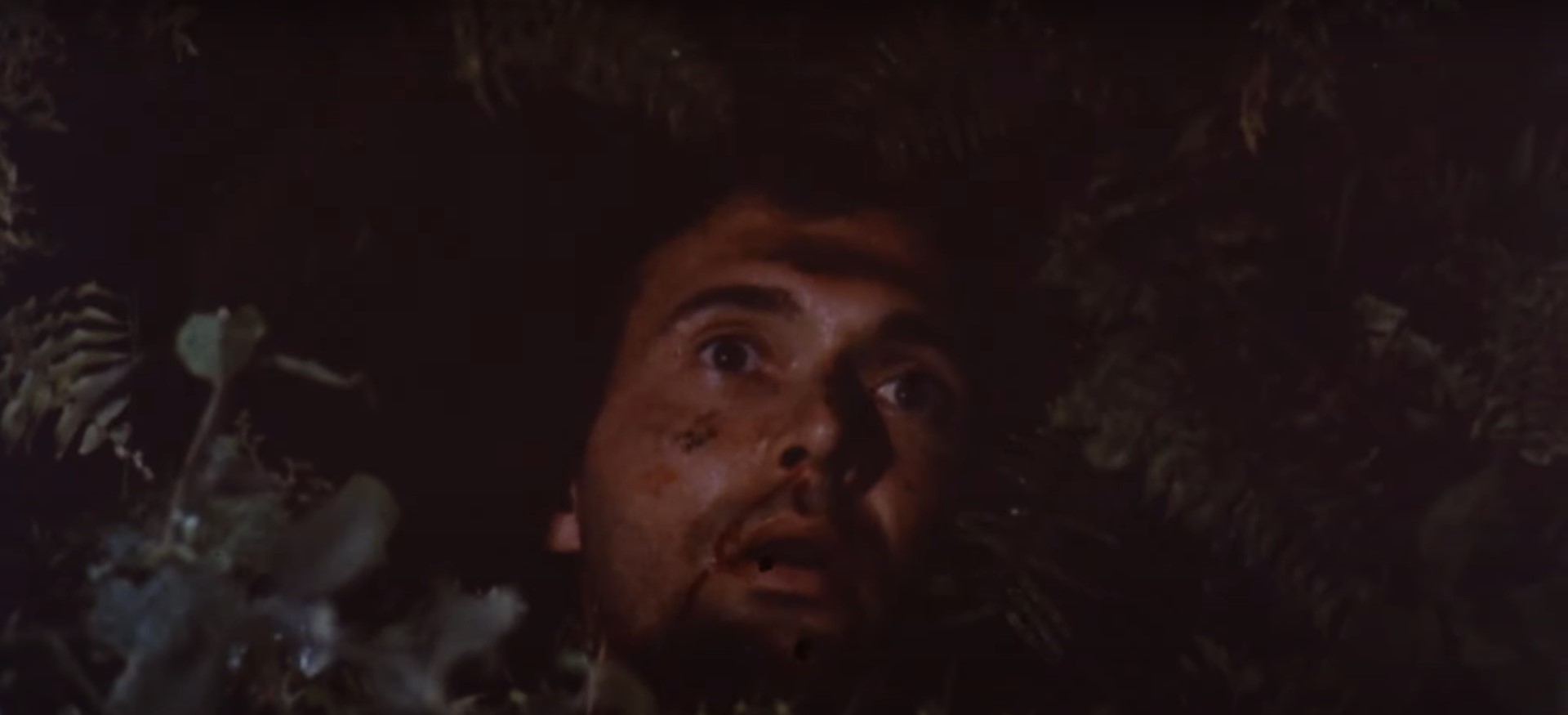
American vacationers in Jamaica book tickets to tour guide Chumlee Jones’s Sunshine Tours. Their destination is Santa Maria Island for a rarely seen religious voodoo ritual. After the unsettling experience involving live goat sacrifices and the necromancing of the dead, the tourists become stranded when the bus driver has vanished from his post. With no transportation to the seaport, a menace lurks amongst the darkness and is picking them off by-one-by. With no other options, the afeared excursionists trek through island thicket in search for a passed remote house but will they survive the perilous journey with an unseen murderous predator or predators camouflaged in the dense foliage?

Jamaica isn’t all about rum punch and ganja, mon. Voodoo is a big part of Jamaican culture. It’s so much a part of the Caribbean Island culture, the practice is a certified religion complete with voodoo priests and public ceremonies to exact a range of obeah spells – most for good, few for spiritual bedlam. For “Zombie Island Massacre,” a theme of mystic voodoo pitches the tale of two sides of every coin as the unknown and the usual differ from one’s own customs begins to swirl unnatural thoughts of fear, trepidation, and censure while other malevolent forces behind the veil may be at work. Also known under the working title of “The Last Picnic,” “Zombie Island Massacre,” a rather arbitrary and common structured title of choice, is the released Jamaican-shot inchmeal killer thriller from director John N. Carter, an industry editor with his one and only directorial credit to his name. The script is penned by Logan O’Neill and William Stoddard based off the O’Neill and David Broadnax concept story. Broadnax serves as producer alongside executive producers Abraham Dabdoub and Dennis Stephenson on a feature that undoubtedly was inspired by the 1982, George Romero influenced, Marion Girolami directed “Zombi Holocaust” in what is arguably influenced by title only as a marketing cash-in of the early 80’s Zombie success.

Stories that progress with a group of unfortunate souls trapped in a dire straits situation and there’s no way out but unwisely toward the path of danger in hope of salvation are some of my favorite types of threatening circumstances.  Think “Poseidon Adventure.”  Think “Predator.”  Think “Deep Rising.”  Any movie where a desperate group of diversified dog chow characters have to move from point A to point B without being swallowed by the darkness around them is great fun in its pick off pattern.  Archetypes of this linear lap through hell can be fairly conventional with its persona of characters where you have the strong hero type, the gorgeous level-headed love interest, the angry shmuck, the slower-downer, and there might even be a cultural token character to round the group out plus a red-shirted body or two for good carnage measure.  By design, there’s a need for these stereotypes and “Zombie Island Massacre” has a hit-and-miss, middle-of-the-road batting average with its cast of characters, beginning with a shared lead man role for Tom Cantrell and David Broadnax.  With his idea for the story and serving as producer, it makes a lot of sense why Broadnax co-ops the lead as a lone wolf, tough as nails photojournalist.  Cantrell, on the other hand, is just another pretty tall boy who becomes more-or-less a babysitter of the group while Broadnax stays behind to leave directional notes for lag behinds and to keep the retirees company when their tickers go South in the heat of turmoil and walking uphill.  This turns the co-op into more of a dog and pony show where the pony just stands there and dog runs around doing most of the entertaining.   Diane Clayre Holub is Cantrell’s love interest as a painter on holiday in Jamaica and the character is more than just reasonable and a pretty face that comes unexpectedly apparent in the third act of attacks.  Broadnax, Cantrell, and Clayre do not bring the star power to “Zombie Island Massacre” and that trend continues with the fourth top billed Rita Jenrette who brings more than just her pretty face to the table too in more of a full-bodied contextualized kind of way who ends up sliding into, if not encroaching into, Clayre’s assigned love interest role without a lick of love.  “Zombie Island Massacre’s” cast fills out with Ian McMillan, Harriet Rawlings, Emmett Murphy, Bruce Sterman, Deborah Jason, Tom Fitzsimmons, Christopher Ferris, Kristina Marie Wetzel, Debbie Ewing, Dennis Stephenson, George Peters, and the “Ghostbusters II” “The Titanic Just Arrived”-guy Ralph Monaco. 

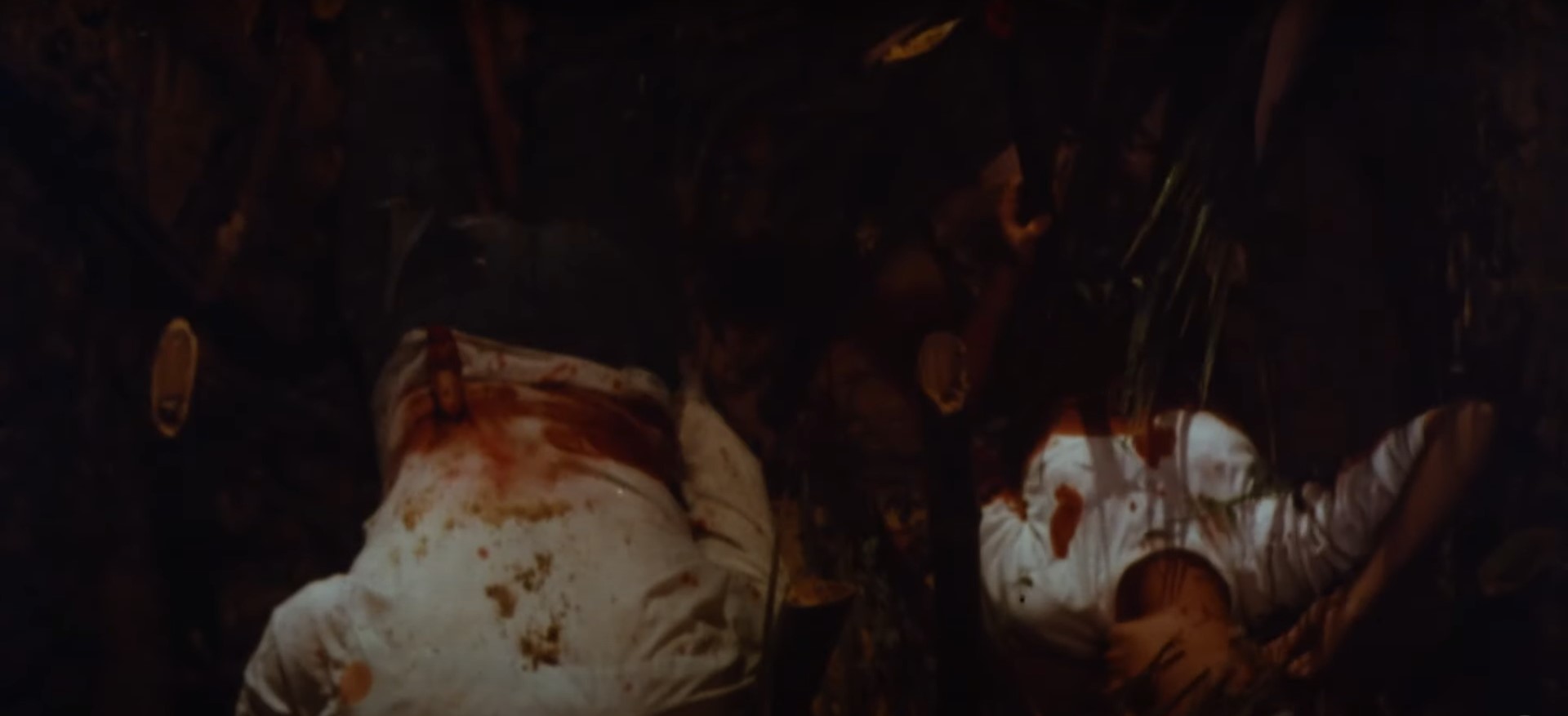
Big kudos to story creators David Broadnax and Logan O’Neill for delivering a narrative with an unpredictable twist that immerses you deep into the voodooist rituals and gets your blood pumped for the monikered title to deliver flesh-eating, blood-thirsty zombies only to be hoodwinked into a genre trap and a good one at that too.  Sneaky and subtle are the hints that not everything is what it seems on the island that hits you like a flashbang grenade when the truth is revealed, shocking the sensory system with a welcome voltage of sleight of hand.  I never saw it coming though I will say that the creature or creatures roaming the woods initially looked shoddy draped in blue trash bags with patchwork foliage sticking out but remaining relatively obscure from view that implored more of a slasher design than one of the undead one. However, “Zombie Island Massacre” is too by far a good film with precarious burlesques that result in a tacky feigning of thrills and chills hubbub. Only a handful of kills rendered a golden touch, such as the slow-motion bashing in of a man’s head with a large stick is effectively gruesome, but yet lots of the kills are done off screen and implied which can be a deficit for a slasher-like story that takes pleasure in and makes whoopee of the big bloody death scene. Some kills are even half-hearted in their execution. For example, one unlucky tourist has his head chopped off with a machete in slow-motion and audience has full view of the entire act; yet the machete snags on the initial slice point into the neck but the head still severs cleanly. The scene, likely needed to be done in one take, makes the cut…pun intended. “Zombie Island Massacre” wiggles peacockishly into the realm of island horror with a mawkish audacity but the wild pragmatic pivot is worth every second of humble hoodooism.

Lloyd Kaufman and Michael Herz presents a Troma team release with “Zombie Island Massacre” on a new region free, uncut, director’s cut Blu-ray. The HD 1.78:1 aspect presented John N. Carter film has favorable surface arrayal with natural grain off the 35mm film stock that comes with very little, yet still noticeable unobtrusively, vertical scratches and white dust specks. Skin hues appear natural, island bush backgrounds are lush despite some contrast issues deep into the background, and no blatant touchup enhancements awkward stand out, confirming that the transfer was in good shape to begin with and compression upon the BD25, churning out an average of 30Mbps, didn’t cause a technical gaff. The English language mirrors the Vinegar Syndrome release with a DTS-HD MA 2.0 and the audio isn’t as near flawlessly fortunate as the image transfer with voice trailing hissing and lots of noticeable crackling and white noise interference which can eat into the already soft and muted dialogue from time-to-time and downsize the details of audio clarity. Plenty of range of sound effects to go around in the story but the depth just isn’t there to elevate it. Harry Manfredini’s score is essentially a reworked composition of “Friday the 13th” and if you close your eyes and listen, you’ll nearly hear the ch ch ch, ha ha ah and have visions of a headless Mrs. Voorhees and a hockey mask stuck in your head. Special features are mostly Troma-related as expected with any Troma Team release. There’s Toxie and Uncle Lloyd smoking ganja introduction at the beginning of the feature. In sectionalized bonus menu option, the film’s theatrical trailer, a promo reel of all the kills under Harry Manfredini’s original “Friday the 13th” score, a 3-part special effects tutorial plucked from various Troma videos through the years, a super-short film “Blood Stab,” and other Troma feature trailers. “Zombie Island Massacre” is an excursion to remember lined and studded with Caribbean macabre that sink tapered teeth into the skin only to have just barely missed the pulsating vein for the kill.

“Zombie Island Massacre” on Blu-ray here at Amazon.com

EVIL Secluded is When EVIL is Most Dangerous. “Hellbender” reviewed! (Acorn International Media / DVD)

Izzy is sheltered from the outside world, living isolated with her mother in the Catskill mountains.  Izzy’s been told all her life that at a young age, she was diagnosed with an autoimmune disease that warrants her from staying away from people.  When a lost hiker stumbles upon Izzy, his friendliness and niceties inform her of his niece who lives nearby and is around the same age as Izzy.  the lonely teen, who spends most of her time rocking out with her mother in a two-person band, curiously ventures away from the safety of her home and meets the niece, Amber, a freethinker and free-spirit very opposite in comparison to Izzy’s protected life.  The interaction ignites a hidden family secret form within Izzy that ties her family lineage to witchcraft, revealing the true intentions of her mother’s overprotecting behavior and an unleashing growing pains of power coursing through Izzy’s thirst for independence. 

No cackling.  No broom.  No familiar black cat.  No pointy black hat.  “Hellbender” isn’t your typical witch and witchcraft reel of dark magic spells.  The family owned and operated, produced and crafted, feature film, released in 2021 and hailing straight from upper New York State’s Catskill mountains, is indie folk horror of coiled family complications in the coming-of-age aspect of a daughter finding herself outside the confines of mother’s safety net as well as the adverse effects on a child because helicopter parenting. “Hellbender” is a family affair as the writers and directors of the film are a nuclear family consisting of father – John Adams, mother – Toby Poser, and their daughter – Zelda Adams. The Adams family, as they like to punningly like to credit themselves, have collaborated, along with their oldest daughter, Lulu Adams, together since 2010 and released their first film, a drama feature from 2014 that was written and directed by John Adams and Toby Poser, known as “Rumblestrips” of essentially mother and daughters playing themselves going on one last RV trip before cannabis cultivating mom’s incarceration. Since then, the unstoppable family unit have been perfecting their craft on the indie circuit with short films, such as with the “Kid Kalifornia” shorts, and such as with their previous horror film, “The Deeper You Dig,” which became Zelda’s debut directorial. As their 6th feature film, “Hellbender” is clearly self-produced by the troupe, specifically Toby Poser who must control the family purse strings, and is a production of their own company, Wonder Wheel Productions.

Being right on the heels of watching “While We Sleep,” an Ukranian-U.S. demon-possession collaboration with an actual family playing a fictional one on screen, “Hellbender” doesn’t feel so terribly unique with its layered, dual roleplaying, but the performances in “Hellbender” are far superior with a richer, robust dynamic and better character progression that leads to terrifying results. Up in the principal forefront playing mother and daughter are mother and daughter, Toby Poser and Zelda Adams, who have made a sustainable and simple life for themselves on the mountainside.  Passing time by forming their own lo-fi garage punk band (tracks recorded and used from their actual band of the same title but with 6s replacing the Es – H6LLB6ND6R), Mother and Izzy entirely live off the land, avoiding strangers, and substituting meat for twigs and berries.  Poser and Adams deliver a real sense of kinship between a caring and shielding mother and a daughter naïve to the rest of the world in an allegorical sense of parents defending their children from the spoils of a loose culture.  Inevitably, an outsider opens the door that now can never be closed and one of two of those outsiders is played by father John Adams as lost hiker.  Subsequently, his presence spurs Izzy to another outsider which is played by Zelda’s sister Lulu Adams as the residential mountain neighbor and individualist Amber.  Zelda admires Amber’s cavalier gamut that includes accepting Zelda into her friendship circle without condition.  The feeling profoundly impacts and alters Zelda’s way of life, way of thinking, and grows the seedling of sorcery inside her.  Watch Zelda flow through Izzy’s blossoming arc is subtle, ambiguous, and slightly volatile – a frightening combination to the best degree.  “Hellbender” rounds out the cast with Rinzin Thonden, painter/model Khenzom Alling, Rob Figueroa, Shawn Wilson, Tess McKeegan, and adding one more Adams to the cast with John Adams Sr. in a cameo role.

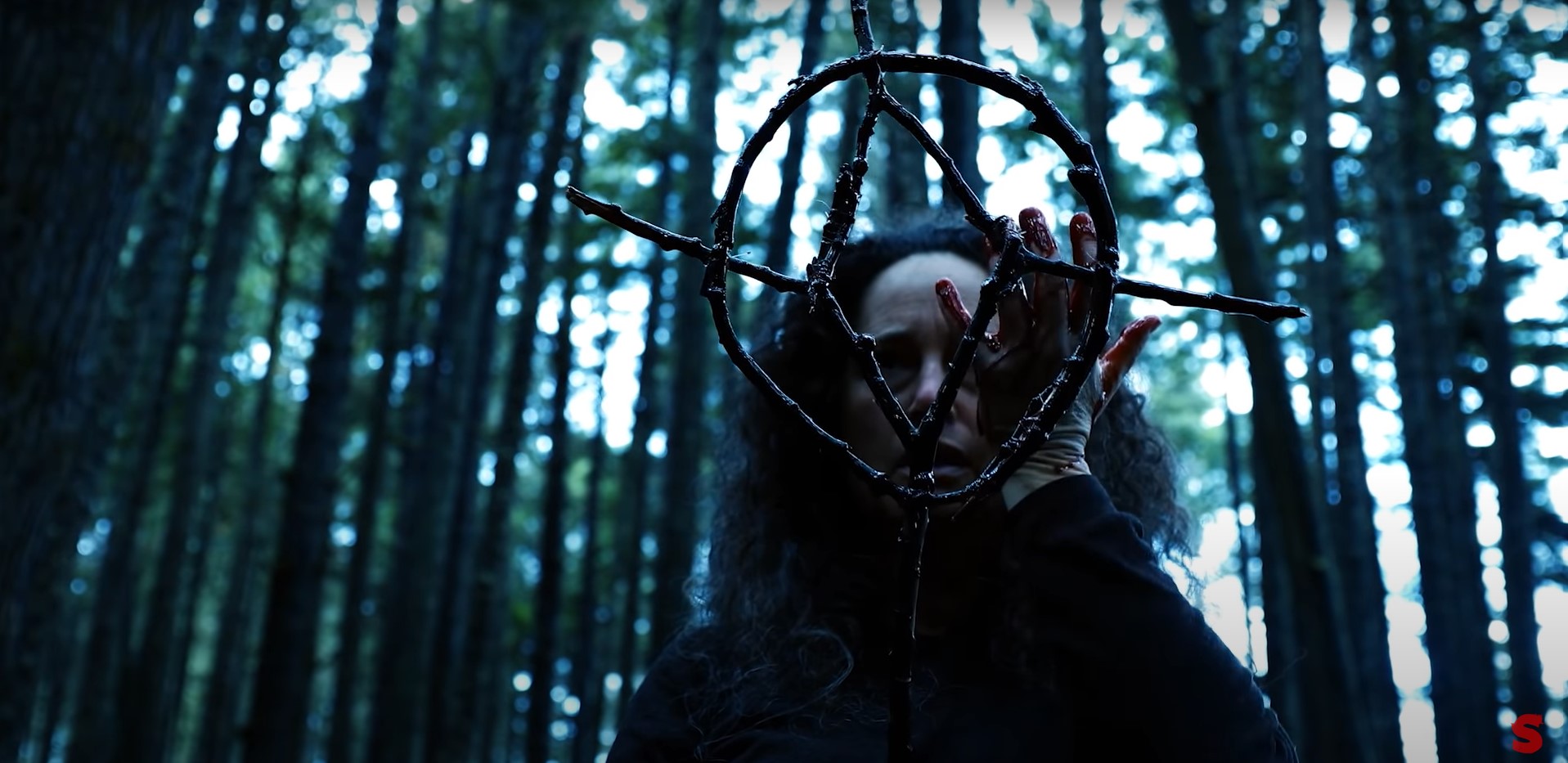
It’s been established that “Hellbender” is classic without being conventional but does that necessarily make the film worth watching.  The answer is resounding yes.  “Hellbender” has a spartan wit of etching out enough character-driven resolve balanced with soft-pedaled special effects around the spellcasters’ craft that’s intertwined more with nature. Their special blood mixed with twigs, berries, or leaves are the special recipe for conjuring charms and incantations and while the mother’s intent is to keep on a low profile and away from people, the teen daughter who was held back from who she really is, held back from her own life even, has been rewired as the monster with a spasmodic surliness seen through her deceivingly wide smile and chipper attitude. The love and psychopathy are a symbolic combination of a stereotypical tumultuous mother and daughter relationship stemmed from being two peas in a pod. The darkness within them yearns to be free and much like a teenage girl eager to spread her wings, Izzy tastes the power of individuality on her lips and develops an incognito ruse in learning more about her powers, her family history, and all her mothers’ secrets to be what all parents fear – to be replaced by their children. “Hellbender” has an immense sense of seeing our own mortality right before our eyes with the very presence of our children and as the idiom goes that knowledge is power, Izzy plans to learn the whole ins and outs of her true self. “Hellbender” never lets up and never doubts the story with implementing a charade within a charade to keep audiences on their toes up to the fiery finale point of no return after opening Pandora’s box.

The Yellow Viel Films distributed “Hellbender” is a witches’ brew unlike anything ever concocted in the genre and the Shudder Original film has a new UK DVD release from Acorn Media International. The region 2, PAL encoded, DVD is presented in a widescreen 1.85:1 aspect ratio, has a runtime of 83 minutes, and has a certified 15 rating for very strong language, strong bloody images, violence and threat. Running at a higher level DVD9 bitrate of 8-9 Mbps, the image presentation is phenomenal for the format with no compression issues and the visual details are seamless. Catskill mountains invoke a tactile dampness throughout, and the foliage enlivens with a primary green with good contrasts against the darker brown and forestry emerald shades. The English language Dolby Digital 5.1 surround sound also has little to complain about with a maxed-out output of 192kbps that provides an unsullied soundtrack to H6LLB6ND6R’s discography. Dialogue renders perfectly as well. The only flaw is with the ambient overlays that distinctly felt exaggerated to a fault. Even when Izzy is walking through the forest, the Foley had an extra 200% crunch underneath her feet being one among the examples. Bons features included a visual FX breakdown by FX artist Trey Linsdsay that goes over layer-by-layer the visual heavy effect scenes to see how they were created, a handful of blooper scenes, behind-the-scenes footage of the Adams family shooting scenes and testing lynched dummies, H6LLB6ND6R band music videos, travelling with Wonder Wheel productions, and a short, very short, slice of film of Zelda Adam’s alter ego, Eville Adams in an odd artificial scope. Unflinching folkloric horror with a pinch of overparenting gone awry, “Hellbender” is hell-spawn defiant and a perfect, LoFi witch film that isn’t a witch film.

Night Terrors Are Not EVIL Enough. “While We Sleep” reviewed! (VMI Releasing/ DVD)

“While We Sleep” available on DVD home video at Amazon.com!

Neurologist Nina Evanko is perplexed by the unusual CAT scans of 13-year-old Cora whose been suffering from sudden onset sleepwalking after her birthday party.  Believing the CAT scan is going through calibration issue with imaging process, Nina orders another set of scans, but when the scans produce the same result and a death of another patient right in front of Cora sends her home early before Nina’s arrival to study the results, Nina convinces Cora’s parents to an at-home sleep observation to root Cora’s sleepwalking cause.  What Nina finds is far more sinister than night terrors or any other kind of parasomnia as a demon has inhabited Cora’s body with nefarious intentions.  Cora’s only hope to save her soul is her bewildered parents, a rattled neurologist, and a rogue priest but a family secret may consume everything. 

If you’re still looking to support Ukraine during the now 6 plus months Russia invasion of their sovereign neighbor, why not support the Ukrainian-U.S. collaborative cinema?  Why not start more precisely with Andrzej Sekula’s 2021 child-possession thriller “While We Sleep” set in the Ukrainian capital and flagship city of Kiev.  Sekula, known more for his work with Quentin Tarantino as a cinematographer on “Reservoir Dogs” and “Pulp Fiction” as well as “American Psycho” and “Hackers,” has quietly and seldomly helmed a handful of films over the two decades with “Cube 2:  Hyperspace” being one of them.  “While We Sleep” returns Sekula to the director’s chair for the first time since 2006 with a script by Rich Bonat and the film’s supporting costar Brian Gross, the first feature script penned by the “Jack Frost 2:  Revenge of the Mutant Killer Snowman” and remake of “2001 Maniacs” actor.  “While We Sleep” is coproduced by American Brian Gross and Kiev-Los Angeles based CinemAday productions, which include company bigwigs Rich Ronat, Yuriy Karnovsky, and Yuriy Prylypko. 

While much of the story begins with Cora and her parents (real life family of husband Brian Gross, wife Jacy King, and daughter Lyra Irene Gross) cursed by Cora’s acute and disconcerting sleepwalking disorder and moody behavior, the daily battle to understand their predicament is not left in the out of their league but most lovable hands of the parents as the film leads you to believe.  Roughly half hour into the film, the narrative switches from the convincing family perspective, despite building background on their low-band relationship troubles and move it nearly 100% to Nina’s problem-solving perspective with a hint of her own troubled past.  Kiev born and “Stranger” actress Darya Tregubova plays the neurologist too curious to shrug off the mysterious case of Cora’s abnormal scans.  Tregubova is fetching without saying but she doesn’t provide the necessary emotional weight of person who’s going through grief and loss issues from the past.  Tregubova also doesn’t convey the necessary weight toward her strong connection to Cora and Cora’s case with only a few expositional moments that hint at such.  These aspects leave Nina outside the bubble of plot events that make the character stick out as unnecessary even more with the character’s negligent professionalism surrounding the wellbeing of Cora and with the parent interactions.  Once the story butts in randomly the blacklisted priest, Father Andrey (Oliver Trevena, “The Reckoning”), with an intimate familiarity with the demon that possess Cora, we know that the story is lost as it tries to quickly and covertly wrap its grip around how to come to a head with this storyline.  You can’t have a possession film without a priest, right?  Father Andrey feels very much like a leftover thought, but Trevena tries his darnedest to sell a washed-up man of the cloth with desperation pouring from word out his mouth despite looking like an English hooligan in a pop collared leather jacket. 

“While We Sleep” has not-so-brittle bones of demonism and possession albeit lacking its own or established cultural mythos, yet there’s a disjointed nature about the story structure and plot points that just don’t make sense that crumble that coherency faster than Cora descending into the depths of demonic disorder. The opening scene is the most perplexing of all with an elaborate birthday cake that neither mom nor dad had made or bought for Cora’s 13th year. Without a care in the world, mom and dad don’t explore further who could have possibly made such a beautiful cake and little do they know, the cake, or rather the cake’s candles, are a conduit for demonic transmission into the soul. This part is never explained through the rest of the picture and, in fact, Gross or Bonat don’t touch back upon a possibility of explaining the odious presence. Much of everything is taken a face value, such as the fact Cora cuts her long hair to a pixie style without an eyelash being bat or in what’s more crtical to the plot is with Cora’s real and darkly unholy father backstory. Those facts are a shot to the brain and we’re still not understanding where Cora’s biological father fits into Cora’s space, into her mother’s space, or even into Father Andrey’s space, but you would think as important as this twist was suddenly deluged in a quick spit of point-blank honesty, the edges would be smoothed over and the picture would become clear as the holy water that was cross was spritzed with; yet, that the aggregation of aggravation of little-to-no details continues to carry out as if everything is perfectly peachy and comprehendible within the story context.

From the at-home release distributor that delivered John Travolta as “The Fanatic,” VMI Releasing, a subsidiary of VMI WorldWide, releases “While We Sleep” on DVD home video. The clear snapper cased DVD, a MPEG-2 formatted DVD5, is presented in a widescreen 2.39:1 aspect ratio with an average speed bitrate of 4-5 Mbps. You can see noticeable banding issues in the darker bedroom scenes sporadically throughout. Aside from that, the picture result is fair with more than enough detail for viewing. The English-Ukranian soundtrack is not listed on the back cover, but my SEIKI player reads two audio options: a Dolby Digital 5.1 and a Dolby Digital dual channel 2.0. Discerning the difference between two is not worth the effort as there’s only subtleties in the output. The 5.1 surround sound has obvious better capacity for multi-channeling. Optional English subtitles are available but neither one of the audio tracks available nor the subtitles offer English captioning for the Ukranian dialogue and often times, there are back and forth exchanges that are intended to carry worth behind the exchange. The subtitles just state foreign language speaking which doesn’t help at all so there’s a bit of lost in translation in the dialogue unless you happen to speak or understand East Slavic languages. The 92-minute film comes unrated but doesn’t come with any bonus material as a feature only release. “While We Sleep” only nips at attempting to be a better than average “Exorcist” akin contemporary but remains on the haphazard course of shaky character building and bumpy, unpaved developments that make only for a rocky portrait of possession.

“While We Sleep” available on DVD home video at Amazon.com!


Taxi Driver by Day, EVIL Serial Killer by Night! “Dr. Lamb” reviewed! (Unearthed Films / Blu-ray)

“Dr. Lamb” is ready to operate.  See him in action on Blu-ray from Unearthed Films and MVD Visual!

Quiet as a boy verbally and physically abused by his stepmother yet laid to experience the adult perversities at the permission of his unconcerned father, Lam Gor-Yu, now as a man, is still quiet and still has unusual interests as an afterhours taxi driver.  Triggered by rainy nights when a torrent of verbal abuse by his female passengers send the usually reserved taxi driver into a homicidal fury, extending his lonely nights into straggling women, returning their bodies to his family homes, and video tapes his exploits within his fascination for amateur medical procedures.  When the police raid his family home after developed disturbing pictures were discovered at the local print shop, Lam’s entire family is hauled into questioning and it’s to Inspector Lee and his team to unearth exactly what transpired to the lifeless bodies seized by a notoriously sociopathic serial killer.

When you think of serial killers globally, Hong Kong isn’t the first place that comes to mind.  In fact, Hong Kong isn’t even a blip on the radar as the Pearl River Delta residence only has two known serial killers attributed to the city.  One of those killers is Lam Kor-wan – aka The Jars Murderer – aka the Rainy Night Butcher – who terrorized the then British territorialized Hong Kong in the early 80s, killing and post-mortem mutilating four young women.  La Kor-wan became the notorious inspirational material for the Danny Lee and Billy Tang (“Run and Kill”) co-directed Dr. Lamb that was released in 1992 and penned by Kam-Fai Law (“The Close Encounters of Vampire).  “The Killer’s” star Lee, who was more Chinese action star than filmmaker, developed the film, reluctantly at first, during the time when Hong Kong’s Category III classification rating was extending from solely high-end erotica and sleaze into extreme horror and thrillers.  Lee served as executive producer with Parkman Wong, who also worked alongside Danny Lee on “The Killer,” under Grand River Films Ltd.

To be portraying one of two Hong Kong’s serial killers feels like an unsurmountable responsibility burdening the actor’s shoulders in order to parallel the motivational intricacies and the mental mindset as accurate as possible knowing that the character can’t just blend into a vast serial killer fold where you can find multiple variations of John Wayne Gacy or Jeffrey Dahmer being grossly rendered for U.S. pop culture exploitation.  Yet, in steps in front of the camera Simon Yam, one of Hong Kong’s prolific action stars in the late 80s to early 90’s now stepping into the shoes of a real-life maniacal persona and relatively close to where all of Lam Kor-wan’s dirty-little-deeds took place.  Simon Yam could very well be the killer himself, that’s how brilliantly Yam’s performance is in what’s certainly a confident display of range in contrast within his acting opus.  Replacing a gun with a scalpel, Lee and Yam dig deep into the character’s psyche with an interpretation of why Lam Kor-wan did what he did and, frankly, Yam just went stoically wild to reach Lam’s staggering levels of crazy as he descends deeper into the retelling of his encounters with each victim. While “Dr Lamb” is a grim tale, there’s a comical side to it with the police force, supervised by Inspector Lee, played by Danny Lee himself in a duality position of cast and crew. More of the comic relief stems from Inspector Lee’s second-in-command, an experienced, yet overweight, cop who lets others handle his workload. Literally named Fat Bing, comedian and “Human Lanterns” actor Kent Cheng continues his whimsical routine in unvarnished subject matter revolving around separate bits and pieces of people’s tissue and organs for twisted pleasures. Collateral damage of Lam’s horrifying late-night exploratory surgery antics on women involve his family as they also become suspects. Lam’s father (Siu-Ming Lau, “A Chinese Ghost Story”) keeps his blinders on while the evidence piles only to be turned when his son’s transgressions include a minor family member does his own flesh and blood then cross a line of no return.

There are always two sides to every story. No, I’m not saying there are two repelling sides to The Rainy Night Butcher’s homicidal havoc. “Dr. Lamb,” as a film, has a dichotomy about it that’s half biographically true and grim while the other half is crime drama peppered with clownery. The combination is odd and equally as frustrating as the black tone of the historical background and the graphic nature of some authentical depicted acts of inhuman urges find their way weaved into the fabric of cavalier cop buffoonery who, on one hand, seem really good and really intense at their job while, on the other hand, lack the gumption for sobering behavior. Even when investigating Lam’s videotape (to which there is no way in Hell Lam videotaped that himself as the camera moves as he’s engrossed with necrophilia and removing body parts), the cops overact the disgust with what looks like chunky tuna being forced out of their mouth along the lines of appearing like vomit. The underplayed theme is anything but funny in its psychological context of misanthropy and misogyny. All of Lam’s scenes of cruelty are told in flashback through his perspective, molded by his undertone hate for women. “Dr. Lamb” is a misogynistic tale bred out of childhood abuse by a woman close to his family and unabashed and unattended by his lenient father’s lack of concern. Three out of the four women Lam taxis-to-taxidermy often verbally and physically assault him and plague his personal space with their awful behavior, setting a dial backwards in his battered brain that reminds him of the time his stepmother slapped him or forced him into a closet for hours. Is “Dr. Lamb” a Freudian lemma that Lam sees his ruthless stepmother in these women and turns on them to humiliate their corporeal existence? That’s a deep dive, but not as deep as “Dr. Lamb” cuts as a visceral experience based off of one of Hong Kong’s notorious serial killers.

Distributing in at number 8 on the spine of the Unearthed Films’ Unearthed Classics banner is “Dr. Lamb” on a new Blu-ray home video. The region A locked, AVC encoded, BD50 is slicked up with a 1080p high-definition upgrade presented in a widescreen 1.78:1 aspect ratio. As one of cinematographer Kin-Fai Mau’s first few pictures, the cool blue and misty has an interesting allure like a hazy bad dream subdued by an infusion of looking through blue glass with a prism of white light filtering through. Perhaps not as detailed as desired, the release does stand above the rest with low-level continuous speck blemishes that are only noticeable if you’re searching for them. Two audio options are available: a Cantonese LPCM 2.0 Mono and a Mandarin LPCM 2.0 Mono. Both tracks do come with well-sync and accurate English subtitles with the only downside is in their quick sojourning. There are a few instances where the subtitles pop up for literally a second as a result of quick nature of the dialect to get to the next set of text. While toggling between the two languages, my audio receptors really took to the Cantonese for a more natural flow and visually for unison between speech and speaking. The Mandarin is certainly more powerful but also too over-the-top as in watching I relate to watching old Japanese with English dub. The special features include an audio commentary by Ultra Violent’s Art Ettinger and Cinema Arcana’s Bruce Holecheck, a background interview about “Dr Lamb’s” genesis with the story producer Gilbert Po Lamb to the Slaughter, an interview with film critic James Mudge on the Golden Era of Cat III Three Times the Fear, a talking point conversation about “Dr Lamb” from film academic Sean Tierney, an Atomic TV interview with star Simon Yam, and trailers. The physical release itself comes with a 6-page, color booklet essay from cinema academic and author Calem Waddell (producer of “The Collingswood Story” and many horror-film related documentaries). A cardboard slipcover with one of the more provocative poster arts. Unearthed Films’ Blu-ray comes unrated with a runtime of 90 minutes. When perusing what to watch one night, be sure to hail down this cab of fact-based macabre driven by “Dr Lamb’s” psychological psychopathy and his pathologic urge for unnecessary medical procedures.

“Dr. Lamb” is ready to operate.  See him in action on Blu-ray from Unearthed Films and MVD Visual!