Timid sociopath Andrew patrons alone at a low-end bar, sipping delicately on straight whiskey and waiting for the perfect opportune moment to approach the right lonely woman. Andrew is not looking for a one night stand. Andrew is on the hunt for a victim, but when the night’s odds don’t seem to be in Andrew’s favor, a lovely young woman approaches him at the tail end of the night and begins to make small talk. After a night of coincided flirting, the woman seductively invites Andrew back to her motel room for some provocative foreplay, but before Andrew can move in for the kill, he suddenly realizes that the woman might just be as more of a sociopath than he could ever imagine by turning Andrew’s moment of a gratifying kill into her tragic tale of a more experienced and assured killer.

Suspense thriller “The Anatomy of Monsters” is the sophomore film from the multitalented writer-director Byron C. Miller and stars Tabitha Bastien, Jesse Lee Keeter, and Connor Marx in a twisted narrative involving love, death, and the struggle between the two. Miller, unfortunately, wrestles to keep buoyant the scope of his story contained as scenes teeter when holding an airtight structure as Bastien’s character, Sarah, asserts her mortal coil. Her plight doesn’t grasp the attention needed to draw in an audience; instead, the back and forth between her present plea with Andrew and her past of leading a double life of affliction with whether to act on her killer instinct with the love of her life or not either passively regresses or just stands completely in place, not moving a motivational inch to take the much needed mile in making us believe in Sarah’s tragic love story and the story is actually, well, tragic by not building the passion between Sarah and Nick, played coyly by Connor Marx, as they just hunker inside Nick’s quaint apartment, affixed to his bed or couch while contemplating their instantaneous love for each other.

A part of the film’s indelicate sting comes from Tabitha Bastien’s performance. Sarah, in the very definition of the character’s persona, is a sociopath which denotes a monotonous person to be without empathy, to have an ice cold demeanor, and to be calculating in their actions. While Bastien epitomizes a sizable amount of emotionlessness, her presentation leans a bit more toward being ingeniously staged, emitting a phoniness that doesn’t naturally crossover. If I didn’t know better, I would have guessed Bastien was a T-100 cybernetic organism underneath a flesh and blood outer layer from “The Terminator’s” apocalyptic bleak future. What Bastien does attribute very well to “The Anatomy of Monsters,” aside from her mechanical display, is a pair of piercingly bright eyes set upon a unique belle face akin to that of the nice looking girl next door you peeping tom on through the cracks of your window shades. Jesse Lee Keeter opposites Bastien with a more genuine approach that favors a Michael C. Hall similarity complete with a kill kit. Keeter’s Andrew is an example of well-written hesitation, exhibiting more of a killer’s struggle to maintain a low profile whereas Sarah leaves nothing to the imagination, baring it all out on the proverbial table with the extreme potency of egocentric cockiness.
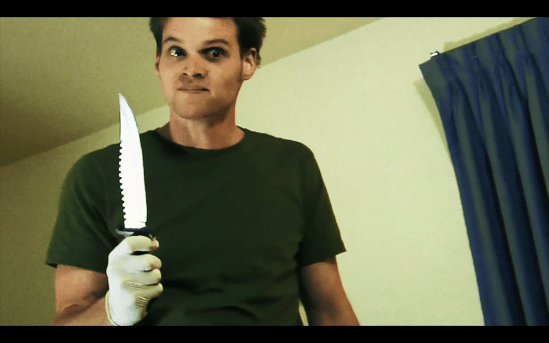
Along with Miller’s stationary script, the industrial rocker’s sporadic editing technique can be best described having a short-sighted attention span and his shaky handheld camera visually impairs the viewing pleasure of one monster’s monstrous thirst for death. “The Anatomy of Monsters” feature does play the role of being the quintessential independent product, but without stability and patience, Miller’s artistic craftsmanship suffers heavily from the technical aspects with really the only exception stemming from the minor gore scene during Andrew’s brief description of past murders, committing to a solid neck piece mock-up that realistically seeps blood in order to get the good throat slit shot.

A fond blend of John McNaughton’s “Henry: Portrait of a Serial Killer” and Showtime’s “Dexter,” “The Anatomy of Monsters” is slated for a DVD and Video on Demand release on November 15th from the Philadelphian distributor Artsploitation Films. Certainly a film that’s an attestant to an American-horror, Byron C. Miller explores the corners of the dark and deranged minds associated with serial killers while meddling through the conventional intimate affairs of the masses, spurring an atomically explosive situation from a slowly, simmering boil. Though technically unattractive with arguably underwhelming and sulky performances, suggestions of a greater notion leaves behind an everlasting scar tissue from the necessary urges and the unquenchable desires of a killer can be appreciated.
Tag Archives: Independent
Family’s First Night in an Evil House! “The Purging Hour” review!

Providing his dysfunctional family with new hope of rekindling, Bruce Diaz ditches the hectic grind of the city for the quiet surroundings of a mountainous Californian resort town. As they settle into their new abode, Bruce tries his hardest to piece together a shattered family. From his scared younger son Manny, to his angst-filled teenager daughter Kacie, to his distraught wife Jennifer, Bruce can only find solace in his daughter’s coasting through life boyfriend Mark. After the first 24 hours, nobody really knows what had happened to the Diaz family until an anonymous source leaks a distorted and violence recorded video tape from the dark corners of the world wide web. With new evidence at the table, a documentarian interviews family and friends of the Diaz family, local residents, and officials associated with the case in hopes to determine the whereabouts of the Diaz family that seemingly went through a violent disappearance and expose that disappearances like these can’t just be quickly covered up.

Vicious Apple Productions and Ruthless Studios add their entry amongst an overcrowded found footage market. More recently in the golden age of independent cinema, found footage films have incorporated faux interviews to add upon an artificial authenticity, but, in reality, these one-on-ones with the closest people to the victims just fill the voids to compensate for a lack of story and “The Purging Hour” plays right into that shortfall story mold. Director Emmanuel Sandoval’s sophomore 2015 feature leads into being a first time venture into horror for the young California director and Sandoval’s potential needs refinement from his also co-authored feature with Robert Trezza and Zaidal Obagi.

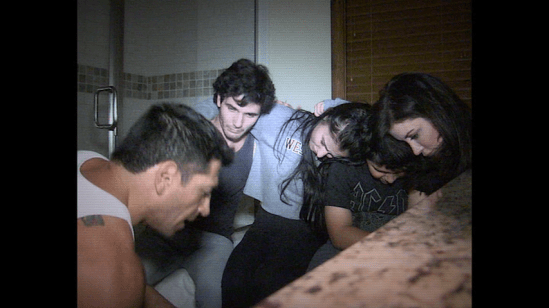
Developmental pacing puts the hurt on the story. I’m not sure how much more Steve Jacques moving of Bruce’s lowbrow attempt to lightheartedly get this family to bind together over this new home I could stomach. If I was Bruce with all of Jacques’ beefiness, not one smart and ugly remark from his ungrateful daughter Kacie would be taken lightly. Kacie’s family trampling is the biggest elephant in the room to the point that’s an exploited archetype in many independent projects. On top of Kacie’s entrenched battle with her family, she’s able to sustain a firm grip over her weak parents by letting her boyfriend Mark stay with them way after the move was completed. Through the muffled sidebar conversations, Mark’s fixture status amongst the family, and an unclear picture of a the family between their personas on the video tape and the their personas through the eyes of the interviewees, which creates a totally different family, speculations fly wildly toward the next steps into what happens next.

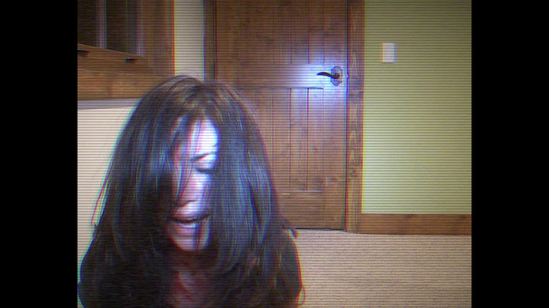
About a little over an hour after being subjected to interviews and multi fits of family bickering, Sandoval begins his HI-8 fright flight and thats where the director soars slightly by casting a muddled look into the family’s last known status. Purge, by the very definition, is to physically remove completely and “The Purging Hour” stays true to that moniker with one hour of purging and 23 hours of family turmoil and in the midst of that hour of purging, either a supernatural force or a violent bunch of heathens do the so said purge. One theory for the latter, a loose one at that, falls upon the introduction of a local resident spooking upon one of Kacie and Mark’s muddled conversations in the outside darkness. The local proceeds to explain that he’s meeting up with friends, which he does every year, and to do what, is not explained. Could this be part of a purging group? Perhaps, but there’s more of an malicious supernatural force at work upon the Diaz family that includes no physical body ever in the scene with the main characters who become main victims.

Ruthless Studios is the same production studio that also delivered “All Hallows Eve” and, frankly, nothing has tickled the distinctive quality from either film. “The Purging Hour” is a low end rental that fails to blend suspenseful drama with suspenseful thriller. Dabbled with touches of key fear elements that does not rendition a bold new of horror, “The Purging Hour” waits until the very last hour to divulge into the subject matter with anything prior to being a waste of reel. The MVDVisual distributed widescreen 1.78:1 presentation has great retro coloring through the purposefully installed Hi8 format while being clear, with little electronic interference, through the interviews and the 2.0 audio mix is muddle through the Hi8 experience, but should be cleaner for more subversive effect. No bonus material included on the static menu. The DVD cover makes you believe the film centers a supernatural entity with a dead cold hand with razor fingertips upon gnarled fingers grasping a door through the jamb. “The Purging Hour” raises too many questions to satisfy a complete and coherent story that relies too much on fake interviews to provide infamy amongst the characters and instead of letting the characters conjure a force reconstructed through their imbalance, an unknown entity, human or otherwise, randomly select their residence to even more obliterate their family coherency.
Exorcising Evil Takes a Toll. “Accidental Exorcist” review!

Unorthodox exorcist and hobby writer Richard Vanuk lives a depressing and humble life full of endless booze and filthy altruism. Driven by the need for alcohol and an underline desire to help possessed strangers for a small fee, Vanuk barely maintains his own sustainability. With each challenging case of demonic inhabitance, the poor full time exorcist, and part time writer, expels demons from their misfortunate hosts into his own wretched soul, draining his self-respecting humanity out of him one demon-expulsion job at a time. The deeper Vanuk spirals downward into nihilism and the deeper he goes into severe debt, the choice to withdrawal from the toll of exorcising demons becomes no longer an option, but a fruitlessly fateful venture to just surviving in a world that’s scarce of good people.

My second undertaking into a Daniel Falicki horror film has the “Awaken The Devil” director batting a solid hundred percent on the ever honest critique block, going a strong two-for-two with his latest film, 2016’s “Accidental Exorcist,” that’s drenched with a despair atmosphere that swallows the intentionally pathetic character who is granted only a glimmer of unattainable hope for a good life. The writer-director has a keen eye for developing horror in various comedic, dramatic, and absurdly berserk formatted segments, delicately defining details to capture memorable moments. Falicki also stars as his own character, Richard Vanuk, and Falicki charms the audience by creating a likable anti-protagonist whose cavalier about demonic possessions and begrudged by a “corporate” employer who pays very little for the precision of demon banishment; this same company performs a stigmata on him after every exhausting job, discarding his limp, unconscious body in a different snow covered park afterwards.

Falicki drowns Vanuk in vices and addictions. Aside from the obvious alcohol and constant inebriation, Vanuk needs the pain of performing exorcisms as much as he loathes the process and the people who employs him. The character can’t reform, can’t function properly in normality, as witnessed when his successful brother offers Richard a once-in-a-lifetime position at his mundane company of pigmentation for sports equipment. When the exorcism well runs dry, Vanuk goes into full blown, borderline psychotic detox as he’s cut off from his, one and only, natural born skill and the ceasing of his per diem position sends him into frantically gulping down bottles of cold medicine to get a soothing fix. Falicki punishes the audience beloved, unconventional exorcist by having Vanuk fall to the bottom by not being unlucky or plotted against, but by simply self destruction and having God turn his back on his loyal servant when the promise, or a test, of a favorable outlook reveals itself.

The casting couldn’t be much more perfect with a cast of talented b-movie stars such as Jason Roth (“Awaken The Devil”), Chris Kotcher, and Jeffrey Goodrich to quickly name a few. Falicki owns Richard Vanuk, embodying the character so brilliantly that I would have a hard time relinquishing Richard Vanuk from Daniel Falicki’s face. Falicki pulls out all the stops by putting every once of degradation the director can muster into the downtrodden exorcist with a performance that sells his hapless nature and spew-filled gigs. Every client Vanuk attends to is portrayed honestly and earnestly from Sherryl Despress’s role of a desperate mother turned possessed super sewer to Patrick Hendren’s blind and levitating demonic being who goes on to have a heart-to-heart with Vanuk after an exorcism recovery.

“Accidental Exorcist” is unapologetic and shameless; a real nasty bitch to love unconditionally. The fun soars above the summit and the ingrained heart bursts beyond the restrictive seams of the reel. The film is nothing I’ve ever scene before; yet, still manages to homage legendary films that “Accidental Exorcist” built it’s bones upon. Similarities to, of course, the iconic William Friedkin’s “The Exorcist” are apparent throughout with the almost beautifully grim and isolated atmospheric exterior scenes of foreboding destiny. Falicki’s film contains special effects so convincing by leaps and bounds when compared to other modern independent horror, portraying Vanuk so well within the confines of his dank and dejected existence that it’s as if he’s sharing his grime and his loneliness with us that’ll result with a quick shower when the credits roll.

Sector 5 Films and Rotomation Studios courtesy produces “Accidental Exorcist,” that’s not related to the Joshua Graham novel, but the audio and video will not be critically reviewed since I received and viewed a press screener and the film has yet to be released onto a home entertainment platform. However, make no mistake that “Accidental Exorcist” strides cockily into the first half of 2016 horror season, flying unnoticed, under the radar, as sleeper agent dangerous to demonic possession film competitors. Director Daniel Falicki is on the up and coming watch list like a high target terrorist, striking the heart of modern day horror and putting fear, and comedy, into a cynical cauldron.
Does Evil Go Incognito? “Sheep Skin” Review!

A four person punk rock band, known as The Dick-Punchers, kidnap an egotistical businessman named Todd because they suspect the white collar professional to be a vicious, man-eating werewolf. Confined to a chair in an abandoned warehouse, Todd is interrogated, threatened, and tortured to reveal his true beastly self, but as the night drags on, the band’s evidence weakens against Todd and tensions boil to a flare as the band’s leader, Schafer, starts to question their suspicions and motives. Doubts divide the band’s handling of the overwrought situation, especially when Todd’s wife tracks her husband’s phone to his exact location, hoping to catch him in an unfaithful act, but ends up becoming entangled in his internment.

Crafting a werewolf film on a microscopic budget is a daunting and difficult task to accomplish and having the resulting finish to be mediocre is a good achievement for any filmmaker whether working in the independent market or in the Hollywood limelight. Writer-director Kurtis Spieler found a conduit through the immensely barbed brier patch for his 2013 indie horror film “Sheep Skin” and came out relatively unscathed by the pricks. The ambitious werewolf flick was developed on the heels of his Spieler’s 2007 short film of the same title with actor Laurence Mullaney reprising his role of the kidnapped businessman, or maybe a werewolf in plain sight, Todd and with Nicholas Papazoglou returning as producer. With a little more backing behind Spieler’s Invasive Image production company, the director was able to recreate his short to a feature film on a reported $25,000 budget.

The budget amount surely gives a bit of hesitation when going into a viewing of “Sheep Skin,” but by cutting down location costs and maintaining afloat with the equipment already obtained, Spieler puts his heart and soul into the cast of gifted actors and a talented crew and into a story that’s nail-bitingly entertaining without the possibility of a werewolf ever making an appearance on screen. Along side the return of Laurence Mullaney, the relatively unknown Michael Schantz, who had a role in the Alistair Pitt episode of NBC’s popular espionage drama series “The Blacklist,” portrays Schafer, the vengeance seeking leader of The Dick-Punchers. Schantz’s rendition of the character is undeniably acute to the rampant emotions and stakes of kidnapping and holding Todd. Schafer’s band member and girlfriend, Dylan, portrayed by Ria Burns-Wilder finds an unwavering loyalty in her man. The two wild cards, Clive and Marcus, filled in fittingly by Zach Gillette and Bryan Manley Davis. Gillette and Davis play characters that contrast each other very strongly with Clive being more of a bruiser and a hot head looking forward to roid-rage mayhem while Marcus nervously questions his friends’ intentions if the situation goes south. Jamie Lyn Bagley is an It’s Bloggin’ Evil favorite (see our reviews for “Flesh for the Inferno,” “Sins of Dracula,” “Frankenstein’s Hungry Dead,” and “Future Justice“) and the upcoming scream queen becomes the last puzzle piece to a dynamic cast as Todd’s mistrusting wife.

The kidnapping portion of the story starts from the get-go, nabbing Todd as soon as he attempts to leave the office. After all introductions are completed and the plot is set, the pace slows down toward an uneventful position with characters vacillating. Schafer holds many sidebar conversations with his crew, as a good captain should always do, but makes for tedious anticipation instead of white knuckling action. The deceleration of content during this time doesn’t necessarily bore down the story as the characters react rightfully so due in part to Spieler intentionally incorporating doubt into The Dick-Punchers’ plan and when the snowball starts to roll downhill and the strain starts to disintegrate their plan and, ultimately, their friendship, “Sheep Skin” is a juggernaut of confined bloodletting.

Unearthed Films and MVDVisual courtesy releases Kurtis Speiler’s film onto DVD with a widescreen 2.35:1 aspect ratio that soaks in a noir style filter for a mysterious-horror atmosphere. The DVD offers an alternate black and white version of the film that’s preferable as the dark filter kept the image devoid of natural colors. Digital noise overtakes the brighter coloring in which DNR could have reduced the effect for a cleaner finish. The noise also affected the Dolby Digital 2.0 audio with a low lying hum throughout the background of the entire duration. Dialogue tracks levels vary heavily during calmer or character enclosed scenes while the soundtrack booms out LFE during abrupt moments. The DVD has a solid cache of extras including director’s commentary, deleted scene with director introduction, behind the scenes look at the making of “Sheep Skin,” the original short film, The Dick-Punchers music video, and the theatrical trailer. “Sheep Skin” isn’t an archaic werewolf tale, but a fresh suspenseful spin on lycanthrope mythos.
BUY “Sheep Skin” on DVD from Unearthed Films and MVDVisual at Amazon.com! Just clink on the above image.
Evil is a Long Trip Home. “Earthrise” review!

Earth has become an uninhabitable wasteland. The human race have resettled and colonized on the red planet of Mars. Years have past and the younger generation has never had the experience of living on Earth. Every year, a select few, those who pass multitudes of tests and reach the age of 30 years, will join the Revive Program and will travel through space on a seven day journey to Earth in order to aid in the planet’s rehabilitation of their once ancestry home. The journey between Mars and Earth is this story, a story of psychological perplexity between three travelers who get to go home for the first time.

“Earthrise” is the creation of writer-director-producer Glenn Payne, tackling the production limits of a space film in an independent market. Payne and his production team effectively generate the illusion of being a single speck in a vast universe without getting overly galactic (i.e. “Moon”) and widely interstellar (i.e. “Interstellar”). Yes, “Earthrise” embodies a minuscule budget that’s certainly evident, but the ambitiousness to recreate the innards of a spaceship without being too blatantly cheap gives creativity credit to the crew. The brief transitional moments outside the ship are about as good as money can afford, but still don’t quite cut the mustard with some big Hollywood blockbusters or even larger independent films.

Along with much of the crew, Payne’s experience mainly stems from a variety of short films with “Earthrise” being his latest full length feature out of a total of four. The three actors who portray the focus-centered characters also mostly come from a short film background. Meaghin Burke (“Trick or Treat” short), Casey Dillard (“Blackout” short), and Meaghin’s husband, Greg Earnest (also from “Trick or Treat”), portray the three protagonist Dawn, Vivian, and Marshall, voyaging to Earth. Within a non-linear story, their tensions cut through finely as an unexplained terror has overtaken, not only their flight to Earth, but their minds that visualize apparitions of people and creatures that shouldn’t be there. Giant spiders, man-eating alligators, alarming amounts of blood – just some of the psychological tensions testing the characters. Is it a form of space dementia? Or the inability to grasp leaving your home, your family, to live on another planet and not having the ability to contact anyone from home for a year, per the Revive Program’s policy? Or is it something else? “Earthrise” domes the answer fairly well until the end.

The sequence of events surround a near catastrophe involving a sudden meteor collision. One side of the collision tells the story prior to their insanely dangerous visions, building upon their backgrounds and delivering their soon obtained new found hope, while the other side explores their descent into madness and, eventually, the two stories meet in the middle with the major calamity. Contrasting the two sides defines, in a good light, director Glenn Payne’s editing style while still able to clearly convey the crews plight. Mise-en-scene clues were used to differentiate the catalyst, such as Marshall’s head wound or Vivian’s limp, but these details were minor enough to not pose an extravagance in order to make clear the outer edges of the story.

The 2014 sci-fi thriller is presented by Indie Rights Movies and MVD in a widescreen 2.35:1 aspect ratio. The details are richly sharp, drenched in a metal tone to create a ship’s inner hull racing through space atmosphere. The dual channel Dolby Digital mix is clear and balanced and purposefully isolating to get inside the loneliness of the great big infinite. Accompanying the 100 minute runtime, a couple extras include the film’s trailer and a commentary. Sci-fi on a budget, “Earthrise” is enjoyably subtle, sleekly structured, and soaked with heart and soul. Many will not be attracted to “Earthrise” and it’s slow-to-build momentum, leaving only true film aficionados and appreciators to find Payne’s work entertaining.