This EVIL is Why I Don’t Have a Roommate! “2DLK” reviewed! (Unearthed Films / Blu-ray)

“2LDK” Now Leasing a New Life on Blu-ray from Unearthed Films!

Rana and Nozomi couldn’t be more different coming from different backgrounds with antagonizing behaviors.  The two aspiring actresses live in a cozy two-bedroom apartment hosted by the same production company that has them vying for the same lead role in an upcoming feature film.  The role could jumpstart either of their careers and, internally, Rana and Nozomi believe the other isn’t good enough despite their different approaches in as city girl Rana uses her famine ways and laxer attitude to slut her way up to the top while the country-born Nozomi diligently studies the dialogue and the role to impress beyond her days as a parent-encouraged elementary stage actor.  When tensions rise through apartment sharing irksome nuisances and a man’s affections put an even more divisive wedge in the already gaping hole between them, Rana and Nozomi reach a breaking point and a violent melee of at each other’s throats ensues.

From my personal experience, the only roommate I’ve ever had was my wife during our engagement period and I can tell you that living with someone else – someone’s quirks, someone’s habits, and someone’s tastes – can be utterly earthshattering and explosive in what seems like every little pampered or established, taken for granted role you had living without a roommate is acutely upended and tossed into apocalyptic chaos.  Or, at least, that’s how it feels, right?  The sentiment is exactly perfectly and with killer instinct in Yukihiko Tsutsumi’s written-and-directed fight!-fight!-fight! film “2LDK.”  The 2003 Japanese movie helmed by the “12 Suicidal Teens” Tsutsumi co-wrote the script with Yuiki Miura, who of the last six years penned episodes of the recent various “Ultraman” series.  The 8-day shoot left no time to spare, leaving much of the cast and crew to shoot longer, sleepless nights, on “2LDK,” which in Japan shorthand describes the type of apartment – a 2-bedroom apartment with a Living room, Dining room, and Kitchen.  “2DLK” is a production of Micott, Times in, and DUEL Film Partners and is produced by Kazuki Manabe and Susumu Nakazawa.

When the central plot revolves around two aspiring actresses cohabiting a single living space and, literally, fighting over every inch of space, also literal as well as figural, there’s no room for more cast or even extras.  We’re first introduced to Eiko Koike (“Terra Farmers”) as Nozomi, a small province girl, reserved in manner, and extremely methodical to the point of obsessive.  Koike perfectly pitches Nozomi’s quiet but strong behavior, yet still judgmental about a roommate from the total opposite spectrum in Rana.  Played by Maho Nonami (“Scarecrow”), Rana’s a big city Tokyo girl with a jaded history.  Blunt, sleazy, and inconsiderate of apartment-sharing etiquette, Rana knows how to push Nozomi’s buttons – hard and on purpose with a innocent smile.  The story dives into differentiating Nozomi and Rana with an immediate internalizing of trash talking voiced over for the audience to see how Rana thinks Nozomi wearing high school gym clothes is hanging on to her humble origins whereas Nozomi itemizes every piece of Rana’s expensive accessories with a dollar amount.  Tensions slowly build from there and the actresses do a phenomenal slow burn into madness where the pot lid rockets to the sky when irritations hit the boing point summit.  Before you know it, electric-corded chainsaws are being wielded, spray cleaner bottoms are being spritzed into eyeballs, and eggs and toilet lids are being cracked over heads.   

“2LDK” is compact carnage, relatable dark fantasies of every roommate with a grudge against something thought their roomie did incorrectly or inconsiderately over and over again.  Other factors play into the two women’s meltdowns that provided fuel to the flame the burns with them in.  Rana struggles with the indirect suicidal death of a mother and child during her affair with the woman’s husband.  Nozomi bears the burden of forcedly shepherd to be the best whether to her studies or acting.  Not to forget to mention that both are in the running to be handpicked for a feature film role by the production company and there’s a man in the mix as an exploited chip against the other adoring roommate just to stick that knife into the side and twist for a little extra gut-wrenching spite.  Tsutsumi builds the seething hate, the tension, and the momentum that all comes crashing down in a Tsutsumi tsunami of cat fighting violence, weaponizing every inch of that small apartment from their individual bedrooms to the kitchen as a battleground.  Tsutsumi smartly doesn’t make “2LDK” a story about good versus evil as there are hardly any instances where the audiences will feel Rana nor Nozomi are in the wrong and wish their demise by virtuous-righteous other.  The bout is equally matched at their core and in scrappy ability to pick up whatever is lying around as a deadly weapon. 

Unearthed Films brings this one-on-one battle royale to an all-new Blu-ray release in association with Duel Film Partners and distributed by MVD Visual.  The perfectly paced and timed 70-minute film is presented in a widescreen 1.78:1 of AVC encoded 1080p high-definition transfer.  Image appearance is quite similar to another Unearthed Films Blu-ray release in “Tokyo Decadence” with a hefty grain product that be very discernible in blacker/darker areas of the image, suggesting maybe a celluloid film gauge that offer a pleasantly filmic presentation instead of a white-glove and sleekly fabricated digital video.  While colors don’t exactly pop, the texture is there surrounding skin pores and facial imperfections that shine in the details.  Unearthed Films presents two options with a Japanese 5.1 DTS-HD master audio and a 2.0 PCM stereo.  The multi-channel has a tad trouble discerning the inner voice overs between the two woman and never quite isolating their individual dialogues.  Some food for thought in case you decide to not pay attention to the movie and look at your phone as the dialogue courses through.  Some of the action came off with a bit of an echo but the overall soundtrack is robust with a clean and clear dialogue that comes with option English subtitles.  Extras include a commentary with actresses Maho Nnami and Eiko Koike with subtitles, a making of “2DLK,” interviews from the Tokyo International fantastic Film Festival, interviews from the premiere screening, production briefs on the duel between the roomies, a video message for theater audiences, interviews from the screening at Kudan Kaikan, and a photo still gallery.  Duel epitomizes “2LDK” exactly and only the Japanese know how to formulate a 70-minute comedy-action-thriller of two going toe-to-toe to the death.

“2LDK” Now Leasing a New Life on Blu-ray from Unearthed Films!

Sexual Asphyxiation is Just One of the Offered Services in EVIL’s Lavish S&M Prostitution Biz! “Tokyo Decadence” reviewed! (Unearthed Films / Blu-ray)


Own the new Unearthed Films Blu-ray of “Tokyo Decadeance” today!

Ai doesn’t believe she is not good at anything.  Her youth and beauty provide the early 20-year-old financial means of survival as a high class, Japanese prostitute with a fetish niche for clientele desiring sadism, masochism, or both.  Eccentrically demanding and various in age customers range their likes from total self-humiliation by pain and punishment to rape and necrophilia fantasies.  Unable to stop herself from accepting jobs because of her self-loathing cycle, Ai continues to endure most of the sexual whims no matter how outrageous or aggressive they may be during the sometimes hours long sessions.  What keeps her knocking on strangers’ doors is the pining for a former lover, a now famous celebrity she at one time dated pre-stardom, who has since married and left the memory of a fragile Ai in his life progressing wake.  After taking a gig alongside a fellow mistress in humiliating a real estate mogul like a dog, Ai’s invited back to the mistress’s elegant home where she’s exposed to a long night of unlabeled drugs that sends her into an uncontrollable high, looking for her former lover on the quiet streets of Japanese neighborhoods.

“Tokyo Decadence” makes “50 Shades of Gray” look like an inexperienced couple’s first time fumbling into cutesy foreplay.  Though both films are adapted literary works made into controversial features surrounding sultry nipple clips, whips, chains and other playthings, the 1992 Japanese psychosexual drama is the only one out of the two where the novel’s author, Ryu Murakami, has total creative control of his tale of one woman’s squirming through perversion land as the screenwriter and director.  Titled Topâzu in its originating country’s language, “Tokyo Decadence” opens up a carnalized world rarely seen amongst the daylighting fray and the price paying struggles of someone as meek as Ai in that position’s lustfully gripping vise that begs the question, is S&M obscurity an insatiable erotic hunger or is it a choking dangerous fantasy?  Shot mainly in the titular city of Tokyo, the film is a production of the JVD (Japan Video Distribution) with JVD’s Tadanobu Hirao (“High School Ghostbusters,” “Celluloid Nightmare”) as producer alongside Chosei Funahara, Yousuke Nagata, and Akiuh Suzuki.

“Tokyo Decadence” is a sure-fire way to start the beginnings of an actress’s career with a rousingly provocative and difficult role that garners attention.  For Miho Nikaido at the very start of her career, the lead role looked like a Tuesday.  The then 26-year-old Nikaido, playing a 22-year-old Ai, stuns as a sympathetically shy S&M prostitute with underlining conflicting issues surrounding her social position, personal interests, and mental status.  The opening scene with her legs lifted and spread strapped into stirrups and her bold colored red lipstick mouth buckled with a black open mouth gag complete with matching blindfold diverts eyes away from the usual nudity focal point.  Instead, we’re more attuned to the happenings of a mild manner, smiling man, who we assume bound her down under professional servicing, as he stands over her, gently stroking her, and telling her to trust him and that he won’t hurt her.  Then, out comes the drug pouch and needle.  The jab sends shock waves of pleasure down Ai’s submissively fastened naked body, ending with Ryu Murakami’s extreme close up on Nikaido’s face after being released from the facial constraints.  Her slightly crooked teeth shiver just past her stark red lips, agape by ecstasy, and the single tear drops from her soft eyes express the gargantuan amount of pleasure coursing through her helpless corporeal temple in a look that says, I am in pure, undiluted heaven.  The opening sets the tone.  Funny enough, Nikaido would go on to have a role in another underground S&M inspired drama “Going Under,” but instead of acting like the subservient dog or humiliating customers by having them suck on her stiletto heels, Nikaido steps aside as the girlfriend to Geno Lechner’s dominatrix role. Sayoko Amano, Tenmei Kano, and Masahiko Shimada co-star.

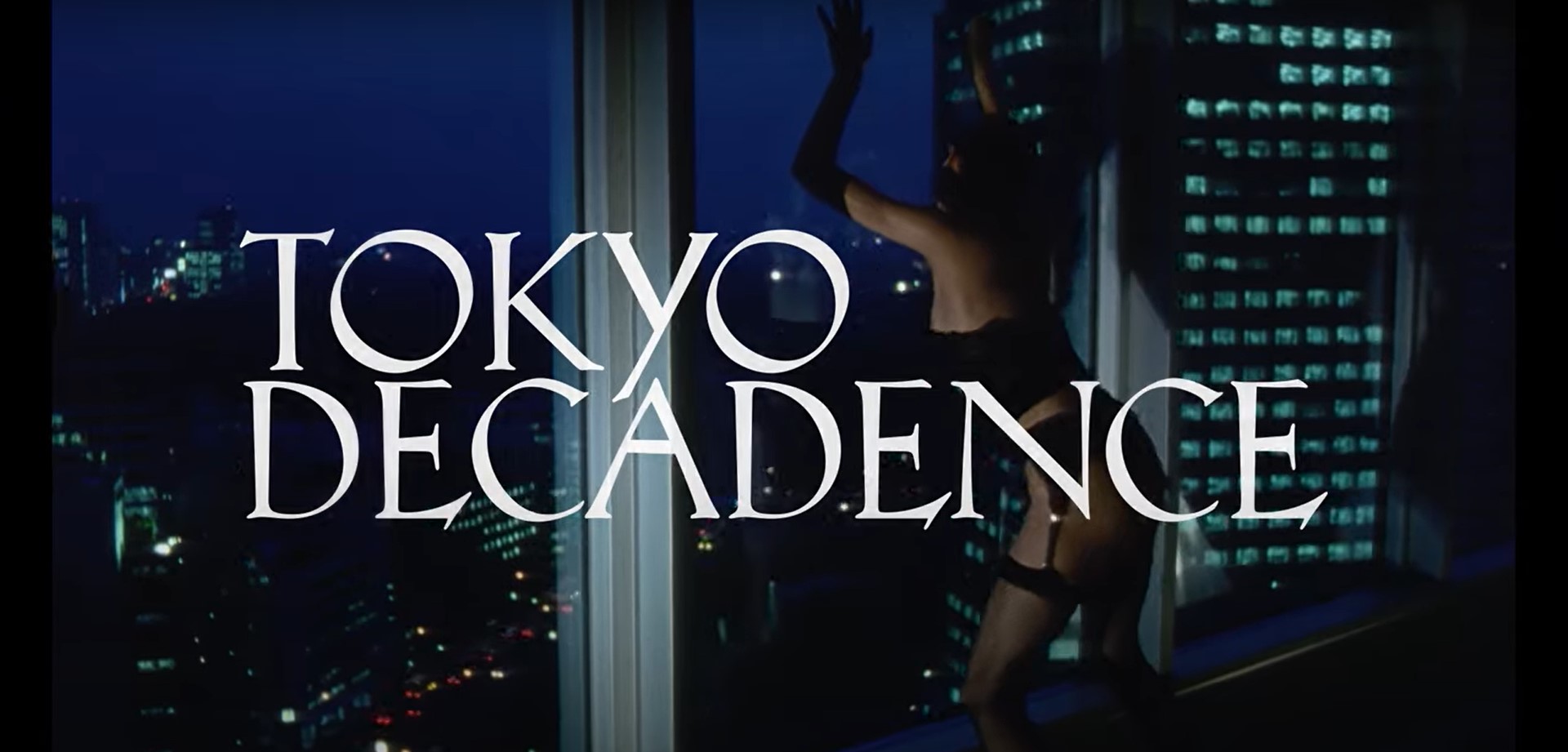
Perhaps one of the most noticeable or mainstream pink films from Japan because of its titillating and iconic cover art of Miho Nikaido arched forward and hands pressed high on the glass above her head, leaning against a tall and large window pane in a skimpy black lace and leather getup and overlooking the city lights and bustling residents,  The very image epitomizes erotica and taboo acts and the narrative itself is nothing short of that slight zing of sordid pleasure we all experience in our minds, bodies, and especially in our more private areas. Pulled straight from Ai’s first job encounter, post-opening credits, with a wealthy business type Mr. Satoh’s and his perversion in dominating and humiliating without much physically contact in the first few couple hours of their session. The long-standing stint pushes Ai’s sexual limits without breaking her spirit that solidifies a baseline for what’s to come and what came crushes Ai’s sexual stimulation beyond the means of pleasure with a petri dish of distinctive peculiarities outside her already fringed tastes. Ai’s self-dismissiveness keeps her plugging away at a profession that’s eating away her, coming close to death in many various forms involving clients’ perversions. When she’s hired by another mistress in a co-op of dominance on a client, an unveiling of empowerment and a lavish lifestyle promises potential happiness away from her fairytale dream of reconnecting with her former lover, but that ultimately becomes a hard pill to swallow after swallowing an unidentifiable pill popper provided by her newfound friend in the trade, a pill that inebriates her into wandering the streets in search for her ex-lover. “Toyko Decadence” is as somber as it is sexy with a paralleling dark trip down delusional happiness and demented fantasy for a young woman clinging onto a past that has completely forgotten her.

Landing in at number seven on the spine is the Unearthed Films release of Ryu Murakami’s “Tokyo Decadence,” receiving a Blu-ray release on the label’s Unearthed Classics line in a widescreen 1.66.1 aspect ratio. The region A release has a runtime of 112 minutes and is plainly evident in exhibiting no rating listed on neither the back of the Blu-ray case nor the cardboard slipcover. After doing some light digging, there is a longer cut of the film with more explicit scenes, especially with Mr. Satoh, that would have adorned the U.S. release with a X-rating. The Unearthed Films release is not that cut; nonetheless, the film before us is still just as decadently beautiful in content and in quality. Stable image and color under the 35mm stock, Tadashi Aoki flipflops between mood lighting and natural light, contrasting the duality of Ai’s worlds with a lightly softness reflecting off the focal subjects. Details extend the same softness as skin textures appear overly smooth most of the time albeit the design of natural color tones. One instance of continuation concern is a prominent scene miscut left in during post at the editing room table. Though the miscut, of a closeup on Miho Nikaido, doesn’t cause a continuity error in the narrative, it does break the integrity of the scene. The Japanese LPCM 2.0 mono sound has a phenomenal, 1920kps bitrate, sound design created around a lite soundtrack that doesn’t leave room for ambient and dialogue tracks to hide behind, as if this release needed to hide behind its brawny audio output. “Tokyo Decadence” is all about the experience and every breath and movement is as felt as it is heard with a discernible dialogue well synched with the English subtitles. An optional English dub track is also available. The Blu’s special features include a release-party featurette/promo trailer that has snippet interviews from the Ryu Murakami during the event, gallery stills, and trailers. An absolute ideal upgrade for one of the best pinksploitation films to ever walk that thin line between sadism and masochism; however, I do believe Unearthed Films insisted upon the safe word by not, whether by choice or other circumstances, retrieving, updating, and releasing the fully uncut and unedited “Toyko Decadence.”

Own the new Unearthed Films Blu-ray of “Tokyo Decadeance” today!

77-Minutes of Nonstop EVIL Combat! “Crazy Samurai: 400 vs 1” reviewed! (Well Go USA Entertainment / Blu-ray)

The Yoshioka clan has been dishonored by the death of two of their samurai warriors in an attack that has left the clan in desperate need for revenge.  Yoshioka clan’s sensei devises a plan to gather the clan’s best 100 samurai and 300 mercenaries and set an ambush for the one they call the crazy samurai, Musashi Miyamoto.  But Miyamoto strikes first, killing two Yoshioka clan members, sparking a torrent of warriors and mercenaries to besiege upon the crazy samurai and bombard him with attack.  The long sword combat stretches for over a hour as Miyamoto defends himself in an impossible task of standing alone while an entire clan’s army of swordsmen come at him from every angle, but Miyamoto is no ordinary master samurai, leaving the 400 to 1 odds in his favor. 

Journey back to Japan’s bushido era when honor and courage reign supreme during times of conflict and unrest with Yûji Shimomura’s nonstop, way of the sword, battle royale skirmish, “Crazy Samurai:  400 Vs 1.”   Originally titled “Crazy Samurai Musashi,” changed only for the home video release and on streaming platforms, the samurai film from Japan sticks out amongst the countless in the genre not for being filmed nearly a decade ago and finally receiving a theatrical and at-home release, but with a one particular, grand feature in being cinema’s first non-stop, one-take action shot for approx. 77-minutes, bookending between a story-functioning epilogue and prologue that clocks the film’s runtime at a total of 92 minutes from start to finish.  Shimomura, who directed the fantasy-action “Death Trance” in 2005 and the covert war drama “Re: Born,” helms a script penned by first timer Atsuki Tomori that bares little dialogue and even less plot to unreservedly place the juggernaut shot into the main spotlight.  The film is a production of the action enrapturing company, Uden Flameworks, based in Tokyo and with the North American streaming rights funded exclusively as a Hi-Yah! original film.

Reteaming with Yûji Shimomura in their third collaboration together following “Death Trance” and “Re: Born” if you follow each film’s sequential release date and if not following the release dates, then, more accurately, “Crazy Samurai:  400 vs 1” would be their second collaboration, Tak Sakaguchi, who cut his teeth in the cult favorite “Versus,” becomes a one-man show as the titular principal samurai, Musashi Miyamoto, slicing-and-dicing his way through a village horde of sword-wielding antagonists.  Kudos must be given to Sakaguchi with the stamina of a workhorse who carries the entire production on his back with a seamless performance without ever breaking stride, or taking a break for that matter, as you can see the sweat beading from his face and weariness in his eyes during the 77-minute long performance that takes a natural exhausting toll on his body, but the actor’s spirit to go on never breaks in any regards.  Sakaguchi fortitude for Musashi is unquestionable, but the backstory quivers at the knees with a character whose unable to be deciphered whether a hero or the villain.  The latter feels like the befitting choice as the plot begins with a Yoshioka clan ploy of arraigning a honorable duel between Musashi and the clan’s child prince after killing two of the dojo’s promising members in an act of defacing, but the ruse is an ambush to swarm Musashi upon arrival and execute him on sight.  Known for being a madman, Musashi comprehends Yoshioka’s deception and penetrates their defenses to immediately strike down the innocent child prince, who is only a pawn following council’s guide to be there, in the first blow that would set off a chain reaction of swordplay events.  Is Musashi that much of a cold-blooded lunatic to kill anyone, even children, and that is why he’s the villain who must be stopped by any means possible?  Or are the Yoshioka so dishonorable that Musashi will take on 400 or more well-armed men, and sacrifice one child, to slaughter them all for the sake of mankind?  Where Musashi motivations lie teeters into well after the credits roll, making the Crazy Samurai an enigmatic means to an unsatisfactory end.  Kento Yamazaki, Yôsuke Saitô, Akihiko Sai, Ben Hiura, and Fuka Hara round out the cast.

The possibilities of something going wrong is extremely high when attempting to film one long scene without breaks that include not only harmless slipups in choreography or dialogue, but also fatigue and risk of injury are likely to be greater.  Luckily for Tak Sakaguchi, and the production’s insurance company, there were enough water bottle and rest breaks strategically placed in between each pocket battle.  On the other side of the katana, the breaks frequent into improbability that there will be a full water bottle and a new sword just laying about in a Japanese village in the exact path of Musashi’s bore.  While most of the wardrobe and scenery feels authentic to the Edo-esque period and each actor puts in the effort to complete the scene, the unthought out choreography cheapens “Crazy Samurai’s” straight-gimmick concept by rotating out Musashi attackers who stumble off screen after being “killed” and rejoining the ranks on the backend.  More than once you’ll see the same faces go toe-to-toe with Musashi.  Rarely do the extras fall and lay dead at Musashi’s feet and only do so when the time at the present scuffle location comes to an end, but when the camera turns in a 360-motion around Sakaguchi, the bodies that had lain fallen previously where the fighting was held have now mysteriously disappeared. And the buck doesn’t stop there as Shimomura’s action film fails to impressive with the swordplay, outlandishly flaunts no blood other the visual effects spray in a blink-and-you-miss-it style, certain samurai have specialized wigs on to absorb Musashi’s signature Three Stooges-style bonk the enemy on the head move, obviously squaring off against more than 400 bodies, and, bluntly, the 77-minute runtime was tediously too long. You can also tell that the opening scene and ending scene were spliced into fold around the story’s trunk, probably shot years later from the original uncut scene, as we’re never able to connect the main characters from the opening and ending to the extended midsection in a slight of misdirection, obscure camera angles, and connecting only a pair of characters in act one and two.

Don’t be remiss to check out Yûji Shimomura’s see-it-to-believe-it “Crazy Samurai: 400 vs 1” on Blu-ray courtesy of Well Go USA Entertainment. Unrated, region A, and presented in a widescreen 16:9 aspect ratio, Well Go USA’s Hi-Yah! original film allures solely by the idea of the stunt, but hones in on two contrasting cinematic styles. The opening and ending scenes are consistent with conventional action flicks with fast edits, slow motion, and purpose with what’s seen in the scene whereas the midriff feels like a third person videogame that dodges and turns around Musashi, rarely taking the focus off him, and “Jaws in Japan’s” Yasutaka Nagano’s near entirely mobile steady-cam is quite an impressive feat considering the amount of moving objects in the frame, even capturing a manufactured lightning storm with rain while the camera then attaches to a boom for an areal shot; however, aside from the post-visual blood and embroidered sound effects, there was little touchup work done to polish the outwardly raw appearance. The Japanese language DTS-HD Master Audio is solid and holds up during the action though having barely much dialogue to play with during the fight. Ambient levels elevate a little louder above norm to put the sounds of a struggle right in your lap, or your ears, while the percussion of traditional Japanese instrumental, in the tune of war, plays erratic at times on the soundtrack. The Blu-ray is encased in a cardboard slipcover of the same illustrations and pictures as the snap case. Bonus material only includes the international and domestic trailers of the film. Yûji Shimomura and Tak Sakaguchi’s ambitious feat deserves a master stroke commendation for pulling off a historical and strenuous deluge of action, but “Crazy Samurai: 400 vs 1: fails to muster much more than that with threadbare editing and tip-toe choreography too dishonorable for the likes of feudal Japan.

Own or Rent “Crazy Samurai: 400 vs 1” on Blu-ray and Other Formats. Click to Poster to go to Amazon.com.

Chronicling the Cannibalistic, Necrophilism EVILs of a Serial Killer is for Adult Eyes Only! “LoveDump” reviewed! (A Baroque House / Digital Screener)

July, 2003 – a hollow-hearted serial killer, Denise Holmes, moves into a motel room of a populated metropolis of the West Coast.  Journaling every perverse and murder-lust desire in a diary, the unspeakable acts of sex and death blend together as one as the urge to kill grows bolder, leaving a trail of gore in the wake.  Paranoia begins to sink in after the last execution of an innocent victim and desecrating their bloodied, decapitated head in an inerasable moment from the mind. What you’re about to hear are the audio recordings of Denise Holmes’ diary inserts, read by Detective Jamie Reams whose giving a tactile voice to a wraith-like monster.

Over the years, the term Horror has been exploitatively glamourized for capital, trendsetting and bedazzled with glitzy gems of tamed teenager torment that sold the strung up, struck down, and sliced-and-diced adolescent carnage-fodder into each and every way the human brain can conceive with only a tweak of difference adorned with each ornate kill. Horror has also become garish with gorgeous women for the gratuitous donation of bare skin for the camera and the audiences to entice and gawk at the beauty in death. I’m not going to lie, I eat every millisecond of film of the good, the bad, and the ugly when it comes to horror, and, truthfully, horror has been making a strong stance in the last couple of years and I’ve been embracing the subtle tingling of mind game thrillers to the overtly ostentatious gore-soaked slaughterhouses of a genre with the broadest spectrum known to the cinematic universe. The filmmaker under the alias of SamHel pushes our tolerance for extreme content to the breaking point with the written-and-directed 2020 adult-fetish exploitation, “LoveDump,” an independent film from the USA under the production company, A Baroque House, that set out to pay homage to the graphic adult and fetish horror films of 1990s Japan.

The 33-minute short film only stars two performers in non-speaking, purely physical roles. First up, Wolvie Ironbear, an intersex non-binary adult content pansexual specializing in gothic and kink fetishisms, depicts the notorious necrophiliac serial killer, Denise Holmes, and Apricot Pitts, an unshaven fetishist whose also in the adult content creator realm, as a hapless prostitute who becomes a slayed statistic of sadism lured in by Holmes to greedily satisfy the nagging ghastly degeneracies. Most of the runtime runs with Ironbear licking at the chops, contemplating the next libidinous victim. Thick in the air is the sordidness moisture of solo self-gratification with unorthodox sex toys: a pig’s head, human blood, and other interesting, socially ignoble objects not fit to describe without dismantling in spoiler territory. Ironbear has to be a killer and a pretender, playing into a pretense that is a wolf in a sheep’s kinky-gimp clothing when Pitt’s prostitute steps into the motel room. Together, Pitts and Ironbear are electric, sexy, and give a damn good X-rated show of lust and macabre that turns the fever of carnality into a gruesome display of monomania participation.

“LoveDump” is not an attractive title, but suitable for unattractive content of desecrating the dead to the likes of Jörg Buttgereit’s “Nekromantik” and Marian Dora’s “Cannibal” while striving to be akin to Japan’s extreme horror like “Splatter: Naked Blood” or the notoriously sought after Guinea Pig films. “LoveDump” has an outrush of a snuff film that emanates a deep, dark secret club with elite memberships under pseudonym-ship in the producer and production departments. The makeup and special effects prompt disconcert of an upholding quality for an indie picture and, so much so, the affect of the human soul skin-crawlingly good that we can’t find ourselves looking away when the urge to be squeamish is strong. SamHel’s film digs niche graves that not everyone will have the courage enough to step into by choice. For myself, “LoveDump” is purely curious voyeurism, ingesting and digesting the film as an informational vessel of visceral paraphilias and without a solid plot to chew on, “LoveDump” is a straightforward stitch in time gorging more on graphic imagery than story and that is where the A Baroque House flick loses me to an extent.

Don’t expect palsied love-stricken hearts to be oozing with jubilee affections; instead, expect a romantic bloodbath of narcissism in a solo courtship like none other in SamHel’s ultra-gory “LoveDump” on a limited edition DVD and Blu-ray from A Baroque House. The camera work by the monikered Excessive Menace renders a SOV resemblance from the 90’s with a lot of unsteady handheld shooting as well as adjusting the clarity of focus, but the frames do flicker noticeably which can be a minor nuisance. Almost all the sex and gore scenes are in an extreme closeup the gives you an extreme eye feel for the commingling faux blood and real semen. One of my only gripes is with the angles in the intercourse with Apricot Pitts that didn’t translate over well without the proper focus and lighting to be as a graphic as possible. Since provided with a digital screener and the screener provided is a rough cut of the short film, there were no bonus material included, if there were any. The limited edition physical packaged Blu-ray will include the full HD uncut version of the film, a still gallery, a behind the scene making of, and trailer. I assume the LE DVD contains the same features, but are not specified. Be warned! “LoveDump” is not teeny-bopping horror filmed for any Joe Schmo to casually sit down to Netflix and chill with their partner, unless they’re into switch BDSM with an ichor fetish and, in that case, “LoveDump’s” an avant-garde aphrodisiac bred out of extreme and unwavering compulsions.

EVIL Does a Little Bathhouse Wet Work in “Melancholic” reviewed! (Third Window Films / Blu-ray Screener)

On nights when a humble Japanese bathhouse is supposed to be closed for business, the lights remain illuminated, gleaming off the crimson covered ceramic tiles of Mr. Azuma’s bathhouse floors as body’s soak in a pool of blood.  The proprietor, Mr. Azuma, is in severe financial debt to Yakuza boss Tanaka who turns his meager business into a nightly slaughter house to dispose of Yakuza opposition or those just on the syndicate’s bad side.  When Tokyo University graduate, Kazuhiko, applies for a job as an attendant to see a girl who regular attends the bathhouse, the reserved model employee becomes enthralled with the disposing and cleaning up of the corpses, working alongside a couple of professional hitmen, Matsumoto and Kodero, but when the job he’s so passionate about requires him to be more hands on with the assassination assignments and the endless pressure from the Yakuza bares down on his colleagues and friends, Kazuhiko’s radical plan to eradicate the woes of his newfangled position just might mean his very life. 

Seiji Tanaka’s self-esteem building and identity attaining crime drama, “Melancholic,” might not reside as absolute horror, but any film involving the Japanese Yakuza is an unpredictable, Machiavellian expo worthy of every second.  Originally titled in Japan as “Merankorikku” or “メランコリック,” writer-director Tanaka retains a bloody disposition of the historically violently depicted Yakuza-storied narrative, but is asymmetrical with a converging love affair, complementary conflicting the dark and light with clarity of the centric character’s unintended double life into the criminal enterprise of cleaning a bloody bathhouse.  Based off Seiji Tanaka’s short film of the same title, “Melancholic” mops up as an immersive black dramedy from Seiji Tanaka as the filmmaker’s first credited feature film produced by One Goose production in association with Uplink and JGMP.

The story concentrates most of the effort around Kazuhiko, a graduate of the prestigious Tokyo University who doesn’t have a good job and lives with his pampering parents, fitted by Yoji Minagawa as a social misfit living on the outskirts of the Japanese mantra of diligence and integrity.  Minagawa bores out Kazuhiko’s diffidence, chocking up his damp disposition to the indecisions toward his future, that forces other characters to influence his choices, such a former high school classmate in Yuri with an effervescent performance by “Tag’s” (“Riaru onigokko”) Mebuki Yoshida.  Yuri’s infectious affection for Kazuhiko and her regular attendance at the bathhouse encourages Kazuhiko to apply and become hired for a cleaning attendant position alongside a blonde, and undereducated in comparison, counterpart in Matsumoto (Yoshitomo Isozaki), but to Kazuhiko’s surprise, his overqualified ego is shattered when he discovers that the bathhouse is a Yakuza place of execution and those all around him are more experienced in that trade, detonating a plume of black comedy, work place haughtiness that Kazuhiko has to balance with his personal relationship growing with Yuri.  Most of the exchanges are straight forward and culturally inflection heavy, especially when dire moments rear their heads, but some more compassionate and delicate scenes rouse through the overt inflections with Minagawa and Yoshida at the helm of their blossoming onscreen romance, adding to the stark contrast to the opposing narrative. Stefanie Arianne, Makoto Hada, Yasuyuki Hamaya, Takanori Kamachi, Hiroko Shinkai, Masanobu Yada, Keiji Yamashita, and Yuti Okubo fill out “Melancholic’s” cast.

“Melancholic” is a rather odd title integrated into the briefly pensive struggles of Kazuhiko to an intrinsic network of assassination gunplay and backstabbing knavery, offering little profound sadness and despair and more shrewd hostility when those in charge ask for an inch but take a mile out of the personnel pool. For a Yakuza film, Tanaka’s bath and butcher story has barely a budget to entertain technical action sequences in tight spaces, but the action is kept taut and intense and despite the lack of a Yakuza presence, with only one single boss representing an entire faction, the transposing of Kazuhiko’s personal and professional stations washes away much of budgetary concerns down the drainpipe as an irresistible curiosity to see how our hero softly stumbles through a sudden confluence of the two repelling paths will play out. Most audiences will overlook the comedy for a countless reasons as “Melancholic” up plays into the satirical rigors of the Japanese sullen humor. The fact that that the subject matter is also about mercilessly murder people in a bathhouse will undoubtedly pigeonhole the film with pre-labeled genre. Tanaka slips in gallons of subdued irony ripe for the complex circumstances hazardous to all bathhouse employees and their pryingly oppressive management.

The award winning Japanese film (aggregated wins from multiple Eastern Asian film festivals) “Melancholic” arrives onto a dual format DVD/Blu-ray from UK distributor Third Window Films, a loyal provider of extreme Asian cult and horror. Since the Blu-ray was a screener, the A/V aspects won’t be reviewed in it’s entirety and the specifications weren’t provided with the screener. Ryô Takahashi’s cinematic vision brings out the beauty in simplification without being ostentatious with camera angles or relying heavily on tint boxes; yet, the blend of steady cam and handheld tilts to the one side with the jitteriness of the handheld seizing the stage. Bonus features were included on the screener, including a behind-the-scenes of a documentary-style shot look at moments before, during, and after takes, a Q and A panel with the cast and crew, and the “Melancholic” short film. Seiji Tanaka’s breakthrough bloodbath, “Melancholic,” sounds more despondent than the dismal thought of a cold shower on a freezing day, but the heated ferocity rite into adulthood keeps this Japanese dramedy warm with tension and cozy with vortex humor.v

Purchase “Melancholic” on Blu-ray / DVD!