Catalepsy EVIL Blended with Japanese Folklore! “Snow Woman” reviewed! (Darkside Releasing / Blu-ray)

Beware the “Snow Woman!”  She Just Might Just Leave You With the Cold Shoulder!  Amazon.com

Trekking up a mountain side are three male villagers hauling up a wooden casket.  Inside the casket is thought to be the malevolent Yuki Onna, the urban legendary beautiful snow woman spirit who roams the snowy landscape enticing men to their death.  Found seemingly dead and half naked amongst the village at the bottom of the mountain, this will mark the second trip up to the crag with her corpse that suddenly comes back to life.  Feared by the men, her casket is left abandoned and stranded atop of the icy, cold mountain yet the thing inside the casket isn’t a ghost, but rather a shunned woman, Yuki, with a thought supernatural evil power that’s actually a death-trance condition where her intense sexual climaxes render her unconscious and not breathing for long stretches of time.  Lodge owner Hyubei discovers her predicament firsthand after bedding the strange woman and the two use her condition to feign the killing of the “Snow Woman” when other persecuting-seeking male villagers coming calling for her head.

Many unusual, but still erotically stimulating, pink films have come across my desk for a professional review and for personal viewing.  Shintaro Sasazuka’s “Snow Woman” might be the goofiest, nonsensical one, and threadbare storied one yet.  Based off the Japanese folklore of Yuki-onna, various versions of Yuki-onna revolve around the freezing harm or death of children as well as succumbing those near the child to an icy grave.  For Sasazuka’s “Snow Woman,” the 2009 released adaptation follows more closely to the Ojiya region of Niigata Prefecture where a beautiful and mysterious woman sought out a man to marry for her own sensual desires only to dissipate into frozen droplets when forced into a bath.  While there’s no forced bathing in the film, the writer-director does pull inspiration of a woman immediately eager to please and marry the first man who doesn’t expel her permanently from companionship upon her climatic death-trance and is, in fact, more inexplicably inclined, aka an inkling of amorousness, to keep her around despite her unsettling disorder that locks their genitals together until she awakes from her stupor.  “Snow Woman” is produced by Takeyuki Morikakuo (writer of “Rika:  The Zombie Killer” and producer of “Legend of Siren XXX”) and is a production of the AMG vintage erotic catalogue.

“Tokyo Gore Police,” “Grotesque,” and JAV model actress Tsugumi Nagasawa stars in the folkloric titular role or Yuki. Nagasawa’s a bit all over the board, which is usually the case with all Japanese pink films, with her misjudged ghostly “Snow Woman” that loses all the pizazz when much of the mysticism is removed almost instantly when the immediate revelation of her sexual catatonic disorder renders her into a rigor mortis like state. Nagasawa doesn’t exactly sell the ethereal quality of the folklore of a presence able to float above sheets of snow without a trace left behind or burst into icicles surrounding heat. Yes, yes, I know pink films are strapped with very little cashflow, banking on the nudity and the bump-and-grind of exploiting popular and historical culture. Takishi (listed as Takashi on other platforms) Okabe opposites Nagasawa as the lonely lodger Nyubei who saves Yuki from an icy death by trying to charge her warmth and shelter. Okabe and Nagasawa fail to bring any kind of chemistry to the screen, romantically or sensually, that render themselves far short of saving this pink’s film vitality rebound on the home video market. The villagers who are seemingly more interested in destroying the Snow Woman as well as contemplating speculative conjecture on whether having intercourse with a monster is better than having intercourse with a woman who eats a lot is better. That whole section of the dialogue arc to the portrayed monster in the story, the Snow Woman, and when the virginal deft villager sees the Snow Woman for the first time, he immediately ravages her in a rape-eseque moment to prove no matter how monstrous she is he’s going to conquer by way of copulation. The other villagers round out with a cast in Takehisa Futagawa, Daisuke Tamaru, Horiken Fumio Yamamoto, Tetsu Teraoka, and Nami Uehara.

As mentioned, “Snow Woman” is considered a pinksploitation parody of a well-known folklore and as stated, the film’s financial support leaves much to be desired in the finish product to the point that there’s really not a story here to be told. Ostentatiously goofy without a morsel of A-for-effort lore or supernatural suspense to call a foundation, the struggle is inherently real to get through the entire film, a film that’s only approx. 1 hour long. The humor doesn’t stick and that would have flipped “Snow Woman” to a more advantageous experience coinciding with the one-on-one action that’s puts pink films on the erotica map. “Snow Woman” ultimately is a double flop on both fronts with the humor missing marks in its ultra-dry deliveries and miscued moments to the romping that’s not stimulating, titillating, or satisfying in the positioned choreography or character heterogeneity as a basic setup and cycle that inches toward only a chip of difference between the sexual scenes by adding the accompaniment of villagers with only the usual outcome results. The scenic views are actually pretty and breathtaking in see the snow-covered landscape with plenty of long and wide shots to capture Japan wilderness and while the location becomes only important in its aesthetic beauty, the b-roll footage never becomes important to the storyline as should with any Snow Woman themed media adaptation. I, personally, just wanted the characters to vamoose the lodge, or rather the overly large hut, that kept becoming the place of Yuki’s catalepsy trances because the location is the only interior location and gets old really quick.

For the first time, Shintara Sasazuka’s romantic-pink-comedy, “Snow Woman,” has a North American release from Darkside Releasing and distributed by MVD Visual. The region A coded Blu-ray release is an AVC encoded BD-R 25 presented in a widescreen 1.78:1 aspect ratio. There are two versions of “Snow Woman” available for viewing: the vintage version retains the Japanese orb of censorship around the nether regions and a newly restored version that basically means the removal of the those said orbs. Both transfers are identical in a clean and free from blemishes and damage eyesores. However, banding is a real issue that creates visible clear lines across a shade washed picture. The Japanese language Dolby Digital 2.0 soundtrack renders over quite well with discernable and clean dialogue, but the English subtitles are slightly out of synch and have at least one error that I saw. Special features include the original “Snow Woman” trailer, an erotic trailer reel that contains erotica and horror from select Italian productions, and a pink trailer reel that includes classic and modern pink films from PinkEiga. I guess in a world where pink films are outrageously perverse and can be downright sleazy and horrific, a necessity for balance would come in the form of goofy-romanticism and that’s what “Snow Woman” offers humbly by exemplifying passion and compassion as a cure for the mobbing disorderly and the ones with misunderstood disorders.

Beware the “Snow Woman!”  She Just Might Just Leave You With the Cold Shoulder!  Amazon.com

This EVIL is Why I Don’t Have a Roommate! “2DLK” reviewed! (Unearthed Films / Blu-ray)

“2LDK” Now Leasing a New Life on Blu-ray from Unearthed Films!

Rana and Nozomi couldn’t be more different coming from different backgrounds with antagonizing behaviors.  The two aspiring actresses live in a cozy two-bedroom apartment hosted by the same production company that has them vying for the same lead role in an upcoming feature film.  The role could jumpstart either of their careers and, internally, Rana and Nozomi believe the other isn’t good enough despite their different approaches in as city girl Rana uses her famine ways and laxer attitude to slut her way up to the top while the country-born Nozomi diligently studies the dialogue and the role to impress beyond her days as a parent-encouraged elementary stage actor.  When tensions rise through apartment sharing irksome nuisances and a man’s affections put an even more divisive wedge in the already gaping hole between them, Rana and Nozomi reach a breaking point and a violent melee of at each other’s throats ensues.

From my personal experience, the only roommate I’ve ever had was my wife during our engagement period and I can tell you that living with someone else – someone’s quirks, someone’s habits, and someone’s tastes – can be utterly earthshattering and explosive in what seems like every little pampered or established, taken for granted role you had living without a roommate is acutely upended and tossed into apocalyptic chaos.  Or, at least, that’s how it feels, right?  The sentiment is exactly perfectly and with killer instinct in Yukihiko Tsutsumi’s written-and-directed fight!-fight!-fight! film “2LDK.”  The 2003 Japanese movie helmed by the “12 Suicidal Teens” Tsutsumi co-wrote the script with Yuiki Miura, who of the last six years penned episodes of the recent various “Ultraman” series.  The 8-day shoot left no time to spare, leaving much of the cast and crew to shoot longer, sleepless nights, on “2LDK,” which in Japan shorthand describes the type of apartment – a 2-bedroom apartment with a Living room, Dining room, and Kitchen.  “2DLK” is a production of Micott, Times in, and DUEL Film Partners and is produced by Kazuki Manabe and Susumu Nakazawa.

When the central plot revolves around two aspiring actresses cohabiting a single living space and, literally, fighting over every inch of space, also literal as well as figural, there’s no room for more cast or even extras.  We’re first introduced to Eiko Koike (“Terra Farmers”) as Nozomi, a small province girl, reserved in manner, and extremely methodical to the point of obsessive.  Koike perfectly pitches Nozomi’s quiet but strong behavior, yet still judgmental about a roommate from the total opposite spectrum in Rana.  Played by Maho Nonami (“Scarecrow”), Rana’s a big city Tokyo girl with a jaded history.  Blunt, sleazy, and inconsiderate of apartment-sharing etiquette, Rana knows how to push Nozomi’s buttons – hard and on purpose with a innocent smile.  The story dives into differentiating Nozomi and Rana with an immediate internalizing of trash talking voiced over for the audience to see how Rana thinks Nozomi wearing high school gym clothes is hanging on to her humble origins whereas Nozomi itemizes every piece of Rana’s expensive accessories with a dollar amount.  Tensions slowly build from there and the actresses do a phenomenal slow burn into madness where the pot lid rockets to the sky when irritations hit the boing point summit.  Before you know it, electric-corded chainsaws are being wielded, spray cleaner bottoms are being spritzed into eyeballs, and eggs and toilet lids are being cracked over heads.   

“2LDK” is compact carnage, relatable dark fantasies of every roommate with a grudge against something thought their roomie did incorrectly or inconsiderately over and over again.  Other factors play into the two women’s meltdowns that provided fuel to the flame the burns with them in.  Rana struggles with the indirect suicidal death of a mother and child during her affair with the woman’s husband.  Nozomi bears the burden of forcedly shepherd to be the best whether to her studies or acting.  Not to forget to mention that both are in the running to be handpicked for a feature film role by the production company and there’s a man in the mix as an exploited chip against the other adoring roommate just to stick that knife into the side and twist for a little extra gut-wrenching spite.  Tsutsumi builds the seething hate, the tension, and the momentum that all comes crashing down in a Tsutsumi tsunami of cat fighting violence, weaponizing every inch of that small apartment from their individual bedrooms to the kitchen as a battleground.  Tsutsumi smartly doesn’t make “2LDK” a story about good versus evil as there are hardly any instances where the audiences will feel Rana nor Nozomi are in the wrong and wish their demise by virtuous-righteous other.  The bout is equally matched at their core and in scrappy ability to pick up whatever is lying around as a deadly weapon. 

Unearthed Films brings this one-on-one battle royale to an all-new Blu-ray release in association with Duel Film Partners and distributed by MVD Visual.  The perfectly paced and timed 70-minute film is presented in a widescreen 1.78:1 of AVC encoded 1080p high-definition transfer.  Image appearance is quite similar to another Unearthed Films Blu-ray release in “Tokyo Decadence” with a hefty grain product that be very discernible in blacker/darker areas of the image, suggesting maybe a celluloid film gauge that offer a pleasantly filmic presentation instead of a white-glove and sleekly fabricated digital video.  While colors don’t exactly pop, the texture is there surrounding skin pores and facial imperfections that shine in the details.  Unearthed Films presents two options with a Japanese 5.1 DTS-HD master audio and a 2.0 PCM stereo.  The multi-channel has a tad trouble discerning the inner voice overs between the two woman and never quite isolating their individual dialogues.  Some food for thought in case you decide to not pay attention to the movie and look at your phone as the dialogue courses through.  Some of the action came off with a bit of an echo but the overall soundtrack is robust with a clean and clear dialogue that comes with option English subtitles.  Extras include a commentary with actresses Maho Nnami and Eiko Koike with subtitles, a making of “2DLK,” interviews from the Tokyo International fantastic Film Festival, interviews from the premiere screening, production briefs on the duel between the roomies, a video message for theater audiences, interviews from the screening at Kudan Kaikan, and a photo still gallery.  Duel epitomizes “2LDK” exactly and only the Japanese know how to formulate a 70-minute comedy-action-thriller of two going toe-to-toe to the death.

“2LDK” Now Leasing a New Life on Blu-ray from Unearthed Films!

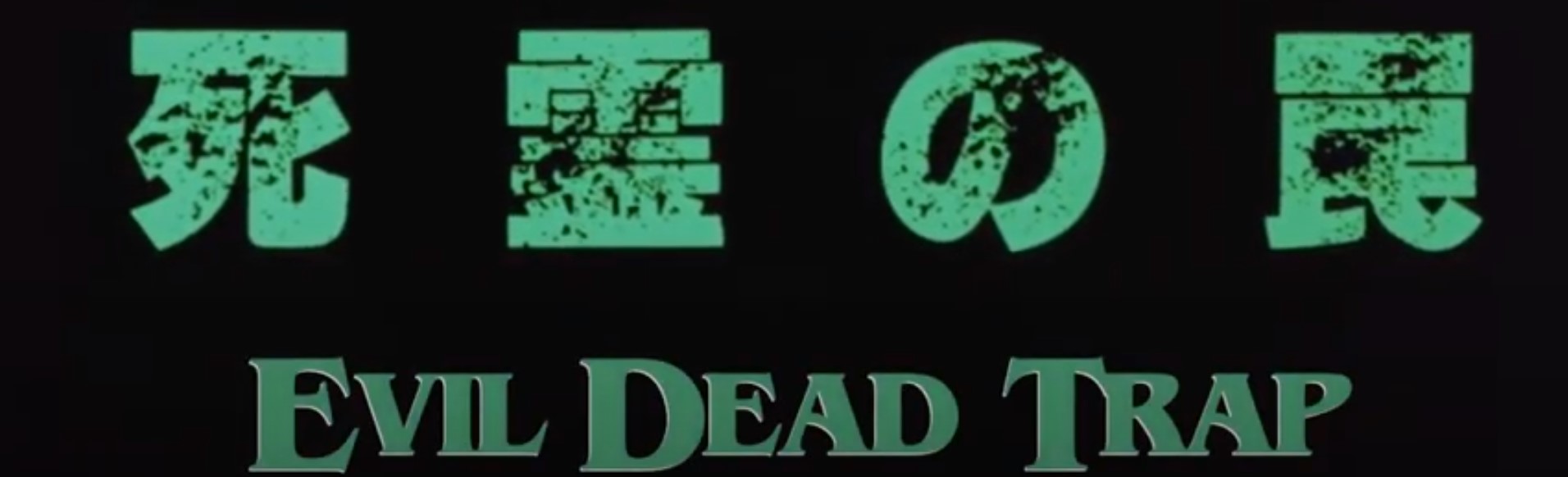
No Sam Raimi. No Bruce Campbell. Just the EVIL! “Evil Dead Trap” reviewed (Unearthed Films / Blu-ray)


Nami, a Japanese late night show host, is seeing her ratings dipping.  Though not in danger of losing her all-female produced show, Nami decides take her team on an investigation of a mysterious snuff tape that was mailed to her specifically.  Left for her is a bread crumb trail of directions to an abandoned military base, Nami and her crew explore the campus’s rundown structure, searching for evidence, a body, a story that they can televise.  Ignoring the dangerous presence around them, they dig deeper into the dilapidating labyrinth where they horrifying discover something waiting for them laid out in a cruel plan of deadly traps with a maniac pulling at all the strings. 

Bred out of a pedigree of pinkusploitations and a nation’s crisis of identity after the Second Great War, “Evil Dead Trap” is a greatly symbolized Japanese machination tale helmed by pink film director Toshiharu Ikeda (“Sex Hunter,” “Angel Guts:  Red Porno”) and penned by an equally historical pink film screenwriter and “Angel Guts” manga series creator Takashi Ishii (“Girl and the Wooden Horse Torture,” “Angel Guts” series).  Also known under its original Japanese title, “Shiryô no wana,” as well as, and my personal favorite, “Tokyo Snuff,” in Spain, “Evil Dead Trap’s” smorgasbord of rape, torture, and gory death naturally shocked viewers upon release and continues to do so as one of J-Horror’s branched out films that segued out from the brutal and depraved pink film inspired context into the new longstanding ghost genre we’ve seen over the last few decades with “Ringu” (“The Ring”) or “Ju-on” (“The Grudge”).  The production company Joy Pack Films, behind the 1980’s obscure Japan films, such as Genji Nakamura’s “Go For Broke” and Banmel Takahashi’s “Wolf,” houses the “Evil Dead Trap” from executive producer Tadao Masumizu.

If you recognize a couple cast members, or maybe just their naked bodies, then there’s something depraved about you!  With all kidding aside, but no seriously, if Rei (Hitomi Kobayashi) or Kondo (Masahiko Abe) look familiar, then you my friend are pink film aficionados as Kobayashi has starred in “Hard Petting” and “Young Girl Story” and Abe was in these pink film hits the “Pink Curtain” trilogy and “Female College Dorm Vs Nursing School Dormitory.”  If these faces didn’t touch you in any kind of sensual way, no worries, leading lady Miyuki Ono brings the star power.  The “Black Rain’s” Ono plays Nami, a go-getter television host/personality with her sights set on ramping up her late night show’s ratings, but also sucked into the posted snuff film’s darkest allure that’s personally calling her into to a precarious story lead.   Nami could also be a homage to one of screenwriter Takashi Ishii’s manga-inspired pink films entitled “Angel Guts: Nami” and the title might not be the only aspect paid honor to with that particular Nami written with a journalistic vocation drawn into and obsessed with a serial rapist’s attacks, making a striking parallel between the two stories that are nearly a decade apart. Eriko Nakagawa and Aya Katsurgagi fill out Nami’s investigating team as Rei and Mako. As a whole, the characters lack personality; Rei and Kondo tickle with relationship woes that are snuffed out before fruition, Rie’s timid innocence barely peaks through, and Nami and Mako’s thicker bond compared to the rest of the team is squashed to smithereens way before being suckled into note worthy tragedy. This late night show team has been reduced to slasher fodder and, honestly, I’m okay with that as we’re only here for the deadly traps. Noboru Mitani, Shinsuke Shimada, and Yûji Honma, as the mystery man looking for his brother, complete “Evil Dead Traps” casting.

“Evil Dead Trap” boasts a melting pot of inspirations, a mishmash of genres, and spins a nation’s split identity variation crowned in aberration. Diversely colorful neon-hazy lighting complimented by a Goblin-esque synth-rock soundtrack from Tomohiko Kira (“Shadow of the Wraith”), Toshiharu Ikeda shadows early Dario Argento inside and outside the popularity of the Italian giallo genre as the “Evil Dead Trap” murder-mystery horrors resemble more of a westernized slasher with a killer concealed behind a mask stalking a fringed, neglected compound in a conspicuous outfit. While the killer dons no hockey mask or snug in a mechanic’s jumpsuit, an equally domicile, yet more calculated, antagonist taunts more brains than brawns, especially with the severity of traps that seemingly float from out of nowhere. The fun is chiefly in the imagination of how the trap designs operate in the void of physics of a slasher fodder film so wipe clean the Jigsaw and the “Saw” films from your mind completely and relax to enjoy the outlandish kill scenes. Some of the kills are imperialistically inspired by Imperial Japan, that is, to blend the wartime nation’s atrocities with how the proud country wants to distance itself from that old-fashion, war-criminal, stoically perverse superstratum layer, but that’s were “Evil Dead Trap” pulls for most of the juicy parts as well as supplementing with Argento lighting, some, believe it or not, “Evil Dead” elements of that menacing presence bulldozing through the spiritual world, and an divergent climatic finale stuck to the narrative body that’s akin to pulling off the head of a doll and replacing it with T-Rex head’s. The uniformity quells under the pressure of how to end Nami’s and her attacker’s coda with pageantry weirdness that’s typical status quo Japanese cinema. Lots of symbolism, little modest explanation.

Get caught in “Evil Dead Trap” now back in print and on Blu-ray courtesy of Unearthed Films, distributed by MVD Visual, as part of the extreme label’s Unearthed Classics spine #5. The Blu-ray is presented in a matted 1.66:1 aspect ratio, a format rarely used in the States but widely used in other countries. Reverting to the 1.66:1 from Synapse’s 1.85:1 crop, Unearthed Films showcases more of the European feel, heightening that colorful vibrancy of the Argento-like schemes. Image quality has peaked on this transfer with natural grain with the 35mm stock, but details are not granularly sharp in an innate flaw of the time’s equipment and lighting. Shinichi Wakasa’s unobscured practical effects heed to the details and don’t necessary suffer the wrath of miniscule soft picture qualities when you’re impaling someone or birthing a slimy evil twin…you’ll see. Add in Ikeda’s wide range of shooting techniques, you’d think you’re watching Hitchcock or Raimi and the focus really lands there with the differently camera movements and techniques. The Japanese language single channel PCM audio fastens against that robust, vigorous quality to make “Evil Dead Trap’s” diverse range and depth that much more audibly striking, but there’s a good amount of silver lining in there being no damage albeit discernable, but not intrusive static to the audio files, dialogue is unobstructed and prominent, and the stellar synth-rock soundtrack nostalgically takes you back to when you first watched “Suspiria” or “Dawn of the Dead.” English subtitles are available but display with a few second delay which can be cumbersome if trying to keep up. Special features includes three commentaries that include director Toshiharu Ikeda and special effects supervisor Shinichi Wakasa, filmmaker Kurando Mitsutake (“Gun Woman”), and James Mudge of easternKicks. Plus, a Trappings of the Dead: Reflecting on the Japanese Cult Classic retrospect analysis from a Japanese film expert, Storyboards, Behind the scenes stills, promotional artwork, trailers, and a cardboard slipcover with phenomenal artwork. Highly recommend this atypical Japanese slasher, “Evil Dead Trap,” now on Blu-ray home video!

Own “Evil Dead Trap” on Blu-ray!

When EVIL Strikes a Family Hard is When Fission Divides and Conquers. “Nuclear” reviewed! (101 Films / Digital Screener)

Emma witnesses her troubled brother violently beating their mother while dragging her through the woods.  After he leaves, Emma and her injured mother escape to the countryside, driving through the night until coming upon a village house, next to what was once a large power plant that now sits vacant, to squat for a few days.  Emma comes into an encounter with a local boy a little older than herself with a free spirit for illegal extreme sports and taking dangerous risks to new heights.  What was intended to be an isolating refuge has turned into an alluring interest for Emma who admires the boy’s nomadic lifestyle, but while her mother’s physical injuries heal, a lingering trauma begins to emerge and Emma’s violent brother is also hot on their trail seeking them out.

Lately, our reviews have been on a stretch of psychological thrillers by first time feature film directors expressing a compelling narrative in the worst of situations; we’ve tackled the unhealthy family relations while battling acute mental illness with Joe Marcantonio’s “Kindred” and have taken a step back in time into the Cold War era with isolation tension and uncontrollable violent outbursts in the “Darkness in Apartment 45,” directed by Nicole Groton.  Well, we’re going for the hat trick with Catherine Linstrum debuting her written and directed psychological drama, “Nuclear,” that deals with the fallout of an estranged, threadbare family under the looming shadow of a defunct nuclear power plant, upending a whole new meaning for the term nuclear family.  Co-written with longtime collaborator, David-John Newman. “Nuclear” is a radiating co-production funded by the British Film Institute, Fields Park Media, and Ffilm Cymru Wales, and Great Point Media with Stella Nwimo serving as producer and Paul Higgins as executive producer.

Much of the narrative hinges on Emma, “Locke & Key’s” Emilia Jones, as a 14-year daughter at the center of her brother’s terrible misdeed that sparks a flight of escape to the country and then befriends an eccentric boy who pulls her toward a more grounded frame of mind despite his extreme antics.  The boy, charmingly played by “1917’s” George MacKay, is exactly the distraction Emilia needed while sheltering in refuge. MacKay boyish good looks accentuates his character’s overweening attitude that renders a thin layer of mysteriousness about him as the boy,, and when I say boy I mean young man not much older than Emilia, lives out of his van near the power plant and does backflips on a stone bridge. With such a small cast, one would assume the boy would have interactions with Emilia’s mother or brother, but that’s not the case as the film purposefully uses evasive maneuvers intended not to mingle the boy with Emilia’s mother, played by another Resident Evil Jill Valentine actress (see review of “Darkness in Apartment 45”) Sienna Guillory, and brother Oliver Coopersmith (“It’s Alive” remake), who are weaved into different stages of Emilia’s cerebral reactions to events that unfold unexpectedly. Floating through the story, like a supernatural Japanese house wife, is Noriko Sakura who, much like most of the other characters, plays that is unidentified, but Sakura’s wraithlike presence attaches itself to Emilia’s mother as a telltale sign that something isn’t quite right with the mother’s mental state.

“Nuclear,” in regards to the term, can be interpreted and dissected on many levels within the film; two possible, and perhaps the more obvious, espies are a nuclear family (as a pun on the phrase that denotes nuclear fission) that goes through a chain reaction of dependent events after a horrible event and the other would be the blatant power plant sitting idle and empty in the background, a symbol of a ruin that once harnessed power and gave energy to all and an allegory to this young teenager Emilia’s handling of the crime committed against her one and only protector- her mother. “Nuclear” is very much a young girl coming of age film that strikes chords of self-reliance and free choice while also strumming to disconnect from her parents and family, but she must face them first in order to really let go of the past. But does Catherine Lindstrum pull all the elements together? Lindstrum’s brain-teasing drama will ultimately confuse the general masses. Hell, “Nuclear” even confuses me by not sewing the last threads to connect the stitches of hecatomb effects as the principles players somber through an inexplicit tapestry that’s not clear, present, and often feels distant. The end result does evoke a sense of a coming of age story, but how that adolescent scores through tribulation is about opaque as murky water.


“Nuclear” is a twisting cerebral topography tale comprised of seasoned actors and promising young talent from the United Kingdom being distributed courtesy 101 Films, releasing digitally November 9th. Behind the camera is French cinematographer Crystel Fournier with a harsh realism that delivers a natural, but bleak tone full of shadows and gray contrast. Fournier captures and differentiates Emma’s solitude and isolation, especially when she, inadvertently, searches for answers through the motif of faith centric crosses and messages that surround her in and out of the cottage. Stephen McKeon’s score compliments Fournier’s atmo-melancholic with beautiful synth piano and Celtic akin violin compositions. There were no bonus features included with this digital screener and there were no bonus scenes during or after the credits. Don’t expect a mushroom cloud of edge-of-your-seat drama and psychological torment, “Nuclear” is the breadth of anticipation of the Cold War, never knowing what, when, and where to expect the bomb to drop in Catherine Linstrum’s debuting quandary.

EVIL Does a Little Bathhouse Wet Work in “Melancholic” reviewed! (Third Window Films / Blu-ray Screener)

On nights when a humble Japanese bathhouse is supposed to be closed for business, the lights remain illuminated, gleaming off the crimson covered ceramic tiles of Mr. Azuma’s bathhouse floors as body’s soak in a pool of blood.  The proprietor, Mr. Azuma, is in severe financial debt to Yakuza boss Tanaka who turns his meager business into a nightly slaughter house to dispose of Yakuza opposition or those just on the syndicate’s bad side.  When Tokyo University graduate, Kazuhiko, applies for a job as an attendant to see a girl who regular attends the bathhouse, the reserved model employee becomes enthralled with the disposing and cleaning up of the corpses, working alongside a couple of professional hitmen, Matsumoto and Kodero, but when the job he’s so passionate about requires him to be more hands on with the assassination assignments and the endless pressure from the Yakuza bares down on his colleagues and friends, Kazuhiko’s radical plan to eradicate the woes of his newfangled position just might mean his very life. 

Seiji Tanaka’s self-esteem building and identity attaining crime drama, “Melancholic,” might not reside as absolute horror, but any film involving the Japanese Yakuza is an unpredictable, Machiavellian expo worthy of every second.  Originally titled in Japan as “Merankorikku” or “メランコリック,” writer-director Tanaka retains a bloody disposition of the historically violently depicted Yakuza-storied narrative, but is asymmetrical with a converging love affair, complementary conflicting the dark and light with clarity of the centric character’s unintended double life into the criminal enterprise of cleaning a bloody bathhouse.  Based off Seiji Tanaka’s short film of the same title, “Melancholic” mops up as an immersive black dramedy from Seiji Tanaka as the filmmaker’s first credited feature film produced by One Goose production in association with Uplink and JGMP.

The story concentrates most of the effort around Kazuhiko, a graduate of the prestigious Tokyo University who doesn’t have a good job and lives with his pampering parents, fitted by Yoji Minagawa as a social misfit living on the outskirts of the Japanese mantra of diligence and integrity.  Minagawa bores out Kazuhiko’s diffidence, chocking up his damp disposition to the indecisions toward his future, that forces other characters to influence his choices, such a former high school classmate in Yuri with an effervescent performance by “Tag’s” (“Riaru onigokko”) Mebuki Yoshida.  Yuri’s infectious affection for Kazuhiko and her regular attendance at the bathhouse encourages Kazuhiko to apply and become hired for a cleaning attendant position alongside a blonde, and undereducated in comparison, counterpart in Matsumoto (Yoshitomo Isozaki), but to Kazuhiko’s surprise, his overqualified ego is shattered when he discovers that the bathhouse is a Yakuza place of execution and those all around him are more experienced in that trade, detonating a plume of black comedy, work place haughtiness that Kazuhiko has to balance with his personal relationship growing with Yuri.  Most of the exchanges are straight forward and culturally inflection heavy, especially when dire moments rear their heads, but some more compassionate and delicate scenes rouse through the overt inflections with Minagawa and Yoshida at the helm of their blossoming onscreen romance, adding to the stark contrast to the opposing narrative. Stefanie Arianne, Makoto Hada, Yasuyuki Hamaya, Takanori Kamachi, Hiroko Shinkai, Masanobu Yada, Keiji Yamashita, and Yuti Okubo fill out “Melancholic’s” cast.

“Melancholic” is a rather odd title integrated into the briefly pensive struggles of Kazuhiko to an intrinsic network of assassination gunplay and backstabbing knavery, offering little profound sadness and despair and more shrewd hostility when those in charge ask for an inch but take a mile out of the personnel pool. For a Yakuza film, Tanaka’s bath and butcher story has barely a budget to entertain technical action sequences in tight spaces, but the action is kept taut and intense and despite the lack of a Yakuza presence, with only one single boss representing an entire faction, the transposing of Kazuhiko’s personal and professional stations washes away much of budgetary concerns down the drainpipe as an irresistible curiosity to see how our hero softly stumbles through a sudden confluence of the two repelling paths will play out. Most audiences will overlook the comedy for a countless reasons as “Melancholic” up plays into the satirical rigors of the Japanese sullen humor. The fact that that the subject matter is also about mercilessly murder people in a bathhouse will undoubtedly pigeonhole the film with pre-labeled genre. Tanaka slips in gallons of subdued irony ripe for the complex circumstances hazardous to all bathhouse employees and their pryingly oppressive management.

The award winning Japanese film (aggregated wins from multiple Eastern Asian film festivals) “Melancholic” arrives onto a dual format DVD/Blu-ray from UK distributor Third Window Films, a loyal provider of extreme Asian cult and horror. Since the Blu-ray was a screener, the A/V aspects won’t be reviewed in it’s entirety and the specifications weren’t provided with the screener. Ryô Takahashi’s cinematic vision brings out the beauty in simplification without being ostentatious with camera angles or relying heavily on tint boxes; yet, the blend of steady cam and handheld tilts to the one side with the jitteriness of the handheld seizing the stage. Bonus features were included on the screener, including a behind-the-scenes of a documentary-style shot look at moments before, during, and after takes, a Q and A panel with the cast and crew, and the “Melancholic” short film. Seiji Tanaka’s breakthrough bloodbath, “Melancholic,” sounds more despondent than the dismal thought of a cold shower on a freezing day, but the heated ferocity rite into adulthood keeps this Japanese dramedy warm with tension and cozy with vortex humor.v

Purchase “Melancholic” on Blu-ray / DVD!