
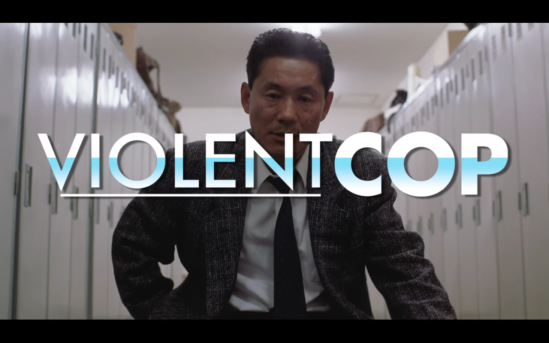
In a city fueled by constant drug trafficking and violence, a weak and corrupt police department has revolving leadership, but one good cop, detective Azuma, of the vice squad doesn’t have the taste for dope. Azuma’s wild card police tactics stir much controversy in his department, placing him on extremely thin ice, but he manages to get the job done no matter the destructive, if yet effective, trail left behind. When the detective learns that his long time colleague and best friend, detective Iwaki, has been involved with trafficking drugs, Iwaki ends up dead in apparent suicide and Azuma will stop at nothing to discover the truth behind his friend’s sudden death. Azuma’s Dirty Harry-style methods catch the attention of a powerful yakuza henchman who kidnaps her and lets his entourage gang rape his mentally unstable sister and with nothing else to lose, the rogue officer shoots first and never asks questions later.
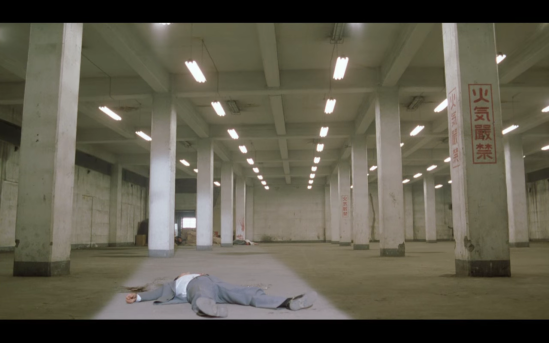
“Violent Cop” is the breakout 1989 directorial film from Takeshi Kitano, one of the most recognizable names and faces in the revival of Japan’s film industry and a staple amongst other mediums including stage performance, television, and other various liberal arts. Kitano also headlines the yakuza genre film as the lead character, the ungovernable detective Azuma, in this unforgiving cop drama under his pseudonym ‘Beat’ Takeshi. Kitano’s harden plastered mug and short, stocky stature caters to the era of lone wolf. rogue cops, providing a hearty performance familiar to that of Clint Eastwood or Charles Bronson. “Violent Cop” quietly packs a punch, patiently waiting to seize the opportunity to display explicitly graphic violence while also being sleek in it’s construction, charmingly odd in it’s humor, and basking more in the parameters of performance than in it’s exposition of dialogue, which is kitano is known more for in his acting.
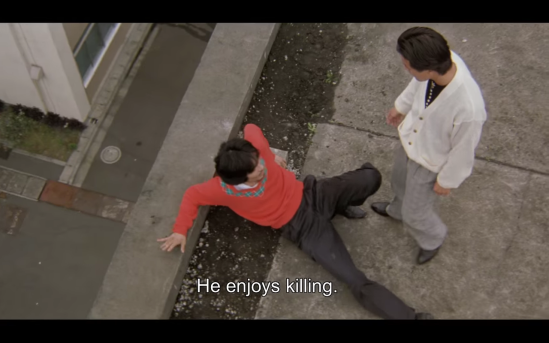
Much of the film revolves around Azuma’s cavalier and stoic personality. In the opening, three teenage boys unjustifiably harass and assault an elder homeless man. Azuma, who happened to witness the assault, follows one of the boys to his home, knocks on the door, identifies himself as a police offer to the boy’s mother, walks up the stairs alone, and slaps the boy around in his own room until the boy confesses and agrees to turn himself in at the station the following day. This introduction not only showcases Azuma’s descriptive title character as the violent cop, but also informs that the work alone Azuma has a vigilante moral principle that even isolates him from his unstable sister. Once a student of comedy, Kitano re-wrote the Hisashi Nozawa original comedic script into a brutal police drama, wanting to exhibit a serious side, but left alone some of the script’s initial comedy elements that blend the spirited yakuza film to being just inside the genre. Kitano’s progressive camera work includes deep long shots along with tight quarter setups, extensive and angled crane shots, slow motion sequences, and long track work that pinpoints Kitano’s diverse style.
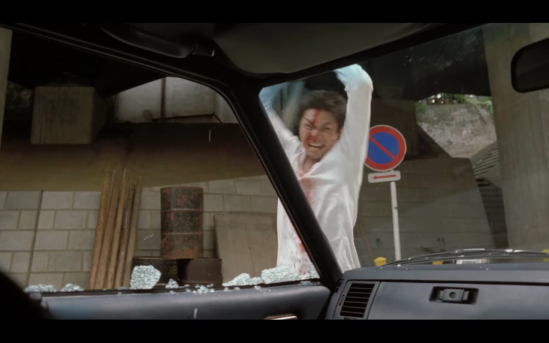
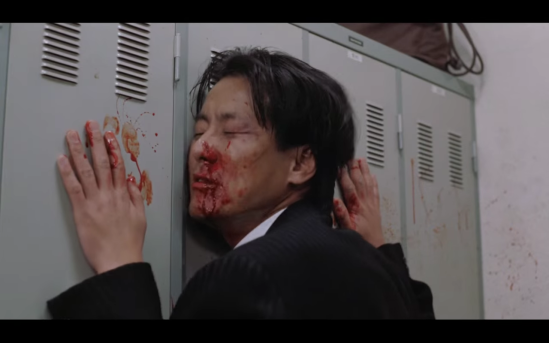
“Violent Cop” lives up to the title. Heads being bashed with an aluminum bat, multiple gory-soaked stabbings, and a sadistic, punishing maltreatments are just a few examples of “Violent Cops” barbaric qualities. The violent scenes feel almost peppered throughout, but they’re really strategically placed between character building segments that only support the necessity of brutality. Did detective Azuma really need to run over a suspect, who just murdered a colleague, down twice with the squad car? Yes, because the suspect desperately and dangerously wielded a baseball bat as a weapon and attacked them numerous time. The actions of the criminal warranted Azuma’s unethical position of bulldozing him over, twice. Only when Azuma is pushed beyond his limits does he lose what was left of any shred of restraints that were holding him back. Azuma meets an antagonistic match, a blood thirsty foe equally resistant and, at the same time, loyal with his boss, creating a villainous mirror image whose just as a loose canon as himself.
Film Movement, the New York based award-winning and foreign cinema distributor, presents a specialized hi-definition Blu-ray treatment of “Violent Cop” in a sharply detailed 1.85:1 aspect ratio stored on a single disc BD-50. The region A disc provides the best transfer quality of this 1989 film to date with stunning, natural coloring, balanced hues, and defined edges with no signs of compression artefacts. Darker scene noise is present, but to affect the experience, the noise would need to be more extensive. With Film Movement’s release, the noise is minimal and shouldn’t be considered a factor. The Japanese LCPM 2.0 audio track is quality with no hiss or pops. Dialogue is evident in the forefront, all other tracks seem level with an accompaniment range of ambiance, and, like aforementioned, all tracks are clean and clear of distortions. Extras include a featurette entitled “That Man is Dangerous: The Birth of Takeshi Kitano” and an booklet essay with the topic of Takehsi Kitano, written by Asian film expert and film curator Tom Vick. “Violent Cop” offers no sympathy, but provides an abundance of rich, dedicated filmmaking in a raw format that seems almost archaic in the present. Film Movement and “Violent Cop” go hand-in-hand, a foreign yakuza melodrama that saw the beginning stages of rebirth in the last days of a struggling Japanese cinema market and Kitano’s face is at the forefront of that movement.
Tag Archives: japanese
Show Evil the Ropes! “Educating Yuna” review!
Innocent Yuna meets famous art critic and collector Professor Shibuya. Shibuya invites Yuna to his countryside home to organize his art collection, but Shibuya’s real intention is to reveal his true self to Yuna – a BDS&M practitioner. He introduces her to S&M queen Erika and her mistress Miho and before Yuna could blink she was thrusted into a world of bondage and pleasure. The experiences were new to shameful and innocent Yuna and though she enjoyed her stimulating new feats, she reluctantly did so and began to question her acceptance of such new enjoyments.

Forget “50 Shades of Grey.” Say hello to “Educating Yuna!” True S&M fans will love this film that tightens the ropes around the scared body, that cums without mercy, that brings masochistic pleasure to the forefront, and shows men and women alike can shed their shame and live an exotic lifestyle. A bondage professional was brought in as an advisor for the extremely intricate shibari rope bondage scenes which director Yutaka Ikemjima, aka Mr. Pink, well crafts into the film. Ikemjima turned innocence into perversion in a matter of a few frames.

Leading lady Mari Yamaguchi delicate body turns rapturous. Yamaguchi remarkably does well at portraying an young and naive college student standing on the brink of kinky sex and just needing that helpful push. Teamed up with actresses Japanese AV pornstar Ran Kurenai (Erika) and masochistic pornstar Satsuki Mochida (Miho) and the combination will get rock hard reactions around the globe. “Educating Yuna” intensity can not be so easily described as the scenes are too extreme for simple words; the extensive bondage scenes are cringe searing, but one can’t help to lust for more of Mari Yamaguchi in tight ropes suspended high in the air with her breasts exposed and her flesh swelling pink with desire. The film isn’t all about BDS&M as there is a serious message behind the film. The Shibuya character at one points collapses and the realization that his willingness to lay with anybody (or anything) puts the fear of Aids into her soul. The penance of careless sex.

“Educating Yuna,” in all its Japanese government mandated genitalia censorship glory, is a raw explosion of dark perversion brought to you by the likes of the wonderful pink film distributor Pink Eiga (www.pinkeiga.com)! Our of the four recently DVD releases from Pink Eiga, the Yamaguichi and Ikemjima film wins the award for making one feel dirty and guilty on the inside yet stimulating and wetting their private parts at the same time on the outside. Strongly recommended for those who love the BDS&M genre or those who want to know a little bit more in their sexual experimental quest.
My Wish is for Evil to Always be this Beautiful! “The Succulent Succubus” review!
Japanese iconic pornstar Sho Nishino stars as Momo, a very unlucky attractive young women whose luck consists of meeting all the wrong and greedy men. On top of that, Momo is told she only has 6 months left to live due to an incurable disease. When Momo is at her lowest, the VP of Hell gives her a visit. Ms. Devil Girl Succubus, played by the stunning Asami, and offers her a single wish in return for the possession of her soul for all eternity. Momo has to decide the outcome of her last six months of life to either keep wasting it on money-hungry men using her for a trip to heaven or give up her soul and spend the rest of her afterlife in the depravity of Hell for a little short tern of happiness.

The two female leads Sho Nishino and Asami couldn’t get any more sexier. I though Asami in “Prison Girl” (review here) was the peak of her sexiness, but I was wrong as her role as Ms. Devil Girl Succubus in “The Succulent Succubus” has gone far and beyond “Prison Girl.” Hair teased and curled, dark lucious lipstick, striking doctored eye coloring, and a figure that kills, Asami couldn’t be any hotter unless she really was in the infernal Hell. This is my first viewing experience with Sho Nishino. The slender body and the tenderness look is a tall tell sign that Nishino is a mega force in the porn industry; probably one of the hottest JAV actresses out there. Nishino and Asami are petite women who don’t need curves to excite and “The Succulent Succubus” pairs sex and parody and weaves a glorious romp-filled tale aiming to delight all you sinners out there.

Director Motosugu Watanabe’s simple editing and framing style works to accomplish creating Asami as the VP of Hell. Quick editing techniques and creative cost efficient special effects combined with quirky Japanese acting turns the what could have been another run of the mill, lackluster erotica film into a fun and entertaining hard-on producing gem. One particular scene stands out involving Nishino and Asami in a Hell setting lesbian scene. As the two grind their love boxes together in a scene of epic proportions, the obviously cheap Hell constructed scene only adds to the charm of the scene. I know what you’re thinking: Why are you looking at the setting instead of two naked and beautiful women doing the nasty? Answer: the setting creates a time warp and a sense of fantasy to where you yourself might think you’ve traveled back in time or to Hell to watch a lustful scene undertake.

Pink Eiga has again successfully distributed a great film to the masses and has notched another great edition into their extensive catalogue. The DVD, available for purchase at www.pinkeiga.com, release isn’t skimpy on the features (unlike the skimpy clothing the actresses are wearing). The DVD contains an interview “Why The Hell?” with actress Asami and includes also the film’s original artwork, a still image slideshow, and the whole presentation is in outstanding widescreen format for your viewing pleasure. Remember, if you love Pink Eiga make sure you pick this little devilish film up and check out other titles on the 99CentNetwork to stream other titles of titillating films.
Is Your Maid this Evilly Erotic? Maid in Japan trailer!
I’ll just leave this here for you to watch…
Enjoy.
Is Your Home this Evil? House (Hausu) review!
Japanese horror isn’t something I pride myself on having a lot of knowledge of or contain much material about, but I do find enjoyment in what I come across even if the resemblance to an anime style becomes apparent in the storytelling. I’ll be straight forward with you right here and now, I’m not a fan of Japanese anime. No, sir. Can’t say that I am. However, my latest venture into the J-horror sends me back in time to the groovy year of 1977. The film is called House and no, not the Steve Miner feature from ’86. Also known by it’s Japanese name Hausu, House is a simple ghost tale with ambitious and groundbreaking special effects that dared much of the decade to catch up with the times.

