This Casting Couch Has Something Far More EVIL Planned Than Some Sleazy Fetish Videos! “Maskhead” reviewed! (Unearthed Films /Blu-ray)

“Maskhead” on Blu-ray from Unearthed Films!

Syl and Maddie are lesbian lovers and producers of adult fetish films.  Always seeking new talent and models, they continuously invite potential performers to their casting couch for a little background interview and test the waters of their willingness to be humiliated or dominating on camera.  When the camera rolls, the plot is about as normal as any fetish produced adult feature can be to get a viewer’s rocks off but when the imposing, metal face gear-wearing Maskhead enters frame, the change of perversion goes from sexualized fetishes to snuff material as Maskhead torments, tortures, and kills the models as Syl and Maddie enthusiastically continue to capture it all on camera with great relish in their pain and suffering.  At the bidding of the sociopathic lesbians, their associate named Cowboy purveys potential performers with his southern charm and witty storytelling as well as supplying them with jet fuel-infused weed.  With shoots lined up, Syl and Maddie are extremely tickled for the soon-to-be tortured talent ahead of them. 

After his stint of SOV sickness and violence with the August Underground trilogy, writer-director Fred Vogel continues his expedition through videotape exploitation with a codirector effort in the 2009 extreme horror “Maskhead.”  Written-and-codirected with Scott Swan, who has since transitioned into a transgendered woman Rebecca Swan, the “Extremity” and “Big Junior” filmmaker Swan folds into Vogel’s guerilla-esque scripted joy for the juggler through a nihilistic lens.  “Maskhead” is hot-rodding sadism at its nastiest in the underground world of ultra-violent and extreme horror, produced by Vogel under his Toe Tag Pictures alongside wife and costar Shelby Lyn Vogel and once frequent collaborator and special effects guru Jerami Cruise whose gruesome squibs and bloody prosthetics of August Underground’s “Mordum” and “Penance” opened the door for specialty costuming for Hollywood blockbusters, especially in the MCU with “Avengers:  Infinity War,” “Captain Marvel” and “Black Panther.”  “Maskhead” might not be a morally just superhero but can be definitely feared as superhuman with his nail protruding through a plank strap-on! 

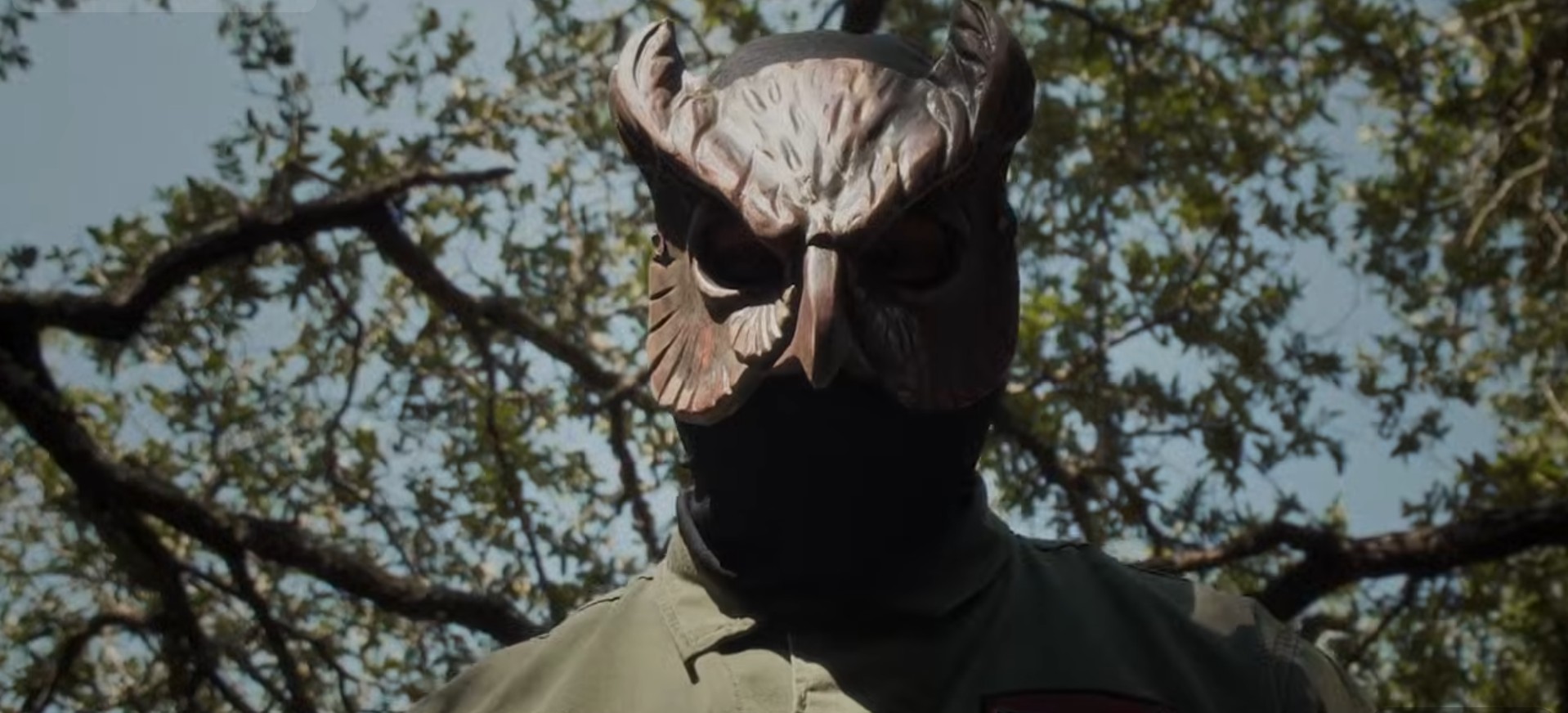
Maskhead is essentially the executioner you don’t want to meet on an isolated porn set, caught vulnerable in your unmentionables.  The titular character is played voicelessly Michael Witherel having just come off the set of Vogel’s “Murder Collection Volume 1” released the same year.  Wrapped in bloody bandages around his upper torso, chest and head, encased with a strapped metal mask with spikes around the mouth area, Maskhead is virtually a ghost without background, without a wound explanation, and we don’t know what makes the grunting brute tick to do the cruelties he does in the unexplained relationship with Syl and Maddie who rely on Maskhead to splatter their stars into full potential.  Syl and Maddie have a little more breadth:  they’re lovers, fetish smut producers, and total sociopaths.  The women speak romantically about their auditioners coupled with immense torture-kill innuendo as a preponderance of their relationship foreplay.  Shelby Lyn Vogel and Danielle Kings have certifiable chemistry between them as lovers and portray crisp killers of apathetic character as they lap up laughter, love, and the loose morals in the face of someone’s life in their hands or behind their camera.  Shelby Lyn Vogel has worked around Vogel’s catalogue for the most of his career with roles in “The Redsin Tower” and “The Final Interview” while Danielle Inks (“My Uncle John is a Zombie!”) inaugurates herself into extreme film, and film altogether in her debut, without missing beat being the dress-wearing famine next to Vogel’s more butch lesbian.  While Vogel and Inks make an interesting pair of murderers, the more fascinating character Daniel V. Klien’s Cowboy, a charming supplier of casting couch talent with the gift of gab and the occasional backdoor fisting.  Klein (“Murder Collection V.1,” “The Final Interview”) adds to Cowboy’s mysteriousness debonair with a great twang, bearish mustache, and slightly portly figure in cowboy boats, black vest, and tight underpants when getting his kink on.  Cowboy’s persuasive manner and false promises build the character who’s to meet Syl and Maddie’s wishes.  Now, whether the couple plays Cowboy or not is not elucidated, one thing is clear the character does the Cowboy way when it comes to fetish desires and traversal wandering.  “Maskhead” is fairly carte blanche in casting their onscreen kill list with actors John Ross, Chris Krzysik, Mary Shore, Nicole Divley, David P. Croushore, Janelle Marie Szczypinski, Donna MacDonald, Lacey Fleming, and Damien A. Maruscak breaking more than a leg in their character acts. 

Suitable for those with bloodlust eyes, “Maskhead” meets niche criteria as an extreme gore and shock feature that’s all exploitational style and no narrative substance.  This type of film is very much similar to Fred Vogel’s “August Underground” series of randomized bits and pieces of not only the poor unfortunate’s filleted flesh and exposed bones but also with the disconnected scenes compiled together to meet at most the full-length feature runtime requirements.  The bare plotline to “Maskhead” are lesbian lovers Syl and Maddie signing unsuspecting actors to their doom for the sake of their snuff movies, that’s the extent and stoppage point of “Maskhead” to move forward with any sort of three act narrative. The rest intends to shock with one-sided, visceral violence that is the epitome of torture porn with bound people being merciless put in the wrath of “Maskhead” and other extreme moments of provocativeness, including Syl and Maddie’s footsy foreplay under a public restaurant table or Cowboy’s elbow deep fisting of a local gay bar tweaker.  While ultra violence and deviancy doesn’t go without merit, everyone knows I enjoy a good uncensored bloodsplatter and sexpot debauchery scene, the film is just a continuous string of nothing but that can be utterly monotonous, especially in the length of 89-minutes as it is with “Maskhead.” 

“Maskhead” is a course in sexual deviancy, a killer perversion that’ll speak to few but be repugnant by many.  You can test your ethic caliber by owning a copy of “Maskhead” on the new Unearthed Films’ Blu-ray.  The AVC encoded, 1080p high-definition, BD50 is packed with extras and presents the feature in the original aspect ratio 1.77:1 widescreen.  Vogel and Swan use polar quality to convey their narrative with a downgraded resolution, around a true 480p, with Syl’s perspective, capturing every gruesome event on her camcorder, much the same as found footage, while the rest of the film is shot in a higher, digital resolution with a third person perspective.  There’s certainly no singular picture quality approach as even third picture rollercoasters with an inconsistent, and slightly unstable, look under low-lit scenes, such as with the Syl and Maddie restaurant scene, and this unfavored condition is not a compression issue but rather a result of equipment and poor lighting, hence gore-and-shock’s conventional bantam budget.  Depth is not really a thing with the quality and a maximization of extreme closeups to get all the uncomfortableness of personal bubble space and grisly slaughter into the frame.  Color grading is also pretty much nonexistent with a raw and natural flat aesthetic palette, adding to the strived realism aspect extreme horror usually attempts to achieve.  The only audio option available is an uncompressed English PCM 2.0 that services these types of films well enough as dialogue comes over cleanly and relatively clear when on-board and commercial on-board mics are placed appropriately.  No hissing, crackling, or popping to note.  If screaming bloody hell is a high-frequency vocal modulation that gets you off than, of course, there’s plenty from the “Maskhead” track to go around.  Again, not much depth or range because of the near proximity of most of the scenes.  English subtitles are optionally available.  Much like Unearth Films’  “August Underground”  release, “Maskhead” comes packed with plenty of new and a few returning special features.  There are two new feature length commentary tracks with 1) directors Fred Vogel and Scott Swan and 2) with Vogel again with wife Shelby Lyn Vogel, special effects artist Jerami Cruise, and Ultra Violent Magazine’s Art Ettinger.  A third 2009 commentary precedes and seeks to replace the first new commentary with Vogel and Swan.  An exclusive Unearthed Films introduction by Toe Tag’s Fred Vogel provides a little gratitude from Vogel about the new release.  Swan also has his own feature cut of the film which may be more favorable for those looking for a story as the codirector’s cut seeks to build more context through editing and pacing toward the story rather than Vogel’s emphasis on the torture/gore.  Interviews with Vogel Frankenstein’s Maskhead, the titular character himself Behind the Mask, and the Cowboy Below the Brim offers that slither of realism and behind-the-scenes bibelots that makes “Maskhead” tick.  There’s also a plethora of new featurettes of raw behind-the-scenes footage:  the first test footage for “Maskhead,” the creation of the titular character, an extended death scene of Food Girl (Janelle Marie Szczypinsk), as well as on set with Food Girl, fun with special effects at Toe Tag Studios, moments from the recording room to flesh out those sound details, such as Cowboy’s whistling and some growling, grunting, and groaning techniques, I Will Break Your Fucking Arm takes you behind the scenes of the arm rack’s special effects and setup, the infamous rape scene with a 2×4 is more raw footage of preparation with a little more skin time from both Mary Shore and Michael Witherel, The Room ganders the old hotel room where Cowboy gets fisty, the character elements – mask, gauze, and 2×4 – that make Maskhead Maskhead, and an extended photo gallery.  Archive extras round out the massive list with the Jerami Cruise commentated short “Dildo:  The Creation of Maskhead,” a blooper reel, Cowboy’s Whistling Clinic to be the best professional whistler as you can be, and the trailer.  Physical elements of Unearthed Films’ latest has a cardboard O-slip featuring green graded image composition of the primary cast of characters.  The same image is displayed on the one-sided cover art of the conventional Blu-ray Amaray case.  I’m curious about one thing though, did Unearthed Films get permission from Rebecca Swan to use her then biological male name Scott Swan for credit?  I assume so with the rational of that was who created the film back in 2009.  The region A locked release and is not listed as not rated but is not rated. 

Last Rites: Most will consider “Maskhead” senseless depiction of pseudo-torture but I’m glad Unearthed Films and Fred Vogel were able to supply and add supplemental raw footage on this upgraded release. Hours upon hours of reel that shows careful preparation and setup and the dedicated cast and crew examining every shot and listening to cast suggestions that humanizes the film a little more on a relatable level and demonize it less as just junk food for gorehounds.

“Maskhead” on Blu-ray from Unearthed Films!

Sometimes, The Choice Itself is EVIL. “A Woman Like Eve” reviewed! (Cult Epics / Blu-ray)


Eve is a stay at home mother of two who ensures the house is in tiptop shape and that dinner is promptly on the table for her working husband, Ad.  When Eve has a break down at the Mother’s Day family dinner table, Ad purchases her a train ticket to enjoy France’s sun and sand with her best friend, Sonja.  There she meets an alluring woman, Liliane, living freely and humbly in a commune.  An attraction flourishes between them after Eve returns to home to the Netherlands and can’t stop thinking of her time with Liliane.  Soon, they become romantically involved with Liliane travelling back and forth from France and that sets the stage for conflict as Ad discovers his wife’s yearning desires for Liliane to horrid and confusing for their young children not to mention also their marriage.  Eve is caught in the middle between the woman she desperately wants to be with who still lives in the commune and her children she can’t deal to part from in a tug-a-war of emotions wrought by a failing marriage, society perceptions on lesbianism, and damaging court room battles for children custody.

When thinking about the history of LGBTQ+ films and the filmmakers behind them, director Nouchka van Brakel’s “A Woman Like Eve” should be at the top of any film aficionado’s list despite flying, unjustifiably, under the radar for decades as the Dutch film makes a profound statement with, at the time, unmapped gender fluidity of the 1970’s timeframe that included the women liberation movement that sought to free domesticated women from the limitations of household responsibilities, it cracked the barriers on what constitutes as healthy union between two people, and dove into the intricate internal struggles of a keystone person being pulled between two very different lives of family dynamics.   Co-written alongside Judith Herzberg, the 1979 romance drama, natively titled “Een vrouw als Eva,” has a very different kind of evil than the werewolves, vampires, zombies, serial killers, and ghosts typically showcased in our reviews and that is those narrow-mindedly frighteningly submerged in antiquated traditions peered through the perspective of a feminist director in Brakel.  Matthijs van Heijningen, who produced Dick Maas’s elevator-horror “The Lift” and also Brakel’s prior work on “The Debut” and later work on “The Cool Lakes of Death,” produces the Dutch tale under his indie banner, Sigma Pictures.”

“A Woman Like Eve” would not have been as provocative with thickly layered nonconformist and spirited topics without the compelling performance of the film’s two leading ladies in Monique van de Ven (Paul Verhoeven’s “Turkish Delight”) as Eve and  Maria Schneider (“Last Tango in Paris” costarring Marlon Brando).  Van de Ven captures a woman tormented by not only what “proper” society, society being her friends and family, tells her to be, but also distresses going against the grain of her innate guilt and nurture for her two small children during a time of emotional transition that impels her to pursue a relationship with not just any other person but another woman.  That other woman being Liliane, an established outlier of what’s considered normal as a lesbian living how she wants in an outskirts commune, and while Schneider’s performance treads lightly through what should be mountains of emotions, especially in a role that has a foundation of someone been out of closet, doesn’t care what anyone thinks, and has tethered a line of security to her soul fulfillment center, Liliane still maintains as the steady constant that never wavers from who she is and what she wants.  Toss in the German born and “A Bridge Too Far” actor, Peter Faber, and you can see the gunpowder burn for miles in tense and uncomfortable discourse when Eve confides into Faber’s character, Eve’s husband Ad, about her proclaimed love for another woman and then we witness Ad patronize her with what he calls an epidemic of woman independence and shrugs her true feelings like scraping foods scraps from a dinner plate and into the trash. Faber can get downright ugly with the homophobic bigotry that begins to carousel Eve’s ebb and flow of having any kind relationship with her separated husband until justice system proceedings for children custody. Marijke Merckens, Renée Soutendijk, Anna Knaup, Truus Dekker, and Mike Bendig round out as the support characters caught is the web of Eve’s love affairs and legal issues.

Feminist filmmaker Nouchka van Brakel depicts tremendous themes of a woman’s status in what could have been a universal position for women all over the globe. Seen as only housekeepers, dinner makers, and children bearers or caretakers, women were placed at a standstill after suffragists fought for the right vote at the turn of the 20th century but that fire inside them stayed lit and you can see that with Eve in the opening scenes as she’s longing and looking for something more than to be a house wife. She eventually obtains something more with love for Liliane, the second theme Brakel implements extends upon unfettering women is with lesbianism. Lesbianism is shown to bring down shame upon family, friends, and even just society in general as Eve was offered no solace from those she had a prior relationship with after coming out, a choice seen as a radical and an integration part of that women’s independence movement. Brakel wanted to explore uncharted passion between woman and woman and, in doing so, lifted the curtain on on various foremost concepts that are still…still being talked about today where inequality in the workplace through sexism and salaries still wage a battle of the sexes and homosexuality is still too taboo for even the modern day system. “A Woman Like Eve” has surely inspired and been of homage in more modern pieces, such as “Blue is the Warmest Color,” and should be exhibited more educationally on it’s abundance of relatable themes and not just be another work of unseen cult fiction but be rather a praised film of realism based on nonfiction.

To watch Eve toil in her new life is like climbing Mount Everest; it’s a long, arduous journey with challenging, sometimes spirit crushing, obstacles to overcome in order to reach the top, but once above the cloud, the tooth and nail fight for what’s finally yours and yours alone can be worth it. Unfortunately for Eve, her cumulus glass ceiling is poignant. “A Woman Like Eve” importance is shamefully overlooked and that’s why I’m grateful Cult Epics has brought Brakel’s film, for the first time, on DVD and Blu-ray in North America. Basing this review off the Blu-ray release, clocking in with a 103 minute runtime, the newly restored high definition transfer from the original 35mm print, shown in 1.66:1 aspect ratio, looks respectable from a moderately preserved transfer. An occasion scratch and some real delineation issues with night scenes factor in only little impact when the story is shot mostly in bright daylight and is well light all around with lots of natural grain. No cropping, compression artefacts, or enhancing was detected and the coloring appears very natural without any overcorrecting or mistakes in the primary or secondary hues. The new Dutch/English/French language DTS-HD master audio 2.0 renders dialogue clearly and positioned as the foremost track with a solid sync with the error-free English captioning. There’s a slight lower key hum throughout and some crackling and popping but none of those are a hinderance to the viewing. As far as bonus material, the region free, unrated release contains a 2020 interview between Brakel and film journalist Floortje Smit at the Eye Filmmuseum, a poster and still gallery, and the theatrical trailer on a dual-layered disc. The limited edition package includes new and original cover art on a reversible case sleeve. Probably seen as antiquated celluloid, I see Nouchka van Brakel’s LGBTQ proud and woman empowering film, “A Woman Like Eve,” as historical treasure dug up by Cult Epics, carefully spit-shine restored, and encapsulated forever on physical media for all to enjoy.

Purchase “A Woman Like Eve” on Blu-ray or DVD

EVIL’s All Inclusive Resort. “Paradise Z” reviewed! ((Yet) Another Distribution Company / Digital Screener)

Sylvia and Rose are living the life of harmonious luxury together on a beautiful and serene Thailand resort. There’s only one tiny problem with their first-class accommodations: the world surrounding them is overrun by a population of rabidly crazed zombies. After establishing a rigorous routine of perimeter checks and pool time, food and gas are running dangerous low to keep a secluded and safe survival lifestyle sustained, leaving them no choice but to venture out to nearby villages in search for fuel, but the smallest of sounds could invite the hungry dead to storm their idyllic retreat. No matter how careful scouring outside the gated walls of isolated tranquility, the zombies’ insidious ways infest as bad resorts guests that turn Sylvia and Rose’s make-due habitation to their prospective tomb when all routes of escape are foiled by flesh-feasting zombies. The couple must rely on each other for survival.

There’s trouble in paradise from Wych Kaosayananda’s melancholic-apocalypticism horror “Paradise Z” focusing on two young women, romantically brought together by undead circumstances, to outlive the encompassing fatalist outlook. Marketed in the United Kingdom as a “Lesbian Zombie Apocalypse Gore-fest” and having been through the wringer with title changes from the original title of “Two of Us” to “Dead Earth,” as called in the States, the uptrend to incorporate the Z in any zombie film has been a musky motif ever since Max Brooks introduced the epithet for his 2006 zombie apocalypse novel, “World War Z,” yet that doesn’t stop writers Kaosayananda and Steve Poirier in dishing out a sanguine trilogy with “Paradise Z” laying the ground work as the first installment and “The Driver,” the third installment, following suit shortly after wrapping production on “Paradise Z.” With the second film, “The Rider,” is still in pre-production and the shot films released out of sequential order, Kaosayananda’s unconventional trilogy methods caters to a seemingly budget and location ready-timeline to which characters from all three films will interconnect the dissociated titles under the filmmaker’s self-funded production company, Kaos Entertainment.

Throughout the entire 1-hour and 35-minute runtime, there are only five speaking roles with three of those roles rarely comprising of about four minutes of combined dialogue, assigning by default much of the chitchat the principle characters, Sylvia and Rose. For the first nine and half minutes, Milena Gorum and Alice Tantayanon don’t say a single word as the day’s routine of waking up, showering, topless swimming, poolside yoga, lunch, and other recreational activities dominate the setup of quietude. When Gorum (as Sylvia) and Tantayanon (Rose) do utter a few words, they’re muttered projection is nearly unintelligible with little effort into the purpose of speaking. Born in Los Angeles and now, predominately, a New York city fashion model, Gorum has come across my radar before with a bit Succubus role in the 2017, Cleopatra Films produced demonic thriller, “The Black Room,” opposite Lin Shaye, Lukas Hassel, and Natasha Henstridge and though “Paradise Z” provides Gorum with her first lead role that showcases her immense beauty but limited acting range. The same wooden expressive opinion can be said for the little known Alice Tantayanon whose pigeonholed herself into a Kaosayananda celluloid corner with her only credits being three of his films. Sylvia and Rose rarely separate from each other sides, being lovers noodled into a pot of thick zombie soup, in a rigid position of affixed dynamics difficult to gauge how either one of them is handling the situation. When a show of complexity is finally unveiled, such as when Sylvia murders in cold blood two other survivors and turns to Rose to say it’s better this way, those actions somewhere along the story from there on out should be dissected in explaining just why lacerating two men to death is a good thing. Of course, we can all assume the survival of the fittest and selfish obvious reason that two rugged men are looking for more than just a box of Twinkies and an unopened can of goulash substitute from two good-looking ladies outside the safety of their homemade stronghold; yet, doesn’t answer where the killer instincts root and Kaosayananda shelves that bit of human nature when the zombie caca spreads throughout the resort upon their return that also evaporates a steamy sex scene and inklings of frustration for their dwindling supplies and mundane routine symbolizing an inching wedge between them. “Ghost House’s” Michael S. New rounds out the cast the DJ, an on-air beacon of infected information.

An Elysian-fabricated getaway resort can be an ideal hunker down for an apocalypse of the zombie kind. Mega resorts have a large footprint that are usually gated and fenced, plenty of food and lodging to accommodate a small village, and an escape route from the beach to the open waters where we all know zombies can’t swim. That works here for “Paradise Z” and almost plays like a pillar character that embeds the women survivalists from going on walkabouts, creating a real sense of comfortable isolation and simmering paranoia of the outside world. Kaosayananda, who can’t quite get the bad taste that lingers from out his mouth with the panned Antonio Banderas and Lucy Liu starring critically slammed and chaos-riddled film “Ballistic: Ecks vs. Sever,” left himself to his own devices in trying to rebuild his career shooting in Thailand, but “Paradise Z” crumbles as a stepping stone trilogy that lacks proper severe conflict of placing the heroines into a tight, perhaps inescapable, spot. What the couple have to escape from are the wild, warm flesh-craving leftovers of a plagued mankind, springing to a sprint at the first audible or visual morsel that tickles the eardrums, but the patchwork caked-face, grayscale zombies don’t render the likes from the bygone Golden Age of Horror, or even the current Golden Age of Modern Horror for that matter, in what looks and feels like cheap knockoffs of the genuine fictional man-eaters by rouge applying professionals. What Kaosayananda has made here is a two-tone, straight-forward, out-smart the dumb zombie breed of uninspired mirth, burdening the actresses to shoulder the story on looks alone rather than include emotional depth oppressed by the Z-factor.

Spend your vacation in a halcyon “Paradise Z” exclusively releasing on UK digital platforms come the new year on January 4th from the marginalized advocating distributor (Yet) Another Distribution Company. In regards to cinematography, presented in a widescreen 2.39:1 aspect ratio, Kaosayananda safely approaches most stories set in Thailand with a warm, yellowish glaze overtop the lush tropic vegetation, but, aside from a class I rapid stream the women decide to cool off in on a whim, without weapons and, basically, in their skivvies, outside the resort walls, there’s a limit to the Thai landscapes that doesn’t reach beyond the resort perimeter sufficing to just the surrounding allure rather than cutting in scenes of breath-taking grandeur. Kaosayananda occasionally reduces the frames per second to emphasize certain scenes with slow motion, such as with Gorum and Tatayanon’s topless make out session or when the two are back-to-back unloading an unlimited amount of ammo against a rushing horde with every shot being a fatal one; the silver lining here is the scene is at least aesthetically cool to watch. However, once again, Sylvia and Rose are given winning hands to play without as much showing their cards that work backwards their highly skilled background of arms fire. With the digital screener, there were no bonus material or bonus scenes included. No need to check the yelp reviews on holiday spot as “Paradise Z” is a four star resort with one star performances battling an underwhelming, minimum gory zombie contingent without dutifully jeopardizing survivors enough for the sake of gratefully being alive.

Copulating in the Woods is Evil’s Catnip! “Don’t Fuck in the Woods” review!


Alex and Jane just graduated college with an uncertain future ahead of them. In financial debt with no aid from their family because of their lesbian relationship, Alex can’t shake the uncomfortable sensation that her life spirals down an unknown path. Jane’s optimism stems from the upcoming reboot woodland retreat with friends. Booze, drugs, and a whole lot of sex is planned to escape reality’s harsh unforgiving grip. There’s only one problem. A creature lurks in the woods, sniffing out the moment of vaginal penetration, and ripping to shreds the naked, sweaty bodies that were entangled in raunchy passion. A jock, a cheerleader, a geek, a stoner, and a pair of lesbians are the familiar horror film tropes fighting for their very lives in a grisly battle against a ghastly man-beast.

“Don’t Fuck in the Woods,” an alluring cavalier horror film title, is the indie project from writer-director Shawn Burkett. Burkett’s crowdfunded low-budget venture doesn’t piddle around the subject matter with interpretive titles or undertone stories. Burkett, with every intention, aimed his sights on developing the most proverbial scenarios of horny young folk in the woods being stalked by an inhuman monstrosity and achieved great success while also topping his film off with a sexually explicit cherry, defining “DFITW” as every young boy’s wet dream with gratuitous nudity and blood splatter mayhem! In fact, nudity, at least in my belief, outweighs the creature in screen time with the majority of the female cast baring more their breasts than the creature bares it’s teeth.

Brittany Blanton and Ayse Howard lead in the lesbian roles of Jane and Alex and are the only two actors to have characters to have some meat on their depth chart. Hence, why they’re in the lead role shoes. Blanton and Howard alternative style spills into the rest of the cast pool. Roman Jossart, the stoner, naturally gushes with wit and delivery that makes the sweaty, large, and overly perverted character very likable. Then there’s the inexplicable Nadia White. The “Give It To Me Grandpa” actress (look it up in Google) wears many shameless hats off screen, from modeling to fetish porn, but the stark blonde who once wrapped herself completely in duck tape except for her massive boobs, dons a hardly uncharacteristic character whose attached to the hip of her tall, dark jock boyfriend Conor, played in a debut performance by Brian Cornell. Hannah Herdt picks up the geek trope with credulous rant about iconic scream queens and their rise to fame without having to bare it all on screen. Kayla Stone, Brandy Mason, Derek Wehrley, and Scott Gillipsie in a dual role as Luke and the creature round out the rest of the “DFITW” cast. What I love about this cast is the fact they’re not these super slender and fit individuals with four, six, eight-pack abs you typically see in horror films. Instead, each one has their own little mid-section cupcake pudginess or pooch and that’s okay!

Above paragraphs contain praise for admiration and passion toward everything that’s right about “DFITW,” but there’s also plenty to dislike and many viewers, and reviewers too, have spoken publicly their harsh negativity. In a more constructive criticism, the first point is that Burkett’s film has no real logical story structure. Why should we care about these characters who trek into the woods, bone like rabbits, and then become lunch meat for an anti-fornication fiend? Secondly, the editing and special effects need firming as some kill scenes felt unnecessarily rushed and prolonged terror scenes didn’t really induce the terror, requiring that edit to break apart the monotony of the scene. The cheaply made creature passes, but the imperfections in the latex, or whatever material it was constructive of, can be clearly captured. Which leads me into the Alfred Hitchcock quote at the beginning of the film, “There is no terror in the bang, only in the anticipation of it.” The anticipation of the creature was sorely absence as much of the film focused on the group and their shenanigans and didn’t give the creature much hype, reducing it to a powerless vessel until rearing that jacked up Ninja Turtle head into the campers’ den.

Concept Media and Shawn Burkett’s “Don’t Fuck in the Woods” is a horror homaging and referencing machine, spitting out as much time-honored horror movie no-nos and final-girl conventionalism as one film can, but the story feels hollow inside and doesn’t offer worthwhile character development in neither protagonists or antagonist. Definitely the title, and even the film as a definitive whole, borders that thin line of becoming a ridiculously bad, but very interesting, parody porn, exploiting the rules of the slasher genre and having little-to-no girth of a plot. Roman Jossart’s hilarity, notable “Predator” references and remarks, and the fair amount of fair skin saves this exploitive film from being a total loss and, as well, the overwhelming communal participation and support to have this film see the light of day is absolutely amazing as a title like “Don’t Fuck in the Woods” would financially scare the money bag pants off any potential backer. You can see “Don’t Fuck in the Woods” on Vimeo On Demand by clicking the link below!

Enter Into Your Darkest, Evilest Fantasies. “We Are The Flesh” review!

screen-shot-2017-02-25-at-8-55-19-pm
Struggling to survive the conditions of the outside world, a brother and sister locate shelter inside a desolated complex and stumble upon it’s strange inhabitant, a solitary middle-aged man named Mariano with a penchant for welcoming his insanity. The alcohol distilling and isolating embracing Mariano has a twisted offer for harboring the young siblings as he also puts the two to work, constructing Mariano’s trash-ridden home into a cavernous structure from taped scraps of lumber and cardboard. Mariano desperately needs them to explore unorthodox depravities upon themselves to become one with their unhinged host that forms, in more than one way, one flesh-ravenous happy family.
screen-shot-2017-02-25-at-8-51-52-pm
“We Are the Flesh,” aka “Tenemos la carne” in the original title, is an experimental art house feature from controversial Mexican director Emiliano Rocha Minter. The 2016 film harbors more than just three hermit individuals dipping their toes into a forbidden pool of acts, but also provides numerous metaphors and symbolisms that might be hard to swallow and difficult to sit through during the 79 minute runtime. “Sin Nombre” actor Noé Hernández stars as Mariano and there isn’t enough praise in the art house world from his performance that consumes his mortal being, transforming him into a well oiled psychotic machine with a blazing stare, a certifiable grin, and a defined muscular physique. Hernández steals scenes left and right from his young and novice co-stars María Evoli and Diego Gamaliel, whom are equally as brave as the more experienced Hernández in their respective roles. “We Are the Flesh” emits racy undertones by just hearing the title alone and, absolutely, lives up to the title’s very core by displaying non-simulated sex acts. Think about it. Minter’s film only has three main characters for most of the narrative and two of them are siblings. Yup, Minter went the incest route for the sake of art.
screen-shot-2017-02-25-at-8-51-43-pm
In the opening scene, heavy breathing creeps upon a black screen until the image pops open to a Mariano’s face, laboring over something. Next cut is Mariano hunched over with a high stack of baled cardboard, walking in the color tone of a dark cool blue with a slight haze engulfing him. This opening scene is one instance where Mariano is portrayed the Messiah prophet Jesus. Other religious symbolistic events that connect Mariano, who would be condemned for his actions in the Christian scope, to Jesus that occur throughout, such as being dying and being reborn, the cave aspect, the motifs of faith from the mysterious eye dropper liquid, and being the sacrificial body as if transpiring to be some sort of demented wafer during a crazed cannibal communion orgy. Of course, opening anybody’s eyes or mind to this notion can be immensely difficult and profanely sacrilegious to even spell it out in text because seeing the streaming drug use, the attempted murder, the cannibalism, and the sibling incest rule the majority of the narrative makes a case that affiliates more with an unholy antichrist rather than Christ, but I believe director Emiliano Rocha Minter, being a Mexican national and growing up in a Catholic, like the majority of Hispanics, culture aimed to blur the lines between the heavens above and the fires below and embodying them as a singular whole.
screen-shot-2017-02-25-at-8-51-34-pm
Intrinsically irrational and insatiably grotesque, “We Are the Flesh” has momentum in a colorfully abrasive form, quickly evolving from act to act with characters reemerging anew every second onscreen. What might seem as a visionless quest for the sole purpose of producing shock value can be re-construed as a message more aesthetically beautiful in man’s most detested nature. Yollótl Alvarado’s cinematic vision is absolutely dripping with gripping, mature atmospherics that are well doused in vividness while, at the same time, being despairing in a post-apocalyptic haze. The experience charges at you, pulls you into this cavernous womb, and scratches at your tender barrier lining, trying to sneakily slip into your soul. The sensation is as much unreal as the film’s avant-garde structure.
screen-shot-2017-02-25-at-8-54-38-pm
Produced by production companies Piano, Detalle Films, Sedna Films, Estudios Splendor Omnia, and Simplemente, “We Are the Flesh” is a poetic approach experimental wonder, gratifyingly brought to home entertainment fruition from Arrow Films in the United Kingdom and Arrow Films, in conjunction with MVD Visual, in the United States on Blu-ray and DVD. Between Lex Ortega’s brutal social commentary gore-flick “Atroz” and Emiliano Rocha Minter’s art house metaphor “We Are the Flesh,” Mexican filmmaking stands high and bold, unafraid to tell unapologetic stories in conservative societies; a mere taste of what’s to come, I’m positive. While recommending this type of film isn’t the easiest for status quo movie lovers, “We Are the Flesh” hopefully will expand minds, open eyes, and encourage skin-on-skin contact for the cinematic adventurers.

“We Are the Flesh” available in USA! and in the United Kingdom!