An EVIL Cult Summons Back “The Hangman” reviewed! (Dread / Blu-ray)

“The Hangman” Now Available on Blu-ray!

Turbulent connecting father and teenage son, Leon and Jesse, retreat to the West Virginia wilderness for a little rekindling before Jesse goes off to college.  Still reeling after his mother’s death five years ago, Jesse blames his father’s inactivity and his rebuff mismanagement of their family’s pain.  The next morning, Jesse has disappeared, the car has been sabotaged, and Leon fears his son might be in the hands of a pair of racist rednecks encountered the day before.  However, what Leon finds himself in the middle of is much worse when a demon summoning cult retrieves The Hangman from the depths of one of Earth’s seven gates of hell and needs a fresh, young, and angst-riddled body to continue his unharnessed hell on Earth.  Jesse becomes the unfortunate soul at stake and it’s up to his father, and a few local God-fearing allies, to try and stop The Hangman’s noose from gripping tighter.

New York City-based director Bruce Wemple has teamed up again with Dread Production to bring another terrifying tale.  The “Monstrous” and “Island Escape” director cowrites the script with frequently collaborator, actor LeJon Woods (“Baby Oopsie:  The Series,” “Island Escape,” to deliver “The Hangman,” a demonic horror thriller that catapults a father and son’s dysfunctionality into the throes of Hell.  Filmed in the rural regions of upstate New York, doubling as the rural Appalachian wilderness of West Virginia, which makes filming having occurred likely around the Adirondack Mountains instead, “The Hangman” carries with it a longstanding racial infamy attached to a father’s supernatural pickle, being the middle of a demon conjuring cult and the lynching-loving demon itself.  Traverse Terror productions, a division of executive producers Cole Payne Traverse Media, in association with Dread Presents sees executive producer Patrick Ewald from the Epic Pictures Group back “The Hangman” feature while Daniel Booker and Vincent Conroy coproduce.

LeJon Woods not only cowrites the script but the actor for Cleveland, Ohio essentially customizes the role of the father, Leon.  What starts as a man looking to just escape into the great outdoors quickly closes in around him as he feels the pressures of latent hostility when son Jesse (Mar Cellus, making his feature film debut) accuses him of running from his past after the death of his mother, Leon’s wife.  What exactly happens to her is not yet apparent other than an offscreen gunshot but the palpable tension between Woods and Cellus is worth noting in a handwringing moment of enmity around the first night’s campfire; a good tall tale sign that this camping trip is going to be doomed from the start.  This tension sets the stage for what’s to come, a missing son, aggressive bigots, murderous cultists, and a Netherworld lyncher, showcased with an awfully underutilized purpose and screentime appeal, especially being the titular villain.  “An Angry Boy’s” Scott Callenberg gets his chance to shine as an inhuman character, prosthetically made-up with burn scars, greasy strands of hair, and cladded darkly in country chic, but doesn’t have the room to spread havoc or really build the character who’s mostly reduced to lurking the background and letting the telekinesis-driven rope to asphyxiate those not in the know of cult activity.  There’s also a slew of throwaway characters that either are too short-lived to really flesh out their role, such as the eye-gouged, bedridden clairvoyant and the tied-up local Leon saves and becomes a flirtatious love interest/gun-toting assassin (see what I mean by not really understanding the character?) in Lindsay Dresbach (“Pitchfork”).  Except for LeJon Woods, the rest of the cast is comprised of mostly short film or background actors and actresses given the opportunity for an expanded principal performance, including Kaitlyn Lunardi, Rob Cardazone, Jefferson Cox, Daniel Martin Berkley, William Shuman, Ameerah Briggs, Jessy Holtermann, and Richard Lounello.

Riding parallel to “The Hangman’s” resurrected demon on Earth, a father and son’s struggle to grow in postmortem of the only woman in their lives, and the fact that there is one of the gates of Hell located in the West Virginia’s Appalachians premise, the story entails a rather barefaced, as well as slightly overtone, racism theme coursing through its veins.  The Confederate flag sporting rednecks and the all-white, Southern accent contingent of white people against a black man and his son shout bigotry as louds as possible through your personal media setup.  Yet, the Hangman himself is the very representation of lynching, a heinously taboo act that has become a stain on America history, typically executed by racially prejudice Southerners on black people when that simmering, seething hate turns red and vigilante justice rears its ugly head.   Though the villain doesn’t don a white hood and gown or perform any gesture of white power, to say Leon, a black man, who must stop the evilly monikered hangman from taking his son’s soul to Hell, is too big a coincidence to not call a spade a spade.  Wemple and Woods make it clear that Leon’s calling is to be a savior, the chosen heroic that can destroy the Hangman, but while the first two acts climb the ladder of an naïve hero, all the indicating signs point to arbitrary means met with arbitrary characters for Leon with no concrete reasoning why his being deceived into the gateway to Hell area is more than just serendipitous destiny, turning the last act of “The Hangman” into just a one man wrecking ball of hillbilly hell spawn that loses that fate-driven connotation.

“The Hangman” nooses a high-definition, 1080p Blu-ray from Epic Picture Group, the at-home distribution label of Dread Presents.  The AVC encoded, single-layered, BD25 has good curb appeal with negligible compression issues in the feature’s 2.00:1 widescreen aspect ratio, so we get a deeper, broader picture with less resolution flaws.  While the certain background or tree-top scenes present a good visual intake of a bird’s eye views, the grading resides to just above a flat overlay, likely within the 10th percentile of grading possibilities, resulting in a more natural tone.  Details are generally fine when in focus or out of the shadows, which is where the Hangman lurks most of his screentime.  The presented audio options are a lossy English Dolby Digital 5.1 and a Dolby Stereo 2.0.  Dialogue has clear and prominent staying power throughout the stock soundtrack that slightly chintzy the ambience audio works of self-acting rope and other mystical milestones whenever the hangman comes calling.  There’s not a ton of spatial volume to diffuse the audio with balance, leaving a lot of the milieu and action resonances as lopsided near the foreground.  English and Spanish subtitles are optionally available.  The Blu-rays special features include a Bruce Wemple commentary track, a making of featurette with interview snippets with LeJon Woods, a lengthier interview with writer-star LeJon Woods, and a deleted scene.  Physically, the deep scar recesses of “The Hangman”s” white-eyed face and long, unkempt hair becomes the front cover face of Dread’s conventional Blu-ray with a disc pressed with more fascination of a coiled hangman’s noose working down the center ring.  There are no tangible bonus materials included. The region free release comes not rated and has a runtime of 90 minutes. 

Last Rites: “The Hangman” won’t snap the neck of novelty and wanders off the path of the tangent, but does instill a strength of cause, a father-son bond that’s being challenged and motivated when threatened, backdropped by systemic racism.

“The Hangman” Now Available on Blu-ray!

The Itsy-Bitsy EVIL Crawled Down Your Throat and Ate Your Insides! “Sting” reviewed! (Well Go USA Entertainment / Blu-ray)

“Sting” Is Available for Pre-Order for a Blu-ray July 30th Release!

A rebellious, preteen girl wading through the stepfather muck of new family dynamics befriends a small spider she discovers while snooping around a neighbor’s room in her apartment building.  The unique, small spider can mimic her every vocal sound, quickly captivating the girl’s interest as she seeks solace from her upended life, and the spider is constantly hungry being sequestered to a jar as the girl’s newfound pet.  The more she feeds the spider she’s named Sting the bigger it grows in a short period of time.  During the night, Sting unconfines itself and roams the airducts, immobilizing apartment residing animals and people alike with a potent paralyzing bite, to then web-encase them in the ducts and feast upon her captured prizes while still alive.  When Sting threatens the girl’s family, she must put her angsty squabbles and feelings aside and take the fight to her once beloved pet that has now become a giant, flesh-eating, arachnid.

There hasn’t been this much fun in a giant spider movie since “Eight Legged Freaks!”  “Sting” is a 2024, Australian creature feature from “Wyrmwood” franchise director Kiah Roache-Turner who pours portions of his own experiences in life into the script, metamorphosing “Sting” from being not only just a monstrous amount of arachnophobia but also a personally purging of multitude of fears rolled up into one web-slinging scary movie.  The story is set inside a slum apartment building in New York City at the centric mercy of a Northeastern blizzard; however, “Sting” is actually shot on a production stage in Sydney, in the New South Wales province of Australia, that has taken on the doubling duty for The Big apple.  “Sting” is a coproduction between Align Films, Pictures in Paradise, and See Pictures with “Wyrmwood:  Road of the Dead’s” Michael Potin, Jaimie Hilton, and “Daybreakers’” Chris Brown producing.

The cast is comprised of mostly Australian actors modulating their voices to the American accent and doing a rather impeccable job at it with only a slight slip of a slower drawl.  The principal nuclear family opens in the middle of new dad throes, the building’s handyman Ethan (Ryan Corr, “Wolf Creek 2”) struggling to not only meet the demands on his slumlord boss / stern aunt by marriage named Gunter (Robyn Nevin, “The Matrix Reloaded”) but also navigate a path toward a better, more-to-his-liking job while also reaching through and connecting with his defiant stepdaughter Charlotte (Alyla Browne, “Furiosa:  A Mad Max Saga”).  Sting, the spider, runs through the apartment tenants that include a depressed and alcoholic widower (Silvia Colloca, “Van Helsing”), a monotone marine biology grad student (Danny Kim), and even a spirited exterminator (the only American in the film in Jermaine Fowler, “The Blackening”) who holsters a nail gun for NYC protection as well as vermin gas bombs on his utility belt.  All-in-all, diversity is rich if not slightly stereotyped, but Roache-Turner does a really good job at telling their backstories through the camera shots and without the need for much expositional dialogue, such as the unsaid death of the widower’s family but enough visuals and grief expressions do formulate what happened.  Components of backstory life heighten the tension, or even share awkward moments, collectively between neighbors and family members that lead to presumptions and to, eventually, an explosion of distrust and anger that makes the perfect screener to blind them what’s really creepily-crawlingly around.  Noni Hazlehurst and Penelope Mitchell (“Hellboy” ’19) conclude the casting as immigrant mother with Alzheimer’s and her first-generation daughter married to Ethan and trying to also navigate a precarious life out from under her slumlord aunt’s grasp.

“Sting” is one of those movies that reminds horror fans why the genre is great and beloved.  Titular spider named after the “Lord of the Ring’s” sword that injured Shelob, the giant spider, in “Return of the King” and a definitive “Alien” inspired film, complete with a viciously blood-thirsty extraterrestrial bug that suspends prey with webbing and a badass female heroine, “Sting” masters the giant spider effect by mostly using practical means.  That’s right, a giant spider puppet, manned by eight puppeteers, checks most of the computer-imagery at the door and enters with confidence from master of effects Sir Richard Taylor and his team from Wētā Workshop, who has help build effects for the recent “Mortal Kombat,” Ti West’s “MaXXXine” films, and has had a helping hand in the MCU.  Skulking on ceilings, stealthily silking down, locomoting with smooth, natural movements as the spider, approximately the size of large black Labrador, has manipulated properties to lurk and hunt to visually feed the need and scare the phobia right into your once comforted being.  The story’s struggling family and honesty-is-the-best-policy themes ground “Sting’s” rabid arachnida with relatable turmoils, especially from a parenting and child point of views and anyone who has had children or parents, like the majority of us do, will understand preteen problems.  Ultimately, Sting represents childish hidden secrets, something they can control of their own volition, and a rebellious cause that’s ironically not good for them, turns uncontrollable, and is an obvious problem, akin to doing drugs for an extended period.  Sting might not be a line of cocaine or a hypodermic needled filled with narcotic poison, but space spider does have toxicity that courses a paralyzing agent conveyed by a single bite. 

Spiders are the demonized sharks of the land and continue to string webs of fear inside audiences.  Well Go USA Entertainment Blu-ray of “Sting” proves spiders still secrete a damn good monster movie that’s one part “Aliens” and one part “Charlotte’s Web” with an AVC encoded, 1080p high-definition, BD25 release presented in a 1.85:1 aspect ratio.  For a Well GO USA product, “Sting” is one of their better compressed discs that I’ve seen, retaining unexpurgated blacks and fling out glistening, texture palpable details throughout, and there were a plenty of black and low-lit areas to what afflicts most of the label’s releases, a potentially image sidelining obstacle. Coloring is a tad soft but moderately sound when juxtaposed against an enormously, slick gun-metal toned spider. The English DTS-HD 5.1 Master Audio surround sound mix renders with strength, a solid, multi-channel testing sound design when the spider creates a clatter in the airducts for back, side, and front localization. Depth appropriate is fine as well as a wide range of audio action onomatopoeia. No issues or obstacles obstructing the clean and clear dialogue, layered in the forefront and level weaved into the action where needed. English subtitles, as well as English SDH and French subtitles, are optionally available. Typically, we do not usually receive in-depth special features from Well Go USA due in part of his long history with Eastern films where bonus content seems nearly nonexistent. For “Sting,” there’s a substantial behind-the-scenes featurette taking a long look on the Roache-Turner’s concept and inspiration, the Creation of the Monster sizes up how the special effects were completed by Sir Richard Taylor’s company, interviews with the cast and crew on making the film, and the theatrical trailer. Encased inside a conventional Blu-ray Amaray, Sting has, in my opinion, a very effective, genuinely creepy poster of a spider walking across the floor next to a body, graded in a blue hue and working deep with the shadow angle for potency. Well Go USA surprises again with the fun disc pressed art of a toon-ish illustration that doesn’t seemingly fit the rest of the package marketing but becomes clear from the storyline. An advert for the company’s other newer releases, “The Flying Swordsman,” “Your Lucky Day,” and “A Creature Was Stirring,” is adjacently tucked in. “Sting” has a well-paced 91-minute runtime, is region A encoded for playback, and is rated R for violent content, bloody images, and language.

Last Rites: No doubt about it. “Sting” is fang-tastic! A modern spidersploitation film that flexes hard, built upon the strong backs of some great pop culture and science-fiction horror moments as an endearing tribute.

“Sting” Is Available for Pre-Order for a Blu-ray July 30th Release!

The Bishop and Castle seek to Checkmate EVIL! “Sabotage” reviewed! (MVD Visual: Rewind Collection / Blu-ray)

“Sabotage” on MVD Visual’s Rewind Collection Blu-ray!

Former Navy Seal Michael Bishop was nearly killed on a gone awry Bosnia mission at the hands of former special forces soldier turned mercenary Jason Sherwood.  Three years and one court martial later, Bishop’s recently hired as a bodyguard for a wealthy businessman and his wife until a successful assassination on the businessman leaves Bishop as the prime suspect in the eyes of Special FBI Agent Louise Castle and his former Bosnia commander Nicholas Tollander now a spook with the CIA.  As Bishop strives to prove his innocence with the help of single mother Castle, looking to impress and rise in the agency to support her daughter, he’s determined to uncover an elaborate conspiracy that involves the FBI, CIA, and the man that put seven holes into him in Bosnia, Jason Sherwood, who enjoys the playful art of mercenary work.  The deep-rooted plot that exploited Bishop as a scapegoat to eliminate gunrunners plays out like a game of chess and each move is deadlier than the next. 

“Sabotage” is the 1996 independent, Canadian cloak-and-dagger thriller from “The Gate” and “I, Madman” director Tibor Takács and cowritten between Rick Filon (“The Redemption: Kickboxer 5”) and Michael Stokes (“Jungleground”).  “Sabotage’s” inspiration pulls from the simple, strategic game of chess where all the pieces, moves, and players are witnessed in plain sight in what is a tactical tornado of interagency spydom and the innocent are only the pawns in the middle, sacrificed to be a part of the puzzle to strike the monarchy behind the shadows on behalf of the across adversaries.  The Andy Emilio (“Shadow Builder”) produced and Ash R. Shan (“Lion Heart”) and Paul Wynn (“Tiger Claws III”) executively produced feature, shot in Toronto Canada (which also doubles for Bosnia in certain brushy areas), is a production of Applecreek Productions and presented by Imperial Entertainment. 

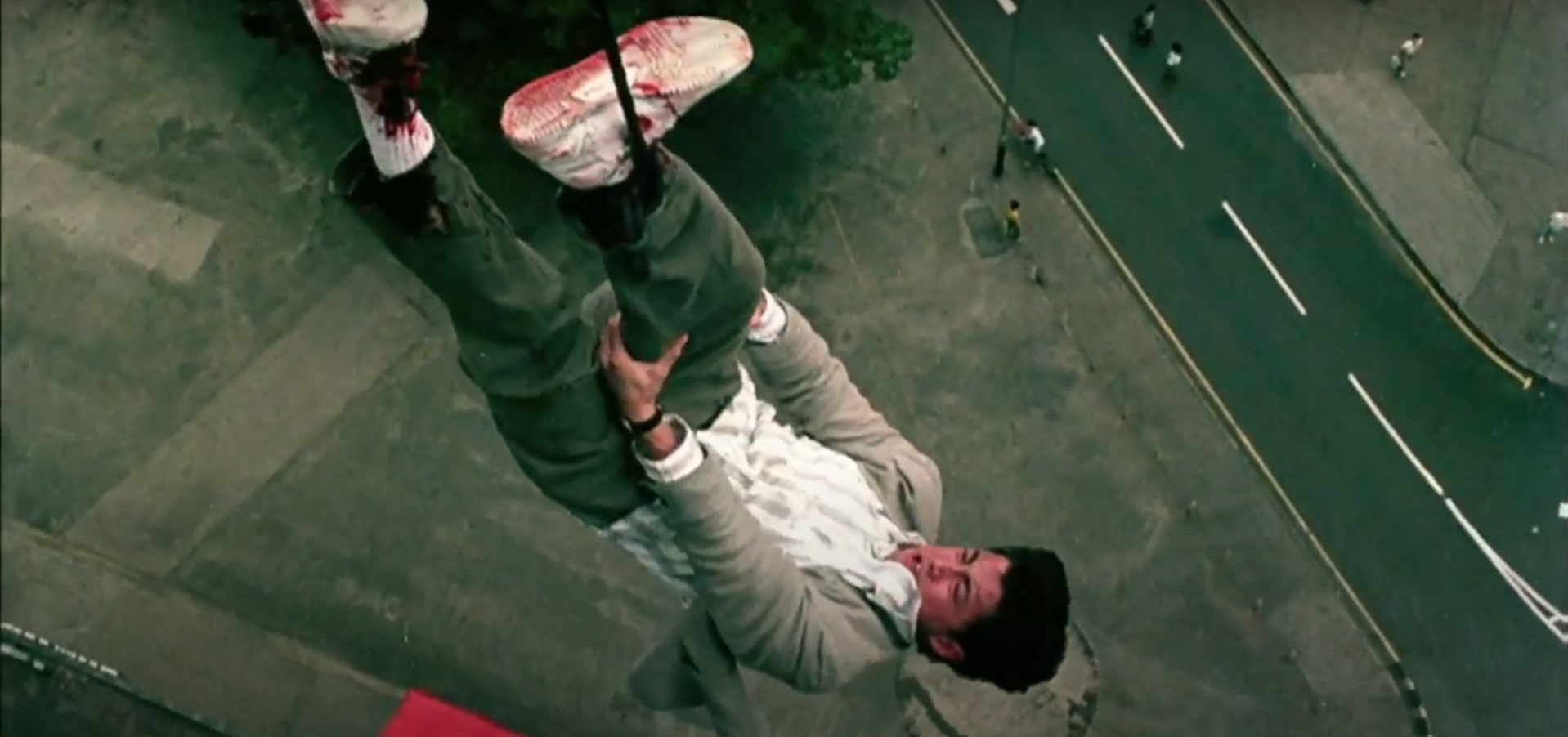
Working off another script from Rick Filon, the previous being “The Redemption : Kickboxer 5,” and hot off his humanoid cheetah role in John Frankenheimer’s “The Island of Dr. Moreau” remake, opposite Marlon Brando and Val Kilmer, the mixed martial artist Mark Dacascos plays the setup and scorned Michael Bishop, disgraced by his own military organizations, and reduced to being a bodyguard for an unscrupulous businessman.  Despite being soft spoken, Dacascos has great charisma on screen that mixes greatly with his eclectic array of martial art fighting styles, such as Muay Thai and Kung Fu.  Dacascos is a shoe in for leading man material, which also includes his swarthy good looks, and does fill the shoes of being a blacklisted former Navy Seal now on the hunt for who burned him in a botched Bosnia mission years earlier.  However, Bishop’s early motivation speaks more toward his character than his need for revenge as Bishop is not aware that it was his former attempted murderer James Sherwood, played by the towering and formidable Tony Todd (“Candyman”), who whacked his client.  Bishop becomes obsessed with the case which speaks to his loyalty and his completist mentality to see something through.  Overshadowing the leading man is Sherwood as Tony Todd instincts with this character is to be a merciless and cutting with his smooth handiwork and jibe remarks, all the while doing the horrible things with a sociopathic smile on his face.  Opposite Dacascos, in a semi-love interest role, is the pre-“Matrix” Carrie Anne Moss as Special Agent Castle who has more complexity of character than Dacascos and Todd combined.  Castle is a struggling single-mother trying to make headway in her governmental career but hits a snag when her morality is checked as she must either stay the course and go along with corruption to obtain security for her daughter or do the righteous thing and unsnarl dishonestly at the highest level with extreme prejudice for her sake of her daughter’s life.  Between the three principal leads, Castle’s arc is the steepest and more stirring with internal conflict, a testament to Moss’s performance.  Graham Greene (“Antlers”), James Purcell (“Bloodwork”), John Neville (“Urban Legend”), Heidi von Palleske (“Dead Ringers”), and Richard Coulter make up the rest of the cast.

“Sabotage” is a down-the-rabbit hole spooktacular 90s thriller, and I don’t mean spooky as in scary.  What I’m referring to is the characters’ covert agencies, such as the spooks of the Counter-Intelligent Agencies, and far-reaching operations that meddle and deconstruct a what should be a tidy organizational design with pot-stirring double-crossing, even triple-crossing, narrative paths that can be a strain to keep straight.  The film’s prelude and core story span 3 years apart and connect while there’s a simultaneous backdrop narrative that’s also connects but only exclusively in exposition.  Audiences will have to hamster wheel their mental gears to connect the dots and keep up with the pacing in this ever-evolving plotline that keeps the action caffeinated with a winding, hard-target center.  Takács also stylizes “Sabotage” with bullet-tracking special effects, high impact shelling, and an indulgence of explosive blood squibs that elevates the independent picture to an upper-class of B movie and gives the feature an edge of fun and entertainment that dichotomizes it from the more slapdash action films of the mid-90s where sex-appeal played more of a role than any other kind of actual action. 

Number 60 on the spine of MVD Visual’s Rewind Collection Blu-ray, Tibor Takács’s “Sabotage” breathes new life into the crisscrossing, projectile-pursuing, scacchic espionage extraordinaire. The AVC encoded BD50 provides a 1080p high-def resolution presented in an anamorphic widescreen 1.78:1 aspect ratio. A well-suffused and maintained print results in an excellent detailing of pixels and a punchy-noir grading. Details on the 2K scan print are historically omitted here, like with many in the Rewind Collection catalogue, but “Sabotage” doesn’t feign to be a product of enhanced visual replication with an organically pleasing form with minimal grain and only one noted frame containing age or damage wear. The uncompressed English language LPCM 2.0 stereo has abundance of vitality, discerning the layers through the dual channel funnel. Range of melee fire power has individualized zenith occurrences rendered at the right synchronization and depth makes the distinction of foreground and background dialogue, ambience, and the sort. Speaking of dialogue (pun intended), the uncompressed encoding keeps faithful fidelity, an ample and adequate of clearly expressed conversations without ever sounding muddled or lost in the skirmish. Optional English subtitles are included. Special features are little light for a Rewind Collection bannered release but what’s available packs a wallop with two new interviews with stars Tony Todd and Mark Dacascos on Zoom, or whichever face time platform is being used, going through their recollection and thoughts of “Sabotage” from nearly three decades ago. A Mark Dacascos trailer reel rounds out the special feature content. The rigid slipcover contains the reprint of the original “Sabotage” poster in a mockup of a VHS case; however, this particular Rewind Collection cover composition has less flair to sell the VHS facsimile. Inside cover art of the clear Blu-ray Amaray case contains the same poster sheet but is reversible with a less-is-more one sheet. In the insert section is a folded mini-poster of the primary cover art and, opposite, the BD50 is pressed with a plastic-patterned, VHS-tape motif. The region free Blu-ray comes unrated and has a 99-minute runtime.

Last Rites: Overall, a gratifying A/V and physical presentation of a mid-90’s, mid-level action-thriller encompassing a showcase of Mark Dacascos’s leading man chops as well as a different side to Tony Todd that isn’t encapsulated in the supernatural during the height of his career.

“Sabotage” on MVD Visual’s Rewind Collection Blu-ray!

An EVIL Assassin Battle Royale! “Mean Guns” reviewed! (MVD Visual / Blu-ray)

“Mean Guns” on MVD Rewind Collection Blu-ray! Purchase Here!

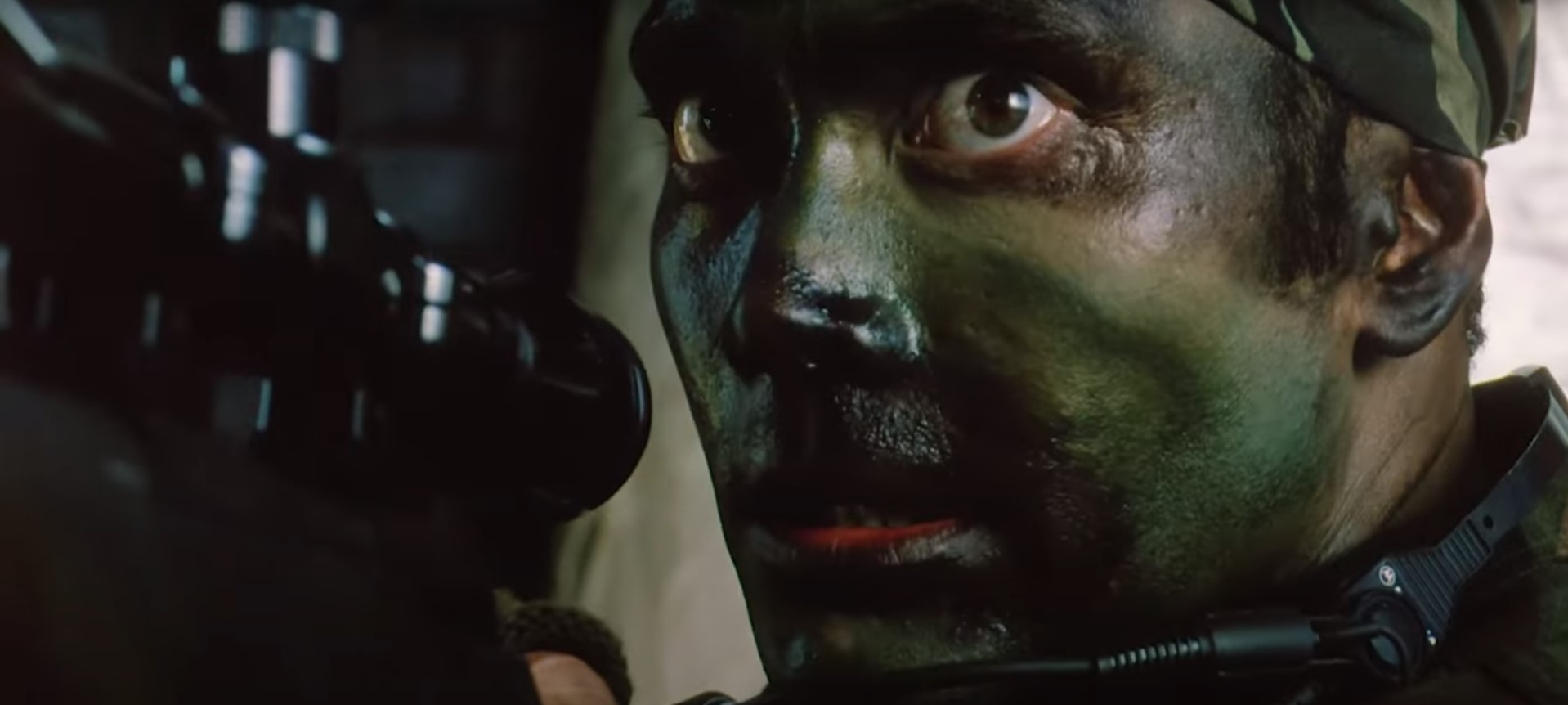
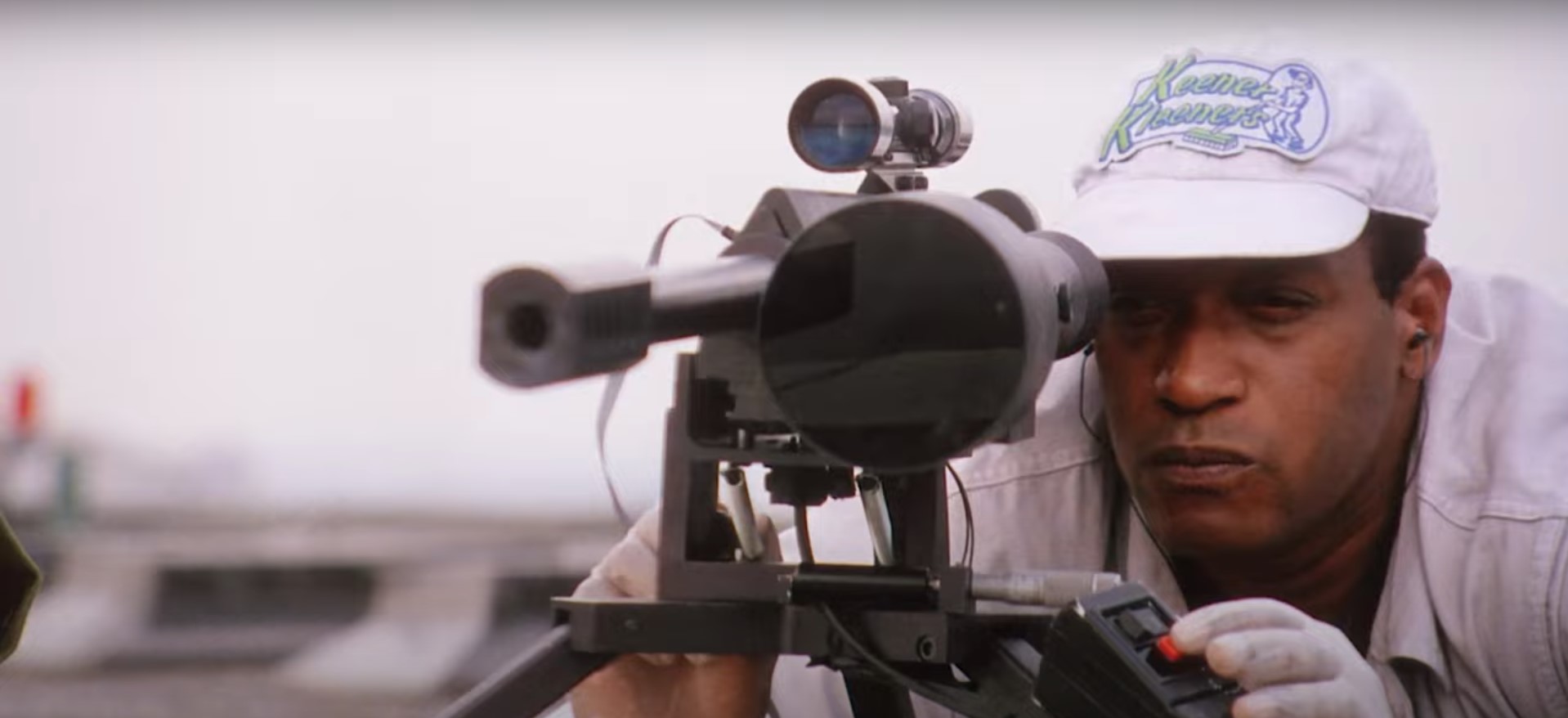
A Crime syndicate mid-level enforcer named Vincent Moon invites professional hired killers and syndicate affiliates to a new, urban-centric prison constructed by the organization the day before grand opening.  The reason for this elaborate invitation is simple:  all those invited have betrayed the syndicate in one way or another and are brought into the locked down prison to battle royale to the death.  The rules of the competition clarify no one will leave the premises, unless being gunned down by a rooftop sniper is acceptable to them, and three contestants must survive the game to claim the prize, the prize being a three-way split of ten million in cash.  As guns, ammunition, and melee weapons are dumped onto the battle grounds, a scramble ensues, and factions are made with 6-hour clock to kill nearly everyone in sight to live and be rich or to be slaughtered by Vincent Moon.  However, there’s no honor amongst thieves and thugs and the rules bend in a rigged high-stakes game of kill-or-be-killed.

The late director Albert Pyun was an ambitious, fast-paced, and prolific director who dominated the late 1980s through much of the 1990s with eclectic, science-fiction action.  The “Cyborg” and “Nemesis” writer-director severed the line between reality and the alternate that brought science fiction to a more grounded realism, such as we see in the aforementioned films, mostly because Pyun was always short on funds and short on time to deliver a final, finished feature.  With his 1997 actioner “Mean Guns,” Pyun severed into another layer on the existential plane and took hold of different kind of alternative reality, one that is plagued by an all-powerful crime syndicate that has its insidious hands in everything, even in the personal and professional lives and secrets of its own employees and hired contracts.  Andrew Witham wrote the script that was produced by longtime Pyun collaborating producers Tom Karnowski (“The Sword and the Sorcerer,” “Cyborg”) and Gary Schmoeller (“Hong Kong 97,” “Omega Doom”), together the trio founded Filmwerks which became the production company under “Mean Guns.” 

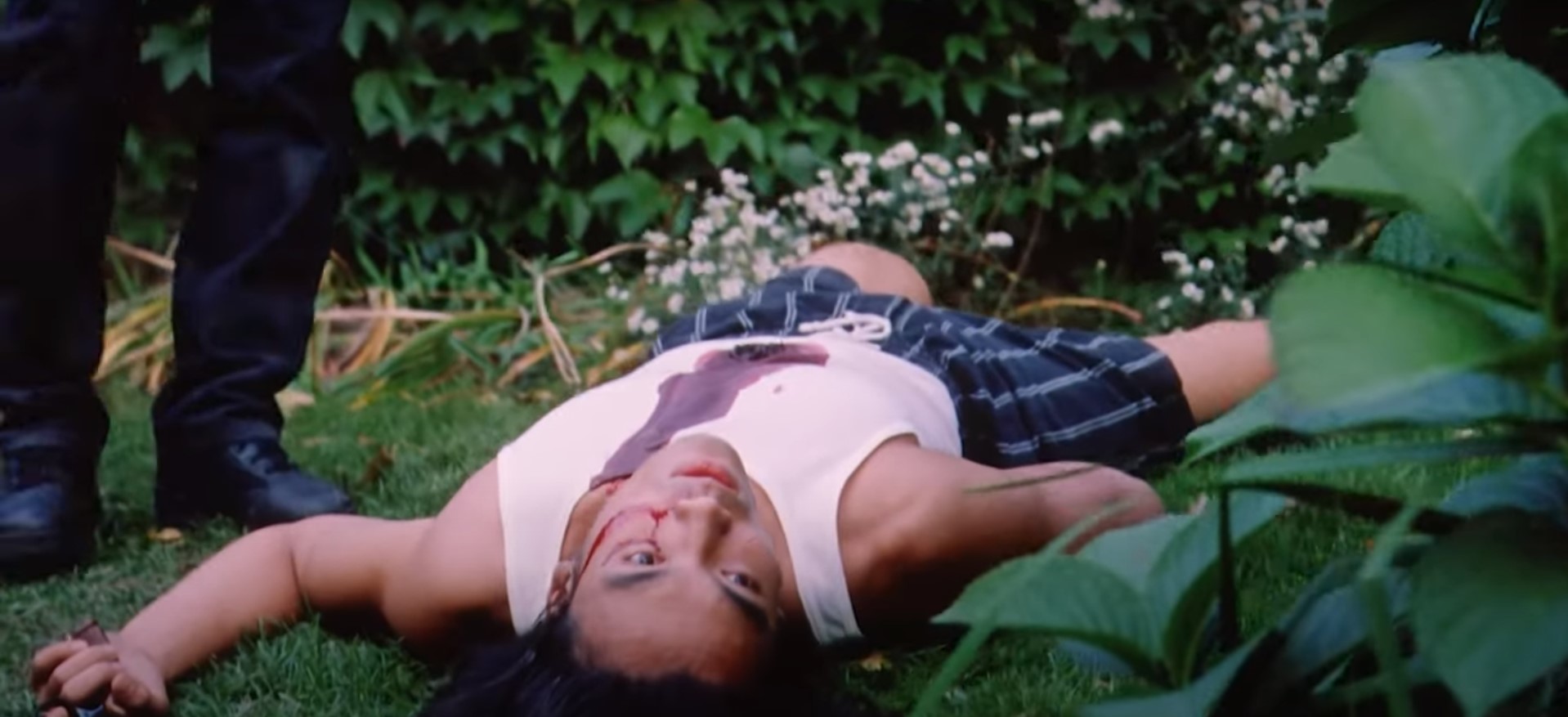
Pre-“Law & Order: SVU,” which would define his career in the film and television industry, rapper Ice-T worked himself in from behind a mic to in front of a camera mostly beginning in the 1990s with “New Jack City,” an urban gangster film that matched his on stage musical presence and starred opposite Wesley Snipes (“Blade”), Chris Rock (“Jigsaw”), and Mario Van Peebles (“Jaws:  The Revenge”).  Ice-T found cult status in more pulpy thrillers with exploitation “Surviving the Game” as a homeless man hunted down by a group of rich sport hunters and playing a post-apocalypse beast in the graphic novel adapted “Tank Girl,” but his gangster persona had stuck with him, leaving him the legendary rapper seemingly encircled in the same kind of urban gangster films. This is the case with “Mean Guns” as he portrays a philosophical, upper-level syndicate criminal Vincent Moon spearheading a game of wetwork for the unscrupulous wetworkers associated with his organization.  Not the most prolifically dialogued or screen timed role, Ice-T does what he can to bring Vincent Moon into the fold of much more colorful characters.  “Highlander’s” Christopher Lambert receives co-top of the bill as a psychotic assassin looking to atone for a careless sin.  Lambert is wonderfully unhinged while calculating as he integrates his “Highlander” sword skills and maniacal grin into his character of Lou, who through flashbacks had accidently killed a child on one of his hits and retrieves his biological daughter for an abusive stepfather to start life anew.  More pragmatic is Lou’s rival Marcus, stoically portrayed by Albert Pyun regular Michael Hasley (“Dollman,” “Nemesis 2”).  Together, Lou and Marcus must team up, along with the coldhearted D. (Kimberly Warren, “Blast”) and syndicate accountant turned informant Cam (Deborah Van Valkenbugh, “The Warriors’), to survive against the fray of likeminded killers.  “Mean Guns” cast fills out with Tina Cote (“Nemesis 2”), Thom Mathews (“Return of the Living Dead”), Yuji Okumoto (“Robot Wars’), Jerry Rector (“Vampire’s Kiss”), James Wellington (“The Evil Inside Me”), and introducing Hunter Doughty.

Like many of Albert Pyun’s caffeinated action films, “Mean Guns” is the epitome of vehemently slick dipped in a 90’s glaze of an alternative, unchecked free-for-all of bad hairdos, trench coats, and guns.  Lots of guns in a pre-computer-generated muzzle flash with real recoil and really bad, but good, one-liners.  What’s more surprising about this Pyun is that, unlike his previously mentioned films, “Mean Guns” is virtually bloodless albeit the shoot’em up melee violently lays waste to nearly 100 bad guys.  Pyun integrated a liberal use of blood squibs in his other guns-blazing and contentious conflicts, but “Mean Guns” takes a step back to a less severe tile like “Unkind Guns” with a comically coated film pulled straight out of a cheesy graphic novel.   For example, a combatant, thinking they just scored the briefcase full of millions, finds their head aflame and their face covered in black powder loony toon style after the opened briefcase explodes offscreen.  These moments provide a reality check to the already outlandish, yet highly entertaining, every man for himself game of death made willingly subjectable by its limited principals and Pyun style action. 

Getting ready to kill for this new Blu-ray of Albert Pyun’s “Mean Guns.”  The MVDVisual release, a part of their MVD Rewind Collection, is presented in a 2.35:1 aspect ratio, AVC encoded onto a 1080p, high-definition BD50.  Pyun and director of photography George Mooradian, who collaborated on many of Pyun’s films, such as “Cyborg” and “Nemesis” as well as standalone projects with “Bats” and “K-911,” utilized a spherical lens with steep drop-offs around the edges of the frame, almost looks like everything around the left and right sides should be falling.  IMDB states anamorphic lens but judging from the complete focus of the background and the severe oval-like nature of the frame, I’m leaning toward a spherical lens. For vast landscapes where length is nearly limitless, a spherical lens would be ideal to unify depth and main focus but since confined to a prison interior, compact hallways are squeezed in beyond a reasonable limit and often side-stance characters are warped in frame.  Details are generally fine with the hi-def pixel count that translates skin tones naturally pleasing with a few moments of corrective coloring aside from the occasional red hot temperature flashbacks that bath everything in color-varied reversal exposure.  The transfer isn’t perfect either with a couple of noticeable damage blips on the 35mm print.  The uncompressed English LPCM 2.0 stereo is a mambo-ladened, bullet-whizzing, melee-skirmishing, and depth-exacting design that’s well balanced and layered.  Dialogue remains free of audible blights and courses prominent throughout.  Optional English and French subtitles are available.  Special features, including an Albert Pyun introduction that’s encoded into the Play Film as well as the bonus content and to which had to be shot well before his death judging by the appearance of his rather healthy person in the video, includes an audio commentary by the director, a new interview with producer Gary Schmoeller, a new interview with executive producer Paul Rosenblum, and a new interview with composter Anthony Riparetti..  The original theatrical trailer is also included. I’m always elated to see the MVD’s throwback package design and the 59th Rewind Collection release continues the theme with a cardboard slipcover in mock disrepair with a corner edged torn and exposing the corner of a VHS tape cassette. Not to forget to mention the designed rental stickers to heighten the effect. Underneath the slipcase is a clear Blu-ray Amaray case with reversible cover art, each side promoted with a scaled down poster art bordered and backgrounded with a similar coloring shade. Inside, the disc is smartly pressed with a VHS-façade while the insert side has a mini-folded poster of the primary cover art. The region free release comes rated R and has a runtime of 104 minutes, which when watching the feature one can see perhaps some cuts were made for timing. Perhaps, Pyun had a longer version and had to edit and cut down for time.

Last Rites: A romping mayhem, “Mean Guns” is ballistically ceaseless and entertaining, if not also the touchstone of 90’s cheesy action, and is presented well here with in the latest, and greatest, MVD Visual Rewind Collection Blu-ray.

“Mean Guns” on MVD Rewind Collection Blu-ray! Purchase Here!

Everything is Bigger, and EVILLER, in Texas! “Deep in the Heart” reviewed! (Fun City Editions / Blu-ray)

“Deep in the Heart” on a Fun City Edition Blu-ray! Here for Purchase.

Boston born Catholic Kathleen was raised in a good home by Irish immigrant parents.  Having moved from the liberal Northeast America to Dallas, Texas, Kathleen finds employment as an American history teacher at a local high school.  She meets born-and-raised Texan, attorney, and gun enthusiast Larry Keeler at a colleague’s outdoor barbeque and the two casually see each other off and on with Kathleen not interested in something more serious with the charming and handsome, budding attorney, but Larry believes Kathleen’s too uptight to see how madly desirable she makes him and rapes her at gunpoint when he can longer steady his urges, proclaiming her sexual hangups and rigidness as faults against her immense drawing of sensuality during post-coital.  Reporting her attack to law enforcement and her Catholic priest for prosecution and spiritual relief, both agencies fail to side with Kathleen’s trauma based on the facts of the case and God’s ever-tolerant forgiveness toward everyone.  The anger seething inside impels her to chop off her long, blond hair, dress more matronly, and join a handgun gun club after Larry continues to casually insert himself into her life like nothing ever happened and down the barrel’s site, Kathleen plots her vengeance. 

If there was an ever a more culturally relevant and timely film today produced and released decades ago, encapsulating the worst parts of American history, “Deep in the Heart,” aka “Handgun,” is that very film.  Through the perspective of the expatriate filmmaker Tony Garrett, having been born and raised in a country without an intense gun culture, “The Prostitute” English writer-and-director entrenches his outsider take on America’s unique, and unhealthy, gun fascination around an equally powerful systematic rape culture that ignores the severity of the transgression and assigns blame to the victim and, in turn, has the attacker come out unscathed due to being an upright citizen and a pillar of the community amongst his, also male, peers.  Filmed entirely location in Dallas in 1981 but not released in 1983, Tony Garrett co-produces the film with American producer David Streit (“The Prowler”) under United Kingdom production companies EMI and Kestrel Films where American distributors were eager to bank off the sexy rape-and-revenge thrillers of “Ms. 45” or “The Last House on the Left” but received a more thought provoking and provocative thriller that analyzed more of a problematic inward of U.S. culture and global societal toxicity. 

A daunting and difficult role for any actress to play, Karen Young had captured the epitome of a formulaic victimized women in an injustice system for her first major feature-length role.  Young, who went on to have roles in “Jaws:  The Revenge,” “Daylight,” and “The Orphan Killer,” embodies the American dream of the young, educated woman, Kathleen, from humble beginnings living away from home and having a career as a high school teacher in Dallas, Texas.  Kathleen’s American dream is crushed by the methodical mentality of Larry Keeler, representing America’s grasping of the past of taking what you want, even if that means by way of force.  Keeler is played by born-and-raised Texan Clayton Day (“Osa”) with a fast-talking, full of himself reproach to a debut performance that involve rape at gunpoint and being fully nude with your equally green costar.  Garrett’s able to convert the two inexperienced actors into raw talent, extracting their singular qualities into a combined effort of a sordid cultural subtext and cat-and-mouse rape-and-revenge suspenser.  Kathleen’s transitional arc from the shy and innocent Catholic outsider to the hate-filled, pro-gun, self-serving vigilante proved to be a dazzling gem of range and moxie pulled from the rough depths of untapped talent and getting to that point is a journey expressed vividly and thoroughly to build up both characters’ constitutions without a ton of exposition or visual insight.  Keelers intentions never slip but we understand through his conversations with Kathleen he’s a gun advocate and collector, he’s a good-time, good ol’ boy party animal at a colleague’s bachelor party at the Foxy Boxy – a Women’s see-through T-shirt boxing competition, and he has overt charm pasted thick with insincerity with out on dates with the high school teacher from Boston.  “Deep in the Heart” is centrically designed around these two principals with an already established built around gun-toting, fast-and-loose, and blinders on male dominated environment inhabited by smaller, yet key roles from the denizens of Dallas.

“Deep in the Heart” is not the sexy, rapey, glorified femme fatale film every will think it is.  “Deep in the Heart” is what Tony Garrett understand and believe in from the interpretation of dark side, misguided American values and how those cultural thorns that prick into the side of the free world change the course of all that is good and pure in the foundational basis America is built upon.  Engrossingly tied to modern day hot topics, Garret had incredible foresight or, maybe, was just brazen enough to go against the grain being an foreign expat shocked by not only the legal system but by the backwards ideas and beliefs of everyday citizens in different regions of the country.  In not only the rape but the whole pre- and post-rape setup is surrounding Kathleen’s inquietude is noticeable and uncomfortable to watch.  Men and women alike should feel icky of the transpiring contexts of spirituality failure, justice system failure, and an overall human being failure that lets Kathleen suffer in silence without the hoopla of scandal and punishment.  Instead, Kathleen’s bottled anger works inward toward a radical, retribution fix, resurrecting her from downtrodden ashes like a phoenix carrying a six-shooting revolver poised to a point of no return in DIY selfcare. 

Fun City Editions understands the power from “Deep in the Heart” by showcasing a new, restored transfer for their Blu-ray release.  Restored in a 4K scan from the original 35mm camera negative, making its first Blu-ray appearance globally, “Deep in the Heart” is stored on an AVC encoded, 1080p high-definition, BD50 and presented in an anamorphic widescreen 1.85:1 aspect ratio.  Not a whisper of image infraction, “Deep in the Heart” has a gorgeously graded picture that sees hardly any signs of aging or wear and the Fun City Edition’s restoration keeps the elements in alignment with the feature’s period of a late 70’s to early 80’s harsh filmed layer.  Color hues are vibrant and bold without appearing washed, presenting near perfect textures on clothing, skin, and environment and darker scenes keep contours and some details present without being completely dense or lost in any compression banding and splotches.  A lossless English DTS-HD mono track is more than ample audio for a very tight knit thriller mostly for indoor acoustics.  Exteriors capture the and highlight the appropriate milieu ambience, managed well within the single layer monaural to keep dialogue front and center.  Dialogue does not go without some crackling and hissing but not enough to be a nuisance, just noticeable.  Mike Post’s soundtrack is eclectic between night club boogies and harrowing hangers.  English subtitles are optionally available.  Special features included are a newly recorded audio commentary by Erica Shuliz, co-host of the Texas-based Unsung Horrors podcast, and Irish filmmaker Chris O’Neill providing in-depth insight and analyst of Tony Garrett’s underappreciated film, a brief archive interview with directory Tony Garrett on his perspective route as an outsider looking at the celebration and de-celebration of guns in America, an image gallery, and the theatrical trailer.  Tactile elements and striking rigid slipcase art from graphic artist Tom Ralston makes this Fun City Edition highly desirable as the U.S. title “Deep in the Heart” graces one side and the U.K. title “Handgun” can be found on the back (or front depending on how you look at it).  Sheathed inside is a clear Blu-ray Amaray casing with reversible cover art of three different country posters from the U.S. (primary) and U.K. and Japan (on the inside).  Disc is pressed with more Ralston imagery while the opposite side insert is of a 10-page color booklet with a new essay from film critic and author, Alexandra Heller-Nicholas.  Rated R with a region A playback, “Deep in the Heart” has a runtime of 99 minutes. 

Last Rites:  “Deep in the Heart” is an important film.  For some, the rape-revenge thriller can be either be eye-opener and another reminder added to the long list that America is gun crazy and legally not perfect.  For others, those expecting the sleazy, sexy rape film followed by the subsequent gratuitous violence will quickly go limp by Tony Garrett’s call-it-as-he-sees-it narrative that, for an intensive purposes, coincides with the rest of the world’s perception. 

“Deep in the Heart” on a Fun City Edition Blu-ray! Here for Purchase.