EVIL Has the Right to Remain Dead! “Magic Cop” reviewed! (88 Films / Blu-ray)

No Two-Bit Magician In ‘Magic Cop” on Blu-ray!  

Hong Kong cops are confounded by a chaotic drug bust when learning that their female suspect, who had managed to overpower an entire unit of male officers and even take a bullet ambling deadpan into the streets, had died 7 days prior.  An outlying officer, and practicing Taoist, Uncle Feng is called to Hong Kong to not only quickly solve the narcotic crime but also investigate the unnatural properties of the case.  Feng is accompanied by his city eager niece Lin and two Hong Kong cops, a Taoist devotee and skeptic of Ancient Chinese spiritual mythologies.  Together, they track the drug trail to The Sorceress, a Japanese witch with powers that rival Feng and that can resurrect the dead into zombies and vampires to do her bidding, such as trafficking narcotics.  When the investigation closes in her business, The Sorceress and her right arm, skilled fighter plan to remove the only man worthy of stopping her.

Fans of Ricky Lau’s “Mr. Vampire” will once again be amazed and entertained by the fantastical and mystical action of Stephen Tung Wai’s “Magic Cop.”  Tung, a fellow martial artist and stunt man who had roles in “The Fatal Flying Guillotine” and John Woo’s “Hard Boiled,” helms his debut directorial penned by Chi-Leung Shum (“Vampire vs Vampire”) and the longtime Stephen Chow script writer Kan-Cheung Tsang (“Shaolin Soccer,” “Kung-Fu Hustle”).  The screenwriting duo brought lighting quick comedy to the mostly fictionally invented yet sprinkled with slivers of hard-pressed veracity and definitive entertaining occultism and what resulted resurrected “Mr. Vampire” semblance out of the being a period piece and into the modern day, backdropped in the year of 1990 when the film was released.  Long rumored to be the fifth sequel of the “Mr. Vampire” franchise, “Magic Cop” is a coproduction between Movie Impact Limited, Millifame Productions Limited, and Media Asia Film with star Ching-Ying Lam producing.

“Magic Cop,” and even “Mr. Vampire,” wouldn’t have such a cult following if it wasn’t for the Vulcan eyebrows and thin mustache of Ching-Ying Lam in costume.  The short-statured, Shanghai-born Lam delivers the same vigorous choreography and tranquil demeanor to this particularly stoic character of Uncle Feng, a Taoist practitioner to essentially wrangle unruly entities and please the spirits in the in-between our world.  Feng is old world and finds himself in surrounded by modernism when in Hong Kong, goaded by the young lead sergeant attached the case.  Practical as well as disrespectful, Sgt. Lam (Wilson Lam, “Ghost for Sale”) epitomizes today’s, or rather back then the 1990’s, modern man who has forgotten tradition and deference to those who came before.  Though padded with a fair amount of comedy coursing throughout, balanced against the impeccably edited tango fight sequences, Sgt’ Lam’s partner, known only as Sgt. 2237 played by “Centipede Horror’s” Kiu-Wai Miu, risibly wants to understudy Uncle Feng’s powers while Feng’s niece Lin, played by Mei-Wah Wong of “The Chinese Ghostbusters,” provides the subtle and quirky opposite sex that catches of the philandering eyes of Sgt. Lam.  The ragtag quartet of influx mindsets and personalities become challenged by their single common goal, to stop whoever is behind breathing life into the formidable dead and stop the unorthodox method of drug smuggling.  Former Japanese bodybuilder Michiko Nishwaki (“City Cops”) embodied that very dark magic antagonist.  Nishiwaki handles The Sorceress character with ease despite not having a surfeit army under her thumb; instead, this forces Nishiwaki to become the entire villain body with the slight, full-contact support for her right-hand bodyguard (Billy Chow, “Future Cops”) and a couple of undead lackeys, including Frankie Chi-Leung Chan of “Riki-Oh.”  “Magic Cop’s” cast rounds out completely with well-versed and seasoned, late actor Wu Ma (“Mr. Vampire,” “Return of the Demon”) as the chief inspector polarized in a complicated history with Uncle Feng.

What director Stephen Tung Wai boils down in essence is another variation of good executants of spirit humbled caretakers versus the wicked necromancers existing inside the fabric of the highly praised and cult-following “Mr. Vampire” universe.  Frankly, there’s nothing wrong with that derivativity since Ching-Ying Lam, Mr. Vampire himself, produces and stars as the titular hero.  Lam can conjure whatever-the-hell he wants in order to battle Hell itself.   “Magic Cop” is also a well-made, entertaining story, balanced between the contest wizardry, slapstick comedy, and the character dynamics, and stacked with improbable yet gratifying step-intensive fight orchestration that has gawked early martial arts films a wonder to behold and continues to do so to today but now trickles with pizzazz more-after-more due to put in place industry safety measures.  “Magic Cop” contains that lost art of potentially hazardous palatable physicality that beguiles more than the movie’s faux magic exhibited on screen.  To add to the authenticity, very little painted composited visual effects were used with makeup and the actors doing much of the heavy lifting with the editing team of Ting-Hung Kuo and Kee Charm Wu in full cut-and-paste fortifying mode to button up each sequence with comprehendible continuity of each punch, kick, and magical chopsocky.  One overtone made well known in “Magic Cop” is the unfillable chasms between old and new, respect and disrespect, and myth and science from whence solves no problems until some unified common ground can be reached in order to succeed, in this case, to stop a bitch of a witch.    

An age-resistance 35mm print scanned onto a buffed 2K Blu-ray that extracts the best print elements to-date. The AVC encoded, 1080p, Blu-ray presents Stephen Tung Wai’s picture in a widescreen 1.85:1 aspect ratio. A fine-tooth comb through the celluloid couldn’t unveil any major issue with the 88 Films release. Colors are richly grafted within the sabulous surfaces that are exceedingly defined with delimited, shadow-creating depth. Decoding speeds average around 35Mbps on a BD50, securing categorical choiceness amongst other releases and formats (that is until the potential 4K release). The release comes packed with four audio options to explore: The original Cantonese DTS-HD master audio 2.0 mix, a Cantonese DTS-HD 2.0 home video mix, an English DTS-HD 5.1 master audio dub, and an English DTS-HD 2.0 dub. Between the variated audio mixes, we preferred the original Cantonese DTS-HD 2.0 due to its cadence with the image and welcoming exactness through the lossless compression process. You can make do with the other three options, but the fidelity is much better with the original mix and only anti-subtitle sectarians would be pleased with an English dub. English subtitles are optional and synch well the dialogue but be prepared to speed read as the pacing is quick much like the dialect. Software special features include an audio commentary with Hong Kong film experts Frank Djeng and Marc Walkow, an alternate, standard definition Taiwanese cut of the film with alternate score, an interview with director Stephen Tung Wai, image gallery, and trailer. Endowed with a limited-edition, cardboard slipcover, the dark green Blu-ray snapper has newly illustrated, front cover artwork by Manchester graphic designer and 88 Films resident artist Sean Longmore, which is also on the cardboard O-slip. The reversible cover art has a reproduction of the original Hong Kong poster art. Stuffed in the insert is a mini-folded poster of Longmore’s front cover and a disc art, a scene moment captured in spherical rotunda, of the opening sequence. Available with a regional playback limited to A and B, the 88 Films release is not rated and has a runtime of 88 minutes. ‘Magic Cop, perhaps, wasn’t the sole proprietor of influence but certainly had a black talisman plying hand in the substrata of more Western favorites like “Big Trouble in Little China” and is a crucial cornerstone in representing the best of the Hong Kong Golden Age of cinema.

No Two-Bit Magician In ‘Magic Cop” on Blu-ray!  

Recalled to Nam is a Return Tour of EVIL! “Kill Zone” reviewed! (MVDVisual / Blu-ray)

Enter the “Kill Zone” on a New Blu-ray Home Video!

Combat POWs are captured by enemy forces, imprisoned in an outdoor internment camp.  Tortured for information, the prisoners are held without water in the scorching heat, strung up for hours on posts, beaten to a pulp, and stowed away in a hotbox if they do not cooperate with interrogators.  When Lt. Jason McKenna snaps and loses grip on reality, he breaks free from his confinement and kills four guards during the process when the soldier believes he’s back in Vietnam.  The only problem for McKenna is that the enemy imprisonment was a his own military’s roleplay training exercise for POW-survivalist.  The commanding officer, Colonel Crawford, had pushed McKenna too hard, making the exercise realistic as possible despite the warnings of fellow trainee and McKenna’s friend, Mitchell.  Now, the incensed Colonel is out for blood, covering his tracks with military leadership as he and the gung-ho soldiers seek to put an end to McKenna and it’s up to Mitchell to find his troubled friend first. 

The high-body count film that became the launching point for what would form Action International Pictures, 1985’s “Kill Zone,” an American-made, military actioner written and directed by the late David A. Prior (“Sledgehammer,” “Killer Workout”), opened the production door for a string of both action and horror ventures that spawned cult followings over the decades to come, especially when obscure titles such as “Kill Zone” never made it passed the release of its VHS format – until now.  John Saxon’s “Death House,” “Teenage Exorcist” with scream queen Brinke Stevens, and even the pint-sized creature feature “Elves” are just a few titles that owe “Kill Zone” some ounce of ground working thanks.  Prior cowrote the script with Jack Marino, who also produced the film under the limited formation of Spartan Films, and was shot in and around what is now Prado Regional Park in Chino, California.

Trekking from internment camp to civilization, aka the kill zone, and fighting and fleeing for their very lives from their own crooked military unit are McKenna and Mitchell, played correspondingly by “Killer Workout’s” Fritz Matthews and Ted Prior, younger brother of director David Prior.  Though Matthews has the emotional range of a tree stump, the leading man more or less fits the bill as a tall and stocky soldier protagonist while Mitchell does all the emotive heavy lifting of the pair, reflected in his large and muscular Stallone-sized biceps.  The comrades’ necks fall under the boot of Colonel Crawford from an aging David Campbell (“Scarecrows”) whose ridicule onslaught is dousing and his ruthlessness remains constant but can’t top the baseline he cemented early on into the story, diluting his villainy with not much formidableness, and becomes a feeble opposition.  Colonel Crawford is backed by his equally inadaqute military unit, former fellow trainees that divide themselves into a clique against the diverging outliers McKenna and Mitchell who separate themselves from the apathetic herd thinking either by post-traumatic mental illness or for concrete concern for a life-saving friend.  Either way, the rest of the unit bully their way into Crawford’s good graces albeit the Colonel’s lack of interest in the lives or death of his men in a nationally organized armed force that breathes the creed to keep the peace, but the Colonel’s men are just as complicit to their commanding officer’s callousness when they begin to rough up and snuff civilians in what is the most cold-blooded aspect of “Kill Zone’s” torrent.  Dennis Phun (“Surf Nazis Must Die”), Rick Massery, Richard Brailford, William Zipp (“Mankillers”), Richard Bravo (“Killer Workout”), and Larry Udy fill out the Colonel’s men while Ron Pace, Tom Baldwin, Jack Marino, and Sharon Young round out the civilian contingent.

On the surface, “Kill Zone” has the presentation of a direct-to-video, low-budget rip of “First Blood” but like the Sylvester Stallone John Rambo thriller, commentary undertones rise to the top with an additional few bobbing and freestanding from 1982 film.  Producer Jack Marino admits watching “First Blood” prior to writing the script that obviously become appropriated from the Ted Kotcheff picture in what is an underlining post-traumatic syndrome plagued individual in a dormant stage of the affliction then becomes pried open by aggressive, misapprehending authority with no time for a condition they’re ignorant too.  What follows is a deadly resistance against a barbaric enemy and the starkly different situations both characters John Rambo and Jason McKenna find themselves caught up in parallel their hellacious Nam tour in many synapse-snapping and physically scarring aspects to a point where the line blurs between being back in that Hell in reality and being back in that Hell in the mind.  What “Kill Zone” adds to its own version of the tale is no pedestrian anti-war pushback like we see with Brian Dennehy’s Podunk sheriff and his deputies but rather a shift in commentary toward the military’s once push harder and neglectful treatment on PTSD in what becomes an anti-military production to the extreme.  John Rambo had military sympathizers in Richard Crenna’s Colonel Trautmann but Jason McKenna’s Colonel spat flak with nothing but contempt for what he considers a weak soldier.  While military criticism is large and in charge, what negatively impacts “Kill Zone” is the no flare for technical military behavior or jargon.  The opening combat scene exemplifies the inexactitudes with Mitchell and his team storming through brush and across a river toward an unseen enemy’s stronghold guns blazing like little boys with popguns and mouthy explosions sounds of amateurism splayed all over as he and his team run wildly, hop like a bunny into fire stances, and point rifles with no line of sight.  Prior is able to achieve some nice shots of ammunition exchange with slow profile pans and aerial assaults filmed up from the ground, but there’s too much downplay to take this low-rung action film seriously and to really get a viewer the headspace of “Kill Zone’s” deathtrap montage that warrants more respect than what the rest of the presentation layout provides.

Missing in action from contemporary formats for over three decades, “Kill Zone” finally becomes rescued from inferior definition captivity and arrives onto DVD and Blu-ray (reviewed) courtesy of MVDVisual’s Rewind Collection series.  The Blu-ray is an AVC encoded, 1080p high-definition transfer scanned and restored in 4K from the 35mm interpositive print.  Presented in a widescreen 1.78:1 aspect ratio, the new transfer breathes new life into the lost but not forgotten feature with an enriched color grading and a sharpening of details, especially textures of the foliage and rocky terrains and assorted skin features.  Not entirely impeccable, contrast often teeters in the same frame and there’s an abundance of saturating grain, like large raindrop grain, in nighttime image that wash out details to great extent, but we’re always reeled back in with warm and pleasant color palette that flushes the previous VHS release quality down the core memory exiting drainpipe.  There’s one or two moments of vertical scratches, indelicately faint, and rough editing patches that distort to a blip that may be more problematic and age-related from the interpositive print than the dynamic restoration that was done.  The English language LPCM 2.0 mono track suffers from the low-quality sound recording equipment or placement that renders dialogue soft and nearly unintelligible as volume levels severely spike depending on how much the actors are projecting their voices.  There is some minor, unobtrusive popping throughout the fidelity faithful ambient and dialogue track, the latter, though softly wavering at times, does ultimately prevail to the forefront.  Optional subtitles are available.  Special features include a new audio (and optional video) commentary with producer Jack Marino, moderated by Cereal at Midnight host Heath Holland, a new Making-Of Kill Zone” featurette with clips interview with Jack Marino moderated by “Kill Zone” restoration project producer Steve Latshaw, the Vestron Video VHS version of the feature in standard definition, a photo gallery, and the original theatrical trailer redone with restoration elements.  The action-packed original poster art obtains a renewed look for the Blu-ray’s retro cardboard O-slip that resembles a torn, scuffed, and stickered VHS box art. Underneath the slipcover, the same poster art is on the front of the clear Blu-ray snapper case with latch and on the reverse side a back-the-scenes still images of Ted Prior and costars in character form.  The insert holds a folded mini-poster of the original poster art and the disc is pressed with the ridged gridlines of a VHS shell cassette with insert this side directions at the top.  Pretty neat design that further leans into “Kill Zone” VHS cult following purgatory.  MVD’s 50th release of the Rewind Collection is rated R feature has a runtime of 91 minutes and the Blu-ray is region unlocked for everyone’s viewing pleasure.  No longer destined to live out its shelf life on VHS, the wonderful contributors to obscure movie restoration brings “Kill Zone” back into action with a rejuvenated hi-def release that’ll blow you away. 

Enter the “Kill Zone” on a New Blu-ray Home Video!

Under an Urban Club Scene, EVIL Horrors Connect Us All. “Flesh City” reviewed! (Wild Eye Releasing / DVD)

“Flesh City” Yearns for Connection on DVD!

An insomnious city pulsates with an industrial soundtrack and claws cantankerously at denizens without pity. Under one of the raging night club scenes, enamored raver Vyren follows the beautifully alluring Loquette, an inspiring electronic DJ, down into the club’s labyrinth of old stone corridors. Their coquettish play becomes the monitored study of Professor Yagov, a glowingly cadent and mad experimenter of anthropology. The two lovers are drugged and abducted by the Yogav with the intent of genetic mutating the couple’s anatomy that renders Vyren’s hand displaced with a bulbous nub and Loquette impregnated with an ingestible sludge. What becomes of their affliction insidiously infects the entire city population with a flesh tentacle curling through the city’s underground sewer and drainpipe infrastructure in what amasses to a single connection of brain-invading techno-horror.

“Flesh City” annexes our individuality for the sake of connective solidarity conveyed in an electronically infused and alternatively aesthetic experimental film from Germany’s own jack of all independent media and artistic trades, Thorsten Fleisch. The 2019 released feature is Fleisch’s first and only written-and-directed full-length film depicting his feverish analog avant-garde, reflecting the filmmaker’s menagerie of orthodox-shredding short films, video art, and written and produced music. Overseeing “Flesh City’s” cinematography and special effects, Fleisch has complete and utter autonomy of the visuals to obtain a harshly discordant image melody edited together, which Fleisch also manages, into an agglomerate of acetic aesthetics to shock and stress the audio and visual cortexes. Once under the working titles of “Berlin Blood” and “Zyntrax: Symphony of Flesh,” “Flesh City” is entirely shot in Berlin, Germany, produced by the director and United Kingdom producers Arthur Patching and Christian Serritiello, and is a feature of Fleischfilm and Tropical Grey Features.

One of the film’s coproducers and musical artists, Christian Serritiello (“Streets of East L.A.”), is at the front lines of “Flesh City’s” afterthought cast of characters with Vryen as essentially the naïve and lured-in Alice chasing the white rabbit Loquette, played by Eva Ferox (“Love Songs for Scumbags”), down the twisted rabbit hole of a cellar dwelling doctor.  I say afterthought because the characters take a backseat to Fleisch’s contortion of reality and the analogical subtext generated by Fleisch’s love for analog anomalies, using them as supporting pawns to carry out his visceral vision of vitality.  Music videos, psychedelic montages, and grotesques images of beetles absorb screen time like formless or arthropodal principals.  Even Professor Yagov (Arthur Patching”) is obscured by a rainbow shimmer, never visually seeing his face as an individual seemingly between two dimensions.  “Flesh City” is a very multiverse, multidimensional nightmare-scape of unconventional color that has culminated from Fleisch’s imaginative idiosyncrasies over the years and that’s what being intently showcased here with more evident display of a less-character driven, shapeless story within the technical aspects of the DVD release where the soundtrack drowns the dialogue into a muffled deaf tone, like any good loud music venue would subdue.  “Flesh City’s” urbanites fill out with Marilena Netzker (“Love Songs for Scumbags”), Shaun Lawton (“Possession”), Denis Lyons (“German Angst”), Anthony Straeger (“Call of the Hunter”), Maria Hengge (“Love Songs for Scumbags”), Helena Prince (“12 Theses”), and Thorsten Fleisch in a Max Headroom meets Total Request Live-like host role of Quantum 1337.

“Flesh City” will not be everyone’s approx. 90 minutes of how to spend their time choice.  The experimental film will only speak to a few select souls with a filmic affinity for Lynchian peculiarities, Terry Gilliam’s bold fantasy, David Cronenberg’s body horror, and a hellish capriccio along with an eclectic music palate for noise rock, henpecking alternative, and strident industrial bass.  I wouldn’t go as far as saying Fleisch’s film is akin to nails on a chalkboard but can be boisterously unpleasant to the ears at times while, in the same breadth, be stimulating visually, even if that stimulation may induce a photosensitive epileptic seizure.  Fleisch’s non-traditional narrative design splices in music videos from various underground and indie artists with him providing introduction as an illusionary host in a virtual world, breaking up the Vyren and Loquette’s post-punk-adelic core quandary with a teetering melodic cacophony of feedback rock electronic, a hostile rhythm, and bizarre lyrics and visuals.  Fleisch pushes the taboo envelope with not only liberal nudity, to which Germans are very at ease with their body image, but also within the unconfined stylistic creativity of multi-formats that razzle-dazzles like the innards of radiant plasma globe; the Tesla coil electrons that’s drawn to your conductive flesh won’t hurt you but provide a feeling of captivated wonder.  Yet, don’t expect to be thrilled in a traditional predator-and-prey sense as “Flesh City” appeals more to our disconnect from each other and how to reconnect must be through some kind of inclemency. 

Likely to transmit under the radar, “Flesh City’s” biomorphic body horror arrives onto unrated director’s cut DVD home video courtesy of cult and independent distributing label Wild Eye Releasing in association with Tomcat Films.  The DVD5 presents the transfer in a widescreen 2.35:1 aspect ratio with varying levels of image quality due to different types of equipment and methods used to create Fleisch’s tripped out vision that contains, but isn’t limited to, black and white, color, stylistic lighting, analog equipment, digital equipment, stock footage, and so forth.  This mishmash movie makes for divisible degrees of signal quality that can be look crystal clear in one scene and then heavy noise interference the next, but the overall clarity is remains stable without any scenes being rifted because of visual vagueness.  The audio comes in two formats:  a English Dolby Digital 5.1 surround sound and a English Dolby Digital 2.0.  Frankly, the original English dialogue track is feeble under the tremendously potent soundtrack and sound design that makes comprehending Vyren and Loquette subterranean exchanges under the industrial rumble of the score virtually impossible to discern.  Even Quantum 1337’s cyber-stutter chat softly introduces us into his world, essentially leading the blind into a mound of musical mania. Bonus features only include other Wild Eye Releasing trailers with the physical aspects of the DVD come with a misconception cover art that has a terrifying gaunt and fleshy, humanoid creature front and center, but that creature doesn’t exist in the film until maybe at the climax that’s nebulously discernible at best what viewers are supposed to see. Inside the standard DVD snapper, the disc art is pressed with the same front cover image but with no accompanying insert. The region free disc features the unrated film with a runtime of 84 minutes. “Flesh City” is a delicacy of distortion, but the Thorsten Fleisch film is an acquired taste that general audiences won’t have taste for but, then again, general audiences are not Wild Eye Releasing’s target audience, now are they?

“Flesh City” Yearns for Connection on DVD!

Amongst the EVILs of Digital, Analog Rises from the Grave! “Night of the Zodiac” reviewed! (SRS Cinema / DVD)

A Mock VHS Retro on a Mock VHS Retro DVD!  “Night of the Zodiac” from SRS Cinema!

A bizarre and grotesque dream about the once notorious Zodiac killer inspires Richard Gantz to create a movie worthy of his idol’s praise.  With little income and having just lost his girlfriend and his job, Gantz is on the brink of being homeless and unable to materialize his dream into reality until he receives a mysterious, unexpected phone call.  The Zodiac killer got wind of his project and is offering support to finance and bestow guidance to Gantz’s film as long as the struggling, yet eager, filmmaker can crack Zodiac’s cipher and stomach the enigmatic task before him.  Gifted the Zodiac’s iconic mask and murder knife, Gantz sets out to record his first kills that pays homage to his aging idol but his mentor wants him to be creative with the new chapter worthy of the Zodiac name and gathering a whole new set of slaves for his paradisal afterlife.  When Gantz hits a barrier of inspiration, he solely becomes reliant on the Zodiac’s encouragement that has become few and a far in between. 

Susana Kapostasy is who I like to label a mad genius.  Many filmmakers have attempted to create antiquated formats of yore with watered down imitations, but for the Michigan-born videographer and editor-by-trade Kapostasy, what has been a challenge to most to faithfully recreate has simply become second nature for the video production enthusiast.  Scraping up any and all elderly video camcorders she could find, the “Metal Maniac” director wrote-and-directed her sophomore feature film “Night of the Zodiac,” pulling inspiration from one of the most notorious unsolved murder cases in America by the Zodiac Killer in San Francisco.  From the West Coast to the Midwest, “Night of the Zodiac” is filmed in and around the backdropped Detroit area for the Zodiac’s next round of sliced-up slaves – only in the creative, moviemaking sense, of course.  The 2022 film has the spitting image of a 1980s/1990s SOV with ghastly, gory effects, a killer hair metal soundtrack, and video characteristics that’ll have you trying to adjust the tracking setting on your DVD/Blu-ray player.  The Johnny Braineater Production is produced by star Philip Digby with Kapostasy serving as executive producer alongside co-cinematographer Apollo David Zimmerman.

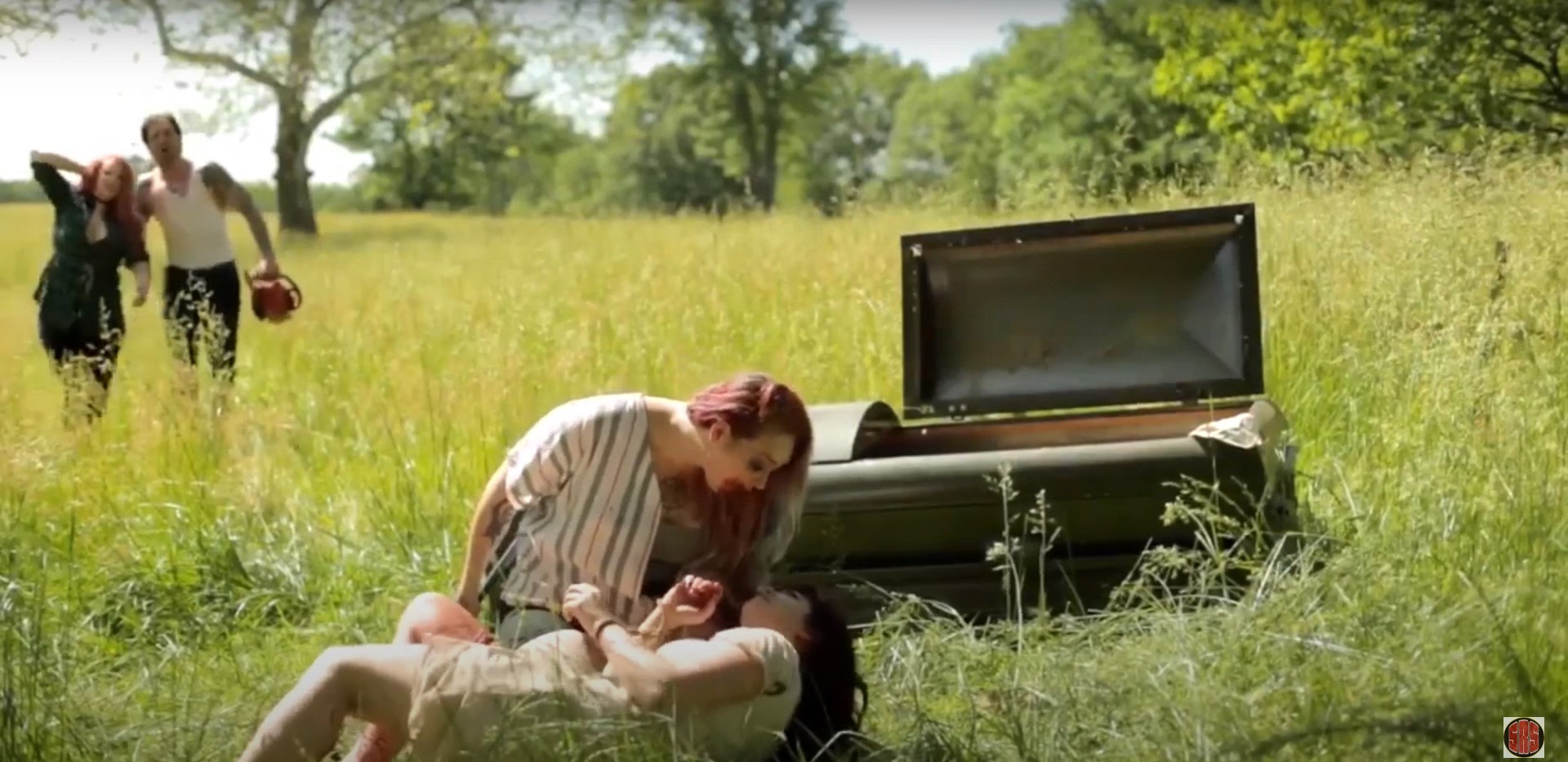
Stepping into the shoes of the infamous serial killer to embark on a theoretical continuance of the real life mass murdering character is Philip Digby.  Channeling his best Jeffrey Dahmer vibe in looks alone with a crazed and obsessive personality suited for Charles Manson, Digby plays a hodgepodge of America’s most notorious killers, adding his own flare for film into the fold to make him a full-fledged psychopath, as he internally celebrates the moniker after his disparaging roommate/Landlord (Victor-Manuel Ruiz) labels him with an ear-to-ear grin and a nearly whoopie jump for joy.  Digby’s eccentric mania thrusts us beyond a threshold we didn’t even realized we had crossed from the very first opening dream sequences of a rotting, coffin-thronged corpse oozing maggots and putrid viscera and, believe it not, my opinion is this thrust doesn’t do justice to Gantz’s character because of the lack of foundation of setting up viewers with an inbred psychosis that puts into question, how did he survive this long without killing someone before?  Dreams are power but are they powerful enough to twist a seeming normal film lover into a frantic frenzy of vile fates and videotapes?  I think only Freddy Krueger can answer that.  Gantz goes around town slaughtering people in parks, in their driveways, and even makes one very bad magician (Derek Dibella) wish he requested to hire Gantz as a videographer for a promotional video disappear as Gantz strangles him to death.  “Night of the Zodiac” completes the cast with Logan O’Donnell, Mark Polonia (director of “Splatter Farm”), Tim Ritter (director of “Truth or Dare?”), and Benjamin Linn as the voice of the Zodiac.

From the video production veneer to the set decorations and locations to the characters themselves, “Night of the Zodiac” perfectly captures SOV horror in this modern day time capsule.  Not until the credits, when I see master craftsman of SOV horror filmming, Tim Ritter and Mark Polonia, appear in the cast credits did it dawn on me that what Susana Kapostasy had accomplished was a labor of love for the niche market, resurrected four decades later and revered by horror fans who were likely still in diapers or weren’t even born yet – maybe to go as far as not even a twinkle in their parents’ eyes.  Yet, there were clues to “Night of the Zodiac’s” contemporary construction, such as the opening title which had a clean, well-polished illustration and Kapostasy’s film is very self-aware by slathering horror in every recessed corner with mountainous stacks of VHS tapes, posters, and  and often, perhaps every other scene, displayed tribute to filmmakers, like Ritter and Polonia, who were still counterparts and establishing themselves as independent videotape artists during the 80s-90s.  This self-awareness harnesses more comedic relief than horror, accentuated by Gantz’s matter-of-fact imbalance, and the humor loosens the reins on “Night of the Zodiac’s” cold cruelty a tad but what the gore spools back in audiences by spilling lots of blood. 

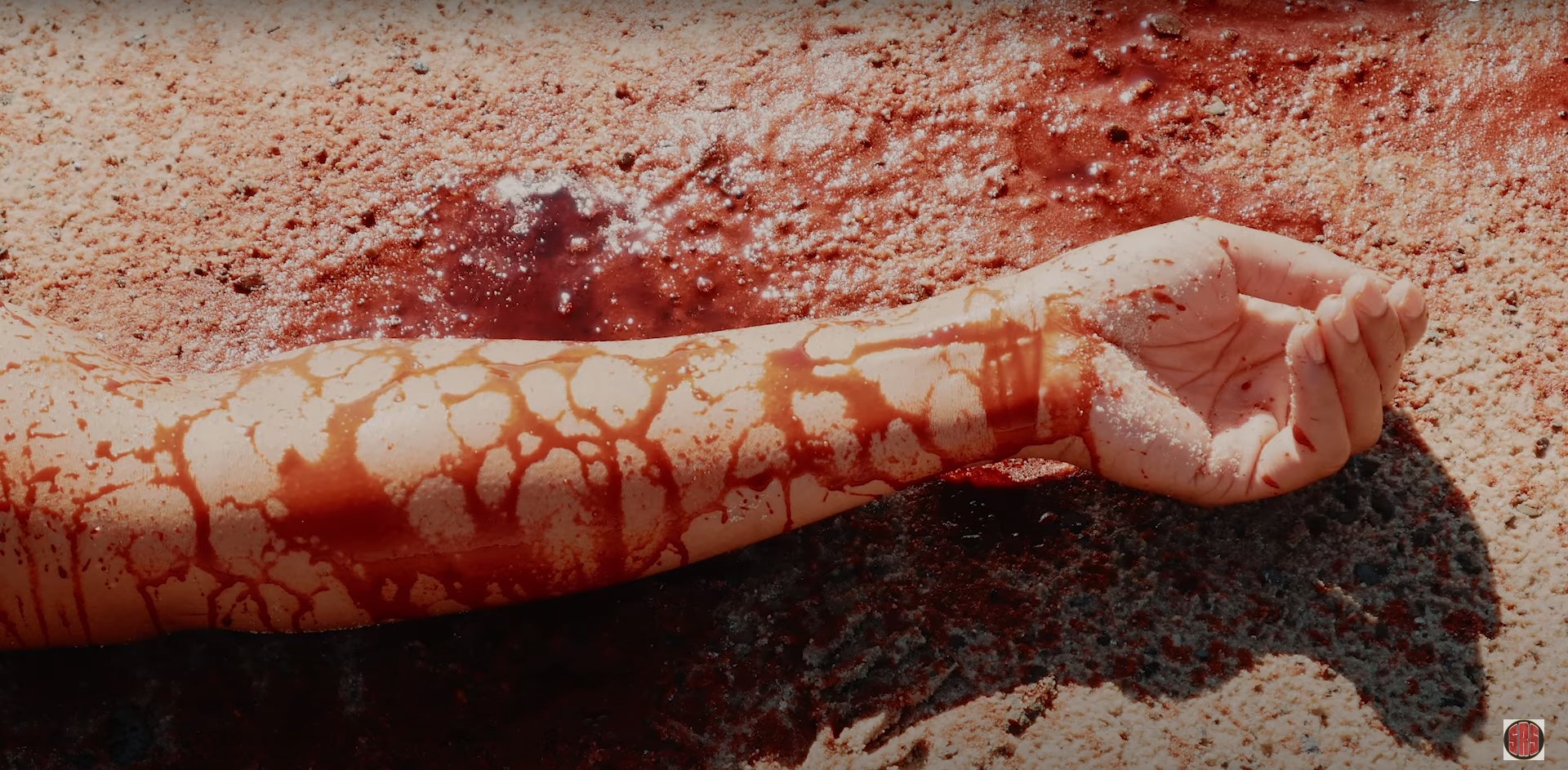
SRS Cinema releases “Night of the Zodiac” onto DVD with a single layer encoding and presented in a throwback letterbox 1:33:1 aspect ratio.  Kapostasy uses a slew of equipment – Cannon XL2, Sony Video 8 AF, Panasonic AG 450, JVC GY X2BU, JVC GY X3, Panasonic AG 456, Panasonic AG 196, Sony CCD FX 330, and a Sony VO 4800 U-Matic S VTR – with some be more present-time cams run through U-matic VHS playback to degrade for SOV quality.  The intentional SOV has a variety of distinct looks with distinct quirks that flexes higher magenta levels in earlier scenes as well as tracking lines and aliasing artefacts.  Detail levels also vary but the overall VHS brands generally remain the same with soft, indistinguishable contours with also a surprising amount of depth and hue range.  The English Dolby Digital 2-channel (2.0) mix can sound boxy at times and come accompanied with a piercing, underlining interference.   Telephone conversations have no distortion depth so the other person on other line sounds present in the room.   The soundtrack from Anguish, Locust Point, and the brunt of it provided by Stoker is metal madness but does overshadow the dialogue when shredding through the scenes.  Dialogue is often clear, but again, no depth and echoey.  There are no subtitles available for this release.  Bonus Features include an audio commentary by director Susana Kapostasy, star Philip Digby, and costar Victor-Manuel Ruiz that goes over a lot of technical aspects of “Night of the Zodiac’s” look and how they obtained the gore and blood for the film, a Tim Ritter conversation about how he became involved with Kapostasy’s video enthusiasm and provided analog input, a blood cannon showcase that’s instructionally descriptive as well as you’ll see Kapostasy’s foot accidently go into the 5 gallon Homer bucket, a gore score Ouija board gag, recreating the Zodiac cipher, and the trailer.  SRS Cinema’s release dons a retro VHS design front cover with an exact and beautiful illustration of Gantz’s copycat Zodiac attire with a cropped version of the front cover on the disc art inside the traditional black snapper case.  “Night of the Zodiac” has a runtime of 86 minutes, is not rated, and has an all-region NTSC playback. Difficult to immerse oneself into a half-a-century old unsolved murder while sticking to glorifying merely the guts and gore, “Night of the Zodiac” stuns more qualitatively with video techniques thought archaic and obsolete but Susana Kapostasy steadfast proves otherwise in her undying love for the flawed, yet nostalgic format.

A Mock VHS Retro on a Mock VHS Retro DVD!  “Night of the Zodiac” from SRS Cinema!

Three Women Murder to Stand Up Against EVIL! “A Question of Silence” reviewed! (Cult Epics / Blu-ray)

“A Question of Silence” Laughs Louder than Words on Blu-ray!

Three different in age and lifestyle women carry on with the routine of their normal lives until police offices arrest them on the charge of murdering a male owner of a clothing boutique.  Having seemingly no motive and have no connection to each other, never having met each other before, the confounded prosecution hire a psychiatrist to determine the women’s mental state for the brutal beating of the shopkeeper.  As the psychiatrist interviews and digs into their personal lives to give rationality to an irrational crime, she finds herself drawn to the women and their heinous act stemmed by a life history that paints a picture of dehumanizing neglect and of providing zero respect.  Subjectively overwhelms objectivity the deeper she looks into their case and her professionalism is put to the test when she has to decide whether being labeled insane fits the accusation or if a more gender bias systemic issue is at play.

After a rousing first part of feminist revenge with “Red Sun” from 1970, we fast-forward slightly over a decade later in 1982, and moving from out of Germany and into the Netherlands, with Marleen Gorris’s acclaimed crime drama “A Question of Silence.”  With little-to-no film prior film experience, Gorris becomes a provocateuse with her debut picture that stirs controversy amongst one side of the sexes.  “A Question of Silence,” natively titled “De stilte rond Christine M,” or “The Silence around Christine M.,” became the best Dutch film of the year with local accolades, including a Golden Calf for best film at the Netherlands Film Festival the year of release.  Along with the Rudolf Thome’s “Red Sun” and the German social commentary on women integrating into equal social and professional positions, Gorris comes at a time where the status of Dutch women were on the lower end of the gender equality scale, especially in the workforce.  Matthijs van Heijningen, who produced polemic features directed by women filmmakers, such as Nouchka van Brakel’s “A Woman Like Eve” and “The Cool Lakes of Death,” risked yet another credit to his name with the virtually unknown writer-director Marleen Gorris and her sizeable undertone story under his company, Sigma Film Productions.

The narrative opens with Janine van den Bos and her husband Ruud having a flirtatious moment on the couch where Janine playfully annoys her book-reading husband with advances sexual foreplay.  Without knowing who these two people are exactly, other than they’re in a version of a relationship, Janine, played by Cox Habbema, and husband Ruud, played by Eddy Brugman setup metaphorically what’s inherently wrong with society with a woman seeking something and the man ignoring her and practically commanding her to stop the foolishness in a dismissive way.  This opening scene then cuts to the three women being arrested, led up to by intercuts of their daily routine before the police confront them.  We’re treated to some of the most idiosyncratic and grounded performances by Edda Barends as the muted housewife Christine, Nelly Frijda as the cackling coffee barista Annie, and Henriëtte Tol as the beautiful and intelligent secretary Andrea.  The three women never met before, never plotted before, and never killed before but a sudden epiphany while shopping became the straw that broke the camel’s back, turning watershed into bloodshed that unveiled something just as sinister as murder.  Cox Habbema engrosses herself into the psychiatric role as an educated woman analyzing and judging other women while also being judged herself by the opposite sex despite a higher-level of learning and professionalism.  Without exposition, characters express themselves through action while being ambiguous through dialogue, working to convey the lopsided gender equality across the screen perfectly without even one ounce of explanatory detail dropped. 

What’s most intriguing about Gorris’s film is it’s mirroring quality to society.  “A Question of Silence” doesn’t fabricate grand futures or alternate universes with eccentric, wily characters to be metaphorical fodder of expression; instead, Gorris remains earthbound, present, and timely by incorporating true-to-form examples that create derogatory silence on women.  The non-linear narrative, cutting back-and-forth from investigative present to the chronicled past visualizes the women’s struggles and frustrations living inside a male-dominated culture.  From being expected to handling all aspects of the household and childcare, to being brushed off and dismissed by colleagues, to forgotten and underappreciated, Gorris forces a frank contemplation on a patternized and patronized patriarchy.  Heightening the tension, Lodewijk de Boer and Martijn Hasebos’s giallo-esque and experimental soundtrack adds a layer of loadstone to see whether these extempore femme fatales executed a crime. 

Cult Epics, in association with the Eye Film Institute, continue their campaign on delivering thought-provoking, provocative, and controversial Dutch masterpieces onto the high-definition stage with their latest release, “A Question of Silence.”  The AVC encoded, 1080p, BD50 stored feature is presented in the 1:66:1 European widescreen aspect ratio.  The 2K HD scanned transfer and restoration is based off the 35mm print; however, judging by the grain levels and very little preserved detail, especially in a HD scan, I’d say the original negative was 16mm and then blown up for 35mm project, which was a fairly common process.  The noticeable enlargement of grain dampens picture details less favorable yet not the image quality is not a total wash with a stable graded rendering, with a natural skin tone and pigment of objects, and the presence of imperfections kept in a minimum – such as the occasional cigarette burns and dust/dirt.  What excels here mostly is the lack of compression issues so we’re only treated to the innate quirks of the original celluloid film.  The release offers two Dutch language audio options – a LPCM 2.0 mono and a DTS-HD MA 2.0.  Toggling between both tracks, there’s not much different between them until Nelly Frijda’s crone-cackle distinguishes itself with robust HD prominence projecting full-bodied through the dual channel.  Again worth noting, Lodewijk de Boer and Martijin Hasebos synthesizing score, coupled with Marleen Gorris’s tense and taut flashback storyline, casts a disquieting tone that’s very fitting for a film entitled “A Question of Silence.”  Dialogue, as well as the score and overall soundtracks, suffer very little from the slight hum of the running camera and some minor hissing but the general result has tremendous.  English subtitles are optional and synch well with error-free translation; however, upon watching the special features, the Cult Epics’ feature translations differ from the copious amount of snippet clips of the interview segments.  Roughly the same interpretation but the phrasing maybe clearer and less wordy in the snippets so I’d be interested in the, what I assume would be, the original English translation.  Special features include an audio commentary by film scholar Patricia Pisters, an archival Cinevise interview with Marleen Gorris from feature release year 1982, a sit-down, one-on-one interview with lead actress Cox Habbema and Cinevise host a year later, a Polygoon Journal Newsreel from ’82 that mentions the Golden Calf award from the Netherlands Film Festival, a promotional gallery, and trailers.  The clear Blu-ray cover comes with the tear-drenched and shadow-obscured face of Cox Hebbema with a reversible still image of the three accused women on the inside.  No insert included and the disc is pressed with the same front cover art.  Cult Epics Blu-ray comes with region free playback and the feature is 97-minutes and unrated.  Marleen Gorris first run as a filmmaker denotes her as a masterful storyteller with a timeless tale of close-quartered and subtle masculine tyranny in an attempt to open the unwilling eyes of the narrow focused. 

“A Question of Silence” Laughs Louder than Words on Blu-ray!