

Scott Edwards, a struggling college student, works as a rickshaw runner on the vivacious streets of Miami. When a beautiful woman offers more than just the rickshaw fare for his service, Scott reluctantly accompanies her on a private boat secured at the local harbor for a night of sensual loving, but Scott finds himself in the middle of a voyeuristic scheme by being videotaped behind a two-way mirror and before fully copulating, Scott roughs up the secret cinematographer and the woman escapes. After realizing he forgot the tape, Scott returns to the boat to discover the man dead and all the evidence points to him, framing him for the murder. On the run and being hunted down by Miami PD and the actual killer, Scott embarks on a mission to clear his name, with the help from the woman on the boat, a stripper named Victoria, and a Chinese witch named Madame Luna, during a pivotal time of Chinese mythology that pits good versus evil entrenched sordidly around a renowned televangelist.

Perhaps one of the most offbeat action-fantasy-horror movies to come out of the U.S. in the late 1980’s, the “American Rickshaw” cinematic experience can be a mesmerizing 97 minutes of claptrap theology and clandestine villainy bedim by a witch’s obscured telepathy powers of fire, snakes, and unveiling evil with a human to pig physical transformation. Also known as “American Tiger” in the States and “American riscio” in Italy, the film has the sensation of a blend of various filmmaking abstracts and for very good reason, it is. Notable Italian filmmaker, Sergio Martino (“Torso” and “Slave of the Cannibal God”), helms the cultivation of a big-ticket American production with the ethereal supernatural essence invoked by the Europeans that results into being one of complex whirlwind of a story from a script penned by Martino, Roberto Leoni (“Sex Diary”), Maria Perrone Capano (Beyond Kilimanjaro, Across the River of Blood”), and Sauro Scavolini (Your Vice is a Locked Room and Only I Have the Key”). Dania Film, Medusa Distribuzione, and National Cinematografica serve as the Italian production companies responsible for the “Rickshaw’s” wild ride through Miami heat.

With a premise already on a high bonkers plane, “American Rickshaw’s” curiosity extends to the casting of an American Olympic gold medalist in gymnastics, the perfect 10 recording Mitch Gaylord, is cast as the male lead, Scott Edwards. The physically fit Olympic hero with little-to-no experience or exposure in acting to his name became the story’s prime suspect on the run from not only the law, but a merciless goon embodied by “Elvira: Mistress of the Dark’s” Daniel Greene. Greene already had an established relationship with Sergio Martino, having worked previously with the director on “Hands of Steel” and “The Opponent,” marking “American Rickshaw” as his first collaborated effort in being the story’s villain, Francis, who is seemingly more of the antagonist foe for Scott Edwards than his sect master, Reverend Mortom, a masquerading televangelist seeking to exploit an ancient Chinese relic for nefarious purposes and it’s “Halloween’s” Donald Pleasance to be the face of what would be established as quintessential evil. Pleasance seemingly goes along with the story even when has to snort like a pig during the character’s climatic ending, but is enveloped in a rather mundane, behind-the-scenes puppet master preaching a good biblical hellfire and brimstone game only to be castrated as a backseat bad guy with little to no vice exploration other than swindling the Chinese witch while dolled up in a kimono. The cast rounds out with Victoria Prouty, Darin De Paul, Roger Pretto and Regina Rodriguez and Michi Kobi as the young and old Madam Luna.

I’m one who never likes to research movies before watching them; I believe knowing the film in and out before viewing will more than likely become ruinous toward the quality of perception and cement a foundation of fixed judgement before the opening title credits roll. I don’t even like reading the film’s synopsis for the fear of spoiling too much on too little so I sat down with “American Rickshaw” knowing virtually nothing about the Marino anomaly and coming out relatively pleased, strangely piqued, and from start-to-finished bewildered. Off the bat, “American Rickshaw” could be grossly compared to be the East Coast variation of or, perhaps, the Italian answer to “Big Trouble in Little China” that channels less Chinese mysticism for more mysterious thriller. There are some noticeable similarities between the two films, such as for the obvious uncanny powers of Madam Luna, and then the not so obvious, but maybe more of a referential nod to John Carpenter’s film with the main character sporting a graphic tank top of a tiger that’s familiar with Jack Burton’s graphic yin-yang tank top, the young and old versions of Madam Luna resemble the young and old versions of Lo-Pan, and the scene where a prominent character gets runover by a big, red semi-truck. You know, the kind of rig Jack Burton mows down Lo-Pan with? “American Rickshaw” pales in comparison or, perhaps, shouldn’t be compared at all as Martino’s spellbinds his work by riddling it with cross cuts that attempts to discern solely by optics that swiss cheeses your mind as it tries to fill in the gaps of where the hell did that snake come from? Why did the key burn through his hand? Why is the stripper key to Scott’s Journey? What’s the reason behind Scott’s year of the tiger birth date significance toward his impelled Chinese zodiac destiny? There lies so many questions, but very few are answered; Yet, “American Rickshaw” is the wonderland tour Martino fabricates as some dysfunctional vision quest mapped with spontaneous witchery, horoscope horrors, and a devil pig in human clothing.

As the second half of the inaugural releases of Cauldron Films, “American Rickshaw” receives a limited edition Blu-ray release with a 2k restoration scan from the original camera negative. Since the review is based off a Blu-ray screener and not a physical copy, only 1500 copies being release, the A/V aspects of the package will not be critiqued, but this unrated 80’s hybrid action-fantasy-horror will receive the works, including a limited edition high quality slipcase with new artwork by Mattias Frisk, a reverse covering featuring the Italian artwork, and a booklet inside with writings by grindhouse comics writer and Tough to Kill co-author, David Zuzelo. The picture will be presented in a widescreen, 1.66:1 aspect ratio, with an English language LPCM dual channel audio track with optional English SDH subtitles. Bonus material aplenty with an one-on-one interviews with director Sergio Martino and production designer Massimo Antonello lamenting about the film while as providing a stark difference between Italian and American filmmaking in the late 1980s, a then and now look at filming locations, The Production Booth Podcast, including commentary from Samm Deighan and Kat Ellinger discussing the zaniness of “American Rickshaw,” and an image gallery. Distinct beyond anything else you’ll ever see and indelible with solid practical effects, “American Rickshaw” deserves the upgraded, horror-marketed update set apart from the poorly sultry, softcore porn “American Tiger” U.S. release that stiffens the story’s true self on retail shelves.
Tag Archives: nudity
Nothing Will Stop EVIL From Being EVIL! “Chaos” reviewed! (Dark Force Entertainment & Code Red / Blu-ray)

Visiting home on break from UCLA, Angelica visits her close friend, Emily, at her parents’ secluded country home. With nothing else better to do in the small rural town just outside Los Angeles, the two teenage girls set off early to attend a local rave deep within the woods at the reluctance of Emily’s overprotective parents and to kickstart what could be a drink and dance fueled night, they aim to push the limits and find a drug pusher to score ecstasy as the first priority to make a dull party fun. They run into Swan who promises the best ecstasy as he leads them to his cabin away from the rave. What Angelica and Emily find is themselves caught in the middle of a ploy by a sadistic gang lead by the ruthless Chaos, whose wanted in 4 states for his barbaric and merciless methods and looking for something fun to play with and torture. The cat-and-mouse game with the girls makes an interesting turn when the gang arrives at Emily’s parents’ house when their van breaks down and the parents suspect them in Emily’s sudden disappearance, veering the night into unreserved chaos.

“Chaos” is the intended true love song remake to Wes Craven’s 1972 sadistically vile “The Last House on the Left” that’s co-produced by Marc Sheffler, who play Junior Stillo in Craven’s film, and, at one time, Krug himself, David Hess, was attached to the project. “Chaos’s” conception is the brain child of Steven Jay Bernheim and David DeFalco, with the DeFalco wielding the hammer of writer and director, and the pair have collaborated a few years earlier on another DeFalco directorial, a comedy horror entitled “The Backlot Murders.” In the eyes of the filmmakers, the amply charged exploitative “Chaos” shares more in common with the original “The Last House on the Left,” despite having no official connection other than the ties with Marc Sheffler, and that the more commercialized remake of the same original title, released four years after “Chaos” in 2009 by Universal Pictures Home Entertainment (UPHE), lost that raw camerawork and visceral storytelling that depicted the abhorrent human malevolency that’s capable from within us all. “Chaos” is essentially a self-funded project from Steven Jay Bernheim’s Bernheim Productions.
Though Sage Stallone, the late son of the iconic action movie star, Sylvester Stallone, receives front cover bill due to, in perhaps, his name alone, but the film is called “Chaos” which centers the story around the “Heat” and “Laid to Rest” actor, Kevin Gage. In some kind of cosmic circumstances in regards to recent events, before the Kelly Preston settled into married life with John Travolta, she was once wedded to Gage, marking “Chaos” as a timely film from 2005 and a just so happened upon my lap occurrence for this review. Yet, Gage, a seemingly giant of a man with a resemblance build toward WWE/WWF’s legendary Bill Goldberg, utilizes his intimidation appearance, transferring all the good and gentleness that’s described of him from fellow costars into a pure embodiment of evil whose misogynistic, bigoted, a killer, and just a downright bad guy giving way a testament to the character’s adverse moniker. Gage brings to the table a formidable tone, viperous wit, and a clean cut brutality in the most sordid and unforgettable ways that makes him stick out as portraying one of the most inhumane villains in the last 15 years of the cinematic universe. Chaos’s infamy is by ingenious design from the Marc Sheffler and David DeFalco collaborations who, along with the actors’ faux backstories, meticulously craft each of the gang’s personalities. Sage Stallone’s Swan seems like a similar parallel version of Sage in reality as a chain-smoking, reserved individual sans the perverse context. “The Love Witch’s” Stephen Wozniak is a complimenting character that offerings a different personality with Frankie and Frankie’s feels like a two-bit slime ball with long, greasy hair, an unkempt beard, and a scrawny figure but can produced an evil that’s step or two back from Chaos; Frankie is a character you’ll love and you’ll love to hate, making Wozniak’s performance singular and one of the best in the film. Then, there’s Daisy, the only female of the group though more butch than delicate, and Kelly K.C. Quann (“Baberellas”) adds a dose of Southern inhospitality to Daisy’s brutish beauty. “Chaos” rounds out with a bunch of victims; hell, everyone’s a victim, but the cast includes Deborah Lacey, Scott Richards, Maya Barovich, Chantal Degroat, Ken Medlock, and Jeb Barrows.

“Chaos” absolutely equates toward the unflinching callous themes from “The Last House on the Left” of violence amongst various degrees of people, youthful ingenuousness, and systematic racism with the latter being extremely relevant and on point, years earlier, of the current social climate in America. Yet, with any remake, “Chaos” yearns to stand on its own by instituting an unmeasurable sense of graphic violence that will churn stomachs, advert eyes, and belly-up the throes of disgust. For a good portion of “Chaos,” the exploitation narrative is fairly run-of-the-mill, damn near walks the same line as Craven’s story, with a sadistic gang kidnapping two young women for their own amusement only to then wander unknowingly into the arms of retributive parents, but two scenes sticky out and go beyond the course of customary exploitation fodder and into necrophilia, mutilation of body parts, and a perverse way to kill another human being with such tactless intentions that the act makes the other gang members splay questions, doubt, and fear amongst their faces. The film opens up with a written warning, not so much on the intense scenes themselves, but resembling more of a public service announcement for parents that what you’re about to see does and will happen to the youth of land, but these shocking scenes are just that, for shock value, and that a small percentage of people partake in such grisly matters. “Chaos” is violence upon violence, leaving no room for conscious absolving resolutions in the unofficial capacity of a remake that pungently separates itself with extreme violence and that’s saying something considering Craven’s visceral first course.

As the bestow flagship release of Dark Force Entertainment, “Chaos” arrives onto a deluxe special edition Blu-ray in association with Code Red and distributed by MVDVisual. Transferred through to a 1080p, high definition scan, from the original 35mm negative, complete with extensive color correction, and presented in a widescreen, 1.78:1 aspect ratio. “Chaos” doesn’t look very chaotic anymore in regards to the image quality; instead, the before stardom cinematography by Brandon Trost (“Lords of Salem” and “Halloween” remake) creates the voyeuristic position of the audience is now visually distinct with stable color markers that are more in tune with the premise’s raw approach. The English language dual channel stereo mix renders softer than desired, especially in the first act as Angelica and Emily converse through the woods. The teenagers dialogue are nearly mumbling on their rave trek with depth issues perplexing their relation to camera. Range seems to be well faceted: rustling leaves through the woods, the clank-clunks of a rustic van, the ground skirmishes. All seem to exude exact decimals of their intended value. Even the firing of firearms has a pleasantry about it. The special features include brand new interviews with co-producer Marc Sheffler, who goes in-depth pre-production and production while also touching upon his other interests before concluding with director David DeFalco and a man in a banana suit making an appearance and offering up dick jokes, and actor Stephen Wozniak with a fountain of information about his time on production, his fellow cast, and about the filmmakers as he is being interviewed in front of a locomotive museum. I love the absurd, obscurity of it all. The bonus material rounds out with commentary from the director and producer as well as the original theatrical trailer. The lewd and radical “Chaos” has engrossing roots of violence that burgeon into realm of rarity or, if not, into sadomishsim extended by the filmmaker’s deepest darkest desire, but what’s transpires on screen is difficult to look away from which begs the question, is it morbid curiosity or is there something far more sinister within us all?

Own “Chaos” on on the new “Blu-ray” release!

EVIL’s Greatest Trick Was Convincing The World Giallo Was Dead. “Abrakadabra” reviewed! (Cauldron Films / Blu-ray Screener)

In Milan 1951, a prestigious magician, Dante the Great, is tragically killed when a deadly trick goes wrong. Fast forward 30 years later, the magician’s son, Lorenzo Manzini, has trouble finding his own success following his father’s footsteps as a struggling magician. The night before his grand debut, a woman has been gruesomely murdered on the very stage his father had died. As a compulsive gambler and an excessive drinker in over his head in debt, Manzini goes on with the show, but the events following his performance inspire a grisly, sadistic murderer to uses magic tricks to kill and point all evidence toward him. Hounded by a mysterious, chain-smoking detective, a frantic Manzini must split his efforts toward his own investigation into the murders, but as the bodies start to pile up and the evidence grows even more against him, there may not be anything left in Manzini’s bag of tricks to prove his innocence.

In the old traditions of an Italian murder-mystery, “Abrakadabra” is the 2018 released giallo inspired film from the Argentinian filmmaking brothers, Luciano and Nicolas Onetti, along with Carlos Goitia serving as the third wheel scriber on the script. The trio have worked previously on one other project from 2017, another horror of course, with the haunted ruins premised, “What the Waters Left Behind.” With the Onetti’s being brothers, their collaboration runs deeper, sharing an affinity for the genre that has inspired the duo to collaborate on another giallo thriller, “Francesca” in 2015 and “Deep Sleep,” where Nicolas served as producer to Luciano’s writing and directing duties. “Abrakadabra,” as well as “Francesca,” are not only far cries from the haunting and terrifying reminiscence of the ruins in “What the Waters Left Behind,” but also varies in direction, cinematography, and production design that more in lines with giallo hallmarks, such as extreme closeups, awkward camera angles, and posh interiors. “Abrakadabra” is a production of the Nicholas Onetti and Michael Kraetzer New Zealand founded company, Black Mandala, and another Nicholas production company on a more localized level with Guante Negro (Black Glove) Films co-founded with brother, Luciano.

Despite being dubbed in a fine-tuned homage of an Italian overlay track, the actors involved are hail from South America, as where the film is shot. The story centers around Lorenzo Manzini, played by German Baudino (“2/11: Day of the Dead”), and Baudino shepherds Manzini toward the brink of desperation, spinning out of control from the malevolent forces that seem to be binding his hands to gruesome murders. Baudino captures the marks of the giallo fervor in his animated performance, especially when running through a memorial park with arms flailing and a streak of fear across his face, but since it’s a murder mystery swarming around Manzini, the magician’s encounters with other rich characters comes key to unravelling Manzini’s dubious circumstances. His lovely assistant Antonella (Eugenia Rigon), the lurking chain-smoking detective (Gustavo Dalessanro), and a hospice-housed convicted murderer (Abel Giannoni) become cryptic pawns that turns “Abrakadabra’s” into a deadly game of chess soused deep into the thralls of a calculated whodunit. The remaining cast, including Clara Kovacic (“Jazmin”), Ivi Brickell, Raul Gederlini (“Francesca”), Pablo Vilela, Alejandro Troman, and Luz Champane, are perhaps the weakest link in the chain to hold “Abrakadabra” back from being a well-rounded giallo. There presence seemingly come into the fold without much creditability to their substance toward the story are, some of them, are easily dispatched with the same loosy-goosiness that firmly dilute their characters.

You have to give the Onetti brothers tremendous credit. Their attention to detail techniques, production design, and overall wardrobe schemes accomplished a toppling feat in taking the natural aesthetics, textures, and sounds of an Argentinian setting shot film and transformed all the blatant aspects to resemble an Italian giallo filmed in Italy from the 70’s or 80’s. Yet, does the veneer alone make “Abrakadabra” a good giallo film or just an immaculate carbon copy? The Onetti’s certainly know enough to exact a perfect replica as seen in “Francesca,” which was my first experience with the Onetti brothers, but “Abrakadabra” is a step backwards form “Francesca” from a story standpoint with some mishmash editing and character underdevelopment around the midsection of the second act that immobilizes the story from going forward properly, leaving the lead character Manzini in a circular rut rather than a tailspin to the climax. The prologue of Dante the Great’s accident and the twist ending that harks back to a opening Harry Houdini quote, “What the eyes see and the ears here…the mind believes,” solidifies as the best riveting acts of the Onettis’ film that becomes equalized negatively by a drab dynamic interior. In any case and though an Argentinian production “Abrakadabra” is an invigorating slice of Italian cinema with razor-sharp characteristics and a well shrouded and gloved killer.

Open sesame on the inaugural, limited edition Blu-ray, release of “Abrakadabra” from the new genre distributor on the block, Cauldron Films, who plans to release a full slate of cult films from 70s and 80s in the coming months. Limited to only 1000 copies, the Blu-ray release will include inserts of promotional artwork, a limited edition high quality slipcase with original poster art, and a CD soundtrack with music by Luciano Onetti. However, I won’t be able to review in full the finished package or the audio and video qualities as this review is based off a disc screener, but I can tell you reaffirm that DP Carlos Goitia’s scenes are amazing well established, lit, and a glimpse into the past. The Luciano Onetti score can be invasive at times, but a pure product of the electro-synth rock that goes hand-in-hand with the giallo cinematography. Audio options include an Italian 5.1 surround sound, and an Italian and English 2.0 stereo that come with optional English and Spanish subtitles. Accompanying the unrated 70 minute film is the theatrical trailer and raw behind-the-scenes footage without subtitles. As Cauldron Film’s maiden release, “Abrakadabra” is anything but hocus-pocus with a bloody homage to Italian giallo films complete with a vital synthesizing soundtrack and a shocking twist finale.

“Abrakadabra” Available on Prime Video!

The Maestro Delivers Us From EVIL! “P.O. Box Tinto Brass” and “IsTintoBrass” reviewed! (Blu-ray / Cult Epics)

Tinto Brass, whose very name is synonymous with erotica cinema, presents a tantalizing series of letters and videotapes, written and recorded for him by adoring women executing their most sensual fantasies, exploiting their carnal desires, and giving the director a peak into their wet dreams. Brass’s lovely young assistant retrieves numerous submissions from his P.O. Box and as Brass scours through the countless correspondences, attempting to penetrate through the mundane to find that special something from his female fans, the stories become animated from text to short film visuals that involve spread eagle voyeurism, reluctantly desiring wife swapping, and a little husband and wife role playing to spice up their drab marital sex life by incorporating home movies. Each woman is able to confide in the maestro who harbors a gift for delivering classy and joyous erotica to not only the cinema market, but also into his admirers’ private lives.

While America became gradually engrossed by the Showtime syndicated erotic drama series, “Red Shoe Diaries,” hosted by “X-Files” David Duchovny that showcased unconnected sensual stories from women who bared it all in heated encounters with male companions, the Italians’, who were experts in erotica cinema that this time, had their very own, slightly more explicit, version released in 1995 in full-length feature form, cleverly titled “P.O. Box Tinto Brass,” from director, and as titular presenter, the erotic master himself, Tinto Brass. Originally titled “Fermo posta Tinto Brass” in the native dialect,” “P.O. Box Tinto Brass” arrives on a new and restored 2-disc Blu-ray release from Cult Epics and acts as a celebration on not only the filmmakers’ immensely arousing body of work, but also a celebration on the director himself who has the uncanny ability to unearth the hidden away desires in all from his tongue-and-cheeky intimacy story arcs that relieve suppression for exploration of our natural sexual ambitions without the culpability instilled by taboo cultures. Granted, some of the material presented might feel dated and not as salacious as every John and Jane Smith can now utilize their God-given bodies to amass a modest fortune across the world wide web of sex, but to understand today’s culture, which still seems a fair share of sexually oppressive forces, we must look at Tinto Brass’s gift in normalizing what once was bedroom only material. Brass, who sport smoking a signature cigar throughout the film, uses his platform and becomes the vessel of expulsion to remove the privacy and shaming barriers that hinder healthy sexual appetites and, literally, creates a tactile representation of sexual jubilee with little-to-no seething judgement other than that of the character’s own restrictions. There are a ton of Brass trademarks shots that include, but not limited to, the hairy vulvas, a playfulness toward the vagina, exhibitionist flaunting, loads and loads of butt and breast angles in and out of clothes, elaborate location patterns on a grand, maybe art deco, scale, and, perhaps his most notable trademark, the expansive range of setting up elegant shots reflected off mirrors. As a whole, “P.O. Box Tinto Brass” brings a lighthearted and free atmosphere that’s uninhibited and sexy during and between each segment and while Brass is no doughy-eyed David Duchovny, I would be remiss in the lascivious eyes of Tinto Brass if I didn’t mention that after immersing ourselves in the “P.O. Box Tinto Brass” anecdotes, me and my wife had the most passionate, free verse sex we ever had since we’ve tied the knot 8 years ago, an experience that’s akin to an economically-friendly version of sex therapy. Thank you, Maestro!

This leads us into the second disc of this Cult Epics epic release with a 2013 documentary, entitled “IsTintoBrass,” from a longtime Tinto Brass colleague and good friend, Massimiliano Zanin, who delves more into Brass’s political, experimental, and monumental work compositions that shaped the director into who is now the renowned eroticism auteur with a belief and a slogan that the ass is the window into the soul. Thought being born, bred, and flourish as an Italian filmmaker, “IsTintoBrass” speaks volumes about his French influences and his life guiding time at the Cinémathèque Française in Paris where he met Henri Langlois and Lotte H Eisner who exposed Brass to rare, unseen films His time Cinémathèque Française afforded him praise on his first films, such as “Who Works Is Lost” and “Attraction,” that were to the likes of French directors like Jean-Luc Godard and were labeled as a blend of part French New Wave movement and pop cinema. Zanin guides us through Brass’s continuous battles with censorship boards whose biggest problem with his filmic formations was not the nudity, but the supposed transgressions against conventional cinematic norms, especially with “Salon Kitty” that was an atypical example against the latter half of his career and used sex as a means of power of another person. His entrenched struggles didn’t end there as the documentary also shed lights on filmmaker’s most controversial work, “Caligula,” which became not his work due to a an underhanded producer who decidedly desired more sex than story and fought Brass, in more than one court of law, for the rights. Notable friends, colleagues, and film critics go through the eclectic Tinto Brass timeline, recalling and reexamining his decisions and aspirations into a multinational praise of his work. Some of these speakers included Franco Nero (“Dropout”), Helen Mirran (“Caligula”), and Sir Ken Adams (“Salon Kitty”). Plus, there is plenty of T and A to go around,

If Tinto Brass didn’t have a stroke in 2010, Zanin’s documentary wouldn’t have been made three years later as it’s a highlighted tribute of one remarkable Italian filmmaker’s life achievements stemmed from something as terrible as a life threatening ailment; yet, that’s how these things usually go, right? A retrospective acknowledgement, usually overwhelming positive in general, of a great artist whose work is greatly admired, frequently in a posthumous manner. In this case, Zanin saw fit to encase a historical record on Tinto Brass before meeting his maker, beginning with a really vigorous look into his inspirations at the Cinémathèque Française, chalking up much of his earlier work to his time spent looking through reels upon reels of avant garde films, but then Zanin quietly fades out of the path that elevated Brass as the cherished erotic connoisseur. Zanin’s story takes this awkward tangent to only skim the surface of Brass’s erotic films, which is strange since Zanin’s known and collaborated with Brass the last 20 years, about 13 years when this documentary was released, and penned a pair of his Brass’s saucy scripts, “Cheeky” and “Monamour.” Yet, the last 20, if not 30, years is surprisingly fleeting in Zanin’s capsulated effort to immortalize Tinto Brass. Still, the overall film is perhaps more endearing than Tinto Brass would have ever imagined, especially as brash and as perverse as his image portrays him outside the parameters of the filmic dome. Inside that dome, Brass has obtained throughout the decades a following of professional admirers and adoring fans who see him for what he truly is, himself. “IsTintoBrass” isn’t a gratuitous or perverted exhibition of an old man’s horniness; it’s an intoxication of what it means to actually be free from the repressive nature of censorship, the rapturous high of being an unchained artist, and being an obsequious master craftsman of cinema.

Cult Epics delivers a 2-disc limited edition Blu-ray of Tinto Brass’s “P.O. Box Tinto Brass” and Massimiliano Zanin’s “IsTintoBrass.” “P.O. Box Tinto Brass” has been newly restored and re-mastered in 4K high definition from the original 35mm negative and presented is a widescreen, 1.85:1 aspect ratio. The picture is absolutely stunning that revels in the burst of primary colors Brass was keen to implement. The details and the tones on the naked skin flesh out every beauty mark, fiber of hair, and every pore. Typically, Tinto Brass films run purposely a little soft to create a dreamlike, if not fantasy-like, setting to obtain a jovial mood setting for the uninhibited moments, but the details are still strong throughout. “IsTintoBrass” is presented in a widescreen, 1.85:1 aspect ratio, from a 2K transfer scan of digital video, aside from the snippets of Brass’s work. Video presentation is like crystal that obviously wouldn’t distinguish any kind of transfer anomalies because there wouldn’t be any. The Italian language 2.0 Mono LCPM/DTS-HD Master Audio 2.0 Mono (“P.O. Box Tinto Brass”) and the DTS-HD Master Audio 5.1 Surround (“IsTintoBrass”) are clearly discernible in all regards, especially in the Tinto Brass directed feature form ’95 with a clarity in the speech, a softer ambience that supports the dialogue rather than be level with it or overwhelm it, a range that mingles to support the dialogue as well. English subtitles are available on both discs. To smooth off any rough edges is a score by Riz Ortolani (“Cannibal Holocaust”) with a vibrant, cheeky score that fits perfectly into Brass’s wheelhouse of curvy, adventurous women. Bonus features on the first disc includes a 2003 interview with Tinto Brass who gives a brief background on his cinematic start, poster and photo gallery, and the trailer. Disc 2’s bonus material includes an interview with writer-director Massimiliano Zanin providing his reasoning for this documentary, a Tinto Brass achieve photo gallery, a couple of short interviews praising Brass’s passion, and trailers The package is also a work of art sheathed inside a cardboard, black and blood red slipcover and inside the casing is a 48-page booklet of Gianfranco Salis stills from the Tinto Brass achieve which are beautiful and almost Playboy-esque. To experience Tinto Brass is invaluable enough, but to experience his films in high definition is without a doubt worth it’s weight in gold with the powerhouse release of “P.O. Box Tinto Brass” and a retrospective documentary “IsTintoBrass” from Cult Epics!

Check out the LIMITED EDITION “P.O. Box Tinto Brass” release!

Spies, Lies, Thighs, and EVIL Guys! “The Dallas Connection” reviewed! (Mill Creek Entertainment / Blu-ray)
Chris Cannon and Mark Austin are back to save the world from a devious organization once again as the two bureau agents are assigned to protect the last world-renowned scientist that developed an International World Arms Removal (I/War) satellite project that could detect terrorists’ weaponry no matter how concealed, but when the other three scientists from around the globe are brutally assassinated, the odds are stacked up against them and the bad guys are always one step ahead of them. Given four computer chips to guard at all times, I/War assigns their best agents to the task of securing hope for the project, called The Dallas Connection, for three days until a specifically timed launch to coordinator with a passing asteroid field that’ll power the satellite for years decades to come, but the well-armed and well-organized crime uses all assets and their power of seduction to gain control over the satellite at all cost.
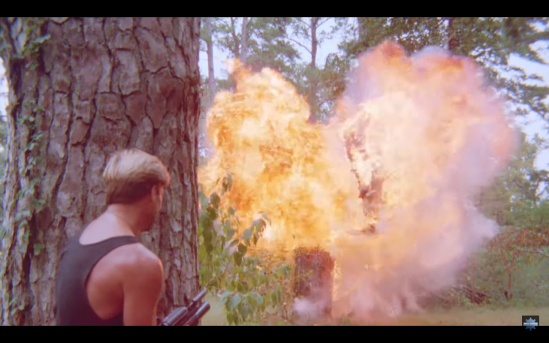
The L.E.T.H.A.L. ladies series continues with the second buddy-cop picture, “The Dallas Connection,” helmed by Christian Drew Sidaris, son of the erotically charged-action producer and filmmaker, Andy Sidaris that follows up on the first Drew Sidaris prospecting fracas, Enemy Gold. “The Dallas Connection” is the tenth installment of the series, known also as the Triple B series (that’s Boobs, Bombs, and Bullets) that has little-to-nothing linking the entire series cache together aside from being exclusively explosive wrapped with a sensual rouleau of Playmate and Penthouse centerfolds, tightly coiled around the tight and firm half-naked bodies of it’s leading stars. The Sidaris team, under the Malibu Bay Films and Skyhawks Films banners, one again economically ignite a successful B movie that promises 90’s attired, flamboyant action on set at a few familiarly recycled locations in Shreveport, Louisiana and Los Angeles, California, redressed for a not-so different genre or distant premise.

As aforementioned, centerfolds are a staple in any Sidaris, father or son, girls and guns feature and “The Dallas Connection” is no exception, starting off with their main squeeze, good friend, and cult movie icon, Julie Strain, as one of the chief co-antagonist under the nom de guerre, “Black Widow.” Strain is tall, sexy, and a wild villain capable of restraining the violent kick of an AK-47 in thigh high boots and a low-cut open jacket that embodies gun nuts most delectable dreams. The once Penthouse Pet of the Year stays quite reserved compared to her tantamount villainous role in “Enemy Gold” by going topless only in a couple of instances in a death grip roll that involves a lap dance before her prey’s demise, a specified attribute to the beautiful and deadly small spider she spins her call sign from. Black Widow is joined the just as deadly Cobra, fellow Penthouse Pet of the Month February 1993, Julie K. Smith, and Scorpion, the equally as Julie Strain tall, Playboy Playmate of the Month December 1991, Wendy Hamilton. Smith and Hamilton offer up polar features that doesn’t make “The Dallas Connection” a one-type of woman show, but both are voluptuous in their own rite, adding sizzling hot tub sex scenes and long-legged strip shows to accentuate “The Dallas Connection” amongst the B movie fray. “Phantasm II’s” Samantha Phillips becomes the whip cream on top, rounding out Sidaris’ centerfold assembly, as another the third Penthouse Pet of the Month, June 1993. There’s also Bruce Penhall and Mark Barriere, but who cares about these shirtless studs who drag race old Plymouths and jet ski when you four gorgeous women to ogle over? Penhall and Barriere mark their return as Chris Cannon and Mark Austin from Enemy Gold in a buddy-cop adventure loaded with a Dirty Harry Magnum .357 and a M1 Grenade launcher assault rifle. Kaboom! Rounding out the cast is Gerald Okamura (“Big Trouble in Little China”), Roland Marcus, Cassidy Phillips, Ron Browning, Tom Abbott, and Rodrigo Obregon as a satellite scientist.

After finishing “The Dallas Connection,” I wanted to say that I’ve seen this movie before and not because of some misplaced form of déjà vu, but, rather, that I, in fact, HAVE seen this movie before in the precursor film of the L.E.T.H.A.L. ladies series, “Enemy Gold.” The story’s been tweaked slightly to a story with the same framework. Hell, like also mentioned, when you throw in some of the same locations as in “Enemy Gold,” Sidaris’s home with the hot tub and the cabin the woods, and redress the same actors, Julie Strain, Bruce Penhall, Mark Barrier, Rodrigo Obregon, Tom Abbott, and Ron Browning all in the essentially the same roles, “The Dallas Connection” just feels like an extension or a mirror image of that former film, making the story a weary one with nothing really new to spectacle except for three pairs of new, large-and-in charge, breasts in Smith, Hamilton, and Phillips. One difference noticed is that the bureau agents this time around are a lot dafter with skulls thick as a brick and unable to use common logic in the most practical situations. There have been many a time when producer Andy Sidaris commented his films to James Bond, but at least Bond had the smarts to always be on guard; Chris Cannon and Mark Austin do indeed think with their other head that do, in benefit, leave the door open for some saucy hot tub sex that’s perhaps the best simulation from Sidaris reel I’ve seen to date.

Available for the first time on Blu-ray, “The Dallas Connection” will get your rocket launchers off with ton of gunplay and is loaded with beautiful women. The region A, 1080p high definition presentation from a 4K scan restoration has an aspect ratio of 1.78:1 widescreen. The image’s simply gorgeous from the 35mm negative baring a few minor faint scratches that linger only for seconds at a time. There’s quite a bit of noise during the night scenes that almost make the scene look daylit, but skin tones, especially gleaming with water, are remarkably velvety and the textures on clothes and skin looks great for a low budget action. The English language DTS-HD Master Audio dual channel mix medleys appropriately, dialogue is clear and upfront and ambience has proper depth and range. Explosions are powerful coming through the dual channels with a hefty LFE and gunfire can rip just as good as Dutch blasting away at a trophy hunting alien in Predator. Even the sexy lounge soundtrack from Ron Di Iulio is on point despite being a rehash of “Enemy Gold” once again. Hardly any blemishes or distortions coming from the audio track. English SDH subtitles are optional. The bonus features mirror that of “Enemy Gold” as well with Andy Sidaris and Julie Strain doing this awkwardly coy and sugar daddy bit showing off “The Dallas Connection” merchandise and international posters that lead into Andy’s film school where him and his wife, Arlene, go onto commentary on how to shoot scenes and edit them together, using an action and a sexy scene from “Return to Savage Beach” as reference. In the same behind the scenes, there’s an equally bizarre Joe Bob Briggs interview where the legendary MonsterVision and The Last Drive-in Host seems uncomfortable with Andy and star Julie K. Smith about how he persuades to get these beautiful centerfolds to be in his films. Other bonus material includes a commentary on the film itself and theatrical trailer. “The Dallas Connection” is a Texas-size IED with a busty ornate façade, but acts more like a duplication of something we’ve already experienced, making the sophomore feature from Christian Drew Sidaris just a more of the same.

Only $12.99 at Amazon.com! Plus, you purchase a VHS tape! WHAAA!?!

 It's Bloggin Evil!