

Recently engaged lovers Daniel and Mina take a trip to visit Daniel’s brother. When they stop to take in one of California’s breathtaking beaches, two vicious bikers, looking for kicks, intrude on the lovebird’s romantic getaway, looking to rape Mina but ending up mercilessly murdering Daniel. Mina’s grief turns the distraught lover into a vengeful bitch, taking the lives of all salacious and beastly men who wish to exploit Mina’s virginal beauty. Meanwhile, Daniel’s brother, a praised police detective, personally takes on the case despite his Captain’s insistence of not getting to close due to his personal connection. The detective tracks down the drug dealer Black Pepper, the head of a notorious biker gang connected to the slaying of his brother, that results in an all out war!

“Dangerous Men” is an action film you hate to love, being so bad it’s good. The film was the non-aborted child of Iranian born, U.S. bound director John Rad, a pseudo name, who had a life-long vision from way back in 1979 to put an eternal awesomeness on the big silver screen and, in one way or another, completed that feat no matter how long the creative process. Only 26 years stood in between John Rad and his masterpiece “Dangerous Men” from being completed and theatrically released to the public, but, low and behold, “Dangerous Men” didn’t succeed into billions or even millions of box office dollars; instead, Rad’s film gained popularity in its notoriety, gaining almost instantly cult status through a niche group of garbage cinema aficionados. By the grace of the provocative arthouse film brew masters at Drafthouse Films and their continuous begging toward Rad’s daughter, “Dangerous Men” redefines the term guilty pleasure.

But what makes “Dangerous Men” so irresistibly appealing? Is it that fact that Iranian born Peter Palian from “Samurai Cop” fame is the most experienced crew member on John Rad’s amateurish, if not solo performing, team? To properly answer that conundrum-filled riddle, looking at what makes “Dangerous Men” so standardly terrible would ultimately lead to the answer. For one, a prominent lead character doesn’t exist in a plot that can’t focus due in part of the two decades the film was shot that resulted in the actors or actresses not being available or unwilling to complete Rad’s work. Various characters, like Mina (Melody Wiggins) or the cop brother (Dutch Van Delsem), come and go in their respective, decade housed plot paths and like one of Drafthouse Films’s bonus features makes light, the film ends on a still frame of characters who have had less than half an hour of screen time. Secondly, the amateur acting in exposition, the cut and dry editing, and the cartoonish foley, by the also writer-director John Rad, hones straight toward gut-punching you to explode into outrageous, painful laughter. “Dangerous Men” is a serious film that’s full of wacky action and some great moments of exploitation, especially scenes involving women knees, but when all the punching and exasperating is of the identical sound bite, like in a “Street Fighter” video game, taking Rad’s film seriously is hard to fathom. Thirdly, the longevity of filming created many production goofs that mistakenly implied the decade. From props, to haircuts, and to clothes, hints of years were obvious to the naked eye. Lastly, a title like “Dangerous Men” should end on an detonative high note; instead, falls just short of a chuckle and a “WTF.”

“Dangerous Men” snuggly finds a spot within the realm of other bad movies not to be missed. “Troll 2,” “Silent Night, Deadly NIght 2” with the infamous garbage day line, “Leonard Part 6,” and “Jaws: The Revenge” would gladly welcome “Dangerous Men” with open arms as a peer in preposterousness. With a little over a measly $2,300 in ticket sales on opening weekend from a film that probably cost John Rad thousands upon thousands of dollars to produce and a whole hell of a lot of time to construct, “Dangerous Men” is most likely an action-packed feature you’ve never, ever heard of before. One positive remark is the soundtrack, which is also composed by John Rad, was, in my humble opinion, swanky and, well, rad – a true testament to the era and the best effort for such bad film. Unfortunately, John Rad never saw his film blossom as he died soon after the release of his masterpiece, sometime mysteriously between 2005 and 2007.

Drafthouse Films, in association with MVDVisual distribution, courteously releases “Dangerous Men” on a sleek not rated two-disc, 1080p 1.85:1 widescreen Blu-ray and DVD set which has a region free presentation that still manages to hold in the cigarette burns and the faded coloring in a sort of time capsule from the 80’s and 90’s. The original print looks to have been kept in good condition for an easy upgradeable and cleanable transfer. The Dolby Digital mono stereo mix is fairly clean aside from some misaligned dialogue tracks with the video and the prevalence of background noise in certain scenes of poor record quality such as the Daniel and Mina restaurant scene. Drafthouse Films doesn’t discriminate amongst the quality of their releases when considering the bonus features. A 16 page booklet featuring documented full-length interviews with director John Rad, audio commentary featuring “Destroy All Movies” authors Zack Carlson and Bryan Connolly, “That’s So Rad,” an epigram stemmed from this film, is an original documentary about the film and its initial 2005 release, an interview with cinematographer Peter Palian, Rare footage of John Rad’s appearance on local access television, and the original theatrical trailer. Quite the laundry list of extras! “Dangerous Men” is so spectacularly unspeakable and trashy it shouldn’t go unseen for absolutely anything, not even for the birth of your first born child!
Tag Archives: nudity
Evil Bikers Take On Unstoppable and Unthinkable Savior! “All Hell Breaks Loose” review!

The spawned from hell biker gang, Satan’s Sinners, ride the dusty roads of west coast America in search of pure virgin women for their master’s ever growing domain. As they wreak hellish havoc along the way, they ride upon newly wed couple Nick and Bobby Sue, stealing the beautiful bride away from her loving husband and leaving him for dead on the side of the road. However, the Lord works in mysterious ways as divine intervention in a form of a boorish Cowboy, who may or may not be God himself, resurrects Nick from the dead again and again to save his wife from the ultimate damnation – Satan’s beautiful virgin slave. Armed and clueless, Nick finds help wherever he can, whether by the prideful local sheriff or the alcoholic priest who performed Nick’s marriage, to stop the bikers and to reclaim Bobby Sue.

“All Hell Breaks Loose” is one of those indie films that’ll fly under the radar of the indie film circuit, scraping and clawing at the surface and trying to create a name for itself. At face value, “All Hell Breaks Loose” is a hell of fun, devilishly entertaining, and so relaxed that it doesn’t take itself too seriously. Unfortunately, those film’s qualities are the complete antonym to a box office money maker or a breakthrough independent golden nugget. I get why money won’t just flow in, though. Director Jeremy Garner’s name won’t ring any bells and has dabbled more in the special effects field than the director’s chair, which I thought his 2009 special effects work on “Melvin” was fantastic, and the screenwriter Jacy Morris, under the pen name The Vocabularist, is also an unknown with only this film under his belt. There’s strike one. Secondly, the lead actor isn’t a big name; Nick Forrest name might seem similar to “Shaun of the Dead’s” Nick Frost, but, sadly, no. But Nick Forrest plays his character of the dimwitted, pee-wee hero character well enough for be recognized and respected. The last, and final strike, is film’s recognizable headliner – “Danger” Ehren McGhehey from “Jackass” fame.

Garner’s film doesn’t need to prove one damn thing to anybody. The horror-comedy story is simplicity thats surrounded itself with undying love, badass demon bikers, and God’s wish-washy methodology; there’s no symbolism or underlining message that suggest otherwise and there’s not much explanation here or there about the particulars of the Satan’s Sinner’s mission or why in that particular region they choose to run amok. Viewers looking for an untamed experience will just want to see the Bikers dish out violence and pain and see Nick die a horrible death over and over again. Even though Garner didn’t dip his hands into conducting the effects for his Sophomore film, Izzy Combs, Ray Kelley, and Steven Strop team up to pull off some amazing lunacy with the limited budget effects that get gory without being over-the-top and ridiculous.

Aside from a pipsqueak-to-a partial demi-god hero in Nick Forrest and “Danger” Ehren portraying a demon biker with an Elvis Presley obsession, the rest of the cast, like the Satan’s Sinners, is a motley crew of talent ranging from twenty years of B-movie experience in Todd Robinson to a slew of undiscovered actors, especially in the biker gang with Hunter O’Guinn, Joshua Lee Frazier, and Tommy Hestmark with leading lady Sarah Kobel Marquette as the damsel in distress while being undressed.
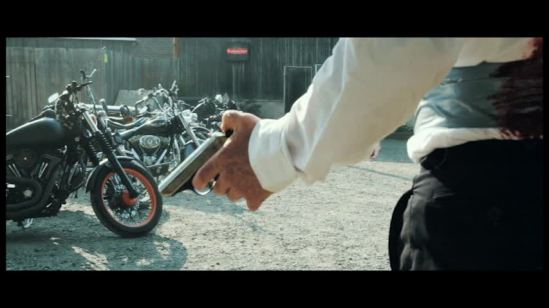
Wild Eye Releasing summons from the underworld “All Hell Breaks Loose.” The unrated, 92 minute feature might have cheesy and cheap DVD cover art, but the entertainment value speaks volumes. The release contains bonus features that contains an informative director’s commentary, a couple of deleted scenes, and trailers. Overall, give “All Hell Breaks Loose” a chance or two or three, just to be completely sure that you understand that what you’re about to see will be utter chaos that’ll make the Waco, Texas shooting look like a little girl’s tea party with her favorite stuffed animals.
Torment and Puke is One Girl’s Evil Journey. “Madness of Many” review!

Victoria propels through an discarded and tragic life of torture and suffering. Her parents sexually abuse her as a child and into her adulthood where she finally is able to desperately flee in search of a new and hopeful life, but Victoria’s destined to fulfill a life with more suffering, even worse than while under the abusive and ever watchful eyes of her family. The anguish built structure of her being leads Victoria to an endless amount of pain that grows inside her, sprouting a vast and treacherous sea of meaningful existence, and blossoming into a eye opening, or eye gouging, experience in which she’ll never forget. This is her journey through the gateway of hell to the inevitable rebirth of pain and puke.
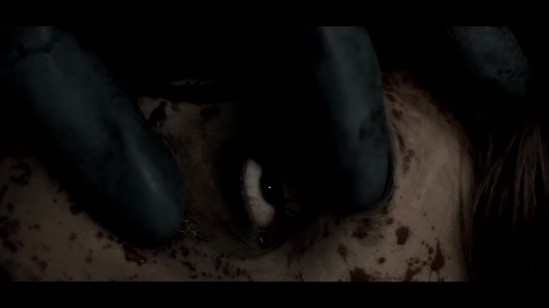
Considered to be the “most controversial” film made in Denmark, director/writer/editor/special effects artist Kasper Juhl’s experimental horror film “Madness of Many” goes through four chapters of Victoria’s detestable existence and transformative suffering. There’s never a time when she’s safe, being dredged through the scum and the dirt for all of her life. The former prostitute and drug addict doesn’t ever rehab or recoup from her time as a sex slave, a human pin cushion, or a human fluid dumpster as her story, mostly told off-screen in a monologue accompanied by grotesque and digestible imagery, is considered to be a rise of a phoenix through the clout of ashes.

However, Victoria is not alone. Numerous other women, some representing Victoria in various stages of her life and others just in an akin to Victoria’s situation, are affixed to the same suffrage and, in the same fashion as many Unearthed Film’s features, self-induced vomiting is a big part of their torment (and about 1/4 of the visual story). “Slaughtered Vomit Dolls” and films like it, such as “Madness of Many,” have never really been my cup of hot bloody spew stew, but “Madness of Many,” by far, has better visual effects when considering the torture and the gore amongst the spew-splattering titles. Much like Victoria, the viewer has to suffer through drawn out portions of the narrator’s exposition in order to set up and enjoy Kasper Juhl’s effectively realistic sinew and gut-churning effects.

I must admit there’s a certain poetic underlining and parallelism to Juhl’s film; a sort of an art-house, coffee shop “fung shui” complexity about suffering that can only be told through the Juhl’s telling of Victoria’s devastating story. The actor portrayal diminishes much of that structure that merely falls into the category, for most of the viewing experience, of interpretative dancing told in the eloquent genre of doom metal and deep underground horror cinema. Yet, Victoria’s plight is never a matter to be cheered for, never a route for hope, and certainly never a situation anyone would envy. “Madness of Many” is not, and I repeat, not a feel good movie. Its not a kid’s movie. Hell, it’s not even a movie for most adults. Certain breeds of human would consider the Kasper Juhl’s film in their niche of subversive cinema.

Produced by Hellbound Productions and distributed fittingly by Unearthed Films and MVDVisual, “Madness of Many” delivers controversy; perhaps not in the States, but for Denmark, I’m sure and will cause much controversy for the weak stomachs who find this title in their possession, going into a viewing without the heads up of what they’re getting themselves into. Juhl’s only English film to date isn’t glamourous popcorn horror with a recognizable cast and it’s replay value is next to none, but if the gore and shock genre is the game you’re willing to play to perverse over, then the “Madness of Many” would be right up that twisted alley.
Don’t Leave Evil On Hold! “Serial Kaller” review

Phone sex models broadcast their televised provocatively dressed bodies over the British airways while chatting with lonely customers. During their biggest broadcasting night, all the girls and crew become purposefully trapped in the sleazy studio, making the phone sex business a dead line. Disappearing one-by-one, each model falls viciously victim to a murderous psychopath who could by one of their most disturbed and perverted fans. With the power out and the studio on shambles, the survivors attempt to escape dead air by any means possible, even if that means coming face-to-face with their stalker.

The cast full of busty beautiful women enthralled to a murderer’s maniacal impulses sounds to be a bit of good horror movie fun untamed by the restrictive harnesses of big studio conventions. Director Dan Brownlie and his producing company Brand B Corporation develops “Serial Kaller” to be the limited budget archetype of the slasher films with an inkling into the very real world of broadcasting UK’s phone sex girls or better known as simply “babe shows.” Co-writer and star of “Serial Kaller” Dani Thompson once worked in the business, and appropriately proportionately so, that sparked the idea in her for a killer loose in the bare bones, deathtrap studio of a babe show. The diminutive budget project attached some B movie talent such as Suzi Lorraine and the iconic Debbie Rochon while rounding out the cast with top heavy talent in Jess Implazzi, Aisleyne Horgan-Wallace, Suzy Deakin, and Zoe Morrell.

With all the dazzling, easy-on-the-eyes women in the cast and a sweetly promised premise coinciding, “Serial Kaller” squirms itself onto the independent slasher scene with barely a thrill to offer and a death to deem applaudable. “Serial Kaller” stands out as much as pig in the middle of a stable of horses with mediocre kills, colorless dialogue, and disjointed concept that resembles more like an unfinished thought than a complete work. Brownlie’s and Thompson’s film subtly whispers similarities to, or homages to, that of the England’s 19th century prostitute murderer Jack the Ripper, with the start of an undefinable and causeless figure stalking sinfully innocent sex workers that happen to be, coincidentally, English. Yet, somehow that hint of respect becomes lost in translation; with a title like “Serial Kaller,” one might be under the impression that phones with have a significant role in the story, such as in Bob Clark’s “Black Christmas.” In reality, the phones are just, well, phones, while the story takes a rogue route that’s far from the intentions of the title, losing the motivations and the inspirations of a modern day Jack the Killer.
The co rrelation between the model’s baleful setup and the murderer circling nearby doesn’t jive to build successful suspense and when the moment finally comes to fruition where a model is about to bite the inevitable dust, there’s no jolt of anxiety toward the situation. The kill effects, consisting of minuscule budget practical and CGI effects, fail to heighten the murderous affairs. Probably the best kill scene in “Serial Kaller” is the electrocution through one of the babe show tech’s genitals, zapping up into the girl that’s unenthusiastically grinding his crotch with her clothes on and exploding out her eye balls. Zany death, but still kind of cool, right?

My good friends at Wild Eye Releasing brought “Serial Kaller” onto DVD, presenting the feature in a director driven retrofitted 4:3 full screen aspect ratio to give homage to once praised VHS nasties. Despite the slight lean toward a grindhouse appeal in the aspect ratio, the picture quality is clean, naturally toned, and detailed. The audio goes without hiss and is well balanced. Extra content includes director’s commentary, behind the scenes featurette, and trailers. The overall, “Serial Kaller” is the epitome of big concept packaged small and can’t quite muster a snowball effect to wrangle in the much needed thrill rush to go along with the scantily-cladded women, but Brownlie’s film redeems a little with Debbie Rochon phenomenal joker-esque performance that, unfortunately, has very little screen time.
All Evil Breaks Loose! “Mansion of Blood” review!

Pretentious millionaire Mason Murphy hosts the largest and sexiest lunar eclipse party in the close knit community of River Ridge. Murphy renovates the old Mayhew estate, home to the mysterious disappearance of the wealthy Mr. Mayhew in 1926, as the party’s extravagant setting. One of the young party goers is also a practicing partaker of witchcraft and when she attempts to summon upon the spirit of her dead boyfriend to ask about whether he bought a winning lottery ticket or not just before his death, she accidentally aligns all things evil right as the eclipse takes place, trapping the oblivious guests in a nightmarish twilight zone that includes black bat demons, Civil War ghosts, lawn ornament zombies, bar tending vampires, and a slew of maniacal murderers.

Director Mike Donahue’s “Mansion of Blood” is a horror-comedy of an ambitious narrative that was doomed during the middle of production, resulting in a shameless, mishmash heap of a film. From what I’ve read from various article sources, “Mansion of Blood” came to a screeching production halt due in part of a sexual assault claim from an actress or two. The complaint was against the film’s headlining star, Gary “Lethal Weapon” Busey. Are we really surprised here? Busey, who suffered permanent brain damage in 1988 after a motorcycle accident, has sustained from his wild and crazy, sometimes delusional, antics that raises many eyebrows through almost the last three decades. The film’s crew was so fed up with Busey that he was actually fired and massive re-cuts and re-edits caused the story’s downward slope. Aside from the Busey debacle, executive producer and one of the film’s stars Tom Tangen is rumored to have screwed over the film’s investors, leaving director Mike Donahue high and dry.
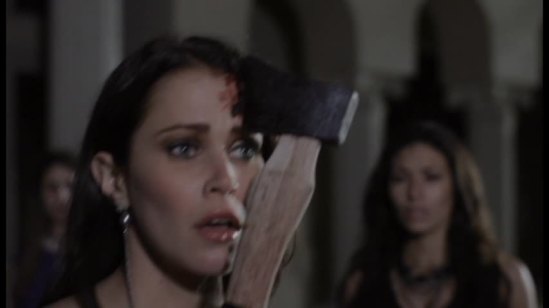
Honestly, I strongly feel “Mansion of Blood” never came an inch off the ground. I get that the film is a horror-comedy in a slapstick sub-genre, but the story is in total shambles. Numerous characters and their individual stories are diluted to the point of being a suffering and aggravated attention deficit disorder. The severely choppy editing, the unbalanced dialogue and ambient audio tracks, and the oafish acting throughout only piles on top of an already high mountain of sadness. And even though I have a soft place in my heart for Busey and his sheer lunacy, in life and on film, his performance as the malicious party host Zachariah was, dare I say it, surprisingly stale. Only a few handful of scenes of Busey’s floating, grinning head faintly superimposed as a ghost or a spirit or as a something are uniquely guilty pleasurable. Not all has failed as the film’s other star, “Star Trek: Voyager’s” and “Innerspace’s” Robert Picardo, attempts and succeeds at a good performance as the party’s caterer who ends up almost being poisoned by his chef wife, played by Lorraine Ziff.
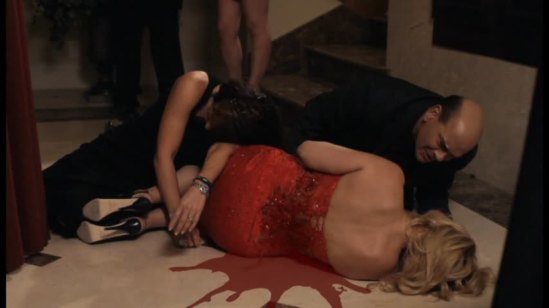
Again, I’m well aware that “Mansion of Blood” is a horror-comedy, but the no budget special effects couldn’t be any more offensive to our intelligence. The “demons” were extras in black face and black leotards with a dark cape and plastered with exuberantly adhesive bat ears. The computer generated lunar eclipse was near 1950’s animated cartoonish. These effects bog down the quality of the film, turning a potential Sci-Fi channel movie spoof to a more of an obsolete, outdated, and cheesy and campy schlock that could be deemed worthy of being presented on Mystery Science Theater 3000. Instead of solidly funded practical and computer generated special effects, Donahue leans firmly on the hard bodies of young (and some slightly older such as Lorraine Ziff) actors and actresses. The naked bodies of upcoming scream queen Mindy Robinson and the industry versatile Dustin Quick are two to name just a few who pair up with the rock hard abs of Kyle Clarke and Frank Mora Jr. One would think Jennifer Tapiero, Sarah Alami, and Tegan Webster would be the group of main characters that would develop and expand throughout the duration since they’re stories begin in a diner, but their characters become junk roles that fizzle into into oblivion and tangents are created for non-setup characters.

“Mansion of Blood’s plethora of characters is too much to handle, especially when the film tries to go in numerous directions that doesn’t give Donahue’s motion picture any direction. The story and script flounders as the legs are cut right from underneath both of them. I empathize that the Gary Busey and the rumored Tom Tangen issues might have derailed this project that categorizes this film into the scrap-to-salvage scenario similar to prior films like “Bad Meat” and “Old 37.” Tom Cat Films and MVD bring “Mansion of Blood” to retail shelves and I encourage those brave enough to venture into the film to remember this particular review because when the credits begin to roll and the popcorn is down to the last few underdeveloped kernels, you will know somewhere in the sands of time and space that I’ll be whispering in the ears of your mind, “I told you so.”
 It's Bloggin Evil!