EVIL’s Brew Just Needs a Severed Head! “The House of Witchcraft” reviewed! (Cauldron Films / Blu-ray)

“The House of Witchcraft,” a part of The Houses oof Doom series, Now on Blu-ray!

Luca Palmer has experienced the same reoccurring nightmare for months of him finding shelter from being chased inside a large countryside house with an ugly hag boiling his severed head in a large cauldron.  The dreams have required him to find professional help in a psychiatric ward but without any real mental or physical health concerns, he’s released to his incompatible, witchcraft practicing wife Martha who sets up a country house getaway in a last ditch effort to save their dwindling marriage.  When they pull up to the house, Luca immediately recognizes it from his nightmares.  From then on Luca believe he’s seeing the malicious old woman from his dreams around on the estate grounds and urges his psychiatrist, who is also his late brother’s wife, to visit him to assess his state of mind, but the visions keep coming and those around him keep dying a horrible death with his wife being the key suspect of witchcraft related deaths.

“La casa del sortilegio,” aka “The House of Witchcraft” is a made-for-television, witch-centric movie for the four-film series The Houses of Doom concept created under the companies of Dania Films and Reteitalia’s producing team Massimo Manasse and Marco Grillo Spina.  The 1989 witchy-slasher hybrid and the third film of the series is helmed by another notable Italian schlock and shock director, Umberto Lenzi (“Seven Blood-Stained Orchids,” Cannibal Ferox”), as well as Lenzi writing the script from the story of The Houses of Doom envisaging duo Gianfranco Clerici and Daniele Stroppa.  “The House of Witchcraft” speaks the very essence of what to expect in a traditional sense regarding witches while really stepping up with Italian nastiness inside the slasher principles, filmed in the heart of Italy in the popular Chianti wine municipality of Rufina where the landscape is lined with vineyards, churches, and castles.

Luca Palmer is committed to his mental health by committing himself to his sister-in-law’s psychiatric hospital after months of nightmares involving a witch and his severed head as the main ingredient for her boiling stew.  Perhaps, because of his rocky relationship with wife Martha, played by French actress Sonia Petrovna (“Flashing Lights”), Luca just needed a break from her witchcraft obsession and loveless aloofness to clear his head.  Either way, the American-born and ‘Naked Rage” actor Andy J. Forest is one of Umberto Lenzi’s go-to action stars, of such Lenzi’s war films “Bridge to Hell” and “The Kiss of the Cobra”, whose taken off the film battlefield and positioned as the confounded centerpiece of a cackling witch tale, completing his task as a the tall, handsome, and flawed hero of a man haunted and driven by unpleasant night terrors of the long face, broad features of the fittingly named Maria Cumani Qausimodo as the dolled-down witch.  Quasimodo is no stranger to the filth and frights of Italian schlock with roles in “Behind Convent Walls,” “Five Women for the Killer,” and even the notoriously porn augmented “Caligula” and her physical traits, long stare of blue eyes, and pandering of character’s wickedness transform her into an ideal archetype of the original folk-acholic Brewmeisters.  Characters for the slaughter tin this supernatural slasher and to be intertwined into the suspect and innocent pool are played by Paul Muller (“Lady Frankenstein”), as the sixth sense blind homeowner Andrew Mason, Marina Giulia Cavalli (“Alien from the Deep”) as Andrew’s visiting niece Sharon, Susanna Martinkova (“Fracchia Vs. Dracula”) as the psychiatrist sister-in-law Dr. Elsa Palmer, and Maria Stella Musy as the doctor’s daughter Debra tagging along with her mother to visit the barely mentally managing Luca. 

Umberto Lenzi’s rollercoaster career has seen its fair share of misses overtop what are today considered trashy, cult triumphs that lure fans to seek out his even lesser known, poorly critiqued titles more often than required for any more than the casual horror moviegoer. However, “The House of Witchcraft” is not one of those latter, threadbare produced pictures as Lenzi instills more aesthetic style and cinematic substance of searing phantasmic enthrall and danger with an unwavering villainess vile down to her very rotten teeth and scraggly, gray hair.  Offing houseguests left and right is the witch’s supernatural birthright but why exactly Luca Palmer, a stressed out journalist, to be the target of precognitive events is more opaque than it is clairvoyantly evident but we get some great malevolent manipulation and sleight of hand with black cat familiars, bulgy maggot-infested corpses, unusual indoor freezing precipitation, severed heads, and a face transfiguration that’s pretty damn good that has no right to be in a Lenzi film, mostly in part to special f/x and makeup artist Giuseppe Ferranti (“Anthropophagus,” “Nightmare City’), his favorable, collaborative relationship with Lenzi, and the fact he’s locked into the 4-part film series The Houses of Doom provides him creative freedom, flexibility, and fluctuation in diversity.  “The House of Witchcraft” is not the one-all, be-all witch story but does scratch that warty itch in the foulest of cloak-wearing evils without flying a broomstick! 

The second of four Blu-rays for The Houses of Doom lineup produced by Cauldron Films, “The House of Witchcraft” is an AVC encoded, 1080p high-definition, BD50 with a transfer scanned into 2K, uncut and restored, from the original film negative.  Very similar to Lucio Fulci’s “The House of Clocks,” Cauldron Films scan is quite impeccable.  A pristine picture with no wear or tear and age deterioration, “The House of Witchcraft” is deep and rich with immense coloring timing efforts, defining an authentic look without overcorrecting to a fault.  There’s no perfunctory enhancing or extreme variability with contrasting, retaining a smooth, consistent picture quality throughout its European aspect 1.66:1 presentation.  Even in the more stylistic lighting work that creates clear tone of how the indoor snow should feel cold or the lightning strikes and wind brings a chill of ominous doom, there’s plenty of delineation to provide space and demarcations of depth between objects.  There are two DTS-HD 2.0 mono mixes with an ADR Italian and an ADR English dialogue.  Synchronously smooth, a noticeable dialogue separation between audio and video is not easily perceptible, which is kudos to the post work on the post-crew efforts, and Cauldron’s mixes have clarity without a fault in the compression means.  The two channel funneling of the mono output separates the dialogue and ambience/score.  Backing of the boiling cauldron stew or the knife swipes that severe heads and stab fleshy trunks, leaving impacting thuds and thwacks, are good examples of the conveyed foley audio that leaves a lasting impression through component construction in the audio design.  There are optional English subtitles on both language tracks.  Special features include Cauldron Films’ produced interviews with FX artist Elio Terribili Artisan of Mayhem, cinematographer Nino Celeste The House of Professionals, and a commentary track with Eugenio Erolani, Nathaniel Thompson, and Troy Howarth.  Also like “The House of Clocks” release, Matthew Therrien and Eric Lee compose a composition of illustrative graphic artistry of film’s decomposing and maniacally laughing madness and logo design for The Houses of Doom series on the front cover inside the clear Scanavo case.  Reverse cover has a still image of the black cat and the disc is pressed with the same front cover artwork but cropped to focus primarily of the witch with title and company logos at the bottom half.  The region free release has a runtime of 89 minutes.

Last Rites: Umberto Lenzi’s “The House of Witchcraft” casts a spell over the hex canon, beguiling it with mystery, enchanting it with surrealism, and bewitching it with blood. Cauldron Films’ Blu-ray is topnotch for an obscure made-for-TV Lenzi production.

“The House of Witchcraft,” a part of The Houses oof Doom series, Now on Blu-ray!

A Eurotrash Mosaic of EVIL. “Jailhouse Wardress” reviewed! (MVD Visual / Blu-ray)

“Jailhouse Wardress” now on Blu-ray!

After the fall of the Nazi Reich post-World War II, one of the more cruel SS-Officers, Muller, is dispatched to South America where he establishes a women’s prison camp and appoints a likeminded, lesbian female warden with strict punitive measures if the inmates don’t fall in line and follow the rules or instruction.  While Muller governs the area, disorder courses its way through the camp when a plea letter to the state, describing in detail the horrors inflicted upon the women at the camp, such as torture and private cells for sex with the inmates, is intercepted before leaving the premises.  At the same time, a young, newly processed inmate, who had killed her rapist uncle in self-defense, plans a daring except.  The once well-oil authoritarian sex prison quickly becomes unraveled by unruly prisoners who’ve had enough with the eternal inhumane debauchery and with the exterior assistance of Jewish liberators and assassins, freedom is all but knocking at the door.   

Hot off the heels of Neon Eagle Video’s Blu-ray release of “Kill Butter Kill,” a Taiwanese rape-revenge narrative that’s been jumbled up with re-edits to engender a whole new structure, we dip into another Blu-ray remix, soaring from Asiatic East to the Western Europe with “Jailhouse Wardress,” a Alain W. Steeve hardly directed women-in-prison schlocker pieced together from three earlier Nazisploitation and caged-women exploitation features with barely any new footage used a binding agent to construct a concentrated concentration camp plot.  Steeve, a pseudo-surname for Alain Deruelle, a pornographic director who did helm “Cannibal Terror” under the name Alain Thierry, hodge-podges a new sordid camp exploitation picture out of already near the bottom-of-the-barrel features that sparked very little lewd cheekiness of sleazy Nazi oppression and the perversities of a hard labor with hard bodies in a women’s prison camp.  France’s Eurociné is listed as the production company but unsure if there was any company backing or shooting the new spliced-in footage since Eurociné outfitted the trio of features used to make up more than half of “Jailhouse Wardress;” these films included “Barbed Wire Dolls,” “Last Train for Hitler,” and “Elsa Fraulein SS.”

Unlike “Kill Butterfly Kill,” much of the new material shot for “Jailhouse Wardress” incorporate different actors into already established roles of the component films and with the scenes going back and forth between new and archive footage, keeping up with a fluent narrative is more difficult than said.  For instance, two different actors play Nestor; Germany’s Eric Falk (“Blue Rita”) footage from sparingly used from the “Barbed Wire Dolls” and most of Nestor’s scenes lie with X-rated and softcore French actor Didier Aubriot (“Naked Lovers,” “They Do Everything”) barking the orders and taking what he wants from the freshly instilled and scantily uniformed actresses inside the cages with Pamela Stanford (“Blue Rita”) and Nadine Pascal (“Zombie Lake”).  You can tell their scenes are newer, fresher, with more color emitting from a different film stock and camera combination compared to the brief, desaturated appearing scenes of Eric Falk who never touches the women prisoners in Beni Cardoso (“Scalps”), Lina Romay (“Female Vampire”), and Martine Stedil (“Marquise de Sade”) who bare a lot of undercarriage bush as a gratuitous rite of exploitation culture.  Much is lost not only in a re-dubbed soundtrack of the source films but what’s also lost heavily are the character attributes that left behind from the original films, such as the prison director’s (Monica Swinn, “Love Camp”) brutish lesbian demeanor with “Last Train for Hitler’s” Ingrid Schüler.  This type of devolving reshapes the characters for worst, takes away much of their cruelty and passes it along to predominantly to the newer footage of Teresa and Lola at the naked mercy of the newer Nestor.  “Jailhouse Wardress” fills out the archive and new footage German, French, and English nationals cast with Eugénie Laborde, Bob Asklöf, Michel Charrel, Peggy Markoff, Paul Muller, Sylvie Darty, Ronald Curram, Maria Cavour, and the archive presence of Jess Franco in a normal camera speed slow-motion flashback death scene as Uncle Jess in this particular feature.

“Jailhouse Wardress’s” old, new, or however you wish or feel compelled to describe the mismatched footage ultimately compromises the plot by the cut-and-paste hack job.  A slight attempt can be seen made to align new and old footage for sequence editing but without a seamless grading and more similar costuming, the events never feel in the same space, creating more a schism between the two material footages rather unifying for a common narrative.  Subplots, such as the imposter prison doctor or the Jewish hit on the Governor, are more prominent than the actual foundational plot so there’s a hindrance of uncertainty to what should be the main premise, including the Nazi angle that seems to vanish without much of a fuss, and the brain works in overtime trying to follow one scheme to then have to jump to another without traversing that pivotal straight line that connects the dots, leading to a complete mental shutdown due to exhaustion and confusion.  What doesn’t help matters is the arterial lifeforce, the purposeful exhibition of exploitation, the whole reason why we watch through our subconscious sadistic eyes women become slaves to ruthless perverts, is severely castrated on a couple’s sexploitation scale.  Much of what is shown is solo work; women lying in bed bottomless or are stripped nude for only a few moments of touching or taking by force without much of a fight.    

The ”Jailhouse Wardress” receives the high-definition Blu-ray treatment from our friends at MVD Visual as part of their MVD Classics label.  The AVC encoded, 1080p, BD25 suits the patchwork Alain Deruelle (and Jess Franco in archive footage only) feature.  While the 2K scan looks pretty darn good for a schlocky eurotrash pastiche, the print used is a gut-punch to videophiles hard-pressed on image quality and preservation.  Presented in a more consolidated pixel count of 1.42 aspect ratio, the print, or at least the “Barbed Wire Dolls” was originally in the European aspect ratio of 1.66:1 as you can see the letterboxing during the titles and they eventually expand out, stretching the image.  The print is in rough shape in its spliced up format with its seam-showing different graded parts that creates a back-and-forth inconsistency.  “Barbed Wire Dolls” is shades darker, grittier, and less definable than inserted shoots.  There’s an abundance of print damage too from frame damage to vertical scratches, mostly early into the runtime.  With the inconsistent picture quality, grain never looks healthy as the amount fluctuates and, often times, becomes more an interference of higher contrast exposure in darker portions.  Both audio options are in an uncompressed PCM 2.0 mono format and you listen in with dubbed English or in the combined original and dubbed French.  Not the flawless audio to ever come across but neither is the worst but what’s inlaid is untouched mix that contains all the hissing, crackles, and pops that blight the audio thread.  Yet, dialogue remains intelligible, thanks mainly to the dub work I suppose, but if you don’t mind Pamela Stanford’s sounding like Smeagol than this audio dub is for you.  English subtitles are optionally available and they synch well enough with a couple of grammatical errors.  The theatrical trailer for “Jailhouse Wardress” is the only direct bonus content available with other eurotrash trailers accompanying.  The packaging is quite eye-catching of an illustrated Nazi-patronized burlesque show front cover inside the traditional Blu-ray Amaray case.  The back cover has the more confounding composite artwork with still captures from neither of the films used and stock image marketing that have little or nothing to do with the film itself.  Inside content is barebones with the BD25 disc stamped with the same front cover art.  The Blu-ray comes not rated, region free, and has a merciful 75-minute runtime. 

Last Rites:  Exploitation fans will find “Jailhouse Wardress” lacking that je ne sais quoi.  The interlocking of multiple prints is like unwelcome visible scar tissue, glad it’s there to heal the wound but unsightly to look at.  As for filling in one’s gap in the Naziploitation and Women-in-Prison collection, “Jailhouse Wardress” isn’t a must-have main ingredient for the diehard fans but for an aficionado completist, MVD supplies the goods with a Hi-Def option.

“Jailhouse Wardress” now on Blu-ray!

Never Weekend on Sadomasochists’ EVIL Private Island Alone! “Eugenie” (Blue Underground / 4K UHD and Blu-ray)

“Eugenie” is Waiting to Tell You Her Story of Perversion!  See It Now on 4K UHD at Amazon.com

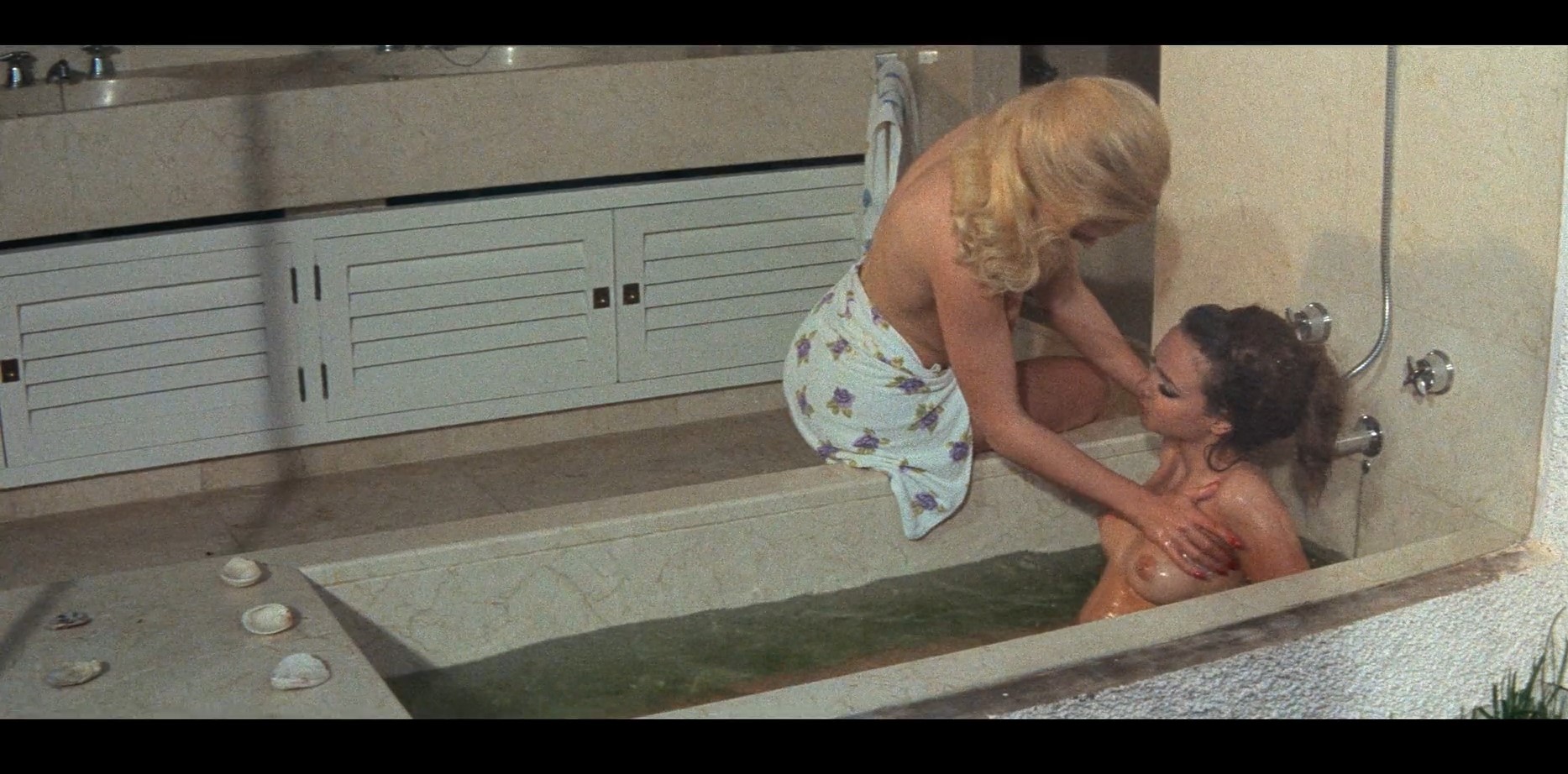
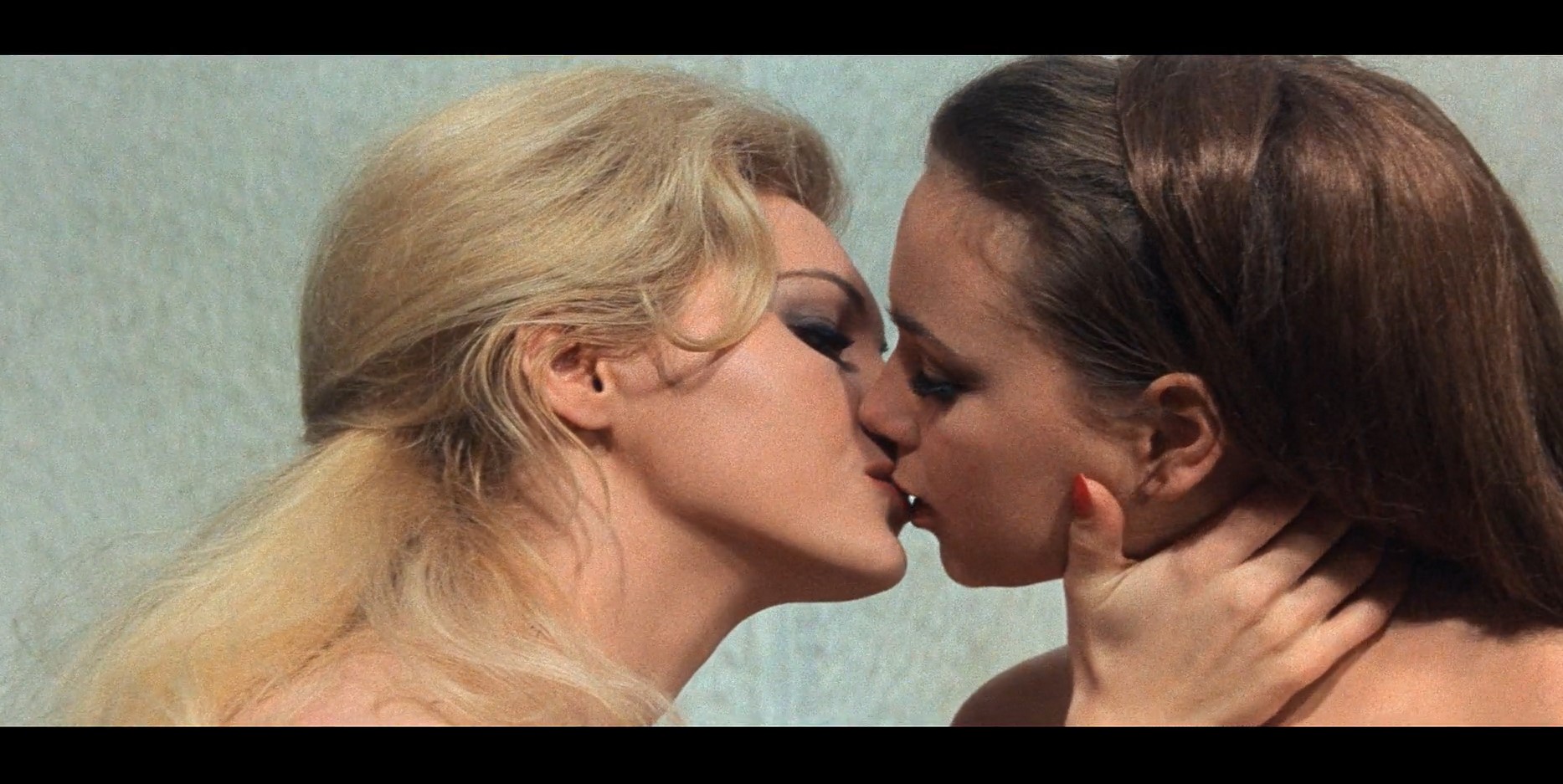
A wealthy, sexually sadistic Madame St. Ange, a specialist in the Marquis de Sade’s teachings, entices to coerce the father of a young and beautiful innocent girl, Eugenie, St. Ange befriends to permit the naïve teenager to visit Madame’s private island for the weekend.  Excited and overjoyed with the idea of feeling like an adult indulging in mature activities, Eugenie is unaware that Madame and her equally as cruel stepbrother and lover Mirvel, who has been beguiled by Eugenie’s beauty, have ulterior motives and lured the unsuspecting youth into a ritualistic trap of sexual corruption and sadomasochism.  The step-siblings drug and rape Eugenie for their unspeakable gratifications only for her to awake in what only be explained as horrible nightmares of phantasmagorical encounters but when the nightmares unveil a disturbing reality when the dogmatic Dolmance and the rest of his Marquis de Sade acolytes arrive to initiate Eugenie into more than just pain and pleasure educations but to be a pawn in a murder scheme that tears the very fabric of virtue. 

Spanish director Jesús Franco, or widely known as Jess Franco, helmed an excessive number of provocative-pushing films over his nearly 60-year-career as a filmmaker before his death in 2013.  Many of the once labeled video nasties director were crafted on a tight budget with an even more so tight timeline as Franco churned out regularly mostly trashy horror and sexploitation that would more than often wind up in the projection booth of local red light district theaters for a dime and a wank.  Yet, “Eugenie” strokes a different kind sensation, one that lies in the ethereal concept of sexploitation and the ruin of youth made to order by the Marquis de Sade himself and artfully stitched by Jess Franco’s profundo knowledge of cinematic sculpturing.  “Eugenie,” or “Eugenie…. The Story of her Journey into Perversion” in the extended title, is based off the French 1795 novel, La Philosophie dans le boudoir (Philosophy in the Bedroom) written by de Sade and the script adaptation is penned by “99 Women” and “Christina” screenwriter and profound producer of film, Harry Alan Towers.  Towers also produces “Eugenie” under the pseudonym of Peter Welbeck for Video-Tel International Productions and was theatrically distributed by Distinction Films.

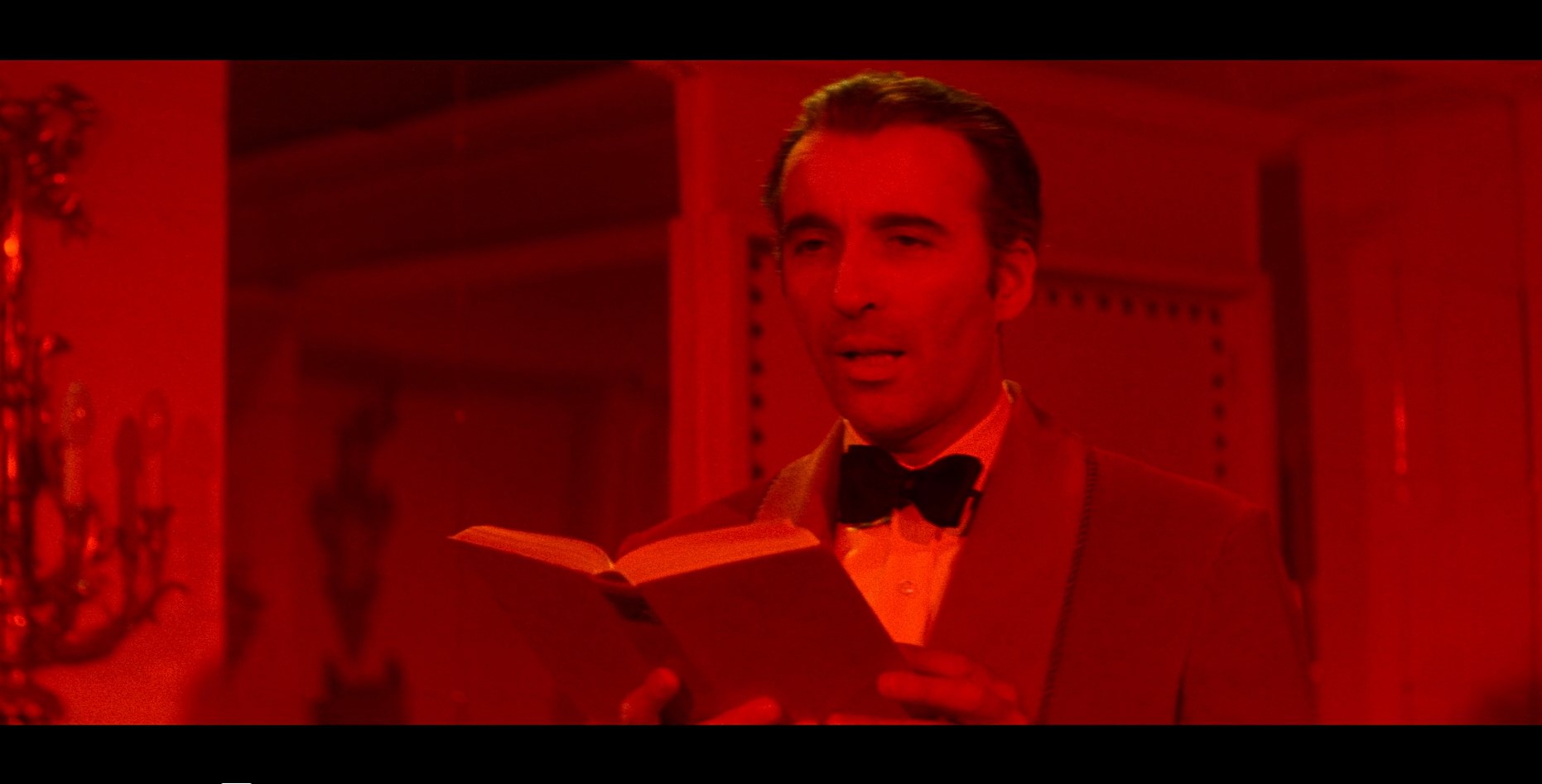
At the frayed edge of an already soul crusher subject matter, “Eugenie” repels against the grain of easily digestible roles,  Marquis de Sade’s characters are sadomasochist with abhorrent qualities of deception, malintent, and insatiability for a cathartic release from sexual pleasure and punishing pain.  On the other side of the coin, Franco and Towers film calls for the characters to push beyond the limits of their comfortability around the idea of drugging and raping, or being the victim of such, as well as violence and murder as part of a cult normalizing and rationalizing unrestrained freedom and ideology.  Swedish born actress Marie Liljedahl had a brief stint in erotica, as a power-seductress as the titular Inga, and only dabbled with sexploitation, “Eugenie” being that dabbled powder only once snorted to warrant a sudden disinterest in the theme altogether.  Liljedahl plays the titular character and she looks every bit the age later-aged teen with a round, youthful face, vibrant demeanor, and curvaceous like a ripe peach.  Like that knot forming in your gut spurred from anxiety, watching Eugenie exploited while in a stupor is the equivalent imaginations of what the deplorable effects and actions of a roofied drink that produces vague and foggy recollections and disbeliefs in what is reduced down to a vivid dream gone wild.  The two inveiglers at the heart of Eugenie’s virtuous destruction quickly become despicably loathed by not only their debauchery plans to corrupt good embodied but also by their snooty affluency and their acrid arrogance with the help.  “The Blood of Fu Manchu” and “99 Women” blonde beauty, Maria Rohm, and the stern faced “Succubus” and “The Vampires Night Orgy” actor Jack Taylor exemplify the essence of evil as the de Sade principled lovers and step-siblings Madame Saint-Ange and Mirvel.  The opened-ended lust Mirvel has for Eugenie morphs into a determined, nagging desire to have her at all costs, kept close to the chest by Taylor but knowing it’s simmering quickly to a head, and you can see in the Madame’s eyes that she’s either really internally pissed about Mirvel’s narrowed focus on a new toy or she’s basking in her ideology’s unchained gratification.  Rohm’s nonaligned decision maintains Madame’s sensual composure and undisclosed intentions until the shocking end.  The presence of Sir Christopher Lee in a Jess Franco film isn’t all that surprising.  The legendary, late British actor – “The Blood of Fu Manchu,” “The Bloody Judge,” and “Count Dracula” – where a handful of euro trashy and exploitative horror that were released around the same time as “Eugenie,” but “Eugenie” garishly bathed in the idea of sexual misappropriations and Lee being a last minute addition due to another actor’s ill-fate, agreed to fulfill the role without knowing how involved the nudity would ultimately land perverted cuts of the film into spank cinema houses.  Lee’s red smoking jacket, elegantly stoic composure and dialogue delivery, and his incredible ability to perform an intimidating figure without as much as lifting a finger compounds the value of Franco’s filmic adaptation to the point where I firmly believe with the original slated actor George Sanders (“Village of the Damned, 1951) in the ringleader and adherent role of Dolmance would likely have not have been half as good.  Anney Kablan, Paul Muller (“Vampyros Lesbos”), Uta Dahlberg, and Maria Luisa Ponte (“El Liguero Mágico”) costar.

Through an ocean of film filth, “Eugenie” may be the very film that proves Jess Franco is a cinematic genius in his own rite by capturing de Sade in the flesh, so to speak, with a plain-sighted fetish that diabolically hatches a scheme within a scheme.  In addition, “Eugenie,” dare I say it, almost feels like a Hammer film, especially with Lee in the picture.  The interior sets are modernly gothic with sleek and sterile furniture but garnished with large candle holders and the Marquis de Sade era sartorial worn by Dolmance’s muted followers. There’s a cadence to Franco’s story, one that leaves breadcrumb plot aspects to go against divulging a straightforward story right from the start, and the history between acquainted characters is contentious and fraught with unpleasant emotions in the act nice, play nice master sadists and the subservient help hierarchy that hints at a fraction of degrading minorities. Saint-Ange and Mirvel boatman Augustine, a black man who has his life reborn from the ashes of poverty only to be toiled as their attendant and frivolous plaything when the mood is right. There’s also deaf and mute woman brought on to be the new maid in a moment’s conversation between the siblings just to drop a dab of her presence amongst them. Augustine and the maid represent the lower class of people, a man of color and a woman of disability, to easily take advantage of just like Saint-Ange and Mirvel do with Eugenie’s innocence. France shies away being overly showy in slipping in this unjust dynamic that unfolds bit by bit as mentioned earlier of Franco’s revelation design. “Eugenie” not only dangles the attractive set locations and nudity carrot to draw attention but also invests in its talent as Frnaco the cherishes the cast of individual portrayers with longer shot moments to speak volumes of their unique objective or to pedestal them in their own keynote scene of power and, subsequently, obliteration that makes every occurrence worth noting and not just something to write off. “Eugenie” has no tears or apologies to spare but only inhuman indecencies separated by a blurred, unfettered line of sex and sadism satisfactions. This is Jess Franco at his finest.

The 1970 “Eugenie” print takes on more pixels, 2180p to be exact, with 4K UHD transfer and a re-release 1080p high-definition Blu-ray in a 2-disc set from Blue Underground. The 4K restoration from the original camera negative with Dolby Vision Hi-Def resolution on a 66GB, double layer UHD and is also on an AVC encoded Blu-ray that are both presented in an anamorphic widescreen 2.40:1 aspect ratio. Both transfers execute their respective program, offering an average frame rate of mid-high 30s Mbps, but there’s a focus issue with the transfer brought upon likely at the origin of filming and we know this because the frame rate never drops, staying consistent throughout the issue. Periods of unfocused detail come and go between edits and often in the same shot as if attempting to render delineation between the foreground and the background in order to get the shot on the fly (there are many instances Franco had limited time to shoot). Color grading, including skins tones, are natural appearing until the red tint, a symbol of when the subject matter becomes dark, eliminates and reduces vast color palette to one single hue. Both formats offer an English and French dub language 1.0 mono mix that buff enough to be ample; in fact, the mix is rather good considering the single channel with substantially clarity with no hissing, popping, or other blights on the dialogue track, Foley, or any track for that matter. Subtitles are offered in English, French, and Spanish. If you’re looking for special features, they mostly encoded onto the second disc, the Blu-ray, with Perversion Stories, a retrospective interview with the late Jess Franco, writer Harry Alan Towers, and stars Christopher Lee and Matrie Liljedahl discussing the behind-the-scenes measures and understandings of the sexploitation classic, Stephen Thrower on Eugenie, an interview with the author of “Murderous Passions: The Delirious Cinema of Jesus Franco,” a new interview with costar Jack Taylor Jack Taylor in the Francoverse, a newly expanded poster and still gallery, and theatrical trailer. The 4K disc also has a new commentary with film historians Nathaniel Thompson and Troy Howarth, plus a theatrical trailer. A two-disc UHD case holds a disc on each side of the interior and the case itself sports the class naked Eugenie pose with her brown locks draped over her shoulders, covering her chest. Speaking of covering, the snapper case is sheathed in a O-slipcover with oval cutout of the front to display Eugenie with a Victorian-aged mirror border. The darkened slipcover is also prominently titled under Marquis de Sade’s novel English moniker, “Philosophy in the Boudoir” that has a regal and classic aesthetic. The unrated, 87-minute film has an all-region playback. Jess Franco distills revolutionary extravagance and couples it with the notion that youth will inevitably be corrupted by family, friends, and a group of cruel Marquis de Sade cultists in what can be construed as one of the director’s most prestigious sexploitation and melodramatic films of his oeuvre.

“Eugenie” is Waiting to Tell You Her Story of Perversion!  See It Now on 4K UHD at Amazon.com