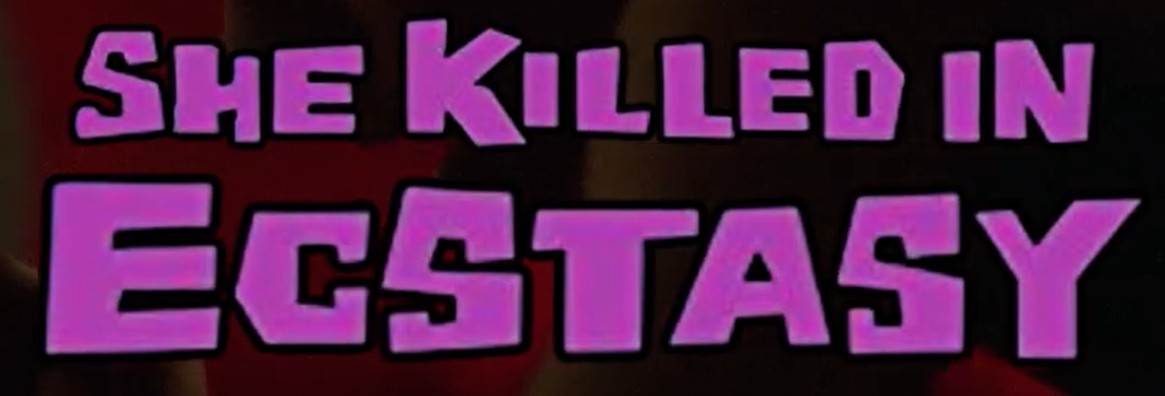
Driven Mad with Revenge, The Doctor’s Wife has Wanton, EVIL plans for Those Responsible for his Death! “She Killed in Ecstasy” reviewed! (Severin Films / 4K UHD and Blu-ray)

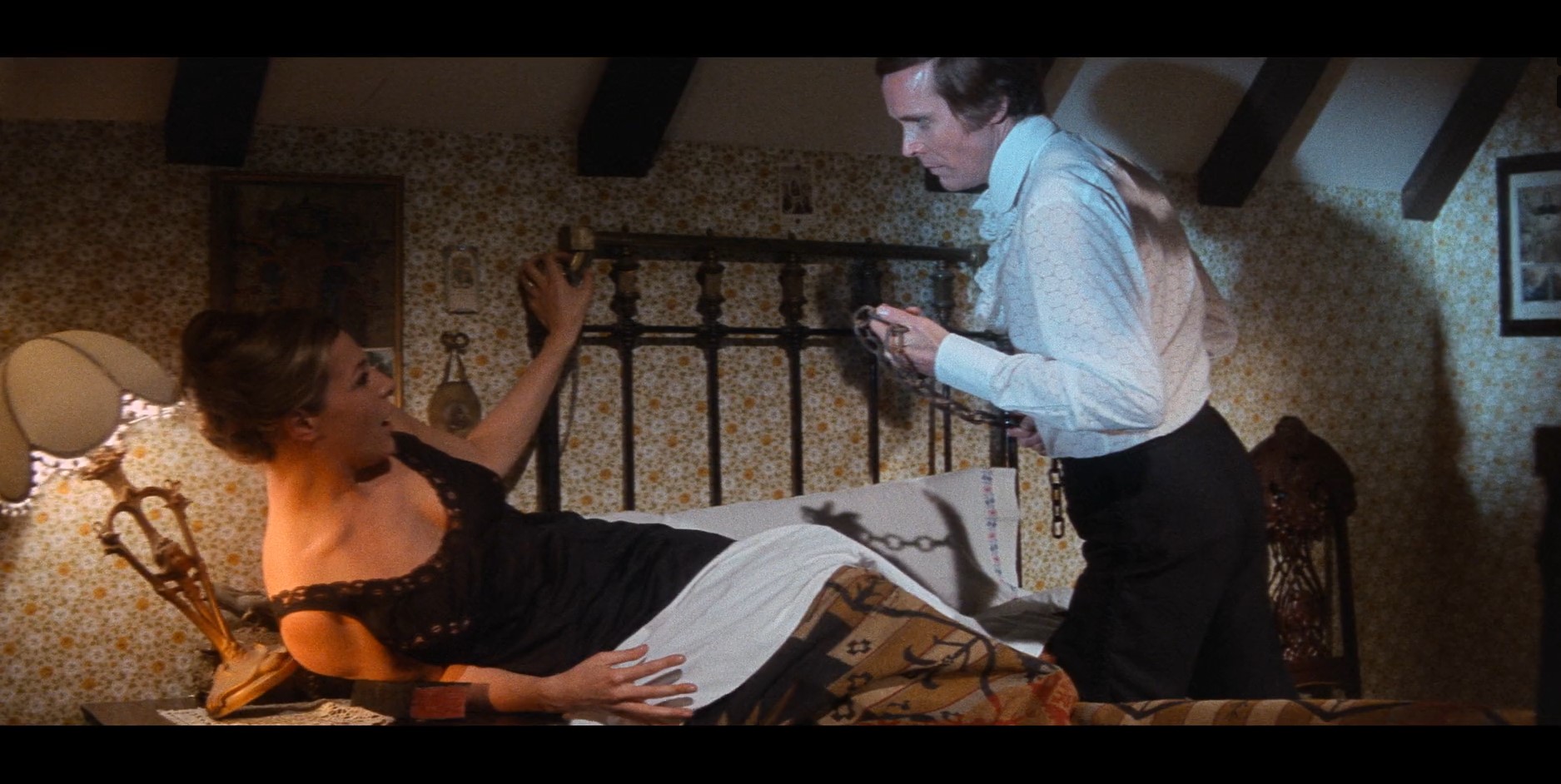
Dr. Johnson is determined to save countless lives from diseases, including cancer, by experimenting his research on human embryos with great results.  However, the more conversative medical board deems his actions too inhumane and unethical for science, rejecting his research, expelling him from the medical board, and revoking his license to practice medicine.  Unable to cope with the loss, Dr. Johnson slowly slips into insanity with his former colleagues’ condemnations rolling through his thoughts to the point where he ultimately takes his own life with one slice of the wrist.  His beloving and dedicated wife reels over his death and swears to avenge him by luring each of the four into a seductive death trap.  Mrs. Johnson entices the respectable professionals one-by-one with her desirable femininity into sordid circumstances that leaves them vulnerable for vengeance but at what cost to her own sanity and the police hot on her trail.

Jesús Franco, aka Jess Franco, writes and directs, under the pseudonym of the Americanized Frank Hollman, a tit-for-tat revenger of European sleaze under the contextual themes of controversial medical research, revenge, and hypocritical moralities with a femme fatale kicker.  The film is called “She Killed in Ecstasy” and was released the same year as Franco’s auteur homoerotic “Vampyros Lesbo” of 1971 and as a pair, the two films see a 4K caliber upgrade from the established genre boutique label Severin with UHD Blu-rays that star sultry actress Soledad Miranda.  Filmed in Spain, more specifically in the Valenciana providence, and like his “Vampyros Lesbos,” “She Killed in Ecstasy” is also a German production produced under Artur Brauner (“The Devil Came from Akasava”) and Arturo Marcos (“Count Dracula”), both of whom worked with Franco on “Vampyros Lesbos,” with Karl Heinz Mannchen returning as well to serve as executive producer under the production banner of Tele-Cine Film und Fernesehproduktion in collaboration with Fénix Cooperativa Cinematográfica. 

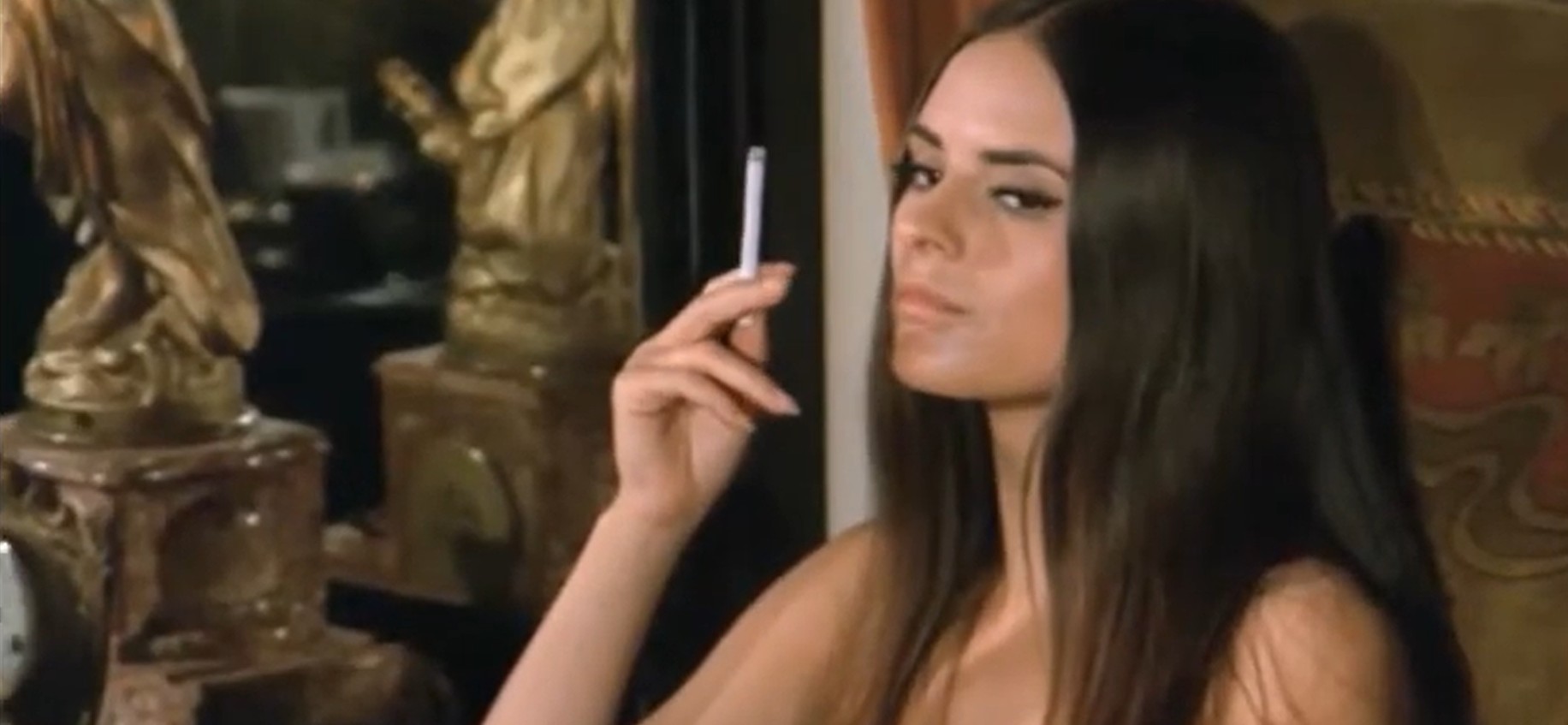
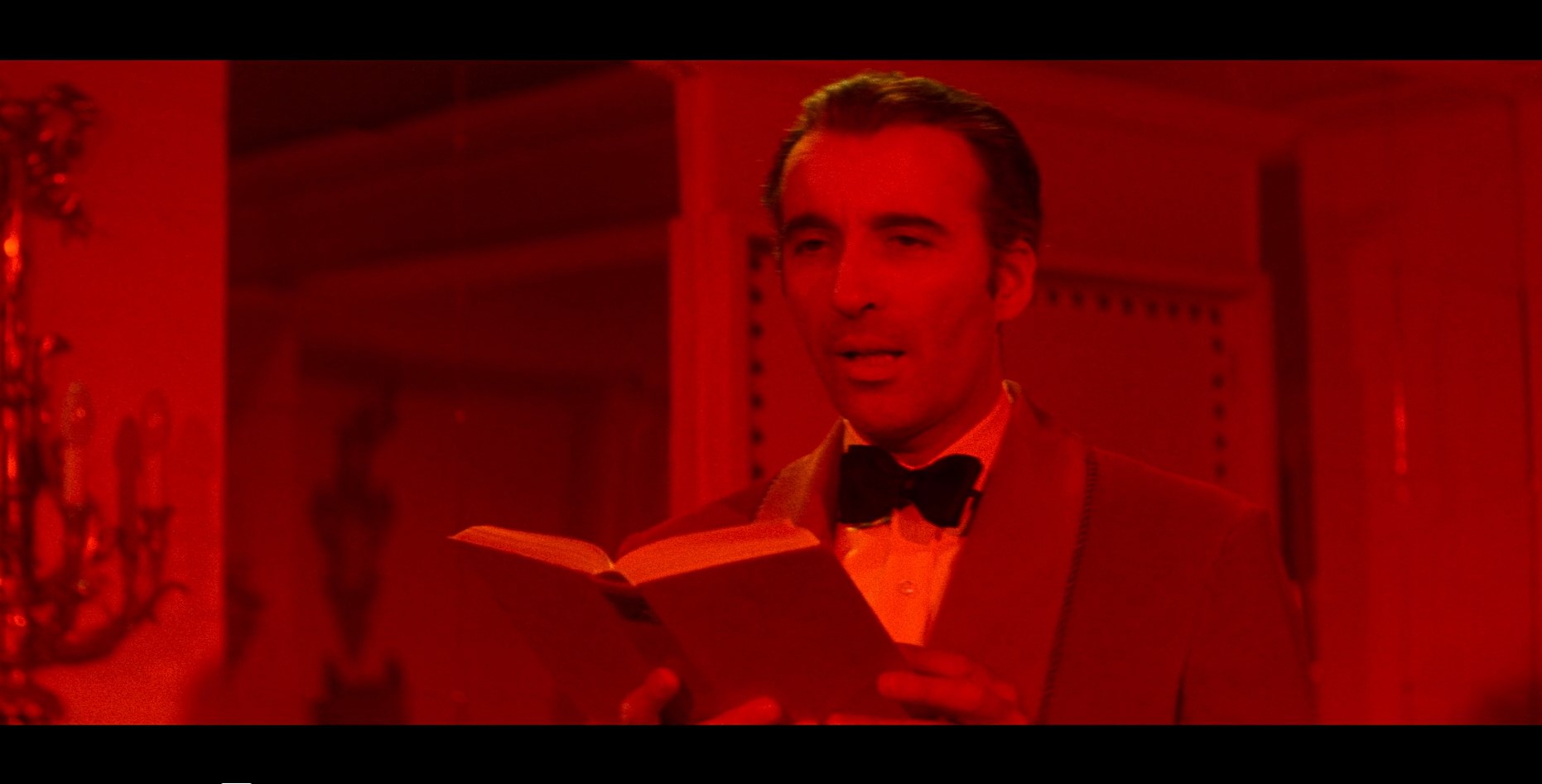
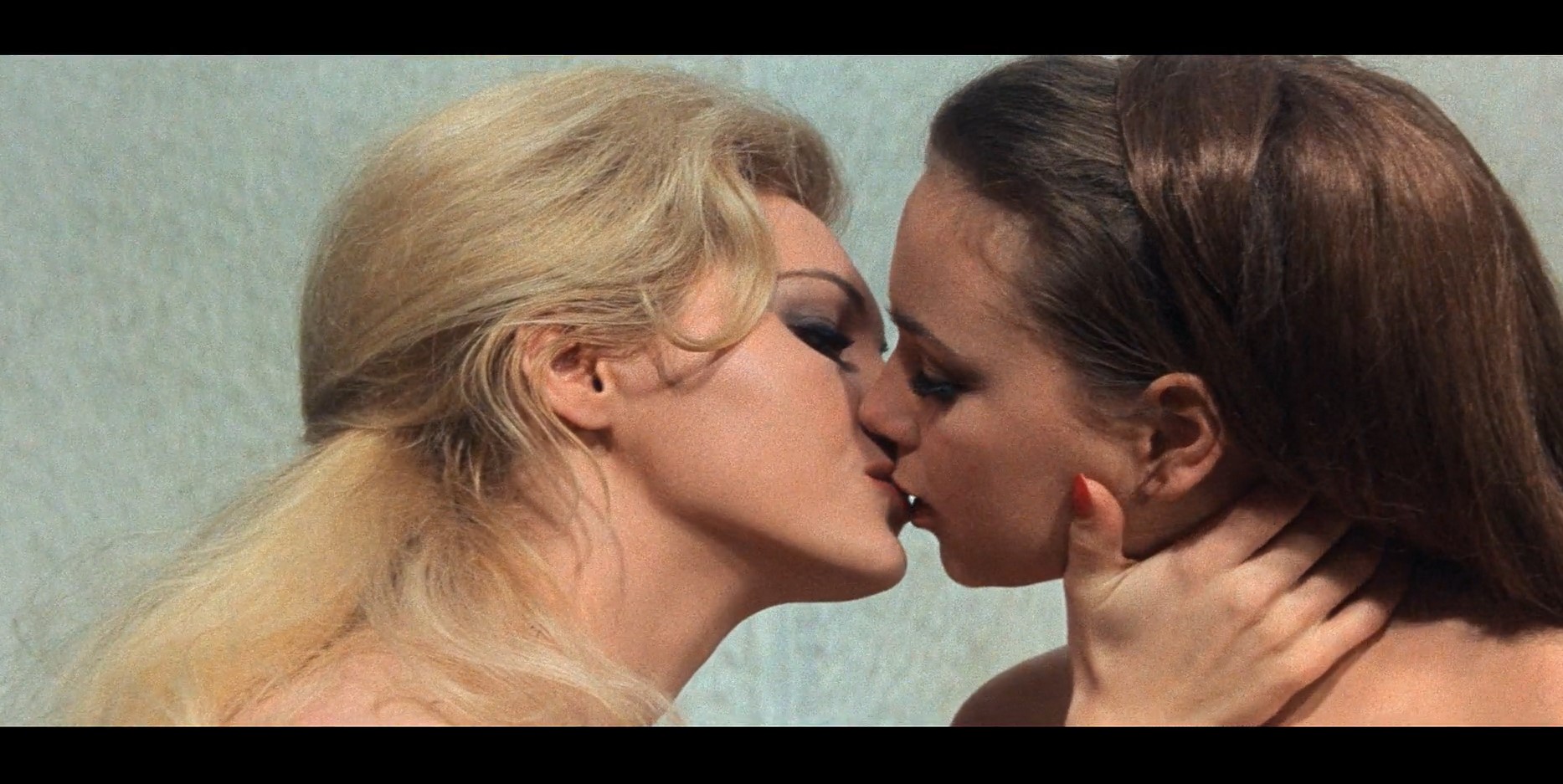
If you thought Spanish actress sizzled as a sapphic bloodsucker in “Vampyros Lesbos,” seeing her manipulate those who’ve done her and her husband (“Fred Williams, “The Red Nights of the Gestapo”) wrong with weaponized sex is the naked, full-bodied zenith of her career as the vehemently vindictive Mrs. Johnson.  “She Killed in Ecstasy” offers Miranda more range of arc that takes her happiness, squashes it, and forces her to sex her way through destroying the lives of those who’ve destroyed her own relationship but with each kill slowly piecing away her soul and sanity.  It takes a woman’s touch to evoke the sordid true selves of the husband-damning medical board who are riddled with their own vices that stray not too far from Mr. Johnson’s unethical research.  Masochism, lesbianism, perversion – these are the sexualized traits of the medical board who fall into Mrs. Johnson’s snare to be snuffed out in the summit throes of sexual foreplay, distracted by her iconic figure, lush bush, and deep brown hair and eyes.  Primarily Swiss and Swedish actors makeup the medical board with Paul Muller (“Lady Frankenstein,” “Eugenie de Sade”) as the Dr. Franklin Houston, Howard Vernon (“Angel of Death,” “Zombie Lake”) as Prof. Johnathan Walker, and Ewa Strömberg (“The College Girl Murders”) returning to costar alongside Miranda from “Vampyros Lesbos” as the only woman in the group as Dr. Crawford while Jess Franco himself takes the last spot as Dr. Donen, integrating himself into the madness.  The last principal cast member is “The Horror of Blackwood Castle’s” Horst Tappert and the German actor plays the generic role of a police Inspector monitoring and tracking a killer unleashing knife-edge fury on specific medical professionals.  The Inspector is essentially a throwaway role with no real contribution to the narrative other than to be an aimless cat chasing it’s own tail with no real sleuth work; instead, the Inspector has the persona attributes and gaited grace of a cool, calm, and collected know-it-all except the killer’s identity and motive. 

Now, the premise itself is promising, like most revenge thriller that exploits sexual provocatively for a death strike, but Franco’s narrative is hindered on being formulaic without any kind of deviation from one kill to the next as Mrs. Johnson spins the same trap of being the promiscuous spider enticing the fly to its bed of web.  Mrs. Johnson does disguise herself differently for every scenario and opportunity to lure, attract, and feast upon her targeted prey, using mostly a melee knife from her garter to slit their throats and castrate them as if to say, you killed my husband, now I take your manhood!   Pure spite drives her until the unhinge of insanity takes the helm with each kill taking a little bit of her soul with each murder.  “She Killed in Ecstasy” fits into Franco’s framing and depth of shots by shooting with wide landscapes and incorporating actors as longshots to engulf them in the environment without it feeling isolating or an immense sense of doom.  Franco can also get intimate with closeups as the actors get intimate themselves, it’s as if Mrs. Johnsons is reeling in the unsuspecting lustful and condemning medical board from the wide, long shots through class panes and door frames to between the sheets that is tightly shot on faces, body parts, and the eventual fatal act. 

The second act on a two part Jess Franco and Soledad Miranda film 4K UHD and Blu-ray release from Severin Films, “She Killed in Ecstasy” comes dual formatted with a HVEC encoded BD100 and a AVC ended BD50 and with their respective resolutions of 2160p ultra high-definition and 1080p high-definition.  The work Severin has done is impeccable with a well diffused, well saturated image containing natural and balanced film stock grain and has immersive details.  There’s not a ton of notable differences between the two formats with more of the darker shades or tenebrous areas on the UHD having a richer control in the decoding that has spot yet minor banding on the standard Blu-ray.  Skin tones and textures never break from normal tones and into splotchy territory; it’s quite an achievement to make the newly scanned 4K image from the original camera negative appear like a fresh film right off the digital scan.  The audio is not as complex with just a simple German language mono track with optional English subtitles that’s about as good as it would be sound on any system setup with coequal layers between dialogue, ambience, and soundtrack.  With an international cast, not all the cast speak German with the film’s dialogue, and ambient, layer produced through ADR with German voice actors.  The produced result is overall clean with minor interference static from the used equipment but does not impede verbal progression and dynamics between characters.  English subtitles appeared accurate and well-placed.  The UHD disc has little-to-no special features in what is essentially a feature-only disc that has an accompany German trailer for the film.  The Blu-ray has all the extra glory with a Jess Franco novel author Stephen Thrower interview Ecstasy in Rage,” a location visit In the Land of Franco Part 13, an archived interview with Jess Franco before his death Jess Killed in Ecstasy, an archive interview with actress Soledad Miranda Sublime Soledad, and an archive interview with actor Paul Muller.  The German trailer is also on the Blu-ray disc.  Much like ‘Vampyros Lesbos,” “She Killed in Ecstasy “ has a O-ring slipcover with commissioned graphic art that resembles the original poster art and the Shriek Show DVD cover with Soledad Miranda in one of her rememberable scenes of her character’s sanity crumbling in a upright fetal on a couch moment.  The backside of the slipcover offers up some of her character’s rage which is intense amongst the eyes and fascial expressions.  The black UHD Amaray case comes with a single sided sleeve with original film artwork and no tangible materials inserted inside.    The region free release for both formats provides all Franco and genre fans with a not rated film clocking in at 80 minutes. 

Last Rites: A must-see Jess Franco film for exploitational revenge and a must have physical release for Jess Franco fans, “She Kills in Ecstasy” is an alluring revenge-thriller that exposes thin morality hypocrisy as well as a deepening madness over grief and death.

Pinksploitation EVIL is Transgressional Passion! “Love and Crime” reviewed! (88 Films / Limited Edition Blu-ray)

Limited Edition and Numbered Blu-ray / DVD Set Available at Amazon!

The dead body of a young woman arrives at pathology for post-mortem autopsy.  A victim of a heinous crime, the bare corpse already informs the head pathologist of sexual activity before, or after, death because of the fresh semen that’s inside her.  As he toils over her to open the chest, separate the ribs, and get a good look inside to see how and why she perished, the pathologist remains in disbelief that the semen inside her, inside his lifeless wife before him on the cold medical table and under the bright lights, is not his own.  Digging deeper into how someone could kill his beloved wife, the researcher in him hits the books, selecting and scouring through records of similar cases of murderers and rapists from over the years.  Each one under different circumstances concludes in a sentence that reflects the person they have become.  Inside the mind of a killer is a long hard look at ourselves in how far we go for treasure, love, and to quench our insanity. 

“Love and Crime,” or officially known under the Japanese title as “Meiji Taishô Shôwa: Ryôki onna hanzai-shi” aka “Showa Era:  History of Bizarre Female Crimes,” is the Japanese anthology from 1969 that pictorializes true crime narratives of mostly women transgressors, as the title suggests.  Yet, the Teruo Ishii helmed anthology is not entirely female perpetrator centric as the anthology jumps ship briefly to explore crimes against female victims for a crossover, comparative distinction.  Ishii, who played his hand in producing late 1960s sexploitation and violence by directing films in Toei Company’s pinku series that showcased the two subcategories, such as “Orgies of Edo,” “Shogun’s Joy of Torture,” “Inferno of Torture, and among many other titles with similar salaciousness, was thrust into “Love and Crime’s” consolidating short film escapade with a wraparound monologuing narrative that was just as intriguing as the sordid stories themselves.  Shigenu Okada produces “Love and Crime” as well as many of the films aforementioned.

Yoshida Teruo kicks off the wraparound with a mater-of-fact narration running through the head of Murase, the anatomist examining his dead wife’s corpse (Ritsuko Nakamura), in what would be the grisliest part of the anthology, especially when that chest snaps during separation.  Having worked with Ishii previously with “Abashiri Bangaichi,” a crime thriller about a reminiscing criminal aimed to reform himself, Teruo only worked a short stint with the Toei Company but his time spent on such films like “Crime and Love” discerns a piece of the dramatic devotion that would be otherwise missing in these purely exploitative films.  As Marase puts nose to book, he unearths and internally narrates the start of his true crime story journey research, beginning with the cut-throating scheme of the Toyokaku Inn case.  Chiyo (Aoi Mitsuko, “Melancholy Flesh Business:  Sensuous Zone”) and Kosuke (Kenjire Ishiyama, “Kwaiden”) own and run the humble Toyokaku Inn but when Chiyo seeks to changes businesses and cut ties with her philandering husband Kusuke, a treacherous and murderous plot against her is formed between Kusuke, spearheaded by assistant manager Kinue Munekata (Rika Fujie, “Outlaw:  Heartless”), and executed by maintenance man Shibuya (Takashi Fujiki, “Shin Godzlilla”).  From there, the film transitions to other female intertwined crime tales of Sada Abe, a woman who would kill her lover because of love and insistence during alternative sex, the case of Kunihiko Kodaire, a serial rapist and murderer spilling tricks of his trade to authorities, and the last known female murderer executed by katana beheading, Takahashi Oden, for poisoning her husband.  Each performance plays into the intricate patterns described by their true life counterparts with either a chilling contentment in taking a life or hurdling the obstacles inward to do the unpleasantries of what is asked of them  Circumstantial opportunities and conniving plots bury bodies six-feet under in a multifacted range of expression, greed, lust, and all the other deadly sins that plague mortals right to the very end.  “Crime and Love” fill out the pinksploitation anthology with Yukie Kagawa (“Female Prisoner Scorpion:  Jailhouse 41”), Eiji Wakasug (“Inferno of Torture”), Tomoo Koike, Tatsumi Hijikata (“Orgies of Edo”), Yumi Teruko (“Horrors of Malformed Men”), and a special appearance by the actual, reclusive, convicted murderer Abe Sada herself, shot from a distance while being interviewed by Yoshida Teruo.

As anthologies go, especially one rare as true-life crime and love, or in this case sexploitation,” “Love and Crime” has an unsystematic design when it comes to the stories and how they relate to the wraparound narrative.  For starters, not all the bizarre crimes are female centric.  The story of Kodaire revolves about a male serial rapist and murderer divulging his collected anecdotes to investigating confessors and are depicted in monochromatic flashback, the same as his present yarn telling scenes.  Though the case involves multiple women victims, Kodaire greatly stands out amongst the compilation of crimes for the very fact he is a man in an anthology literally entitled History of “Bizarre Female Crimes.”  Was the case of Kordaire a gap filler? Perhaps the uniquity of Japanese serial killers is so low and rare in their culture and history that this particular short story had enough estrogenic blood spilled it avoided the short list cut.  Each story’s relationship toward the wraparound is also thin as neither story suggests a same or remotely similar pattern to death of Maruse’s wife in what is more of a random-generator selection of stories read and worked through for better understanding of the killer female psyche rather than what makes the male killer tick to hit-and-run his wife.

“Love and Crime” is 88 Films’ answer to opening the door of the wonderfully violent and sexually charged world of pinksploitation.  A limited edition and numbered dual-format, AVC encoded, 1080p, 50-gigabye Blu-ray and standard definition, MPEG encoded, dual-layered DVD, set presents the 1969 film in the original aspect ratio of 2.35:1.  With various stylistic color grading outfits, such as grayscale image for the Kadaire case story or the last case of Takahashi Oden that’s starkly cold rooted in blue and green.  There’s not a lot of mention of what kind of work went into restoration but the print has kept in excellent condition with age or damage wear kept to a minimum with nominal vertical scratching and dust speckling.  Colors appear to be handled with true reproduction of the dyed processing, rich and bold leaves no room of ambiguity of image or object representation.  Skin tones appear natural that do flirt a lighter shade of orange at times, textures are coarse and greatly apparent, even in the black-and-white story, and there’s tremendous environment or background distinction that creates an organic depth between character and their setting rather than them being crushed into an all-in-one image.  The encoded audio is the original Japanese language LPCM mono 2.0 that captures the soothing project whir during post ADR.  Dialogue retains prominence with a clean enough clarity albeit some negligible hissing sporadic throughout.  Ambience is not as enlivened within what’s mostly an isolated dialogue mix but is there to complement to composition when necessary, such as the blustery snowfall during the execution that sets a tumultuous tone of desperation and severity.  The improved English subtitles are timely synched and error-free.  Special features include an audio commentary by the 88 Film’s Japanarchy release fire starter and Midnight Eye’s co-editor Jasper Sharp and Fangoria staff writer Amber T., a brand-new film introduction and conversation by film critic and journalist Mark Schilling, a still gallery, and trailer. The Obi-striped 88 Films packaging has a very familiar feel to what Radiance Films, another boutique UK label, is doing with their Blu-ray releases nowadays and “Love and Crime” could be confused for a Radiance resemblance, but clear UK Amary has a gorgeous, commissioned, newly designed artwork from Ilan Sheady that brings all the sordid shades of this anthology to life. The cover art is also reviersible with the original Japanese one-sheet. Inside, the Blu-ray and DVD overlap in a dual-disc lock system on the right while the left stashes 15-page black-and-white-and-colored pictured adorned essay by Nathan Stuart prologued with cast, crew, and release acknowledgments and bounded by the same Sheady artwork without the Obi strip obstruction. 88 Films release comes both in region A and B playback, is not rated, and has a runtime of 92-minutes.

Last Rites: “Love and Crime” will be a love-it or hate-it anthology of early pink violence and sexual discordance because of its broad stroke theme but the 88 Films’ limited edition, Japanarchy debut is an exciting and eager look toward the future of the label’s dive into Japan’s exploitational cinema.

Limited Edition and Numbered Blu-ray / DVD Set Available at Amazon!

How Many Chickens Need to Have Their Throats Cut to Satisfying Ritualistic, Naked EVIL! “Voodoo Passion” reviewed! (Full Moon Features / Blu-ray)

Get Entranced by Full Moon’s “Voodoo Passion” Blu-ray!

Newly married Susan House travels to Haiti to join her consulate husband, Jack House, who has been stationed at the British Embassy.   Captivated by the Haitian voodoo religion and culture, Susan is eager to tour the island nation’s most ambiguous practice most don’t or will never understand all the while Jack’s naked and nymphomaniac Sister, Olga, makes forward, flirtatious advances toward her.  That fervor for voodooism and Olga’s point-blank seduction has seemingly incepted terrible nightmares of naked, animal sacrificial rituals and murder conducted beguilingly by a priestess in the form of Jack House’s native housekeeper, Inês.  When Susan awakes, the realism of her dreams afflicts her but her husband Jack and his colleague, a psychiatrist by the name of Dr. Pierre Barré swear there have been no police reported murders.  Night after night, Susan’s entranced nightmares continue to be vivid with murderous mysticism that’s slowly driving her mad in the land of voodoo. 

One of Jesus “Jess” Franco’s more bosom and bush erotic-thrillers, “Voodoo Passion” is nearly a fully naked runtime feature sprinkled with hints of the nation’s cultural religion.  The 1977 released, German Production, also known by the titles “”Call of the Blonde Goddess” or “Der Ruf der blonden Göttin,” was less about his own stylistic substance and auteur stamp and more about spasmatic, gyrating nudity under rhythmic bongo beats for the Spanish sleaze and exploitation genre filmmaker.   The gratuitously sexed-up, multinational feature is penned by the Switzerland born, sexploitation and adult genre screenwriter Erwin C. Dietrich under one of his pen names, Manfred Gregor.  Dietrich also produces the film amongst a substantially historical collaborative effort between himself and Franco over the course of the late 70s to early 80s.  Nestor Film Producktion serves as the production company, filming entirely not in Haiti but in the beautifully scenic and old-world allure of the seaside capital of Lisbon, Portugal.  

Lots of hot body action in this beat-driven, voodooism thriller primarily between a trio of character-diverse, titillating ladies and peppered with peripheral nude women and men tribals engaged in a ceaseless native, ritual thrusting, pulsing, and shaking trance dance.  “Voodoo Passion” grips itself around the rags-to-riches character of Mrs. Susan House in what is a matron-look for Spanish actress Ada Tauler (“The Sexy Horrible Vampire,” “Love Camp”) brought to Haiti at the behest of her British consult, newlywed husband Jack House, played by the stony-faced and “Eugenie” and “Pieces” American actor Jack Taylor able to swing both thrills and feminine frills in his films.  While Tauler’s doesn’t shy away from full nudity of Susan House’s fever dream state, the actress pales in comparison to the other two-thirds who are more engaged in sexual promiscuity and the liberating fervor of ethnic ceremony.   Those two actresses are “Caged Women’s” Karine Gambier as the nymphomaniac sister of Jack House and the face of most of “Voodoo Passion’s” physical marketing with French actress Muriel Montossé (“Cecilia”), under the more westernized stage name of Vicky Adams.  With a face and body like a model, Vicky Adams’s wild arm and stoic expression dance moves will hypnotize viewers entranced with the bongo tempo’s transfixing pomp, contributing to the film’s psychotronic premise of magical and religious rites, obfuscated nightmares, and, cue Austin Powers’s voice, murder.  Yeah, Baby!  “Voodoo Passion” has curves for days and in all different personas that keep things weirdly, but welcomingly, platonic on some level and not just an overly saturated sex-fest.  The film’s cast rounds out with Vitor Mendes (“Swedish Nympho Slaves”) and Ly Frey.

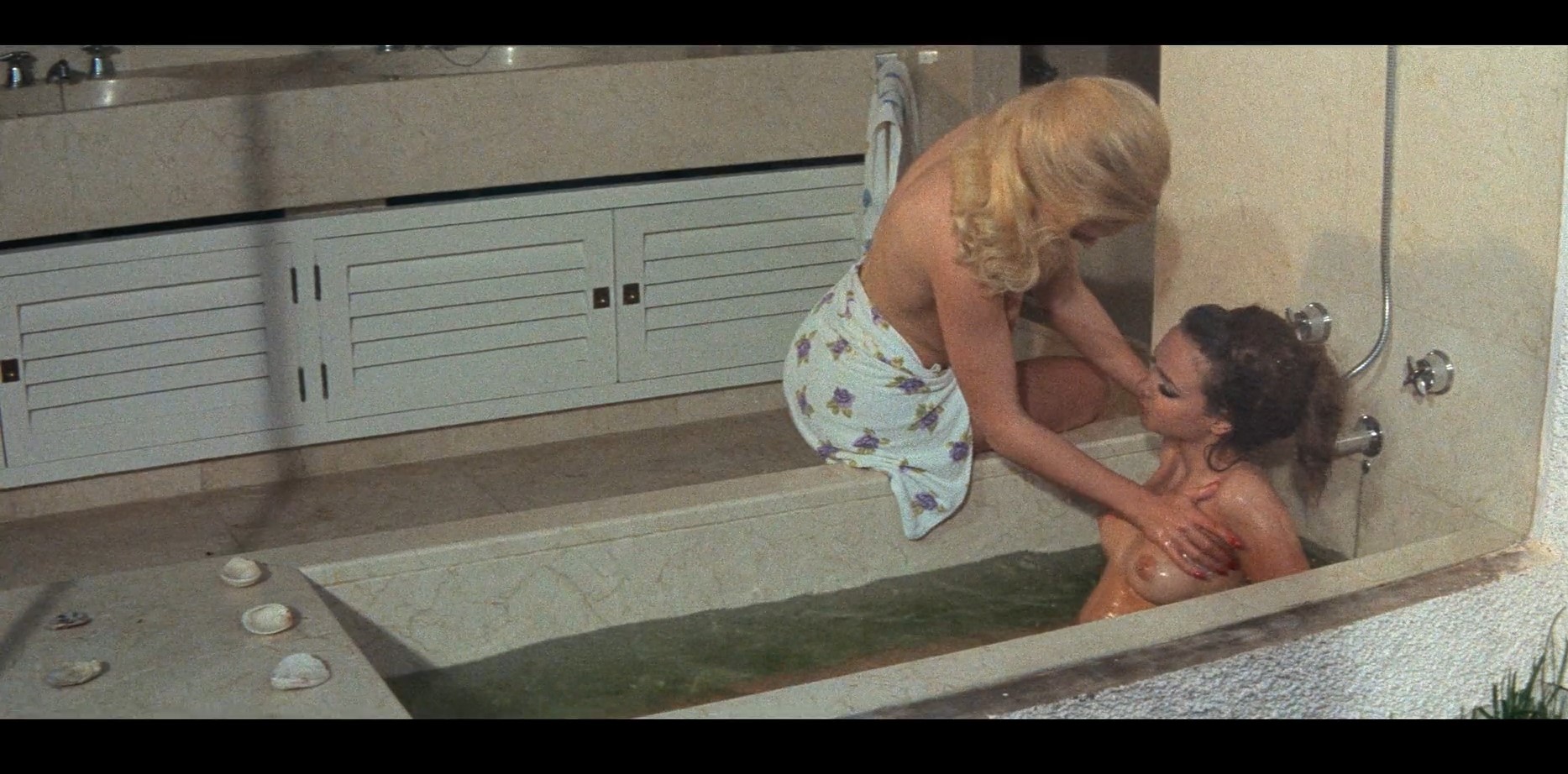
If asked to describe or give an opinion on “Voodoo Passion,” one would say cheekily the Jess Franco film is a thriller swathed in an eyeful of bosom and bush.  If the 4-minute introductory scene with voiceover exposition to the ceremonial voodoo band and half-naked native dancers wasn’t enough of a clue, Ada Tauler and Karine Gambier pull you right back into the soaking tub with their soapy, wet bodies as they immediately take a bath together upon meeting for the first time.  From that point on, the bosom and bush bar has been set and in that the thicket of unshaven landing strips, there’s a good story underneath about the mystics and misconceptions of Haitian voodooism.  Unfortunately, much of that story falls behind the showcases of skin, thrusting the principal ladies into the spotlight, overshadowing Jack Taylor’s performance as well as doing nothing for the poor psychologist in Vitor Mendes, and undercutting the very theme of ritual exploitation and misconduct which is half of “Voodoo Passion’s” concept.  The entirety is all quickly surmised in one fell swoop of exposition without the necessary leg work, that should have been carried out by either Susan House or the consul assistant Inês, of building evidence for or against the contrary exposed in the finale.  Then again, does gorgeous naked women dancing about really need a well-rounded plot?  All depends on the eyes of the beholder and these eyes needed that equilibrium!

Full Moon Features conjures up a Blu-ray for this Jess Franco thriller debased in sexploitation slather.  The AVC encoded, high-definition 1080p, is housed on a single layer BD25, yet not encoded heavily with bonus content, “Voodoo Passion” is able to retain a full-bodied image from a remastered German original negative owned by producer Erwin C. Dietrich.  Vivid color saturation, contrast levels accompanying each other, natural looking skin tons, and the stunning detail render this Full Moon Features release the bees’ knees.  No signs of blocking or banding but some celluloid frames are slightly grainier than others that might be a result of age, wear, or the variable of film stock.  There is only a single audio option, an English LPCM 5.1 renders lossless audio, clearing each channel with ease, and delivering a rhythmic bongo drum beat with intensity.  Dialogue mirrors the richness despite the ADR track overtop the diverse nationalities’ native tongues.  There are no English subtitles, or any setup option for that matter, for this English only track release.  Special features included are an archival interview with Jess Franco with forced English subtitles Franco, Bloody Franco, a rare photo slideshow of images from the film, the German trailer, and a Jess Franco vintage trailer reel of most of his schlocky Eurosleaze fair.  What’s party treasured about these newly re-released films onto a new full HD transfer is Full Moon’s physical package redesigns that offer a cardboard slipcover with new illustrated, pinup-esque, art.  “Voodoo Passion” has a half-naked woman, presumably the nymphomaniac sister Olga, moaning in ecstasy while holding a…hand mirror?  Wonder if that should have been the champaign bottle Olga uses to, well, you know, pleasure herself with.   There’s also a striking, NSFW, Muriel Montossé pose in a scene from the film on the traditional Blu-ray Amaray front cover with additional explicit scenes on the backside.  The disc is pressed with the same slipcover illustration and there are no inserts inside the case.  Presented uncut and region free, this Full Moon release of Jess Franco’s vintage sleaze has a runtime of 86-minutes.   

Last Rites:  Another wholly impressive picture quality presentation of another unwholesome, softcore sexploitation by Full Moon Features, a friend to Haitian voodoo and you, the licentiously greedy viewer! 

Get Entranced by Full Moon’s “Voodoo Passion” Blu-ray!

Never Weekend on Sadomasochists’ EVIL Private Island Alone! “Eugenie” (Blue Underground / 4K UHD and Blu-ray)

“Eugenie” is Waiting to Tell You Her Story of Perversion!  See It Now on 4K UHD at Amazon.com

A wealthy, sexually sadistic Madame St. Ange, a specialist in the Marquis de Sade’s teachings, entices to coerce the father of a young and beautiful innocent girl, Eugenie, St. Ange befriends to permit the naïve teenager to visit Madame’s private island for the weekend.  Excited and overjoyed with the idea of feeling like an adult indulging in mature activities, Eugenie is unaware that Madame and her equally as cruel stepbrother and lover Mirvel, who has been beguiled by Eugenie’s beauty, have ulterior motives and lured the unsuspecting youth into a ritualistic trap of sexual corruption and sadomasochism.  The step-siblings drug and rape Eugenie for their unspeakable gratifications only for her to awake in what only be explained as horrible nightmares of phantasmagorical encounters but when the nightmares unveil a disturbing reality when the dogmatic Dolmance and the rest of his Marquis de Sade acolytes arrive to initiate Eugenie into more than just pain and pleasure educations but to be a pawn in a murder scheme that tears the very fabric of virtue. 

Spanish director Jesús Franco, or widely known as Jess Franco, helmed an excessive number of provocative-pushing films over his nearly 60-year-career as a filmmaker before his death in 2013.  Many of the once labeled video nasties director were crafted on a tight budget with an even more so tight timeline as Franco churned out regularly mostly trashy horror and sexploitation that would more than often wind up in the projection booth of local red light district theaters for a dime and a wank.  Yet, “Eugenie” strokes a different kind sensation, one that lies in the ethereal concept of sexploitation and the ruin of youth made to order by the Marquis de Sade himself and artfully stitched by Jess Franco’s profundo knowledge of cinematic sculpturing.  “Eugenie,” or “Eugenie…. The Story of her Journey into Perversion” in the extended title, is based off the French 1795 novel, La Philosophie dans le boudoir (Philosophy in the Bedroom) written by de Sade and the script adaptation is penned by “99 Women” and “Christina” screenwriter and profound producer of film, Harry Alan Towers.  Towers also produces “Eugenie” under the pseudonym of Peter Welbeck for Video-Tel International Productions and was theatrically distributed by Distinction Films.

At the frayed edge of an already soul crusher subject matter, “Eugenie” repels against the grain of easily digestible roles,  Marquis de Sade’s characters are sadomasochist with abhorrent qualities of deception, malintent, and insatiability for a cathartic release from sexual pleasure and punishing pain.  On the other side of the coin, Franco and Towers film calls for the characters to push beyond the limits of their comfortability around the idea of drugging and raping, or being the victim of such, as well as violence and murder as part of a cult normalizing and rationalizing unrestrained freedom and ideology.  Swedish born actress Marie Liljedahl had a brief stint in erotica, as a power-seductress as the titular Inga, and only dabbled with sexploitation, “Eugenie” being that dabbled powder only once snorted to warrant a sudden disinterest in the theme altogether.  Liljedahl plays the titular character and she looks every bit the age later-aged teen with a round, youthful face, vibrant demeanor, and curvaceous like a ripe peach.  Like that knot forming in your gut spurred from anxiety, watching Eugenie exploited while in a stupor is the equivalent imaginations of what the deplorable effects and actions of a roofied drink that produces vague and foggy recollections and disbeliefs in what is reduced down to a vivid dream gone wild.  The two inveiglers at the heart of Eugenie’s virtuous destruction quickly become despicably loathed by not only their debauchery plans to corrupt good embodied but also by their snooty affluency and their acrid arrogance with the help.  “The Blood of Fu Manchu” and “99 Women” blonde beauty, Maria Rohm, and the stern faced “Succubus” and “The Vampires Night Orgy” actor Jack Taylor exemplify the essence of evil as the de Sade principled lovers and step-siblings Madame Saint-Ange and Mirvel.  The opened-ended lust Mirvel has for Eugenie morphs into a determined, nagging desire to have her at all costs, kept close to the chest by Taylor but knowing it’s simmering quickly to a head, and you can see in the Madame’s eyes that she’s either really internally pissed about Mirvel’s narrowed focus on a new toy or she’s basking in her ideology’s unchained gratification.  Rohm’s nonaligned decision maintains Madame’s sensual composure and undisclosed intentions until the shocking end.  The presence of Sir Christopher Lee in a Jess Franco film isn’t all that surprising.  The legendary, late British actor – “The Blood of Fu Manchu,” “The Bloody Judge,” and “Count Dracula” – where a handful of euro trashy and exploitative horror that were released around the same time as “Eugenie,” but “Eugenie” garishly bathed in the idea of sexual misappropriations and Lee being a last minute addition due to another actor’s ill-fate, agreed to fulfill the role without knowing how involved the nudity would ultimately land perverted cuts of the film into spank cinema houses.  Lee’s red smoking jacket, elegantly stoic composure and dialogue delivery, and his incredible ability to perform an intimidating figure without as much as lifting a finger compounds the value of Franco’s filmic adaptation to the point where I firmly believe with the original slated actor George Sanders (“Village of the Damned, 1951) in the ringleader and adherent role of Dolmance would likely have not have been half as good.  Anney Kablan, Paul Muller (“Vampyros Lesbos”), Uta Dahlberg, and Maria Luisa Ponte (“El Liguero Mágico”) costar.

Through an ocean of film filth, “Eugenie” may be the very film that proves Jess Franco is a cinematic genius in his own rite by capturing de Sade in the flesh, so to speak, with a plain-sighted fetish that diabolically hatches a scheme within a scheme.  In addition, “Eugenie,” dare I say it, almost feels like a Hammer film, especially with Lee in the picture.  The interior sets are modernly gothic with sleek and sterile furniture but garnished with large candle holders and the Marquis de Sade era sartorial worn by Dolmance’s muted followers. There’s a cadence to Franco’s story, one that leaves breadcrumb plot aspects to go against divulging a straightforward story right from the start, and the history between acquainted characters is contentious and fraught with unpleasant emotions in the act nice, play nice master sadists and the subservient help hierarchy that hints at a fraction of degrading minorities. Saint-Ange and Mirvel boatman Augustine, a black man who has his life reborn from the ashes of poverty only to be toiled as their attendant and frivolous plaything when the mood is right. There’s also deaf and mute woman brought on to be the new maid in a moment’s conversation between the siblings just to drop a dab of her presence amongst them. Augustine and the maid represent the lower class of people, a man of color and a woman of disability, to easily take advantage of just like Saint-Ange and Mirvel do with Eugenie’s innocence. France shies away being overly showy in slipping in this unjust dynamic that unfolds bit by bit as mentioned earlier of Franco’s revelation design. “Eugenie” not only dangles the attractive set locations and nudity carrot to draw attention but also invests in its talent as Frnaco the cherishes the cast of individual portrayers with longer shot moments to speak volumes of their unique objective or to pedestal them in their own keynote scene of power and, subsequently, obliteration that makes every occurrence worth noting and not just something to write off. “Eugenie” has no tears or apologies to spare but only inhuman indecencies separated by a blurred, unfettered line of sex and sadism satisfactions. This is Jess Franco at his finest.

The 1970 “Eugenie” print takes on more pixels, 2180p to be exact, with 4K UHD transfer and a re-release 1080p high-definition Blu-ray in a 2-disc set from Blue Underground. The 4K restoration from the original camera negative with Dolby Vision Hi-Def resolution on a 66GB, double layer UHD and is also on an AVC encoded Blu-ray that are both presented in an anamorphic widescreen 2.40:1 aspect ratio. Both transfers execute their respective program, offering an average frame rate of mid-high 30s Mbps, but there’s a focus issue with the transfer brought upon likely at the origin of filming and we know this because the frame rate never drops, staying consistent throughout the issue. Periods of unfocused detail come and go between edits and often in the same shot as if attempting to render delineation between the foreground and the background in order to get the shot on the fly (there are many instances Franco had limited time to shoot). Color grading, including skins tones, are natural appearing until the red tint, a symbol of when the subject matter becomes dark, eliminates and reduces vast color palette to one single hue. Both formats offer an English and French dub language 1.0 mono mix that buff enough to be ample; in fact, the mix is rather good considering the single channel with substantially clarity with no hissing, popping, or other blights on the dialogue track, Foley, or any track for that matter. Subtitles are offered in English, French, and Spanish. If you’re looking for special features, they mostly encoded onto the second disc, the Blu-ray, with Perversion Stories, a retrospective interview with the late Jess Franco, writer Harry Alan Towers, and stars Christopher Lee and Matrie Liljedahl discussing the behind-the-scenes measures and understandings of the sexploitation classic, Stephen Thrower on Eugenie, an interview with the author of “Murderous Passions: The Delirious Cinema of Jesus Franco,” a new interview with costar Jack Taylor Jack Taylor in the Francoverse, a newly expanded poster and still gallery, and theatrical trailer. The 4K disc also has a new commentary with film historians Nathaniel Thompson and Troy Howarth, plus a theatrical trailer. A two-disc UHD case holds a disc on each side of the interior and the case itself sports the class naked Eugenie pose with her brown locks draped over her shoulders, covering her chest. Speaking of covering, the snapper case is sheathed in a O-slipcover with oval cutout of the front to display Eugenie with a Victorian-aged mirror border. The darkened slipcover is also prominently titled under Marquis de Sade’s novel English moniker, “Philosophy in the Boudoir” that has a regal and classic aesthetic. The unrated, 87-minute film has an all-region playback. Jess Franco distills revolutionary extravagance and couples it with the notion that youth will inevitably be corrupted by family, friends, and a group of cruel Marquis de Sade cultists in what can be construed as one of the director’s most prestigious sexploitation and melodramatic films of his oeuvre.

“Eugenie” is Waiting to Tell You Her Story of Perversion!  See It Now on 4K UHD at Amazon.com

A Concentration Camp of Desecrated Flesh and Pure EVIL. “The Gestapo’s Last Orgy” reviewed (Blu-ray / 88 Films)

After nearly escaping war criminal charges for his role as Commander of a bordello operated Nazi concentration camp that mistreated and murdered multiple thousands of Jewish women, former office Conrad Starker meets his lover Lise Cohen, a former Jewish prisoner of his he fell fond of during their time of occupation, at the same barbaric camp now in vacant ruin. Alone together and wandering the grounds, Lise recalls her first arrival at the camp and how the then ruthless Starker made it his mission to break Lise of her guilt-based nihilism by exacting cruel torture upon her and those close to her in camp. Commander Starker’s direct reports, a dominatrix SS officer named Alma and a sordid Lt. Weissman, serve as his deviant and sadistic right arm, assisting him in striking fear into his new pet project. While troves of Jewish women are being raped by a slew of German soldiers on leave, as well as being tortured and even tested as a source of delicacy, Lise’s alleviated guilt turns her to play Starker’s game, making her become his own mistress, but Lise will never forget the camp atrocities at the hands of the Gestapo.

Never in my life would there be the time I salivated over the thought – dang, what a poignantly awesome title. Far from a generic, uninspired appellation that has completely captured my attention, lured me in like a fish by a dangling sex and exploitation worm, is the 1977 Italian-made Naziploitation “The Gestapo’s Last Orgy.” Understanding that the Cesare Canevari written-and-directed exploitation extravaganza is fabricated fiction from the mind of the Italian filmmaker sexploitation films such as “The Nude Princess” and “A Man for Emmanuelle,” and amongst other popular genres of that particular Italian era, there still lies a contrite underlayer deep inside my bowels for knowing “The Gestapo’s Last Orgy” is inspired by a baseline of truths – aka – the rounding up of Jewish people, forcing them into work and slavery in some sort of servitude compacity, and ending their lives as many were murdered in concentration or extermination camps by incinerations while still alive; all of which are displayed in graphic detail by Canevari in his film. Also known as the “Last Orgy of the Third Reich” and co-written with fellow “The Nude Princess” collaborator, Antonio Lucarella, no words can describe the depictions of Aryan abomination better than Canevari with a display of a wide-range of depravities from the master race in this shocking Cine Lu.Ce. production that Canevari produces.

Only two main characters span the narrative’s timeline between the active war and in the post-war clampdown of former Nazi officers.  We’re first introduced to Commander Conrad Starker (Andriano Micantoni aka Marc Loud, “LSD Flesh of Devil”) in an unofficial capacity as a voice over of a heated war crime trial rages over his driving around a small village before arriving at a dilapidated camp to meet with his beautiful lover, Lise Cohen, an introductory feature film role for then model, and presently a UNICEF Goodwill Ambassador, Daniela Poggi (aka Daniela Levy, “Olga O’s Strange Story”).  From then on, the story goes back-and-forth between the camp horrors from most of Lise’s perspective and her present day melancholy strolling through the now empty camp.  Just between these two, a burdensome and destructive self-contained bubble ignites a prudent connection for a means to an end, whether be Commander Starker’s from merciless lust to love or Lise’s reversal of her exploitation to gain a survivalist’s upper hand by playing right into Micantoni’s sadistic impulses.  Micantoni and Poggi, despite their vast difference in age with Micantoni in his mid-50’s and Poggi in her early 20’s, have shuddering, knee-buckling chemistry in the more abhorrent scenes, one particular involving the fellatio act on a German Lugar.  There are other various scummy characters and if you like girls in uniform, the Doberman-loving Alma (“The Stepdaughter’s” Maristella Greco) is as beautiful as she is a gestapo femme fatale.  Greco’s domineering performance matches her male counterparts in enthusiasm but with a bonus side dish of sultry sadomasochism that can’t be forgotten as Alma whispers her viperous tongue into the camp Commander’s ear (while also sticking the blunt side of her whip into his rectum – ooph!).  “The Gestapo’s Last Orgy” is a perverse party with respectable size cast, including roles played by Fulvio Ricciardi (“Killing of the Flesh”), Vittorio Jorderi (“Gang War in Milan”), and Caterina Barbero (“Raptus”), enlarged by a grand amount of extras from German soldiers to the Jewish women creating the allusion of an inhuman love camp.

“Ilsa:  She Wolf of the SS,” “Love Camp 7,” “S.S. Experiment Camp,” “Nazi Love Camp 27,” “Achtung! The Desert Tigers,” S.S. Hell Camp.”   I’ve seen my fair share of Nazisploitation and, aside from Tinto Brass’s erotica-elegant “Salon Kitty,” Cesare Canevari’s wartime rape and ravager hails to be one of the more distressingly twisted and disturbingly beautiful entries in the exploitation subgenre.  For Canevari, every scene counts by not making every scene gratuitous.  Yes, “The Gestapo’s Last Orgy” has it’s preposterous moments where sex-crazed Nazis aggressively dominate unarmed, vulnerable women, especially when they decide to soak an unconscious naked woman in brandy and set her on fire to taste pork-like flesh; however, even in that instance of out of left field cannibalism, the atrocities are all in the name of progressing Germany in the wake of victory and to leave nothing to waste in Germany efficiency when utilizing inferior races, whether for labor or food, after Germany has conquered opposing forces.  Most of the second and third acts returns back to Earth with smaller scale plot devices surrounding Lise and Conrad locking horns in a battle of wills to extract fear from Lise’s, mostly nakeda nd suspended, fearless body.  “The Gestapo’s Last Orgy” can be said to be a film about challenging will power, enduring strength, and patience and for when the opportunity is right for the taking, strike while the iron is hot.  Or, for many, Canevari’s lopsided carnal lark can be viewed as a wicked sex fest reaped from the backs of other the people.   Canevari rides that thin line and never pushes the gratuitous full monty  down our throats.

For the first time on Blu-ray, anywhere, “The Gestapo’s Last Orgy” arrive onto a remastered in 2K transfer scan Blu-ray from UK distributor 88 Films who have crossed regions with one of their first North American releases!  Still currently banned in the UK, the stored film’s Blu-ray, remastered from the original print negatives, is region free and in full 1080 high definition, presented in a widescreen 1.85:1 aspect ratio.  The restoration is frankly flawless.  The composition of skin tones and textures and contrasting hue scheme offer a perceptible palate of every shadowy contrast and infinitesimal detail, especially in the impeccable facial diversities.  The release has offers two restored audio options:  An English dub 2.0 DTS-HD master audio and an Italian DTS-HD master audio with in-built English subtitles.  Both tracks share an ambient and soundtrack equality quality through the dual channel stereo; however the original Italian track is inherently smoother with the dialogue with accurately synched English subtitles. The Blu-ray snap case comes with reversible cover art, original poster art are in the inside along with a mini poster of the same art as one of two inserts. The other insert is a 21 page booklet brimming with stills, different country posters, and an essay from film historian Barry Foreshaw entitled Taking on the Censors: Italian Excess. All of this limited edition tangible goodness is housed under a limited edition cardboard slip cover with new art by illustrated Richard Davies. Inside the coding on the BD50 is also a work of art with audio commentaries by Italian film experts Tony Howarth and Nathaniel Thomason as well as a separate commentary with critic and author Samm Deighan. Special features also include an alternate Italian ending (rather an extension of the feature cut), an interview with Pierpaolo de Sanctis on Remembering Alberto Baldan Bembo the soundtrack composer, an interview with Luigi Cozzi in One Thing on His Mind in regards to director Cesare Canevari, and the English trailer. Movies like “The Gestapo’s Last Orgy” are completely in bad taste beyond a shadow of doubt. Luckily for me, and perhaps those reading this review, we’re a tasteless bunch of sleazy celluloid purveyors glad to see 88 Films praise Cesare Canevari’s most controversial and infamous film with a snazzy new Blu-ray treatment.

Don’t Miss Out on Owning 88 Films’ “The Gastapo’s Last Orgy” on Blu-ray!