In the zombie post-apocalypse, the human discovered that by not firing their weapons allowed the flesh eating hordes to calm their desires, resulting in the protection of the zombie species and institutionalizing laws against the killing zombies for fear of another undead swarm attack. One of the many survivors Clay has lived in a zombie cooperation world for over a year after the initial outbreak along with his sister Mia, whose boyfriend Gerry didn’t survive, but still roams the Earth as the walking dead. With no one truly dying, the whole idea of existence becomes meaningless and where people, like Mia, won’t move on when they’re loved ones still feel very much alive. When Clay discovers his sister’s attachment to undead Gerry, he takes it upon himself to kill Mia’s zombie boyfriend, releasing a zombie swarm post-apocalypse apocalypse on the his town.

Unprecedented and gushing with rage, “A Plague so Pleasant” redefines the way audiences would view the zombie since 1968, constructing still a vicious species of man-eating undead while domesticating them to a lumbering land fixture much like the way pigeons amongst the birds. First time directors Benjamin Roberds and Jordan Reyes triumph amongst the modern zombie competition, spilling their heart and soul onto the script and onto the screen. With a story to match, a Romero-inspired social commentary zombie film held true to form by instilling normality to a post-apocalyptic world. Zombie and man living together. What was that Bill Murray line in “Ghostbusters?” “Cats and dogs living together… mass hysteria.” Clay and Mia were living a mundane life while the dead remained alive and protected, socially poking fun at how society maintain a normal livelihood with zombies: the U.S. Government made killing zombies a national felony, companies were mandated to go through a yearly undead awareness program as a formality, and there’s a guarded visitation area full of the undead much like a graveyard without graves.

Stunning cinematography added much needed life to “A Plague so Pleasant” which settles into an already over saturated zombie genre. Starting in black and white, Clay introduces his life in a offscreen monologue, conveying much of the post-apocalyptic and zombie information. The black and white symbolizes how simple and plain life has become with the living with zombies regulations. When Clay breaks the law by offing Gerry for good, thats when the movie turns to color and creating complications in a black and white life. The once unvarying and shuffling zombie nuisance goes into full berserk mode with “28 Days Later” sprinters thirsty to tear into anything with a heart beat. Only when the zombies turn calm is when life goes back to being black and white, considering the option that normality needs to be simplified to live peacefully.

The special effects by first timer Tyler Carver are a great effort clashing together a classic European Giannetto De Rossi style with Carver’s own settle flair by not being overly gruesome. There’s not an over-the-top, chart-topping special effects moment that defines the “A Plague so Pleasant,’ but there the solid effects subtly throughout satisfies. The zombies overall look are the usual stock type, yet they’re exhilarating to watch with an army of intense actors who are no doubt from the Athens, GA Halloween attraction named Zombie Farm where Tyler Carver has a connection. Not everything about the creation of a frightening zombie was accomplished as much of the audio tracks were out of sync and just too gaudy.

Actor David Chandler as Clay does a fine job portraying a bored survivor and a clueless big brother while also performing the second zombie swarm nearly without speaking during the entire engagement. Mia, played by Eva Boehnke, resembles the gorgeous Lebanese-American porn star actress Mia Khalfia with her giant nerdy glasses. Boehnke creates a free spirited, yet delusional, persona in Mia whose holding onto the past and coping the only way she knows how and that’s by not separating from her undead boyfriend Gerry. We round out the cast with Todd played by Maxwell Moody. Todd becomes the catalyst of the coming events by placing the idea of him and Mia being a couple and putting a bullet into Gerry’s rotting brain. Chandler, Boehnke, and Moody on paper are amateur actors in an estimated $1,500 budget, independent movie, but they own their performances and shine through budgetary constraints.

Another awesome release from Wild Eye releasing that would make a worthy and unique edition to a zombie fanatic’s movie collection. Don’t judge to harsh the production value with the slight aliasing, the out of sync zombie audio tracks, and the muffled off screen Clay character monologue. Instead, focus on the cinematography, the actors performances, and the genuine story telling of a socially awkward scenario. Let “A Plague so Pleasant” infect, let it sink it’s teeth deep, and let it help turn your undying attention unto a lively concept.
Tag Archives: Post-apocalypse
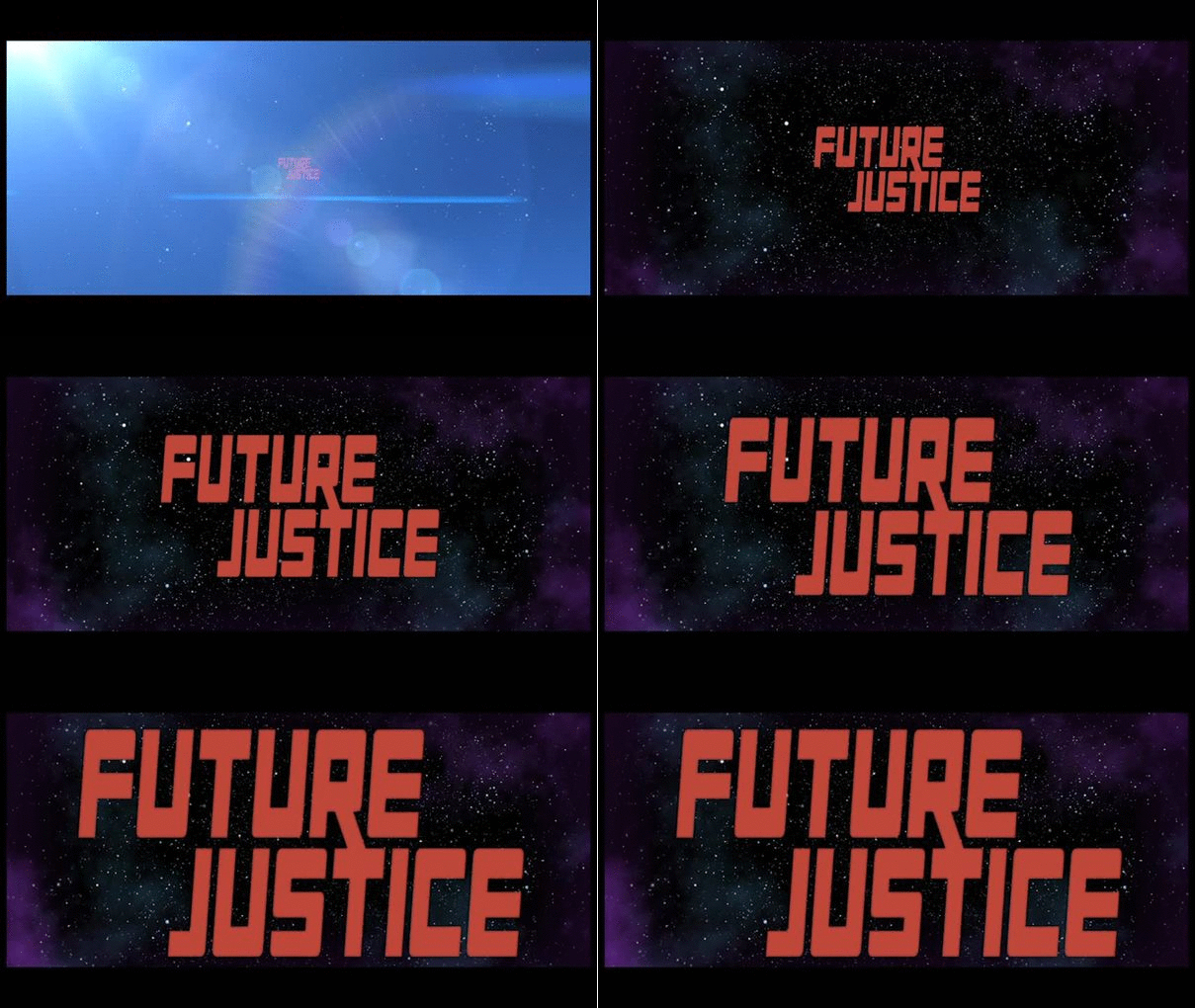
No Justice for Evil! “Future Justice” review!

After five years of cryogenic solitude, Python Diamond returns on a heavily armored military escort ship, returning from Saturn where a maximum prison holds Earth’s most dangerous convicts until their execution date. As they close in on home, Earth has gone dark, communications have gone silent, and massive radiation cover most of the populated soil. A faint signal of power draws the crew down to a manageable radioactive portion of scorched Earth where they discover a small band of people, surviving in an underground bunker and striving to live in a post nuclear fallout. The exploration of life search doesn’t go unnoticed as a violent, more dominant group of survivors seek to take the military’s possessions, if not their lives too, and when war breaks out between them, another mutated and dangerous player enters the game.

Another Richard Griffin directed project and another great example of a superbly self-reliant genre film thats sharp-witted, off-colored, and, of course, entertaining to horror and post-apocalypse fans. Though Griffin and his usual cast of cast members tackle the homage with full-brute strength, Griffin places a gently new-used spin upon each of his inspired works in the form of great absurdity that’s hard to refute or dislike no matter what genre of movie fits your fancy. His post-apocalyptic, science-fiction, horror film “Future Justice” revolutionizes the homage by stripping iconic films of their popularities and mashing them together into a very coherent and comprehensible story without seeming like a total rip off. Instead, Griffin takes the Nathaniel Sylva written story and runs with it like a powerful running back whose hugging on tight to that pigskin ball and charging like hell to the end zone for his first touchdown, treasuring that first score and making it his own unique success even though scoring touch downs has been down countless times before.

The underwhelming title, “Future Justice,” doesn’t speak much to the film’s overall enthusiastic gesture. Yet, the witnessing of gung-ho filmmakers given only an inch to work with and stretching that into a long mile, or even two, is always an amazing length. Nathaniel Sylva didn’t only write the film, he also starred as the lead character, a confident and calculating convict named Python Diamond which is a bit of a play on the John Carpenter Snake Plissken character from “Escape from New York” and “Escape from L.A.” Then, the story embarks on a motley crew, like you would see in a “Mad Max” movie, group of scavengers looking to take all and leave nothing for the rest. Finally, “Future Justice” takes an unexpected turn by introducing a radiation mutated, humanly doctored, one pissed off person-creature that hungers to seek and destroy every last living being in the underground bunker.

The successfulness of character actor Steven O’Broin’s Gazeebo, head of the blood thirsty gang, makes him ruthlessly enjoyable to watch on screen. O’Broin and Griffin have worked previously together on “Sins of Dracula;” O’Broin aspired to be similar to Vincent Price in the Hammer Horror influenced Dracula film. Michael Thurber, more notable one of Griffin’s entourage of actors and also co-stars in “Sins of Dracula,” delivers a phenomenal and intentionally excessive method acting skill that always fits into, in every which way, all of Griffin projects. Working with an estimated $20,000 budget and limited locations doesn’t translate over to O’Broin or Thurber who can transform a small production into the illusion of a bigger ordeal, causing a mind altercating effect with their viewership. “Future Justice” delivers movie magic at its finest.

Speaking of movie magic, visual effects supervisor John Dusek works along side again with Griffin and meshes a blend of practical effects with campy computer generated imagery. The result only adds to the unique charm, capturing the zany essence of this world gone dark story and running with it to take the zaniness one step further, but also respecting the Italian post-apocalyptic films of the 1980s. Exploding heads, detaching limbs, brain-splattering head shots keep the violence fresh when various effect methods are implemented and Dusek tunes right into his entire arsenal to deliver. The effects go hand-and-hand with Daniel Hildreth’s space epic score, striking the composer analogue of other Sci-Fi film greats.

The MVDVisual region free DVD release is presented an in unrated 16:9 widescreen format at a runtime of 83 minutes. The extras include a commentary with cast and crew, a short film entitled “Mutants of the Apocalypse,” and a theatrical trailer of the film. The clear picture defines the details and vividly displays the colors, especially when the mutated creature emerges. The 2.0 audio mix hinders a little in the dialogue by the overpowering score and ambient tracks, but doesn’t disrupt much at all. “Future Justice” doesn’t apologize for laying down the law by smacking action and thrills right to the face. I’d recommend this title to any Sci-Fi or horror buff in a need of a necessary relapse into the post-apocalypse.