
EVIL’s the Bacon, the Pork Roll, and the Scrapple All Mixed and Slashed together! “Butcher’s Bluff” reviewed! (Breaking Glass Pictures / DVD)

“Butcher’s Bluff” on DVD from Breaking Glass Pictures!

Film students Rodger, Nicole, and Derrick decide to head to the rural Texas town of Emerald Falls and make their class project documentary around the 28 missing persons over the years and the Hogman, an urban legend of an escaped killer now roaming the woods of Butcher’s Bluff.  Bringing along their friends to make it concurring party getaway at Rodger’s family vacation cabin, the trio conduct interviews with the eccentric town locals to build a story around the Hogman myth, even ascertaining the original location for the mask Hogman wore during his first kills before escaping psychiatric prison.  The more they investigate into the Hogman, the more the locals warn them to stay away from Butcher’s Bluff but in a case of curiosity killed the cat, the documentary film students and their drug-fueled, sexed-up friends find themselves being hunted with no cell service, no help within miles, and no way out of the Hogman’s kill radius. 

Co-directors William Instone and Matt Rifley helm their first collaborative feature “Butcher’s Bluff,” a 2023 small town slasher reminiscent of the renaissance slasher movement of the 1980s, packed with practical gore effects, odd backwoods characters, a campy party of vice-riddled youth, and, moist importantly – excuse me – most importantly, T&A.  Instone, whose all-in director, writer, and producer debut horror “Jon” from 2012 brings one man’s delusions into horrifying reality, cowrites his latest grim story with writer, painter, and overall liberal arts connoisseur Renfield Rasputin.  Filmed in Texas with principal locations taking place in Bastrop, New Braunfels, and San Marcos to composition a story set in the fictional town of Emerald Falls and its rural woodland of Butcher’s Bluff.  The film is a crowdfunded venture that raised an approximate $60K to cover principal shooting and post-production costs with Instone and Rifley serving as primary producers amongst an amalgamation of crowdfunded producing backers   Instone’s Thunder Mountain Films, in association with Dull Knife Productions and Spicey Ramen Productions, go hog wild with their slasher horror. 
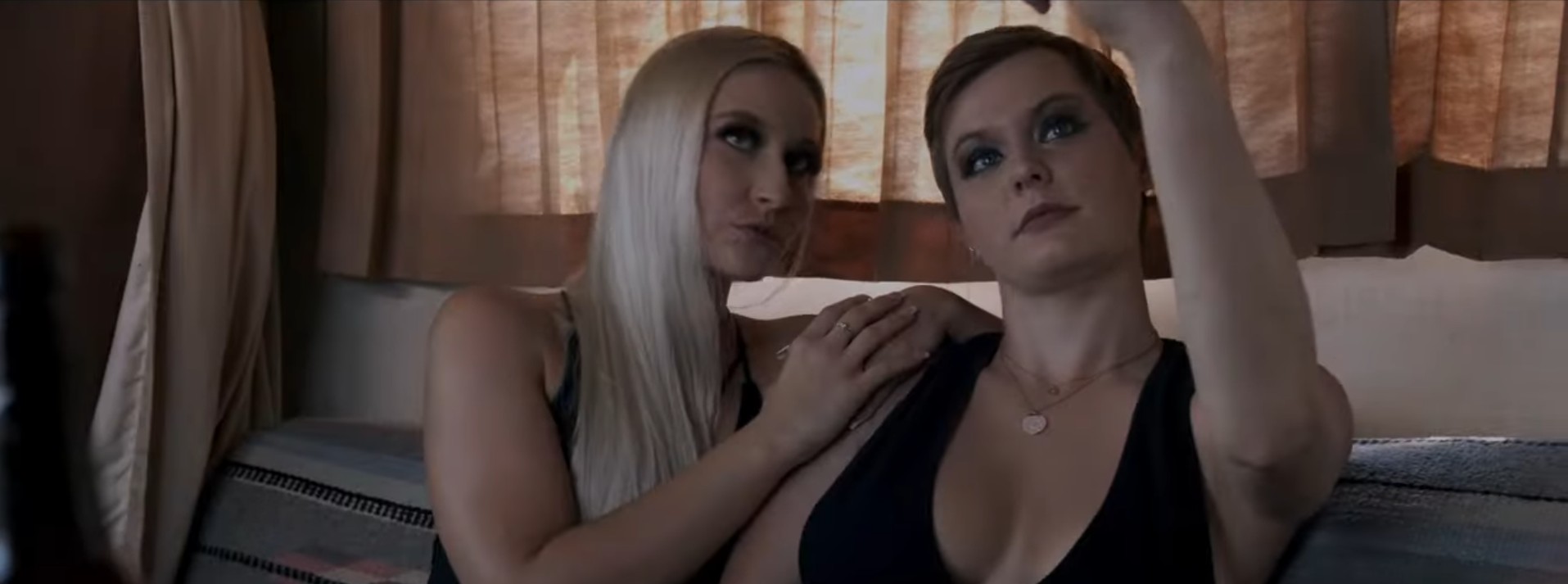
As if he doesn’t have enough on his plate writer, directing, and producing “Butcher’s Bluff,” Instone also portrays the main antagonist Hogman, masked with a stitched together pig head complete with cockeyed tusks and garbed with a dingy mechanic jumpsuit and tan jacket.  The Hogman is a walk-and-run chaser with a duel-sided axe and rusty, broad curved knife as main melee weapons though he’ll get his bare hands dirty from time-to-time.  Instone’s not flashy with the villain and doesn’t key-light any iconic poses, stances, or stares to incite a nerve coursing fear.  Hogman’s victims are anyone and everyone who enters the Butcher’s Bluff forest, from necking lovers (Jacqueline Hays and “Mallrats’s” Jeremy London), to lost pot farm thieves (“You’re Next’s” L.C. Holt, “Scare Package’s’” Christopher Winbush, “Girls Gone Dead’s” Shawn C. Phillips), to finally, but not limited to, the Rodger’s friends and classmates on their excursion investigation and party.  Fortunately, the group displays different caricature tropes without going full-blown cliché.  Between them you have the exuding sexy yet overly bitchy duo of Sam and Tina (a cut pixie cut but broodingly built Samantha Holland and a slender yet high-end platinum blonde Kayla Anderson), Rodger’s sex-driven, dweeb cousin Bobby (Dakota Millett) who Sam and Tina torment, the polar opposite to Bobby stud with Jake (Santiago Sky) and of course the three documentarians:  Rodger (Michael Fischer), Derrick (Johnny Huang), and Nicole (Paige Steakley), each reside in their own attribute world consistently, dying the way they live, that’s very telling of their moral fiber.  In additional to Jeremy London and Shawn C. Phillips, who have worked themselves into being staples of the indie genre films, other notable names to mention for their brief but key roles are Brinke Stevens (“Nightmare Sisters”), Paul T. Taylor (“Hellraiser:  Judgement”), Bill Oberst Jr. (“3 From Hell”), and Bill Johnson (“The Texas Chainsaw Massacre II”) peppered into the rest of the supporting cast to draw in fandom.

“Butcher’s Bluff” has the necessary bone structure to be a digestible slasher, checking all the elemental boxes, and Instone and Rifley manage to technically pull off a nearly 2-hour film on a crowdfunded budget.   The problem is “Butcher’s Bluff” has a hackneyed routine about it.  Instead of creating something new and wonderfully, gory and diabolical, under a distinct flag of novelly progressive storytelling, every scene feels all too familiar, a telltale sign to horror fans that we’ve seen this kind of story before.  From Hogman’s stony silence and indiscriminate aggression bores him as a Michael Myers carbon copy, a family in cahoots with a s flesh-stitched maniac plays the tune of “Texas Chainsaw Massacre,” and there’s even a character moment of yelling What Are You Waiting For? aimlessly into the dark forest while spinning around with arms wide apart that oozes Jennifer Love Hewitt vibes.  Add in some rather uninspiring frame, shot design, and editing and “Butcher’s Bluff” very much embodies the crowdfunded costs rather than the intended crowdfunded spirit.  Now while all of this portion of the review sounds grossly negative, don’t just run for the hills to the next slasher film in line just yet as Instone and Rifley still manage to keep an engagement lock on what makes the slasher film enjoyable to behold with some decently inlaid practical gore effects, including a pleading head being sliced horizontally through from mouth to hair or a posthumous, lawn chair display of one fine girl’s nipples and eyes plucked from her body and posed on her eye-gouged out person as if giving a blood offering to the audience Gods.  There’s also the inviting gratuitous T&A from Samantha Holland, Kayla Anderson, and Jacqueline Hays that keeps the old theme motif alive within the campy slasher genre as well as keeping young boys’ dreams from becoming dry.

Breaking Glass Pictures distributes the archetypical slasher “Butcher’s Bluff” onto DVD home video.  The MPEG2 encoded, 720p upscaled standard definition, DVD9 really has a tough go with the compression capabilities as there’s quite a bit of data to encode/decode within a near full-time night shoot picture and color accompaniments that blend right into the darkness, melding out of a clean definition.  Presented in a widescreen 1.78:1 aspect ratio, banding and splotching render a difficult deciphering of data in inkier fields.  When colors do contrast or arise into lighter hues, there’s a pop of demarcation with its full potential held back by an ungraded layer.  Textures are extremely fluid throughout with the prominent skin scenes offering a decent, natural look but most scenes are fuzzy as if the upscale fights the downscaling for supremacy.  The English Dolby Digital 5.1 surround sound offers an adequate compression for a routine slasher with mid-level range with clear and clean dialogue overtop eerie forest soundscape of breaking branches, tree knocks, and leave crunching footsteps.  The mix doesn’t convey much depth with dialogue and ambience hanging around the front channels while medium shots and some tree knocking flirt with the side channels.  A mainstay slasher should have a memorable, tense-riddles soundtrack for the chase or create omnipresence fear but “Scream, Queen!  My Nightmare on Elm Street” and “Dinner with Leatherface” composer’s Alexander Taylor’s insipid inspiration can’t be held in the memorable bank and fails to elevate the Hogman’s imposing sheer terror.  English closed captioning is available.  Special features include a proof on concept trailer for the crowdfunding campaign that stars a handful of the actors from the feature film, such as Michael Fischer and Paige Steakley, and a behind-the-scenes music video that contains behind-the-scenes footage.   The DVD presence is standard fair for Breaking Glass Pictures with a DVD Amaray and a one-sided front cover art, which subjectively pleasing in its retrograde mockup of an illustrated Hogman looming over a scared, running Steakley (supposedly) in her white tank top and high cut shorts.  There is at least one noticeable error on the back cover that spells Paige Steakley’s name incorrectly in the credits, listing her last name as Steakely.  The Not Rated release is hard encoded with region 1 and has a two-hour runtime which can appear quite long, but the pacing was not terrible and the long runtime for an indie slasher didn’t feel overly immeasurable. 

Last Rites: “Butcher’s Bluff’s” has little to offer as far as the next novel and generational slasher but scratches the genre itch with a large body count, solid kills, and campy campers looking to buy, sell, and trade their vices for being violated.

“Butcher’s Bluff” on DVD from Breaking Glass Pictures!

‘Twas the Night Before Christmas, When All Through the EVIL “A Creature Was Stirring” reviewed! (Well Go USA Entertainment / Blu-ray)

Purchase “A Creature Was Stirring” Here at Amazon.com

During the height of a 6-day Christmas blizzard, nurse Faith remains home to care for her mysteriously afflicted daughter Charm.   Faith diligently stays vigilant over her daughter’s inexplicable condition with test after test and maintaining Charm’s constant body temperature between 102 to 104.4 degrees, seemingly stabilizing Charm’s condition.  If the temperature exceeds beyond, Charm transmogrifies into a barbed humanoid creature.  While Faith works on a compound cure, Liz and Kory, a sibling pair of Jesus zealots, break into the house seeking shelter out of the deadly snowstorm.  Faith has no other choice but to let them stay the night until the storm subsides but the appearance of Charm’s at-home care and the young girl’s sudden seizures and erratic behavior sends Liz into savior mode, meddling into more than she can comprehend.  Yet, something else lurks inside the house, between the shadows, and beneath the veil of reality that is way more terrifying. 

Even though Christmas might be long over and all the gaudy and brilliantly lit decorates are stowed away back into Grandma’s attic that doesn’t mean the holiday horror train has to depart the station.  And I’m not talking about no Polar Express with the edging on creepy motion capture animation.  I’m talking about “The Cleansing Hour’s” Damien LeVeck’s Twas the Night Before Christmas-inspired titled “A Creature Was Stirring.”  The equivocal creature feature set in the throes of a raging blizzard and inside a very decked the halls house is penned by debut screenwriter Shannon Wells under the original title of “Good Luck, Nightingale.”   Aimed to be more than what meets the eye, “A Creature Was Stirring” blends the involuntary struggles of drug addiction with potent secretions of supernaturalism.  The U.S. production was shot in Louisville, Kentucky, produced by LeVeck, wife Natalie, as well as “Scare Package” producers Aaron B. Koontz and Cameron Burns with Vladislav Severtsev (“The Bride”) under the production companies Skubalon, 10/09 Films, and Paper Street Pictures. 

Topping the bill as Faith is “This Is Us” star Chrissy Metz, portraying a nurse practitioner and mother desperate on concocting a cure to her daughter’s strange, monstrous manifesting condition.  Metz brings the multifaceted mania between being rock solid and stringent with medical checks and procedures and being able to turn aggressive when the moment calls for it, especially swinging a screwed-spiked baseball bat.  This underlines an underlying secret or hidden predicament viewers will be dipped into and begin processing all the little traces of one-offs that don’t necessary make sense to an already peculiar narrative.  Then, there’s Charm, played by Annalise Basso (“Oculus”), in constant oversight, constantly mutable, and urging to constantly be free from her mother’s impervious iron grip to lighten up.   Basso retains angsty opposition while tossing moments of reflective consideration for her mother and for herself, disquieting the teetering tranquility when Liz and Kory come into play.  Respectively played by “Halloween” ‘07’s Scout Taylor-Compton and “Stake Land’s” Connor Paolo, siblings Liz and Kory stir the pot that’s slowly simmering to a boil as one religious dogmatist and one eager to break the constraints of his sister’s purity with sex and drugs complicate the strained mother-daughter relationship with their intrinsic quirks that expose a deeper, rooted-to-reality problem.  The now generational scream queen Compton dons colorful dreads and a large Messiah back tattoo amongst a high and mighty attitude while Paolo can be praised for the sarcasm brought out from the scripted dialogue.  Each of the four principals are inherently different and clash, in a good way, to provoke complications. 

Drug addiction has infiltrated horror years ago and have been the basis of many notable films such as Abel Ferrara’s “The Addiction,” Larry Fessenden’s “Habit,” and Frank Henelotter’s “Brain Damage” to name a few from the massive lot.  “A Creature Was Stirring” taps into that same vein as LeVeck’s injects and shoots up his own interpretation of horrors with withdrawals.  Long time addicts suffer through agonizing, powerful withdrawals that screenwriter Shannon Wells incorporates symptomatically with a figurative approach and while Wells’ story invokes colorfully rich characters and enigmatic tale of terror, brought to life by LeVeck’s vibrantly warm and glow Christmas adorned and atmospheric house, the finished feature, that really has nothing to do with Christmas oddly enough, feels uneven when revealing the irony of surprise doesn’t become catchall illumination.   The most ambiguous part about the tale is the spiny-signified creature, a mutated, zoomorphic porcupine of sorts, to represent ferocity of the withdrawn drug with its hypodermic needle-like defense mechanism and malevolence nature.  The shadowy man-thing is given such a threadbare association between Charm’s anecdotal encounter with large rodent and its manifestation metamorphosis into the fold that the hostile has hardly any staying power as a villain and, like a rodent, really does feel just like a mouse was stirring as it scurries arbitrarily throughout the house but not all is negative as there are scenes that make you go holy crap when recollecting character and creature interactive moments that suddenly click and make sense, often coinciding and juxtaposed against really neat interior cinematography bathed in mixture of hard light and soft glows. 

Well Go USA Entertainment presents “A Creature Was Stirring” on a high-definition Blu-ray home video.  The AVC encoded, 1080p, BD25 has soft illumination but a grading design that’s befits the ’tis the season paradigm with the primary color warmth radiating out from Christmas lights strung up around the house and the beaming brilliance of white battery-operated light-up decorations. Between the crude adornment lighting, some lighter translucent gels, and with a splash of black-and-white, Alexander Chinnic cinematography, presented in an anamorphic widescreen 1.78:1, resembles a rave clad fitting into the drug theme as an echo of the one character’s pill-popping, molly-dropping past. Details become diffused by the varying, indiscriminate incandescence and shadowy fields that play into the creature’s tenebrific threat, but those same shadows are often deep without posterization. The English 5.1 DTS-HD master audio achieves the goal of the very title of something stirring inside creating rustling movements and spiny-shifting clacking, coursing through the back and side channels and maintaining an even keeled LFE. Space awareness is key for close quartered tension and that’s rendered well in the design. Dialogue comes off without a hitch and is elevated above the rest of the tracks with no issues with compression faults or a fractured recording. English SDH subtitles are available. Like most Well Go USA releases, “A Creature Was Stirring” shoulders only Well Go USA preview trailers with no real bonus features of its own in the semi-static main menu but what we do get is a better than modest laid out standard Amaray Blu-ray package with a lightly titled embossed cardboard O-slipcover and on the back two different texture types, a polaroid slick abutted against the smooth cardboard. Image design is a greatly detailed silhouette of the porcupine creature looming over the house. The same image is also on the Blu-ray cover with a simple red-beaded or red-string light encircling the title on the disc. There is no insert inside. Rated R for violence, bloody images, drug context, language, and some sexual suggestion, the 96-minute Blu-ray comes region A locked. 

Last Rites: Chrissy Metz battling a deformative disease, drug addiction, an angsty teen, two home invasive siblings, and a large porcupine monstrosity all in the name of “A Creature Was Stirring” is the prickly cold turkey suspenser this side of the New Year.  

Purchase “A Creature Was Stirring” Here at Amazon.com

Furbish the Four Walls EVIL Lives Inside of Your Brain with “The Yellow Wallpaper!” (Hysteria Pictures / Digital Screener)

A prominent physician escorts his wife, Jane, and newborn child to a secluded countryside home after a severe episode of hysteria rattles Jane’s mental state.  For three months in the Summer, Jane is confined to the house grounds with strict instructions to do nothing to exert herself other than to partake in a little gardening.  Even writing, which was profusely Jane’s pursuit, is harshly forbidden.  The bedroom she shares with her husband is nearly unadorned with only their bed in the middle of the room and yellow wallpaper ornamenting all four walls.  As the weeks pass in isolation, Jane can’t escape the feeling the yellow wallpaper is creeping into her mind, imprisoning her, and driving her mad, lending her relaxing retreat from societal nervousness be laid to waste in solitude. 

Charlotte Perkins Gillman’s short story, “The Yellow Wallpaper,” has seen a fair share of filmic adaptations in over a span of a century since being published back in 1892, but all of those variated works have been grounded in the last four decades .  Amongst the numerous shorts and a handful of features, the most notable version of “The Yellow Wallpaper” would be Logan Thomas’ 2012 interpretation, starring Juliet Landau, daughter of the late Martin Landau.  That’s the funny thing about public domain property is it opens up a plethora of pathways to spin and redefine creativity to rework Gillman’s feminist tale from the artists’ voices speaking of the times when women’s mental health, and mental health in general, was perceived naively as anxiety.  Kevin Pontuti steps up to the plate to take a crack at the spiraling to madness story as the filmmaker’s inaugural feature directorial of the American and Ireland co-produced celluloid from an adapted screenplay written by the director and co-written with the story lead actress and producer, Alexandra Loreth.  Under the duo’s entertainment banner, Hysteria Pictures in association with Ireland’s Emerald Giant Productions, the crowdfunded “The Yellow Wallpaper” project receives the latest contemporary treatment that brings Gillman’s words back to the screen.

Co-writer and producer, Alexandra Loreth, takes the lead as Jane coming down off the ledge of a nervous breakdown but still ballooning with instability that’s stretching her fashioned societal-front seams. “The Yellow Wallpaper” is also the California based filmmaker’s first feature film alongside Pontuti, basically penning Jane’s entire mindset of combating the time’s unfamiliar sexisms and mental health. Loreth crawls on her hands and knees, feign glossy, far away eyes, and be cold and distant to be in tune to a woman disassociating with herself and reality and, truth be told, portrays a convincible case that shows feature debut courage with on screen nudity and a stamina for being the focus for the entire 99 minute runtime; however these acts remain stuck in a excessive loop that roots Loreth’s character decline to one a taciturn setting, lacking range and depth to carry Jane into full metal straightjacket crazy. Opposite Loreth is Irish actor Joe Mullins as John, the physician, the only character mentioned in Gillman’s short story. Mullins impels like an automaton through the role with not a lick of zestful misogyny to contrast against. Loreth completely dominates the screen as you barely notice Mullins whisk in and out of scenes to medicate Jane or comfort her with little white lies. John’s dismissive attributes were more dispassionate with Mullins behind the wheel that leaves only half the work’s presence omitted and it’s sorely felt. In the role of Jane’s domicile caregiver, Jeanne O’Connor paves a road of sturdy era authenticity that also is fleeting from “The Yellow Wallpaper” and with her 19th century genteel aesthetics, we’re sucked into the period to keep us grounded in time. Performances round out with Clara Harte as the abstruse infant caregiver and Mark P. O’Connor briefly standing in as Jane’s doctor brother.

Pontuti and Loreth’s “The Yellow Wallpaper” targets the very essence of Gillman’s journal narrated themes of the downplayed and untapped mental health and the secondary expectations of women in 19th century society.  The differences between the 1800’s paper and 2021’s movie narratives are ever so slightly tweaked into the contemporary medium with Loreth narrating right from Gillman’s pages word-for-word in between the auxiliary scripted dialogue and the finale concluding toward a more grim avenue that will surely satisfy the more macabre of hearts.  Yet, not enough material could be extracted from the short story to entice as entertainment as the adaptation lingers in monotone fashion. Jane carries on about the woman trapped behind the yellow wallpaper and is shown going in circles of staring at the wallpaper, crawling on her hands and knees on the estate grounds (as describe in the short story), and just being listless throughout the entirety with her mental issues linked to post-partum and drowning in passive despair.  Perhaps better suited for a short film, as many have been completed already, audiences will become tiresomely and frustratedly lost in all of Jane’s 99-minutes of tedium as there just isn’t enough to sate a feature length film unless you add embellishing bells and whistles in the realm of supernatural or the puppeteering of an unseen force symbolizing Jane’s fractured mindset. Don’t expect “The Yellow Wallpaper” to paint a gripping tale of feministic horror as the story peels off in a superannuated ream of soapbox issues.

“The Yellow Wallpaper” made its world premier this past March at Cinequest in San Jose, California. The film is shot in a modernly unconventional 4:3 pillarbox aspect ratio aka the black bars on each side of the near square image presentation. The intention by cinematographer Sonja Tsypin (“Scare Package”) was to meet the age of Gillman’s original. Yes, I know in 1892, video wasn’t exactly a thing, let alone pillarboxed formats, but aspect ratio does point the a modern adaptation into the right blast from the past direction. What is also curious about Tsypin’s photography, and I’m not positive if this is in fact intentional or not, is the lesser frame rate that induces jumps in the picture in an almost lag effect that doesn’t add much but of annoyance to the viewing pleasure. I was slightly more impressed with Robert J. Coburns score fathomed the depth of disturbance going through Jane’s head and lured out the creepy that played like a broken-melody music box. There were no bonus scenes during or after the credits. Even with a well established and powerful ending shot, a preserving memento of the patriarchy’s ill-conceived mansplaining of a woman’s mind and body, and an intrepid performance by Alexandra Loreth, “The Yellow Wallpaper” stagnates in faithfulness to Gillman’s short and doesn’t offer new and improved ideas of century old, feminist gothic literature.