Never Cry EVIL Unless You Mean It! “Night Visitor” reviewed! (Ronin Flix / Blu-ray)

“Night Visitor” Creeping Onto Your Doorstep!  Now on Blu-ray!

Never-on-time high school senior Billy Colton can’t seem to catch a break in arriving to class on time. To make matters worse, Billy makes up a lame excuse for every tardy to his surly history teacher, Mr. Willard. On thin ice with Mr. Willard with only a few weeks left to graduation, Billy must keep his nose clean in order to not make any more waves that’ll cost him his diploma. When a new, extremely sexy, call girl neighbor moves in next door, Billy becomes entranced by her casual sexual affairs. So much so, Billy sets up a telescope from out his bedroom window to spy on her and convince his naysaying friends of her profession by sneaking a rooftop picture catching her in the middle of a tryst. What Billy sees is his neighbor being stabbed to death and the culprit is none other than his history teacher, Mr. Willard, continuing his conducting of Satanic rituals and sacrifices on local prostitutes. Because of his reputation for making up stories, no one believes Billy, not even the police, and he’s forced to attend Mr. Willard’s class with both parties having the knowledge of what really occurred. Billy’s desperation sends him to seek the help of a retired detective, Ron Devereaux, a close friend of Billy’s late father, and extreme measures must be taken by Billy to prove a killer’s identity and to stop Mr. Willard from coming after him.

“Night Visitor” is the 80’s alteration of the classic Aesop fable, “The Boy Who Cried Wolf.” The 1989 teen-campy cult horror is the first venture into feature length films by Rupert Hitzig, producer of “Wolfen” and “Jaws 3-D.” The twisted, modernized story derived from the fable was penned by Randal Viscovich to sought to provide nods to other films, one film in particular, “Fright Night,” shares a story parallel or likeness of an older teenage boy spying on the carnal rendezvouses of his alluring neighbor and ends up becoming involved in something far more sinister. At one point in time the film was under the working title, “Never Cry Devil,” a spin on the fable idiom cry wolf, Hitzig’s final product eventually landed on “Night Visitor” and the graphic nudity and cannibalism pared down for general audience consumption. Premier Picture Corporation served as the production company with Alain Silver (“Kiss Daddy Goodbye,” “Mortuary Academy”) producing, Randal Viscovich and Richard Abramites associate producing, and Tom Broadbridge (“The 13th Floor”) and Shelley E. Reid (“Nine Deaths of the Ninja”) as executive producers with United Artists serving as film rights distributor.

At the center of the story is a coinciding dual lead. One might be more prominent in the beginning, but the second soon catches up to run alongside in an even dichotomy of good and evil. Derek Rydall (“Popcorn”) plays into the stereotype of a hang loose teenage boy named Billy Colton on the edge of adulthood with a penchant for voyeurism as he spies on the late-night sexual commerce of her blonde bombshell neighbor. Rydall introduces mis makings of an energized, poofy-haired hunk who might be a little bit naive as a closeted peeping tom and looks to score with an older woman despite exhibiting and declaring feelings for his longtime friend Kelly (Teresa Van der Woude, “Killer Workout”). Who can blame Billy when Billy’s new neighbor was a Playboy Playmate? Shannon Tweed (“Cannibal Women in the Avocado Jungle of Death”, “Of Unknown Origins”) seduces, arouses, and paints by the numbers in what she does best – to be the sexiest woman on screen. Having never really dug herself out of being typecasted, Tweed humble horror beginnings is about the extent of her range before being cornered in the sex-thriller market and the Playmate of the Year 1982 is great fun to watch onscreen as her sex-working-kittenishness character, Lisa Grace, causes Billy Colton to steam in his pants. As much as it was a joy to watch Rydall and Tweed chart a possible older woman, younger man fling (fun fact: Tweed was supposedly playing a 26-year-old but was actually 31-32 and very much looks her age in the film), I thought Allen Garfield (“Diabolique”) and Michael J. Pollard (“Scrooged”) as brothers rollicking as Satan acolytes or rather just Garfield’s character Mr. Willard is the Satanist and Pollard as brother Stanley is just insane and fancies mentally manipulating the furniture as he calls the working girls him and his brother abduct and hold in the basement. Pollard is absolutely demented! All of the snarky quirks, plus a slew of scampish facial expressions and remarks, turn the fun-loving eccentric into a total maniac of truly scary proportions. Garfield’s method approach offers a different kind of demented, one that’s calculating and cunning to counter his brother’s outward lunacy. “Night Visitor” rounds out the cast with more gifted, recognizable talent in Elliot Gould (“Dead Men Don’t Die”), Richard Roundtree (“Shaft”), Scott Fults (“Hide and Go Shriek”), Brooke Bundy (“A Nightmare on Elm Street 3: Dream Warriors”), Henry Gibson (“The ‘burbs”), and adult film actress Teri Weigel giving Shannon Tweed a run for her money in the skinemax department as the basement-bound prostitute.

If you had told me “Night Visitor” was a strictly a chilling cut thriller, I would have not believed you and would recommend psychiatric help. Aside from the opening scene of a hooker being violently snatched and grabbed into a gothic black car, “Night Visitor” has the hallmarks of a teen comedy amped up on sex-driving hormones, teenage melodramatic antics, and parades light-hearted teen comedy up until throats are slit, chests, are daggered and Michael Pollard wildly wields a chainsaw with an impish grin. The blithe spirit soon turns dark and grim as the carefree attitude of the hero goes toe-to-toe with stern and Satanic teacher, a wonderfully metaphorical relationship to the extreme that’s universally relatable as everyone has had an encounter with a discontented classroom instructor at least once growing up. Surprisingly stark how bleak the film turns, an overwhelming sense of dread lingers after that second prostitute meets her maker in a ghastly way that, as far as kills go, isn’t very radical but the true nature of the subject matter is shaded so well that the moment literally hooks you into the story as you start to connect what just might happen next to the new neighbor. One aspect that felt lacking was that there isn’t much depth to the Willard brothers’ Satanism; a few upside-down pentagrams, a goat’s head, Baphomet’s goat head statue, a topless sacrifice with chant, and Allen Garfield’s robe and elaborate horned masked, which is an excellent design, are all the thin layer of thematic elements but still retains sufficiently the Willards connection to Satanism. Whenever the story moves from Billy Colton’s obsession to expose Mr. Willard, much of the narrative then focuses on the interrelationship of Zachary and Stanley Williard which is mostly a nonaggressive superior and subordinate kinship. Stanley, who caters to Zachary’s every request and even squeezes for him fresh orange juice, plays along with his brother’s inadequate display of being a disciple just to get his own malevolent kicks out of tormenting women of the night. There’s this unexplained fixation with prostitutes that puts forward less a Satan worshipper and puts forward more a pair of mania driven maniacs quenching a thirst for blood by offing the lower class of society that no one will miss. A brief scene backs up this theory of an angry prostitute chewing Captain Crane’s ear off about protecting the girls on the street and he just casually strolls along, waving her off as if to say, yeah whatever.

Ronin Flix, in association with MGM and Scorpion Releasing, urges you to never cry wolf in this tale of terror as “Night Visitor” lands on a Blu-ray home video, distributed by MVD Visual. The 1080p, high-definition release comes with a brand 2019 transfer master that’s clean as Mr. Willard’s rap sheet with no 35mm celluloid impurities, no aged wear or tear, and a healthy amount of unadulterated grain, presented in a widescreen 1.78:1 aspect ratio. Color grading has excellent appeal and defines the natural color palette greatly amongst the delineated details and appeasing textures. The DTS-HD Master Audio 2.0 stereo is on the only audio mix on the release and while it provides clean and clear dialogue track, the depth is often disproportion to the characters on screen. Much of the dialogue is in the forefront channel of the dual outputs, making every sentence feel closer than it should actually be in the stationary location of the character. Other than that, transfer’s hyper free of hiss, pops, and other audio blights. Option SDH subtitles are available. Bonus content has the original theatrical trailer and brand-new interview with director Ruport Hitzig, editor Glenn Erickson, and writer Randal Viscovich who all share a commonality regarding “Night Visitor,” the story was trimmed down of all of Viscovich’s nasty bits and shocking ending and made more upbeat for a better sell. Physically, “Night Visitor” comes in the traditional blue snapper keep case with brilliant red and illustratively glowing cover art of the sacrificial mask. The back cover claims the cover art is reversible, but it is not. The Blu-ray is region A encoded, has a runtime of 93 minutes, and is rated R. The cast alone is worth the price of admission as “Night Visitor” preys on the inculpability of Satan’s most righteous worshipper and on the power position of a role model with a secret life who has it out for the boy who cried wolf too many times.

“Night Visitor” Creeping Onto Your Doorstep!  Now on Blu-ray!

The Dark One’s EVIL Sucks the Air Out of You! “Robot Holocaust” reviewed! (Ronin Flix / Blu-ray)

“Robot Holocaust” enslaves Humanity on Blu-ray!

Year 2033 – a robot rebellion turned the once convenient machines into man’s most deadly adversary.  The aftershock of war has left mankind almost extinct and most of the atmosphere uninhabitable with radiation.  The last standing metropolis on what is now known as New Terra has the only breathable environment monopolized by the tyrannical Dark One, a disembodied machine that uses human slave labor to fuel the air producing contraption for the entire city.  A motley band of heroes, led by an outsider from a wasteland tribe who can breathe the toxic air, embark on a perilous journey to the Dark One’s factory lair, evading deadly flesh-eating worms, wasteland mutants, and a ruthless robot subordinates under the command of the Dark One.   Their mission is to rescue a purloined scientist after developing a device that lets people breathe outside the Dark One’s grip of a controlled environment.

The 1980s is a goldmine for post-apocalyptic cinema that has virtually no ambit.  Whether a big Hollywood studio or a rinky-dink production, inhospitable badlands filled with cutthroat survivors and malformed beings unfortunate enough to be left alive to battle it out to the death over the Earth’s last remaining precious resources was (and to an extent, still is) a salivating story prospect with vast barren landscapes, dangers around every corner, an untamed primal violence, and a BDSM-like wardrobe that hits the suppressed kink nerve in all of us.  Tim Kincaid’s “Robot Holocaust” is right smack dab in the middle of the subgenre and plays tune to every crowd-pleasing characteristic.  The 1987 post-apocalypse actioner is written-and-directed by Kincaid who cut his teeth on gay adult films in the late 1970’s and has maintained a healthy dose of homosexual erotic and adult films throughout his career until 2017 under his pseudonym of Joe Gaga.  After complete stag only cheapies “Cellblock #9” and “…in the Name of Leather,” Kincaid received a hankering to dip his directorial toes into sci-fi and horror, beginning with the sexual assaulting alien flick “Breeders” in 1986.  “Robot Holocaust” became the filmmaker’s subsequent feature one year later, shot mostly in the abandoned Brooklyn Navy Yard buildings as well as the undeveloped then Roosevelt Island in New York City.  Presented by Wizard Video (“I Spit on Your Grave”), Tycan Entertaiment and Taryn Productions are the companies behind the film. Taryn Productions is a subsidiary created by Charles Band (“Puppet Master’) and named after his daughter Taryn. Cynthia De Paula produces the film, who she almost exclusively produces every Kincaid sci-fi horror fixation, and the film likely supported by Charles Band in an executive producer role.

“Robot Holocaust” follows the narrative of a ragtag bunch of good-guy survivors journeying to rescue a friend and take down a tyrannical overlord.  While not one role stands as a principal lead, the band of heroes is led by Neo, played by Norris Culf.  Starring in his first lead role following a couple of smalltime gigs in supporting roles in another Taryn Production, “Necropolis,” and in Tim Kincaid’s “Breeders,” Culf receives his big break as a wasteland conqueror able to breathe outside in the radioactive atmosphere.   As a leader, Culf isn’t as charismatic as Keanu Reeves’ Neo nor is he fierce enough to be intimidating; instead, Culf is quite reserved, unpowerful, and lacks coordination to pull off choreographed fight sequences with a believable plausibility.  Nyla, on the hand, is played Jennifer Delora of “Frankenhooker” and “Fright House.”  Delora, an martial arts blackbelt, brought the proper attitude to her fiercely feministic leader of the She Zone women tribe by adding the mean to Nyla’s demeanor.  The other woman of the group is Deeja, Jorn the Scientist’s daughter who terribly reliant on her father, sparking major contrast between her delicacy in daddy issues and Nyla’s hardnosed, man-hating feminism.  Nadine Hartstein and Michael Downend reconnect from their minor roles in “Necropolis” to be the daughter and father team at the core of suicide mission. More ceremonious than being an emotional wreck of being separated during the middle of a robot run world, Harstein and Downend bring little flair as they themselves often are more automaton than the automatons. Joel Von Ornsteiner (“Zombie Death House,” “Slash Dance”) had the most flair as Klyton, a pickpocketing free-thinking droid that looks like a cross between Star Wars’ C3PO and MAC from “Mac and Me.” Ornsteiner never let up or broke the eccentric droid’s light-hearted Robin to Neo’s Batman antics complete with rigid, robotic movements and a ray gun that never seems to work. One of the more painfully pressed roles is Valaria, the Dark One’s flamboyantly dressed second in command. Think “Forbidden Zone”-esque. Angelika Jager performance in cahoots with the Dark One is about as dry as toast and at odds with her own vestigial accent. Jager’s the congenial visual to her counterpart Torque’s effectual exoskeletal mechanical cover who could pass for a T-800 with the teeth replaced by dangling like Lobster antennae. Rick Gianasi, who went on to be Troma’s Sgt. Kabukiman, plays the underestimated and underrated villain, leading the way for other sidelines roles with a cast that rounds out with George Grey, Michael Azzolina, John Blaylock, and Nicholas Reiner.

As mentioned earlier, “Robot Holocaust’s” acting isn’t good.  It borders old-timey melodramatic in a proclamation sense.  There are no in-depth discussions, debates, conversing naturally, or any aspect of the dialogue having a normalcy about it as everything is vigorously proclaimed or is awkward narrated for exposition.  The other half of the problems is in direct result of Kincaid’s poorly written script that can’t capture ordinary conversation, much like those of his pornographic films, I would think. Nor could Kincaid write himself out of the erratic flippancy of some principal characters who woujld go from bad to good then from good to bad in a blink of an eye.  While the communication is about a dull as a butter knife, the costuming is where “Robot Holocaust” balances the scales with 80’s ridiculously appropriate garb of what the ruined future would sport.  A metrosexual mixture of v-neck pelt shirts of mystery animal origin and early WWF professional wrestler spandex turn the men into “Conan the Barbarian” types, to which a few other influencing aspects are pulled from the Schwarzenegger epic fantasy.  The women are equally suited but with more finesse in the way of warrior princess as well as a goddess. With a title like “Robot Holocaust,” the android designs better be spectacular and in all for its time period, Ed Fench’s designs and Valarie McNeill’s fabrications are a mixed bag of good and bad. Klyton derives too heavily from “Star Wars'” inspiration without wowing into something of the tiny production’s own while Torque radiates power and fear with a complete head-to-toe body suit of an acolyte with attitude. Both designs don’t compartmentalize by operating individual body parts, such as moving mouths or even hands for that matter, which would have nailed the robots down for a film called “Robot Holocaust.”

Ronin Flix, under the re-distribution of Scorpion Releasing and MGM, release “Robot Holocaust” on a 1080p high-definition AVC encoded Blu-ray. The hard coded region A North American release is presented in an anamorphic widescreen 1.85:1 aspect ratio from the original 35mm negative. Natural grain, a palatable and diverse color palette, and swelling textures, such as fine details in the skin, scuffed up droids, and a grimy industrial complex provides a zestier interest that parallels the languishing storyline. The English language 5.1 DTS-HD Master Audio is remarkably clean, much like the transfer, with a coextending presence of robust range, depth, and quality. The proclaiming dialogue is crystal clear, hanging on every syllable and syntax, with no issues with hissing, popping, or other flaws. Jager’s accented monologues and conversations are kitsch guilty pleasures to hear her laissez faire style and delivery. Special features include a new interview with Nyla actress Jennifer Delora touching upon little-by-little her experience with cast, crew, and overall project. There’s also the official trailer included. The physical release comes in a regular blue snapper case with one-sided grindhouse artwork of a looming Torque, an explicitly worn skull, and Angelika Jager’s Valaria with her eyes closed and slight smirk. The unrated film runs a brisk 79 minutes. The “Robot Holocaust” is only 11 years away according to the film’s timeline, but director Tim Kincaid’s future can’t help but feel like a vintage hunk of junk by the stale performances and skimpy Tarzan-like duds and getting through the brief runtime proved unfortunately challenging.

“Robot Holocaust” enslaves Humanity on Blu-ray!

Bestest EVIL in the Whole Wide World! “Clifford” reviewed! (Ronin Flix / Blu-ray)


“Clifford” is the Best Comedy of 1994 and Now on Blu-ray!

10-year-old Clifford wants to go to Dinosaur World in Los Angeles.  I mean, really, really, wants to go to Dinosaur World and will stop at nothing to get his heart’s desire, even if that means intentionally grounding his parent’s plane destined for Hawaii.  Clifford’s parents, on the verge of strangling their own relentless mischievous son, concocts a care plan that includes reaching out to Uncle Martin, an out-of-touch, workaholic, kid-adverse L.A. resident looking to impress upon longtime, child-longing girlfriend that he adores children.  It’s a win-win for everyone, even Clifford who’s chances to ride Larry the Scary Rex rollercoaster at Dinosaur World have significantly increased.  The perfect plan is swimmingly going well until Martin’s boss throws him a deadline curveball that sidelines Clifford’s theme park trip, breaking his promise to a more than impish little boy who has declared life-ruining war against the Bestest uncle in the whole wide world.

Yes, finally!  “Clifford” has arrived onto Blu-ray home video and just like that that mischievous little brat comes back into our nostalgic hearts.  The 1991-filmed, 1994-released PG-rated comedy is written by “Back to School” duo Steven Krampmann and William Porter and directed by Peter Flaherty, director of “Who’s Harry Crumb?” and Martin Short’s pseudo-late night talk show series “Primetime Glick.”  If you don’t see Krampmann or Porters’ names in the pre- and post-credits but notice Jay Dee Rock and Bobby van Hayes scrolling by than that’s because the writers used pseudonyms to quietly disown the finish final film that was embroiled in questionable approaches such as hiring Martin Short, a then 40-year-old comedian-actor, to portray a 10-year-old boy.  Yet, the bizarre comedy that has a talented cast as well as a demented and twisted side to it has gained a rather quiet cult following.  Larry Brezner (“The ‘Burbs”) and Pieter Jan Brugge (“My Demon Lover”) produces “Clifford” and is one of the last releases to trickle out from Orion Pictures before their unfortunate bankruptcy. 

Through extremely creative measures to ensure Martin Short can sell the physicality of a prepubescent boy on screen, “Clifford” is one of the former SNL performer’s best and memorable roles amongst his arsenal of personalities.  The naughtily tormenting persona with a Devil’s grin and absent eyes for sympathy brings Clifford to a level that’s analogous to a fixated horror villain setting a target goal of destruction, mayhem, and chaos. No one is safe from Clifford’s duplicitous trajectory, not even Uncle Martin played by the late, great Charles Grodin (“Midnight Run”) who provides his standard uptight and exasperated character at first but slides into a sinister nihilism when push beyond the point of return. Short and Grodin are centric to the story, phenomenal dynamically, and funny at very second despite how antiquated the content and comedy is at 30 years old. Seeing Short play a little boy doesn’t even register he’s a grown man in an adolescent role and that’s how good Martin Short can massage the material in his favor. You see Short, you see he’s a kid amongst the rest of the cast, you see his childish exploits, and, yet, none of that is troublesome, bothersome, or even a tiny bit weird as you’re drawn into an overexaggerating, yet highly relatable, parenting hardships in negotiating with out of control, scheming children and the pure, unabashed wackiness of Martin Short who, in my mind’s eye, is essentially in a step-down version of his iconic Ed Grimley personality. Bringing down Short’s antics and Grodin’s disgruntled demeanor is the measured Mary Steenburger (“Back to the Future III, “Powder”) subduing, in a good way, audiences as Uncle Martin’s lowkey love interest to bring us down from the eccentric shenanigans. The casting is overall tight on those three leads but Dabney Coleman (“Dragnet”) becomes the sleazy bigwig wedging between his employee, Uncle Martin, and Martin’s girlfriend, Richard Kind (“Stargate”) searching for patient with his insufferable Clifford, Jennifer Salvidge (“Evolution”) as Clifford’s yielding, but equally as exhausted, Clifford’s mother, and “Little Monster’s” Ben Savage as a troubled youth set to follow Clifford’s footprints.

How does “Clifford” hold up to today’s comedies? Rated PG, the 1994 film lacks the big hitting criteria that ultimately slaps stricter rating labels right onto the trailer and home video covers, that ultimately bring in audiences with sex, violence, and harsh language, but “Clifford” isn’t a kids’ film per se and subtly lands more adult oriented and sexually suggestive one-liners and scenes that wouldn’t fly by today’s standards. In fact, I personally believe the entire production would have been scrubbed if the first casting choice for a young boy was a 40-year-old man. Movies like “Clifford” are relics that should be treasured because we’ll never see comedy like this again and that’s what makes “Clifford” a part of cult cinema. “Clifford” doesn’t need itemized fixings to be a great story and to possess substance to be a phenomenal film. Instead, the idiosyncrasies of the plot and the singularity of talent glue the first draft of the inane script together in its finished product, rewinding that chunky gray and white brain matter and the bits of skin, tissue, and tufts of hair back into and onto the head after having its top blown thinking, how the hell do we pull off this script? The first two acts are character building and about the dynamics of two conflicting temperaments that ensue a series of tit-for-tat jail landing pranks and a slew of grating and passive insults, suggesting a character-driven, quirky slapstick story of growth and understanding between the two sides. However, the third act shows another, unexpected side of “Clifford” that revels in Uncle Martin’s vindictiveness after having his mind and spirit broken by a child’s chastising for breaking a promise and Flaherty goes big and berserk with the Larry the Scary Rex rollercoaster (which looks amazing to ride to this date) to which the calamity of events culminates an epiphany for one of them, abetted by the fact a run amok mechanical dinosaur nearly chomped down on a human-sized snack.

“Clifford’s” mischief and mayhem in hi-def never before has looked so good on this new U.S. release Blu-ray from Ronin Flix in association with Scorpion Releasing and MGM. The region A, 90-minute release is presented in 1080p and in an anamorphic widescreen, 1.85:1 aspect ratio, and much like the Blu-ray’s front cover of blown-up headshot closeups of Martin Short and Charles Grodin and a crumbling two-story home that’s not a component in the film, the picture quality also appears to be a bit stretched, leaving details slightly scattered and marginally pixelated. The transfer print is without a doubt clean and discernable but retains the original, untouched up MGM anterior. The English language DTS-HD Master Audio 2.0 is the only audio option that provides a good mix and balance of dialogue, chaos, and everything else in between to come together for a gratifying dual channel audio alloy. In extreme instances of bickering, high level pranking, and even the clamorous and deep dino-discharging climax, much of the details remain intact and clear without losing distinctiveness. The Ronin Flix Blu-ray is a feature only release with no software or hardware bonus content. With or without bonus features, the film itself is worth the cinematic calories as “Clifford” shines as arresting tale full of laughs, heart, and anarchy and is a hellraising life-amenity that shouldn’t be lived without.

“Clifford” is the Best Comedy of 1994 and Now on Blu-ray!

EVIL’s on the Shallow End of “Deep Space” reviewed! (Scorpion Releasing / Blu-ray)

“Deep Space” Invades Blu-ray on Amazon.com!

A government funded space craft containing a monstrous biological weapon crashes to Earth.  The organic creature is genetically coded to be a killing machine with a craving for eating it’s enemy and, now, it’s loose in the city and not responding to the scientists’ command self-destruct codes.  Tough and obstinate cop Ian McLemore and his partner, Jerry Merris, are ordered ot investigate the crash site before government agents take control of the case, even removing a pair of strange organic pods with them for further examination.  When a couple of close colleagues are shred to pieces at the hands of the creature, McLemore will stop at nothing to figure out what’s wreaking havoc in his city and blow it away.  

1988 – a weird, yet greatly satisfying transitional period of fading 80’s horror into nipping at the insanity of 90’s brazen prosthetic creature effects right before the turn of the computer generated decade.  Granted, Fred Olen Ray’s Sci-Fi horror “Deep Space,” which is ironically set on Earth, is very much an enamored 1980’s horror, but the Olen Ray film is where you can kind of see the turning of change on the horizon when the story’s ideas become too grandiose for tangibility alone, no matter how much us fans love to see practical effects over CGI.  The script, cowritten between Olen Ray and T.L. Lankford (“Hollywood Chainsaw Hookers,” “Fatal Passion”), is massive more expensive than anything the filmmaker’s had previously done and with a $2 million budget, “Deep Space” gets a giant explosion, high speed car scenes and wreckage, the iconic face and voice of Charles Napier, a Xenomorph-like creature, and a ultra-bloody chainsaw scene that could give “Evil Dead’s” Ash Williams a run for his money.  “Deep Space” is a production of Trans World Entertainment (no, not the same monikered company that sunk money into the bleeding financially physical media brick and mortar outlets like FYE, Camelot Music, or Suncoast) and shot in Los Angeles under producers Olen Ray, Alan Amiel (“Inner Sanctum”), and Herb Linsey (“Neon Maniacs”) with Yoram Pelman (“Commando Squad”) as executive producer.

At the center of the chaos is Ian McLemore, a hardnose and stubborn, harmlessly sarcastic detective who goes against the authoritative grain and cuts through bureaucratic tape to get the job done.  Playing McLemore is the unmistakable Charles Napier.  The “Rambo:  First Blood Part II” and “The Silence of the Lambs” actor, who is about as legendary as they come in supporting roles, lands his own lead man role with his own buxom beauty romantic leading lady in Ann Turkel {“Humanoids from the Deep”), as a new, but experienced, cop, Carla Sandbourn, on the L.A. force.  Experiencing Napier as an attractive male lead was a little more off-putting that initially thought.  The veteran actor, who began a career in the movie picture industry in his early 30s which was later than most of his counterparts, is hovering around early 50s in this role, middle of the ground with his physical appearance, and has a masculine square chin akin to Ron Pearlman with matching hair color to the “Hellboy” actor.  At an age gap of approx. 10 years between them at the time of filming, Napier and Turkel make their courtship appear easy; in fact, almost too easy as Turkel’s drops her shirt at the mere sight of McLemore dressed as a Scotsman blowing away at bagpipes for a gag effect in sleeping with him.  Both Napier and Sandbourn are charming enough to pull off a love affair without causing too much of a they’re so old stir.  “Serenity’s” Ron Glass plays the casual with the flow Partner Jerry Merris, “The Inglorious Bastards’” Bo Svenson is full of patience as the McLemore insubordination absorbing Captain Robertson, and the original Catwoman herself, from the Adam West “Batman” television series, Julie Newmar as a psychic who can clairvoyantly see the creature’s murderous mayhem.

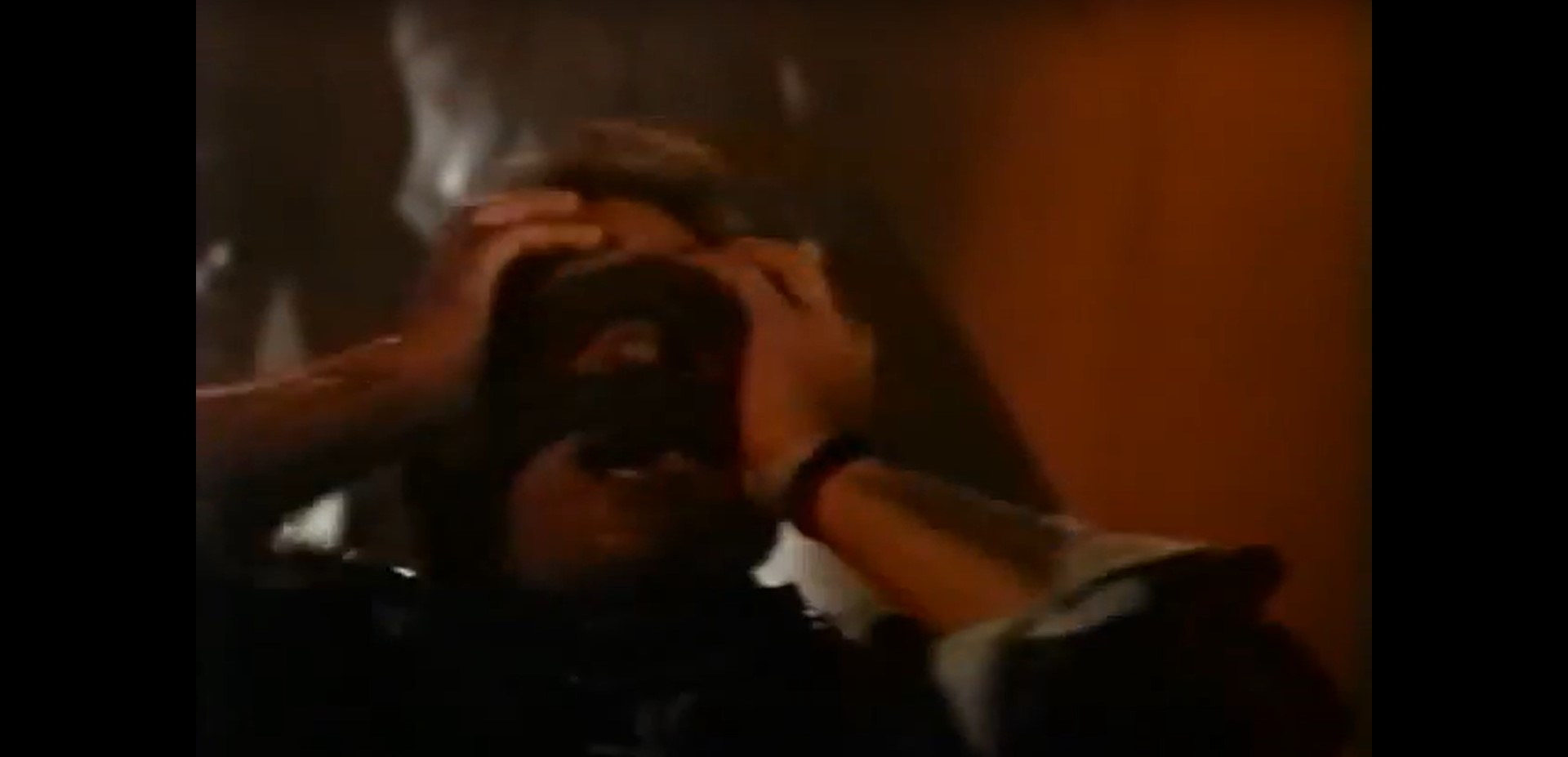
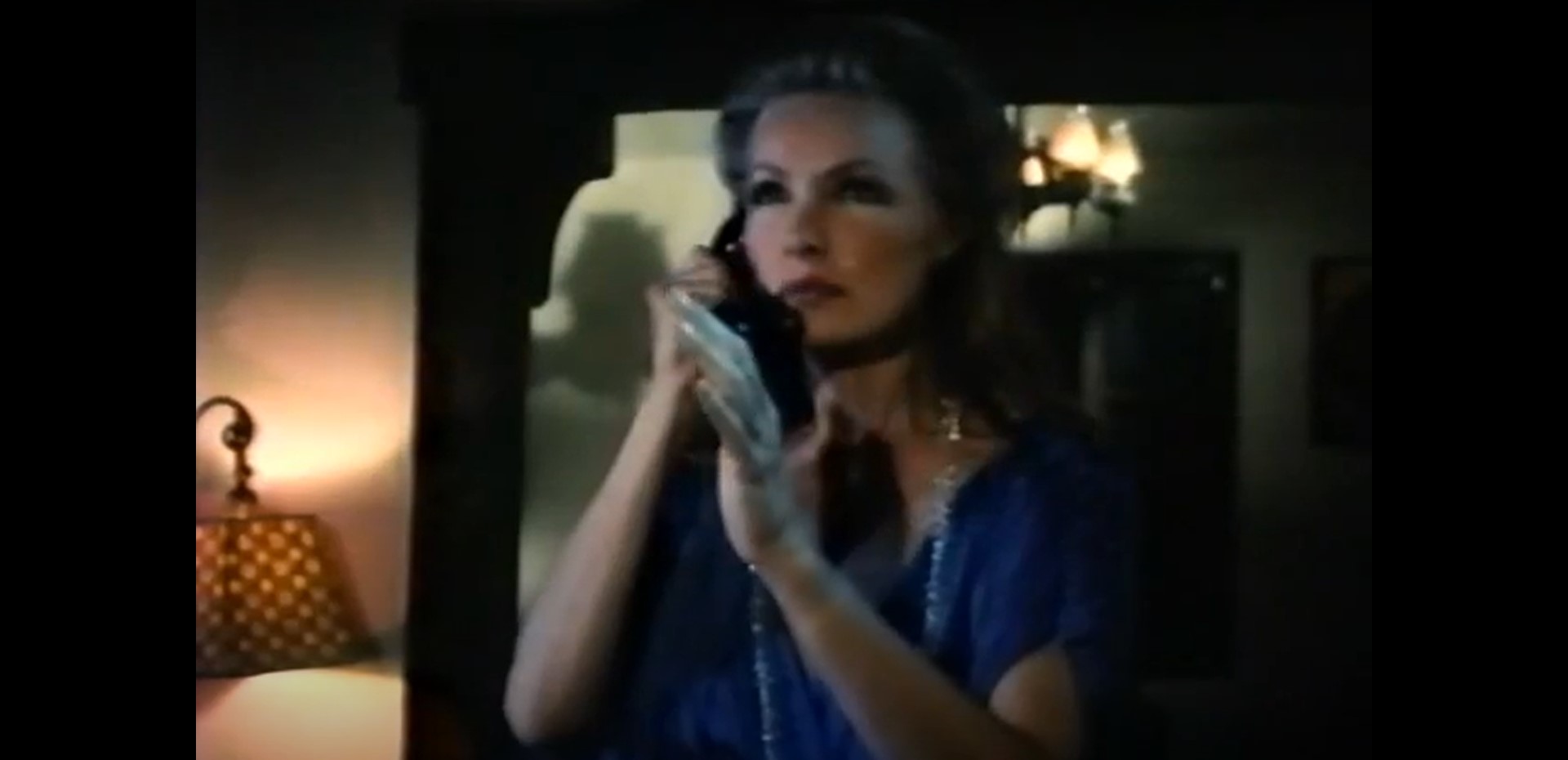
The fact that “Deep Space” doesn’t take place at all in space is innately tongue in cheek to begin with, but that brand of flippancy courses through the film’s veins despite the blood splattering and semi-serious veneer, weaving between an action-horror and a horror-comedy during the entire 90-minutes.  Some of the comedy is intention, such as McLemore’s husky wit and sarcasm, but there’s also the extremely foggy campy side to this gem.  Some of these elements include the creature being hinted as a genetically mutated cockroach or the left field use of Julie Newmar’s psychic abilities that are randomly injected the storyline for the sole purpose of forewarning McLemore over the telephone rather being an intrinsic piece to stopping the creature.  The creature carnage would undoubtedly be investigated and exterminated without the psychic’s help, making her character farcical in futility.  “Deep Space” also pulls a little inspiration from “Alien,” maybe even the sequel, “Aliens,” with a toothy, long-headed, and eyeless black organism that resembles much like a Xenomorph or the Xenomorph queen and there’s also a near shot-for-shot sequence of a security guard whistling to and trying to persuade a cat to come to him while the monster rises from behind and strikes a fatal blow.  The scene is very reminiscent of Harry Dean Stanton’s death in “Alien.”  Being campy has it’s highlights but never can fully overshadow scenes that erect suspense or are saturated with gore which “Deep Space” has both with a combination of editing and piercingly sharp sound design and a rip-roaring, blood-splattering chainsaw kill that’s leaves that good metallic taste in your mouth.

There’s no escaping the blood-hungry tentacles of the “Deep Space” monster coming at you in a brand new 2018 high-definition master Blu-ray from Scorpion Releasing, leased from MGM, and distributed by Ronin Flix and MVD Visual. The hard-locked region A Blu-ray is presented in an anamorphic widescreen 1.85:1 aspect ratio and is rated R. Fred Olen Ray knew how to develop an eerie, twirling fog and wind atmosphere and this master crisps up that iconic trope image. Textural details and natural-appearing skin colors are delineated nicely throughout as you can make out every little blemish and hair on a shirtless Charles Napier as well as really getting into the slimy orifices of the creature and having a sense of its viscosity with a decisive sheen. Black areas are inky and dense with the right amount of grain in the overall picture and no obvious signs of image posterization, retaining the natural shadowing, along with no cropping or border enhancements. The English language DTS-HD master audio stereo finds common quality ground with a tidy dialogue track that does Napier’s resonating and recognizable jest justice. However, there is some hissing early on into the film, especially in the lab scenes in the contentious dialogue between the military general and the lead scientist. Omar Tal’s sound design proves vital to the story that relies on the screeching, the scuttling, the whooshing of tentacles, and the booming roars of the creatures, coinciding appropriately with Alan Oldfield and Robert O. Ragland’s rather run of the mill serrated and discordant electronic score. What “Deep Space” Blu-ray lacks is robust extras with only an audio commentary with director Fred Olen Ray and a scene selection index. “Deep Space” ages about as well as you expect over the last 35 years, but this Fred Olen Ray creature feature relic becomes rightfully preserved for being quintessential B-movie verve that no longer seems to exist in today’s age and also the fact that Charles Napier wears a kilt.

***Stills do not represent or were captured from the Blu-ray release

“Deep Space” Invades Blu-ray on Amazon.com!

Early Bill Paxton EVIL in “Mortuary” reviewed! (MVD Visual / Blu-ray)

The tragic swimming pool drowning of Dr. Parsons might not have been an accident as determined by the police.  At least that is what his daughter, Christie, believes and she is for certain her mother has some involvement in the so called accident.  Plagued with nightmares followed by a stint of sleepwalking a month after her father’s untimely demise, Christie tries to maintain a semi normal life as a high school student romantically involved with boyfriend Greg Stevens.  Meanwhile, Greg’s best friend disappears after the two trespass onto local mortician Hank Andrews’s storage warehouse.  Christie and Greg unwittingly become embroiled into sinister intent by a masked and caped ghoulish killer stabbing victims with a detached embalming drain tube and at the center of it all is Hank Andrews and his son Paul’s family morgue that processes and possesses all the dead’s secrets. 

Before Wes Craven’s “Scream” mega-franchise turned caped killers revolutionary cool with meta-crafting horror tropes of the genre slasher, there was the little known “Mortuary” that perhaps paved just a slab of keystone for the Ghostface Killer who has become the face of slasher films for more than 20 years, much like Jason Voorhees or Michael Myers back in the 1980s and early 90s.  Written and directed by the Baghdad born filmmaker, Hikmet Labib Avedis, credited under the more westernized stage name of Howard Avedis, the 1983 film nearly had all the hallmarks of a peculiar macabre dance that skated around the slasher sphere.  “Mortuary” had seances, pagan rituals, a shrouded murderer, and, of course, the embalming of dead, naked bodies that are the inevitable, natural, mortality reminding entities in movies regarding morgues.  The late director, who passed away in 2017, cowrote the film with wife, producer, and actress Marlene Schmidt who had a role in every single piece of his body of work.  “Mortuary” was self-produce by the husband and wife filmmakers under their Hickmar Productions company and by grindhouse producer Edward L. Montoro (“Beyond the Door”).

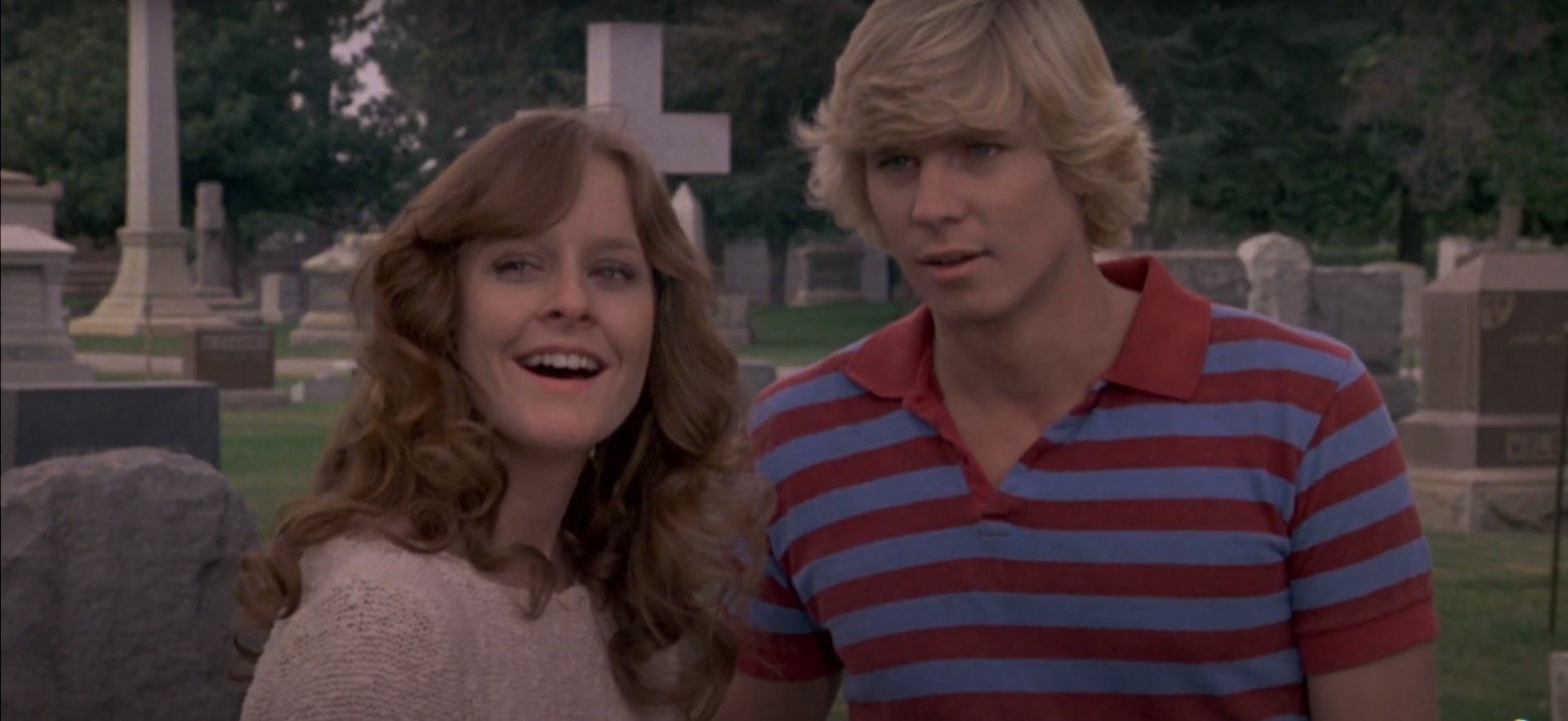
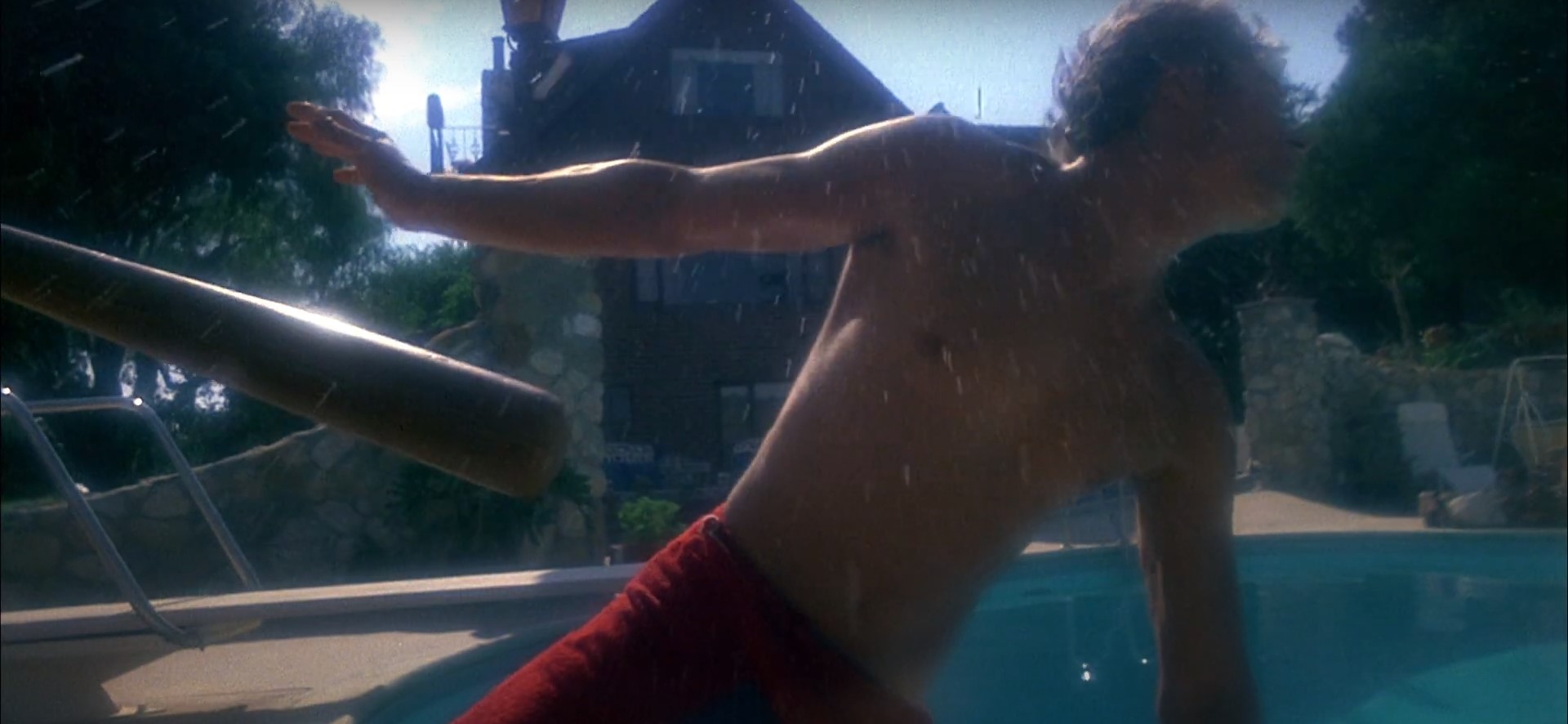
Though the post-credit opening scenes begins unscrupulous enough with Greg Stevens, played by television soap opera star David Wysocki whose credited as David Wallace, and his best friend Josh (Denis Mandel) stealing tires from Josh’s ex-employer, morgue owner Hank Andrews, the late “Day of the Animals” and “Pieces’s” Christopher George’s last cinematic role, because of being fired without being paid for his services, “Mortuary” inconspicuously moves from Stevens’ infringing on local law to surround itself more aligned with Stevens’ girlfriend Christie Parsons who feels more like a backseat character upon introduction.  Yet in a flurry of exposition with her mother, Christie, who is played by “Mom” actress Mary Beth McDonough, circles back and ties into the opening credit scenes of an unknown man being bashed over the head with a baseball bat and falling into his pool.  We learn that the man is Christie’s father whose death has been rule an accident (no evidence of baseball bat related injuries? Was evidence collecting really that low-tech in the 1980s?), but Christie begs to differ as she point blank accuses her mother, Christopher George’s life co-star Lynda Day George, being involved in his poolside death.   While performances statically hover inside the wheelhouse of teen horror with Greg and Christie seemingly unaffected by the mysterious incidents happening all around them until someone literally is grisly murdered in their adjacent bedroom, a fresh-faced Bill Paxton (“Frailty”) inevitably steals the show with this enormous presence on screen as Paul Andrews, the town’s mortician loony son working for his father as an embalmer.  Paxton’s zany act borders “Mortuary” as either a diverse trope horror with an awkward outlier character stuff into the eclectic mix or a seriously unserious bluff of being a serious horror film – see what I did there?  Paul listens to Mozart on vinyl, has an obsession for Christie, and likes to prance and skip through the graveyard as a son broken by his mother’s unhinged suicide.  “Mortuary” rounds out with Curt Ayers (“Zapped!”), stuntwoman Donna Garrett (“The Puppet Masters”), Greg Kaye (“They’re Playing With Fire”), Alvy Moore (“Intruder”), stuntman Danny Rogers, Marlene Schmidt, and Bill Conklin as a walking contradiction as a beach town sheriff wearing an unabashed cowboy hat like a sorely out of place rootin’-tootin’ lawman from the West complete with country draw lingo. Also – don’t miss the bad nude body double used for McDonough when Christie is lying on the morgue slab.

Now, I’m not saying “Mortuary” is the sole inspirational seed that sowed the way for the “Scream” franchise, as I’m sure many, many other iconic classics inspired Kevin Williamson, but, in my humble opinion as an aficionado about the genre components and how they’re all connected by a few or many degrees of separation, “Mortuary’s” villain could be the long, lost ancestral sperm donor responsible for the origins of Ghostface.  The purposeful movements and actions align very closely in a parallel of deranged defiance and floaty black and white costumes.  However, “Scream” is just packaged nicer as “Mortuary” continuously drips all over the place like a three scoop ice cream cone on a hot summer day.  Containing Avedis’s arc on Christie was nearly impossible as each act jumps and focuses on someone entirely different while also exposing the killer blatantly without even trying to misdirect or repel any kind of suspicion.  It was as if Avedis and Schmidt swung for the fences with a convoluted giallo mystery plot but couldn’t figure out how to build that into the narrative without drawing from and drowning in exposition and that’s how the cards came crashing down by unfolding with talking head pivotal plot points that steered to a rather quick, yet pleasant, climatic head of a total mental meltdown that’s much more cuckoo than Billy Loomis and Stu Macher will ever be. 

If you didn’t score a copy of Scorpion Releasing’s limited edition release of “Mortuary” on Blu-ray, then sing the praises of second chances with this Scorpion Releasing Blu-ray reissue through the MVD Visual Rewind Collection line. The all region release is presented in a high definition, 1080p, widescreen 1.78:1 aspect ratio of the Scorpion Releasing AVC encoded transfer on a BD25. Quality-wise, the release delivers the perhaps the full potential of a cleaned up 35 mm restore with no sign of cropping, edge enhancing, and a healthy amount of good grain, but there are noticeable gaffes with select scenes that seemed to have missed or left out of the restoration all together, reverting back to the rough, untouched image. Coloring, skin and objects in the mise-en-scene, come out lively, naturally, and without a flutter of instability with transfer damage at a minimum. Probably the most surprising is the original 2.0 mono LPCM track. The English language mix does the job without climbing the audiophile corporate latter, leaving in the wake a soft dialogue that’s a struggle to get through if you’re not wearing headphones. Depth seems a little slim, but the range keeps progressing nicely that often feeds into the late John Cacavas score. Cacavas operatic film score is bigger than the movie itself, often grandiose the Gary Graver one-note cinematography. The overexposed ethereal flashback has slapped redundant fatigue plastered all over it but, then again, the film is from the 80’s. Option English subtitles are available. Special features include only an interview with John Cacavas from 2012, from the original Scorpion Releasing print. Two upsides to the MVD Visual release are the cover art mini-poster tucked inside the casing and the added cardboard slip cover that resembles a tattered VHS rental tape slip box complete with a faded Movie Melt yellow caution sticker, a Be Kind, Remind sphere sticker, and a Rated R decal. If you’re a big Bill Paxton fan, “Mortuary” reveals another shade of talent from the late actor. Other than that, the Howard Avedis production often haphazardly stumbles bowleggedly to a giallo-errific-type ending made in America.