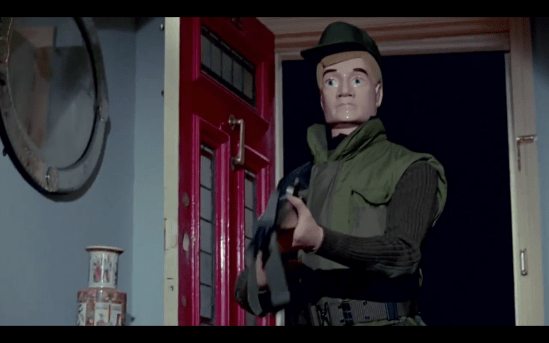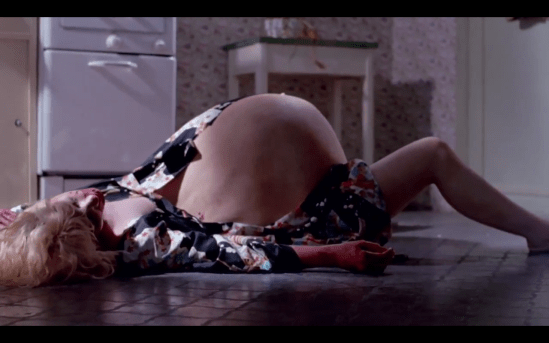
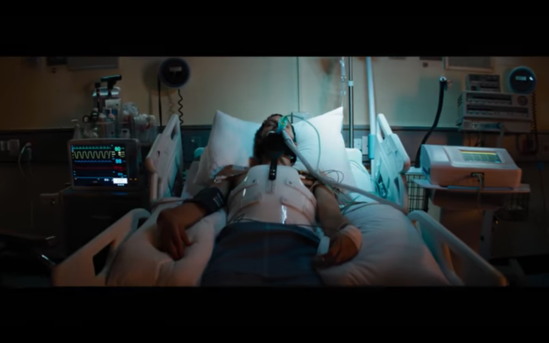
In the near future where assistive technology serves as the cultural way of life, a very manual Grey Trace still clings to being self-independent while his loving wife, Asha, laps up and embraces new and innovative tech. When an fatal shooting strikes down Asha and cripples Grey to an automated wheelchair, Grey is forced into a depressive world he no longer recognizes. Desperate to find his wife’s killers, he accepts experimental computer chip implant known as STEM to send the signals from his brain to his extremities; however, that is not all STEM can do. The smart technology can also scan, record, and reactive to all of Grey’s experiences, be a voice of knowledge, and enact super human abilities that will aid in Grey’s vengeance, but without much control over his own body, how much will Grey continue to use the smart device that becomes smarter every minute.
In a cinematic age when remakes, re-imaginings, and sequels really do rule supreme, a breath of innovation and compelling storytelling in Leigh Whannell’s 2018 science fiction, action-noir “Upgrade” is a technological advance that’s feels lightyears ahead in comparison. The “Saw” and “Insidious” writer, who indulges in all of horror’s gracious qualities, tackles the future with a synergetic and brutal vengeance film on indie-budget proportions; however, “Upgrade” feels no where near being low budget in a futuristic world that includes monochromatic self-driving cars, bio-weaponized forearms and hands, and a robotic protein shake slingers for those meal replacement pick-me-ups. With the assistance from Blumhouse Tilt, a Blumhouse production sublabel that seeks to release projects onto multi-platforms, Whannell gained freedom to script, in every sense of the world, his own vision of cyborg horror and crime thriller.
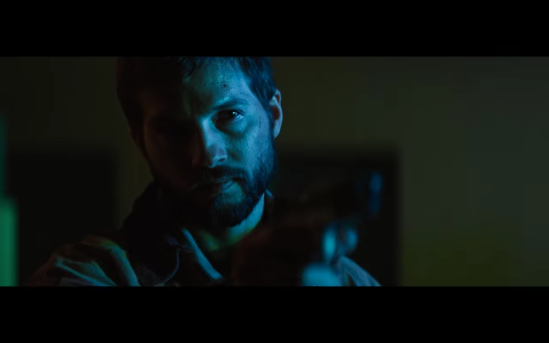
Logan Marshall-Green stars as Grey Trace, an analog man living comfortably in a digital world. Trace is a dying bred as the technology ecosystem slowly creeps into all that earned by hard work, even in his small classic car restoration business. The “Prometheus” star tackles a unique physicality aspect of an action film that involves the robotic responses of hand-to-hand combat while also being the emotional punching bag of pelted heartache and turmoil. Portraying his character as a man’s man, Marshall-Green has to find humility in not only unable to self-serve himself as a cripple, but then also rely on the one thing he withdrew himself from for help….a machine. “Upgrade” primarily focuses on Trace to even having the camera affix to his character during fight sequences, but though most of the narrative is through Trace’s vindictive narrative, a cascading effect of his destruction brings one of his nemesis’s into reactive defense. Fisk, Benedict Hardie from the upcoming remake of “The Invisible Man” that’s also directed by Whannell, is a mysterious soldier of fortune whose backstory, that salivates at the tip of the tongue to be told, is only sampled at best with his cybernetic implants or why he was even chosen to be a deadly, robotic killing machine. Perhaps Fisk’s backstory, and those of his fellow veteran comrades, are another misrepresentation or the maltreatment of veterans by conglomerate, privately owned tech and weapon companies that lean more toward involuntary experimentation rather over anything else that’s an allegory of owning a person, a piece of property, as we also see with STEM attached to Grey Trace’s spinal cord. “Upgrade” rounds out with performances from Melanie Vallejo, Harrison Gilbertson (“Haunt”), Betty Gabriel (“Get Out”), Kai Bradley, and Simon Maiden as the voice of STEM.
Shot in urban Melbourne that’s quasi-reflective of the gritty streets of Chicago, Leigh Whannell aimed for a fatalistic mystery that breaks down relationship barriers and sustains a punitive jurisdiction of grime. Whannell surely achieves the desired affect that goes from a classy futuristic society to the bottom barrel of human existences that have been tainted by the dark side of tech including addiction and dangers of being fully aware as a sanctioned being. “Upgrade” capitalizes on every inch of its capital to enlarge the quality of a miniature budget and utilizes local talent, who, aside from Logan Marshall-Green, never wane from their unnatural American English accents, to offer heartfelt human performances despite their mechanical transitions. “Upgrade” isn’t “Robocop” or “Nemesis,” but rather more “Terminator” where organic and inorganic don’t exactly coincide to benefit as a single entity. Unlike the autonomous killing machine portrayed by Arnold Schwarzenegger, “STEM” acts like a computer virus working off commands, coding, and complex algorithms to infiltrate and deploy executions to subverse the man over the machine and Whannell’s concept brilliantly contextualizes that dynamic without having too much exposition to divulge and is easily computed without having to be deciphered from binary code.
Coming November 18th is Second Sight Film’s limited edition Blu-ray release of “Upgrade” presented in full HD, 1080p, and clocks in at 100 minutes under a region B UK coding. Unfortunately, a screener disc was provided for review and so I will not be critiquing the video or audio quality at this time so this review is solely about the film only. A static menu including chapters were available on the disc as well as bonus features including a commentary by writer-director Leigh Whannell, a new Second Sights’ interview with the director about his envisioning and how it came to fruition, more new interviews with producer Kylie Du Fresne, cinematographer Stefan Duscio, editor Andy Canny, and fight choreographer Chris Weir. All the interviews showcase depth with the material to their respective roles and opinions about “Upgrade.” Don’t think it necessary to refer filmmaker Leigh Whannell as the “Saw” guy now that “Upgrade” has completely overshadowed the franchise in a single sitting entertained with action, gore, and a heart-rendering story. Surely to be Whannell’s break out film from the horror genre.
Tag Archives: second sight
Evil’s Crimes Against Nature Will Not Go Unpunished! “Long Weekend” review!

Peter coerces his begrudging wife, Marcia, to forgo the luxurious hotels and chauffeured holidays for a long weekend of camping on a remote beach in Australia. An enthusiastic Peter packs the jeep with thousands of dollars worth of outdoor gear, including a surf board, a spear gun, and a hunting rifle. Marcia loathes the outdoors, can’t stomach the very thought, and she lets Peter know her distaste of his plan every other second while on holiday. Yet, this trip for them isn’t just a routine getaway, but, instead, a trip to get away from the swinging friction of close and very intimate friends, to rekindle their relationship, and save what little is left at a frayed string. The already awkward and complaint-riddle holiday turns from bad to worse when nature looms a foreboding shadow over the estranged couple, unleashing one ill-fated omen to the next that checks their nonchalant attitude toward nature with eco-radical discipline.

“Long Weekend” is an eco-horror film by “Innocent Prey” director Colin Eggleston. Alfred Hitchcock, perhaps, birthed the horror subgenre with his 1963 film “The Birds” that led to such films as “Day of the Animals” and “Grizzly.” Nearly 15-years later, Eggleston hones in on his inner Hitchcock by expanding the background on why nature turns cold and unsettlingly supernatural like. Working off a powerfully detailed and haunting script by “Razorback’s” Everett De Roche that circles around two characters like a hungry vultures, Eggleston vitalizes De Roche’s script with a paper to screen bleak, unsettling imagery on a monumentally minimalistic scale. “Long Weekend” could be considered a Hitchcockian film, and most likely is, but can stand firmly by itself as an extension on how mother nature can be a bitch when push comes to shove.

Two characters and the wilderness. That’s all “Long Weekend” boils down to on brass tacks, leaving two actors on the line to act off each other and off of the ominous presence that has fully engulfed them on an isolated stretch of beach and shoreside forestry. “The One Angry Shot’s” John Hargreaves tackles the conceited Peter with a full-bodied combination of heedless gusto and desperation that Hargreaves can seamlessly become lost in Peter’s self-worth. The Sydney born actor is paired with an English actress by way of Briony Behets from the 1980 film “Stage Fright,” a film also co-written by Colin Eggleston. Behets’ Marcia epitomizes the stereotypical enigma that men all think is the inner workings of a woman’s brain; Marcia is hot and cold with fleeting moments of passion for Peter, yet ready to kill him in the next scene. Behets converts the baffling intertwinement of Marica’s energy and channels it well into the dynamic that is their failing marriage.

What’s really special about Eggleston and De Roche’s film is the overloading symbolism. From subtle to simple, “Long Weekend” has the money betted on working on an underlying moment-to-moment, scene-to-scene in each act; a method tirelessly schlepped through with many modern features of today. Using non-threatening animals, such as a small possum and a sea cow or dugong, to be part of a menacing force driving the ominous presence across the narrative just sets the feng shui mindset of an unadulterated evil genius. Instead relying heavily on a physical entity, Eggleston heavily coincides creature imagery with the use of audible creature cues, whether a baby-like wail in the distance or the overpowering cacophony of animal growls and sneers, to invoke panic, fear, and paranoia to divide the already fragile pair into an atomic disaster of their undoing. “Long Weekend” will overshoot some viewers as piecing the puzzle together can be a slow and long process, but one aspect is certain, the off-camera animalistic stare has a powerful affect.

Second Sight delivers the ozploitation classic, “Long Weekend,” onto Blu-ray home video for the first time in the UK this November. Unfortunately, a review DVD-R disc was provided for this critique and audio and visuals components will not be covered. Bonus material was included on the review disc with audio commentary with executive product Richard Brennan and Cinematographer Vincent Monton, an Umbrella Entertainment produced panel discussion with film historians Lee Gambin, Alexandra Heller-Nicholas, Emma Westwood, and Sally Christie, Uncut “Not Quite Hollywood” interviews with Briony Behets, Vincent Monton, and Everett De Rocha, an extensive still gallery with an John Hargreaves audio interview, and original theatrical trailer. “Long weekend” is man versus nature at it’s best with sheer, unrivaled terror in a quaint eco-horror thriller package with a powerful message that nature will seek extreme judgement against Mother Earth criminals.
Daddy’s Home and He Brought Evil With Him! “Xtro” review!

A father mysteriously goes missing when visiting aliens violently abduct him from his serene cottage home. Thought to be a deadbeat husband and father for abandoning his family, the man returns three years later at the doorstep of his wife’s London flat. A bewildered and conflicted wife struggles with his return while the live-in boyfriend makes it clear that he wants the man out, shelling out a vicious cold shoulder whenever in the same room, but the returned father seeks to resume his patriarchal position amongst his family; however, he’s not exactly the same person he used to be as he garnishes an exterior shell of a human and the interior of a hostile extraterrestrial with ulterior motives. His return has nightmarish affects on his traumatized son whose becoming a device of deviancy at the hand of his father’s otherworldly influence, issuing carnivelesque ill will toward other flat tenants. By the time the boyfriend suspects something, the not-so-friendly alien might have already established the intended invasion into a family so eager and willing to accept their sorely absent loved one.

Perhaps one of the most out of this world science fiction horror films ever made that’s set on Earth, “Xtro” is the Don Coscarelli-like bizarre horror film from British filmmaker Harry Bromley Davenport. Co-written the story with Michael Parry (“The Uncanny”), Davenport’s blended American and British financed 1982 unsettling venture was penned by Iain Cassie (assistant director on “Schizo”) and Robert Smith. Honestly, no other film comes within a comparison zone of “Xtro’s” sheer creativity that doesn’t just redesign the genre or it’s tropes, but, rather, embraces a new kind of fragmented oddity by telling an uncomfortable story consisting with the graphic birth of a full grown adult, the flesh crawling sensation of an adult man bending down to child level to drink from the bare skin of a child’s shoulder, and the exhibition of the dark pageantry of humor underlined death. Over an umbrella of horror shades metaphorically a fairly common family crisis baseline premise of an inattentive father’s return home to try to reinstate himself with conflicted wife and eager son only to, once again and concretely, destroy them internally.

Philip Sayer sets foot into the duplicitous titular space invader. The trained veteran actor had experience from the stage that translated to what could be considered performance art in “Xtro” to embodied a creature on the inside to his humanity on the out. Sayer costars alongside an unseasoned child actor, Simon Nash, as the young Tony and the pair make a inharmonious father and son with cankerous performances by Nash who doesn’t exactly fit, when considering accent and even appearances, his portrayed parents. Bernice Stegers is the other half of Tony’s folks and the “Macabre” star does a phenomenal job as the stiffly conflicted mother and wife Rachel Phillips, straining toward more what’s best for her love life rather than to the care of her son. The live-in boyfriend Joe, portrayed by Danny Brainin, limps by as a fairly useless character who doesn’t contribute either way to a conclusion. Other than providing a minor tether to Rachel Phillips life to normalcy, Joe can’t swallow his emotions and the best the character can offer is to abandoned his girl and son, another frail male in their life. Brainin’s performance is good for the character’s weak minded attitude. The cast rounds out with Maryam d’Abo (who goes onto to be a bond girl in “The Living Daylights”), Peter Mandell, and Anna Wing.

Though thought provoking and wildly entertaining through soul rattling imagery, “Xtro” is by far from a perfect film. Sure, the Tom Harris special effects pull at innard chords you may never knew you garnished and certain scenes would be the subject of mysterious gif images in the dark corners the internet that proclaimed creatures do live unknown amongst us, but the British science fiction horror film, a video nasty of the time, just might have been too absurd in the nonconformist form that struck unpopular opinions with audiences and critics because the villain wasn’t necessarily tangible and wielded a blood stained machete and more so involved obscure telepathic references that were non-explicit. There’s literally no connective tissue which makes this film so beyond the mind’s grasp. “Xtro’s” niche saw non-homaging aspects, but had familiar flavors such as a bit of Peter Jackson humor, a dry slapstick that’s hard to enjoy, but fascinating to take in at the same time. That’s the whole idea behind “Xtro” was to create an off-structured horror film that pushed the limits while not just replicating other great horror movies.

New Line Cinema’s “Xtro” is coming to a limited edition Blu-ray set from UK distributor Second Sight. The newly restored extended presentation of the transfer will also have option alternate ending plus will also be accompanied with the original video version. Unfortunately, a screener disc was provided for this particular review and comments about the image and audio presentations will not be commented on. The disc did include extras such as a brand spanking new 57-minute documentary that included new interviews with Harry Bromley-Davenport, Mark Forstater (producer), Bernice Stegers, Susie Silvey, Tim Dry (Tik), Sean Crawford (Tok), Robert Pereno, Alan Jones and Craig Lapper. Also included is a new featurette with Dennis Atherton, Harry Bromley-Davenport and Mark Forstater, ‘Beyond Xtro’ – a new featurette with Harry Bromley-Davenport and Mark Forstater looking ahead to new reboot, ‘Xtro – The Big One’, including exclusive test footage, ‘Loving The Alien: A Tribute to Philip Sayer’ featuring exclusive Brian May music tribute, and ‘Xtro Xposed’ archive interview with Harry Bromley-Davenport. A venturous Robert Shaye at New Line Cinema wanted to match wits with his own one-two punch version of a video nasty. The result was an out of body experience alien feature with unapologetic tastes and unafraid wills to push the shock market limits. “Xtro” might be one of the billions of stars in the film archive, but at least it’s one of a kind.
Hauling Evil Earns a Living! “Space Truckers” review!

Times are tough. Loads are scarce. For John Canyon, being an independent owner operator space trucker in the year 2196, without the influential assistance of conglomerate sponsors and big corporations, is the last freedom in the last great frontier, but even Canyon needs to earn a living and when a questionable load becomes his only way out of a jam with the authorities, Canyon and his new and young partner, Mike Pucci, snatch the haul bound for Earth. Manifested as carrying sex dolls, Canyon and Pucci become suspicious of their cargo that’s loaded with a fatal self-defense mechanism, but when encountered by space pirates, lead by former company man named Macanudo, the space truckers learn their hauling thousands of virtually unstoppable killer cyborgs programmed to conquer Earth.

In today’s age, a nationwide driver shortage threatens to slow down crucial logistics worldwide. Director Stuart Gordon (“Re-Animator,” “Dagon”) with co-writer Ted Mann had the inverse premonition that trucker cargo would be at a premium in the space; the point A to point B in a timely fashion has not and neither have the negotiations of rate costs and demurrage time in this world-saving adventure entitled “Space Truckers.” In the same science fiction-comedy vein as the similarly colorful Luc Besson’s “The Fifth Element,” “Space Truckers” has that unrefined inviting quality about it, categorized as blue collared heroes, that complete the dynamic character arcs, but what’s more interesting about “Space Truckers,” which was released a year earlier than Bruce Willis film, was that it was constructed on a third of the budget, making the film one of Stuart Gordon’s most expensive and ambitious projects chocked with square pigs in cages, a self-built cyborg with a ripcord sexual organ, and an army of ass-kicking fembots with disintegrated lasers…”Space Truckers” is out of this world fun!

In the realm of Sci-fi comedy or fantasy, one legendary actor has nailed his performance in every flop that’s too big for commercial audiences. From “Waterworld” to the movie adaptation of popular and beloved video game, “Super Mario Bros.,” Dennis Hopper ruled the 1990’s with memorable, fascinating, and engaging overweening characters, especially villains, but Hopper snags John Canyon, a long in the tooth trucker who prefers to work alone. Hopper’s in his element, in control, and in the lead role despite not being top bill; instead, a young Stephen Dorff would be eyed as the one to provide fresh protagonist momentum into the mid-nineties. Dorff’s rather low-key to Hopper’s giant persona and that’s inherit to the character’s written traits, by always complimenting and complying with and whatever John Canyon says, but the soon-to-be “Blade’s” Decon Frost actor has a sturdy performance that’s portly as any trucker can be portrayed and has great repertoire with Debi Mazar as a trucking hub waitress who needs a hitch a ride to Earth. Mazar’s all-natural New York City accent compliments her guido-type character attire and she downplays her beauty with instilling innocents and ramping up the wit when the scene calls for it. “Game of Thrones'” Charles Dance makes an appearance as the space pirate captain Macanudo and Dance has always has a steel complexion, but in “Space Truckers,” he lets his hair down as far as becoming subjected to hours worth of cyberpunk makeup and prosthetics that’s comically outlandish and utterly fleshy. Certainly not a role one would consider the actor who comes complete with a rich British accent and an urbane quality about him to then sport a sparkling fishbowl cranium and a battleship gray half a buttocks. The remaining cast includes George Wendt (“King of the Ants”) and Shane Rimmer (“The Hunger”).

CGI was relatively in the early stages of infancy; yet “Space Truckers” had an astonishingly working blend of computer generated imagery and palpable miniature models that were supported with an integrated futuristic edifice style of production design by Simon Murton, whose speciality is high concept science fiction with illustrative art department experience that includes “Demolition Man,” “Tank Girl,” “Judge Dredd,” and “Stargate.” Murton’s style incorporated with the bright colored visuals of neon flicker marquees, illuminating body parts, and red hot poker red infrareds hues are the very antagonistic views of a cold and dark space, yet Gordon and his crew envisioned characters who sought out color, who wanted nothing to do with the darkness, and that’s what made them colorful and maybe a bit off-kilter.

Stuart Gordon’s stellar “Space Truckers” rockets to a region B, 1080p Blu-ray courtesy of UK distributor Second Sight that delivers with a widescreen presentation, 2.35:1 aspect ratio, that has out of this world image quality vividly displaying the massive color palette through a 2K restoration from the 35mm negative. Running at nearly 24 fps, Second Sight’s edition is superior in detail, cleanliness, and balance amongst the coloring and despite being able to see the special effect wires, “Space Truckers” has one of the best restorations I’ve seen lately under the black Blu-ray box laced with new artwork by graphic designer Rich Davies. The English 2.0 LPCM uncompressed stereo track, with optional subtitles, has immense range across the board. From cheesy John Canyon dialogue to the vary of space-kindred ambience, not one track felt short to being muddled or murky. Colin Towns bigrig score is big country cadence that’s emits a well-rounded six pack from the dual channel sound. The robot’s disintegrations amplify a high pitch note that can be a thorn in one’s ear, but adds to the chaotic charm when all hell breaks loose in space. Bonus features include a new interview with Stuart Gordon delving into the film’s beginnings and his recollections with the stars, and a new interview with composer Colin Towns (“Rawhead Rex”), a new interview with Art Director Simon Lamont (“Event Horizon”). “Space Truckers” is 96 minutes of mudflappin’ mayhem strapped with slender models in killer robot suits and Charles Dance’s exhibiting his tin-can half-nakedness in a bizarro world of high concept meets tongue-and-cheek performances of a film that ultimately pits the epitome of the blue collar workforce as the unsung heros of space.
Oscar Wilde’s Not-So-Evil…”The Canterville Ghost” review!

An ambitious physics professor Hiram Otis obtains a research grant that requires him to study in England, pulling his wife, daughter, and two young boys from their Indiana home into a strange new world. In an age of obsolete aristocracy, the Otis family is able to afford rent at the grand Canterville Hall, a legendary castle with an infamous tale of death and suspicion that also might have resulted in being an affordable estate for the American family. Legend records have it that the lord of the castle, Sir Simon de Canterville, had subsequently killed his wife due to his obsessions and became the victim of his wife’s family spiteful vengeance by being chained to a dungeon cell. For 400 years, Sir Simon remained in that cell and his ghost haunts Canterville Hall, but despite their beliefs in the supernatural, the physics professor and his wife can’t see the ghost and only their teenage daughter and two young boys are able to witness him roam the halls, haunting those who live within the castle walls.

Every once and awhile, we’ll thoroughly review a light-hearted fantasy, horror, or sci-fi film and since we’re hot off the heels of the review for Wes Craven’s “Summer of Fear,” the made-for-television train might as well keep chug-chug-chugging alone with the 1996 TV movie adaptation of the Oscar Wilde novella, “The Canterville Ghost.” Distributed by ABC, the Sydney Macartney (as Syd Macartney) directed and Robert Benedetti teleplay written installment tries to differentiate itself and standout amongst a plethora of adaptations that span across the globe, but the American Broadcast Company, a subsidiary of the great and powerful Disney, aimed to separate from the masses by adding star studded power and the result brought a rejuvenation to the ye old tale over two decades ago.

The big name headliner is none other than Captain Jean-Luc Picard himself, Patrick Stewart, two years after his 7-year stint on Star Trek: The Next Generation. Stewart, who co-produced the film, adds his theatrical flair and is absolutely brilliant shaping drama monologues into dense thickets that define Sir Simon de Canterville’s ghost, but there’s an issue; the problem doesn’t lie with Patrick Stewart, but with how Benedetti’s teleplay expos from the story as a continuous, if not slightly jumbled, stream of old English that just feels like rambling. To alleviate that strain is Stewart’s co-star Neve Campbell to add a softer, glassy-eyed touch to the story with a pinch of plain jane American girl insecurities, characterized in Wilde’s story as Virginia Otis. Perhaps in the beginning portion of the height of her career, Campbell finds herself between “Party of Five” and hitting scream queen status as Sydney Prescott in “Scream,” but the “Wild Things” actress wasn’t that sultry or that chased in “The Canterville Ghost” who only took upon an annoyed teenage girl persona, wishing her life was back in America up until the mysterious spirit of Sir Simon de Canterville allured a spark into her dull life. Alongside Stewart and Campbell, Daniel Betts, Ciarán Fitzgerald, Raymond Pickard, Cherie Lunghi, Donald Sinden, Joan Sims, and the late Edward Wiley, who died shortly before the film’s premiere, costar.

Going into “The Canterville Ghost” was nothing short of knowing nothing other than the fact the Patrick Stewart and Neve Campbell were in the lead roles of a Disney backed, family film and to be completely honest, Macartney’s vision completely underwhelms. Along with the verbose nature of the script-to-teleplay alterations, the magical supernatural portions are inarguably cheap, even for television. The simple superimposing of Sir Simon de Canterville offered no stimulation as the the two scenes just didn’t splice together well to seamlessly make the grade. Firecracker explosions and party store cobwebs dilute even thinner the already slim pickings of special effects that top when Virginia Otis crosses over into a dense fogged ghostly realm thats chopped, cropped, and edited with such disorganization, the entire scene feels more lost than Virginia trying to escape the other side back to the living.

Sydney Macartney’s “The Canterville Ghost” is presented for the first time ever on Blu-ray courtesy of the U.K. distributor Second Sight Films. The Blu-ray is presented in the Academy ratio of 1.33:1 with 1080p resolution on a MPEG-4 AVC BD 25. Second Sight’s release will have the best looking version of this film, if the quality is anything like the screener sent to me, with a strong color palette, minor digital noise, and rich in great detail; so detailed in fact that the blemishes on Neve Campbell and Daniel Betts can be seen. The English DTS-HD audio track is lively, but not entirely boastful with more thematic and dramatic elements. Dialogue track is clean and clear and the score by “Dead Heat” and “Tremors” composer Ernest Troost augments his fairy tale rendition into the mix. Bonus material includes new interviews with director Sydney Macartney and producer-writer Robert Benedetti. Second Sight’s presentation of Hallmark Entertainment’s “The Canterville Ghost” has strong Blu-ray technical potential, but despite the big names of that time period and a visually stimulating setting, the fantastic adventure through a cursed ghost’s melodrama and a bored young girl’s tenure of self discovery unfortunately didn’t rivet with excitement or wonder, losing steam with it’s important message that life is more than being in a bubble of stagnant disappointment and guilt.