A Double Bill of Evil! “Murderlust” and “Project Nightmare” review!

vlcsnap-00001
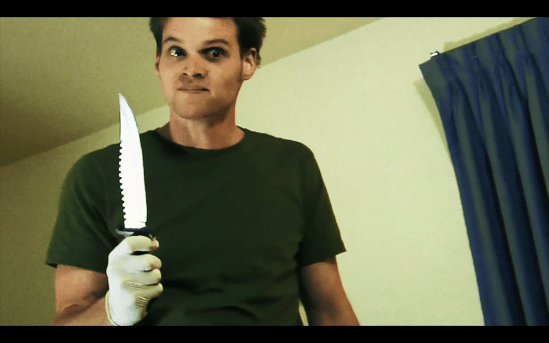
During Sunday’s services, a calm and confident Steve Belmont heads the Christian Sunday school youth class and seeks to be the permanent director of the Church’s suicide crisis unit that’s coming to the end of the planning stage. On Sunday’s, Steve performs as the model citizen whose ready to serve and give back to his community. During the rest of the week, the horse race track security guard can barely sustain societal worth, arriving late for work, constantly drunk, and has disdain for people being a speed bump in his path to greatness. All Steve Belmont has in life is the potential director’s job and his thirst, his unquenchable thirst for strangling women and dumping their bodies in the excessive heat of the Mojave desert. The local newspapers label his killings that of at the hands of the “Mojave Murderer” and his lust for killing call girls and young women runs a thin line alongside his Sunday best and when he begins to trust a Church regular, Steve’s mistakes begin to catch up with him.
vlcsnap-00002
“Murderlust” is the first feature on the Intervision Picture Corp’s double bill DVD release from director Donald Jones and writer James Lane. The 1985 suspenseful horror-thriller comes to DVD for the very first time and doesn’t just boldly display a story of another run of the mill serial killer but does so with remarkable performances and a body of work that’s well crafted. Lane pens the center character focus on Steve Belmont and his delusion of power, being an overwrought sociopath with a belief he’s better than everyone else, and Belmont’s brazen lures to secure helpless victims is nothing short of a con artist’s trait. The ability of convincingly seducing the congregation to his benefit provides him pseudo mystical powers that pull the blinds over their God fearing eyes while he continues to slack through a meager life and holds tightly his reign of terror near the Mojave. Basically, in Belmont’s mind, he is God.
vlcsnap-00003
Eli Rich plays Steve Belmont, who can only be described as a twisted blend between Michael Beihn and Nick Offerman, and Rich canisters Belmont’s psychopathic tendencies in an terrifying performance of exact realism. Not many films can pull off the on and off switch of a serial killer, even Patrick Bateman in “American Psycho” was sensationalized, but the relatively small time actor produced a manufactured fearful reaction. Rich splits Belmont into two personalities while still managing to be contain a menacing aurora to feed audiences with dread, fear, and suspense and while Rich might be doing more than just one public service for his community by picking up and strangling local street walkers, Belmont never transitions into that role of the likable anti-hero as he manages to forthrightly ostracize himself from friends and family. As Steve’s square statured and responsible cousin Neil, Dennis Gannon epitomizes the upstanding citizen character, but maintains a soft spot for his unscrupulous next door neighbor cousin. Rochelle Taylor’s role is something of a love interest for Steve, who can’t bring himself to kill her even when the opportunity is present, but the one film and done actress Taylor can’t bring “Murderlust” to the promise land with an overzealous portrayal of an eager beaver, love struck Church girl that doesn’t fit the bill of Belmont’s world.
vlcsnap-00004
After a couple of quick Mojave Murderer victims, one including the scene illustrated for the DVD’s front cover with a topless and unchaste Ashley St. Jon, Steve, along with the flow of the story, banks into a suppressive funk. The narrative’s pace slows when Steve attempts to organize his life around his murderess hobby, turning the suspenseful thriller into a drama segment that is more or less of a laundry list on how to obtain rent money for an aggressive landlord, until the demand to hunt tugs heavily at his pant leg and he can no longer ignore the urge. “Murderlust”, despite the captivating title, is nearly a bloodless horror thriller. Steve uses his signature method of strangulation, leaving smartly no blood trail, and only at the finale does blood spill when Steve deviates from his unsympathetic hunt, kill, and dump program.
vlcsnap-00007
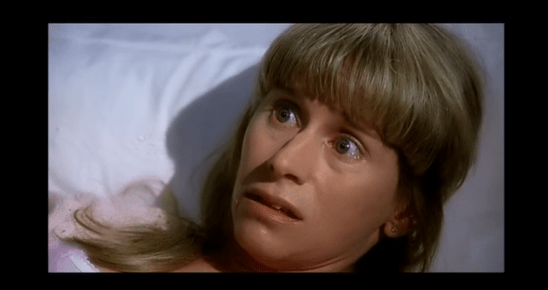
Woodland campers and best buds Gus and Jon wake up to discover their gear has been shredded and dispersed. They’re soon pursued by a frightening force of unknown origins. Lost and hungry, the two friends stumble upon a mountain cabin where cabin owner Marci shelters them for a night. Rested and resupplied, but haunted by their dreams, the two continue on foot in search of a town; instead, they become split up and Gus finds himself in the bizarre belly of a government facility that’s conducting an experiment and root of Gus and Jon’s predicament. Gus must confront the inner workings of his mind and take back control of his thoughts or else all that he knows, his friendship with Jon, and all that he desires, his passion for Marci, will soon be lost to the unchecked government secret known only as Touchtone.
vlcsnap-00008
The second film on the double feature, “Project Nightmare,” starkly contrasts in genre with “Murderlust.” “Project Nightmare,” otherwise known as “Touchtone,” is a science fiction thriller piggy backing as a bonus feature and the 1979 conduit for confusion showcases how scarily surrealistic director Donald Jones can achieve. An odd film that materializes shortly after Gus and Jon’s plight begins and doesn’t let up the enigmatic ambiance as the audience will surge deeply into the rabbit whole. Even though told linearly, “Project Nightmare” feels, in fact, like a nightmare, peppered with sporadic scenes of uncomfortable imagery and repetitive ambient noises and soundtrack that jar the senses. Jones’ direction and style denotes an appeal of black and white scenes, but, in color, the film works better to give an ominous a stimulating visual and without that color, the story just wouldn’t work.
vlcsnap-00010
Charles Miller and Seth Foster star as the baffled and lost campers Gus and Jon. They’re joined by Elly Koslo, as Marcie, and Harry Melching, as Carl the government scientist, who provide indifferent character roles or just products of the imagination to support the dreamlike atmosphere. As a whole, the actors’ dynamic was obsoletely rigged but in an unsettling Lynchian fashion causing your eye balls to stay with the scenes. “Project Nightmare’s” experience will make you feel you’re watching a film much older than produced with the costumes, the language, and the wood paneled elevator and granted that Jones’ isn’t big budget, but the director was able to deliver with the minuscule budget available to fruition a sci-fi odyssey.
vlcsnap-00011
Intervision Picture Corp has a snazzy, two-headed snake in “Murderlust” and “Project Nightmare” presented in full frame 1.33:1 aspect ratio with a single channel Dolby Digital mono track. The original prints looks great with “Murderlust” slightly heftier in the cyan department during it’s 98 minute runtime. The single channel had better luck with the 74 minute runtime in “Project Nightmare and “Murderlust” had moments of softness where dialogue became a strength in exercising one’s hearing. Both issues listed didn’t hinder the final product; in fact, I’m quite pleased with the end result on both features. “Project Nightmare” has a natural presence that’s appeasing and “Murderlust” blankets itself warmly in, well, the associated Mojave desert. The bonus content on the Intervision release include two audio commentaries with writer-producer James Lane. The “Project Nightmare” commentary has partial audio. In conclusion, “Murderlust” might not be this tour de force of bloodletting hookers. The sheer realistic characteristics of a serial killer among us are more alarmingly exploited and continue the terrifying ordeal with “Project Nightmare,” a sci-fi sensory conundrum overloaded with spastic psychological terror from the Golden Age of film.

Murderlust

Buy Murderlust on DVD at Amazon!

Evil Gets to Cookin’! “Gran Bollito” review!

screen-shot-2016-12-31-at-2-38-11-pm
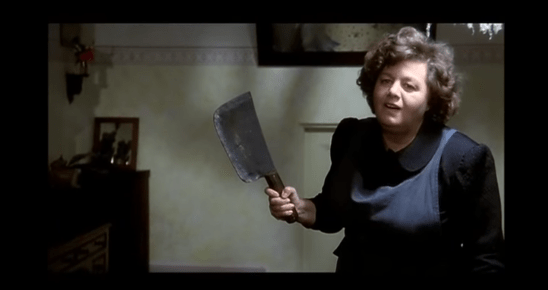
Journeying from the South to reside with her son Michele, Lea is a boisterously strong matriarch whose suffered through twelve miscarriages in fifteen years and has become insanely protective of her sole breathing progeny. Michele lives in a stately condominium that accommodates an eclectic bunch of women of various tastes, housing his mother Lea to mix as a lottery fortune teller of sorts. Lea’s talents go beyond just predicting winning lucky numbers as she’s also a fantastic cook in the kitchen, a superb soap maker, and an efficient killer that supplements the prior traits. Madness consumes a mother who seeks to absolutely protect her only child and a contractual deal with Death itself orders the end of minuscule lives, such as the other tenants of Lea’s apartment building, to fulfill her obligations to Death.
screen-shot-2016-12-31-at-10-05-12-pm
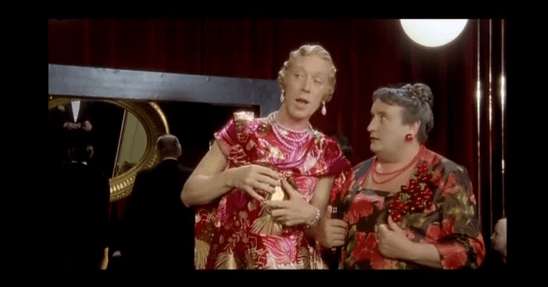
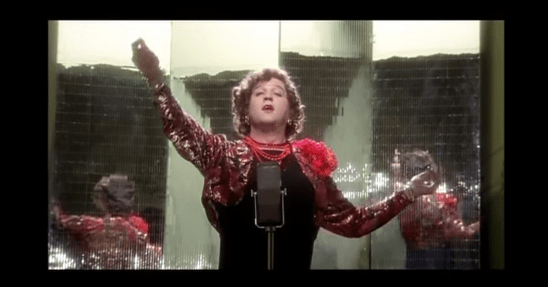
I promise you, you’ve never seen a Shelley Winters performance like this! “Gran Bollito,” otherwise known in the U.S. as “Black Journal,” is a 1977 Italian macabre from director Mauro Bolognini and has for the first time ever been slow cooked to Blu-ray high definition. “Gran Bollito” has been resurrected from the archives of production company Italfrance Films’ with Shelley Winters (“The Poseidon Adventure”, “Lolita”) exploiting her mother’s animal instincts to provide Death with as many souls as she can chop up and boil into a lathery substance. “Gran Bollito” loosely translate as very boiled, a form of murder that would top the charts and these heinous acts were, in fact, inspired by the true, inexplicable story of an Italian serial killer named Leonarda Ciancillui, a soap maker whom sacrificed three women in hopes to protect her war drafted son. Alongside mother mayhem are a trio of cross-dressing actors portraying the three victims; actors such as singer-actor-director Renato Pozzetto, Italian sex-comedy actor Alberto Lionello, and the legendary Max von Sydow (“The Exorcist,” “Game of Thrones”) go full blown drag, donning the period piece’s late 1930s conservative wardrobes while conducting themselves loosely with their intimate and delicate privacies.
screen-shot-2016-12-31-at-10-05-24-pm
As I mentioned, “Gran Bollito” tackles numerous undertones with multiple notations of the horrors of war and the inexplicable amount of death from it as well as from disease, to miscarriages, and to the actual beheadings to sustain a red soap bar factory and food processing plant Lea runs in her custom made kitchen. The Bolognini film also notes many facets of mental illness and health with merely Winters’ topping the psychological pyramid. Conditions consisting of states from a stroke, absentminded dementia, and severe delusions to name a select few are displayed throughout to which almost puts the perception of Lea, or maybe Lea’s perception, one of relative normalcy. Lea’s derangement stems from her fifteen years of pain and suffering through multiple miscarriages. Bolognini very conspicuously has Pozzetto, Lionello, and Sydow portray Lea’s victimized women. They represent Lea’s resentment for their wasteful contributions toward their natural given right to bear children as if the women were merely men without a womb and that strikes a sensitive nerve with Lea who would do anything to give her children life again.
screen-shot-2016-12-31-at-2-43-15-pm
Generally, Bolognini’s constructs a well paced film, seamlessly passing the days, weeks, or months from Lea’s condominium integration to the slow seep that eventually breaks into maddening despair and desperateness. The cinematography by Armando Nannuzzi is soft and lofty that appeases to angelic similarities akin to that of Tinto Brass films, but when the tide turns, her kitchen brights white and Lea is dressed in midnight black as if she’s the Grim Reaper herself. Nannuzzi’s an artist at his trade by enabling Shelley Winters to shed the wholesome of her prior performances and at the same time present a false sense of calm and good fortune. Composer Enzo Jannacci’s score underwhelms when accompanying said Nannuzzi’s style; the score’s flat and breathy tone just doesn’t leave an impression, lacking substance and girth that doesn’t quite fit the Bolognini’s mold. Though acting and performing not in her native country, the St. Louis born Shelley Winters extracts a true life serial killer from off the Italian crime section.
screen-shot-2016-12-31-at-2-44-00-pm
Twilight Time’s “Gran Bollito” is now on a Blu-ray High Definition 1080p transfer presented in a widescreen 1.85:1 aspect ratio. The limited edition release look impeccably detailed, sporting natural coloring and depth. Twilight Time, by far, has the best image quality compared to any release. The Italian 1.0 DTS-HD Master Audio is pretty good with balanced range and clarity in all aspects of audible tracks with only a minor pops in the tracks during transitional scenes. Bonus features include an audio commentary with film historians Derek Botelho and David Del Valte with also the original theatrical trailer. Twilight Time polishes “Gran Bollito” with the respect this obscure Shelley Winters film deserves; a horror-comedy that pushes the limits bordering insanity and disparity in a twisted display of narrative too intriguing to fathom.

“Gran Bollito” on Limited Edition Blu-ray!

Takes Evil to Know Evil. “The Anatomy of Monsters” review!

screen-shot-2016-11-01-at-9-28-21-pm
Timid sociopath Andrew patrons alone at a low-end bar, sipping delicately on straight whiskey and waiting for the perfect opportune moment to approach the right lonely woman. Andrew is not looking for a one night stand. Andrew is on the hunt for a victim, but when the night’s odds don’t seem to be in Andrew’s favor, a lovely young woman approaches him at the tail end of the night and begins to make small talk. After a night of coincided flirting, the woman seductively invites Andrew back to her motel room for some provocative foreplay, but before Andrew can move in for the kill, he suddenly realizes that the woman might just be as more of a sociopath than he could ever imagine by turning Andrew’s moment of a gratifying kill into her tragic tale of a more experienced and assured killer.
screen-shot-2016-11-01-at-7-38-12-pm
Suspense thriller “The Anatomy of Monsters” is the sophomore film from the multitalented writer-director Byron C. Miller and stars Tabitha Bastien, Jesse Lee Keeter, and Connor Marx in a twisted narrative involving love, death, and the struggle between the two. Miller, unfortunately, wrestles to keep buoyant the scope of his story contained as scenes teeter when holding an airtight structure as Bastien’s character, Sarah, asserts her mortal coil. Her plight doesn’t grasp the attention needed to draw in an audience; instead, the back and forth between her present plea with Andrew and her past of leading a double life of affliction with whether to act on her killer instinct with the love of her life or not either passively regresses or just stands completely in place, not moving a motivational inch to take the much needed mile in making us believe in Sarah’s tragic love story and the story is actually, well, tragic by not building the passion between Sarah and Nick, played coyly by Connor Marx, as they just hunker inside Nick’s quaint apartment, affixed to his bed or couch while contemplating their instantaneous love for each other.
screen-shot-2016-11-01-at-9-26-52-pm
A part of the film’s indelicate sting comes from Tabitha Bastien’s performance. Sarah, in the very definition of the character’s persona, is a sociopath which denotes a monotonous person to be without empathy, to have an ice cold demeanor, and to be calculating in their actions. While Bastien epitomizes a sizable amount of emotionlessness, her presentation leans a bit more toward being ingeniously staged, emitting a phoniness that doesn’t naturally crossover. If I didn’t know better, I would have guessed Bastien was a T-100 cybernetic organism underneath a flesh and blood outer layer from “The Terminator’s” apocalyptic bleak future. What Bastien does attribute very well to “The Anatomy of Monsters,” aside from her mechanical display, is a pair of piercingly bright eyes set upon a unique belle face akin to that of the nice looking girl next door you peeping tom on through the cracks of your window shades. Jesse Lee Keeter opposites Bastien with a more genuine approach that favors a Michael C. Hall similarity complete with a kill kit. Keeter’s Andrew is an example of well-written hesitation, exhibiting more of a killer’s struggle to maintain a low profile whereas Sarah leaves nothing to the imagination, baring it all out on the proverbial table with the extreme potency of egocentric cockiness.
screen-shot-2016-11-01-at-8-40-24-pm
Along with Miller’s stationary script, the industrial rocker’s sporadic editing technique can be best described having a short-sighted attention span and his shaky handheld camera visually impairs the viewing pleasure of one monster’s monstrous thirst for death. “The Anatomy of Monsters” feature does play the role of being the quintessential independent product, but without stability and patience, Miller’s artistic craftsmanship suffers heavily from the technical aspects with really the only exception stemming from the minor gore scene during Andrew’s brief description of past murders, committing to a solid neck piece mock-up that realistically seeps blood in order to get the good throat slit shot.
screen-shot-2016-11-01-at-7-25-30-pm
A fond blend of John McNaughton’s “Henry: Portrait of a Serial Killer” and Showtime’s “Dexter,” “The Anatomy of Monsters” is slated for a DVD and Video on Demand release on November 15th from the Philadelphian distributor Artsploitation Films. Certainly a film that’s an attestant to an American-horror, Byron C. Miller explores the corners of the dark and deranged minds associated with serial killers while meddling through the conventional intimate affairs of the masses, spurring an atomically explosive situation from a slowly, simmering boil. Though technically unattractive with arguably underwhelming and sulky performances, suggestions of a greater notion leaves behind an everlasting scar tissue from the necessary urges and the unquenchable desires of a killer can be appreciated.

Watch The Anatomy of Monsters on Amazon Video!

Movie Magic Evil Waters Down Real Evil. “House on the Hill” review!

output_NEYAtv
Based on the true story of serial killers Leonard Lake and Charlie Ng, director Jeffery Frentzen (Black Dahlia) chronicles the speculated portions of Lake’s and Ng’s homicidal and psychopathic murders. Their murderous spree involved kidnapping young women, enslaving them, and eventually murdering them while also targeting their own relatives and friends, and even seizing the opportunities to abduct whole families. After Lake served in the Marine Corps, he met Charlie Ng and by the 1980s, the two men had constructed an isolated house where innocent people were brought to be tortured, ransomed, and eventually their demise at the hands of their materialistic and deviant captors.
vlcsnap-2015-08-08-13h01m52s8
“House on the Hill” is the Jeffery Frentzen directed and co-written with Nicole Marie Polec film that semi-documents the tragic events of Leonard Lake’s and Charlie Ng’s serial killing spree of the 1980s and incorporates actual footage of Leonard Lake speaking about his disturbing views on the world such as enslaving women and being prepared for the inevitable world apocalypse. Most of Frentzen’s movie is embellished as, like the majority of serial killer documentaries, most of what is unknown of Lake will never see the light of truth of what really happened on his ranch. The legend behind Lake and Ng states that there could have been as few as 11 murders or as high as 25; Frentzen attempts to showcase the latter by adding many fictional victims into his film to be representatives to those unknown victims who were never discovered or whose bones were severely untraceable.
vlcsnap-2015-08-08-13h09m19s120
However, some of the facts that are true, that we do know about Lake, didn’t quite make the cut because of Frentzen’s x, y, or z reasons. In the film, Lake’s wife is named Cat played by Rachel Devlin (Zombie Nation), but in reality Lake’s wife name was Claralyn Balazs aka “Cricket.” If Lake’s wife name is clear, why go with “Cat?” Also, Lake had constructed a bunker in the backyard of his ranch, but “House on the Hill” has a separate, well-locked shed in the backyard. Simultaneously, Frentzen’s movie has consistent filming errors that even the untrained eye can catch. Continuity glitches that are obvious (Naidra Dawn Thomson’s bra strap is in various positions between takes on a particular scene) and obvious props that are in more need of a convincing sell from the actors and to be well edited to not give the impression of false intentions. Lastly, the overly generic title doesn’t specifically speak much upon Leonard Lake and his accomplice Charlie Ng. “House on the Hill” title has no curb appeal and no real bite to entice viewership.
vlcsnap-2015-08-08-13h03m47s126
What I did find pleasurable about “House on the Hill” was the leads’ acting. Canadian actor Stephen A.F. Day and first feature film actor Sam Leung do an above mediocre performance of Leonard Lake and Charlie Ng. They manage to show and sell having no empathy when committing terrible acts, managing the ability to embody the evil within a killer on screen. Barring Frentzen’s epileptic editing and use of tints, lenses, and over exposers, I still was able to see the good in Day’s and Leung’s performances without the editing hoopla that attempted to make the events more dramatic, shocking, and traumatizing.
vlcsnap-2015-08-08-13h07m29s46
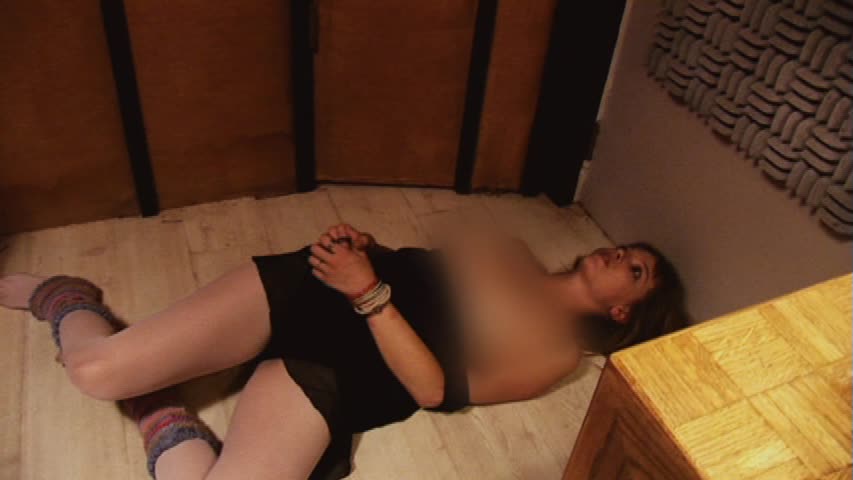
I’m a little disappointed in the distribution of this film. Not only does the jejune title leave a bleak taste, but the DVD cover doesn’t quite represent what is being sold here. On the cover, there is a dirt pathway leading up to a two story, mansion-like structure sitting on top of a hill and seemingly decayed and abandoned. On the DVD backside, a meathook pops right out at you along with a female victim strung up by her arms, screaming toward to the sky. Meathook does not make a credited or on screen appearance nor does the house in the film look like the mansion on the DVD cover. What is even more disappointing, and what I have to comes to term with every now and then, is the heavily edited cut in which “House on the Hill” was released. The DVD cover states, “Warning Explicit Content,” and does show some intense moments containing blood and torture with implied rape. ‘Some’ being the key word because I’ve seen more explicit content on the local evening news. This might be due in part of the post-production censorship which most noticeably focuses on covering up any and all nude scenes. Olivia Parrish’s topless scene was crudely censored by being blurred out and awkwardly cropped to show a low-resolution image, a forced zoom in, of her neck up as she’s being molested. The same cropping censorship goes against Laura Hofritcher’s topless scene as well during her torturous scene.
vlcsnap-2015-08-08-13h02m45s22
The North 40 Production film and MVD and ITN distribution DVD release doesn’t score to well for this reviewer. I’m able to look past the editing techniques, post-production effects, and unbalanced audio, but being a writer and a firm patron of freedom of speech, the censorship of the nudity and potentially the bloodletting has my blood boiling. However, even though Leonard Lake and Charlie Ng may have not been extensively covered on the silver screen or on entertainment television, I am glad Frentzen told partial of the notorious story and was able to tell his rendition of the unknown accounts.

Evil Skips Big Foot Once Again. “Black Water Creek” review!

vlcsnap-2015-01-10-21h18m33s194

Sasquatch is withheld love. Once again. How can the eluding furry beast of the woods get the run around treatment every time being reduced to a cheap, half-assed horror project for amateur filmmakers? “Black Water Creek” doesn’t stray far from the same old, same old big foot bobbling. An on leave cop is reinstated to a cold case when a string of supposed animal attacks leave many dead and many questions unanswered. When the bodies pile up even more, the “animal attacks” are more than meets the eye.
vlcsnap-2015-01-10-21h16m04s235
A shoddy, barebones costume with rubber fingers and stationary face expressions and lack of consistent video editing throughout “Black Water Creek” turns the film incoherent and nearly unwatchable. To finish you must be a masochist. Many characters come and go without explanation and the background ambiance seems to run long and leap onto other scenes that don’t warrant the ambiance. The storyline jumps without seamless cuts. And the deaths scenes are all implied and goreless even though many of the victims have been eviscerated and facially mauled.
vlcsnap-2015-01-10-21h17m21s237
There might be a good reason for the lack of quality costuming and the unclarity comes from the story that Big Foot might actually be a rouse for a backwoods drug dealing and smuggling operation. Big Foot is a disguise to take out the competition and to take out the also greedy drug connections in order to lessen the pot of splitting a $65 million dollar drug profit. Only the two detectives on the case, Shaw and Lisa, stay consistent with their story, but the character are dull, dense, and dreary. More like rookies than true detectives. Or Sasquatch is actually a serial killer as the end suggests that it may very well be the work on a serial killer hacking off faces.
vlcsnap-2015-01-10-21h18m05s160
As “Black Water Creek” progressed, I really wanted to push that off switch, but I powered on. Sucked up the aggravating editing and the hypnotic special effects. I tolerated the cheesy costumes and the implied deaths. I clenched my teeth at the video and audio imperfections and had high hopes for a knock your socks off ending. In conclusion, “Black Water Creek” holds no water, bares no teeth, and Big Foot has yet to be discovered on the big screen. Reality Entertainment’s “Black Water Creek” should have a warning label describing how much of the plot will be a convoluted mess. There are far better worse Sasquatch films out there than this shell of a movie.

Nudity Report

No nudity 😦

black-water-creek