If the Tenants Keep on Dying, Better Get Out of that EVIL High-Rise! “The Case of the Bloody Iris” reviewed! (Celluloid Dreams / 2-Disc Blu-ray and 4K UHD Set)

Own Your 4K and Blu-ray copy of “The Case of the Bloody Iris” today!

A pair of beautiful women are heinously murdered in a respectable high-rise apartment building.  As the case remains unsolved, a real estate architect, Andrea Antinon, is looking for models to market his new property, happening upon models Jennifer Langsburgy and Marilyn Ricci during his photographer friend’s photoshoot, and entices them by offering a sublet of the now vacant apartment in the building where one of the girls was murdered.  Jennifer, who finds herself slowly falling for the Andrea, is stalked by her polyamorous sect past and the group’s leader, her ex-husband, Adam who refuses to let her go and while he proves himself dangerous, attempting to kill Andrea after one of his dates with Jennifer, Adam is found dead in her new apartment.  The suspect pool grows as police are continuing to be baffled by an elusive killer remaining at large and set their sights on Andrea with his brief connections in two of the three victims.  Evidence against Andrea swells as those around Jennifer wind up dead and she’s next on the kill list. 

“The Case of the Bloody Iris,” the Iris represented as the delicately beautiful flower that symbolized the bound between Jennifer and her deranged, sex cult ex-husband Adam, is the 1972 giallo thriller from the prolific spaghetti western, Italian director Giuliano Carnimeo (from the previous “Sartana” series and would later helm “The Exterminators of the Year 3000″) and prolific giallo screenwriter Ernesto Gastaldi (“Your Vice is a Locked Room and Only I Have the Key,” “Torso,”) shot in the city of Genoa doubling as Milan.  Full of eccentric suspects, taboo desires, and handsome principals, “The Cast of the Bloody Iris” is a very attractive, violent, and superbly shot whodunit.  Under the original native title of “Perché quelle strane gocce di sangue sul corpo di Jennifer?” aka “What Are Those Strange Drops of Blood on the Body of Jennifer?” Galassia Films serves as the production company with Luciano Martino (“The Strange Vice of Mrs. Wardh”) having produced the giallo. 

The story floats back-and-forth between a pair of co-headlining stars, one of them being the retrospective cult and sex icon actress Edwige Fenech in one of her earlier performances, and who has starred in “Strip Nude for Your Killer” and “The Strange Vice of Mrs. Wardh.  Co-star George Hamilton also stars in that latter giallo, reteaming the handsome-faced “The Case of the Scorpion’s Tail” actor born in Uruguay, and whose birth name is Jorge Hill Acosta y Lara, with Fenech in their respective roles of model Jennifer and architect Andrea intertwined into what is a romantic tale of love at first sight that becomes mangled by a crazed killer on a murder spree and they’re at the heart of the matter.  If revisiting Giuliano Carnimeo, comedies and watching some of his interviews, you can see why he folds in subtle comedic elements that doesn’t allow “The Case of the Bloody Iris,” or a good chunk of his credits, to be a totally engaged, heart-racing murder mystery; those comedic elements come in the form of bumbling police, a too dead-set on commissioner (Giampiero Albertini, “Commandos”) and his more ungainly assistant (Franco Agostini, “The Sex Machine”), who are always one step behind and in the wrong direction.  The juxtaposition may be too evident yet it’s also welcoming, breaking up the forbidding business with a little levity, and creates a backend sense of assurance knowing police, just like today, can be human and clueless on serious natured instances.  The suspect pool and other salient supporting principals include Paola Quattrini as Jennifer’s roommate Marilyn (no doubt based loosely on Marilyn Monroe), Ben Carra as Jennifer’s sex cultist ex-husband, Jorge Rigaud as the professional violinist neighbor, Annabella Incontrera as the professor’s lesbian daughter, Oreste Lionello as a sleazy photographer, Carla Brait as a nightclub’s dominating femme, and Maria Tedeschi as the unfriendly neighbor.

Even though giallos did not appeal to him nor did they really become a staple of his oeuvre, director Giuliano Carmineo had a different perspective than most and that closely aligns with masterclass filmmakers like Dario Argento.  Carmineo and cinematographer, who’ve collaborated previously on a pair of Sartana westerns, had purpose in their odd and first person camera shots and movements, such as laying the camera down and sideways as characters perform routine events before being attacked or looking up and doing a 360-degree turn as if scanning a stairway, that coincided with the usual first person perspective of the conventionally masked and gloved killer wielding a deadly blade.  The technique engages the viewer, as in a sort of tell that something is about to happen or is amiss in a scene to create breath holding, heightened anxiety, but the multi-faceted narrative itself doesn’t need assistant in keeping viewers glued to the edge of their seats with the eclectic mix of sultry and taboo eroticism, lampooning the authority figures, designed seamless red herrings, unique characters, a variety in murder, and an elaborate, mysterious complexity that’s downright deviant. 

If you’re a distributor looking to shoot your shot on your first release, new boutique physical media label, Celluloid Dreams, hit the bullseye with a 2-disc 4K UHD and Standard Blu-ray release of “The Cast of the Bloody Iris” on a HVEC encoded, 2160p resolution, 100 gigabyte 4K UHD and on an AVC encoded, 1080p, 50 gigabyte Blu-ray, scanned and restored brand new in 4K on a pin-registered Arriscan from the film’s original 2-perf Techniscope camera negative, and presented in the original widescreen aspect ratio of 2.35:1.  Coloring grading and restoration is noted on the interior insert being entirely completed by Celluloid Dreams Studios to remove all the celluloid and age imperfections and stimulate a vivid, vibrant picture quality and, by the giallo-Gods, this has to be one of the more flawless image presentations I’ve seen on 4K and Blu-ray in a very long time, or ever!  Meticulous precision techniques reveal a straight from-farm-to-table quality, organic for its era with a balanced, natural grain and color saturation.   Details have delineated trim and higher contrast leveling where appropriate for darker scenes, such as an unilluminated bedroom or a basement boiler room, that retains the rich inkiness of the negative space.  No signs of compression issues in the negative spaces as well and no signs of unnecessary enhancing.  Two, lossless audio options are available for selection:  an Italian 1.0 DTS-HD and an English 1.0 DTS-HD.  Both remastered tracks from the optical sound negative provided full fidelity through the single channel.  Concise and crisp dialogue renders through in full, robust effect with ample detail in the ambience and depth to create a dynamic space.  No hissing, crackling, or popping in the ADR dialogue or ambient tracks and swanky tuned by Bruno Nicolai’s multi-instrumental base, drum, sintir-like guitar, and more score.  English subtitles are available on the Italian track.  With the larger capacity on the UHD, both formats are able to handle the included three featurettes with star George Hilton, principal actress Paola Quattrini, and director and writer, Guliano Carnimeo and Ernesto Gastaldi in Italian language.  Also included is a new commentary track from film critic and Celluloid Dreams co-founder Guido Henkel, an outtake reel that extend out certain scenes, photo gallery, the original Italian Opening Credits that beginning of the feature, and Italian and English theatrical trailers. Inside a dual-sided cardboard slipcover with both the feature’s baptized titles and illustrated cover art representation of Edwige Fenech, the black 4K UHD Amaray case possesses a second and more fleshy-erotic illustration of Fenech. The same art and arrangement are on the reverse side but with the Italian title. Each disc is housed on either side of the interior snapped firmly on a press-lock on with a release acknowledgements and an advert for their next physical feature, “La Tarantola Dal Ventre Nero” aka “Black Belly of the Tarantula.” The region A playback release has a runtime of 94 and is not rated.

Last Rites: Showing such diligence in the restoration efforts, Celluloid Dreams is the new kid on the block, the promising young boutique label with the Midas touch, with a killer first presentation in “The Case of the Bloody Iris.” We can’t wait to see more!
Own Your 4K and Blu-ray copy of “The Case of the Bloody Iris” today!

Who Let EVIL Out of the Bag? “The Catman of Paris” reviewed! (Imprint / Blu-ray)

Meow!!  “The Catman of Paris” is on the Prowl on Imprint Blu-ray!

From rags to riches, writer Charles Regnier pens one of the most popular and polarizing books of France.  Titled Fraudulent Justice, the subject matter coincidently contains secret court case information in it’s text.  Regnier stands firm his book is creative fiction while the French government think otherwise.  When a government agent of the Ministry of Archives, carrying the detail accounts of the case to be reviewed, is found slashed to death and the case file missing, the police naturally suspect Charles Regnier while also another, eccentric police theory circulates of a monstrous cat person.  Regnier, who suffers from headaches and blackouts from a tropical fever he contracted during his two year travels away from Paris, begins to suspect himself as the deranged killer on the loose, attacking and killing those around him.  Without a solid alibi and the unknown from his blackout memories, Regnier evades the police by hiding with his darling lady friend, Marie Audet, but when the headaches begin and Regnier conscious slips into a strange darkness, will he let the cat out of the bag to strike again?

Let’s travel back in time to 1946, just after the Great Second War, when the movie industry rolled film once again and take a pawing look at Lesley Selander’s shapeshifting film noir “The Catman in Paris.”  Though story set in Paris, the black and white horror film helmed by “The Vampire’s Ghost” director is a United States product shot on location at the Republic Productions studios in Los Angeles, reusing and transforming many of the company’s stout storage of Western set pieces into Parisian milieus.  From the spittoon saloons to high end restaurants and from dusty stagecoaches to redesigned aristocrat carriages, Republic Pictures aimed to take transformative risks in order to hop on the Val Lewton and his 1942 “The Cat People” success train while making statements of his own from a Sherman L. Lowe (“Valley of the Zombies”) script.  “The Catman of Paris” is produced by Belarus expat Marek Libkow who fled Europe because of World War II but the feature would be his last producing feature.

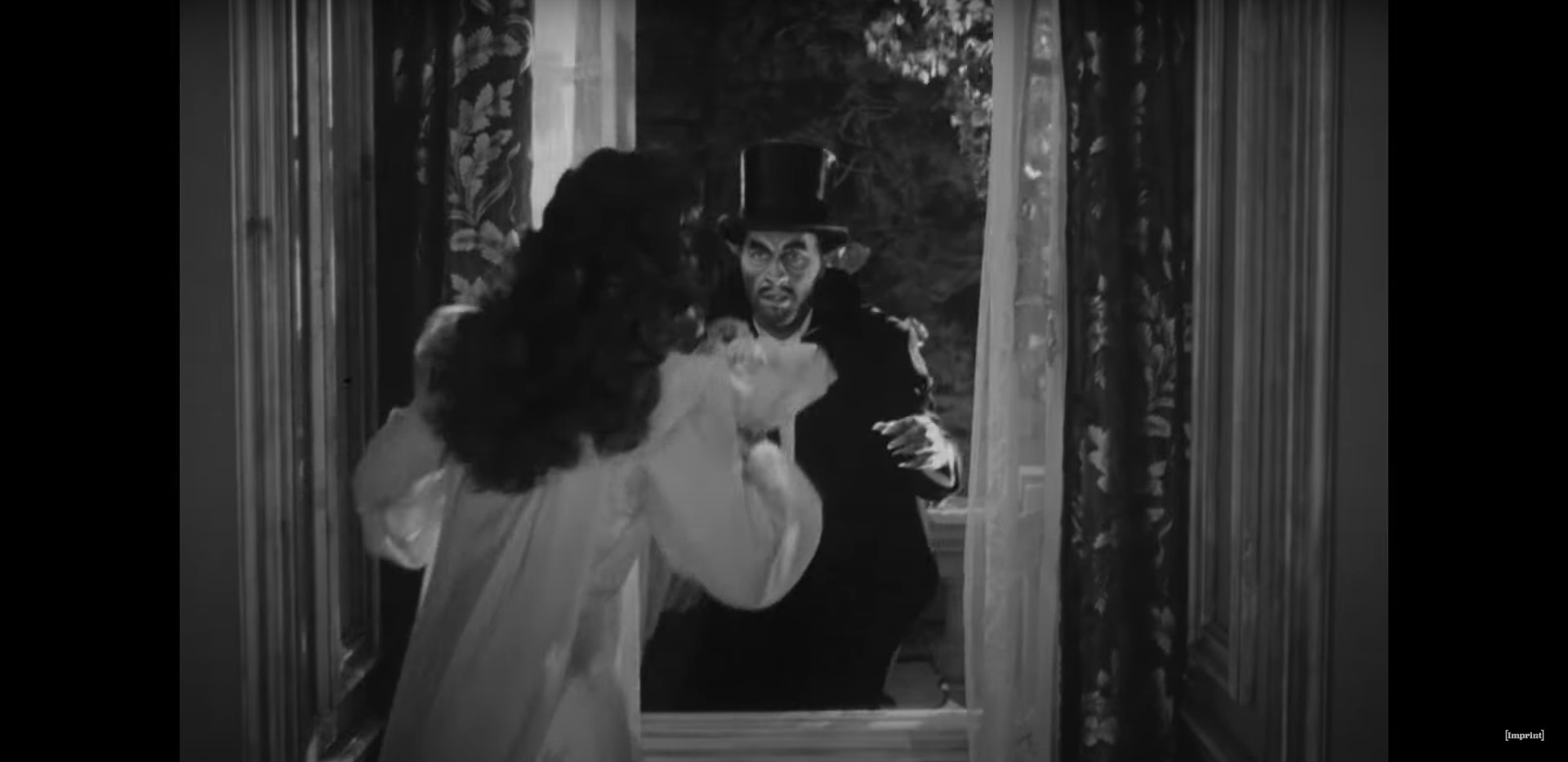
In the ambiguous role that puts into question his sanity and his humanity is the Austrian actor of “Slave Girl,” Carl Esmond.  Esmond plays the rift creating writer adored by the public and despised by the government, driving him back into a corner of continuous defense of his work that has been argued to be plagiarized form secret documents and unlawful for the access of aforesaid secret documents regarding a controversial court case decades prior. On his tail is a paranormal receptive prefect of police (Fritz Feld, “Phantom of the Opera” ’43) and a more pragmatic inspector named Severen (Gerald Mohr, “The Monster and the Girl”) who, based on little-to-no evidence, immediately suspect the writer by affiliation to the court case he could in no way possible have known. This dichotomy of theory doesn’t affect the prime suspect, doesn’t seep into a larger suspect pool, and keeps the investigation status quo up until the revealing finale, but the police state characters have subjectively targeted Regnier with all but a harassment mentality, adding to Regnier’s conflicted dismay about the association between the killings and his disassociation with consciousness – which is visualized by a series of random, inverted images of a gusty barren tundra, a buoy gushing ocean water, a dark and cloudy moon, and a black cat’s eyes at the center. Regnier finds comfort in the bosom of Marie Audet (Lenore Aubert, “Abbett and Costello Meet Frankenstein”) over his finance (Adele Mara, “Curse of the Faceless Man”) and in his promised fickleness, broke her heart before falling victim to the cat’s claw in a metaphoric gesture of aggressive sexual assault. The whole love triangle is loosely adhesive to “The Catman of Paris’s” integral entanglement of un-kittenish affairs. In fact, Regnier is very kittenish with Marie to the point that his engagement appears to be frivolously made and has locked him into an inescapable promise because of emasculating masculine posture. Instead, the writer could care less about his word, or rather conveniently forgets, as he plays footsy with the girl of his dreams. “The Catman of Paris” rounds out the cast with Douglas Dumbrille, Francis Pierlot, and Georges Renavent.

Long thought derivative of Val Lewton’s “The Cat People’s” success, Republic Pictures challenges the perspective with a cattier fracture of manhood, putting the main protagonist of their own cat person horror, “The Catman of Paris,” through the whiskery wringer of test and tribulations of harboring suspicions about oneself. Charles Regnier has seen the other side of the tracks. For all intents and purposes, Regnier was a nobody who suddenly rose to respect and wealth in the eyes of the general public with the stroke of a pen for creative thought to formulate an enthralling story, out of the fabric of his own mind he assumed he wrote. Yet, his work of fiction has also become a sign of guilt, suspicion, and unlawfulness in the eyes of the authorities. If the weight of the government isn’t burdensome enough, Regnier is also divided with personal doubt when a killer’s bodies pile during his time spent in a stint of amnesia and all of evidential signs point in his clueless direction. The more dire latter echos his former self in a subconscious belief that he isn’t his true self, such as with imposter syndrome in which he questions his current, more affluent status and fame with being contributed by a darker, murderous side, perhaps a sign of his impecunious past. The story has Regnier averting decisions to marry into opulence when he really just wants to continue his fervent pursuit of his publisher’s daughter, a sign that now he’s worth a pretty penny, he can muster enough confidence to chase after the woman of his dreams and still feel grounded to the common people despite is sudden wealth. At one point in time, “The Catman of Paris” was a harrowing horror tale with fantastic prosthetic cat features, a decent carriage chase and crash sequence, and a whodunit mystery quencher for the masses, but, for today, the 1946 is about as antiquated as they come like most of “The Golden Age of Film” features with a one-note suspense narrative and a monotone melodrama that’s imposing and frank without a lot of flair. I will say one thing about “The Catman of Paris'” twist ending is it’s not easily reckoned as Selandar has beguiling direction to pile on guilt to the point that audiences will have to submit to the director’s feline frisky hokum.

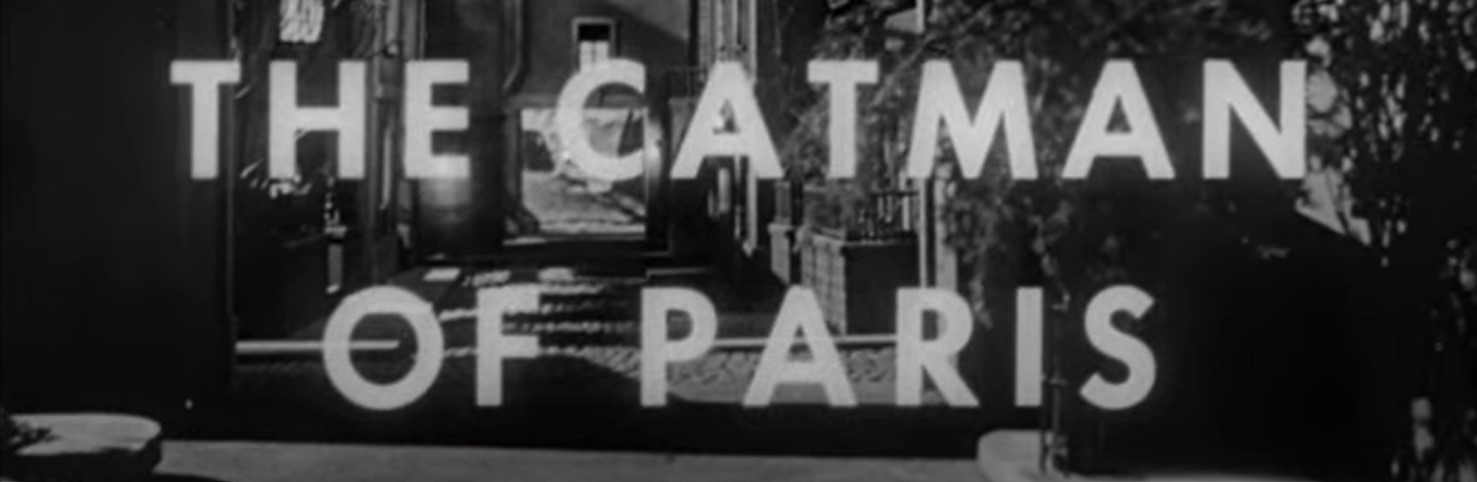
A part of the Imprint Collection, coming in at #219 on the spine, is “The Catman of Paris” on an Australian Blu-ray release. The limited edition high-definition release is AVC encoded on a single layer, BD25. The 1080p Blu-ray presentation comes from a 2017 4K scan of the original negative and is presented in the Academy ratio of 1.37:1. The original print material has sustained a few visible marks of infrequent vertical scratch damage, minor dust and dirt, total loss single frames, noticeable cigarette burns, and wavering levels in grayscale and contrast stability during edit transitions. Yet, there’s still a richness of the black and white image for the majority that refuses to fold outside the competent restoration attempt that gives dimension to a nearly 80-year-old film. The overall picture is a solid pass above par as it’s likely the best we’ll ever see in our time. The English language LPCM 2.0 mono track crescendos with a run of the mill brass band score overtop a quite clean dialogue track. Sure, the unmitigated track is slightly sullied by a consistent yet unimposing shushing with sporadic, stifled popping; however, there are no major issues with the mix and the dialogue through the dual channel is clean and distinguishable. Optional English subtitles are available. Special features include a new audio commentary track feature film historians Kim Newman and Stephen Jones, an oldfangled feature length documentary running through the cinematic history of stills and video clips from Republic Pictures The Republic Pictures Story, and a film historian Kat Ellinger video essay entitled Mark of the Beast: Myth Making and Masculinity in The Catman of Paris. Imprint’s tangible package is eye catching with color-washed front cover image on a thick cardboard side-slipcase; the illustration is pulled from one of the feature’s various marquee posters. Inside the slipcase, a character composition mockup includes the menacing Catman at the forefront with Regnier and female principals frozen in fear. The Imprint release runs at a slim 64 minutes, is unrated, and has a region free playback. “The Catman of Paris” is in servility of early Cat People productions but stands on its own two, or rather four, feet with an entrenching murder mystery that can keep you anthropomorphically guessing.

Meow!!  “The Catman of Paris” is on the Prowl on Imprint Blu-ray!

EVIL Inspires a New Concert. “Nightmare Symphony” reviewed! (Reel Gore Releasing / Blu-ray)

“Nightmare Symphony” is a Falsetto of Praise for Lucio Fulci.  Purchase the Blu-ray Below!

Unable to cope with another large box-office failure, the American indie horror director, Frank LaLoggia, is in the travails of a make-or-break psychological thriller overseas in Kosovo.  With an executive producer forcibly pulling LaLoggia’s creative marionette strings and the film’s screenwriter displeased and disapproving LaLoggia’s arm-twisted version of the story, the struggling director finds himself frantic and in the middle of a breakdown caught between a rock and a hard place with a postproduction from Hell.  Those around him, the conceited producer, the upset screenwriter, the pushy wannabe actor, and more, are being hunted down and brutally murdered by a masked killer and the imaginary line between Frank’s reality and paranoia grows in intensity coming down the wire of completing his career-saving, or rather lifesaving, film.

Long time since I’ve heard the name Frank LaLoggia enter the dark corners of my brain as it relates to the horror genre.  The director of 1981’s “Fear No Evil” and 1995’s “Mother” had seemingly vanished from the director’s chair spotlight and more-or-less, or rather more so than less so, vanished from the broader film industry altogether.  Then, Domiziano Cristopharo’s “Nightmare Symphony” suddenly drops on the doorstep and there’s Frank LaLoggia, starring in the lead role of an Italian horror production.  Domiziano, known from his entries of extreme horror, such as with “Red Krokodil,” “Doll Syndrome,” and “Xpiation,” engages LaLoggia to act in an unusual role, as himself, and turns away from the acuteness depths of uber-violence and acrid allegories to a toned down, more conventionally structured, narrative inspired by the Lucio Fulci psychological slasher “Nightmare Concert,” aka “A Cat in the Brain.” Co-directed with first time feature director Daniele Trani, who also edited and provided the cinematography, and penned by the original screenwriter of “A Cat in the Brain,” Antonio Tentori, “Nightmare Sympathy” plays into questioning reality, the external pressures that drive sanities, and weaves it with a meta thread and needle. The 2020 release is produced by Coulson Rutter (“Your Flesh, Your Curse”) and is an Italian film from Cristopharo’s The Enchanted Architect production company as well as companies Ulkûrzu (“Cold Ground”) and HH Kosova (“The Mad MacBeth”).

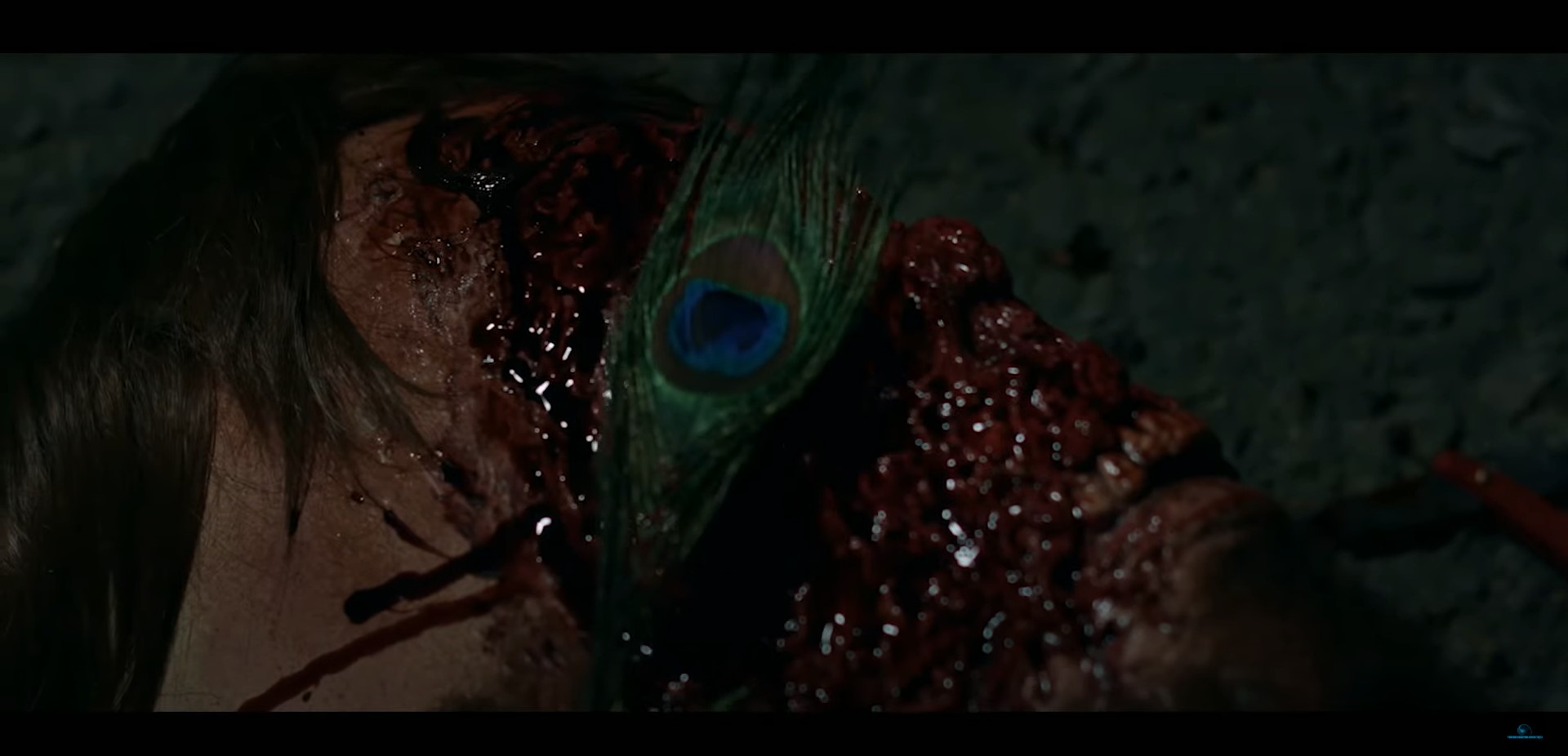
Much like “A Cat in the Brain,” Frank LaLoggia depicts his best Lucio Fulci representation as a horror filmmaker whose storyline production mirrors the individual slayings surrounding him. As a character, LaLoggia is not entirely aware of the murders as the peacock headed slasher’s string of sadism runs parallel to LaLoggia’s post-productional workload. Cristopharo pays a simultaneous tribute to not only Fulci but also LaLoggia with a built-in brief, off-plot moment of the editor, Isabella, a good friend and longtime partner of LaLoggia, running a reel of “Fear No Evil” to reminisce over his debut picture. Antonella Salvucci (“Dark Waves,” “The Torturer”) plays Isabella but also LaLoggia’s pseudo film lead actress Catherine in a dual role performance with the latter marking Salvucci’s topless kill scene that hits and sets up the giallo notes. Isabella denotes the director’s only real friend with everyone else, from the screenwriter to the executive producer, push their own self-gratifying wants onto the American filmmaker from all angles. A vulgar herd of personalities descend upon LaLoggia to exact their strong-willed ideas on how the film should appear and be marketed. From the screenwriter Antonio (Antonio Tentori, ‘Symphony in Blood Red”), the imposing desperate actor David (Halil Budakova, “Virus: Extreme Contamination”), to the uncultured and pushy executive producer Fernando Lola (Lumi Budakova) and his aspiring actress Debbie (Poison Rouge, “House of the Flesh Mannequins”), they all look to exploit LaLoggia’s modest career for their own benefit. Performances vary with a range of experience, and we receive more noticeably rigid recites and acts from the Kosovo cast in a clashing pattern with the Italy cast that has worked with Cristopharo previously. Ilmi Hajzeri (“Reaction Killers”), Pietro Cinieri, and Merita Budakova as a chain-smoking lady stalker that has glaring eyes for Frank LaLoggia.

While not necessarily thought of as a remake, “Nightmare Symphony” is certainly a re-envision of the Fulci’s “Cat in the Brain.” What Cristapharo and Trani don’t quite well connect on is connecting all the pieces of the psychotronic puzzle together into what is meant to be expressed. The giallo imagery is quite good, a praise of the golden era period in itself, with a mask and glove killer, the closeup of gratuitous violence, most of the score, and the stylistic visuals imparted with ominous shadow work, foggy and violent dream sequences, and with congruous cinematography and editing of earlier giallo. Plus, audiences are treated to not only the aforementioned Antonio Tentori, screenwriter of “Cat in the Brain,” but also have composer Fabio Frizzi score the opening title. Frizzi, who has orchestrated a score of Lucio Fulci films, such as “Zombie,” “The Beyond,” “Manhattan Baby,” and even “Cat in the Brain” just to select a few notable titles, adds that proverbial cherry on top to evoke Fulci directing “Nightmare Symphony” vicariously through Cristapharo and Trani. There are some questionable portions to reimagining’s take on the original work that are more the brand of the contemporary filmmakers. The presence of death metal prior to one of the kill moments puts the overall giallo at odds with itself in a fish out of water aspectual scene composition. Another out of place component are the external characters that are not directly involved with LaLoggia’s peacock-head themed slasher; the ironical venatic of an animal hunting down people is the reversal of a Darwinism theory that instead of sexual selection, the beautiful and elegant peacock forgoes using grace to attract and aims to survive by natural selection and thus the killer kills to remain alive. However, the story and the directors never reach that summit of summation and with the oddball characters adrift from the core story – such as the stalking woman and the eager actor – “Nightmare Symphony” flounders at the revealing end with its severe case of blinding mental delirium.

With a cover art of an upside skull overfilled with film reels and unfurling celluloid through the soft tissue cavities, “Cat in the Brain” continues to be reflected in “Nightmare Symphony” up to the release’s physical attributes on the Reel Gore Releasing’s Blu-ray. Presented in on a AVC encoded BD25, with a high definition 1080p resolution, and in a widescreen 2.35:1 aspect ratio, the Reel Gore Releasing espouses the Germany 8-Films’ Blu-ray transfer for a North American emanation, which might explain some of the complications with the bonus features that’ll I’ll cover in a bit. Situated in a low contrast and often set in a softer detail light, “Nightmare Symphony” doesn’t pop in any sense of term with a hazy air appearance and a muted color grading that goes against the giallo characteristics, especially when the clothing and set designs have the same desaturation or are colors inherent of low light intensity. Despite appearing like a slightly degraded transfer on a lower BD storage format, compression issues are slim-to-none with artefacts, banding, or blocking and this results in no tampering edge enhancements or digital noise reduction. The release comes with three audio options: A German DTS-HD 5.1, German DTS-HD 2.0 Master Audio and an English and Italian DTS-HD Stereo 2.0 all of which are Master Audio. The German audio tracks are a dub from the 8-Film Blu-ray and the 5.1 offers an amplified dynamics of the eclectic soundtrack and limited environment ambience. Dialogue remains outside the dynamics on a monotone course but is clean and clear with good mic placement and a neat, fidelity fine, digital recording. The German dub has a distinct detachment from the video because of its own layer environment, sounding a little sterile than the natural English or Italian, but works well enough as expected with the supplement multi-channel surround sound. English SDH and German subtitles are optional. Bonus contents feature a behind-the-scenes which is entirely just a blooper reel, an English language interview with co-director Domiziano Cristopharo whose secondary language is English, the original soundtrack playlist, and the teaser and theatrical trailer. I mentioned an 8-Films’ transfer complication with the bonus content because there’s is also an interview with Italian screenwriter Antonio Tentori that’s only in German dubbed and subtitled with no option for English subtitles or dub. When you insert “Nightmare Symphony” into your player, an introductory option displays to either pick German or English and I considered this to be the issue for the German only interview with Tentori; however, that is not the case as both country options are encoded in German for the interview, so at the beginning option display, I would recommend the German selection because the setup will have contain all audio options for the feature whereas the English selection will only contain the English 2.0. Reel Gore Releasing’s Blu-ray comes housed in a red snapper case, the same as the company’s release of “Maniac Driver,” and has a less tributing reversible cover art with more revealing and illustrated aspects of the narrative. The release is region free, unrated, and has a runtime of 78 minutes. Another little fun fact about the release is the incorrect spelling of the director’s name on the back cover that credits his surname as Christopharo instead of Cristopharo. Influenced by Lucio Fulci beyond a shadow of a doubt, “Nightmare Symphony” proffers the Horror Maestro’s less notable credit with a companion piece that punctuates both films love for the giallo genre, love for the violence, and love for the morbidly unhinged human condition.

“Nightmare Symphony” is a Falsetto of Praise for Lucio Fulci.  Purchase the Blu-ray Below!