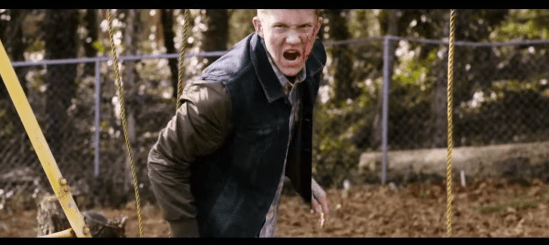
Elliot, Sasha, and John move into an old manor home just off the university’s campus. The tight knit three friends stumble upon a tattered nightstand with scribbled nonsense inside the drawer and underneath the incoherent writing and scratched into the wood is The Bye Bye Man. Once you hear the name, a searing imprint has been made into the mind, opening up a layer within the universe that invites a grim reaper-like figure to come horrifically collect individuals who have been infected with the name. The mysterious malevolence will impose hallucinations, or tricks, upon the mind to induce others to commit evil acts on another and will stop at nothing until those who know his name are either end up dead or spread his vileness. For Elliot, Sasha, and John, their close relationships will be tested, they’re bodies will be challenged, and their minds will be altered in a race against the clock in order to beat death, to defeat The Bye Bye Man.

“The Bye Bye Man” is an Universal Pictures and STX Entertainment distributed boogeyman concept from 1995’s “The Last Supper” director Stacy Title. Title, who hasn’t been active for about ten years since her last directorial, helms the project written by her husband, an appropriately named Jonathan Penner, who also had a co-starring role in “The Last Supper.” The inspiration stems from a collection of horrific tales from Robert Damon Schneck’s “The President’s Vampire: Strange-but-True Tales of the United States of America,” but “The Bye Bye Man” borrows heavily from well-crafted horror brethren too, birthing a mythological personification of death that doesn’t wield a scythe, but rather being a master, underneath a dark hooded cloak, to a hellish beast that munches on the faces of The Bye Bye Man’s victims. “A Nightmare on Elm Street,” “Final Destination,” and a little bit of “Scream” become the selected examples that are the genetic makeup of TItle and Penner’s film, but doesn’t grossly rip from the said works, two of which are the late Wes Cravens masterpieces. Instead, Jonathan Penner reconfigures the nightmare man, a modern day Freddy Krueger type stalking every soul during the day and night hours, whom establishes his own brand of Rube Goldberg deaths through deadly vision inflictions that pray upon a human’s moral subconscious. “Don’t say it. Don’t think it” sets as the 2017 film’s tagline with the notion that perhaps little white lies are, literally, lifesavers or that the truth can be hurtful, and or knowledge can be powerful, but can also lead to your own demise.

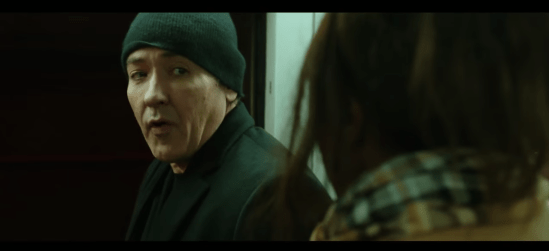
“Ouija’s” Douglas Smith succumbs to his lead role of Elliot, an educated and patient young man who seems to have everything despite tragic misfortune that’s whisked through the character development. From friends, to a supportive brother, to a loving girlfriend, Smith transition seamlessly to languishing burden during a spotlight scene with co-star Carrie-Anne Moss (“Matrix”) that’s raw and cuttingly empathetic. The story centers around Elliot, but Sasha and John have pivotable relationships to Elliot, two essential roles given to two British actors, former girl of Prince Harry, Cressida Bonas, and television actor Lucien Laviscount. Both Bonas and Laviscount expensed drab performances, mechanically and, often, monotonically coming and going from scene-to-scene without mingling well into the rest of the film’s grim and dire trimmed overalls that basically left Smith out to pick up the slack. Along with Carrie-Anne Moss, who always seems to be typecast in a women of power role and, in this case, a detective, “The Bye Bye Man” sports other veterans of both horror and general film, but; instead, take a backseat to a younger generation of actors. “HellBoy’s” Doug Jones silently strolls through one of the easiest prosthetically garbed performances of his illustrious career as the titular character, genre stable Leigh Whannell (“Saw”) commits to a haunting performance as a murder-suicide martyr, and the legendary Faye Dunaway portrays a longtime widow of the aforementioned madman. Michael Trucco (“Wishmaster 4: The Prophecy Fulfilled”), Jenna Kanell, Cleo King (“Hood of Horror”), and Erica Tremblay round out the supporting cast.

Universal picking up a horror title resembling an infantile kids feature and releasing it theatrically might with relatively unknown, mostly non-American cast, will scratch some questioning heads, but with a well oiled supporting cast consisting of many years of guild service, a director, despite being inactive for many years, maintaining a sensible and visionary eye, and a story, aside from a few underdevelopments, that captivates with edge of your seat scares and with next moment eagerness, “The Bye Bye Man” has great potential. With smoothing out details of Elliot’s and The Bye Bye Man’s backstories and construing more of a slow burn method when getting the characters involved with the ‘don’t think it, don’t say it’ villain name, Universal would have increased their gross profits by double and the world would be happy once again. Unfortunately, that scenario was not the case as credits bombarded “The Bye Bye Man” as about as borrowed and as hokey as any low-budget horror film can be, but “The Bye Bye Man” surpassed the production budget by triple and to me, someone who generally has the same stance as most credits, that’s a win for Stacy Title and company.

The Intrepid Pictures and Los Angeles Media Fund production “The Bye Bye Man” makes a Universal Pictures Home Entertainment debut on a two-version unrated Blu-ray and DVD combo. The MPEG-4 AVC, 1080p Blu-ray disc contains a razor sharp image in the 1.85:1 presentation. Depth and shadows phenomenally define the space, especially in closer quarters and the ariel shots. A motif of bleak black and grim grey is consistent throughout, creating a tone through the darker shades, with vivid hues to gloriously fend for themselves amongst the achromatic reel landscape. The English DTS-HD Master Audio 5.1 surround sound doesn’t feign in the balance category with dialogue prevalence not short of excellence and, much like other atmospheric horror, the spooky elements are outlined in various levels from a coin dropping to a train horn. Bonus features are surprisingly zilch with no extras on either format; I guess there wasn’t much to say during or post-film. In all, “The Bye Bye Man” is a total hack with plot holes. A completely borrowed and revamped product with a terribly childish title promising nothing to the genre, but that doesn’t necessarily mean “The Bye Bye Man” can’t be entertaining, providing a wicked sense of humor and a morbid final destination outlook with unexpected casting choices and a barely bordering PG-13 horror rendering.
Tag Archives: Suicide
Mysterious Evil Destroys Small Village Families. “The Wailing” review!
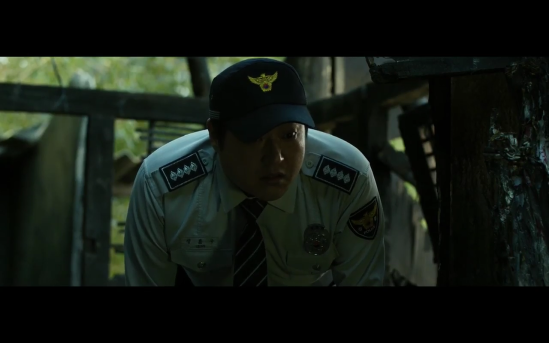
In a small South Korean village, tight-knit families practically know one another in the quaint middle-class community. When mysteriously deadly destructions from inside local families and strange stories of animal carcass devouring creatures in the woods surface, local police sergeant Jong-Goo begins an investigation to connect a pattern of violence and superstition and at the center of it all is a suspicious and reclusive Japanese traveller. Bound by the law and an overall lack of courage, Jong-Goo proceeds to investigate with extreme caution, but when his young daughter, Hyo-jin, becomes subjected to the same symptoms that overtook destroyed families from within, the desperate father sets aside rules and regulations and uses threats and force when visiting the Japanese Stranger, whose rumored to be an evil spirit that’s plaguing the small village with terror and death.

By far, “The Wailing” sets the precedent on folklore horror. Acclaimed writer-director Hong-jin Na lands a harrowingly ambitious, well-constructed film right into the lap of horror fans with “The Wailing,” known also as “Goksung” in the film’s country of South Korea. South Korean filmmakers have once reestablished proof that foreign films can be as masterful, as bold, and as elegant when compared to any other film from major studio productions. Hollywood has started to come around by remaking one of South Korea’s most notorious films, the vengeful thriller “Oldboy,” and seeks to remake recent international hits in “Train to Buscan” and “I Saw the Devil.” Lets also touch upon that top Hollywood actors are beginning to branch out to South Korean films. “Captain America” star Chris Evans had obtained a starring role in Joon-ho Bong’s “Snowpiercer” alongside co-stars Ed Harris and the late British actor Sir John Hurt. “The Wailing” will reach similar popularity being one of 2016’s most original horror movies and one of the more unique visions of terror to clutch the heart of my all time favorite’s list.

Do-won Kwak stars as Sergeant Jong-Goo, a officer who avoids trouble at all costs and has no motivation to be on time for anything. Kwak, basically, plays the fool character, comically going through the routine of investigating brutal murders complete with stabbings, burnings, and hangings despite his Captain’s constant chastising and seizes every opportunity to act dumb and look stupid, but once the story starts to focus “The Wailing” as nothing more than an offbeat black-comedy, Hong-ja Na devilishly about-faces with a severe turn of events that’s a mixed bag of genres. Kwak no longer plays the lead role of comic relief; instead, a more self-confident Sergeant Jong-Goo takes control of the investigation as the deeper he finds himself involved in the dark plague that’s ravaging his village. He hunts down the Japanese Stranger, the debut South Korean film for long time Japanese actor Jun Kunimura (“Kill Bill,” Takashi Miike’s “Audition”) with a zen like aurora that’s enormously haunting to behold and captivating when his presence is lurking amongst the scene. Though Kunimura’s demeanor contrasts with other actors, he’s very much in tune with the dynamic, but it’s the maniacally, foul-mouth ravings of Hyo-jin, played by Hwan-hee Kim, that stand out and are the most distraught during her possession state that could give “The Exorcist” a run for it’s money and is a visceral vice grip to the soul that has to be experienced. Woo-hee Chun and Jung-min Hwang round out the cast in their respective and memorable co-starring roles as a peculiar no named woman and a flashy shaman.

“The Wailing” incorporates various folklore stemming from cultures all over the world including the Koreas, China, Japan, and even from China’s bordering neighbor Nepal and meshes them with religious practices of Buddhism to even the far corners that the Catholic faith possesses. The luxuriant green South Korean mountain backdrop sets an isolated, ominous cloud over a beautiful and serene archaic village, an awe-inspiring juxtaposition created by cinematographer Kyung-pyo Hong that coincides with the complete dread piercing through the heart of the story; a perspective vastly opposite to Hong’s works in the previously mentioned “Snowpiercer” that’s set in the tight confines of a class dividing bullet train. “The Wailing” bundles together mythos with visionary concepts and landscapes in an epic mystery-thriller that’s unforgettable; it will cling to you, like a evil-dwelling spirit, well after the film is over.

20th Century Fox, in association with Ivanhoe Pictures and Side Mirror, produce Hong-jin Na’s top horror contender “The Wailing” with Well Go USA and Kaleidoscope Home Entertainment distributing on DVD and Blu-ray. Unfortunately, I was provided with a DVD-R screener and can’t specifically comment on specifications and image or audio quality. Accompanying the screener were two bonus features: a behind-the-scenes featurette and the beginning tale of “The Wailing” featurette. Both were fairly informative that gives insight on Hong-jin Na’s mindset and how the director’s ambitious story in a malignant tale of comedy, horror, and mysterious involving demons, shamans, and, quite possibly, the devil himself. “The Wailing” significantly captivates, sucking you into the darkness with an uncanny amount of pull with a story too terrifyingly original to avert and too thick with vigorous characters in a plot twist too harrowing to forget.
Dope Dealing Evil Doers Meet Their Match! “Violent Cop” review!

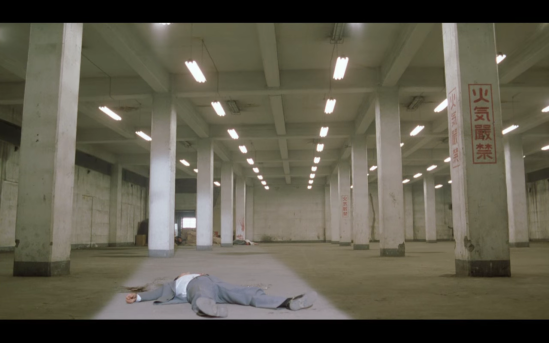
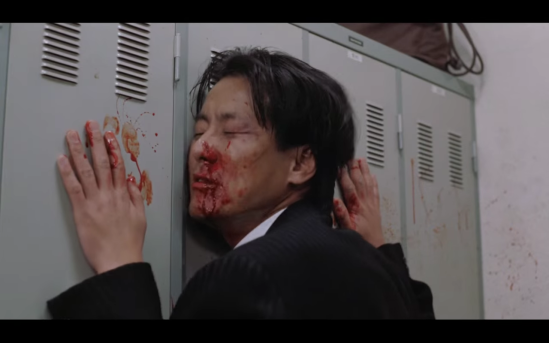
In a city fueled by constant drug trafficking and violence, a weak and corrupt police department has revolving leadership, but one good cop, detective Azuma, of the vice squad doesn’t have the taste for dope. Azuma’s wild card police tactics stir much controversy in his department, placing him on extremely thin ice, but he manages to get the job done no matter the destructive, if yet effective, trail left behind. When the detective learns that his long time colleague and best friend, detective Iwaki, has been involved with trafficking drugs, Iwaki ends up dead in apparent suicide and Azuma will stop at nothing to discover the truth behind his friend’s sudden death. Azuma’s Dirty Harry-style methods catch the attention of a powerful yakuza henchman who kidnaps her and lets his entourage gang rape his mentally unstable sister and with nothing else to lose, the rogue officer shoots first and never asks questions later.

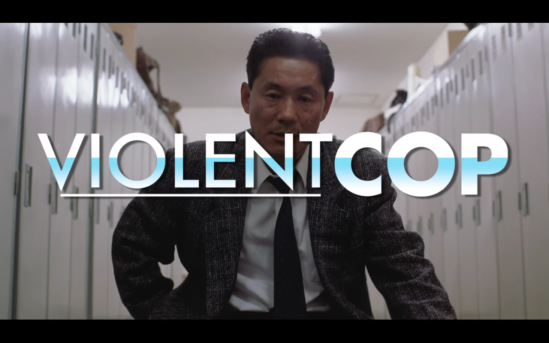
“Violent Cop” is the breakout 1989 directorial film from Takeshi Kitano, one of the most recognizable names and faces in the revival of Japan’s film industry and a staple amongst other mediums including stage performance, television, and other various liberal arts. Kitano also headlines the yakuza genre film as the lead character, the ungovernable detective Azuma, in this unforgiving cop drama under his pseudonym ‘Beat’ Takeshi. Kitano’s harden plastered mug and short, stocky stature caters to the era of lone wolf. rogue cops, providing a hearty performance familiar to that of Clint Eastwood or Charles Bronson. “Violent Cop” quietly packs a punch, patiently waiting to seize the opportunity to display explicitly graphic violence while also being sleek in it’s construction, charmingly odd in it’s humor, and basking more in the parameters of performance than in it’s exposition of dialogue, which is kitano is known more for in his acting.

Much of the film revolves around Azuma’s cavalier and stoic personality. In the opening, three teenage boys unjustifiably harass and assault an elder homeless man. Azuma, who happened to witness the assault, follows one of the boys to his home, knocks on the door, identifies himself as a police offer to the boy’s mother, walks up the stairs alone, and slaps the boy around in his own room until the boy confesses and agrees to turn himself in at the station the following day. This introduction not only showcases Azuma’s descriptive title character as the violent cop, but also informs that the work alone Azuma has a vigilante moral principle that even isolates him from his unstable sister. Once a student of comedy, Kitano re-wrote the Hisashi Nozawa original comedic script into a brutal police drama, wanting to exhibit a serious side, but left alone some of the script’s initial comedy elements that blend the spirited yakuza film to being just inside the genre. Kitano’s progressive camera work includes deep long shots along with tight quarter setups, extensive and angled crane shots, slow motion sequences, and long track work that pinpoints Kitano’s diverse style.

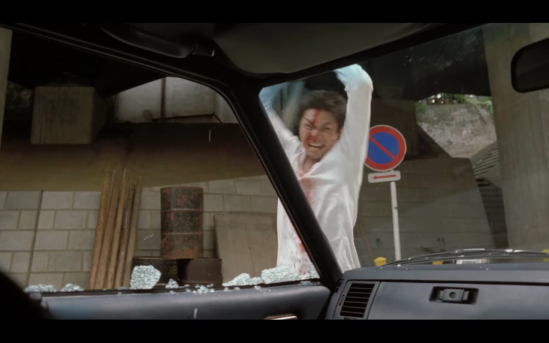
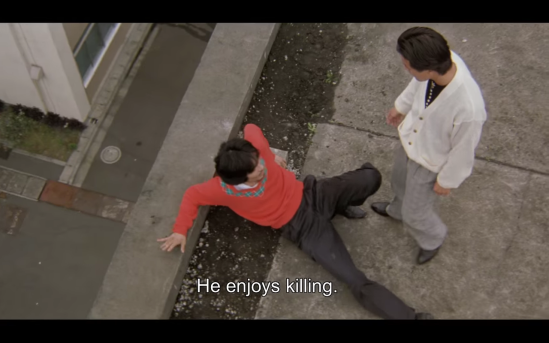
“Violent Cop” lives up to the title. Heads being bashed with an aluminum bat, multiple gory-soaked stabbings, and a sadistic, punishing maltreatments are just a few examples of “Violent Cops” barbaric qualities. The violent scenes feel almost peppered throughout, but they’re really strategically placed between character building segments that only support the necessity of brutality. Did detective Azuma really need to run over a suspect, who just murdered a colleague, down twice with the squad car? Yes, because the suspect desperately and dangerously wielded a baseball bat as a weapon and attacked them numerous time. The actions of the criminal warranted Azuma’s unethical position of bulldozing him over, twice. Only when Azuma is pushed beyond his limits does he lose what was left of any shred of restraints that were holding him back. Azuma meets an antagonistic match, a blood thirsty foe equally resistant and, at the same time, loyal with his boss, creating a villainous mirror image whose just as a loose canon as himself.

Film Movement, the New York based award-winning and foreign cinema distributor, presents a specialized hi-definition Blu-ray treatment of “Violent Cop” in a sharply detailed 1.85:1 aspect ratio stored on a single disc BD-50. The region A disc provides the best transfer quality of this 1989 film to date with stunning, natural coloring, balanced hues, and defined edges with no signs of compression artefacts. Darker scene noise is present, but to affect the experience, the noise would need to be more extensive. With Film Movement’s release, the noise is minimal and shouldn’t be considered a factor. The Japanese LCPM 2.0 audio track is quality with no hiss or pops. Dialogue is evident in the forefront, all other tracks seem level with an accompaniment range of ambiance, and, like aforementioned, all tracks are clean and clear of distortions. Extras include a featurette entitled “That Man is Dangerous: The Birth of Takeshi Kitano” and an booklet essay with the topic of Takehsi Kitano, written by Asian film expert and film curator Tom Vick. “Violent Cop” offers no sympathy, but provides an abundance of rich, dedicated filmmaking in a raw format that seems almost archaic in the present. Film Movement and “Violent Cop” go hand-in-hand, a foreign yakuza melodrama that saw the beginning stages of rebirth in the last days of a struggling Japanese cinema market and Kitano’s face is at the forefront of that movement.
Evil’s Calling… “Cell” review!

Clay Riddell just landed in Boston after scoring a huge deal in New York involving concepts for his graphic novel. With all the cellphone charging stations occupied, Clay calls his estranged wife from a pay phone to speak with his son, but when the landline severs communications, that’s when it started. People on their cellphones turn into Phoners, murderous maniacs who tear through anyone in a destructive path mindless insanity. Clay, in the midst of panic, bumps into subway train conductor Tom McCourt and fight their way out of the city, barely escaping with their lives. Fleeing a burning Boston overran by Phoners, Clay is determined to track down his family in New Hampshire with the help of Tom and two teens, Alice and Jordan, but the Phoners are not just absentminded anymore as individuals start to flock together exhibiting the beginning signs of their telepathic network lending to something far more sinister than just temporary mayhem.

“Cell” is the feature film adaptation to Stephen King’s novel of the same title and reunites John Cusack with Samuel L. Jackson once again since their last costarring venture of King’s book-to-silver screen production of “1408.” King shares screenplay credits with Adam Alleca, who co-penned “The Last House on the Left” remake in 2009, and with “Paranormal Activity 2” director Tod Williams at the helm. From the first inkling of a “Cell” movie, back with Eli Roth was attached, the excitement couldn’t be contained as I read the Stephen King novel and was captivated by the unique story of mixed and varied human emotions and the uncontrollable yearnings to be a part of the collective through being electronically connected that ultimately becomes mankind’s undoing.

However, “Cell” was heading in the direction of certain doom from the moment Roth unattached himself from the project, sending “Cell” into the annoyance of limbo until a production company conglomerate formed to pull “Cell” from it’s stagnant state and attached Williams to direct. Yet once again, King’s beloved story goes into the throes of uncertainty with distribution after filming wraps in 2013. 2016 comes and Saban Films, along with Lionsgate , distributes “Cell” theatrically and within the home entertainment market respectively.

After all the monumental problems, I personally wanted to “Cell” to be one of the most entertaining and frightening horror films of the modern age, but as fate would have it, the Williams’ film disappoints. An film adaptation of a King novel needs more minutes to cover the story’s girth and “Cell” lacked pages of warranted minutes to be a full tell all for Clay, Tom, and the Raggedy Man. Portions of the novel were translated to the screen, but for the majority of the film, a rushed version of the story debuts to silver screen audiences that loses the book’s essence and dilutes character development, such as with Raggedy Man who has a sizable role in the book, but the character in Williams’ movie barely scratches the surface with being just a figurehead for the Phoners and not the collective’s soap box looming leader. The film started out great with intense chaos at Boston airport, pictorializing to life the Phoners from the King’s book with pinpoint precision, but from there on, the story’s time span goes vague whereas the book stretches out the length of time. Only a matter of two or three days does it seem the survivors jump from Boston, to the school, to the bar, to the story’s final location of Kashwak, but in reality terms and in the amount of devastation and character portrayal, weeks have passed.

The ending has been rewritten from a surprisingly mixed reaction to the book’s and yet, the unravelling of the finale does more than convolute matters when Clay finds his son. There lies almost a dual ending where one’s interpretation can be the film’s own storybook ending. Stephen King’s “The Mist” had an ending that, when compared to Frank Darabont’s totally new ending for the film, was totally inferior to Darabont’s and I feel like that’s the stage that was trying to bet revisited here with “Cell” and it just missed the mark completely. Not all changes are for the worst. Character Tom McCourt, whose white in book, went to Samuel L. Jackson who absolutely fits the role without question, nailing PTSD stricken McCourt with little emotion but with untapped hurt. If I ever had to choose an middle aged white actor for the role of Clay, John Cusack would be my first and only choice even before casting began for the film. I do feel like having a white Raggedy Man was purposefully steered away from social sensitivities with an antagonistic young black male in a hoodie. The cast rounds out with Isabelle Fuhrman, Owen Teague, and Stacy Keach (“Slave of the Cannibal God”).

The digital visual effects were so poorly constructed and composited that I’m not surprised “Cell” didn’t have a longer theatrical run. The book had a number of jaw-dropping visuals the imagination could run with and now with seeing the depictions of those visuals on screen, they seemed seriously slapped together in such haste to where the devastating sensationalism turns inane and bland. King’s apocalyptic story warrants Hollywood scale effects, but received a few levels below that bar, failing to deliver major catastrophe on a world ending scale to the likes of “War World Z” or to cleverly style the film through a smaller medium such as George Romero accomplished with this first three “Living Dead” films.

Lionsgate’s Blu-ray release is presented in widescreen 2.40:1 aspect ratio and the 1080p Hi-Def resolution becomes a disadvantage that clearly outlines the quality of the effects. The English 5.1 DTS-HD master audio is par for the course, but slightly in-and-out with dialogue that’s difficult to balance. The 98 minute feature’s bonus features includes an director’s commentary and “To Cell and Back: The Making of the Film” which is redundant if you’ve read the novel. Bottom line is if you’re fan of Stephen King’s novel, you’ll be sorely disappointed with Tod Williams’ “Cell” that’s nothing more than a long awaited entertaining rated-R apocalyptic horror with obsolete effects and with star-studded names attached to this Stephen King story adaptation.
Dutch Avant-garde is the Next Evil on the Butcher’s Slab! “Meat” review!
A young and beautiful butcher shop assistant succumbs to the middle-aged butcher’s sexual advancements and fantasies at the workplace after she catches glimpses his sorrow, but when the butcher ends up naked on the shop’s floor with his throat cut, the assistant becomes the number one murder suspect for an inspector who coincidently looks almost identical to the deceased butcher. As the investigation deepens into the assistant, the inspector’s solemn, solitary life blurs to an assimilation into the butcher’s and his suspect turns from being a prime target to being a crucial part of the his physical and mental altering integration into the dead butcher.

“Meat” is a powerful transcending film seismically barreling through a Lynchian structure consigned to provoke the consequences of unhappiness and the consequences of poor choices during unhappiness. Directors Victor Nieuwenhuijs and Maartje Seyferth have orchestrated a moderately expressionistic arthouse Dutch drama told in a spiraling sexual context. The meat in “Meat” and the sex in “Meat” clearly share a correlation, peppered as motifs from start to end, and the positive and negative dimensions of the two are so obscured that pinpointing the differences between them are impossible, but both are for sure the last hope for the butcher and his assistant Roxy to embody the essence of sex and meat for opposite reasons. Whereas Inspector Mann simply drags wholeheartedly through his existence, expressing his numbness toward his mundane job and harshly breaking up with his lover without an ounce of compassion. Its until the butcher’s case lands in his lap does the Inspector shows signs of life again.

If you notice that lead actor Titus Muizelaar’s dual roles have purposefully generic labels. The butcher is credited as just the butcher while the Inspector has a proper name, but the name Mann is just as indistinguishable as if the character was christened Guy. The synonym character was intended for blending, to blur their personas, and to transform one into another. To explore the transformation, “Meat” begins a parallel between the butcher who, in a metaphorical sense, has his cake and eats it too and the inspector painstakingly limps from one spot to another. A contrasting experience between the two firmly establish their individualities. Then, the film shifts gears midst a catalyst with the butcher’s mysterious death, forcing the female assistant, an uninhibited role performed uninhibitedly by Nellie Benner, to be the resilient gateway for the inspector. Third gear shifts into the inspector being more and more intrigued, if not extremely envious shown very subtly, by the butcher’s seemingly unchained facade. Each character emits an expressionless stature with a deep-rooted ugliness burrowed inside and each desire a change in their turmoiled lives, whether it’s sustaining love, seeking love, or able to love in order to battle every aspect of oppressive depression.

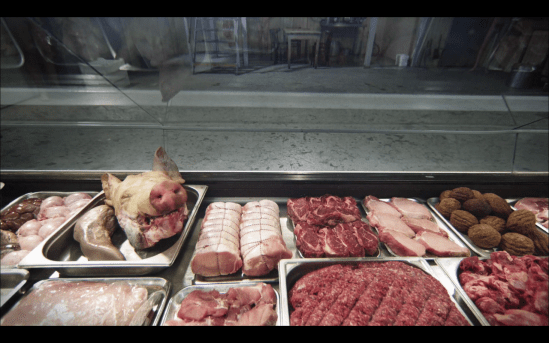
The uncomfortable open and intimate relationship between the butcher, Wilma Bakker’s Tiny, and the shop owner and the psychosexual workplace harassment involving the enthusiastic, video-documenting assistant filets the juicy bits from the bone with numerous innuendoes and explicit carnal exhibitions taking brazen residence within the animal blood stained walls of the butcher’s small meat market. You’ll never look at steak, pork chops, and leg of lamb the same way again! Only when “Meat” transitions into that second gear does the erotica becomes less erotic and more forced and horrifically exploitive. Scenes of undisclosed rape and of blatant genitalia speak upon that aforementioned correlation of raw meat and sex; no choice is given to the cow when the cow is killed and slaughtered for the cow’s delicious beef and the same can be said in sex as it’s taken without much consent and it’s being reaped for the benefit of others.

Graphically infrasexual and skewed beyond simplicity, “Meat’s” refreshingly loaded with unpleasantries and basted moistly with an outer layer of perversion that drips into an oven of thriller surreality. The Artsploitation team lives up to the moniker by, after being long overdue, crafting a home video release of 2013’s “Meat” aka “Vlees” onto DVD and on digital home video. The digital screener provided for review doesn’t give much insight into the audio and video qualities or speak to the testament of the special features. However, “Meat” is a phenomenal film that’s well-aged and ready to be rubbed, tenderized, devoured in all senses of the meaning.