You’re Not Going Crazy. EVIL Has Snuck in Its Egg! “Cuckoo” reviewed! (Neon / Blu-ray)

Fresh Horror for the Taking! “Cuckoo” Available on Amazon!

Moving to the Bavarian Mountains can be breathtaking, relaxingly scenic, and peacefully remote.  For Gretchen, however, the involuntary move comes shortly after the death of her mother, and she’s forced to leave the U.S. with her father, stepmother, and half-sister to now live at the base of the German Bavarians where an isolated vacation resort is overseen by Herr König who has hired Gretchen’s father to architecturally design an extension to the resort’s vast campus.  Reluctant to make the best of an undesirable situation, Gretchen attempts to run away with another woman and go back to America but on the way, an accident lands Gretchen in the nearby hospital and the odd, omnipresent and oppressive sensation that has surrounded her upon her arrival begins to unravel around Herr König and the resort grounds.  Disorientating visions and sounds, entranced female guests vomiting in the hotel, and an aggressively cloaked women pursing her in the shadows, a battered and bruised Gretchen can’t convince her family of the oddities around her or the ones that have plagued her mute half-sister without warning like a flash flood but with the help of a police detective, the only other person who believes her, the two investigate the strange threat that’s closing in on Gretchen’s family.

For fans of the 2018 under-the-radar, mighty mite demonic possession film “Luz,” director Tilman Singer helms another inimitable horror that’s literally for the birds.  “Cuckoo” is Singer’s this year’s released production in which he penned the script.  His sophomore feature-length film, a plotted preservation of a quickly diminishing deadly, infiltrating species, keeps in line with his Germanic heritage by filming on site at the base of the Bavarian Mountains around the North Rhine-Westphalia region of Germany.  “Cuckoo” is a production of Neon, Fiction Park, and Waypoint Entertainment, spearheaded by producers Thor Bradwell (“Saint Clare”), Emily Cheung, Maria Tsigka, Josh Rosenbaum, Ken Kao (“Rampart”), Markus Halberschmidt, and Ben Rimmer (“Midsommar”).
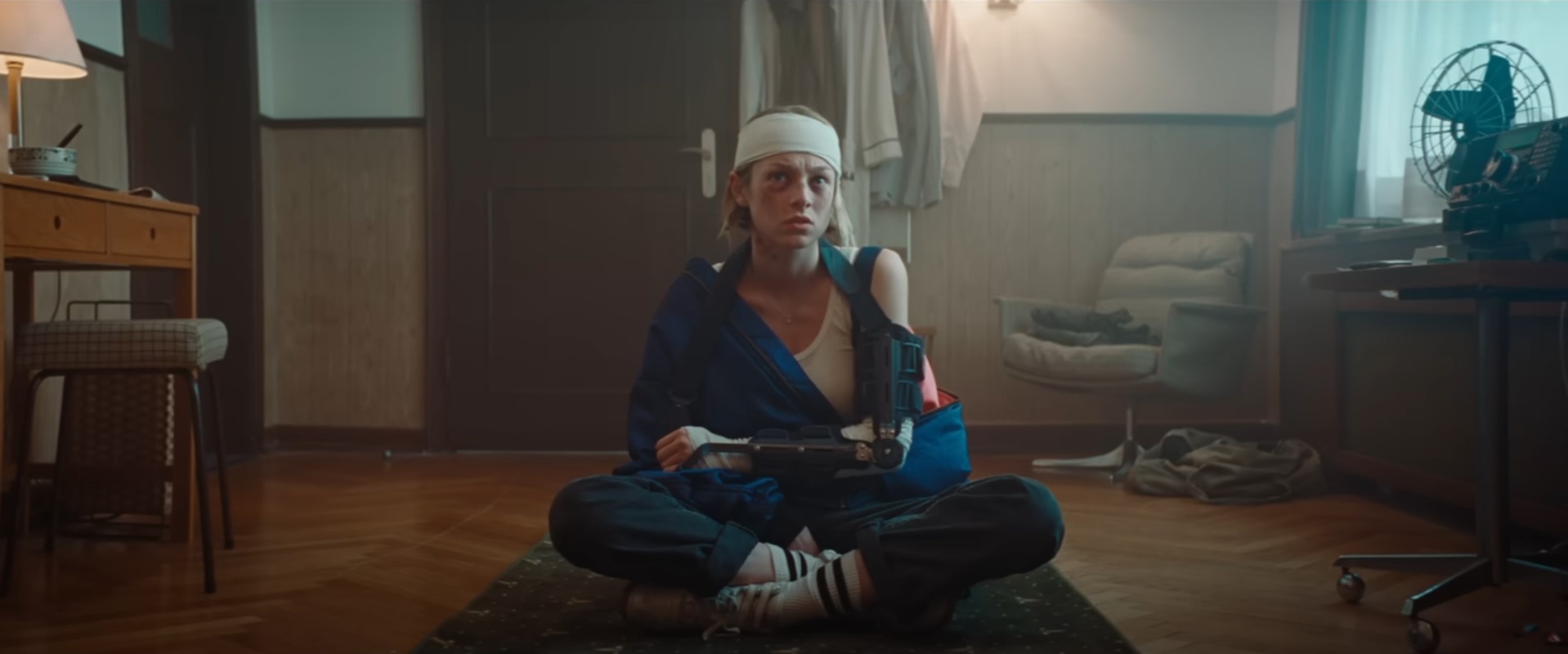
Having established himself as a refined and charming British actor in the widely popular BBC series “Downton Abbey,” Dan Stevens has slowly but surely infiltrated himself in what Lydia Deetz might describe as strange and unusual films.  Shortly after the untimely demise of the Matthew Crawley character, the principal love interest to Lady Mary (for those who know, know), Stevens jumped right into the Adam Wingard thriller “The Guest” where the then slightly over 30-year-old actor proves himself capable of portraying so much more than a stiff socialite.  As resort owner, nature preservationist, and the overall prototype of Zen in Herr König, Stevens displays another side of his deranged splits while showcasing his perfection of the German language.  Opposite Herr König in the teen heroine role is the rising star from “The Hunger Games:  The Ballad of Songbirds & Snakes” and the provocative HBO series “Euphoria,” Hunter Schafer.  As Gretchen, Schafer instills a grappling of grief for a mother she was not ready to let go, institutes steadfast judgements about her father’s new family, and impresses a level of loneliness when having to move away from familiar America to the foreign and alienating grounds of Eastern Europe which all evoke the epitome of teenage angst who can’t see beyond her music, her longing for home, and her new family aversion to see that all those negative, destructive traits innately push her away from what’s important, her family.  Herr König embodies Gretchen’s impediment to move forward while another, Henry the detective (Jan Bluthardt, “Luz”), is stitched to ground Gretchen as the past representation of events you can’t change and the anger it has over you.  Jessica Henwick (“Love and Monsters”), Marton Csokas (“Evilenko”), Greta Fernández (“Embers”), Proschat Madani, Kalin Morrow, Astrid Bergès-Frisbey (“Pirates of the Caribbean:  On Stranger Tides”), and the introduction of Mila Lieu as the mute Alma rounds out the cast.

There are no Coco Puffs to go for here in what will be Tilman Singer’s signature breakthrough hit in the cult genre.  “Cuckoo’s” unique spin on the certain genus of the titular bird is next to none as it radicalizes extreme measures to save a mimicking, infiltrating, surrogate-forcing species from extinction.  The story, which takes on the play God and find out narrative, is a perfect prefect of cutting your nose off despite your face in both the sensationalized horror element and in the rite of passage of teenager squabbles that oxymoronically favors a contrasting parallel.  “Cuckoo” falls into area of weirdness that could be an episode of the “Twilight Zone” in its earthbound peculiarity hidden from public view for decades, if not centuries, blending the once unforeseen man and animal into one and trying to keep that unity intact no matter what the natural process of survival decrees; the story goes between the shadows into its lockbox of nature’s little dirty secrets left in the dark recesses of the forgotten closet and what’s found there is unnatural, wrong, and perhaps even prehistoric.  “Cuckoo” might be too weird.  Understandably, audiences may find “Cuckoo’s” birdy thriller too intractable and maybe too, too far-fetched for a horror film that tiptoes around political hot topics, such as with the violation of women’s bodies and the pregnancy genetics that ensues.  Yet, that controversial conversation starter inside a soupy mixture of on-your-toes tension and the solid acting from Schafer, Stevens, Bluthardt, Bergès-Frisbey, Lieu, Henwick, Csokas, and Morrow develop a much needed off-the-wall and cacophonous-stirring horror that offers a new breed of horror.

The unbelievably scary ordeal arrives onto Neon’s standard Blu-ray set with an AVC encoded, 1080p high-definition resolution, BD50, presented in the anamorphic widescreen aspect ratio 2.39:1 CinemaScope.  Graded with a lower contrast, “Cuckoo’s” antiquated, perhaps wall-to-wall 70’s or 80’s veneer, elevates the finish with bolder conventional colors, enriching wood paneling, gaudy wallpaper, and the like to pop out rather than blend in.  Textures are retained in finer fabrics but appear to be lost on much of the skin surfaces with the revolving door of lighting.  Cinematographer Paul Faltz’s play on light, shadow, and depth creates tension, mood, and a lasting impression.  The lossless English (and some German, which isn’t listed) language DTS-HD Master Audio 5.1 mix provides favorable fidelity, especially when a partial of the film’s story revolves around immersive sound – Gretchen’s music, vibrating vocal sirens, Herr König’s recorder tune, etc.  Depth and range hit on the exact spatial amalgam, diffusing nicely and dynamically into the back and rear channels when scenes play out to a chase or civilly devolve into gunfire.  The second, accompanying audio option is an English Descriptive Audio 2.0 mix that provides same quantity without much of the immersive quality.  English and Spanish subtitles are optionally available.  Bonus features include the making-of “Cuckoo” with snippet interviews and behind-the-scenes look, a video diary series, on-set interviews with actor Hunter Schafer, costume designer Frauke Firl, and production designer Dario Mendez Acosta, a handful of deleted scenes, and a teaser and theatrical trailer.  Neon’s hard-encoded region A, standard Blu-ray comes in the traditional blue Amaray case with the poster art as primary cover design.  Disc is pressed with a black background and “Cuckoo” in red font.  There are no inserts or other tangible features.  The R-rated film, for violence, bloody images, language, and brief teen drug use, has a runtime of 102 minutes.

Last Rites: “Cuckoo’s” a devouringly devilish and deranged nightmare discording from the pattern to breach onto a new form of terror.

Fresh Horror for the Taking! “Cuckoo” Available on Amazon!

Is this EVIL Real or is it a “Deathdream” reviewed! “(Blue Underground / 4K UHD and Blu-ray Combo)

The Nightmare is Here. “Deathdream” on 4K UHD Blu-ray!

The Brooks family just sat down for dinner before receiving a personal house call by a military commander, conveying the tragic killed in action telegram of their son Andy during a Vietnam War skirmish.  Very early next morning, Andy inexplicably arrives at their doorstep and the whole family is elated with his return and relieved in the military’s gross error about his death.  But something isn’t right with Andy; he isn’t the same affable young man his family and friends knew.  All day, every day Andy sits in his room, gliding back and forth in his rocking chair, won’t eat or drink anything, and has the social personality of a slug.  While his father can’t grasp Andy’s bizarre behavior, his mother defends him, being overjoyed, comforted, and relieved by her son’s safe return.  Anybody who comes close to discovering what Andy has done or has become is preyed upon by Andy’s need for concealment and need for blood. 

If there was ever the quintessential anti-Vietnam War film, Bob Clark’s “Deathdream” is it.  The 1974, Alan Ormsby (“Cat People,” “The Substitute”) scribed grindhouse classic introduces combat shock to audiences through a macabre and ghoulish lens as the U.S. involvement in the Vietnam War came to an official end in 1973.  Before becoming one of the holidays’ household names with “A Christmas Story” and “Black Christmas,” Bob Clark sat in what would be one of his first films as a director, a film that wasn’t sold in taking just one title having also been bestowed “Dead of Night,” “The Veteran,” “Night Walk,” and “It Came from the Grave.”  The U.S.-based shot and crewed feature, filmed in and around Brooksville, Florida, is a production of Quadrant Films and Impact Films with United Kingdom producers Gerald Flint-Shipman, Peter James (“Children Shouldn’t Play with Dead Things”), and Geoffrey Nethercott (“Blue Blood”) with John Trent and Bob Clark coproducing.  

For the ambiguous terror of “Deathdream” to work without baffling audiences to a nonsensical death, the cast had to really give it their all and not only that but also sell the deteriorating dynamics of an American nuclear family when the son returns home strangely different from then when he left for war.   The debut film of Richard Backus, playing the reclusive and uncharacteristic Andy who has returned home from the battlefield, is complimented by the heart-wrenching performances miseries of his onscreen parents in John Marley (“The Dead Are Alive!”), as the distraught father over Andy’s peculiar behavior, and Lynn Carlin (“Superstition”), as the denialist mother who can’t or won’t see the issues with Andy, the gift of her little boy returning home. Not only does Andy’s return ignite a slow-burning divisive wedge between parents and child but it also exposes pre-war schisms that were long established years ago.  We’re initially introduced the family sitting around the dinner table filled with compassion, hope, and happiness but Andy’s return kicks the wasp’s nest and we can see their true nature.  The father is a crotchety, dogged man who can’t connect with a more sensitive son and the mother spoils his only boy the point where Andy must enlist himself voluntarily to prove something to toward his father’s disappointment.  Then, there’s sister Cathy.  Poor sister Cathy, the gentle, positive, and sweet daughter who is all buy nearly forgotten by her parents as they push her out of the way by her father stating to mind her own business or is exclaimed in so many words of her little worth in compared to her brother by her mother.  Yet, Cathy, played softly and attractively by Alan Ormsby’s then wife, Anya Ormsby (“Children Shouldn’t Play with Dead Things”), continues a cool and level head about her shoulders as the only true family member willing to give Andy time, to let him be himself, while acclimating back into society, let alone his family.  However, the family’s opposing forces is ultimately what destroys them in conjunction with Andy’s terrible, morbid secret.  Henderson Forsythe, Jane Daly, Arthur Anderson, Michael Mazes, and David Gawlikowski fill out the cast.

All of the costly signs of shell shock and PTSD are present within the context of “Deathdream,” blanketed under a sensationalized, representational guise, but the film’s cinematic façade of Tom Savini’s rot and decay special effects and the appalling imagery of living death doesn’t alleviate or even dilute the horror of the revenant in the actual disorder.  In fact, it pales in comparison if you ruminate on it for a while.  Andy’s withdrawn from the likes of acquaintances, friends, and family alike and is severely impassive at signs of cordiality.  Director Bob Clark emphasizes the effect even further in one scene where a World War II veteran anecdotally describes in nonchalant detail the death of a brother in arms and this flashes images in Andy’s mind of him and his friend’s own mortal wounds in the jungles of Nam, sending the young man into a minor fight or flight moment, two of the associated signs of shell shock:  fight and flight.  Within the sensationalized horror context, Andy requires blood to keep his body from decaying, like a reanimated corpse trying to hang on a little long before his skin and muscle tissue just seep and ooze off, and in one scene of attack, Andy shoots up his victim’s blood with a hypodermic needle in a reminiscent drug addiction scene of shooting up narcotics right into the vein of one’s arm, an experience afflicted on many PTSD vets. Ormsby’s script might be specific in the anti-Vietnam War propaganda but is not so detailed in the narrative’s whys and wherefores as much of Andy’s unlikely, and undead, return to his family falls into that inexplicable, ambiguous, “Twilight Zone,” and “Tales from the Crypt” category to foster a greater cloud of mysticism and darkness around the story, one in which has a hopeful, desperate mother conjure will and desire in order to see her son come home again.

In continuing to upgrade their catalogue to the best possible format currently available, “Blue Underground” pulls an Andy and returns “Deathdream” from the dead, heading home to the nearest ultra high-definition player. The 2-disc 4K Ultra HD and Blu-ray combo set arrives with a brand-new restoration, scanned in 4K 16-bit from the 35mm negative with Dolby Vision HDR in honor of its 50th anniversary. The UHD is HVEC encoded onto a 66GB Blu-ray with 2160p resolution while the Blu-ray is AVC encoded, 1080p resolution, on a BD50, both presented in a widescreen 1.85:1 aspect ratio. A grainy 35mm print is ingrained with superior color saturation and understanding of how to manage the perceptibility of image. Blue Underground’s previous restorations show a spectrum, step-by-step improvement to get to where the film is today in a higher, upgraded format. “Deathdream” can be a very dark film at times and often, but this release eliminates speculation of events without collapsing the contrast integrity, providing a clear and concise image for its spot in history. Blu-ray is a step down albeit only minorly and with some color stability shimmer, more notably in the finale with a less than standardized and wear-showing deleted scene that is integrated back into the story. A single, English DTS-HD master audio mono track is available. The lossless option doesn’t need any more or any less to effectively be the overlaid track. Distinction runs through the single channel with managed assurances that dialogue, ambience, and soundtrack divide and conquer their respective uniquities. English SDH, Spanish, and French subtitles are available. Due to space on 4K UHD disc, all of the package’s special features are encoded onto the standard Blu-ray. The UHD Blu-ray includes an archival commentary from director Bob Clark, a commentary by writer Alan Ormsby, and a brand-new commentary with a pair of film historians Troy Howarth and Nathaniel Thompson, plus the theatrical trailer. All that and a slew of previously recorded content, including a recollection featurette with Alan Ormsby and star Anya Liffey (Ormsby), an interview with composter Carl Zittrer Notes for A Homecoming, an interview with production manager John “Bud” Cardos Flying Down to Brooksville, an interview with star Richard Backus Deathdreaming, an interview with Tom Savini regarding his early years in special effects, a screen test of the original Andy actor Gary Swanson, an alternate opening title sequence, Alan Ormsby’s student film, theatrical trailer and still galleries. The only other new content is an interview with the original Andy actor Gary Swanson The First Andy. The same illustrated cover art composite from the 2017 Blue Underground Blu-ray is recycled for the 4K UHD Blu-ray with tactile elements of a raised title and taglines on the cardboard slipcover. The primary art also resides on the black UHD Amary but the reverse side has retro traits of the film’s starkly contrasted yellow and blue poster art and the “Dead of Night” title to which, once again, is preferrable for me to have diverging slipcover and case cover arts. The two discs reside on their respective sides of the interior with the 4K UHD pressed with the illustrated art and the Blu-ray going contrarily retro like the reverse cover art. There are no loose insert materials. With an 88-minute runtime, Blue Underground release comes region free and is rated R.

Last Rites: Andy didn’t destroy his family. He was only the last straw, a catalyst that tipped the boat over into a sea of slowly brewing tempest. Doesn’t help that he was also decaying right before their eyes as the embodiment of walking death and looked good doing it too with the help from Blue Underground’s sharp-edged and solidly sound 4K upgrade.

The Nightmare is Here. “Deathdream” on 4K UHD Blu-ray!

The Cycle of Life Can Be EVIL. “Vivarium” reviewed! (Screener/Vertigo Releasing)


Gemma and Tom are a happily in love young couple who are looking to purchase a starter home. They visit a real-estate agency for a brand new housing development called Yonder. Met by a strange and persuasive real-estate agent, they’re convinced to follow the unusual agent to tour the neighborhood that has been marketed as the family forever home with everything they could ever need and want. A row upon row of identical houses and yards go as far as the eye can see and before the tour of the rather ordinary house number 9 ends, Gemma and Tom find themselves alone inside with the bizarre agent gone. Their efforts to leave the mysterious residential suburbia proves impossible as each turn leads them back to house number 9. When a box containing a baby boy is left at the doorstep with a note to raise the child to be released, the young couple reluctantly reside into domestic confinement.

Vivarium defined is an enclosure, container, or structure adapted prepared for keeping animals under seminatural conditions for observation or study or as pets, like an aquarium or a terrarium. “Vivarium,” the 2019 movie, embraces the definition, twisted into an idiosyncratic neighborhood block of duplicity from the “Without Name” director, Lorcan Finnegan. Story concept is flushed out by Finnegan and “Vivarium’” credited screenwriter, Garret Stanley, in their second collaboration for the director’s sophomore feature endeavor that’s a panicking puzzle in every square foot of Yonder’s backwards backyard. The film resonates with echoes of Finnegan and Stanley’s seminal short film, “Foxes,” from 2012, revolving around a couple living in a remote and forgotten housing development and become drowning in obsession, madness, and malaise as shrieking foxes surround their isolated home. There’s an equating animalistic instinct to each film that brandishes many of the same motifs as well as joining themes that are corralled in Finnegan’s copious foreboding and disconnecting dehumanization narrative. “Vivarium” is produced by XYZ Films (“Tusk”), Fantastic Films (“Stitches”), PingPong Film, and Frakas Productions (“Raw”).

The happy, young love birds are played by Imogen Poots (“Green Room” and “Black Christmas” 2019 released remake), who has an underlining affinity for not typecasting herself in the same role, and Jesse Eisenberg (“Cursed” and “Zombieland”), who manages to step a foot outside his conventional performance of a rattle mouth, know-it-all. However, Eisenberg deserves the praise of a man with severed ties from reality as the actor embraces a reserved manic by channeling Tom’s obsessive need to dig, an aspect of his handyman profession he’s good at in perhaps providing an escape from cage-less confinement, and being the bearer of skepticism of caring for an abnormal child. Gemma has complications of her own confronting her educator responsibilities for young children. She struggles with internal conflict, does she still use her innate care and instruct a young mind or in self-preservation, take Tom’s passive aggressive approach? Poots and Eisenberg share a mutual, caring bond that defines Gemma and Tom kind of steady, kind of loose relationship that gradually devolves civilly, like the amicable breakdown of a marriage revealing lost, but not forgotten love between two people. Along with the surreal atmosphere, “Vivarium” grades well in the creepy kid department with the child in Tom and Gemma care, but don’t even bother giving a name. Dubbed with a playful man’s voice, a shrill scream ignited by displeasure, a knack for imitating, and always dressed in Sunday’s best, Senan Jennings’ middle aged boy presence is a supernova of chilling proportions with a performance that gives his co-stars a run for their money while Eanna Hardwicke is equally spasmodic and creepy as the grown up, young man version of the boy with a little more alienating know-how and clandestine about his origins.

Finnegan and Stanley pursue thought-provoking substance of human corporeal limitations and how we, as humans, cycle through them with such cavalier ease. The opening scenes examples this with the practice of the common cuckoo laying their mimicry egg inside the nests of other birds. As a brood parasite amongst birds, the cuckoo egg hatches and the cuckoo chick pushes out the mother birds’ inborn chicks and becomes the sole chick in the nest with the surrogate mother tending to the cuckoo’s dietary needs. When the cuckoo is matured, it is grossly larger than the mother bird and, also, mimics the bird species to an extent, much in the same way of the boy or young man Gemma and Tom surrogate as being the unintended mimicry that infiltrates and ousts the limitations of his foster parents. Finnegan and Stanley also explore the parental lifecycle with the theme that our children will replace us, extend our legacy, but we will ultimately be forgotten. “Vivarium’s” craft dictates a larger scale, disproportionate, otherworld teemed with secret subterranean corridors leading to other disturbing observatory immures, making for a stimulating meta-induced terrarium as we watch miniature versions of Jesse Eisenberg and Imogen Poots suffer inside a screen from the comfort of our couch.

If you’re stuck at home, living the quarantine life you’ve always wanted, “Vivarium” may just break of your introverted stance on home with it’s “Black Mirror” and “Twilight Zone” encouragement. Because of the COVID-19 pandemic, the Vertigo Releasing and Wildcard Distribution released film has circulated digital only on the following platforms in the UK: iTunes/Apple TV, Amazon, Sky Store, Virgin, Google Play, Rakuten, BT, Playstation, Microsoft, Curzon Home Cinema, and BFI Player. Unfortunately, I will not be able to comment or critique of the audio, video, or bonus features of this release due to the varying elements of a digital screener. Novel, suspenseful, and a great film to brood over, yet difficult envisaging, “Vivarium” truly resembles slithers of somber dimensions of an upside world with lashings of surveillance paranoia.

Amazon Prime Video is one way to watch! Rent or Buy “Vivarium” with Prime Video

When Evil Lurks Outside… “Never Open the Door” review!

screen-shot-2016-12-23-at-10-17-28-pm
Six friends break bread for the holidays in a remote woodsy cabin. As their jovial and joyful conversation continues, a wicked evil lurks in the forest. A sudden and harsh knock at the door confuses the group on who would be calling at their isolated retreat and at the late hour. When Tess volunteers to answer the knocking, a stranger spews blood all over her and falls to the ground as she opens the door. With his dying breath, the aging stranger warns them to never open the door. stunned with complete shock and terror, the group doesn’t realize that the very moment the strange dies on their doorstep is the very moment of the beginning of the end as weird occurrences and odd behavior pits friend versus friend, girlfriend versus boyfriend, and spouse versus spouse when staying or fleeing the cabin becomes a life or death decision.
screen-shot-2016-12-23-at-10-12-19-pm
“Never Open the Door” strikes as an odd feature that marries projecting horror genres with resurrecting structures from the past into modern times. The Vito Trabucco directed 2014 released film, who also had producer Christopher Maltauro collaborate on to pen the script, stirs up vintage Alfred Hitchcock cinematography craftwork and mirrors the enigmatic nature of particular and peculiar “Twilight Zone” episodes. Trabucco and director of cinematographer Joe Provenzano voids the film of color to encompass the mood of bygone black and white thrillers and employs composer Carlos Vivas to enchant the story with a classically engaging score that embellishes upon harrowing pivotal moments in the story. Vivas and Trabucco have a prior working relationship under Trabucco’s previous nunsploitation slasher “Bloody Bloody Bible Camp.”
screen-shot-2016-12-23-at-10-14-57-pm
Vito Trabucco casted his staple entourage of actors. If you’ve ever seen “Bloody Bloody Bible Camp,” you’ll recognize many faces with the exclusion of George Troester, who plays the crude, unhitched Terrence. However, Troester does fit into the whole seven degrees of Kevin Bacon theory, being a co-star in “Crack Whore” along side Kristina Page and Steven Richards, Angel and The Stranger in their respective roles. Contemporary scream queen Jessica Sonneborn, the lead actress in “Never Open the Door’s” quasi-dual Tess performance, has a director’s credit under her name for her work on “The Haunting of Alice D” starring the iconic Kane Hodder. The 2014 film also rostered supporting actresses Kristina Page and Deborah Venegas, who portrays in Trabucco’s film as Maria, Luke’s wife. Luke is portrayed by Mike Wood with fellow “Bloody Bloody Bible Camp” co-star Matt Aidan as Angel’s fiance. Whew. Overall, the actors click as a group with a dinner room dynamic that’s natural with slightly pretentious moments that don’t really kill the mood. When the story ramps up, performances start to dwindle and overacting starts to unfold. Mike Wood absolutely murders the shower performance with ghastly exposition, but, again, this might be playing the retro card. Sonnerborn does well as the headliner. Her demon-like twin dominates, but just didn’t receive much screen presence in measly 66 minute runtime.
screen-shot-2016-12-23-at-10-16-15-pm
Continuing with the Tess demon, the black and white style fortunately masks most of the low budget special effects with the aid of some great uses of silhouettes and editing. Evil Tess’s pudgy demon sausage fingers dressed with cheap plastic looking fingernail attachments couldn’t fool a fool that they’re razor sharp, but with jagged teeth and glowing eyes encircled by a pitch black ring, she’s a nightmare inducing boogeywoman. Aside from a pair of demonic dispatches with one involving the razor blade finger caps, the effects were safely contained inside the realm of an independent feature. A few spurts of black blood and a handful of stabbings share a common bound of having being what remains of the effects which were executed well enough to serve the intended purpose. Mostly, “Never Open the Door” relied heavily on editing. Editing that involves characters’ hallucinating future or past events, attributing their frantic confusion and life threatening situation toward an endless loop of purgatory.
screen-shot-2016-12-23-at-10-15-44-pm
Yes, the characters are afflicted with a hell on repeat, switching identities on a continuous horizon that leaves fragments of prior rebroadcasts. From gathering information about the characters, none of them strike me as a damned souls. Tess is a veterinarian who performs the occasional neutering and spade and dates a man nearly twice her age. Terrence just doesn’t want to grow up, but no skeletons appeared from out of his closet. The couples, Angel and Isaac and Luke and Maria, grow suspicious of each others’ intentions that involve jealousy, paranoia, and hatred. Unlike a “Twilight Episode,” “Never Open the Door” leaves open doors of unsolved questions, such as answering the question of how the group came to acquire the house. Before the abrupt knock at the door, the person who located the isolated question seemed to befuddle the entire group. Another loose end lies with the person texting Luke messages about an illicit affair his wife’s having with one of their friends. Again, the loop doesn’t quite close on this interesting caveat.
screen-shot-2016-12-23-at-10-13-45-pm
Maltauro Entertainment presents in association with Baumant Entertainment the Vito Trabucco film “Never Open the Door” on Blu-ray. Unrated in a HD 1080p, the widescreen 1.78:1 is delectably sharp on a BD-25, but that really isn’t a surprise here with a black and white feature barely over a hour long. However, black-upon-black scenes define the Blu-ray with a low bitrate, displaying some blotchy, compression issues. Audio quality is quite fair. Carlos Vivas score channels through a Dolby Digital dual output that caters, again, to a vintage replication, but in creating an atmospheric feature, having surround sound would have boosted the result tenfold. The dialogue is a bit wish-washy, pending on the scene and character positioning, but forefront evident in the quality and that is what really matters. English subtitles are also available. “Never Open the Door” has grand potential in a small package, but trips over it’s own inconsistencies with erratic editing and walled details. Director Vito Trabucco’s vision in modernizing classic techniques and styles merely becomes just that, a vision, and was inches, or rather seconds, away from opening the door for potentially a far greater anxiety-riddled psychological thriller.

“Never Open the Door” on Blu-ray, DVD, and Video on Demand!