EVIL’s Brew Just Needs a Severed Head! “The House of Witchcraft” reviewed! (Cauldron Films / Blu-ray)

“The House of Witchcraft,” a part of The Houses oof Doom series, Now on Blu-ray!

Luca Palmer has experienced the same reoccurring nightmare for months of him finding shelter from being chased inside a large countryside house with an ugly hag boiling his severed head in a large cauldron.  The dreams have required him to find professional help in a psychiatric ward but without any real mental or physical health concerns, he’s released to his incompatible, witchcraft practicing wife Martha who sets up a country house getaway in a last ditch effort to save their dwindling marriage.  When they pull up to the house, Luca immediately recognizes it from his nightmares.  From then on Luca believe he’s seeing the malicious old woman from his dreams around on the estate grounds and urges his psychiatrist, who is also his late brother’s wife, to visit him to assess his state of mind, but the visions keep coming and those around him keep dying a horrible death with his wife being the key suspect of witchcraft related deaths.

“La casa del sortilegio,” aka “The House of Witchcraft” is a made-for-television, witch-centric movie for the four-film series The Houses of Doom concept created under the companies of Dania Films and Reteitalia’s producing team Massimo Manasse and Marco Grillo Spina.  The 1989 witchy-slasher hybrid and the third film of the series is helmed by another notable Italian schlock and shock director, Umberto Lenzi (“Seven Blood-Stained Orchids,” Cannibal Ferox”), as well as Lenzi writing the script from the story of The Houses of Doom envisaging duo Gianfranco Clerici and Daniele Stroppa.  “The House of Witchcraft” speaks the very essence of what to expect in a traditional sense regarding witches while really stepping up with Italian nastiness inside the slasher principles, filmed in the heart of Italy in the popular Chianti wine municipality of Rufina where the landscape is lined with vineyards, churches, and castles.

Luca Palmer is committed to his mental health by committing himself to his sister-in-law’s psychiatric hospital after months of nightmares involving a witch and his severed head as the main ingredient for her boiling stew.  Perhaps, because of his rocky relationship with wife Martha, played by French actress Sonia Petrovna (“Flashing Lights”), Luca just needed a break from her witchcraft obsession and loveless aloofness to clear his head.  Either way, the American-born and ‘Naked Rage” actor Andy J. Forest is one of Umberto Lenzi’s go-to action stars, of such Lenzi’s war films “Bridge to Hell” and “The Kiss of the Cobra”, whose taken off the film battlefield and positioned as the confounded centerpiece of a cackling witch tale, completing his task as a the tall, handsome, and flawed hero of a man haunted and driven by unpleasant night terrors of the long face, broad features of the fittingly named Maria Cumani Qausimodo as the dolled-down witch.  Quasimodo is no stranger to the filth and frights of Italian schlock with roles in “Behind Convent Walls,” “Five Women for the Killer,” and even the notoriously porn augmented “Caligula” and her physical traits, long stare of blue eyes, and pandering of character’s wickedness transform her into an ideal archetype of the original folk-acholic Brewmeisters.  Characters for the slaughter tin this supernatural slasher and to be intertwined into the suspect and innocent pool are played by Paul Muller (“Lady Frankenstein”), as the sixth sense blind homeowner Andrew Mason, Marina Giulia Cavalli (“Alien from the Deep”) as Andrew’s visiting niece Sharon, Susanna Martinkova (“Fracchia Vs. Dracula”) as the psychiatrist sister-in-law Dr. Elsa Palmer, and Maria Stella Musy as the doctor’s daughter Debra tagging along with her mother to visit the barely mentally managing Luca. 

Umberto Lenzi’s rollercoaster career has seen its fair share of misses overtop what are today considered trashy, cult triumphs that lure fans to seek out his even lesser known, poorly critiqued titles more often than required for any more than the casual horror moviegoer. However, “The House of Witchcraft” is not one of those latter, threadbare produced pictures as Lenzi instills more aesthetic style and cinematic substance of searing phantasmic enthrall and danger with an unwavering villainess vile down to her very rotten teeth and scraggly, gray hair.  Offing houseguests left and right is the witch’s supernatural birthright but why exactly Luca Palmer, a stressed out journalist, to be the target of precognitive events is more opaque than it is clairvoyantly evident but we get some great malevolent manipulation and sleight of hand with black cat familiars, bulgy maggot-infested corpses, unusual indoor freezing precipitation, severed heads, and a face transfiguration that’s pretty damn good that has no right to be in a Lenzi film, mostly in part to special f/x and makeup artist Giuseppe Ferranti (“Anthropophagus,” “Nightmare City’), his favorable, collaborative relationship with Lenzi, and the fact he’s locked into the 4-part film series The Houses of Doom provides him creative freedom, flexibility, and fluctuation in diversity.  “The House of Witchcraft” is not the one-all, be-all witch story but does scratch that warty itch in the foulest of cloak-wearing evils without flying a broomstick! 

The second of four Blu-rays for The Houses of Doom lineup produced by Cauldron Films, “The House of Witchcraft” is an AVC encoded, 1080p high-definition, BD50 with a transfer scanned into 2K, uncut and restored, from the original film negative.  Very similar to Lucio Fulci’s “The House of Clocks,” Cauldron Films scan is quite impeccable.  A pristine picture with no wear or tear and age deterioration, “The House of Witchcraft” is deep and rich with immense coloring timing efforts, defining an authentic look without overcorrecting to a fault.  There’s no perfunctory enhancing or extreme variability with contrasting, retaining a smooth, consistent picture quality throughout its European aspect 1.66:1 presentation.  Even in the more stylistic lighting work that creates clear tone of how the indoor snow should feel cold or the lightning strikes and wind brings a chill of ominous doom, there’s plenty of delineation to provide space and demarcations of depth between objects.  There are two DTS-HD 2.0 mono mixes with an ADR Italian and an ADR English dialogue.  Synchronously smooth, a noticeable dialogue separation between audio and video is not easily perceptible, which is kudos to the post work on the post-crew efforts, and Cauldron’s mixes have clarity without a fault in the compression means.  The two channel funneling of the mono output separates the dialogue and ambience/score.  Backing of the boiling cauldron stew or the knife swipes that severe heads and stab fleshy trunks, leaving impacting thuds and thwacks, are good examples of the conveyed foley audio that leaves a lasting impression through component construction in the audio design.  There are optional English subtitles on both language tracks.  Special features include Cauldron Films’ produced interviews with FX artist Elio Terribili Artisan of Mayhem, cinematographer Nino Celeste The House of Professionals, and a commentary track with Eugenio Erolani, Nathaniel Thompson, and Troy Howarth.  Also like “The House of Clocks” release, Matthew Therrien and Eric Lee compose a composition of illustrative graphic artistry of film’s decomposing and maniacally laughing madness and logo design for The Houses of Doom series on the front cover inside the clear Scanavo case.  Reverse cover has a still image of the black cat and the disc is pressed with the same front cover artwork but cropped to focus primarily of the witch with title and company logos at the bottom half.  The region free release has a runtime of 89 minutes.

Last Rites: Umberto Lenzi’s “The House of Witchcraft” casts a spell over the hex canon, beguiling it with mystery, enchanting it with surrealism, and bewitching it with blood. Cauldron Films’ Blu-ray is topnotch for an obscure made-for-TV Lenzi production.
“The House of Witchcraft,” a part of The Houses oof Doom series, Now on Blu-ray!

The Blind Leading the EVIL. “Oddity” reviewed! (Acorn Media International / Blu-ray)

“Oddity’s” Blu-ray from Acorn Media International is Here!

Dani Timmins spends many nights renovating her and her husband’s new country home.  While her psychiatrist husband Ted works long nights most nights at the mental hospital, Dani spends her time in solitude and isolation to fixup their future home.  When a strange man knocks on her door and warns someone is inside her house, Dani must make the difficult decision to either trust the stranger into her home or dismiss his warnings as subterfuge to get inside.  The next day Dani is dead, brutally murdered.  A year later, Ted and his new girlfriend reside in the country home and Darcy, Dani’s twin sister with retrocognition abilities, arrives at the country home with supernatural suspicion toward the couple, bringing with her a trunk containing a family heirloom of a life-size wooden mannikin.  Threatening to expose him, Darcy appetite for blind justice is stronger than Ted’s need to convince her otherwise when the plot against her sister thickens beyond the plane of the corporeal world.  

“Oddity” is the 2024 release supernatural haunt and golem thriller from “Caveat” writer-director Damian Mc Carthy.  The sophomore feature from the Ireland born filmmaker is a mishmash of culture inspired heavily on the Jewish folklore of the inanimate, human formed material being commanded to animate a task, such as being bewitched for wicked transgressions and this commingles with twin superstitious beliefs of extrasensory connection, and, I’m going to stop your train of thought right there, just because this is an Irish production with an Irish actress playing twins doesn’t make this a movie about the derogatory Irish twins concept.  Filmed in the County Cork, Ireland, “Oddity” is produced by “Come to Daddy” producers Evan Horan, Katie Holly, Laura Tunstall, and Mette-Marie Kongsvad with Lisa Kelly as co-producer and Keeper Pictures and Shudder serving as co-productions presenting as a Shudder Exclusive film.

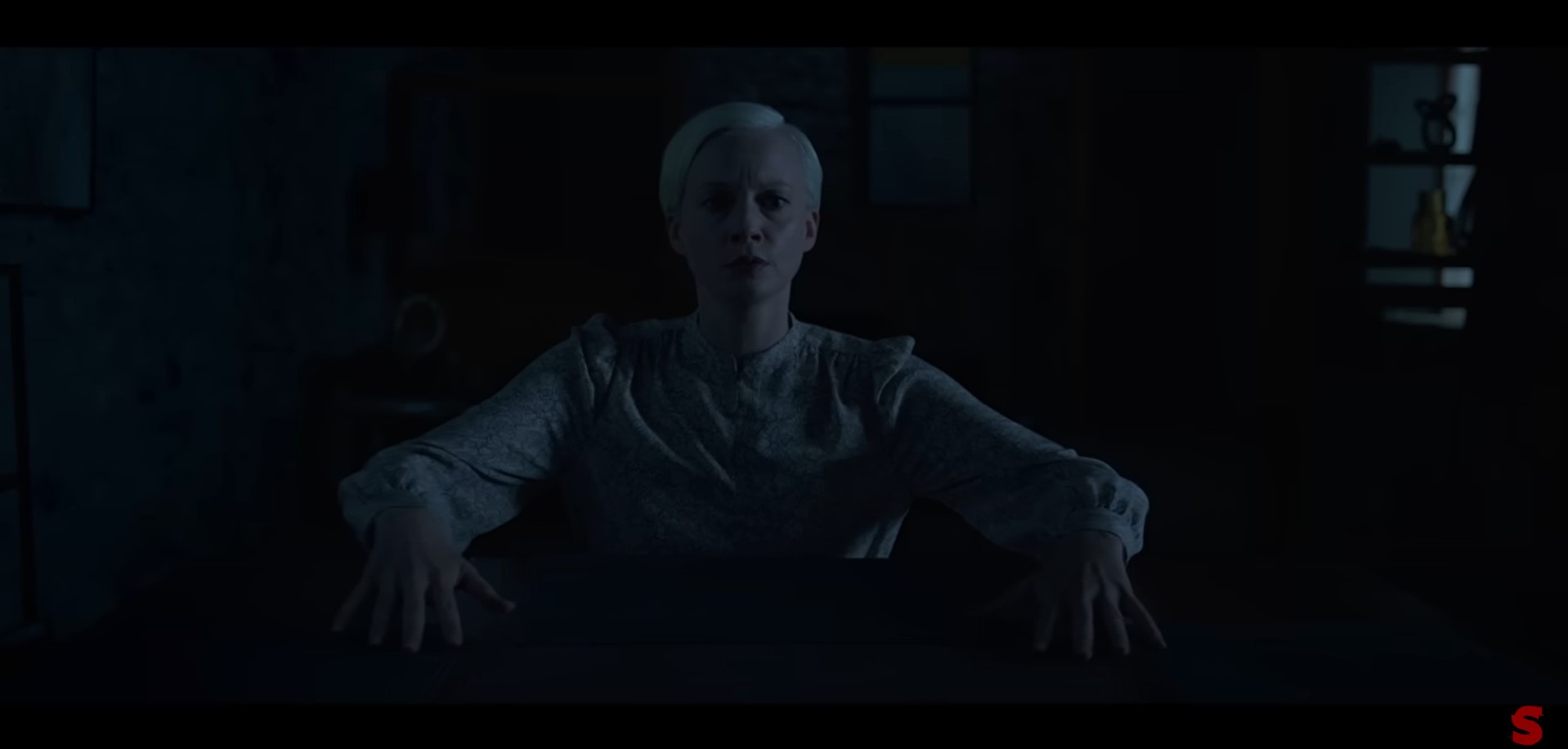
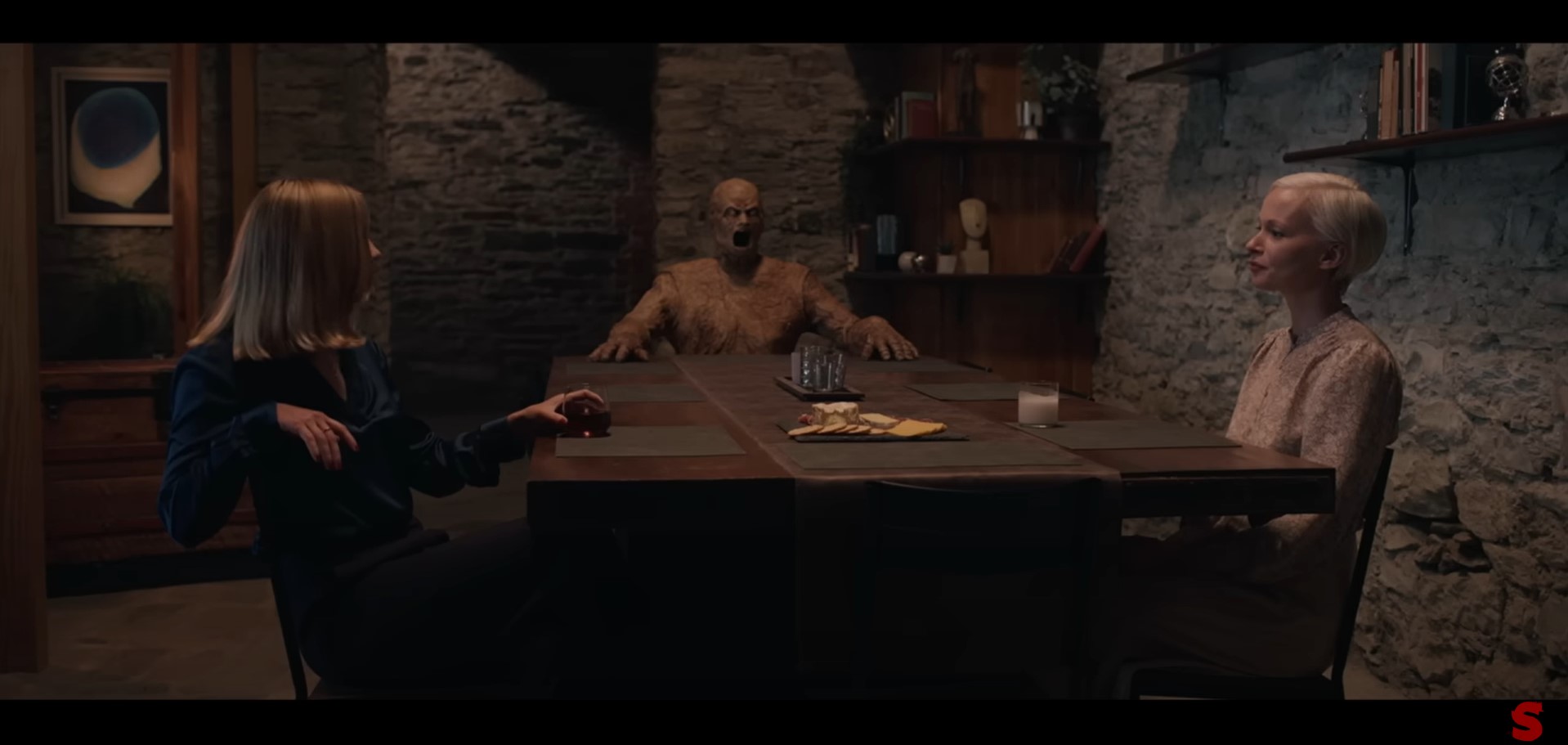
Carolyn Bracken (“You Are Not My Mother”) dons the double role of twin sisters Dani Timmins, murdered housewife to doctor Ted Timmins, and Darcy Odello, a blind psychic who owns an oddity emporium called Odello Oddity, as partly in the title.  When we think of twins in films, we think identical down to the very last mannerism and hair fiber, but for Dani and Darcy, they’re similarities are in blood and face structure alone.  The differences are stark with Dani sporting dark, long hair whereas Darcy’s is nearly white and cut pixie short., Dani’s health is more intact whereas Darcy’s afflicted with blind caused by a brain tumor, and the aforementioned results in Darcy’s gift whereas Dani lacks in that department.  Lastly, Darcy exudes more confidence for a blind woman who’s able to read the room without her known unnatural ability, possessing a separate superhuman knowledge left without the power of sight.  While Bracken only plays Dani for a short period of time a lot can be said between the two women who are portrayed perfectly contrasted; yet a connection between forms an invisible bond through Darcy’s practice of learned witchcraft that involves the wooden manikin.  Opposite Bracken is Gwilym Lee as Ted Timmins, a man unable to escape the haunting of his deceased wife and start again with new girlfriend Yana (Caroline Menton).  Lee’s an absolute pragmatic when it comes to being psychiatrist Ted Timmins in a good display of when a rational doctor plays a rational plan on how to do something irrational and while Timmins and Bracken share not a ton of screentime together within either of Bracken’s dual roles, the thick tension formed between their characters is palpable wrought.  Yet, the real award-winning performance should be handed to Ivan de Wergifosse, the unsung face and movements of the wooden man.  Menacingly still like a large Pinocchio doll ready to come to life at any second, Wergifosse’s golem movements erratically alter the tone of drama-thriller to creature-thriller, coupled with an intense sound design that will resonate in nightmares.  “Oddity’s” principal cast fills out with Steve Wall (“Dune:  Part Two”) as an unscrupulous orderly and Tadgh Murphy (“Boy Eats Girl”), who really does have an artificial eye, as the red flagging mental patient.

A confluence of componential folklores doesn’t stale “Oddity’s” unique brand of Mc Carthy storytelling.  Shrouded deep in shadows, an underlining sense of intense dread, and colorful in diverse characters, the film truly represents the meaning of the title despite its adopted resources and, to be honest, that’s how most stories survive nowadays when the familiar is rebranded with fresh frights dwindling every second.  Sometimes, being too novel can have the reverse consequences of being too odd for most general fans.  “Oddity” provides balance with a slow burn buildup by chopping out exactly what happens to Dani, creating a cliffhanger right at the beginning to get the investigative wheels turning.  Where I do believe Mc Carthy suffers to retain a truth uncovered is in the story’s predictability.  We already know who the bad guy and we’re just waiting to see how he did it.  That takes a good chunk of suspenseful whodunit away from the narrative when it’s practically spelled out for you.  The mysteriousness around witchcraft and the supernatural twin sibling bond, coupled and accentuated with the manmade blunt force apathy, carries the weight, and can overshadow what’s missing and purposefully omitted to keep a sense of the unknown palpable. 

Acorn Media International presents “Oddity” on an AVC encoded, 1080p high resolution, BD50. Mc Carthy and director of photography Colm Hogan’s first collaboration together in a horror feature that results in the graveness of blanketing shadows and an aged, speckled, and muted color scheme solemnity. Graded in undertones of green, blues, and yellows, “Oddity” contrasts nicely and frighteningly against an object, like the brown wood of the mannequin, is in juxtaposition of the norm.  Detailing is superb around said golem with tree notices and grooves despite looking like a man in a suit in certain angles.  There’s also finesse detailing around skin textures, costuming, such as Darcy’s intricate green and white outfit, and other concepts implemented into the story’s narrative, such as Tadhg Murphy’s false eye that’s been accentuated with a bright iris or the leathery strap around another patient’s ravenous mouth.  The British and Brogue English DTS-HD Master Audio 5.1 courses through the individually marked rear, side, and front channels for full surround effect of the mannequin’s wailings and joint creeks, relying more on the discordant higher pitches than minor chord LFE to scare wits.  Oppositely, an earnest and tense stillness is achieved when all sound ceases to exist without the faint hint of interference and or other noticeable popping, humming, or generated soft noise.  English subtitles are available under the static menu selection.  Special features include a behind-the-scenes with cast and crew, a storyboard to screen vignette of one’s scene’s storyboard conceptual illustration compared to the final scene’s cut, and the the making of the wooden mannequin told through an image gallery.  The standard release comes in a thicker than normal North American Amaray Blu-ray case with Darcy and the wooded mannequin in spiritual positioning cloaked partly in darkness, similar to the shadow work in the film.  Inside does not contain any inserts or other physical accompaniments but there is a more detailed facial depiction of the mannequin’s face on the disc pressing.  Hardcoded for region B PAL playback, Acorn Media’s Blu-ray clocks in at 98 minutes and is UK certified 15 with no certification qualifications but the story has violence, strong language, and intense situations.

Last Rites: “Oddity” may not feel like nothing new but it’s nothing new done well in its reenvisioning of folklore and the standard horror tropes to give this Damian Mc Carthy’s filmmaking career an open door and a blank check to scare us with something far more novel and next level in the Irishman’s films yet to come.

“Oddity’s” Blu-ray from Acorn Media International is Here!

No EVIL Gets Left Behind! “P.O.W. The Escape” reviewed! (Ronin Flix / Blu-ray)

“P.O.W. The Escape” on Blu-ray at Amazon.com!

Colonel James Cooper’s moto is no one gets left behind.  The seasoned P.O.W. extraction officer volunteers for a politically spearheaded suicide mission to save Vietcong American captives before a cease fire treaty ends the war, effectively turning the P.O.W.’s into M.I.A. and possibly never heard from again.  As the U.S. Airborne Colonel expected, the mission of rescue results in a complete fiasco of resources and being empty handed of prisoners as the enemy suspected an imminent attack.  Cooper becomes a P.O.W. alongside the men who set to rescue but that doesn’t deter the determined officer to plan his escape, but before detailing out a route out, the camp’s warden Captain Vinh has alternative plans for his prized captive in all of North Vietnam.  Vietcong headquarters wants to retrieve the Colonel in two days for public execution but Capt. Ving seeks a better life outside his country and accumulates the K.I.A. and P.O.W.s valuables plus in addition to stealing gold bars form his country in order to relocate him and his family to the U.S. but on his terms with a perilous journey across enemy lines with all the P.O.W.s in order for no one to get left behind.

The Carradine name is one of the most recognizable names in Hollywood with David Carradine the most famous, behind his father John Carradine, with his highly successful television series from the mid-70s, “Kung Fu.”  A part of “Kung Fu’s” success was due in part of the decade itself where kung fu films were a peak popular with rising star Bruce Lee.  A decade later and still in the shadow of that breakout series with a made-for-television movie, Carradine breaks into another rising type of films that trades in hip-throws and round house kicks for M1 assault rifles, Huey helicopters, and the jungles of the Vietnam war.  And coincidently enough, Vietnam actioners were made popular by another martial artist with “Missing in Action” starring Chuck Norris.  Carradine’s venture into the America’s shame frame being exploited for personal gain is P.O.W. The Escape, a rip-roaring and explosive do-or-die war caper from first time director Gideon Amir and penned, and re-penned, by Jeremy Lipp (“The Hitchhiker” TV series), James Bruner (“Invasion USA”), and “Deadly Sins” co-writers Malcolm Barbour and John Langley.  Also known as “Attack Force ‘Nam” and “Behind Enemy Lines,” the Philippines doubling Vietnam production is produced by Yoram Globus and Menahem Golan as a Globus-Golan Production.

The Late Carradine epitomizes stone-faced patriotism as the exfiltration expert Colonel Cooper.  Showing hardly any emotion except for a handful of scenes that call for it, or else Cooper would be a full-scale unempathetic sociopath, Carradine gives his best harden American warrior as well as an indestructible combat commando where a barrage of bullets whizz around him, explosions don’t impede his health, and an army of Vietcong are no match for the Colonel’s American flag draped, M60 machine strapped fighting spirt in an uphill battle of certain death.  Its farcically funny to behold but that was the traditional one-man-army paradigm back then and, to an extent, still is even today to give audiences as gung-ho and impossibly invincible hero.  Cooper leads a bunch of weary P.O.W. troopers on the brink of becoming lost in wartime politics and only three out of the bunch are highlighted throughout the misadventure toward safety with those roles’ boots on the ground by Steve James (“McBain”), as the order-following Sgt. Johnston, Phillip Brock (“American Ninja”) as wise-cracking know-it-all, good soldier Adams, and Charles Grant (“Witchcraft”) as the maverick Sparks who initially goes against Cooper’s plan.  Sparks is likely the most interesting and complex character with an internal conflict having set into his own path of escape dedicated on selfishness and greed only to feel the tremendous weight of guilt and burden of his fellow soldier while on the bed of a half-naked, North Vietnamese prostitute.  The last major principal is actually a Captain, that is Captain Vinh, played by one of the most recognizable faces in Japanese cinema history, Mako, of Arnold Schwarzenegger “Conan” fame as the Akiro the Wizard.  Understanding Vinh’s motivation hardly musters conclusively on why he wishes to defect his country and why he needed Colonel Cooper to accomplish it.  Perhaps Vinh’s undergoing hate for his own country was lost in the editing room as the film is noted to have gone through multiple re-writes, edits, and additional post-production shoots.  “P.O.W. the Escape” fills out the cast with Daniel Demorest, Tony Pierce, Steve Freedman, James Acheson, Ken Metcalfe, Ken Glover, Rudy Daniels, and Irma Alegre.

For Gideon Amir’s first picture, this Vietnam vehicle is an action-packed romp.  Never letting up on the accelerating peddle, especially with Cooper’s blank determination to get all the men out of the arm struggle before a treaty wraps up the conflict and leaves his charge in casted away in the arms of the enemy, what Amir accomplishes at the behest of his influential producers wonders how this high-value production ever made it past post without being a completely incomprehensible mess.  There lies choppy moments of editing that puts into question it’s original concept even if one isn’t aware of the film’s narrative conflictions.  What ensues is not a traditional rally and escape from a torturous, inhuman enemy camp that one can’t abscond from so easily; instead, the narrative becomes an escapade of itinerant provides various difficult scenarios that split up the group, sees internal turmoil, and propels desperation to get to the friendly Huey’s with their very lives, but doesn’t see Cooper come under threatening fire as he spurts off short rifles rounds and takes out a handful of Vietcong at once with one scene reminiscent on a particular World War II hero charging up hill and taking out a whole German squadron alone with a machine gun.  Audie Murphy, If remembering accurately, but instead of sustaining any projectile wounds, Cooper thrusts forward unscathed while those G.I.s he’s trying to recover and rescue perish in an inescapable firefight.  Carradine’s stoicism throughout the life profit and loss campaign doesn’t match Cooper’s liberation maxim that forces “P.O.W. the Escape” into an impassive, often times comical, attitude with the story’s central character.

Director Gideon Amir and David Carradine tempt their hand at the Vietnam vamoose now on a Hi-Def Blu-ray forged by Ronin Flix through way of Scorpion Releasing’s 2019 HD transfer of the previous MGM print.  The widescreen 1.78:1 aspect ratio presented feature fails to capture impeccable clarity of acme perfection with approx. half the frames wilted away with artefact de-escalation of details. Half the scenes look great with a semi-serious saturation of color, a few of facial and foliage details come out, and textures have tactile range at times, but the film’s glass is only half full within a darker dilution of speckled splotches. The English DTS-HD 2.0 master audio mix relays a fair enough dialogue consignment with comprehensible clarity and is utterly clean but lacks punchiness with a flat as a David Carradine’s poker-face facade. With a robust range of gunfire, explosions, and modes of transportation, especially going through the mucky and miry jungles of war-torn Vietnam, the film definitely needed a stronger suit of sound but was ultimately discharged without dullness. English subtitles are available. Special features include three on-camera interviews with Director Gideon Amir, screenwriter James Bruner, and stunt man Steve Lambert discussing their particular involvement in pre-and-principal shoots, some of the process woes, and how exotic the opportunity was to work internationally and with David Carrine. The film’s original trailer rounding out the special features block. Physically, the Ronin Flix release comes in a standard Blu-ray snapper with an action-packed and commandoed David Carradine blasting off his rifle like in a Ghana-esque illustrated movie poster. Inside, the lack of insert and reversible cover art leads our eyes straight to the disc art that’s the same as the cover, cropped down to fit in the circumference. Rated PG, that is rated 1986 PG with strong war violence, strong language, and nudity, the release is region A locked in playback and has a runtime of 86 minutes. A campy commando campaign capitalizing on the success of the Vietnam prison camp subgenre, “P.O.W. the Escape” could be much worse for wear as a solid action flick fierce in delivery yet fickle in substance.


“P.O.W. The Escape” on Blu-ray at Amazon.com!

EVIL Secluded is When EVIL is Most Dangerous. “Hellbender” reviewed! (Acorn International Media / DVD)

Izzy is sheltered from the outside world, living isolated with her mother in the Catskill mountains.  Izzy’s been told all her life that at a young age, she was diagnosed with an autoimmune disease that warrants her from staying away from people.  When a lost hiker stumbles upon Izzy, his friendliness and niceties inform her of his niece who lives nearby and is around the same age as Izzy.  the lonely teen, who spends most of her time rocking out with her mother in a two-person band, curiously ventures away from the safety of her home and meets the niece, Amber, a freethinker and free-spirit very opposite in comparison to Izzy’s protected life.  The interaction ignites a hidden family secret form within Izzy that ties her family lineage to witchcraft, revealing the true intentions of her mother’s overprotecting behavior and an unleashing growing pains of power coursing through Izzy’s thirst for independence. 

No cackling.  No broom.  No familiar black cat.  No pointy black hat.  “Hellbender” isn’t your typical witch and witchcraft reel of dark magic spells.  The family owned and operated, produced and crafted, feature film, released in 2021 and hailing straight from upper New York State’s Catskill mountains, is indie folk horror of coiled family complications in the coming-of-age aspect of a daughter finding herself outside the confines of mother’s safety net as well as the adverse effects on a child because helicopter parenting. “Hellbender” is a family affair as the writers and directors of the film are a nuclear family consisting of father – John Adams, mother – Toby Poser, and their daughter – Zelda Adams. The Adams family, as they like to punningly like to credit themselves, have collaborated, along with their oldest daughter, Lulu Adams, together since 2010 and released their first film, a drama feature from 2014 that was written and directed by John Adams and Toby Poser, known as “Rumblestrips” of essentially mother and daughters playing themselves going on one last RV trip before cannabis cultivating mom’s incarceration. Since then, the unstoppable family unit have been perfecting their craft on the indie circuit with short films, such as with the “Kid Kalifornia” shorts, and such as with their previous horror film, “The Deeper You Dig,” which became Zelda’s debut directorial. As their 6th feature film, “Hellbender” is clearly self-produced by the troupe, specifically Toby Poser who must control the family purse strings, and is a production of their own company, Wonder Wheel Productions.

Being right on the heels of watching “While We Sleep,” an Ukranian-U.S. demon-possession collaboration with an actual family playing a fictional one on screen, “Hellbender” doesn’t feel so terribly unique with its layered, dual roleplaying, but the performances in “Hellbender” are far superior with a richer, robust dynamic and better character progression that leads to terrifying results. Up in the principal forefront playing mother and daughter are mother and daughter, Toby Poser and Zelda Adams, who have made a sustainable and simple life for themselves on the mountainside.  Passing time by forming their own lo-fi garage punk band (tracks recorded and used from their actual band of the same title but with 6s replacing the Es – H6LLB6ND6R), Mother and Izzy entirely live off the land, avoiding strangers, and substituting meat for twigs and berries.  Poser and Adams deliver a real sense of kinship between a caring and shielding mother and a daughter naïve to the rest of the world in an allegorical sense of parents defending their children from the spoils of a loose culture.  Inevitably, an outsider opens the door that now can never be closed and one of two of those outsiders is played by father John Adams as lost hiker.  Subsequently, his presence spurs Izzy to another outsider which is played by Zelda’s sister Lulu Adams as the residential mountain neighbor and individualist Amber.  Zelda admires Amber’s cavalier gamut that includes accepting Zelda into her friendship circle without condition.  The feeling profoundly impacts and alters Zelda’s way of life, way of thinking, and grows the seedling of sorcery inside her.  Watch Zelda flow through Izzy’s blossoming arc is subtle, ambiguous, and slightly volatile – a frightening combination to the best degree.  “Hellbender” rounds out the cast with Rinzin Thonden, painter/model Khenzom Alling, Rob Figueroa, Shawn Wilson, Tess McKeegan, and adding one more Adams to the cast with John Adams Sr. in a cameo role.

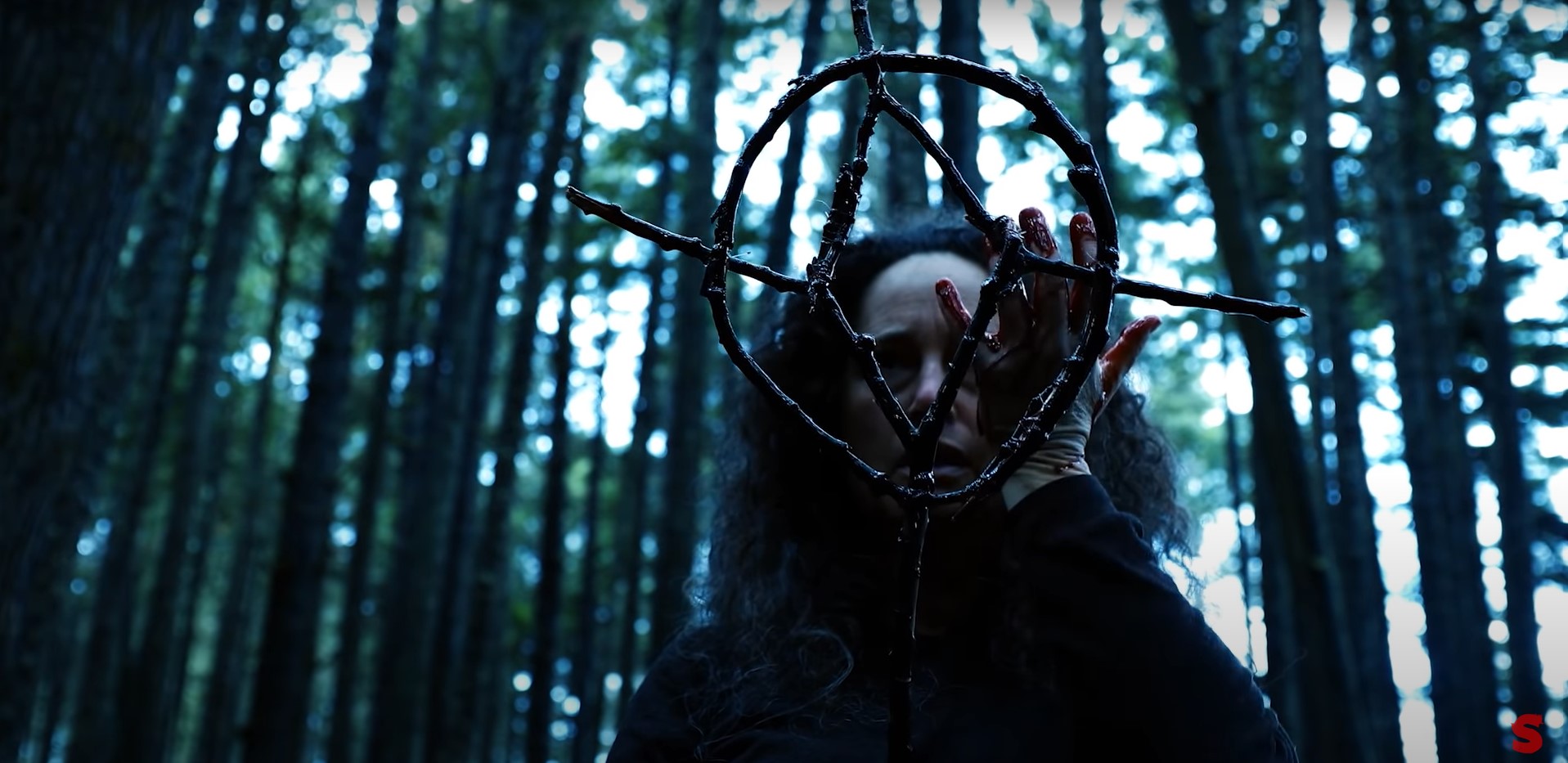
It’s been established that “Hellbender” is classic without being conventional but does that necessarily make the film worth watching.  The answer is resounding yes.  “Hellbender” has a spartan wit of etching out enough character-driven resolve balanced with soft-pedaled special effects around the spellcasters’ craft that’s intertwined more with nature. Their special blood mixed with twigs, berries, or leaves are the special recipe for conjuring charms and incantations and while the mother’s intent is to keep on a low profile and away from people, the teen daughter who was held back from who she really is, held back from her own life even, has been rewired as the monster with a spasmodic surliness seen through her deceivingly wide smile and chipper attitude. The love and psychopathy are a symbolic combination of a stereotypical tumultuous mother and daughter relationship stemmed from being two peas in a pod. The darkness within them yearns to be free and much like a teenage girl eager to spread her wings, Izzy tastes the power of individuality on her lips and develops an incognito ruse in learning more about her powers, her family history, and all her mothers’ secrets to be what all parents fear – to be replaced by their children. “Hellbender” has an immense sense of seeing our own mortality right before our eyes with the very presence of our children and as the idiom goes that knowledge is power, Izzy plans to learn the whole ins and outs of her true self. “Hellbender” never lets up and never doubts the story with implementing a charade within a charade to keep audiences on their toes up to the fiery finale point of no return after opening Pandora’s box.

The Yellow Viel Films distributed “Hellbender” is a witches’ brew unlike anything ever concocted in the genre and the Shudder Original film has a new UK DVD release from Acorn Media International. The region 2, PAL encoded, DVD is presented in a widescreen 1.85:1 aspect ratio, has a runtime of 83 minutes, and has a certified 15 rating for very strong language, strong bloody images, violence and threat. Running at a higher level DVD9 bitrate of 8-9 Mbps, the image presentation is phenomenal for the format with no compression issues and the visual details are seamless. Catskill mountains invoke a tactile dampness throughout, and the foliage enlivens with a primary green with good contrasts against the darker brown and forestry emerald shades. The English language Dolby Digital 5.1 surround sound also has little to complain about with a maxed-out output of 192kbps that provides an unsullied soundtrack to H6LLB6ND6R’s discography. Dialogue renders perfectly as well. The only flaw is with the ambient overlays that distinctly felt exaggerated to a fault. Even when Izzy is walking through the forest, the Foley had an extra 200% crunch underneath her feet being one among the examples. Bons features included a visual FX breakdown by FX artist Trey Linsdsay that goes over layer-by-layer the visual heavy effect scenes to see how they were created, a handful of blooper scenes, behind-the-scenes footage of the Adams family shooting scenes and testing lynched dummies, H6LLB6ND6R band music videos, travelling with Wonder Wheel productions, and a short, very short, slice of film of Zelda Adam’s alter ego, Eville Adams in an odd artificial scope. Unflinching folkloric horror with a pinch of overparenting gone awry, “Hellbender” is hell-spawn defiant and a perfect, LoFi witch film that isn’t a witch film.

EVIL Spam E-Mail Wants to Play a Game! “Planet Zee” reviewed! (Darkside Releasing / Blu-ray)

Land onto “Planet Zee” now on Blu-ray! 

Struggling woman filmmaker Zee Bronson is trying to make what she loves a supportive career. Smoking pot, drinking beer, and living with her grandmother Sam mellows out Bronson’s anxiety of potentially landing a writer-director’s gig one day. When her sleazy producer, Serge, closes a deal with an investor interested in her script, Zee eyes widen with excitement, but her premature celebration quickly turns sour when Serge notes the financer wants someone else to direct her screenplay. A vexed Zee turns to a weird email spam virus that has seemingly appropriated her computer to propose a game of life with superpowers or death. Convincing Serge into joining her, the two unwittingly open a diabolical portal that traps them inside the apartment, subjecting them to battling a demon and persuading them to kill one another. As their relationship dissolves slowly throughout the night, lines a drawn between friend and foe in order to escape the grip of a computer-commanding Game of Power.

There is bottom-of-the-barrel independent schlock done with very half-hearted inspiration and then there’s bottom-of-the-barrel independent film done with A for effort around a difficult to sell single-locale story that includes witty dialogue and humble homemade effects. Some of these mighty, homegrown indies stem from one ultra-eccentric Berlin, Germany physics and prehistoric archeology studied-turned-artful filmmaker Zetkin Yikilmis in her second written and directed feature, “Planet Zee.” Her B-movie, or should I say Z-movie, is the epitome of independent filmmaking in knowing the production’s limits and how to make the most of a film with what little material is available to use, such as a deluging cash flow for big budget grandstanding that’ll get your name on marquees, posters, and regional commercials. Instead, “Planet Zee” is very much meta love and confidence concept toward Zetkin Yikilmis herself, as the title implies, being a woman in a typically projected masculine dominated industry. Yikilmis follows up her sophomore film from an array of micro shorts and her 2019 released debut feature, “Some Smoke and a Red Locker,” incorporating elements of the stoner horror-comedy into her 2021 film that’s self-produced by Yikilmis and her cinematographer husband, Dominic, as well as longtime collaborator S.B. Goldberg.

Zetkin Yikilmis, obviously, stars as Zee Bronson, a bohemian screenwriter attempting her hand at filmic success while having her grandmother live with her in a small apartment. Having surveyed Yikilmis’s micro shorts, her droll act as stoner-chic Zee Bronson imitates far from her other self-applied roles with a sluggish repartee and often tinkering with slapstick with fellow costar Alexander Tsypilev as squalid producer Serge. Yikilmis and Tsypilev’s reconnection after “Some Smoke and a Red Locker” gives way to a natural onscreen dynamic that has experience role reversal, gender role reversal, and to test their association connection. With a tight-fitting shirt that flirts with exposing his slightly protruding belly, Serge fits swimmingly into the cesspool of sexist producers with Tyspilev crafting Serge’s slimy mold with little pinches of details toward the producers first-rate me-first attitude. While Bronson and Serge are the two chief residents of “Planet Zee,” there is often a forgotten third wheel who bookends the narrative. Sam, Zee’s elderly only in looks grandmother played by Trish Osmond who had a small role in Zack Snyder’s “Army of Thieves.” The 1944 born English actress bloomed late in her career that begin in 2014, but that doesn’t stop Osmond from being a dominating player of goodwill toward bizarre films and roles, especially playing ones involving an usually vigorous old woman with underlying uncanniness probably important to the story. Minor characters fill in the rest with small brushes with minor scenes from Roland Bialke and Michael Tietz.

Through the veneer of bare budget and puerile comedy, “Planet Zee” puts together a couple of ugly statements well versed like a stain amongst the film industry but only brought up more recently during the #MeToo movement and seen as ingrained into industry as par for the course. Yikilmis mentions in the dialogue that as a woman filmmaker she fears oppressive struggles in forming a passionate career in creating art, her art being satirical comedy-horror motion-pictures, insinuating female-driven aspirations are often squashed by misogynistic viewpoints akin to the British journalist and author Christopher Hutchinson’s claim that women are not funny because they are pretty and do not need to appeal to men through humor. Yikilmin writes pitting herself, as Zee Bronson, against a sleazy and dismissive producer who exploits her with pretense friendship, mirroring the real-life exploitation of certain long-standing, fundamental moguls who instead of being held responsible for distasteful chauvinistic corruption, held women’s careers in the palms of their hands with a conniving, convincing promise of blacklisted ruinous slander or unfounded gossip if unethical compliance to their advances were denied. In lighter terms of the film’s satire, Yikilmis uses the situation as an allegorical parallel of who really has control over the story – the creator or the producer. As the creator, Zee Bronson yearns to maintain creative rights in telling her tale whereas the producer gives into the meddling whims of the highest bidder, reaching for the dollar signs that illuminate over their eyes. Serge’s me-first persona during the game offers no collaboration as he literally pushes down Zee for the faint prospect of survival and causes more harm than beneficial good. Look past the stock electricity effect visuals, polished lens flares, and the cheaply made demon getups and you’ll see inside “Planet Zee’s” fiery core, a passively seething call to overcome the darker side of a biased film industry.

Explore the terrain of Zetkin Yikilmis’s “Planet Zee” now on Blu-ray home video a part of the Darkside Releasing, as feature #24 on their Darkside Collection line, and distributed by MVD Visual. Shot and released in an aspect ratio of 1.78:1 widescreen, “Planet Zee” isn’t breathtaking with nearly the full 97-minute runtime inside Zee’s tight apartment living room, aka Yikilmis apartment where many of her shorts were filmed, and so the 1.78:1 aspect ratio is overkill or wasted on nothing spectacular aside from the trippy wallpaper or the bone-curtain that linger the background. In truth, “Planet Zee” could have been shot in a 4:3 for better framing inside a vertical inclined ratio. The full high definition, 1080p output does look good in the details. The trippy-cladded apartment and warm toned outfits pop with robust color. Though not labeled on the Blu-ray back cover, the release offers a DTS-HD 5.1 surround mix and despite being produced in Germany with Germany actors, the original language track is in English thick with a dialect accent but overall adequate and clean in delivering dialogue. Ambient effects often feel just as distant or separated from the visual trunk as their digitally rotoscoped onto the frame. Special features include a behind-the-scenes that actually isn’t anything relevant to behind-the-scenes material with a couple of rehearsed statements on set from Alexander Tsypilev pretending to be scared of Zetkin Yikilmis’s feigned dictator-like direction. Other bonus content includes a string through of Zetkin Yikilmis’s micro-shorts with Yikilmis serving as a host in between and a woman in horror trailer reel. “Planet Zee” is an unpretentious good time. Small, yes. Limited in budget, yes. Unknown cast, yes. Yet, where the film lacks with high dollar density it makes up for in free reign creativity and breezy humor that becomes a middle finger to inequality and duplicity.

Land onto “Planet Zee” now on Blu-ray!