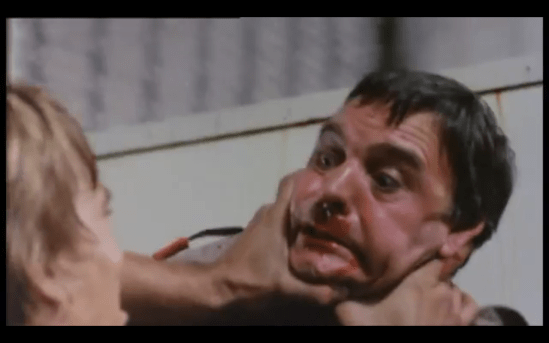
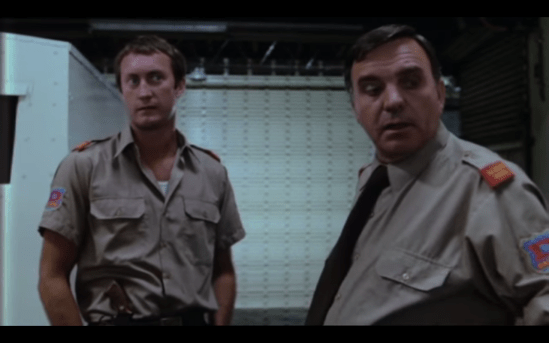
Eric Bana Embraces EVIL’s Infamy! “Chopper” reviewed! (Second Sight Films / Blu-ray)

Mark “Chopper” Read is one of Australia’s bestselling authors.  Read is also one of Australia’s most notorious criminals having wrote his autobiography in prison.  The pathological criminal’s life begins in the H Division of the Pentridge Prison in the late 70s where he quickly establishes himself a leader of a small three-man gang and viciously murders a rival leader at the chagrin of his acolytes, Jimmy Loughnan and Bluey Barnes.  When Jimmy turns on Chopper, stabbing him multiple times and then accusing him of attacking first, the ordeal has a subtle effect on the wildly shrewd and wayward Chopper who 8 years later is released with massively suppressed paranoia as old flings and old acquaintances are believed to be going behind his back or contracting a kill order on his head.  Under the delusions of working for the police, a paranoid, suspicious-filled, and unpredictable Chopper takes the opportunity to revisit old accomplices, such as the treacherous prison mate now turned drug addicted family man Jimmy Loughnan, after rumors circulate of Loughnan’s involvement in placing a contract on Chopper that results in conspiracy and murder.

Not to be confused as being completely autobiographical, or even semi-biographical, “Chopper” is a highly-stylized and self-proclaimed embellished account of the late Mark Brandon Read.  The Australian feature written-and-directed by Andrew Dominik (“Killing Them Softly”) was once the highest grossing Australian films of all time and still marks as a predominant, early 2000 release to accentuate Chopper’s high energy, erraticism, and violent behavior along with a stellar, method-acting performance from the lead star Eric Bana, who before turning into one of Hollywood’s most recognizable Australian actors was a former sketch comedian and stand-up comic.  Shot in Melbourne, Victoria, “Chopper” is produced by Michele Bennett and Michael Gudinski (“Wolf Creek,” “Cut”) with Al Clark (“Gothic”) and Marin Fabinyi (“Bait’) as executive producers under the state funded Australian Film Finance Corp. as well as Mushroom Pictures and Pariah Entertainment. 

As mentioned, Eric Bana, star of Ang Lee’s “Hulk,” and having villainous roles in the J.J. Abrams “Star Trek” prequel and “Deadfall” alongside Olivia Wilde, helms the titular character with a plumped-up version of himself, grows a wicked handlebar mustache, and engrosses himself into the peculiar persona that is Mark Brandon Read.  “Chopper” really puts Bana’s range on display with a crucial to success performance and the actor lets Read sublease headspace in what is an aberrated humor and darkly concerning ball of a biography.  Bana manages to make Chopper likeable yet terrifying, funny yet ferocious, and human yet monstrous as an unpredictable juggernaut of paranoia and survival that only knows how to protect himself by thwarting violence with violence.  Chopper mingles with other unsavory, carnivalesque characters in his journey through a jailbird’s life with what he considered his number one mate in prison Jimmy Loughnan (Simon Lydon, “Blackrock”), an old foe in Neville Bartos (Vince Colosimo, “Daybreakers”), and druggie girlfriend Tanya (Kate Beahan, “The Return”).  In Chopper’s post-near death eyes, enemies and friends are now subject to his suspicions, making him truly lonely in his own world of crime.  Performances shepherd in waves of volatility, intensity, and even immodest humor that force the scenes between them and Chopper into a pool of frigid and death-calling ice water, yet somehow, in the same breath, Dominik is able to take those performances in “Chopper” and turn them into one-giant joke at Read’s expense while still managing to keep afloat some sort of baseline truth to this period in time of his existence.  “Chopper’s” cast fills out with other colorful roles from Dan Wyllie, David Field, Gary Waddell, Hilton Henderson, Kenny Graham, Brian Mannix, Sam Houli, Robert Rabiah, Skye Wansey, and Terry Willesee. 

Most Americans will likely never understand “Chopper” as the comedy Dominik intends.  Bana does so damn good at his job, especially in his feature film debut, and Dominik’s black humor becomes murky by subsequent and sudden jerks toward humanization that audiences will grasp in different directions on how they’re supposed to feel and relate toward a character who stabs a man to death in the face and then cry in compassion for him or beats his girlfriend and then next scene unzips his pants and pulls out his manhood under the bar countertop to show his now ex-girlfriend while talking to two police investigators about his delusions of undercover responsibilities at the other end of the bar.  In its two-tone theme of the 1970’s thin, assured, and incarcerated Read and the decade later bulkier, paranoid, and free Read, “Chopper” has paradoxical and against the grain tones of wildly encompassing visualized thoughts stitched stylistically in the same fashion for pure entertainment value to symbolize Read’s emotively internalized expression.   Though fully linear, Dominik’s narrative structure can also be off-putting to audiences, digging into the entertainment value with crude edits and choppy segues that hardly shapes a timeframe and that can be tough for viewers invested in a particular storyline only to be abruptly pulled out of it and placed into another decade and an entirely different situation altogether.  Then again, “Chopper” essentially has no conventional plot other than the fleeting, distinct stages of a bumpy and insecure Mark Brandon Read’s course through crimes of contract and charisma of character. 

“Chopper” arrives onto a Second Sight Films Limited Edition Blu-ray set and a Standard Edition Blu-ray in association with Vertigo Releasing.  This reviewer was able to get hands on the Standard Edition that’s an AVC encoded BD50 with 1080p High-Definition resolution of a 2K graded, restored scan presented in a widescreen 1.78:1 aspect ratio.  A steely graded first act leads into vivid variability with color, matching Chopper’s descent tenor from shaking stability to a rocky road of mistrust. Decoding at a bitrate of approx. 23Mbps, Second Sight Films’ scan has elevated the details within the tumble of stylistic choices that closely symbolizes specific Chopper eras in which a very different Chopper is exclusive to one or the other while retaining a great amount of natural grain of the 35mm print. Audio specs include an English DTS-HD Master Audio 5.1 which, though lossy, has great compressed fidelity mostly in the dialogue department. Plenty of reverberations captured onsite at the Pentridge Penitentiary scenes that add a slither of realism instead of isolating solely the actors’ discourse. Dialogue itself is clean and clear without obstruction. When moved past Pentridge, the environment layers are scaled back to more isolated effects driven by the actors, i.e. gunshots, scuffles, etc., and so we lose that bit of realism deeper we go into Chopper’s psyche and the soundtrack from “Deliver Us From Evil’s” Mick Harvey pumps a little harder. Optional English subtitles are available. Though missing out on some of the physical lot in the bonus content, the standard release still offers a bountiful built-in special feature of old and new with fresh commentaries by Australian critic and author Alexandra Heller-Nicholas and Australian film scholar Josh Nelson, new interviews by writer-director Andrew Dominik Stand-up Comedy and Violence, new interview with composer Mick Harvey Not your Typical Film Composer, and a new interview with editor Ken Sallows A Tale of Two Halves. Archived bonus material regains new life and traction with commentaries from Chopper himself Mark Read and one with Andrew Dominik, a behind-the-scenes that sees raw film footage and cast and crew tidbits, a Weekend With Chopper is raw and untouched home video footage of Andrew Dominik and Eric Bana spending a couple of days with a wildly excited Read giving anecdotal accounts of his prison life and discussing his disbelief with a film where the subject is himself, and deleted scenes with optional director’s commentary. This particular Second Sight release comes off a little different than past dispersions in physical attributes with a clear green Amary Blu-ray case, something I have not seen before from the UK label. Detail illustration of Eric Bana as the titular Chopper holding a gun to his head in ebullience is quite striking and explicit in its purple-green coloring. Inside is what you roughly get with any standard release with no insert, but the disc is pressed with the same cinereal-alike art representing one of the Chopper’s frequent locations in the story. ”Chopper” is regionally locked on B for the feature that has a 94-minute runtime and is UK certified 18 for strong bloody violence and very strong language. Unlike any criminal to have ever lived and to have ever been represented on screen, “Chopper” wily tussles with Western audiences despite the dedication of Eric Bana but the work and the film can’t be denied as anything but great about an unusual man in a hyper dramatization that pierces more truth than fiction and now Second Sight cements a next level, Hi-Def release to better legitimize the irregular gang member and thug Chopper into cinema homes around the globe.
In a Remote Australian Town, EVIL Can Hear You Scream. “The Dustwalker” reviewed! (Umbrella Entertainment / DVD)

A quaint, outback town become the epicenter of a mysterious, otherworldly contagion that infects lifeforms to become mindless carriers, targeting loved ones for senseless, uncontrollable violence.  In her last days as sheriff of the town she grew up in before moving to the big city, Jolene must piece together the puzzle of last night’s mysterious meteor that crashed on the outskirts of town having an correlating connection between the town’s sudden communications blackout and the unknown epidemic that has physically and mentally transformed the townsfolk into a vicious, violent horde.   Jolene bands together the remaining survivors when the town is overrun by the zombie-like residents and tries to organize an escape, but a large dust storm walls them in not letting them flee to safety, while a large subterranean creature burrows through the dusty landscape intent on searching for the infected.

Sandra Sciberras’ “The Dustwalker” brings big universe problems to small town Australia as an alien tainted corruption courses violence through the veins of secluded outback locals with a humungous extraterrestrial on a raging prowl.  Shot in the shire of Cue, Western Australia, Sciberras’ written-and-directed Sci-Fi terror cataclysm of zombies and monstrous creature showcases some of Cue’s unique historical and architectural buildings and natural landscapes landmarked around the microscopic population of a few hundred people of the dust bowl region, creating a isolating apprehension of endless nothingness when hell breaks loose on Earth.  “The Dustwalker” is the first thrilling genre film outside the drama and comedy context for the director, creating new challenges for the seasoned director to incorporate monsters and mayhem into the fold, while also serving as co-producer, alongside Megan Wynn and Grace Luminato, in this female steered production under Sciberras and Luminato’s Three Feet of Film banner and financed by a conglomerate of Head Gear Films, Kreo Films, Metrol Technology, and SunJive Studios.

With a strong female contingent behind the camera, there is also one in front of the camera beginning with Jolene Anderson (“Prey”) as longstanding Sheriff Joanna Sharp who’s ready to leave her hometown in the dust, but before disembarking on her new big city adventure, the municipal officer has a showdown with a plague not of this Earth.  Anderson is sided by “The Hunger Games’” Stef Dawson and “Wolf Creek’s” Cassandra Magrath, playing the roles of little sister, Samantha, and the local geologist, Angela, respectively.  Aside from the sheriff rounding up an uninfected posse to arm and fight their neighbors plagued by an insidious infection, Samantha and Angela rarely contribute to the cause with their subtle character terms.  Samantha cowers mostly behind her big sister’s shield and gun, never adding substance to the sibling dynamic, sidelining Dawson’s confident performance.  Subjecting Samantha’s young son, Joanna’s nephew, into harm’s way would have affably weaved an obligatory edge-of-the-seat motivation toward family tension and desperation into the story that’s very honed in on a small town framework.   On the opposite side, Angela runs wild around town and is continuously depended upon by the story to be the scientific expert, though displays very little scientific knowledge, who discovers the crash site crater in solid rock and is willing risktaker with experimenting driving into the dust storm wall.  Despite her character’s poor introduction and setup who literally appears out of nowhere, Magrath’s outlier enthusiasm forces her character more into the narrative than otherwise innately.   The poorly written Samantha and Angela character are completely overshadowed by Joanna’s second in command, and the town’s only other cop, Luke, played with a righteously thin long mustache and scruffy mullet on Richard Davies.  Davies entrenches a consistency that’s present throughout “The Dustwalker’s” fluid scenario as the causal, yet dedicated, man of the law that compliment’s Anderson’s butt out the door Sheriff who has to stick around a few hours more to see the disturbance come to a head.  A miscellany of townsfolk partition side stories for the sheriff to investigate, involving a portion of the film’s remaining cast with Talina Naviede, Harry Greenwood, Ben Mortley, Ryan Allen, and Oscar Harris.

I have a very big problem with Sciberra’s “The Dustwalker.”  A problem that is approx. 16 years the film’s senior and has invaded a portion in my brain that is already occupied, trying to evict the current and rightful tenant that has paid, in full, dues of being the blend of sci-fi and horror I want domiciling my mental vacancy.  “The Dustwalker” follows nearly an identical story path as the 2003, Michael and Peter Spierig film, “Undead,” that follows a small Australian town under siege by a meteorite brought plague that turns residents into flesh eating zombies with something more obscure transpiring around them.  Sounds familiar, right?  If not, scroll up to the top and re-read the synopsis for “The Dustwalker” once again.  Now, I won’t slip spoilers into this review to explain exactly how “Undead” and “The Dustwalker” are undoubtedly two peas from the same pod, but minor tweaks here and there issue obvious differences in names, places, and villainous traits, but the rudimentary bone structure mirrors strongly “Undead” so conspicuously that “The Dustwalker,” after some contemplative comparisons, leaves a sour taste.  As for the film itself, the first 20 minutes of “The Dustwalker’s” first act compellingly sets up caught off guard characters being mixed into an unknown and threatening situation that is well-crafted with bread crumb clues provided to the characters as well as the audience, but the second acts staggers through principle character awareness with a stillness in their too-little-too-late reactions from being completely ignorant of the facts that something terribly wrong is happening and this leads into the unfolding of the third act which divulges the “Undead” echo.  The mindless local horde have a malformed screech producing from an abnormal elongated jaw, are speedier than Speedy Gonzales, and jump higher than a professional basketball player, but their purpose for at first targeted then randomized violence has an unclear schematic other than being driven by the ooze from the space. Correlation between the substance controlling the townsfolk and the oversized camel cricket with a scorpion tail and can breath fire fails to materialize purpose, especially when great dust walls, expanding as far as the eye can see, are formed to keep things nicely contained that provides one certainty – there is an alien intelligence at work here.

From out of this world and into your living room, Umbrella Entertainment releases “The Dustwalker” onto DVD home video. The NTSC formatted, region 4 release runs at 95 minutes and is rated MA15+ for strong horror, themes, and violence (and language if you’re easily offended by “what the fuck was that?” line stuck on repeat by the principle characters). Presented in a widescreen, 2.35:1 aspect ratio, image consistency holds throughout and really develops that dusty, outback setting with a bunch of aerial shots of the rocky terrain and spread apart shanties to tune up the isolation factor. David Le May’s blend of hard and natural lighting adds to emptiness as long shadows have no structures to bounce off on. However, some of May’s shooting techniques on filming the running infected tilted into being too cleanly staged that often downplayed the tingling fear from the organic full speed sprint of a crazed person. “The Dustwalker” standalones as a feature without any bonus materials on the DVD which isn’t atypical of many Umbrella Entertainment releases. There were also no bonus scenes during or after the credits. Supporting Sandra Sciberras’ “The Dustwalker” has been nothing less than controversial for the soul due chiefly against the derivative storyline from a better assembled modern classic that’s full of gore, fun, and, at that time, an ingenious concept, but “The Dustwalker” clone feels pieced together by the leftover scraps of an august predecessor.

Own “The Dustwalker” on DVD!

When EVIL Isn’t That Black & White. “Choir Girl” reviewed! (Nexus Production Group / Digital Screener)

Eugene lives a lonely, pitiable existence.  Residing with his ailing father in a slum neighborhood, his photography background captures the crime and the desolation that surrounds him, snapping pictures without ever interceding with his crime-riddled subjects, in an attempt to hold an exhibition or sell his work to a high profile magazine, Slipstream, as his ticket out of the despair that engulfs him.  When Eugene stumbles upon young teenage girls being drugged and held for prostitution, he becomes fixated on Josephine when a low-level editor, seeing her as a professional stepping stone, prods him for more pictures that evoke hope out of her situation, but when he finally intervenes, helping her escape, Eugene falls into a world of a massive prostitution ring with doctors, cops, and major organizations on the payroll and a kingpin named Daddy at the helm.  The deeper the debt placed upon him for showing compassion to Josephine, the more the lines blur on whether he’s become his muse’s lone savior or just his meal ticket out his current life.

How far will your moral principles take you to save a teenage girl when you’re locked into a no-win situation?  That’s the theme explored to a shocking sexual assault conclusion in John Fraser’s 2019 unscrupulous Australian thriller, “Choir Girl.”  Introducing Fraser’s first credited written and directed full length feature film, shot entirely in black and white, the Melbourne arthouse and a goose egg-fairytale version of “Pretty Woman” speaks volumes toward the perceived illegality of immigration, the horrors of sex-trade, and the touch-and-go balance act between doing what’s right and self-serving opportunities with a 15-year old girl’s fate dangling at the end of a line.  “Choir Girl” is produced by Ivan Malekin under his Melbourne based label, Nexus Production Group, along with Lucinda Bruce serving as co-producer.

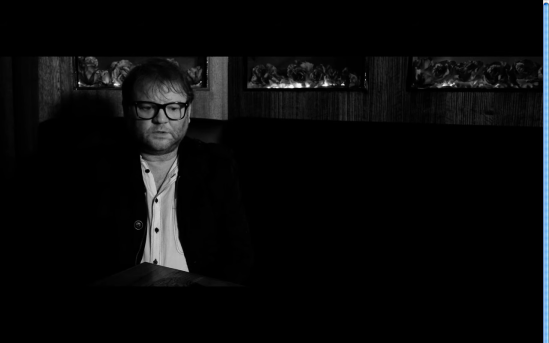
To carry “Choir Girl” through the muck of it all, a strong performance must arduously burden the gravity of the content and Peter Flaherty astounds with an ingloriously flawed and unlikely hero, Eugene.  “The Butcher Possessions” and “KIllervision” actor masts a greasily haggard with bordering neurodevelopment issues, disheveled in his attire, and walks with a noticeable limp, made intentionally noticeable when as he walks away from characters and situations.  Though Eugene seems meek, the shutterbug aches to improve himself by seemingly exploiting others as a freelance photographer and being persistent in that pursuit until becoming engrossed into a 15-year-old prostitute’s life struggle blossoming before our eyes a rather unsettling grown man and teenage girl relationship that assumes a pedophilia ideology of adoring the child to the extent of protection, but also falls in to grooming and sexual exploitation.  The film introduces audiences to Sarah Timm, playing Eugene’s muse, Josephine, an Eastern European illegal immigrant who literally has nothing left that is her own, this including her body, when forced into sex slavery so when Eugene and other characters call her diminutively by Jo, she immediately corrects them to call her Josephine in order to keep the one thing left that is still hers, her name.  In her first feature role, and a mightily demanding role it is with the amount of discomfiture of playing essentially an abused child, the German native will have audiences overlooking the fact that she’s portraying a teenager in the sordid sultriness of sex-trafficking with crafting Josephine’s war-torn history and pre-adolescent childhood stories as always the girl in the background, the unpretty forgotten girl that blended in and no one noticed, until she’s a part of a much larger, more ferocious, uncompromising system that Daddy (Jack Campbell) dictates with CCTV live feeds of every sleazy, scummy hotel bedroom in his syndicated footprint.  The cruelty that Jack Campbell reins savors every facet of Daddy’s being on screen with an intent to be a immovable roadblock in Eugene’s advanced for progress and for John Fraser’s “Choir Girl,” the character development and personalities find justification from the cast with the exception of one, the low on the totem pole and self-absorbed Slipstream magazine editor, Polly.  Krista Vendy imposes on Polly’s rabid  narcissism with an incredibility that becomes the underbelly amongst a bloc of solid performances.  Andy McPhee (“Wolf Creek”), Lee Mason (“The Caretaker”), Jillian Murray (“Body Melt”), and Kym Valentine fill out supporting roles. 

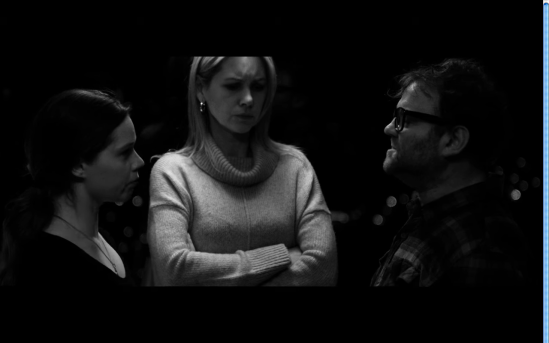
I love the juxtaposition opening of Eugene in his dark room in the middle of photographic processing his oblivious subjects, including a drug abusing child with a hypodermic heroine needle sticking out of his arm, a blowjob being serviced between a wall and bushes, or the aftermath of man being beaten with his assailants walking away from his leveled body, and then the title fades in from black and the next scene is of a framed magazine cover with the cover title “It’s All Back and White.”  The sequence sets up perfectly the entire premise driving “Choir Girl’s” gray area circumstances that nothing substantial, meaningful, or controversial can be black and white. Plus, the entire film is shot in black and white furthering the contrivance of the theme. The gray area challenging Eugene is a tightrope walk when squeezed for payment for snatching Josephine by the amoral organization claiming property theft, making him submit to the idiom of pulling his strings like a marionette or shooting at his feet to make him dance for insatiable perverse satisfaction. Eugene rarely displays remorse in his demeanor, face, or actions for the things he does and doesn’t do when faced with adversity in a slither of sociopathic idiosyncrasy, but when outright criticized for his inaction, he’s able to right wrongs with deplorable methods like a toddler trying to mop up a grape juice spill with mother’s expensive, white dress. There’s a bit of innocence or naivety in Eugene’s mind as you can almost see the gears slowly spinning when confronted but in the defense of the man who no really gave the time of day, those gyrating mice wheels of delicate thought snuck past every contingency against Eugene surviving Daddy’s deadly game, leading to an unsavory solution that puts the viewer in an awkward spot to either avert the eyes or remained captivated to see it through.


I, for one, remained seated, steadfast to the end, hypnotized by audacity of John Fraser in his feature film directorial, “Choir Girl,” that has arrived onto Apple’s iTunes. The unrated film is presented in it’s original aspect ratio of a widescreen format and will have an English language Dolby Digital 5.1 surround sound availability. Though derided as kitschy at times, the black and white veneer works here inside “Choir Girl’s” vascular system of catch-22s and director of photography, Mark Kenfield, rides a consistent straighten arrow style with steady cam shots, decent framing, and some tracking shots without pushing the envelope in regards to angles or oscillation. There were no bonus content or additional scenes during or after the credits. “Choir Girl” sings no praises of hallelujah. Offers no solace in time of hardship. If you’re looking for a movie that touches you, then you’re in for a rude awakening as “Choir Girl” obliterates the moral standards, leaving faith outside, with a severe penance in abetting the Devil’s work, selling their soul to do what’s right.

Did Evil Put You On It’s Will? “Next of Kin” review!


After the untimely death of her mother, Linda returns from her university studies to reacquaint herself with the inherited Montclare, a home for the elderly her mother owned and operated through the decades as a family business. As she internally debates about whether to sell the grand, yet antiquated estate, 24-year-old Linda shuffles through her mother’s left behind things that rekindle Linda’s faded memories of her youth and add a sense of melancholy about her mother’s mental condition. A seemingly quiet, if not quirky, home for the elderly quickly becomes shrouded with mystery after the discovery of one of the residents found dead in a bathtub. Soon after, Linda feels as if she’s being watched and toyed with inside the corridors of Montclare: candles found lit, bathroom fixtures overflowing and cascading with water, mysterious figures looming from inside her room’s window, and her mother’s belongings sprawled out about the room. Paranoia sets into Linda as she suspects the resident caretaker and doctor of a lethal plot against her inside an old, foreboding manor that troubled her mother into deathly consequences and she searches for answers inside her mother’s extensive diaries that reveal the ominous dread that overwhelmed her inside an evil house.

“Next of Kin” is Australian’s answer to Dario Argento’s hauntingly apprehensive and vividly hued classic, “Suspiria.” Directed by Tony Williams and co-written with Michael Heath (“Death Warmed Over”), “Next of Kin” embodies monolithic brooding merits of a gracefully shaped horror and palpitating anxiety unlike any other Australian horror film we’ve ever seen before. In fact, Williams 1982 film doesn’t feel very Australian at all that’s set chiefly in and around Montclar, a lavishly gothic estate with expensive fountains and floral garnishes. Aside from native accent and barely a dusty road to drive down, the country of origin could be anywhere, punching home the aspect that the incident at Montclar is universal. Looking into a couple of their techniques, Williams and cinematographer Gary Hansen (“Image of Death”) utilize slow motion and interlaced scenes to convey a surreal dread that transcends from film to senses, also involving disruptive audio cues and visual jump scares, to culminate every scene, ever moment, into a well thought out result on how to effectively reach out and affect that scared little boy or girl in all of us.

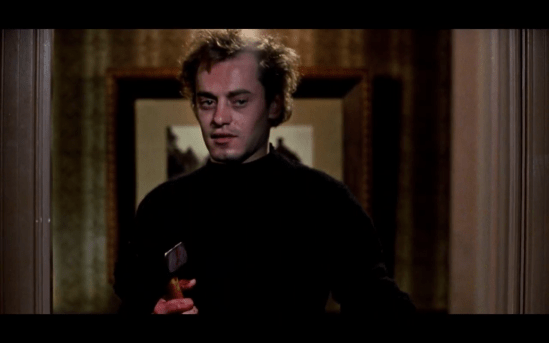
Primarily a television and mini-series actress, Jacki Kerin sets foot into the main actress Linda. Kerin’s able to flip emotions from emitting a passive quality while she seemingly annoyed by her mother’s death while switching gears into a hyper-tensive defender. The small screen actress translate well onto the big screen, accompanying well versed thespians in “Picnic at Hanging Rock’s” John Jarratt, who went onto to more notably the “Wolf Creek” franchise. There’s also Alex Scott (“The Abominable Dr. Phibes”) and Tasmanian-born actress Gerda Nicholson. Scott and Nicholson do a fine job of portraying un-trust worthy snoops with underlining knowledge yet to be exposed and with Kerin, the fear goes unopposed and spreads like wild fire. the remaining cast includes Charles McCallum, Bernadette Gibson, Robert Ratti, Vince Deltito, and Debra Lawrence.

Practical effects are minimal in “Next of Kin,” but are well integrated with a meticulous purpose. Williams maintains the gore to an infancy amount, but the New Zealand born director doesn’t nickel-and-dime the macabre. Much of the death displayed comes in at post-humorous, visually positioning the cold and blue hued, more at times ripped life from, bodies to vessel the story forward toward a shocking, what-the-hell, and oh glorious climax. Then, when all the proverbial cards on the table, Linda finds herself ensnared in a cat-and-mouse game where Chris Murray’s practical effects come to the forefront. Special effects maestro, Chris Murray, had the George Miller experience while working on “Max Max” in 1979, prepping him to be the adequate effects artist to create surreal and, also, brutal Giallo-like murder.

Umbrella Entertainment presents Tony Williams’ “Next of Kin” onto a region free, full HD 1080p Blu-ray home video. An Ozploitation classic in itself, Umbrella Entertainment puts the film on a home media pedestal with a remastered 4k transfer from the original 35mm interpostive and presented in a widescreen, 1.77:1 aspect ratio. Beyond gorgeous with lush grim colors and able to keep the natural grain of the 35mm nitrate, “Next of Kin” sees one hell of an upgrade that shows no wear in the transfer and no compression issues or edging enhancements. Even with the heavy blue tint at time, the amount and the use is appropriate alongside Gary Hansen’s vision. The new English DTS-HD master audio emphasizes the heavy synthesized score by German electronic music composer Klaus Schulze that meshes fine with the creepy house ambiance. Dialogue is properly forefront and crystal clear. Special features run amok with audio commentaries with director Tony Williams, producer Tom White, and with cast members John Jarrett, Jackie Kerin, Robert Rattie. Also on the release is a “Return to Montclar – Next of Kin” shooting locations revisited, extended interviews from “Not Quite Hollywood” director Mark Hartley, deleted scenes, original and VHS trailer, German opening credits and trailer, an image gallery, and a couple of Tony Williams’ short films: “The Day We Landed on the Most Perfect Planet in the Universe” and “Getting Together.” “Next of Kin” has a brawny Italian Giallo flavor with a gritty, distinctive core of Australian horror filmmaking; sheerly beautiful and indisputably morbid, director Tony Williams has garnished a choice horror favorite that’s been sorely passed over through the years.

Evil Plots and Plans From Within! “Money Movers” review!


When a deadly robbery strikes one of Darcy Security Services armored cars, the security company’s chief executives aim to crack down on the already rigorous operational security protocols by implementing vastly unpopular and Union-irritating measures. The hit not only induces change to security procedures, but also opens up a can of worms that forces the hand of the three internal company men, who’ve been planning to steal from inside Darcy Security Services over the last five years, to accelerate their timeline. Their carefully laid out plan quickly becomes complicated when the mob gets wind of their elaborate heist, compelling the small three man crew to work for the crime boss without much of a choice as life and limb come to stake. Now the only thing that can stand between them and millions of dollars are two new Darcy recruits, a highly trained former police officer with a penchant for doing what’s honorable and a gun shy bloke targeted to be a prime suspect in previous armored car robberies.

Based loosely on a pair of actual robbery events authored by novelist Devon Minchin, “Money Makers” bares a ruthless resemblance to hardnose acts of crime as filmmaker Bruce Beresford captivates as the maestro behind the orchestration of Minchin’s book that’s gritty and enthralling on the big screen. The “Driving Miss Daisy” and “Double Jeopardy” director also pens a script full of bloody encounters and unflinching greed that delivers “Money Movers” as the first R-rated feature to stem out of South Australian Film Corporation, a production company that, up until then, co-produced dramas, mysteries, and family films, such as Peter Weir’s “Picnic at Hanging Rock” and “The Last Wave,” with McElroy & McElroy and later co-produced the widely successful Outback horror “Wolf Creek” starring John Jarrett nearly 30 years later.

While numerous characters are subject to suspect and their roles’ intentions are guarded to the very end, the plot, for all intents and purposes, circulates around Eric Jackson, a former champion race car driver who now tenures as a 5-year senior security guard at Darcy’s, played by Terence Donovan. Donovan gives the performance his all with a wide range of subversive behavior. From cool, calm, and collective to feral gumption, Donovan race ends in drenching ferocity that’s fueled by his fellow costars who meet him at his level of performance. The most recognizable face, at least for me, is “F/X’s” Bryan Brown who portray’s Eric’s brother, Brian Jackson. They butt heads with former police officer Dick Martin and his no tomfoolery. The late Ed Devereaux had an old school acting method, very impersonal and straight forward like a John Wayne-type, and that worked perfectly in the role of Martin who befriends the projected patzy Leo Bassett played by “Quigley Down Under’s” Tony Bonner. Bonner’s able to capture Bassett’s unconfident, yet smooth persona that’s complete opposite of his partner Dick Martin, whose confident, but brash. What’s curious about the characters lies under the surface of a domineering male lineup – the women. Not one female character is apparent in a co-lead role and each role has a presumable flaw to them. Candy Raymond is an undercover private eye who uses her body and wits for information, Eric Jackson’s wife, played by Jeanie Drynan, has an absent and naive approach, and a handful of minor roles involving non-verbal girlfriends and late night secretary carnalities. The cast rounds out with Charles ‘Bud’ Tingwell, Alan Cassell, Lucky Grills, Hu Pryce, Terry Camilleri and Frank Wilson.

“Money Movers” doesn’t scream perfection, but plays a major influential part in the infancy stages of violent crime thrillers that paved the way for such films like “Heat” or “Point Blank” and supplies another keystone in constructing the genre a solid foundation. “Money Movers” is bookend with graphic shootouts and peppered with conniving dealings and unsavory characters toward a shoot’em up heist climax that Bruce Beresford was able to depict visually and script confidently. In early scene, the storyboards could have been revised, restructured, or reordered to unearth a clear picture of establishing character backstories and setup that still process a puzzling connection between their nefarious intentions, but the ample storyline corrects course quickly without loosing too much time to ponder about the after effects of the early scenes.

Umbrella Entertainment re-releases “Money Movers” on a PAL DVD home video. The region free DVD is presented in a widescreen, 1.85:1 aspect ratio. Definition is key as the colors are, for lack of a better word, washed, but the clear cut outline that produces a sharp finish image grants this release of “Money Movers” a seal of approval that isn’t asterisked with blatant enhancements. The English Dolby Digital 2.0 track is on point with clarity in the dialogue and properly aligned, volumed, and untarnished ambiance. What’s interesting about “Money Movers” is the lack of a score that forces the viewer, subconsciously, to hone in more acute to the characters and their brazen actions. Bonus material includes “Count Your Toes – a making-of featurette with writer-director Bruce Beresford and cast members Bryan Brown, Terence Donovan, Tony Bonner, and Candy Raymond. There’s also the theatrical trailer and Umbrella Entertainment’s propaganda material. One of the first to be up on a prestigious pedastal of heist films, “Money Movers” is a violent, toe-cutting, experience armored with a great cast of acclaimed actors and filmmakers in this Ozploitation classic.