Burt Gummer Neutralizes EVIL Graboids in “Tremors: Shrieker Island” reviewed! (Universal 1440 Entertainment / Digital Screener)

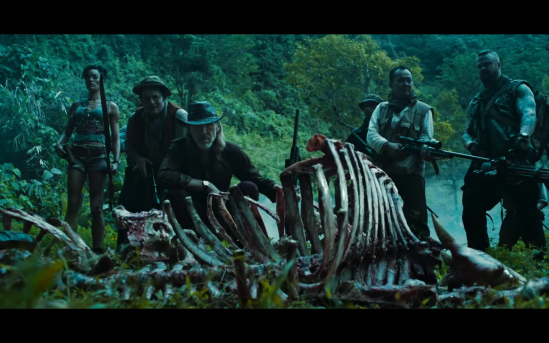
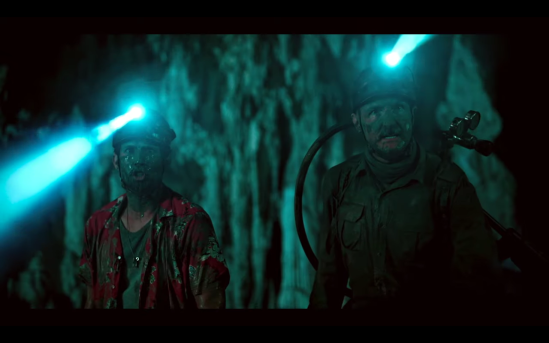
A wildlife preservation maintains categorizing and tracking of native elephants, but when one of the company’s philanthropist turns his private island, just across the water from the preservation campsite, into a game reserve for apex predators, nothing will stop him from wagering the thrill of the hunt on expensive, top-of-the-line game.  That is until the graboids he’s illegally bred and genetically modified starts to hunt the wealthy trophy gamers back, especially when the Precambrian lifeforms metamorphize into the fast-spawning shriekers.  With an island full of graboids and shriekers that contributed to already one death, graboid expert and arms enthusiast-survivalist, Burt Gummer, is tracked down and brought out of retirement to once again battle his longtime killing machine adversary.  With no munition weapons, an obstinate playboy’s maniacal urge to hunt the fierce predator, and the most powerful of the graboids bred on the island able to wriggle underneath the sea floor between land masses, Gummer and a team of preservationists must band together to stop the graboids from being an invasive and unstoppable species. 

From an icy Canadian landscape in “Tremors:  A Cold Day in Hell” to the tropical beaches of Thailand, “Tremors:  Shrieker Island” is the seventh feature film in the Tremor’s 30-year franchise.  Heading straight to video on Blu-ray, DVD, and Digital, including Streaming and VOD platforms come this October 2020, the subterranean monster action-comedy is steered by serial sequel director Don Michael Paul, who directed the last two “Tremors” installments, off a Paul script co-written with Brian Brightly that set sights on expanding the graboid footprint even farther East and surrounded by the seas of Thailand, further more distancing itself from the dust bowls of Perfection, Nevada and Mexico into new and unexplored terror-itories.  Universal Pictures’ off-shoot subsidiary banner, Universal 1440 Entertainment, and Living Films serves as the presiding production companies. 


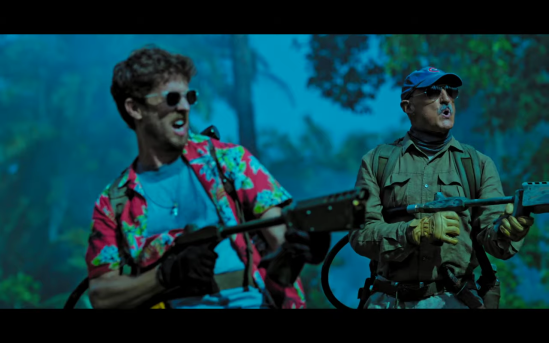
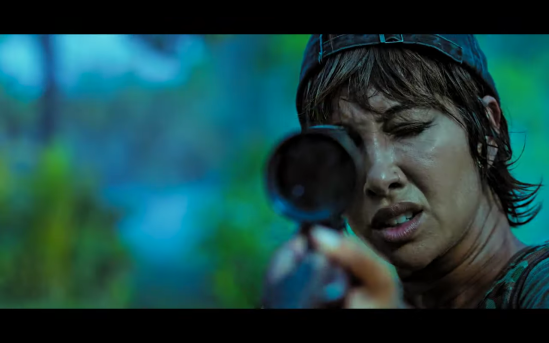
The smart-mouth, quick-wit, arms-toting Burt Gummer has become, dare I say it, the Ash Williams of the Tremors’ franchise as a perpetually dragged back hero into monstrous circumstances to battle graboids and their offspring on land, air, and in the pits of hell of the innate underground habitat.  Aside from Bruce Campbell, there are not too many heroes in a genre that usually has a villainous backbone and so Michael Gross is the longest lasting reoccurring actor, spanning now 30-years, to return as an original hero who first encountered and killed the bastard creature who “broke into the wrong God damn rec room” in Perfection, Nevada.  Gross, now gray with a few more wrinkles sporting his iconic Gummer mustache, fits into the military-esque attire under his ball cap to square off alongside a ragtag team of unprepared, unqualified, and novice graboid hunters in Jon Heder (“Napoleon Dynamite”), Jackie Cruz (“Orange is the New Black”), Caroline Langrishe, and Richard Brake (“31”).  Heder fills in for the Jamie Kennedy role of Burt Gummer’s son, Travis, from the two previous installments and though Travis is mentioned briefly, the character’s presence is extended through Caroline Langrishe as Travis’s mother and preservation camp leader.  Heder and Langrishe complete that entangled trio that has been a trope present in nearly all the Tremor Films, starting with Val McKee, Earl Basset, and Rhona LeBeck, battling side-by-side to overcome the odds.  Cruz and Brake offer a serious side dish of badass on a polar opposite spectrum.  Jackie Cruz as Freddie, an entrenched team member of elephant tracking, is the Latina MacGuyer and is a weapon in herself that only someone like Burt Gummer would fully appreciate while Richard Brake, with his trademark sinister smile as obsessed game hunter Bill, relishes the role, pulling a watered down, PG-13 version of his typical bad guy motif from the more violent-venomous Rob Zombie films.  However, a minority of characters fall through character development cracks, such as Anna played by the up and coming Cassie Clare (“Death Race 4:  Beyond Anarchy”).  The archery expert Clare is a pertinent show off with a bow and arrow and is Bill’s right hand, but the Anna, under Cassie’s muscular thin frame and ironclad persona direction, has an inclined built up that goes to naught as she’s snubbed-shoved to a lesser role without having a significant impact in the latter half.   The reverse can said for Heder’s Jimmy character with first impressions of a top class scientist with lower class ambitions; yet, in an instant, Jimmy becomes a battle-worn graboid and shrieker killer while more experienced hunters, especially one wielding a mini gun, have less of a handle on the situation. 

While it’s neat and cool and nostalgic to see graboids and Burt Gummer back in action, much like the disconnect with lopsided arch able characters left to be graboid-fodder, “Tremors:  Shrieker Island” falls short of earlier predecessors, replacing personal filmmaking style over story substance.  For one, graboids just haven’t been the same since going from practical applications to computer imagery since “Bloodlines” on that has radically evolved the creatures from a less-is-more model to a complete overhaul of their veneer, resembling the dark and slimy man-eating tentacles of “Deep Rising,” and as well an overhaul of the creature mechanics that lead graboids to leap out of the ground and into the air like a flying fish, spiraling and twisting back into their dirt environment.   The graboid burrowing irks me as well as the ground explodes 10-15 feet up into the air in a blatant uses of detonating charges by the effects team to create the earthworm moving effect instead of just a perpetual hump and collapse of the ground that’s more of a menacing effect. Nuances run amok, causing subtle points of frustration in how Paul’s direction is really more a passive glance than a serious absorption of the franchise. Meandering people on the ground when they fully well know graboids are attracted by movement, half the film scaled back to slow motion to accentuate big money explosions, and the mother of all graboids able to target Burt Gummer for a mano on monstro showdown are just more examples of the charmless details in, what is, a palpable comedy with Earth dwelling monsters. “Tremors: Shrieker Island” is the equivalent of “Jaws: The Revenge;” the story may not make sense, but watching gigantic monsters cause mortal destruction is pure creature feature bliss.

What may be Burt Gummer’s last ride (or so they said in the last film), “Tremors: Shrieker Island” tunnels onto Blu-ray, DVD, and VOD come October 20th, 2020 and soon to be streaming on Netflix shortly after. The BD50 Blu-ray will feature an anamorphic widescreen, 16:9 aspect ratio, with an English language DTIS-HD Master Audio 5.1 while the DVD9 is presented in a widescreen 16:9 with a Dolby Digital 5.1 surround mix. Both formats will include optional English Dolby Digital 2.0 as well as a dubbed French, and Spanish DTIS Digital Surround 5.1 with a slew of option subtitles: English SDH, French Canadian, French European, and Latin American Spanish. Since the film was reviewed on a digital screener, the A/V aspects will not be critiqued. The exclusive bonus features listed on all physical and VOD include a Burt Gummer narrated “The Monster of Tremors” that gives you everything you need know about the diabolical monsters, “Tremors Top 30 Moments” that hone in on 30 years worth of scenes that provide laughs, Burtisms, and some of the most gory moments in graboid history, and, lastly, “The Legend of the Burt Gummer” that focuses on the iconic graboid hunter character told by his persona creator himself, Michael Gross. Richard Brake, once again, nails the villain, Jackie Cruz stuns as a resourceful Gummer-ite, and Michael Gross fleshes out one more commando swashbuckling Burt Gummer in the zany seventh installment of the unstoppable “Tremors” franchise.

Pre-order Tremors: Shrieker Island on Blu-ray/DVD/Digital!

EVIL Does a Little Bathhouse Wet Work in “Melancholic” reviewed! (Third Window Films / Blu-ray Screener)

On nights when a humble Japanese bathhouse is supposed to be closed for business, the lights remain illuminated, gleaming off the crimson covered ceramic tiles of Mr. Azuma’s bathhouse floors as body’s soak in a pool of blood.  The proprietor, Mr. Azuma, is in severe financial debt to Yakuza boss Tanaka who turns his meager business into a nightly slaughter house to dispose of Yakuza opposition or those just on the syndicate’s bad side.  When Tokyo University graduate, Kazuhiko, applies for a job as an attendant to see a girl who regular attends the bathhouse, the reserved model employee becomes enthralled with the disposing and cleaning up of the corpses, working alongside a couple of professional hitmen, Matsumoto and Kodero, but when the job he’s so passionate about requires him to be more hands on with the assassination assignments and the endless pressure from the Yakuza bares down on his colleagues and friends, Kazuhiko’s radical plan to eradicate the woes of his newfangled position just might mean his very life. 

Seiji Tanaka’s self-esteem building and identity attaining crime drama, “Melancholic,” might not reside as absolute horror, but any film involving the Japanese Yakuza is an unpredictable, Machiavellian expo worthy of every second.  Originally titled in Japan as “Merankorikku” or “メランコリック,” writer-director Tanaka retains a bloody disposition of the historically violently depicted Yakuza-storied narrative, but is asymmetrical with a converging love affair, complementary conflicting the dark and light with clarity of the centric character’s unintended double life into the criminal enterprise of cleaning a bloody bathhouse.  Based off Seiji Tanaka’s short film of the same title, “Melancholic” mops up as an immersive black dramedy from Seiji Tanaka as the filmmaker’s first credited feature film produced by One Goose production in association with Uplink and JGMP.

The story concentrates most of the effort around Kazuhiko, a graduate of the prestigious Tokyo University who doesn’t have a good job and lives with his pampering parents, fitted by Yoji Minagawa as a social misfit living on the outskirts of the Japanese mantra of diligence and integrity.  Minagawa bores out Kazuhiko’s diffidence, chocking up his damp disposition to the indecisions toward his future, that forces other characters to influence his choices, such a former high school classmate in Yuri with an effervescent performance by “Tag’s” (“Riaru onigokko”) Mebuki Yoshida.  Yuri’s infectious affection for Kazuhiko and her regular attendance at the bathhouse encourages Kazuhiko to apply and become hired for a cleaning attendant position alongside a blonde, and undereducated in comparison, counterpart in Matsumoto (Yoshitomo Isozaki), but to Kazuhiko’s surprise, his overqualified ego is shattered when he discovers that the bathhouse is a Yakuza place of execution and those all around him are more experienced in that trade, detonating a plume of black comedy, work place haughtiness that Kazuhiko has to balance with his personal relationship growing with Yuri.  Most of the exchanges are straight forward and culturally inflection heavy, especially when dire moments rear their heads, but some more compassionate and delicate scenes rouse through the overt inflections with Minagawa and Yoshida at the helm of their blossoming onscreen romance, adding to the stark contrast to the opposing narrative. Stefanie Arianne, Makoto Hada, Yasuyuki Hamaya, Takanori Kamachi, Hiroko Shinkai, Masanobu Yada, Keiji Yamashita, and Yuti Okubo fill out “Melancholic’s” cast.

“Melancholic” is a rather odd title integrated into the briefly pensive struggles of Kazuhiko to an intrinsic network of assassination gunplay and backstabbing knavery, offering little profound sadness and despair and more shrewd hostility when those in charge ask for an inch but take a mile out of the personnel pool. For a Yakuza film, Tanaka’s bath and butcher story has barely a budget to entertain technical action sequences in tight spaces, but the action is kept taut and intense and despite the lack of a Yakuza presence, with only one single boss representing an entire faction, the transposing of Kazuhiko’s personal and professional stations washes away much of budgetary concerns down the drainpipe as an irresistible curiosity to see how our hero softly stumbles through a sudden confluence of the two repelling paths will play out. Most audiences will overlook the comedy for a countless reasons as “Melancholic” up plays into the satirical rigors of the Japanese sullen humor. The fact that that the subject matter is also about mercilessly murder people in a bathhouse will undoubtedly pigeonhole the film with pre-labeled genre. Tanaka slips in gallons of subdued irony ripe for the complex circumstances hazardous to all bathhouse employees and their pryingly oppressive management.

The award winning Japanese film (aggregated wins from multiple Eastern Asian film festivals) “Melancholic” arrives onto a dual format DVD/Blu-ray from UK distributor Third Window Films, a loyal provider of extreme Asian cult and horror. Since the Blu-ray was a screener, the A/V aspects won’t be reviewed in it’s entirety and the specifications weren’t provided with the screener. Ryô Takahashi’s cinematic vision brings out the beauty in simplification without being ostentatious with camera angles or relying heavily on tint boxes; yet, the blend of steady cam and handheld tilts to the one side with the jitteriness of the handheld seizing the stage. Bonus features were included on the screener, including a behind-the-scenes of a documentary-style shot look at moments before, during, and after takes, a Q and A panel with the cast and crew, and the “Melancholic” short film. Seiji Tanaka’s breakthrough bloodbath, “Melancholic,” sounds more despondent than the dismal thought of a cold shower on a freezing day, but the heated ferocity rite into adulthood keeps this Japanese dramedy warm with tension and cozy with vortex humor.v

Purchase “Melancholic” on Blu-ray / DVD!

Flesh Combustible EVIL Ore in “Primal Scream” reviewed! (Dark Force and Code Red / Blu-ray)


In the future of 1993, a privatized and powerful mining corporation is extracting a newfangled element cleaner and more abundant than any other energy source known to mankind, but the element, known as Hellfire, is also the most dangerous as it causing the human body to spontaneously ignite the internal organs in a heap of electro-combustion, searing the body from the inside out. A private detective is hired under the pretense of an affair scandal but becomes intertwined in a power struggle to harness complete control of Hellfire that leads from explosive skirmishes on a mining station on Saturn to the many charred bodies scorched by the unforgiving Hellfire on Earth and the investigator is caught in the middle behind a veil of cloak and dagger criminal conduct, searching for answers and the truth.

A gumshoe narrative with a caustic boost of flesh destroying flair, “Primal Scream” is the 1987 independent science fiction action epic from first time filmmaker William J. Murray and an equally tenderfoot crew buckling down for their inaugural ignition into full-length feature film space. More recently familiar with Murray’s work on the Jersey shore thriller, “Exit 0,” as the director of photography, the writer-director got his big start helming “Primal Scream,” also known originally as “Hellfire,” a planetary, melodramatic perusal also set in New Jersey, shot primarily on location in Atlantic City. The title change from “Hellfire” was the brainchild of the distributor who bought the rights to the film, claiming “Primal Scream” as a more marketable title, but with a name like “Hellfire,” the spaceship models, web of lies, and evil corporations detective story would have garnered an audience. “Primal Scream” is a production financed by a movie theater concession stand franchisee, Howard Foulkrod, looking to be a part of movie-making team.

Before working with Murray in “Exit 0” as a heedful bed and breakfast front desk attendant with a pervading cocksure attitude, New York born Kenneth McGregor first and foremost collaborated with the filmmaker on “Primal Scream” as a washed up police officer turned private dick Corby McHale that became McGregor’s debut lead role in the low-budget sci-fi feat. McGregor could carry the weight on such a profound role that required physicality from a browbeaten scoundrel that could attract young new love as well as re-attract his former affairs. However, I wasn’t especially sold on McHale’s love interest, Samantha Keller, who came off strong toting up a lip-giving and gritty female officer who has history with McHale. Sharon Mason dons the role with her lanky, on the gaunt side, appearance that could have elevated the role in a incongruous, yet positive, light, but Mason withers down to a lovestruck puppy besotted with McHale back in her life, losing that salt of the Earth edge that keeps her sharp in repelling the scum around her as a beat cop. Jon Maurice was a real presence on screen as a weary and angry captain on the force and maintains a mutual respect for his former office and friend, McHale, though doesn’t look it. In his only credited acting role, Maurice has the towering posture of “Dawn of the Dead’s” Ken Foree or “Candyman’s” Tony Todd with a resonating voice, a gospel actor, and compliments McHale’s unkept and insouciant façade. Rounding out the cast is Julie Miller, Stephen Caldwell, Edward N. Fallon, Joseph White, and timeless showman Mickey Shaughnessy in his last performance before death.

I find difficulty in thinking of one single aspect in where “Primal Scream” doesn’t deserve admiration. Do I think “Primal Scream” is a flawless attempt of a gargantuan dystopia of escapism? Not at the least, but for a pressurized, first time director, William Murray, his equally untried crew, and a cast of novice actors, the space ship model and pyrotechnics-laden gumshoe narrative palpitates wildly with tremendous heart for the amount of other intrinsic details that went into the feature, like the video phones and the ultramodern everyday vehicles, that didn’t produce a sensory overload of futuristic adornment and kept a practical milieu of face-to-face gambling bookies (location was set in Atlantic City after all) and ballistic projectile weapons despite a significant advancement in space travel. Hell, there’s even a sleek unrivaled-looking DeLorean in the first moments of the movie as a cherry on top. Granted, “Primal Scream” is set in 1993, nearly a decade outlook from production, and maybe undershot a realistic timeframe for interplanetary mining base construction. Another thing unclear is the story’s plasticity, murkily prefaced with a drop-in climax that is then refocused on the beginnings of Corby McHale’s seemingly diminutive hired involvement that leads to corruptive strife and dislodging of greed for the better of mankind. While trying to maintain a belief in the systemic universe the characters live in, the scenes are told through McHale as noted in the climatic introduction, but there are a few scenes outside that perspective box and don’t make filmic sense to the storytelling core. Ambitiously executed, “Primal Scream” dotes on films, such as “Blade Runner” or “Brazil,” of an Earth dystopian future and challenges us to totally recall our affection for the practical movie making magic.

In what I consider an odd release for Dark Force Entertainment and Code Red, I have to remind myself that William Murray’s “Primal Scream” is an oddity film with rich background and ludicrous-speed potential all around and makes a grand, high-definition Blu-ray debut distributed by MVDVisual. The region free release is presented in anamorphic widescreen, 1.78:1 aspect ratio, from a rather preserved source. The picture maintains a stable course throughout with some flare ups of scratches, blemishes, cigarette burns, and omitted frame jumps that were nearly inherent with 35mm productions. Yet, the coloring is excellent and balance with no diluting edge enhancements or cropping. A forced English language DTS-HD Master Audio 2.0 stereo mix is a palpable mix that is clear and unfractured by distortions. There remains a constant, low-toned crackle and hum throughout the approx. 85 minute runtime, almost as if it’s electronic interference, but the mix maintains a par score that offers beveled depth and a resounding range of bombastic explosions and the snap, crackle, pop of skin being corroded and cooked by Hellfire. Special features include an audio a new commentary by director William Murray and crew as well as the same group in a Making of “Primal Scream” featurette “Made A Movie, Lived to Tell,” showcasing current interviews recollecting 30 years ago their experience in making, and surviving, their first movie. Also included is the “Hellfire” 1981 promo reel. “Primal Scream” is more down to Earth than it is pew-pewing in the inky expanse, paralleling the dangers of new and unexplored elements and mining procedures, such as fracking, with a sleuth story rigmarole to save man from not only destroying their corporeal selves, but also destroying their souls from corruption.

Own Primal Scream on Blu-ray today!

EVIL’s Off the Train and onto the “Peninsula” reviewed! (Well Go USA / Digital Screener)


For four years after the initial zombie outbreak, a unified Korean peninsula is completely quarantined from the rest of the world with the remaining survivors having to fend for themselves. A former Korean Captain, Jung Seok, who was one of the last survivors to escape pre-quarantine and now lives in Hong Kong, is hired for a four man team to return to the peninsula and retrieve an unmarked and abandoned truck stowed with $20 million dollars in U.S. currency. With a promise from a Hong Kong mafia boss to keep part of the loot for their recovery services in order to start a new life, the team agrees to the terms and embarks on the seemingly succeed mission only to find survivors who have gone mad, pillaging their mission and conscripting them into a malicious betting game of survival in a watery pit full of zombies.

The highly anticipated sequel to South Korea’s 2016 sleeper zombie hit, “Train to Busan,” docks into U.S. theaters and VOD services on August 21st and is entitled simply, “Peninsula.” From the bullet train rails to the a devastated Korean port, the predecessor film’s director, Yeon Sang-ho, returns with a zombie overrun post-apocalypse that completely metastasized Korean derived from a biological agent quickly spreading throughout the two cinematically unified, North and South Korea. Joo-Suk Park returns as co-writer alongside Yeon to provide heart clenching, brutal action-horror suspense and a human sense of selfless compassion that won the hearts of many genre fans with “Train to Busan.” Zombie hordes rampage down streets, alleyways, and toppling over cars, fences, and other structures as a collective flesh easting unit that specializes in dominating and ravaging for the pure motive of infection and while that sounds all hip and cool that the “War World Z” and “I Am Legend” running zombie pandemonium makes for a glitzy entertainment feedbag, the Next Entertainment World and RedPeter Film production punches down on the gas pedal of gaslighting audiences with more of a “Fast and Furious: Tokyo Drift” with zombies, revving more to the tune of an exasperated exhaust rather than finishing strong with gripping storytelling.

As a standalone film, the story doesn’t return the surviving characters from “Train to Busan.” Instead, a whole new set of characters reset the parameters of expectations, starting with the guilty conscious of the grief-stricken ex-soldier, Jung Seok, played by Dong-won Gang, who will star in Scott Mann’s upcoming disaster film “#tsunami.” Seok’s a reserved and stoic individual whose good a gun play, but isn’t the thinker when a plan is needed in place and while Dong-won Gang gives a par performance, the overall package of the lead character is sorely two-dimensional. This leaves room for other characters flourish, such as the mother and children Seok attempts to save on a second go-around. The mother, played by Lee Jung-hyun, has more grit that clearly defines her underlining hope for not only her salvation, but also her children who’ve known nothing but death, destruction, and meaning of being devoured growing up in the midst of a zombie apocalypse. On the slim change of success, she implements a plan to infiltrate Unit 631, former military turned murderous scavengers, to steal back a satellite phone and a truck full of cash while not becoming zombie chow or get caught in Unit 631’s sadistic survival methods. That brings us to the villains, the real villains, where are not the zombies, but the section 8 soldiers of Unit 631, Captain Seo (Koo Kyo-hwan) and Sergeant Hwang (Kim Min-jae). Though Seo and Hwang bring internal tension to the table, a mental game of cutthroat chess, they’re inevitably soft against the main threat, a combined effort of Jung= Seok and Min-jung, and don’t spill enough blood and craziness onto the screen to make them worthy of the antagonist position. “Peninsula” rounds out the cast with Kim Do-yoon, Lee Re, Lee Ye-won, Moon Woo-jin and Bella Rahim.

As almost methodical as it is with any second film in a series, “Peninsula” failed to be a rejuvenating and transcending sequel to “Train to Busan,” abandoning the first story’s benevolence for CGI flair that extends to not only the zombie hordes, but to the car chases. As excellent as the rendered zombies are slammed against the drifting cars can be represented, in what “Peninsula” can be described as an “Escape from L.A.” meets “Land of the Dead” meets “Mad Max: The Road Warrior,” the cars themselves are a product of computer imagery with little authentic driving happening. While the effects are not bad (they’re pretty good chiefly obscured by dim lit night scenes), the sensation of being scammed can’t be ignored as the vehicles operate unnaturally and maneuver in impossible situations without blowing a tire or upending or just frankly be dead in the water with an overheated and stress tussled engine that frags zombies left and right, becoming a collective character to have the highest kill count. That disingenuous feeling also spreads to the overly long-winded ending that tries really, really hard to capture a courageously defiant and heroic moment of family and personal redemption and much of the blame lies on director Yeon Sang-ho with a drawn out awkwardness and edit that made it seem satirical. In light of some positive words for “Peninsula,” the zombies are a greater, gigantic force that swarm on a colossally epic scale more so than the much more compact “Train to Busan” and, as aforementioned, the structured CGI isn’t of the degraded detail variety so the hordes never look cheap or obviously artificial alongside the more palatable, practical versions. What’s also interesting about “Peninsula” and what makes it separate from “Train to Busan,” which perhaps laid the foundation for, is “Peninsula” has integrated the western counterparts as English speaking actors chime in as U.S. Military, U.N. peacekeepers, or English mafia bosses based in the U.K. This challenges the Korean actors to speak a few different languages, especially English, inclining “Peninsula” as more of a global problem than an isolated Korean one.

The zombie genre isn’t just defined by the ungodly amount of undead bodies reaping the world of every living soul, but is also defined by the diversity of chaos-driven social structures people find themselves confronted with in the action-heavy “Peninsula,” arriving into U.S. theaters on August 31 and distributed by Well Go USA Entertainment. This review will not contain the A/V aspects of the release as it’s a theatrical screening of the feature, but the theater specs will look something like this: projection is in scope lens format at an aspect ratio of a widescreen 2.39:1, a surround sound 5.1 stereo mix, Korean/English/Cantonese language with English subtitles, and has a runtime of just under two hours at 116 minutes. I will note that some scenes are very dark, but this only adds to the complete blackout of a civically desolated Korean peninsula. From fast trains to fast cars, “Peninsula” has retained the adrenaline popping rampant style with weaving, bobbing, and chassis chucking zombie bodies like the ball in a pinball machine despite a facile approach, but is ultimately missing that down-to-Earth social context complexity aimed to provoke thought and shed a few tears as an inferior part two of the “Train to Busan” universe.

EVIL’s a Little Furball Wielding a Submachine Gun in “Killer Raccoons! 2! reviewed! (Digital Screener / Indican Pictures)


Ten years after the campsite mayhem of a raccoon attack that supposedly killed everyone and incarcerated Ty Smallwood for a decade in the wake of a governmental coverup, Ty, who now goes by the name Casey, is released from Prison located in Independence, Colorado and meets up with his pen pal Darlene, the younger sister of Ty’s girlfriend who was murdered by the killer raccoons. The two board a train on Christmas Eve heading toward Washington D.C. where Casey will attempt to explain to Darlene just how his sister died, but the thought dead former camp counselors, conscripted by the sinister Ranger Rick Danger, team up with elite mercenary raccoons to hijack the train to usurp a military weaponized satellite manned by a trained raccoon astronaut to inflate their offshore bank accounts. With the assistance of a train porter, Casey must recall his raccoon stopping abilities in a convergence that reunites enemies and friends back together in once again a diabolical raccoon assault.

The not-so highly, yet enthusiastically wish granted anticipated sequel you never knew you wanted to “Coons: Night of the Bandits of the Night” is here! “Killer Raccoons! 2!” dusts off the taxidermized black masked and ringed tailed trash can diggers for another round of loco-motional chaos, written and directed by Travis Irvine. Though the two stories span only ten years apart, the precursor film and its predecessor are released 15 years apart with “Coons” being released in 2005, hitting under the radar of retail shelves by the indie distributor, Troma Entertainment. Irvine’s follow up film, which is also known by “Killer Raccoons 2: Dark Christmas in the Dark,” is a hot take spoof on one particular insane Steven Seagal action film from the mid-90’s, when the 7th-dan black belt in Aikido Steven Seagal still had his slim build and audiences still took him seriously, also while giving minor homage to iconic action films over the decades. Irvine’s Ohio based production company, Overbites Pictures, finances an over-the-top critter action clash with ample dick jokes and a crude sense of admiration.

On any given sequel, returning actors would step back into their character shoes, donning, once again, the persona woven specifically for that role to reignite the same soul for a new plot, but with a few titled “Killer Raccoons! 2!” the customary guidelines and conventional means of filmmaking become shot out of the sky by a giant dick shaped laser orbiting in space. Thus, comedic actor-writer Yang Miller replaces Lehr Beidelschies as Ty Smallwood, James Myers replaces Nic Maier as the camp counselor turned eunuch and number one bad guy, and Mitch Rose replaces Brian Kamerer, being the best Eric Bogosian impersonator that can be. I bet now you can guess with Seagal flick Irvine spoofs! Yet, some of the original cast returns, such as Zach Riedemaier, Kasey Cooper, Colin Scianamblo, and Tom Lyons, bracing themselves for another interspecies skirmish. The new and old cast offer a seamless one-two punch of thirst quenching pasquinade, but in all fairness, I never saw “Coons: Night of the Bandits of the Night” and don’t really have a point of reference, but the confluence of confidence surrounding these outlandish performances doesn’t perpetrate a sense of disconnect. New roles played by new blood also courses through the sequel’s jiggly veins and what better way to fight raccoons than with a hedgehog; legendary porn star Ron Jeremy harnesses the dim-wit power of Lord Helmet from Space Balls, becoming military brass with a gaudy general’s cap and an aloof sense of what’s going on. The sequel rounds out with Briscott Stevenson, Michelle Weiser, James Adomian as a version of the presidential hopeful Bernie Sanders, and comedian actor Ron Lynch as General Negligence.

By now, if you haven’t guessed, “Killer Raccoons! 2!” is a rumpus-raccoon mockery of Steven Seagal’s all aboard follow-up of anti-terrorist tactics in “Under Siege 2: Dark Territory.” At first, Irvine sets up Ty Smallwood’s eventual release from prison and coming to know his pen pal, Darlene, while also running into a few other character to which one conversation leads into how prison turns you into a completely different person, a poke in humor at itself for having not the same actor play the lead. The initial backstory ran through the typical “Airplane!” farce with a few more dick jokes, such as the satellite being christened PEN15. Get it? Once the train chugs along and the introduction dust settles, Irvine nearly does a scene for scene with the Seagal sequel, capturing almost identical shots within a familiar storyline. This hilarious reenactment flatters the only way a low budget knows how with poor composite effects that add to the hilarity and Mitch Rose really nailing Eric Bogosian; I can’t stress that enough. There are some performances that are too over over-the-top, stepping more toward terribly mindless and silly of unintentional inimical aftertastes. “Killer Raccoons! 2!” doesn’t take itself seriously and we shouldn’t take it seriously either in this fun feed error Xerox copy of “Under Siege 2: Dark Territory” run amok by pesky raccoons!

The fury-bandito train ferociously pulls into the action-packed and explosive station come October 1st onto DVD from Indican Pictures. Already released theatrically in the mid-west and on digital platforms from this past July, “Killer Raccoons! 21” will claw and scratch a foundation before physical format that will resonate more older audiences familiar with the 1995 Seagal film, but potential viewers should trust in the diversity Indican Pictures strive for and know that “Holy Hell” was an equally profanely funny feature raising eyebrows and regurgitating laughs. Since the screener is digital, there will be no critique on the A/V and there were no bonus material available from the forthcoming DVD, but there is a short bonus scene after the end credits. The broad-based humor of “Killer Raccoons! 2!” can cause long-lasting laughter from that cull the most mediocre action film and serve it up as the base for a critter-infested gun-toting comedy-thriller!

Available to rent on Prime Video!