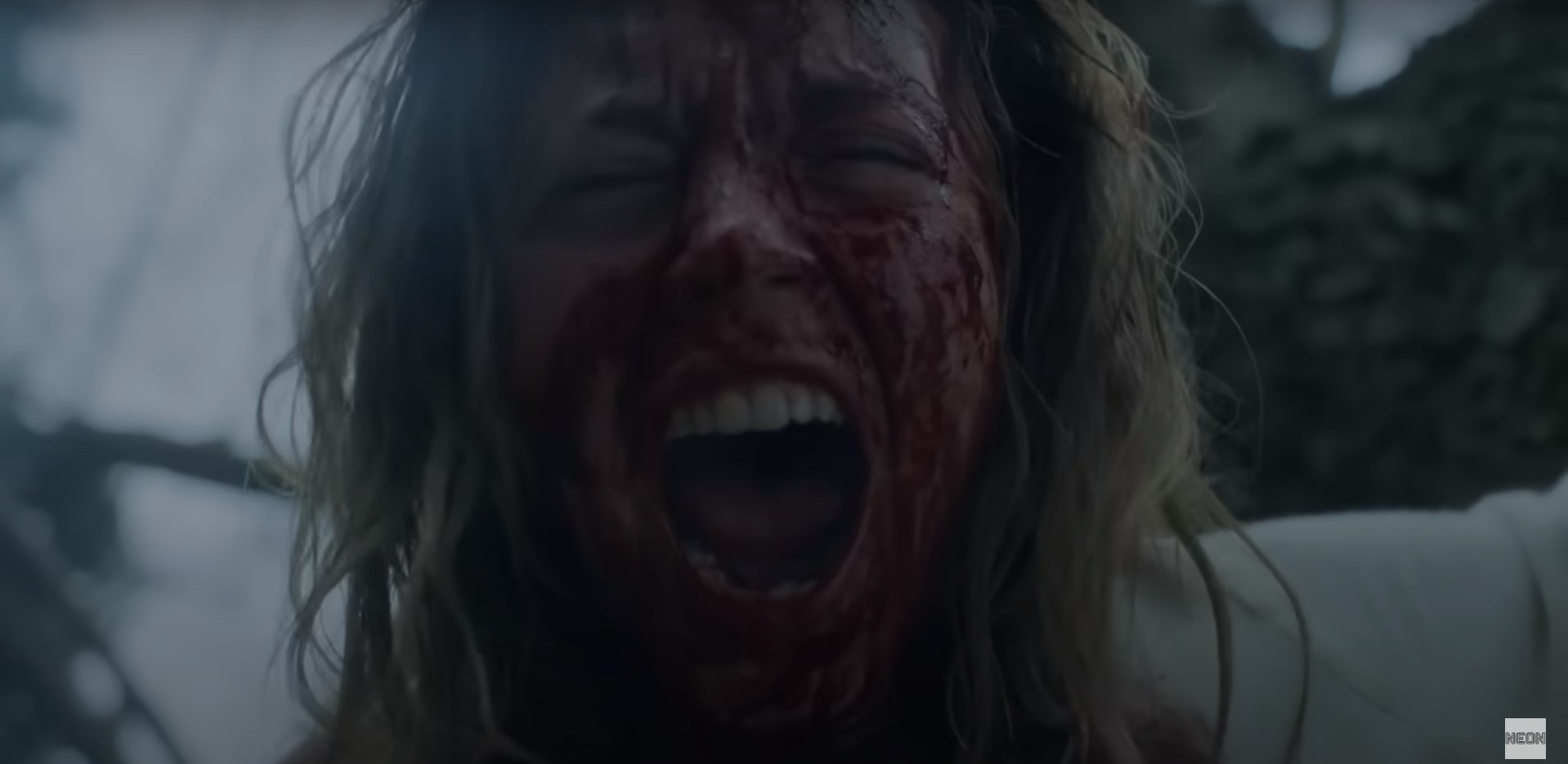
God Works in Miracles, Man Works in EVILs. “Immaculate” reviewed! (Neon / Blu-ray)

Mary Didn’t Have This Much Trouble. “Immaculate” on Blu-ray!

Devout American nun, Sister Cecilia, has been appointed a position in the Italian countryside, a historical convent where terminally ill nuns live in the sisterly comfort of hospice.  Feeling blessed for the opportunity to serve and her faith remaining second to none, the young nun believes she found her true calling and takes her devotional vows in the eyes of God and Jesus Christ, amongst other young nuns in confirmation.   During her training of changing out bedpans and beheading chickens for meals, an uneasiness washes over Cecilia ever since the night of her confirmation reception and being granted to behold one of the stakes that was impaled through the hand of Christ.  As if by miracle, an explanation suddenly and terrifyingly reveals itself not only to her complete shock but the entire convent when she’s discovered to be pregnant through immaculate conception.  As weeks turns to months, Cecilia is forced to focus on baby instead of chores but there’s something dark and malevolent happening behind the convent doors that result in her unable to leave the convent grounds, fellow outspoken nuns disappear, and one sister commits suicide.  The once blessed opportunity has turned into unimaginable terror with no way out. 

Sydney Sweeney is so hot right now.  With her provocative success on HBO’s take of youth and vices in “Euphoria” and a nihilistic teenage daughter in the same premium channel’s series, “The White Lotus, the now 26-year-old Washington state-born actress has also peppered her career with horror films, even at a childish age with her first appearance, a minor role, in a comedy-horror “ZMD:  Zombies of Mass Destruction” and continuing her fresh and new vocation with notable parts directed by notable directors, such as John Carpenter’s “The Ward” and Tibor Takács “Spiders,” that would subsequently offshoot into principal leads of less heeded, moderately successful thrillers when in adulthood with “Along Came the Devil,” “Dead Ant,” and “Nocturne.”  Her latest venture is one she became personally invested in, a modern-day nunsploitation titled “Immaculate,” reteaming Sweeney with her 2021 “The Voyeurs’” writer-director Michael Mohan at the helm of their latest collaborative effort.  Mohan, however, did not write the film with feature film newcomer Andrew Lobel taking the job that would take a decade to fruition once Sweeney, who auditioned for the role when she was 17 years old, made it her passion project to see it come to life  Alongside Sweeney producing is Ben Shafer, Riccardo Neri, Michael Heimler, David Bernard, Jonathan Davino, and Teddy Schwarzman with Neon distributing the Black Bear presentation of the Fifty-Fifty Films and Middle Child Films coproduction. 

Sweeney exacts the very definition of virginal innocence, a small-town girl with a miraculous backstory that nearly cost her her life.  As a sincerely devout Catholic in Sister Cecelia, Sweeney must shape up an intake of naivety that blinds her to the subtle sinisterism amassing around her.  To do that, a medley of personalities must dupe her, sway her, disparage her, and comfort her to keep the character balanced before the blindsiding shock that surprises her with a twisted misconception and exploitation of God theme. Heading up the mix of madness is the convent’s resident priest, Father Sal Tedeschi, played by Spanish actor Álvaro Morte, indoctrinating a warm welcome as a guise for advantageous deceptiveness, but for what, we yet don’t yet know.  The alarming setup pins Cecelia to the convent grounds, surrounded by equally unconscionable characters in an insistent Cardinal Franco Meroa (Giorgio Colangeli), a benignly sweet Mother Superior (Dora Romano), and a disparaging Sister Isabelle (Giulia Heathfield Di Renzi”), and with little options of escape, or even allies within the walls, Cecelia is truly alone against a rogue Catholic sect that seeks to resurrect Christ in an unconventional and unnatural way against Canon law.  Cecelia’s arc fully embraces the change through Sweeney’s rather transfigured understanding of the religious institution Cecelia devotes her life to and, in the same breath, the nun keeps with the organization’s traditional principles of God’s will and not man’s interference and must be the righteous hand of wrath.  “Immaculate’s” cast rounds out with Benedetta Porcaroli, Giampiero Judica, Giuseppe Lo Piccolo, and Simona Tabasco, who has a “White Lotus” connection with Sydney Sweeney.

If you’re like me and avoid most trailers, reviews, or spoilers to try and keep an unbiased opinion, you may be taken aback by “Immaculate’s” gargantuan twist that goes against everything you may know and believe about the Catholic Church’s dogma and principles.  Granted, several non-Catholics likely believe the Church is corrupt and with recent years’ newsworthy scandals, those Church cynics’ fire has had a continuous stream of fueling fodder.  “Immaculate” plays into the fear, pessimism, and beyond reproach suspicion by subverting religion as a false façade and integrates unlikely, go-against-the-grain coupled themes of genetics tampering, bypassing God, murdering in His name, and even exploiting the Catholic hierarchy with slivers of patriarchal governance over a woman’s body.  We get the latter from the very first opening sequence of Cecelia having just arrived in Italy and is brought before two custom officials who remark, in Italian in order for her now to understand, that her religious vocation to be obedience, impoverished, and chaste wastes her youthful beauty. Then again, “Immaculate” is not beautiful; it’s grotesque, perverted, and shocking and at the core, a purity that’s being sullied by deranged power and evil enlightenments.  Cecelia represents a beacon of hope in a maelstrom of immorality. 

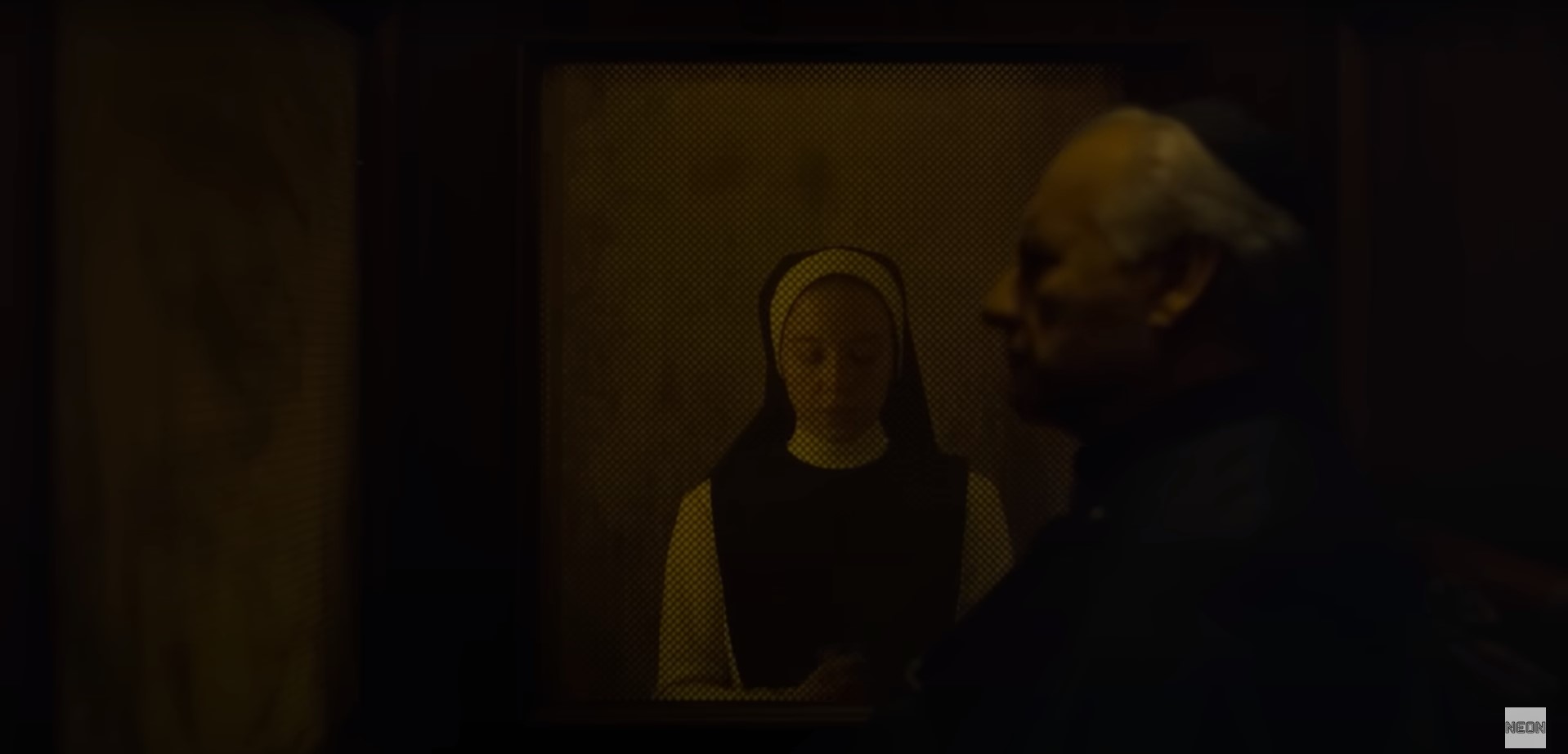
Shudderingly intense and sordidly messed up, “Immaculate” arrives onto a Neon Blu-ray home release.  Presented in a widescreen, Univisium aspect ratio of 2:00:1, the AVC encoded, 1080p high-definition, feature is housed on a single-layered 25 gigabyte disc.  Curious the reason why Neon would choose a lower capacity for such a purposefully soft and dark videographic image that creates a solemn tone inside a harsh appearance of an unpronounced period piece, perhaps set around the 1960s-1970s judging by the wardrobe, suitcases, and other set dressings.  Not also to exclude the premature notions of genetic manipulations that have made giant modernized leaps in the contemporary day-and-age.  Even with emaciated encoded, “Immaculate” looks pretty good around skin tones and textures and not a tone of compression follies to report.  With darker images on lower capacities banding and blocking rear their ugliness but there’s not a tone of that here. Saturation reduction plays into the time period and mood and the specified range of grading is kept to a modestly warm yellow, greens, and reds surfacing above ever so slightly through thick shadows of inkier, key-lit or candle-lit frames and even making a miniscule presence in daylit moments, boarding classical noir on some occasions.  The English-Italian DTS-HD 5.1 Master Audio has lossless appeal that wriggles out clean atmospheric genre cues through the multiple, surrounding channels.  Creaky doors and floors, deep footsteps, cavernous echoing, all play into the ambience track’s gothic timbres.  Conversating dialogue mounts a clear fixed positioning that sharp and clean through Sweeney’s character’s slight Midwestern intonation to the heavily and broad Italian accents from native vernacular to second language English speakers.  A descriptive English 2.0 audio track is also available as well as optional English and Spanish subtitles for the primary track.  One reason “Immaculate” is on a BD25 is because of the only bonus feature available is a feature length commentary track with director Michael Mohan.  The physical side of the Neon release includes a slipcover with the same tones mentioned above with a pious looking Sydney Sweeney in habit and also covered stoically in blood from the collar down.  The backside of the slipcover scarcely has technical information which is pleasant to see the limited real estate being used for something else other than the nuts and bolts that should remain on the Blu-ray’s Amaray case.  Its slightly reminiscent of the way certain boutique labels design their limited slips.  However, what’s not reminiscent of boutique design is the same slipcover front and back image is used for the Blu-ray case too.  Inside is sparse with only the disc with a simple yet effective black background, red titled pressing.  Rated R for Strong and Bloody Violent Content Grisly Images, Nudity, and Some Language, the Neon release has a runtime of 89 minutes and is encoded for region A playback.

Last Rites: “Immaculate” is blessed be the fruit of present-day Nunsploitation themed with power trips that attempt to bypass God and the laws of nature. The finale powerfully depicts and deciphers the principles of one’s firm held faith under God’s will, and perhaps wrath, in its ugliest form.

Mary Didn’t Have This Much Trouble. “Immaculate” on Blu-ray!

Invisible As They May Be, Their EVIL is Palpable. “Imaginary” reviewed! (Lionsgate / 2-Disc Blu-ray and DVD Combo)

Chauncy Wants You To Be his Friend! “Imaginary” on Blu-ray DVD/Combo set!

Jessica purchases her family home, moving in with her new husband and stepchildren where she reminisced being happy once as a child up until her father’s mental breakdown forced her to move out of the house and live with her grandmother.  Returning to her childhood home might have suppressed most of memory but has also spurred a few good recollections she aims to share with the conflicting attitudes of her stepdaughters, the angsty, teenager Taylor and her little sister, Alice, who suffers from a traumatic past.  When Alice discovers a stuffed bear in the basement and conjures up an imagery friend named Chauncy, Jessica feels content knowing Alice is coping with a new friend outside intense therapy sessions but when Chauncy’s seeming innocent scavenger hunt turns to hurt Alice, all the forgotten, difficult memories of her past surface and Chauncy is more than an Alice’s imaginary friend but spurned entity seeking to reconnect to Jessica, feed off her unique creativity, and keep her always in the Never Ever world of imagination.

At least once during our childhood, we all had an imagery friend to lean on, to play with, to cope with difficult situations.  For me, my imagery friend was an 8-foot white teddy bear I would snuggle into its lap and read my adventurous stage one or two books to.  For Lionsgate and Blumhouse, their imagery friend is much, much more sinister!  “Imaginary’s” dark twist on the juvenile fantasy is the brainchild of writer-director Jeff Wadlow, the filmmaker behind 2018’s “Truth or Dare” and 2020’s “Fantasy Island.”   The Charlottesville, Virginia native seemingly has thing for spinning games and fantasies into crooked, ill-fated variants.  “Princess and the Frog” writers Greg Erb and Jason Oremland cowrite the script with Wadlow, adding their experiencing in writing children stories for Wadlow’s eviscerating of childhood joy.  Lionsgate Films and Blumehouse Productions distributor the Tower of Babble Entertainment film with Jason Blum, Sean Albertson, Paige Pemberton, Paul Uddo, Jennifer Scudder Trent, and Jeff Wadlow producing.

In the crosshairs of a targeting imaginary friend is Jessica, a successful children’s book author on the outside of trying to assimilate herself into a new family while, at the same time, struggling to understand her nightmares and troubled childhood past.  DeWanda Wise (“Jurassic World:  Dominion”) stars the struggling, but good-natured stepmother Jessica who’s married to “The Walking Dead’s” Jesus, I mean Tom Payne.  Taegen Burns and Pyper Braun play Payne’s sibling daughters in their respective roles of Taylor and Alice as they make their horror film debut.  Detrimental to “Imaginary’s” silkiness of a happy couple is the artificial interactions between Wise and Payne who appear to be just going through conventional motions of a very awkwardly scripted and painfully garish couple.  When Payne departs the entire climatic acts for his character’s musical tour, other characters begin to flourish more naturally from between Wise, Burns, and Braun who become entwined into a certain teddy bear’s revengeful plan and this fountains a pleasant range of character arcs with overcoming fears, building character emotions, and settling the tension between them within the context of a common foe narrative.  One crucial, tell-all character goes critically by the wayside because, at the very last possible moment, Betty Buckley (“Carrie”) as the longtime neighbor Gloria becomes a deluge of exposition and she’s only introduced in full much later into the story because the writers had no idea how to integrate her earlier and make the information Gloria sits make sense until desperate moments arise.  Buckley, though monotone at times, makes for a good crazy lady.  “Imaginary’s” cast fills out with Veronica Falcón (“The Wind of Fear”), Samuel Salary, Matthew Sato, and Alix Angelis (“The Cleansing Hour”).

Audiences will need to expand their imaginations to get immersed into “Imaginary’s” interdimensional, child creativity-eating plot that careens through the specifics and details.  “Imaginary” suggests children have this invisible pal that snake tongues into their ears, feeding them childish ploys and harrying shame to get them to do what they want, and, inevitably, suck them into the Never Ever world through a checklist bizarre ritual.  The story suggests a globally subversive circle of these entities have been explains that every culture has a take on the imaginary friend concept and even throws into the dialogue other children having disappeared shortly after speaking of the Never Ever but the shorted change of the widespread disappearances background and the fact that crazy old, neighbor lady Gloria somehow surmised a pile of information on the subject, self-published knowledgeability on the ritual, being, and even the Newer End world, provides threadbare, credulous support for the storyline.  Stylistic and visually, “Imaginary” endorses its own title with tactile manifestations of the entity’s power.  Men in nightmare costumes is always preferable over overly silky-smooth and impalpable computer-generated monsters and the work done by the effects crew greatly engenders childish fears with an overgrown, toothy, scary teddy bear and a topsy-turvy world that are magical yet foreboding. 

Snuggle up with your Teddybear and get ready to be scared in “Imaginary” on a 2-Disc DVD and Blu-ray set from Lionsgate Films. The AVC encoded, 1080p high-definition, BD50, presenting the film in a 2.39:1 widescreen aspect ratio, is a solid showing of image integrity with crafty cinematography from James McMillan (“Twisted Metal“) that avoids the seams of the monster suits, keeping them in a considerable degree of low-level shadows, and using odd angles to make contradictory scenes flush in the Never Ever. Yet, despite the max storage capacity of a 50-gigabyte disc, compression banding still rears its ugly between gradient tones contrasting dark and lit scenes; problematic areas are not entirely throughout the picture but intermittently spotty to say the least. The DVD9 is MPEG-2 encoded with an upscaled 1080p. The English language option is a three-dimensional Dolby Atmos surround sound and if Dolby Atmos was going to be used for anything feature, “Imaginary” would be that feature with tons of range and depth mechanicals to float audio into the spatial fields above and below. When Never Ever doesn’t formulate a logical structure and up is down and down is up, Atmos caters and evolves to the fluid environment, emitting pinpoint ambience to be shaped to the size of television room. Dialogue comes over clean and clear, established in the forefront amongst the other audio layers. Spanish and French 5.1 Dolby Digital surround sound are also available audio options with English, Spanish, and French subtitles to select from. Special features include a feature length audio commentary by director, and cowriter and producer, Jeff Wadlow with producer-actress DeWanda Wise. Also, encoded into one long featurette, are four medium-short mini-featurettes of Meet Your New Imaginary Friends of getting to know the characters of “Imaginary,” Frills and Thrills of taking a child’s joyous creativity and twisting it into a creature-laden nightmare, Crafting the Beast of Imaginary is a look at the tangible creations of “Imaginary’s” monsters, and Bringing Nightmares to Life looks at how the Never Ever is constructed and shot to get the illusion of an upside down interior slice of another dimension. Sheathed inside a glinty, nearly lenticular, cardboard slipcover is the traditional Blu-ray Amary, both with the innocently, ominously looking Chauncy bear on the front cover. In the interior, each side houses a respective format within a push lock. A digital copy does come with the release within the insert clasps. “Imaginary” is a PG-13 horror (are they trying to appeal to kids?) with a runtime of 104-minutes and a region A playback.

Last Rites: I Imagine “Imaginary” could have gone over ten times as smoothly and more coherent with a longer runtime time to flush out more characters and a better designed narrative. Instead, pacing is quickened to race through unpacking more complex themes: childhood abuse, childhood trauma, the division of the original and regluing of a new nuclear family, family history of mental illness, the concept of imaginary friends, and so forth. The result is a less than desirable bastardization of an imaginary friend that leaves us high and dry for more context and substance than just a puppeteered scare bear.

Chauncy Wants You To Be his Friend! “Imaginary” on Blu-ray DVD/Combo set!

What EVILS Lie After Death? “We Go On” reviewed! (Lightyear Entertainment / Remastered Blu-ray)

Get Haunted as “We Go On” is now on Blu-ray!

Miles Grissom lives in fear every minute of his life.  What scares the editor of shoddily performed, midnight television infomercials the most is the unknown after death.  The question is Is there a life after you die or is there just a black void of nothingness?  To answer that existential question, Miles places a quarter page newspaper ad seeking an ounce of proof of the afterlife with a $30,000 reward attached for one single person who can show him that there is an existence beyond death.  With the unconditional support of his mother, he scours through hundreds of fakes, solicitors, crazies, and the like until he narrows down the advert answerers to a few possibilities that have real promise.    As Miles investigate the claims of each one, he finds himself closer to the truth than he ever wanted to be and now he’s forever trapped between existential planes for the rest of his life.  

One of the longstanding and biggest questions in the universe is what happens to us when we die?  Where does our immortal soul, the individualistic essence of our being, wander to after the corporeal shell is empty?  Or does it just poof vanish, like an extinguished candle flame?  While all of these questions can be up for philosophical debate amongst the various, and often contentiously stubborn, religious groups and cultures, filmmakers Jesse Holland and Andy Mitten use the idea for their 2016 drama-horror “We Go On” that gives one possible, uncontested and cinematically electric, explanation as well as imparting a somethings are better left unknown dread.  The duo behind “YellowBrickRoad” returned to write-and-direct their sophomore U.S. production with a principal photography location shoot in Los Angeles.  “We Go On” is produced by Logan Brown, Irina Popov (“Chilling Visions:  5 Senses of Fear”), and Richard W. King (“The Witch in the Window”) under the production banner Filmed Imagination.

Miles Grissom is a mild-mannered and scared into solitude individual.  His loneliness, though not conspicuous to any extent, extends to his profession of a video editor of infomercials and other overnight television programming.  Agoraphobia and thanatophobia keeps Miles securely isolated in his modest apartment building where a recurring dream of a car accident sends his heart racing, a side effect of a core, back history moment yet to be explored when we meet Grissom, who is played by a stiff, but gets the psychologically wounded character across, Clark Freeman who has worked previously with Holland and Mitten on “YellowBrickRoad.”  “Cat People” and “Superman III” actress Annette O’Toole fills in as Miles’s ride-or-die, overprotective mother with a deep, dark secret of her own coated with a thin film of backseat family drama that’s doesn’t make her character shine like it should, especially being an important piece and highly influential to Grissom’s character.   Instead, the exposure of the secret and the impact it’s supposed to have is left on the backburner for Nelson to come into play, a greasy airplane janitor with deadly drug problem in what can be described as the best Sean Whalen role he never played with Jay Dunn filling those janitorial coveralls.  Dunn, who would go on to have a role in Andy Miton’s solo project, “The Harbinger,” dons slicked over balding hair, grimy teeth, and a deep, sunken eyes to be a bane toward Grissom’s existence and while Dunn doesn’t have dialogue for half of his onscreen time, he makes for a perfect hang around the background, meanspirited glarer.  The rest of the “We Go On” cast pop in and out as Grissom dwindles down his list of fakes and phonies with appearances from Laura Heisler (“YellowBrickRoad”), Giovana Zacarías, and the always wonderful on screen, “Gremlins 2’s” actor, John Glover, as a scientist trying to scare Grissom into giving him the reward money.

“We Go On” encases more drama elements than horror but the circling horror imagery enclosed has a beautifully grim layout with the minor touches, such as the slow turn of a hanging corpse or the statement of a ripe smell of a long dead overdose victim, that add a palpability, reinforcing the horrific moments and increases the ghastly tension.  The further we journey with Miles Grissom in his obsessive search, the grislier the imagery gets in what is essentially a two-part tale that firstly puts us and Miles on the hunt for life after death that quickly nosedives into a leeching supernatural torment.  Oddly, Grissom takes his newfound nuisance almost instantly in stride with not a ton of obstacle or self-realization work to warrant an acute enlightenment of how to handle an orbiting ghost that flashes disturbing images every other minute inside his mind and allows him to see between the planes of other gruesome ghosts stuck in limbo.  There are other examples of these sudden reversals or improvements that work against the pacing and don’t invite reward through struggle or pain in what is a walk in the park for Miles Grissom to see and handle ghosts being introduced to audiences as a man emotionally crippled by a traumatic, underlying fear.

Via Lightyear Entertainment, an American coast-to-coast independent film distributor, “We Go On” receives the Blu-ray treatment with an AVC encoded, 1080p high-definition resolution, BD25.  There’s little information regarding the remastering of the film with the only kick up being a digital restoration and enhanced visual effects and touchups to provide a smoother, cleaner picture presented in the film’s original anamorphic widescreen aspect ratio of 1.78:1.  Having never watched the DVD or first Blu-ray version, I have to take Lightyear’s restoration at face value which does have a crisp, clear picture full of natural color and graded with brilliance that sometimes makes the picture look too digitally sterile with not a ton of contouring shadows that can make the picture look depthless at times.  The infused visual digital f/x add about the same flavor, but the images never linger on screen, turning brevity to the film’s effects advantage.  No apparent issues with compression on the 25gig BD; textures modestly tactile despite the bright and airy grading and blacks are deeply saturated with spectrum banding.  The English language audio options include a lossy Dolby Digital 5.1 and a lossy Dolby 2.0 Stereo.  Dialogue is clear and projecting over the other layers but lacks that full-bodied, full-channeled trait of lossless.  Supernatural effects find distinctive ground and synch greatly with the sudden scares in transition between reality and the ghost realm.  Range and depth are favored by the remastering in the scenes that warrant both, such as the LAX’s airstrip takeoffs that considers the jet plane’s positioning in the background or above, increasing steadily the jet noise volume whenever a plan is in the extreme background to a more overhead location.  Also added for the remastered release are three new, feature-length commentaries:  two with the individual directors in Andy Mitton and Jesse Holland with the third houses the two stars, Annette O’Toole and Clark Freeman. The clear Blu-ray Amaray arranges a darker composition cover art than what the movie actually entails with an interior disc pressed with the same cover and a reversible cover that has one of the more memorable scenes from the feature. There are no insert materials included. The region free, unrated release has a runtime of 89 minutes.

Last Rites: You get what you ask for is the moral of the story maxim in Andy Mitton and Jesse Holland’s “We Go On,” a commercially technique, light-weight thriller with a thin lining of grim imagery between drug overdoses and suicide and adequate performances by Annette O’Toole and Clark Freeman that drops the everlasting question of desire and extreme, emotional fear for instant peace of mind, even if experiencing the terrifying truth firsthand.

Get Haunted as “We Go On” is now on Blu-ray!

Happy, EVIL Halloween, Halloween, Halloween. Happy, EVIL Halloween, Silver Shamrock! “Halloween III: Season of the Witch” reviewed! (Via Vision / Limited Edition Blu-ray)

“Halloween III: Season of the Witch” Available on Limited Edition Blu-ray from Via Vision!

Just days before Halloween, a man stumbles hurt and delusional rantings into the hospital of Dr. Daniel Challis.  Clutching a Halloween mask to his chest, Challis figures the man to be crazy before stabilizing his vitals for rest but when the man is heinously murdered in his hospital room and the murderer burns himself alive in the hospital parking lot, Dr. Challis doesn’t know now what to make of the man’s rantings about something or someone is going to kill us all.  In walks Ellie Grimbridge, the man’s daughter, who has been investigating her father’s mysterious death.  Intrigued not only by the case, but also by the lovely Ellie, Dr. Challis and Ellie’s investigative work leads them to the Silver Shamrock mask factory in Santa Mira, the same mask factory that created the mask Ellie’s father was clutching before he died.  What they uncover is a plot of sacrifice on Halloween night, spearheaded by an Irish toy maker in Conal Cochran.

With a novel concept in the hands of one of horror’s most promising filmmakers, John Carpenter, a script penned by an uncredited yet famed British science fiction writer in Nigel Kneale and touched up by Carpenter, and a young Carpenter protégé, Tommy Lee Wallace, at the helm, “Halloween III” attempted to be an off-the-beaten path of success new story for what would have an annual Halloween-themed anthology going forward.  Unfortunately, and regrettable, “Halloween III:  Season of the Witch” failed to connect with an audiences and Michael Myer fanboys too stubborn to let go of The Shape.  It wasn’t until years later that the 1982 feature, released on the coattails of 1981’s part II of the original Michael Myers saga, found footing with fans who now appreciate the unique story, its practical effects, and the bold, yet defunct, vision Carpenter and crew once envisioned.  Carpenter and Debra Hill returned to produce, alongside Joseph Wolf, Irwin Yablans, and Barry Bernadi, with Universal Pictures as the backing studio. 

Now, “Season of the Witch” just didn’t star a bunch of nobodies in this offshoot of a newly branded “Halloween” concept.  Before playing the quasi-alcoholic, deadbeat father Dr. Challis, Tom Atkins was already a rising star in the land of John Carpenter films with “The Fog” and “Escape from New York” In 1980 and 1981.  Atkins’s usual confident and charming qualities underneath the rugged good looks and trimmed mustache serve him the better part of man doing his bit part in a not-his-business investigation of a man’s death to please a good-looking woman that happens to be the dead man’s daughter.  That good-looking woman is Ellie Grimbridge, embodied by the Mad Magazine Production’s “Up the Academy’s” Stacey Nelkin, and if you blink, you might miss Atkin’s Dr. Challis being perhaps the worst father ever to his two children and ex-wife.  The subplot is so subtle and overshadowed by the Silver Shamrock Halloween plot that being invested in the crumbling family dynamics doesn’t even hold substantial weight and it truly works to subvert the subconscious and plant a destructive pipe bomb smartly into your moral compass because if you think Dr. Challis is the hero of the story, which in many perspectives he is, he’s also doesn’t keep up with his own children interests or current events, numerously bails on their planned care, runs off and sleeps with a much younger woman he hardly knows, is an active alcoholic, and is quite the handsy philanderer at that when he grabs his much older nurse’s bottom in a playful moment.  No, Dr. Challis is every ounce an antihero hidden in plain sight and in the guise of a potential savior of the children, the world, as he takes on Silver Shamrock and its founder, an Irish toymaker named Conal Cochran with tremendous evil genius and mastermind appeal by Dan O’Herlihy (“The Last Starfighter”).  “Halloween III:  Season of the Witch” rounds out the cast with Ralph Strait, Jadeen Barbor, Al Berry, Michael Currie, Garn Stephens and Essex Smith in key support roles.

Lots of previous opinionated chatter surrounding “Halloween III” collectively concludes to if the filmmakers decided to title the film anything else, maybe just the tagline of “Season of the Witch,” then the film would have won over audiences with a fresh take of science fictional horror and would not have been wrongfully panned by critics and moviegoers.  I call BS on this take.  The original intention was to deliver a new, Halloween-themed horror film year-after-year with John Carpenter attached in some way, shape, or form of bringing novelty terror to our eyeballs and brain.  Instead, public persuasion and studio submissiveness rendered the concept powerless and as a result, and no disrespect to any Michael Myers films that followed, was the departure of John Carpenter and Debra Hill and a string of mediocre and wacky Michael Myer sequels that went deep off the far end.  “Season of Witch” is not a teeny bit at all slasheresque, separating itself far from Michael Myers as much as possible by unconfining itself from location concentration by expanding the threat domestically, if not globally, with a parlor trick plot that involves special, laser-shooting masks that make kids’ heads melt into glop of crickets, snakes, and other creepy-crawly sui generis of the animal kingdom.  While strange in the cause and effect, the practical effects and superimposed visuals work to convey some taught gore and prosthetic knots that can be unraveled, even retrospectively critiquing them by today’s standards.  Wallace masters the film while, at the same time, hitting the ground running on his debut feature that has a look and feel of a graduate from the film of the John Carpenter. 

Halloween season may be months away, but Christmas comes early with Via Vision’s limited-edition Blu-ray set of “Halloween III: Season of the Witch.” The AVC encoded, high-definition 1080p, BD50 presents the film in a widescreen aspect ratio 2.35:1. Much like the Via Vision’s companion release with “Halloween II,” “Season of the Witch” mirrors the same resolution picture quality and stellar package presentation. Dean Cundey’s delivers another smoky noir realism that definably hard-edged and hard-lit that while isn’t the most colorful contrast it does create an abundance of inky shadow to lost in and sink into. A cleaner picture does bring with a reveal of how obsolete some of the composite matte effects but, simultaneously, revives what once was, nostalgia and a more tactile truth in movie magic. Details come through within contour delineation and textural elements. The English language DTS-HD Master Audio 2.0 has dual channel balance and strength with lossless fidelity. Dialogue retains saliency throughout from a rather middle-of-the-road strength ambience albeit a wide range of effects from explosions to laser beam bursts and its constructed, catchy Silver Shamrock jingle, often muted through the television programming, and John Carpenter’s and Alan Howath’s synth collaboration that’s tonally reminiscent of previous “Halloween” films but stands by itself in distinct measure to garner new-sound tension. English subtitles are optionally available. Also, like Via Vision’s “Halloween II” Blu-ray release, a 2024 commentary is recorded and encoded with film critic/historian Lee Gambin and a special appearance by “The Howling” director Joe Dante. Archival commentaries from Tommy Lee Wallace and Tom Atkins are also on the disc with all three commentaries in the setup menu. Special features content includes 2012 Scream Factory-Red Shirt productions with Stand Alone: The Making of Halloween III: Season of the Witch documentary surrounding a Micheal Myers-less picture, it’s critical shockwave, and its ultimate cult following and Horror’s Hallowed Grounds: Revisiting the Original Shooting Locations hosted by Sean Clark visiting a few of the locations used for the film. A still gallery, theatrical trailer, and television spots round out the rest. Of course, my favorite part is the lenticular cover on the limited-edition and numbered cardboard sleeve case of the three, silhouetted little trick-or-treaters with a crone-ish face coming down from above the fire red dusk sky. The slightly thicker Blu-ray Amaray case cover art is stark still image from the movie with another, different image on the reverse side. The black background disc has the skull mask and title across from each other in nice compositional juxtaposition. Next to the Amary case is an envelope with 6 art (picture) cards taken from the film. The Via Vision release is rated M for Mature for moderate violence and moderate coarse language, has a runtime of 109 minutes, and has region B playback only.

Last Rites: Who knew being the outcast looked so damn good. “Halloween III: Season of the Witch” deserved better and received the best on this Australian, limited-edition, lenticular Blu-ray set that’ll leave you whistling the Silver Shamrock jingle and fearing Halloween masks more than ever.

“Halloween III: Season of the Witch” Available on Limited Edition Blu-ray from Via Vision!

Is this EVIL Real or is it a “Deathdream” reviewed! “(Blue Underground / 4K UHD and Blu-ray Combo)

The Nightmare is Here. “Deathdream” on 4K UHD Blu-ray!

The Brooks family just sat down for dinner before receiving a personal house call by a military commander, conveying the tragic killed in action telegram of their son Andy during a Vietnam War skirmish.  Very early next morning, Andy inexplicably arrives at their doorstep and the whole family is elated with his return and relieved in the military’s gross error about his death.  But something isn’t right with Andy; he isn’t the same affable young man his family and friends knew.  All day, every day Andy sits in his room, gliding back and forth in his rocking chair, won’t eat or drink anything, and has the social personality of a slug.  While his father can’t grasp Andy’s bizarre behavior, his mother defends him, being overjoyed, comforted, and relieved by her son’s safe return.  Anybody who comes close to discovering what Andy has done or has become is preyed upon by Andy’s need for concealment and need for blood. 

If there was ever the quintessential anti-Vietnam War film, Bob Clark’s “Deathdream” is it.  The 1974, Alan Ormsby (“Cat People,” “The Substitute”) scribed grindhouse classic introduces combat shock to audiences through a macabre and ghoulish lens as the U.S. involvement in the Vietnam War came to an official end in 1973.  Before becoming one of the holidays’ household names with “A Christmas Story” and “Black Christmas,” Bob Clark sat in what would be one of his first films as a director, a film that wasn’t sold in taking just one title having also been bestowed “Dead of Night,” “The Veteran,” “Night Walk,” and “It Came from the Grave.”  The U.S.-based shot and crewed feature, filmed in and around Brooksville, Florida, is a production of Quadrant Films and Impact Films with United Kingdom producers Gerald Flint-Shipman, Peter James (“Children Shouldn’t Play with Dead Things”), and Geoffrey Nethercott (“Blue Blood”) with John Trent and Bob Clark coproducing.  

For the ambiguous terror of “Deathdream” to work without baffling audiences to a nonsensical death, the cast had to really give it their all and not only that but also sell the deteriorating dynamics of an American nuclear family when the son returns home strangely different from then when he left for war.   The debut film of Richard Backus, playing the reclusive and uncharacteristic Andy who has returned home from the battlefield, is complimented by the heart-wrenching performances miseries of his onscreen parents in John Marley (“The Dead Are Alive!”), as the distraught father over Andy’s peculiar behavior, and Lynn Carlin (“Superstition”), as the denialist mother who can’t or won’t see the issues with Andy, the gift of her little boy returning home. Not only does Andy’s return ignite a slow-burning divisive wedge between parents and child but it also exposes pre-war schisms that were long established years ago.  We’re initially introduced the family sitting around the dinner table filled with compassion, hope, and happiness but Andy’s return kicks the wasp’s nest and we can see their true nature.  The father is a crotchety, dogged man who can’t connect with a more sensitive son and the mother spoils his only boy the point where Andy must enlist himself voluntarily to prove something to toward his father’s disappointment.  Then, there’s sister Cathy.  Poor sister Cathy, the gentle, positive, and sweet daughter who is all buy nearly forgotten by her parents as they push her out of the way by her father stating to mind her own business or is exclaimed in so many words of her little worth in compared to her brother by her mother.  Yet, Cathy, played softly and attractively by Alan Ormsby’s then wife, Anya Ormsby (“Children Shouldn’t Play with Dead Things”), continues a cool and level head about her shoulders as the only true family member willing to give Andy time, to let him be himself, while acclimating back into society, let alone his family.  However, the family’s opposing forces is ultimately what destroys them in conjunction with Andy’s terrible, morbid secret.  Henderson Forsythe, Jane Daly, Arthur Anderson, Michael Mazes, and David Gawlikowski fill out the cast.

All of the costly signs of shell shock and PTSD are present within the context of “Deathdream,” blanketed under a sensationalized, representational guise, but the film’s cinematic façade of Tom Savini’s rot and decay special effects and the appalling imagery of living death doesn’t alleviate or even dilute the horror of the revenant in the actual disorder.  In fact, it pales in comparison if you ruminate on it for a while.  Andy’s withdrawn from the likes of acquaintances, friends, and family alike and is severely impassive at signs of cordiality.  Director Bob Clark emphasizes the effect even further in one scene where a World War II veteran anecdotally describes in nonchalant detail the death of a brother in arms and this flashes images in Andy’s mind of him and his friend’s own mortal wounds in the jungles of Nam, sending the young man into a minor fight or flight moment, two of the associated signs of shell shock:  fight and flight.  Within the sensationalized horror context, Andy requires blood to keep his body from decaying, like a reanimated corpse trying to hang on a little long before his skin and muscle tissue just seep and ooze off, and in one scene of attack, Andy shoots up his victim’s blood with a hypodermic needle in a reminiscent drug addiction scene of shooting up narcotics right into the vein of one’s arm, an experience afflicted on many PTSD vets. Ormsby’s script might be specific in the anti-Vietnam War propaganda but is not so detailed in the narrative’s whys and wherefores as much of Andy’s unlikely, and undead, return to his family falls into that inexplicable, ambiguous, “Twilight Zone,” and “Tales from the Crypt” category to foster a greater cloud of mysticism and darkness around the story, one in which has a hopeful, desperate mother conjure will and desire in order to see her son come home again.

In continuing to upgrade their catalogue to the best possible format currently available, “Blue Underground” pulls an Andy and returns “Deathdream” from the dead, heading home to the nearest ultra high-definition player. The 2-disc 4K Ultra HD and Blu-ray combo set arrives with a brand-new restoration, scanned in 4K 16-bit from the 35mm negative with Dolby Vision HDR in honor of its 50th anniversary. The UHD is HVEC encoded onto a 66GB Blu-ray with 2160p resolution while the Blu-ray is AVC encoded, 1080p resolution, on a BD50, both presented in a widescreen 1.85:1 aspect ratio. A grainy 35mm print is ingrained with superior color saturation and understanding of how to manage the perceptibility of image. Blue Underground’s previous restorations show a spectrum, step-by-step improvement to get to where the film is today in a higher, upgraded format. “Deathdream” can be a very dark film at times and often, but this release eliminates speculation of events without collapsing the contrast integrity, providing a clear and concise image for its spot in history. Blu-ray is a step down albeit only minorly and with some color stability shimmer, more notably in the finale with a less than standardized and wear-showing deleted scene that is integrated back into the story. A single, English DTS-HD master audio mono track is available. The lossless option doesn’t need any more or any less to effectively be the overlaid track. Distinction runs through the single channel with managed assurances that dialogue, ambience, and soundtrack divide and conquer their respective uniquities. English SDH, Spanish, and French subtitles are available. Due to space on 4K UHD disc, all of the package’s special features are encoded onto the standard Blu-ray. The UHD Blu-ray includes an archival commentary from director Bob Clark, a commentary by writer Alan Ormsby, and a brand-new commentary with a pair of film historians Troy Howarth and Nathaniel Thompson, plus the theatrical trailer. All that and a slew of previously recorded content, including a recollection featurette with Alan Ormsby and star Anya Liffey (Ormsby), an interview with composter Carl Zittrer Notes for A Homecoming, an interview with production manager John “Bud” Cardos Flying Down to Brooksville, an interview with star Richard Backus Deathdreaming, an interview with Tom Savini regarding his early years in special effects, a screen test of the original Andy actor Gary Swanson, an alternate opening title sequence, Alan Ormsby’s student film, theatrical trailer and still galleries. The only other new content is an interview with the original Andy actor Gary Swanson The First Andy. The same illustrated cover art composite from the 2017 Blue Underground Blu-ray is recycled for the 4K UHD Blu-ray with tactile elements of a raised title and taglines on the cardboard slipcover. The primary art also resides on the black UHD Amary but the reverse side has retro traits of the film’s starkly contrasted yellow and blue poster art and the “Dead of Night” title to which, once again, is preferrable for me to have diverging slipcover and case cover arts. The two discs reside on their respective sides of the interior with the 4K UHD pressed with the illustrated art and the Blu-ray going contrarily retro like the reverse cover art. There are no loose insert materials. With an 88-minute runtime, Blue Underground release comes region free and is rated R.

Last Rites: Andy didn’t destroy his family. He was only the last straw, a catalyst that tipped the boat over into a sea of slowly brewing tempest. Doesn’t help that he was also decaying right before their eyes as the embodiment of walking death and looked good doing it too with the help from Blue Underground’s sharp-edged and solidly sound 4K upgrade.

The Nightmare is Here. “Deathdream” on 4K UHD Blu-ray!