In EVIL’s Chair and Ready for a Cut. “The Stylist” reviewed! (Arrow Films / Digital Screener)

Excellent at styling hair, but not so much at making friends, Claire lives a solitary life as she’s unable to personally spark connections, even with those who she interacts with on a daily basis.  As a hairstylist, she absorbs a plethora of private information provided willingly by her clients who see her as someone not significant enough to be troublesome or detrimental to hurt them, but, little do her clients know, Claire has a dark secret with obsessively overstepping into their lives and, sometimes, directly into their shoes as murder becomes a conduit for Claire to experience a slither of momentary solidarity and belonging happiness.   Brief in its euphoria, the elated feeling doesn’t last and Claire finds herself back into a vicious cycle beginning with being defeated, but when a regular client, Olivia, begs for wedding hair help, Olivia befriends the stylist who begins to sink deeper into a misinterpreted friendship with Olivia fabricated inside Claire’s disturbed mind. 

Whenever stepping onto the hair clippings of a barbershop, sit on the padded, pump-hydraulic chair, and be asked by a for certain fallible person how I want would like my haircut, my hands nervously clutch each other, the space between my eyebrows fold in and crunch, microscopic beads of sweat go down my hair raised back and the agitation in my mind grows louder than a blow dyer on a high setting.  Why do all these externally stemmed irritants happen to me at the seemingly communal and smile gracing barbershop?  Think about my situation, one driven by introverted behaviors and pessimism for the human race, this way:  your neck is choked tight with a hairdresser body-bag resembling cape, sharp, haircutting sheers clipping swiftly overhead, and the loud buzzing of a motor purring around your ears’ edge before they detailing the side of your face with tiny razors moving hundreds of miles per hour.  Let’s not also forget about the straight-razor across your neck to attack the five o’clock shadow!  No, thank you!  So, there was already an abundance of established anxiety heading into Jill Gevargizian’s written-and-directed hairdresser horror, “The Stylist,” that takes just a little bit more off than just what’s on top.  The “Dark Web” filmmaker reteams with co-writer Eric Havens to extend the profile of the quiet and quaint, Victorian chic hairdresser, Claire and her lonely killer inclinations based off their 2016 short film of the same title and add Los Angeles based copywriter and “Night of the Wolf’s” Eric Stolze into the salon of psychological horrors mix. “The Stylist” is a production of Gevargizian’s Sixx Tape Productions, that also includes Eric Havens and lead star Najarra Townsend, alongside co-productions Claw Productions, Method Media, and The Line Film Company.

Najarra Townsend reprises her role as Claire, the lonely hairstylist bedeviled by a lack of belonging and rapport with no family or friends. Claire spirals into internalized madness that unveils when trying to step inside the lives of others as her own. The “Wolf Mother” star becomes a granular speck of torment plagued severely by social awkwardness to the point of her need for perfecting the imaginary bond between her and Brea Grant’s character, Olivia, goes into destruction level transgressions that’s normal, living rent free, in Claire’s headspace. Grant, writer and director of one of our favorite films of 2020, “12 Hour Shift,” and in the recently released, critically acclaimed, Natasha Kermani thriller, “Lucky,” has to be a larger than life persona whose the center of attention, as soon-to-be-bride going through the throes of wedding planning, that can draw in the wide-eyed and impressionable Claire like a moth to a flame. Townsend’s a specific kind of talent to get inside Claire’s ennui state not once, but twice. The latter precisely nails down Claire’s outlying, exterior behavior, but also smooths out a mustard nuance veneer of vintage chic that becomes a part of the building blocks peculiarly exclusive to her quietly disruptive cause. Starkly contrasted against Claire, Grant relates to who we all see on the outside as Olivia, a shining glow of smiles and worries that most people can digest with ease on a daily bases and while her life, as chaotic as may seem with a wedding near on the horizon and questioning a deep down decision about marriage, is juxtaposed with such distinction that Gervargizian literally puts Claire and Olivia side-by-side in a split screen early in the film to expose one hiding her secrets and the other letting them all hang out. Sarah McGuire (“The House of Forbidden Secrets”), Millie Milan (“Clownado”), Davis DeRock and Laura Kirk round out the supporting cast.

Take a moment and breathe the very essence of women-driven horror that’s as stylish as it is deliciously deranged.  “The Stylist” echoes similar psychopathic traits of William Lustig’s “Manic” and displays self-careening elements soaked in barbicide and Gothicism.  The junior film of Jill Gevargizian narrates through the eyes of Claire’s unraveling humanity from the stylist’s quick fix of bloody hair removal to the potential for climbing out of that deep, dark hole of loneliness only to be suddenly sideswiped by the falters of manufactured delusions. “The Stylist” is wrapped in a sullen hairnet that never shows the jovial side of Claire’s pleasures as she’s embodying someone under their locks after calculatingly cutting more than just their hair; a perspective exclusively held within Claire’s head, leaving viewers entangled in her in seemingly normal beauty shell and her inner demented chaos. You feel sorry for her forlorn life, but creeped out by that same life’s byproduct. One aspect that “The Stylist” lacks, that can be off-putting for some, is the mold that made Claire. Miniscule slips of her upbringing becomes not enough to paint an exact portrait of Claire as a malevolent monster with sociable dysphoria and as the story builds to a climax and Claire tries to imitate her mother, who died in her mid 30’s when Claire was 17, the mimicry fairs to say that her mother also had similar problems that has innately passed and has coped a different way of dealing with mental illness by way of alcoholism, mentioned by Claire in a moment of courting a friendship with an eager bridezilla, Olivia.

What a fitting film to be discussed and celebrated on International Women’s Day 2021 in the Jill Gevargizian directed and Najarra Townsend lead “The Stylist” now released exclusively on Arrow Film’s UK VOD platform ahead of the physical Blu-ray package and digital HD releases come June 2021. Film film clocks in at a 105 minute runtime and is presented in a widescreen 2.39:1 aspect ratio. Behind the camera is Robert Patrick Stern whose composition of imagery is based mainly in natural lighting while dabbling in warm coloring such as reds, the occasional vibrant magenta, and a consistent yellow mustard, a favorite not only in Claire’s wardrobe but also tinged on the lens whenever a part of Claire’s localized disturbia. Stern’s clean and sleek picture palpably elevated John Pata’s editing of montages that were superimposed with transitions and the soul searing music of Nicholas Elert’s melancholic inducing piano-industrial score. There were no bonus features included nor were there any bonus scenes during or after the credits. “The Stylist” honors the past by reinventing the wheel in Jill Gevargizian’s clipping thriller with a hair-raising performance by Najarra Townsend as the maniacal hairdresser lonely next door.

EVIL is in the Waiting Room. “Host” reviewed! (Second Sight Films / Blu-ray Screener)

Six friends, locked down due to COVID-19 quarantine restrictions, hold a séance with a medium over a video chat platform.  With some skeptical of the astral plane practice and connivingly mock the ritual without aware of the consequences, they unwittingly call forth a false spirit under the guise of their seemingly harmless mockery.  In short, a malevolent demon crosses over their spiritual internet connection plane, attaching itself to their domicile surroundings.  Unable to break the connection to the spirit world, surviving a night that was supposed to shoulder quarantine boredom with excitement and booze has beleaguered the friends with a night of undisclosed deadly terror.

When online game night during quarantine life goes horribly wrong in Rob Savage’s “Host.”  The UK bred survival tech-horror is the sophomore feature length film from Savage who co-wrote the cast sundered script with Gemma Hurley and Jed Shepherd, who has previously collaborated with Savage on the director’s short films, “Salt” and “Dawn of the Deaf.”  “Host” plays into being a film of the moment, shot entirely over the pandemic lockdown with unconventional production direction conducted through video chat platforms with each actor pent-up performing in their own personal abode and being subjected to wear multiple crew hats to avoid spreading COVID-19 from face-to-face interactions.  Despite the severe limited enforced by the threat of infection and the local governmental mandates, the film received hefty financial backing from horror’s most prolific streaming service Shudder after director Rob Savage pulls off a video chat prank with colleagues and friends of him checking out a mysterious sound in his antic and seamlessly interlacing a jump scare clip from Jaume Balagueró and Paco Plaza’s “REC” that scared the bejesus out of the unsuspecting participants to his prank.  “Host” is a production of Shadowhouse Films. 

“Host” stars five real life friends, aspiring actresses in the London area looking for work that has become frighteningly scarce in the pandemic’s wake, and they’re joined by a sixth, the outlier male to join the virtual hangout session.  To add authenticity to the circumstances, each actress has their parent-given (or stage-made?) names incorporated into the film, heightening the illusion of a friend being ripped apart by a demonic entity, especially if a sly Rob Savage redacts much of the script to keep his actors in the dark in certain scenes to garner real reactions.  Haley Bishop, who has worked previously with Savage on “Dawn of the Dead,” spearheads the nighttime gathering for a little séance fun, to stave boredom with her closest friends, with prearranged invitations to Jemma Moore (“Doom:  Annihiliation”), Emma Louise Webb, Radina Drandova, Caroline Ward, and Edward Linard, who is the only one of the six not to use his actual name and goes by Teddy.  Each character provides a slight unique viewpoint that integrates into the story nicely, such as Jemme’s jokester and cavalier attitude, Caroline’s bracing for the supernatural consequences, Radina’s distracted relationship troubles, and Teddy’s wild and carefree persona.  “Host” rounds out with minor co-stars enveloped into the séance chaos, including Alan Emrys, Patrick Ward, Jinny Lofthouse, and “Double Date’s” James Swanton as the malevolent spirit.

Cyber and social media horror has no leverage to be groundbreaking horror anymore as a handful of these subgenre jaunts slip into our visual feeds every year in the last decade and “Host,” on the surface, might perpetuate the long line of outputted tech horror in an overcrowded market.  However, “Host” has a beauty about it that doesn’t reach into capitalistic territories like the ill-conceived “Corona Zombies” from Full Moon or the Michael Bay-produced “Songbird” about sustaining love in the time of dystopian pandemic and, instead, redefines how tech horror not only uses innovated methods in creating movies during lockdown but how the knuckle white and teeth chattering terror is perceived in the reinvention of the ominous presence that has found its way through the fiber optic cables and into our cyber lives not in the context of a social media obsessed society but in a quarantine-forced one that brings a whole unique set of isolation fears and complications.  While the characters try to form a much desired human interaction the best way that they can through internet video chats, they’re also connected by the spiritual circle that has engulfed the apart, but together, connection, sparking a palpable atmosphere of mass fear together.  Audiences will be pulled into this fear being visually privy to Haley desktop screen, that’s not quite tipping into the found footage field, as she helms control of the video chat that quickly spirals into a Zoom-screen of death as one-by-one each friend succumbs to the unwittily summoned demon.  Rob Savage has reformed the tech horror genre much like George Romero had revamped the zombie on not so much a social commentary level, but vitalizing new life into it, making “Host” a game-changer in horror. 

While I wasn’t lucky enough to review Second Sight Film’s Limited Edition Blu-ray Boxset of Rob Savage’s “Host,” dropping today, February 22nd in the United Kingdom, housed in a rigid slipcase with illustrated artwork from Thomas Walker with an original story outline booklet, new essays from Ella Kemp and Rich Johnson, and 6 collectible art cards inside, I was graciously provided a BD-R that included the film as well as the bonus content.  The region B, PAL encoded, just under an hour runtime film, clocking at 57 minutes, is nearly shot entirely on Zoom that melds in the position of negative space inside tightly confined camera optics and plays right into the hands of dark spots that the optics can’t entirely define, leaving the space void in a blanket of inky black.  From video to audio, the sound design meshes the natural auditory blights that would conventionally spoil audio tracks for the sound department, but Savage and Calum Sample found the mic static or the distorted or near cancelation of sound during a high pitched screams added elements of grounded fear rooted by technology to where people can relate to when having their own video chat technical difficulties during meetings or such while also playing into the theme with funny face filters, augmented backgrounds, and the bells and whistles of the platform. Second Sight’s slew of special features for this limited edition boxset includes exclusive commentaries with director Rob Savage, producer Douglas Cox, and the cast, cast interviews about their individual takes on the film, a behind-the-scenes feature, Rob Savage’s group prank video that sowed the seed for the film, the same prank done on a single individual, Kate, Rob Savage’s short films – “Dawn of the Deaf” and “Salt,” the actual Séance held by the cast, crew, and a real life medium, a British Film Institute Q&A with the director, Gemma Hurley, Jed Shepherd, Douglas Cox, Haley Bishop, Brenna Rangott, and Caroline Ward, and an evolution of horror interview with cast and crew. The best horror movie of 2020 now has the best release of 2021 from Second Sight Films; “Host” logons to be the heart clutching video call from hell.

Own “Host” on Limited Edition Blu-ray Boxset from Second Sight Films by clicking the poster!

Time Travel to Stop EVIL via Astral Projection: Part II! “Mandao Returns” reviewed! (Indie Rights / Digital Screener)

With his powerful ability to astral project, along with the help of a motley entourage of friends and family, Jay Mandao saved multiple lives, some who are close to him, from his blood thirsty ex-girlfriend on Halloween night.  Two months later, days before Christmas, and now living in the scheming medium Cousin Andy’s townhome after his unrelated cousin Jackson set fire to his apartment, Mandao and Jackson float through life, sleeping in Cousin Andy’s living room and barely off the royalties of Mandoa’s father breakfast cereal line.   Dreams of his father, Raymond Mandoa, urging him to stop astral projecting as dark entities will discover him are reluctantly ignored when Cousin Andy connives a get-rich-quick opportunity to contact the recently deceased Aura Garcia, a well-known B-movie actress having died a few nights ago after a drug overdose, but as soon as the spiritual and time planes are disturbed, sinister plans of murder, from the living and the dead, deck the halls with a blood red Christmas.  

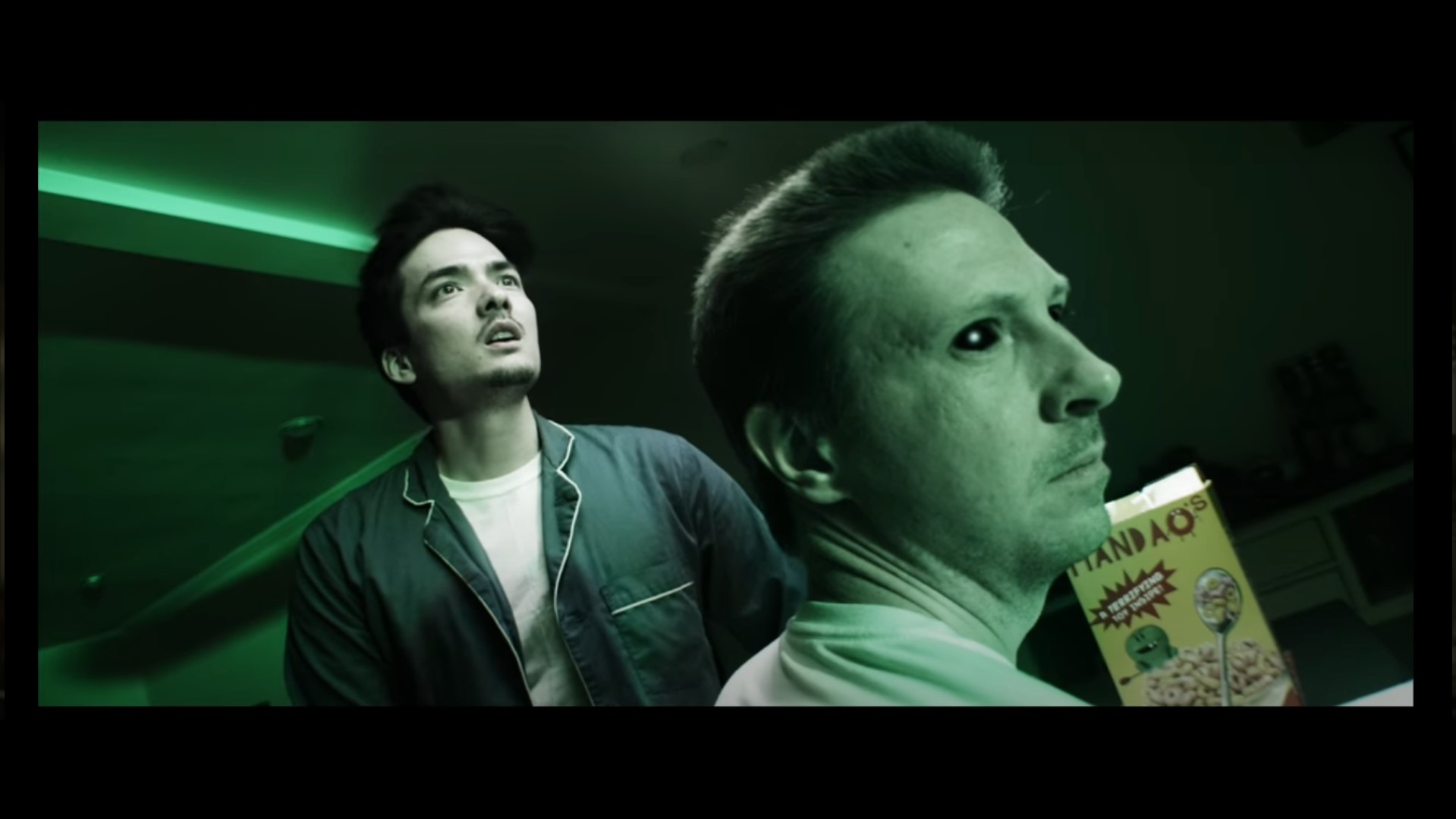
Mandao is back!  Or rather returns in a new scouring the astral plane misadventure entitled “Mandao Returns.”  When we last reviewed the Scott Dunn 2019 comedy-horror sleeper hit, “Mandao of the Dead,” an open ending left us salivating with a possible sequel under, what we know now to be a working title, “Mandao of the Damned” that promised exploring the nonphysical and paranormal realm’s mysteries and secrets that threatened Jay Mandao’s whole grain boxed-in existence, at least according to Mandao’s father, Raymond with a foreboding sign of inexplicable things to come.  The Kickstarter.com, crowdfunded modern cult favorite raised more than $26,000, doubling the first film’s budget, from approx. 250+ generous likeminded supporters within two weeks time that brought back four core characters essential to “Mandao of the Dead’s” grim, but lighthearted success to battle half-cocked the supernatural forces of evil.  Instead of a blood drinking cultist, a by-midnight death ceremony concretes stardom and greatness, but not if Jay Mandao has something to say about it.  “Mandao Returns” is a production of Scott Dunn’s Dunnit Films and distributed by Indie Rights.

Returning, obviously as stated in the title, to ensure the safety and well-being of those who incessantly annoy yet deep down care for him on a daily level is the hapless Jay Mandao, the titular hero played by writer, director, and story creator, Scott Dunn, along with Dunn’s wife, Gina Gomez Dunn, who steps back into a co-producer role for the sequel as well as stepping back into the shrewdly wild shoes of Fer, a close but no cigar Mandao love interest continuing to become mixed up in Mandao’s spiritual shenanigans while being a private driver for the Uber-equivalent Bum Rides.  Though blood is thicker than water, Mandao’s cousin-by-marriage Jackson oozes with dense innocence as Sean McBride reprises the daft role to another perfect tune of witless naivety.  Together, Mandao and Jackson arouse a likeable dynamic duo that becomes the keystone to both films’ success because without McBride’s timely childlike disposition, Mandao would just be a snippy and angsty loner and without Dunn’s subtly serious tone, Jackson would overrun the comedy-horror with one-sided gullibility.  With any sequel aiming to top its predecessor, the buddy comedy needed to be bigger and by adding the fourth returning character, Cousin Andy, as an important ingredient to the mix, Sean Liang adds a grounding hoodwinking conspirator that thrusts Mandao and Jackson into action on the astral plane field when the no-good antagonist, Aura Garcia, played by newcomer Jenny Lorenzo, becomes scorned in the spiritual world and takes heinous vengeance that not only involves Mandao, Cousin Andy, Jackson, and Fer, but also Garcia’s talent manager, Ted (Jim O’Doherty), in a sacrificial ritual gone terribly wrong. 

“Mandao Returns” is a smartly written script from creator Scott Dunn whose able to mold fallibly fascinating characters into unlikely heroes juxtaposed against a monumental occurrence much greater than themselves with the vast possibilities in the spacetime continuum.  Of course, the cinema flair to decorate the otherworldly dimensions with accessible ease and gloomy aesthetics faces speculation of existential questions of mindpower and life after death and the challenges the mechanics of the theory of metaphysics, but all that abstract mumbo-jumbo is pushed aside in order to make the “Mandao” films entertaining and for a good reason because when the script has colorful characters and a working narrative, “Mandao Returns” allows audiences to turn off rationality for approx. 71 minutes to enjoy a modestly produced Sci-fi comedy-thriller with a cast accurately in sync with each other’s methods.  The one thing I will say about “Mandao Returns” that I found to be a sore spot, despite still immensely enjoying, is that the story echoes eerily to “Mandao of the Dead.”  With a slight tweak to Mandao’s astral projection powers and trading in a different breed of villain, from point A to point B, from dynamics to outcome, everything seemed nearly identical to “Mandao of the Dead’s” narrative, delivering nothing distinctively new to the table to elevate the character’s fate and circumstances into unique, un-before-seen horizons.  Dunn comes close to challenging and upgrading the prior narrative by hinting something lurking within the spirit world was on the verge of closing in on Jay Mandao if he continues blindly using astral projection by the forewarning words of his father, Raymond Mandao, but slips out of that digressional stream to pit Mandao versus greenhorn cult acolytes looking for glam and glory by way of the gory and that, done in the Dunnit Films’ essence, is okay too.

As a quirky, out-of-body sci-fi thriller experience, “Mandao Returns” succeeds in succeeding as the sequel that brings the thrills and the laughter of far-fetched heroes ready to tear into the fabric of time to stop evil once again. The film comes to you from distributor Indie Rights and is available now streaming only on Amazon Prime so get your pandemic pants on aka comfy, stretchy pants, grab some movie style popcorn, and recline back to watch “Mandao Returns.” Experience the vibrant and wraithy-visioned glow cinematography of A.J. Young, returning from “Mandao of the Dead” as well as Dunn’s first film “Schlep” and another camping trip horror film, “Camp 139.” Young stays true to the films atmospherics with hard lighting a variety of hues and creating a story through the presence of shadows, working movie magic creating an opulent visual experience when really only working with about 25 grand. There were no bonus features nor extended credit scenes with this digital screener. One day, I’d like to see Scott Dunn and his Dunnit Films team work with a good chunk of budget cash and push the limits beyond the simplicities of the “Mandao” films, but until then, “Mandao Returns’ is disseminated with a whimsical awareness and fervent macabre that’s intent to please.

Watch “Mandao Returns” on Prime Video. Click the Poster!

Uncalcified Penal Glands and Designer Drugs are an EVIL Around-the-Clock Cocktail. “Synchronic” reviewed! (Blu-ray / Well Go USA Entertainment)

A new over-the-counter designer drug called Synchronic has been at the center of a string gruesome deaths in New Orleans.  Simultaneously, two best friend paramedics, Steve and Dennis, individually battle their own life-altering personal problems while responding to the grisly emergency calls.  With each horrific scene of Synchronic’s doing, Steve decides to take matters into his own hands by purchasing the remaining supply in all of New Orleans after Dennis’ teenage daughter mysteriously disappears after ingesting the drug.  With no leads on the missing girl’s whereabouts and after being visited by the time abstract ramblings of the chemist responsible for creating the drug, Synchronic’s harmful hallucinogenic properties have more tangible dangers than what meets the eye leaving Steve no choice but to pop one of the pills to understand where, or when, his friend’s daughter may have disappeared to.

I’ve said it once before and I’ll say it again, Aaron Moorhead and Justin Benson are visionary filmmakers with a penchant for the larger-than-life and otherworldly terrors.  From their directorial of a mind-bending death cult in “The Endless” to their producing hand in Jeremy Gardner’s lost love and creature feature, “After Midnight,” and Amy Seimetz deathly contagious, “She Dies Tomorrow,” under Rustic Films, the ambitiously talented duo returns with “Synchronic,” an anything but plain spoken, time-winding, Sci-Fi tale revolving around themes of redemptive purpose and grateful circumstances stitched by the uncanny temporal effects of artificial illicit drugs.  Lying somewhere between the cognitive warping psychedelic drug and feeling disconnected from the environment of a dissociative drug, “Synchronic” sojourns random grooves with the needle of time in a culminating enlightenment that now, the present, is a gift worth enjoying.     Along with Moorhead and Benson’s Rustic Films, Patriot Pictures, and XYZ Films bring to fruition the filmmakers’ biggest production yet. 

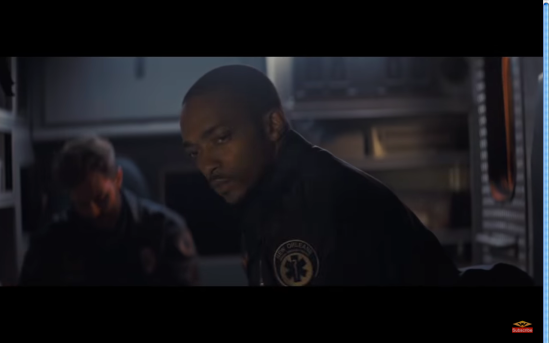
Like most of us during pandemic times, but not quite exactly like us who are working stressfully from home, is Anthony Mackie acting comfortably in his hometown of New Orleans, Louisiana.  The “Captain America” star temporarily hangs up Falcon’s wing harness to play lonely paramedic Steve frequented by his tragic past that has led him down a path of casual flings and an inability to attach to anyone romantically.  Opposite Mackie is Irish actor and “Fifty Shades of Grey” star Jamie Dornan as Dennis, a man kicking himself hard for marrying and starting a family too early in life that’s created a bizarre Prince and the Pauper dynamic where Steve and Dennis are envious on each other’s life.  Mackie is pitch perfect in the timing of a seemingly tailored-to-Mackie script that is funny as it is engrossing and thought-provoking.  “Synchronic” is truly the Mackie show with Dornan playing second fiddle as a compliment to Mackie’s more clandestinely troubled character who aims to upend and mend many wrongs in his life, including those of his best friend, and weaves in and out through the fabrics of time with Katie Aselton (“She Dies Tomorrow”), Ally Ioannides, Ramiz Monself, and Bill Oberst Jr (“DIS”).

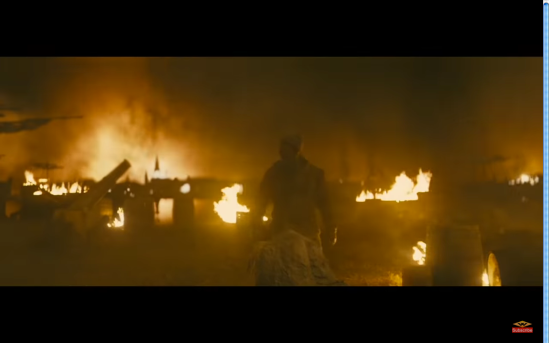
Time travelling is a finnicky concept.  Lots of variables have to be ironed out in order to break the planes of chronological, set-in-stone, thinking and construe time as an infinite recording always available for repeat and playback.  Time travel is perhaps science fiction’s most powerhouse model, producing some of the most influential and staple films of the genre in our time that include “The Time Machine,” “The Terminator,” and “Back to the Future” that have carried out repeated viewings of admiration, a franchise legacy, and been the source of inspiration and remakes.  Plot holes and flaws in these films go without saying and are considered expected, but if filmmakers can get away with convincing audiences otherwise, then expect a blast from the past, present, and future.  Moorhead and Benson’s “Synchronic” has a gripping and cosmically vast story done in only one small corner of the world, the historically rich and diverse culture of New Orleans, and that isolating effect pressed upon by the distant and ominous unknown, a supremely niche and bracing style from the directors.  “Synchronic,” like time jumping films before it, has the anticipated plot holes in the mechanics of the designer drug’s side effects that are seemingly straight forward to the experimenting character only after attempting a handful of pill-popping jumps.  There are also no adverse butterfly effects stemmed from any of the Synchronic’s users.  You’ll find yourself lost in time over these questions that routinely shoot up other films to smithereens in the ole inconsistency corral thanks to Moorhead and Benson, along with the riveting and hilarious performance from Anthony Mackie, who suck you in with their relatable and humanizing story premised around Steve and Dennis’ life regrets mended by an eye-opening slight tear in the fabric of time to understand what you have now could have been a lot worse then.


“Synchronic” is stylish, Sci-Fi craftsmanship coming to you onto Blu-ray home video from Well Go USA Entertainment. The film is also available on DVD and digitally. Presented in 16:9 widescreen format, “Synchronic” barrages with a somber and slick, yet almost alien, plating over the Creole and double gallery architectures in a mesh of robust multicultural with the grimy slums, envisioned by director of photography, Aaron Moorhead, who, in part with Ariel Vida, the production designer, is able to capture era slithers native to Louisiana lineage. The Blu-ray comes with an English language DTS-HD master audio 5.1 surround sound that’s crisply makes distinct every track element defined by individual scenes. Jimmy Lavalle returns to collaborate with Moorhead and Benson once again to compose an unique compositional score that can only be described as driving nails into your soul while also being powerfully moving without being an echo out of inspiration. The release is rated R with a runtime of 101 minutes and comes with a fair amount of bonus features including commentary with Aaron Moorhead and Justin Benson, a making of featurette, a previsualization (a fancy word here for live-action storyboarding with a camera phone), a VFX breakdown (which is touched upon a lot in the making of featurette), a deleted scene, and an alternate ending that will doggone blow your mind! “Synchronic” is intense medication to repair a kindred friendship falling into disrepair in this literal mind-boggling must see it to believe it thriller. Expect more great things from Aaron Moorhead and Justin Benson to come!

Order “Synchornic” on Blu-ray by clicking the poster above!

Keep the EVIL Family Drama for Your Mama. “Abigail Haunting” reviewed (High Fliers Films / Digital Screener)

While searching for a life in Reno, Katie reluctantly becomes an accomplice in a heist job with her abusive boyfriend, scoring a small brown paper bag packed with stolen money.  In the middle of post-heist uncertainty, an opportunity to escape a troubled relationship presents itself and Katie hightails it to her hometown of Prescott with the loot, leaving the dark life behind her in Reno.  Unsure of her next steps, she hides away by moving back into her childhood trailer home with foster mother, Marge, who has nearly deteriorated into a completely catatonic state over the last few years.  As the days pass and Katie catches up with Brian, rekindling a relationship with a high school crush, her secretive past becomes plaited into Marge’s sinister skeleton in the cupboard that pulls both of them into the supernatural wrath of a tormented spirit haunting the trailer home, merging the past and present with a shocking conclusion.

Cursed.  No, not the vengeful spirit who resurrects to plague havoc on the still breathing, flesh and boned to set their tortured, spiritual planed souls to rest.  The curse I speak of involves putting Haunting into the title of any ghost film that has been released in, oh let’s say, the last 20 or so years culminating into being one mediocre release after another of mainstream and independent films that has, frankly the lack of a better word, cursed the subgenre.  Type haunting in the IMDB search field and just glaze over as hundreds of films crash over you in a tsunami of stale capitalism ever since the remake of Robert Wise’s “The Haunting” in 1999 with Liam Neeson and Catherine Zeta-Jones.  “The Haunting of Connecticut.”  “An American Haunting.”  “23:59:  The Haunting Hour.”  Being one step behind the hackneyed “possession” in nearly every title about, well, possession, these post-2000 ghost films are just morsels of the bigger crapola pie that investors love to sink as little of their money into as possible because the return is greater because ghost film don’t necessarily a R rating unlike other subgenres and, sometimes, piggyback off a successful film with the parlance.  PG-13 in slashers is an oxymoron, if you ask me, but in with ghosts, fear of mysticism and the unknown has enough power to scare if done correctly, i.e. the original “Poltergeist.”  This unbecoming setup leads us to the 2020 release of the revenant thriller “Abigail Haunting,” the latest Kelly Schwarze written and directed full length film after tackling an Area 51 inspired bloody battle beyond the stars set in our backyard with “Alien Domicile, and before we go into whether the Schwarze film, co-written alongside Charisma Manualt, can tame an unbridled use of title-exploitation with a first rate story, the Indie Film Factory production will receive full benefit of the doubt until the end of the review.


The story follows a small town girl, Katie, from Prescott, Nevada who falls into small time crime with a lowlife boyfriend that quickly turns sour and deadly after an armed cash grab, presumably from a Reno casino.  Chelsea Jurkiewicz fits that small description recipe of stuck in a rut local girl without much cause for disbelief.  As Katie, Jurkiewicz’s able to be the part of a young, harried woman running from a checkered past and into the flames of a paranormal bombardment.  The then early 20-something, “Stalker” actress kept Katie balanced between her cash stealing time in Reno, integrating back into what was a rough patch with an unreasonable and abusive foster mother, and dealing with unexplainable occurrences of nightlights turning on by themselves, her room being ransacked, and succumbing to disturbing visions while reminiscing of being a scared child hidden behind a makeshift potato sack mask that becomes a reoccurring object throughout.   While Schwarze loosely ties all the facets together in a nice, tight bow that leads to a climatic unraveling of Katie’s past, the visually assaulted Katie suffers as the centerpiece punching bag that connects them altogether.  To top Katie’s mounting pressure, a face from the past tries to pry his way into her life.  A lost fling in Katie’s fleeting existence is Brian, played by Austin Collazo in his debut film performance, forcing himself into her life in what reeks of single parent desperation.  A moment involving Katie looking through a photo scrap book shows the two smiling together in a lone picture, as if she’s reflecting upon a previous romance or friendship that has since fizzled, but that’s about the extent of their history that doesn’t dive deeper into the reflection or explain the spark from the sudden interest from Brian.  At the crux of the story is Marge (Brenda Daly), a dirtied, nightgown wearing middle-aged woman who fostered abandoned at 4 months old Katie in what only has been, in Katie’s sole exposition, a terrible experience.  Schwarze instinctively ties the trailer home and Marge together as a single entity, enacting as one to push Katie around in a fit of unmotivated hysteria.  Katie doesn’t seem too eager to lift an investigated finger any of phenomena that has plagued her in the home, in the back shed, or even follows her out on a date with Brian.  Instead, Brian initiates digging into her past that sends Katie down Marge’s rabbit hole of hidden secrets in an off kilter directional take where a protagonist stands indifferent or remains stagnant after multiple Abigail encounters that would seemingly rouse up curiosity or for the sake of proving sanity.  Rounding out “Abigail Haunting” is Michael Monteiro, Christopher Brown, and Taylor May as the titular ghost.

Not a positive start with flat, often time dunce, characters in “Abigail Haunting.”  The mindset behind Katie’s involvement with the Reno robbery and a scoundrel lover strains to play a bigger role into the eerie defense she’s positionally locked into at Marge’s dreary trailer home.  Schwarze remains on the fringes around the preoccupations that descend Katie into this dark place in her life between searching for her real mother that abandoned her as an infant, the deadly robbery in Reno, and the abusive ex that all seem to be weighing less on Katie’s shoulders than the duffle bag of a couple thousand dollars that would typical skewer one’s psyche, manifesting more than just the typical side effects of pressure.  Instead, Schwarz doesn’t fold in well enough the incorporation of our angry spirit, Abigail, whose unexplained appearance out of the Nevada blue sky in between Katie’s leaving and returning to Marge’s home denotes not one single explanation of when and why Abigail chooses to be a resurrected, phantasmal spite.  More jeopardizing toward Katie’s past and present life is her obsession with the stolen money versus living a decent life with possibly Brian and his dissociable, divorce struck kid, who the former is clearly obsessed with her, but the story more so saturates with a free floating, full torso phantasm, as the Ghostbusters would say, that undermines the subterranean psychology at work here and clouds the ghost foundation built on deceits, lies, and ugly truths. What “Abigail Haunting” succumbs to is being about as rudimentary as they come with a climax too riddles with plot holes that squish much of good establishing camera work and some decently laid jump scares. Haunting, as in a title, still curses the horror subgenre with middle-of-the-road dynamism.

Death clings to us all. In “Abigail Haunting,” death clings to vengeance in this supernatural thriller dropping on DVD in the UK on February 8th courtesy of High Flier Films and ITN Distribution. The region 2, PAL encoded DVD will be presented in a widescreen 2.35:1 aspect ratio with a runtime of approx. 85 minutes. I initially had high hopes for Abigail to be at least be a derivative carbon copy of “The Conjuring” as “Scare Me’s” Michael TusHaus’s shows off impressive camera work that organically flows through Marge’s tight quartered trailer, as well as in other scenes when applicable outside the trailer location, with generous use of a stepping in-stepping out steady cam. TusHaus’s hard lighting also creates stern atmospherics with full bodied shadows that symbolically keep secrets and spirits in the dark. The digital release had no extra bonus feature available with none displayed on High Flier Film’s website. There were also no bonus scenes during or after the credits. Solid cinematography and palatable performances couldn’t plug up all the plot holes that stiffen “Abigail Haunting” into a two-bit carnival attraction that looks cool upon entry but not worth the money on exit.