PROGRAM DESCRIPTION
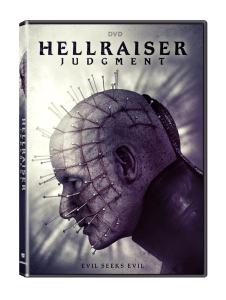
Experience a terrifying new chapter in the legendary Hellraiser series when Hellraiser: Judgment arrives on Blu-ray™ (plus Digital), DVD, Digital, and On Demand February 13 from Lionsgate. The tenth film in the classic horror series tells the story of three detectives as they struggle to solve a horrifying murder, but instead find themselves thrust into the depths of Pinhead’s hellacious landscape. Including horror icon Heather Langenkamp (A Nightmare on Elm Street, Wes Craven’s New Nightmare), and written and directed by Gary J. Tunnicliffe (Hansel & Gretel), the Hellraiser: Judgment Blu-ray and DVD will be available for the suggested retail price of $21.99 and $19.98, respectively.
OFFICIAL SYNOPSIS
The dreaded Pinhead returns in the next terrifying chapter of the classic Hellraiser series. Three detectives trying to stop a diabolical serial killer are sucked into a maze of otherworldly horror, where hellish denizens including the Auditor, the Assessor, and the Jury await to pass judgment.
BLU-RAY/DVD/DIGITAL HD SPECIAL FEATURES
· Deleted & Extended Scenes
· Gag Reel
CAST
Randy Wayne – “Escape Room” and “Death Pool”
Heather Langenkamp – “Star Trek: Into Darkness” and TV’s “Truth or Dare”
Paul T. Taylor – TV’s “Sheltered” and “Alternative Math”
Rheagan Wallace – TV’s “Malcolm in the Middle”
Recently released from prison, ex-con Boris reaches out to his former lover, Wendy, to discuss the status of their relationship after her cold feet episode on a robbery job where she drives away the getaway car, leaving him red handed when the cops arrive. Wendy wants more than anything to live a normal, honest life and Boris aims to please her wishes, but needs to pull of one big job to set their future. Fortunately for him, Wendy happens to be the plaything of a wealthy paraplegic who owns a lustrous castle. Boris convinces Wendy to recon the inside, to find where the treasure might lay within the belly of the castle walls, and when the pair of thieves manage to break into the castle’s fortified basement, escaping is inevitable when a deadly game unravels. Trapped inside a chamber of terror, Boris and Wendy must go through a series of enigmatic riddles and deadly traps to move forward toward what they’ve broken into to steal, but when offered a chance to leave the game with their lives intact, will an acceptance to live be decided upon or will Boris and Wendy gamble for greed?
InterVision Picture Corp., has done it again with another stellar resurrection from the VHS video graveyard with the release and distribution of the Canadian gem “Beyond the Seventh Door.” The debut of B.D. Benedikt’s written and directed horror doesn’t display much of the elements associated with the horror genre with the exception of an acute dispersion of thrills and mystery; instead, Benedikt’s film breeds a mutt that commingles fear invoking atmospherics with the intensity of an unflinching, yet undetectable, moral essence that amusingly reestablishes the very Canadian stereotype of being too nice for the North American nation’s own good. The clearly expressed message of greed goes without saying in a plot that involves incurable thieves making life and death choices over materialistic riches despite the consequences that follow if to pursuing the latter. Another theme exposed is that working together will increase your chances to overcomes obstacles as Boris and Wendy mesh their strength and their smarts to solve puzzles and to escape traps before them and on the other end of the spectrum, going at the situation alone doesn’t work out for either one of them. The prominent themes intertwine effortlessly into a modest story that doesn’t become undercut by today’s inherent plot twists or fail to meet captivating interests as the themes are timeless and current as greed never goes out of style proven by the recent Oscar nominations for Ridley Scott’s drama “All the Money in the World.”
The cast quartet requires not one more soul to showpiece this Canadian cult classic. Leading the quaint pack is the Yugoslavian stud Lazar Rockwood and the rumors are true, Rockwood does look like the long time on screen villain Billy Drago, but Rockwood, as Boris, is no hard nose bad guy but along the lines of an anti-hero with his crooked conscious overtop a softer, tender heart for his past life lover Wendy. Bonnie Beck tackles Wendy as a woman pulled by two desires: her feelings for Boris and a normal life without lawlessness. Her more memorable scene consists of her stripping her red, thigh high skirt, exposing the lacy, black garter underneath, and comically trying to plug water spewing holes in order to not drown. Rockwood and Beck’s on screen chemistry doesn’t jive and, to be overly honest, their bond is substantially weak, but to embody and embrace a characterized scorn and torn twosome, the pair share a set ablaze with passion for accomplishment that oddly resembles Richard Chamberlain’s Allan Quartermain’s adventures sans the quirky comedic charm. Rockwood and Beck completely make up about 90 percent of the screen time as Gary Freedman, in his sole credit, dons the mysterious Castle owner and a local Canadian celebrity, a street performer, named Ben Kerr who only had to sit with his eyes open and act a corpse.
Modest as it was, “Beyond the Seventh Door’s” independent production couldn’t rival the end resulting magnitude of which the construction of the trap rooms and the characterization of the score would suggest a bigger wallet project, transforming that aforementioned simple story into a big ticket item. Behind the financial curtain is the responsible parties, the Herceg brothers Frank, Steve, and Tony and along with a fourth producer, Lubomir J. Novotny, Bozidar D. Benedikt gained the trust to pull off a no-budget thriller into a wild brain, catacomb horror that pre-dates the escape room element of “Cube” and Jigsaw’s lethally virtuous games. Now, I wouldn’t say “Beyond the Seventh Door” pioneered the genre, but merely had a minor influenced and sometimes that’s all it takes for inspiration.
Canada’s ambitious exploitation film “Beyond the Seventh Door” is now out for the first time every on DVD courtesy of InterVision Picture Corp., the sui generis distributor of rare independent genre films. Presented in a full screen 1.33:1 aspect ratio, the shot-on-video image quality retains an above VHS level quality with a clearer picture and refined details. BBlotchy moments are still prevalent, especially in long shots of Boris leaving the prison and walks along a cold path to the waterfront, but doesn’t kill the reflective moment. The audio 2.0 mono track has great clarity, range, and depth that showcases some of Lazar’s greatest lines of his hilariously read dialogue, such as “Screw you! You hear me, screw you!” The synthesized soundtrack emanates balanced LFE and range. There’s minor, but inconsequential, hissing during dialogued lines. Bonus features include audio commentary with director B.D. Benedikt, star Lazar Rockwood, and moderated by Paul Corupe of Canuxploitation.com. Also included are interviews with B.D. Benedikt, Lazar Rockwood, and Paul Corupe in a “Beyond Beyond the Seventh Door” segment and a look at Ben Kerr, a Toronto eccentric, in “The King of Cayenne” that delves into Kerr’s street performing life, his run for political office, and his overall love for a cayenne pepper cocktail. “Beyond the Seventh Door” is an anomalous, door-after-door misadventure with eccentric performances and an exceptional plot twist that only B.D. Benedikt could kook up and only Lazar Rockwood could pull off.
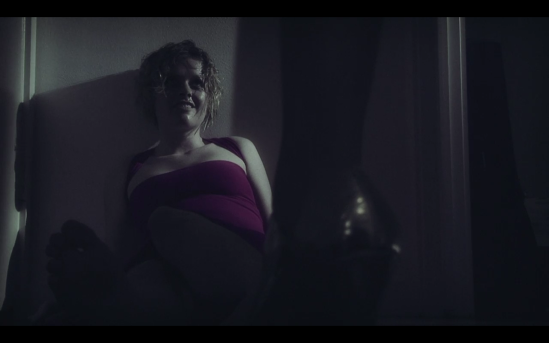
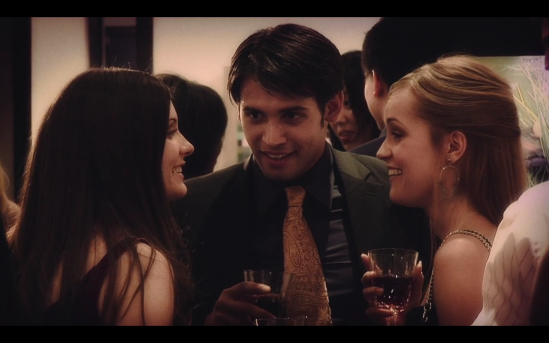
On the campus of Williamsburg University in 2006, a popular fraternity house holds an upscale house party, filled with the most beautiful students dressed in formal wear, liquored with martinis and gin and tonics, and customized to fit the luxurious lifestyle the men of fraternal brotherhood. When the fraternity president Christian Roane conducts a round around to greet guests, he catches glimpse of Sarah Stein, a coed being a good sport by giving into her friends’ urges to party greek. Christian’s unhealthy obsession with Sarah starts innocent enough, but when Sarah doesn’t take that step toward sharing the same affection, Christian’s control goes into self destruction that not only threatens Sarah, but also threatens to unearth the true and ghastly nature of the brotherhood and the brothers aim to lockdown their secret by any means necessary.
“Somebody’s Darling” is the 2016, independent drama horror from the multi-faceted filmmaker, writer-director Sharad Kant Patel, churned out from a story by Sebastian Mathews. In his directorial debut, Patel, known more for his short film work, heedfully courses through detail and treads lightly on the coattails of a sensitive social issue. His film skirts on the subject of rape culture in the American college and university setting while also touching upon sexuality complexities and severe anguish in today’s youth. Basically, “Somebody’s Darling” is a higher education dissertation on the experiences of collegiate life with a horror twist and all the along the way, Patel slowly paints Christian and his brotherhood onto a canvas of ambivalent malevolence by deconstructing Christian to quickly reconstruct him in a ravaging roundabout. Patel throughout leaves a bread crumb trail of clues that don’t make sense at first, that might lead to other conclusions, and that doesn’t explicitly genre “Somebody’s Darling” as a horror.
Christian is the film’s central focus and with a dark and brooding character, a dark and brooding soul must ride parallel and Paul Galvan intently delivers a cryptic persona. Peppered erratic is Christian obsession Sarah Stein, a run-of-the-mill coed playing darlingly enough by Jessa Settle. Then there’s the brotherhood, whom are begrudgingly split on how to action Christian’s off course fixation, consisting of a youthful lineup of white, stuck-up preppy frat boys with an actor list to match including Fred Parker Jr., “Spirit Camp’s” Matt Tramel, and Mike Kiely. Sarah also has an entourage but not as prominent and, to be honest, the brotherhood weren’t just a hair more involved, but Kristen Tucker and Cathy Baron (“The Lights”), who play Madison and Riley, hit the stereotypical college coed right on the head as the two look to score big when scouring their hot boy wardrobe and provide unnatural sexual banter toward their goody-two-shoes friend, Sarah.
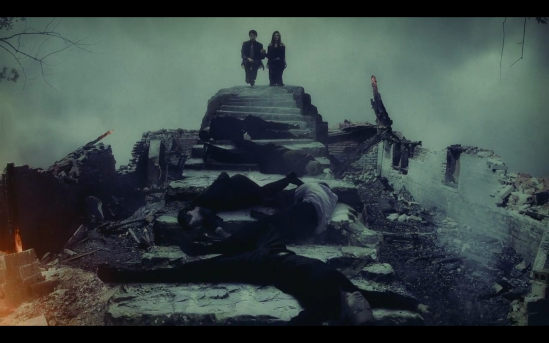
“Somebody’s Darling’s” independent genetic makeup doesn’t hide under a flashy production, but presuming an indie dramatic horror that’s more bark than bite isn’t worth wild should is the incorrect assumption as the climatic end will be attention catching. Granted, the dialogue’s overdrawn breathiness can bog down a regular popcorn viewer and turn away heads that have a disdain for immense screenplay scripture, but to comprehend the whole story and to become invested in the characters, being a viewer from start to finish won’t go in vain. Patel personal investemnt extends to much more than spitfire directions and scribing with a hand in producing, composing, editor, and digital effects with the latter being used sparsely to convey the Christian’s internal aspirations and quondam self. When effects do come into the real word, a practical, lifelike approach is taken and that intensifies the horror tenfold.
Distribber released Sharad Kant Patel’s “Somebody’s Darling” onto various streaming platforms such as iTunes, Amazon, Google Play, and Vudu on December 1st. I was provided a screener disc and can’t focus on or comment too much on the details of image or sound quality, but the disc did provide bonus material including the making of the score and behind-the-scenes in creating the dream sequence. Sharad Kant Patel’s “Somebody’s Darling” has an edgy appeal that draws you in like an unsuspecting moth to an alluring light and then zaps a fatal shock right into the nervous system as soon as the undertones are evidently a metaphor for something far more sinister.
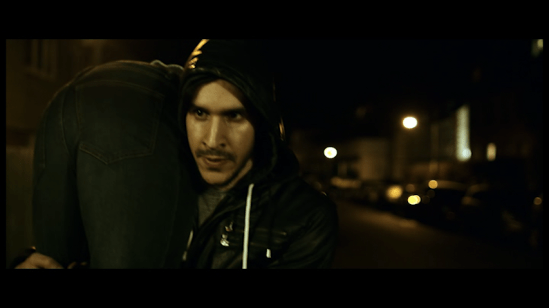
Zaki owns a small kebab shop in England’s vern own party central in Bournemouth on the South Coast. Every night, Zaki withstands the late night drunken antics of the local party goers in the hope his son, Salah, would continue his graduate studies and to also, maybe, one day own his own fine dining restaurant, but when he becomes involved in a scuffle with a late night rowdy bunch, he’s killed in a fit of alcoholic whims. Salah takes over his father’s shop, neglecting his studies, and continuing the serve the intoxicated public in his father’s memory, but when he accidentally kills one stubborn customer, he mincings his body parts into kebab meat instead of calling the police and whenever a deplorable enter his shop, he serves them the newest menu item. One sloppy drunk customer after another, Salah wages a vigilante’s war on party world, especially toward a new dance club that masks over a drug trafficking ring.
“K-Shop” is the 2016 horror from writer-director Dan Pringle in his first helmed feature that aims to explore the troublesome nature of the after party, intoxicated human plagued upon sensible people. Pringle strengthens the social commentary by implementing actual footage of drunken debauchery filmed right on England’s South Beach that range between spewing chunks onto the sidewalks to heated back and forth fisticuffs. Pringle’s script tackles that insatiable inner urge everyone has felt at least once in their life when dealing with unreasonable nightlife and that is to raise a fist against them to show how to act like a decent human being. “K-Shop,” which denotes being a double entendre for Kebab Shop and Kill Shop, takes the act one step further, introducing a cannibalistic element to the mix as Salah rids scrum from the earth by slicing and dicing them into his kebab mixture. Salah’s father, Zaki, is a Turkish refugee and him and his son are essentially immigrants that becomes another script undertone brought up the club owning, drug trafficking, all over bad guy Jason Brown.
Salah is brilliantly executed by Ziad Abaza who brings a cache of raw emotions to his character. “K-Shop’s” trailer hinted at a horror-comedy feature, but there’s nothing funny about Abaza’s Salah who seems that life is wholeheartedly against him as a downtrodden college student in a search for basic human decency and compassion. Salah is pitted against an egregious Jason Brown played by Liverpool native Scot Williams and Williams embodies and embraces being a person of high social status and fame, a person of who lavishes in luxury, and epitomizes being a slime ball. Brown’s a stark contrast against Salah who has to slave away and earn his living while Brown takes his life for granted. The supporting cast are also very interesting starting with Reece Noi as Malik who voyeuristically takes an interest in Salah’s vigilantism and who also, perhaps, shares common cultural aspects, but Malik is just a kid acting beyond his age at times and then drastically at his age at the most crucial moments during his dynamics with Salah. Another character is Salah’s potential love interest in Sarah portrayed by Kristin Atherton. Atherton provides a sweet, quiet, and intelligible demeanor to Sarah that projects onto Salah whereas other women in Salah’s life, mostly his patrons, are loud, obnoxious, and corrupt. Lastly, “Doomsday’s” Darren Morfitt instills a catalytic character in fallen from grace Chaplin Steve. There’s a bit of a confessionally staged event between Salah and Steve that offers a realization and a tale-end twist that just puts that unwanted pit into the bottom of stomachs.
Now “K-Shop” isn’t totally perfect, especially in the flow of the film. Pringle doesn’t clearly provide a timeline of progression. Between the holidays Christmas and News Years is perspectively prominent, but Salah’s calling, or mission, seems to extend weeks, if not months, and that isn’t clearly communicated. Plus, there’s slight difficulty understanding turn page moments that dilute the significance of events whether it’s through too much exposition or choppy editing. Where “K-Shop” is weak, Pringle makes up with gore and story. The gore is absolute from scorching an inebriated man’s face sizzling in a vat of hot oil to chopping up limbs with a butcher’s knife in order to make his delicious kebabs. Pringle’s conclusion is absolving, satisfying, and also, at the same time, fruitless because even though Salah makes a stand against immorality, a realization washes over him that nothing will ever change despite cutting the head from the snake.
Breaking Glass Pictures distributes “K-Shop” on to an unrated DVD home video. The DVD is presented in a widescreen 2:35:1 aspect ratio and the overall quality is stunning sporting a dark painted picture and still convey a healthy color palette even if lightly washed in a yellow hue. The’s no attempt to enhance the image as the natural color tone comes right out and off the screen and that dark gritty matter really speaks to Pringle’s capabilities to create shadows. The English Dolby Digital 5.1 audio track is surprisingly hanging around par level as, some of those key moments once spoken about, are lost in a muddled heap in the dialogue track, but there’s range and fidelity thats good on the output amongst a balanced five channel track. Bonus material includes a behind-the-scenes segment and deleted scenes plus Breaking Glass trailers. “K-Shop” is dark, gritty, and eye opening backed by a versatile lead in Ziad Abaza and helmed by newcomer filmmaker Dan Pringle, seeking to entertain and unearth our inner and deadly vigilante doppelgänger in the midst of social indecencies.
An ambitious physics professor Hiram Otis obtains a research grant that requires him to study in England, pulling his wife, daughter, and two young boys from their Indiana home into a strange new world. In an age of obsolete aristocracy, the Otis family is able to afford rent at the grand Canterville Hall, a legendary castle with an infamous tale of death and suspicion that also might have resulted in being an affordable estate for the American family. Legend records have it that the lord of the castle, Sir Simon de Canterville, had subsequently killed his wife due to his obsessions and became the victim of his wife’s family spiteful vengeance by being chained to a dungeon cell. For 400 years, Sir Simon remained in that cell and his ghost haunts Canterville Hall, but despite their beliefs in the supernatural, the physics professor and his wife can’t see the ghost and only their teenage daughter and two young boys are able to witness him roam the halls, haunting those who live within the castle walls.
Every once and awhile, we’ll thoroughly review a light-hearted fantasy, horror, or sci-fi film and since we’re hot off the heels of the review for Wes Craven’s “Summer of Fear,” the made-for-television train might as well keep chug-chug-chugging alone with the 1996 TV movie adaptation of the Oscar Wilde novella, “The Canterville Ghost.” Distributed by ABC, the Sydney Macartney (as Syd Macartney) directed and Robert Benedetti teleplay written installment tries to differentiate itself and standout amongst a plethora of adaptations that span across the globe, but the American Broadcast Company, a subsidiary of the great and powerful Disney, aimed to separate from the masses by adding star studded power and the result brought a rejuvenation to the ye old tale over two decades ago.
The big name headliner is none other than Captain Jean-Luc Picard himself, Patrick Stewart, two years after his 7-year stint on Star Trek: The Next Generation. Stewart, who co-produced the film, adds his theatrical flair and is absolutely brilliant shaping drama monologues into dense thickets that define Sir Simon de Canterville’s ghost, but there’s an issue; the problem doesn’t lie with Patrick Stewart, but with how Benedetti’s teleplay expos from the story as a continuous, if not slightly jumbled, stream of old English that just feels like rambling. To alleviate that strain is Stewart’s co-star Neve Campbell to add a softer, glassy-eyed touch to the story with a pinch of plain jane American girl insecurities, characterized in Wilde’s story as Virginia Otis. Perhaps in the beginning portion of the height of her career, Campbell finds herself between “Party of Five” and hitting scream queen status as Sydney Prescott in “Scream,” but the “Wild Things” actress wasn’t that sultry or that chased in “The Canterville Ghost” who only took upon an annoyed teenage girl persona, wishing her life was back in America up until the mysterious spirit of Sir Simon de Canterville allured a spark into her dull life. Alongside Stewart and Campbell, Daniel Betts, Ciarán Fitzgerald, Raymond Pickard, Cherie Lunghi, Donald Sinden, Joan Sims, and the late Edward Wiley, who died shortly before the film’s premiere, costar.
Going into “The Canterville Ghost” was nothing short of knowing nothing other than the fact the Patrick Stewart and Neve Campbell were in the lead roles of a Disney backed, family film and to be completely honest, Macartney’s vision completely underwhelms. Along with the verbose nature of the script-to-teleplay alterations, the magical supernatural portions are inarguably cheap, even for television. The simple superimposing of Sir Simon de Canterville offered no stimulation as the the two scenes just didn’t splice together well to seamlessly make the grade. Firecracker explosions and party store cobwebs dilute even thinner the already slim pickings of special effects that top when Virginia Otis crosses over into a dense fogged ghostly realm thats chopped, cropped, and edited with such disorganization, the entire scene feels more lost than Virginia trying to escape the other side back to the living.
Sydney Macartney’s “The Canterville Ghost” is presented for the first time ever on Blu-ray courtesy of the U.K. distributor Second Sight Films. The Blu-ray is presented in the Academy ratio of 1.33:1 with 1080p resolution on a MPEG-4 AVC BD 25. Second Sight’s release will have the best looking version of this film, if the quality is anything like the screener sent to me, with a strong color palette, minor digital noise, and rich in great detail; so detailed in fact that the blemishes on Neve Campbell and Daniel Betts can be seen. The English DTS-HD audio track is lively, but not entirely boastful with more thematic and dramatic elements. Dialogue track is clean and clear and the score by “Dead Heat” and “Tremors” composer Ernest Troost augments his fairy tale rendition into the mix. Bonus material includes new interviews with director Sydney Macartney and producer-writer Robert Benedetti. Second Sight’s presentation of Hallmark Entertainment’s “The Canterville Ghost” has strong Blu-ray technical potential, but despite the big names of that time period and a visually stimulating setting, the fantastic adventure through a cursed ghost’s melodrama and a bored young girl’s tenure of self discovery unfortunately didn’t rivet with excitement or wonder, losing steam with it’s important message that life is more than being in a bubble of stagnant disappointment and guilt.