An Evil Demon Ate My Baby! “Out of the Shadows” review!


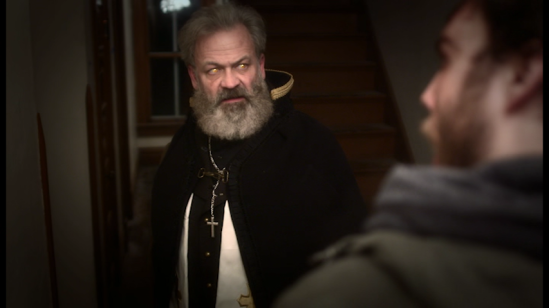
Police detective Eric Hughes and his pregnant American wife Katrina strive to find their own place and withdraw from Eric’s father’s home. A hot tip leads them to small, slightly rundown, midwives maternity facility just out on the rural outskirts of Crystal Springs. With help from their friends and a lot of elbow grease, Eric and Katrina rehab the structure into their dream home to settle down in hopes to raise their first born, but Katrina quickly discovers that her dream house is more like the house from hell when shadowy figures suddenly appear through the walls with an apparition of a midwife nurse bellowing, “Give me Scarlett!” – the name of Katrina’s unborn child. The Hughes turn to the Church to plead for assistance and an unorthodox demonologist, hearing their call for help, tends to their aid in hopes to cease the languishing torment, but rushing into the situation, eager to rid the supernatural forces from plaguing the Hughes, has escalated the pending doom for their unborn child.

“Out of the Shadows” is the 2017 released, ghostly-demonic horror from Australia, directed and co-written by Duncan “Dee” McLachlan along with co-writer Rena Owen (“The Last Witch Hunter”) from a story by Eric Nash. McLachlan’s atmospherics can compete with the best, toying with the shadowy figures passing behind frosted windows and door panes in a glimpse of a moment, demonic tongue ripping through the ears of the latched upon victim that is Katrina, and conjuring up vivid and haunting figures that are airy and grim. All of which is backed by sound cinematography by Viv Scanu in creating a personality, essentially giving breath, toward the Hughes home of destined damnation. Set location speaks for itself being a countryside, rundown hovel, but the innards bare an unsecured unsettling with many windows in a well ventilated structure fenced around by obscuring foliage that creates a gloomy prison for a tormented Katrina.

Kendal Rae stars as the stalked Katrina Hughes who goes from happy-go-lucky to a panicky mess in less than sixty seconds from the first inkling of trouble. Rae has a fine performance being the frightened house wife to the never-at-home husband, but that inability to transition, with time, Katrina’s slow burn into insanity or supernatural plunder is a blight on her performance. That never-at-home and naive detective husband finds an actor as the first feature film for Blake Northfield. Northfield’s has naivety down pat with Eric’s dismissive attitude and a penchant for not caring. Eric and Katrina seek the help from a renegade exorcist Linda Dee (Lisa Chappell) whose a biker relative of Father Joe Phillips (“Matrix’s” Helmut Bakaitis) with a checkered past and on thin ice with the Catholic Church for practicing unauthorized exorcisms, but that’s about how far the script takes us when delving into Linda Dee’s backstory. Jake Ryan, Jim Robison, and “Alien: Covenant’s” Goran D. Kleut, as the Hat-man Demon, round out the remaining cast.

As with the Linda Dee character, a noticeably uncomfortable underdevelopment of major roles put divots into the, what should have been, a cut and dry storyline whose only complexity would be if Katrina’s harrowing ghostly encounters are caused by either a sudden loneliness with her husband leaving her by herself for work, the fluctuation of pregnancy hormones, or an acute combination of both. Dee’s wavering stance with the Church, and also with her uncle, is hardly touched upon with brief exposition and doesn’t convey the severity of her actions that warrant being on the outs with the Catholic officials. Concurrently, Katrina suffers with a tangent subplot with unspoken tension between her and her State side mother that never gets explored, leaving the scenes left detached like an unhinged satellite orbiting the planetary story.

Umbrella Entertainment releases the Bronte Pictures produced “Out of the Shadows” onto DVD that’s presented in an 2.35:1 widescreen. Image quality has some nice outlined details without sizable DNR, especially during night sequences in the midsts of constructing a formidable shadow army. Though tinted in more of a blue and yellow hue, the overall color palette is pleasing, even if staged like a “Saw” film. The computer generated effects are where the details go awry dipping toward a softer side that perhaps exhibits the production value. The English Dolby Digital 5.1 soundtrack has no defining qualms with a even spread of low and high level ranges to where even the muttering demonic chanting is audible. There are no bonus material and the DVD doesn’t even have a static menu for guidance as the movie plays as soon as the opening credits roll. “Out of the Shadows” has a premise that’s been through the horror mill before, but director Dee McLachlan holds the thrilling line, maintaining a collectively strong start to finish to only stray from one or two key subplots that would wholeheartedly tie the entire film together.

In Search for Evil, Evil is Always Close! “Lycan” review!


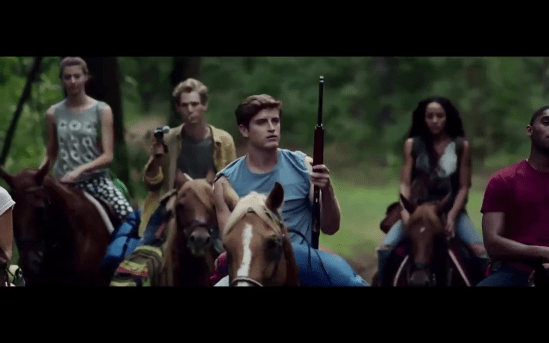
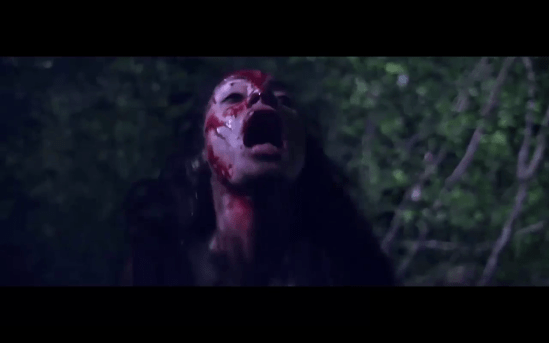
Set in Talbot County Georgia of 1986, six university students are assigned a write a 25-page report on a moment in history. The subject for the report was ultimately based off of local lore, a haunting story from a century old newspaper clipping that told legend of Emily Burt who was the prime suspect of being the notorious wild animal that tore through the local sheep herds. Ill-prepared and flippant for the report’s hot Georgia weathered journey into the woods, the students ride horseback through a labyrinth of trails on the Burt property and come under attack by a lurking bloodthirsty presence hellbent on separating them and tearing them to pieces. Desperation sets in when tensions flare, sides are taken, and perceptions are misled in a time of grave crisis, leaving the schooled students being taught a lesson in isolation and confusion in a classroom of ill-fated situations.

“Lycan” is the 2017 released survival horror thriller from co-writer and director Bev Land, making his inaugural feature film debut. Michael Mordler co-wrote the script that’s been described as “Hitchockian” and resembles a backdoor twist much to the similitude of M. Night Shayamalan films. Like Shaymalan’s earlier work, “Lycan’s” horror is extremely effective without having to bare witness an antagonistic beast and by leaving the girth of the killer’s destructive path to the imagination, our minds begin to formulate diegesis theories and build hypotheticals to the killer’s characteristics. The use of wolf-o-vision is a past time tool that flashes all it’s teeth to bring life to an unseen threat, but Land and Mordler pen a breadcrumb trail of hints that compound to a head in the midst of the chaos, unveiling the true threat in a full frontal way that’s a silver screen rarity, but nearly takes the fun out of the mystery.

Starring in “Lycan” is Bev Land’s wife, Dania Ramirez (“Quarantine”), in the lead role of the mysterious Isabella Cruz. Ramirez’s has to accomplish multiple feats with Isabella Cruz whose a bit of an awkward loner who then has to reintegrate herself into the social realm of a group of variously distinguished characters. Parker Croft portrays as pot smoking, wise-cracking, pervert named Kenny McKenzie who documents the trip with an 8mm camera, Rebekah Graf is the stuck up and prissy Blair Gordon who only accompanies the group on this trip because of Jake Lockett’s baseball jock Blake Simpson. Craig Tate, unfortunately, falls into the stereotypical ‘token black guy’ Irving Robinson while Blair’s sorority pledge, Kalia Prescott’s Chrissy Miller, opts to the gal to get laid. Aside from Ramirez, the rest of the cast of characters fall into formulaic limbo, stuck in their own devices, and never really elevate into more than just surface level characters. Two of the more eyebrow raising actors that never saw the character development light of day were that of Gail O’Grady (“Chromeskull: Laid to Rest 2”) and Vanessa Angel (television’s “Weird Science”). O’Grady’s Ms. Fields warranted more background into how the ranch owner came to have Isabella Cruz enter her life and much more unopened mysteries about their dynamic.

While “Lycan” offers an up-to-snuff survival horror, the story’s bookends fall short of fully completing the story. The opening puts big man Presley Melson’s lonely farm boy stuffing lady of the night Anna, played by Alina Puscau (“Dracuala: The Dark Prince”), full of his pork roll. As the wolf-o-vision circles the lovemaking barn setting, Melson and Puscau trot out with only their skivvies to check out the outside racket and become, uh, victims of the antagonist? Not really sure because the scene starts from afar and the wolf-o-vision glides right up to Melson’s face without much of a peep from either Puscau or Melson. The ending is just as enigmatic with a brief present day scene (the story is set in Georgia 1986) of an unknown little girl picking up a razor sharp object from the leaf strewn ground and then there’s a cut to black to roll credits. Before this useless segment, the pinnacle moment of the third act springs too many leaks to plug. Combined with the stagnant and underdeveloped characters, “Lycan” is an unkempt story left wide open becoming a victim by it’s own scripted structure.

MVD Visual presents onto a region one, unrated DVD, the 1 Bullet in the Gun production, “Lycan.” Presented in anamorphic widescreen 1.85:1, MVD’s DVD image is beyond spectacular with immense details in every scene, even in the production illuminated night scenes. Digital noise is completely absent and the coloring is naturally vibrant. The Dolby Digital 5.1 Surround Sound has an effective ambient track with clarity and range in the wolf howls and the cracks and snaps of outdoor living. The original soundtrack by Devine Adams and score by Jason Pelsey revel in distortion free perceptible measures. An audio downside would be the dialogue track that suffers from unfortunate mic placement, leaving major story affected parts of the dialogue left muddled and indiscernible. Bonus material includes interviews with director and co-writer Bev Land, along with co-writer Michael Mordler, the cast including with Dania Ramirez, Rebekah Graf and Vanessa Angel, and Crystal Hunt (Executive Producer) and Steven C. Pitts (2nd Unit Director). A panel discussion with the Lycan producers and the original theatrical trailer round out of the extras. Land and Mordler’s “Lycan” disperses moments of original horror with snap-witty dialogue, but as a whole, the story trends toward a paint-by-the-numbers route without breaking the mold as a low tier “Hitchockian” thriller.

Buy “Lycan” on DVD at Amazon!

An Evil Hog Demon Won’t Let You Escape this Island! “The Forlorned” review!


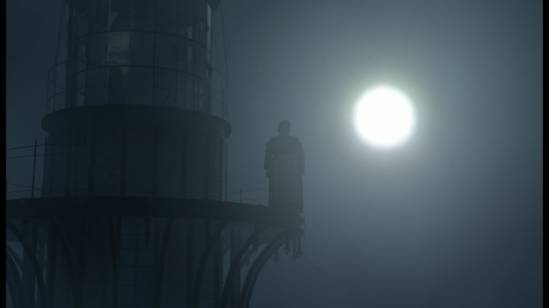
Just off the rough stormy shores of Nova Scotia is a remote island where American Tom Doherty becomes the newly hired lighthouse caretaker in search for good money. Already overwhelmingly cloaked with the lighthouse’s creepy adjacent housing and being forewarned by the island’s infamous legends, an isolated Tom experiences the abilities of dark force first hand and doesn’t know whether the forces are real or madness has swallowed him from the extreme isolation. As Tom continues the work, he discovers clues along the way that suggest the island holds a nefarious past involving murder, suicide, and cannibalism, but an old bible with a list of names is the key that has the potential to unlock all the island’s mysterious doors and can also be Tom’s unfortunate undoing if he maintains being the lighthouse caretaker.

Based off the Angela Townsend book with the same title, “The Forlorned” is the 2017 silver screen adaptation of Townsend’s mystery-thriller from “Dead Noon” director Andrew Wiest who has helmed a jolting, supernaturally visual and auditory accompaniment to Townsend’s literary work. To maintain authenticity, Townsend co-wrote a script alongside Wiest and Ryan Reed that’s riddle with an ill-omened story leading audiences down a path of insanity-ladened darkness. But what exactly is “The Forlorned?” Forlorn has two definitions: 1) pitifully sad and abandoned or lonely 2) unlikely to succeed; hopelessness. Either of the disparaging definitions, if not both, can be used to described “The Forlorned’s” eerily gloomy story that’s saturated in a motif of burdensome loneliness and relentlessly bashes the concept into our heads in a constant reminder that no one can ever escape the island even in postmortem. The character Tom is the very definition of the forlorned. Whether because of due diligence or a dark force, his role of caretaker is a permanent position allotted to him unwillingly by a sadistic, secret-keeping demon that seeks to swallow more unfortunate souls.

Colton Christensen inarguably shapes the role of Tom Doherty into his own with a solid solitary performance for more than half the film. Christensen also, for much of the last ten minutes of the story, had to systematically break away from his character in order to forge a combative persona to Tom and while Christensen does the job well for one character, shouldering a second didn’t suite the actor’s abilities despite a total embrace of character and a few jabs at his own humility. Wiest has worked with Christensen prior to “The Forlorned” and has seemed to continue the trend of using his own entourage of actors with the casting of Elizabeth Mouton (also from “Dead Noon”). Mouton’s character is briefly mentioned near the beginning as a little girl of a previous caretaker, but her adult version only makes the scene in the latter portion of the story to provide a better clarification and exposition into the demon’s background. Also serving exposition as story bookends and peppered through as emotional support is Cory Dangerfield’s “Murphy,” a sea-salty old bar owner who liaisons with the lighthouse committee and can make a mean clam chowder. Murphy hires Tom to do the restoration and caretaker work and while Murphy initiates Tom existence into the fold, Murphy, for the rest of the film, serves as slight comic relief and, in a bit of disappointment, an unfortunate waste of a character. I also wanted Benjamin Gray, Shawn Nottingham’s priest character, to be built upon and expanded more because the character is a key portion that, in the end, felt rushed with quick, messy brush strokes in order to finish painting the picture.

At first glance, Townsend, Wiest, and Reed’s script screens like a typical, if not slightly above par level, haunting where Tom encounters sportive spirits, ghastly visions, and a slew of ominous noises inside a time-honored lighthouse home, but then a twist is written into play, pitting Tom against a masterminding demon whose conquered many other bygone caretakers and whose the epicenter of all that is sinisterly wrong with the island. The demon, who has taken the form of a man hungry hog, lives only vicariously through the camera’s point of view, never bestowing an appearance upon to Tom or even the audience, but referenced numerous times by island locals and boisterously given hog attributes whenever the demon is near. The concept fascinates with this demon-hog thing kept stowed away deep inside the isle’s bedrock even if the dark entity never makes a materializing appearance, but where that aspect thrives in “The Forlorned,” a pancake thin backstory for the demon goes simply construed with a slapped together account of its languished two-century long past and wilts the demonic character wastefully down with backdropped uncertainly, powerlessness, and puzzlement that’s forlornly misfired. There’s no deal with the devil, no selling of the soul, no medieval rite that gives the demon-hog it’s power; it just turns into an evil spirit out of greed.

Andrew Wiest’s production company, Good Outlaw Studios, presents “The Forlorned” that found a distribution home in Midnight Releasing, the fine folks who released “Blood Punch” and “WTF!” “The Forlorned” is available on DVD and multiple VOD formats such as iTunes, Vimeo, Vudu, Xbox Video, and Google Play. Since a screener was used for this critique, a full review rundown of the technical specs will not be provided and no bonus materials were featured on the disc. Director Andrew Wiest and his cast and crew entourage are able bodied participants in assembling a good, entertaining, and sufficient indie mystery-thriller brought to fruition out of Angela Townsend’s story with the author’s pen ship assistance. With a little tweak here and there on the antagonistic demon-hog, “The Forlorned” might have necessarily escalated into a richly dark territory of a more volatile, blood thirsty spirit that’s scribed to have racked up body after body, century after century; however, the fleeting chronicle of how the demon-hog came to be a malevolent being leaves a bittersweet aftertaste on a premise that started out spooky and strong.

Available on DVD at Amazon.com!

It’s in Human Nature to be Evil. “It Comes At Night” review!


Set in an infectious diseased post-apocalypse world, Paul, his wife Sarah, and their son Travis have fortified themselves in a dense forested and isolated house to ride out the easily spreadable disease. Always prepared and ever suspicious, Paul expects everyone to follow a rigorous routine, following procedures in order to avoid becoming infected, but when a young family, seeking supplies and refuge, enters their lives and their home despite Paul’s hesitations. Paul’s family’s routine and order face disruption that opens themselves up to the ever present danger outside and inside their home.

“It Comes at Night” is an intense, heart-pounding mystery thriller set inside the close quartered confines of a desolate house where trust doesn’t come without auspicious interrogation and teeth clinching suspicion. Writer-director Trey Edward Shults’ sophomore feature has layers upon layers of underlying human nature undertones when people are put up against an unsurvivable situation inevitably with their backs against the wall, literally, when confronted to whether to implement the good will nature of their humanity or not, to take that risk to help others or to save their own skin, and to attempt to reconnect with other people or stay separate from the masses. Even the “it” in “It Comes at Night” isn’t as simple as one would first think. Most unfamiliar audiences would assume “it” is a snarling, brooding, oozing, and grotesque creature, or perhaps even a devilishly grinning clown, that comes around when the sun falls; instead, the “it” is an occurrence, an event sparking nightmares inside the human mind that formulates fear and a tall order of exemplary caution.

The Australian born Joel Edgerton (“The Thing” remake) stars as Paul, the father of the family he’s trying to protect at all costs. Edgerton perfectly pitches as a, supposed, American voice, since the story doesn’t exclaim a locality, but the assumption is the setting is nowhere, U.S.A, and plants a firm foot down as a rugged resident of wilderness survival accompanied by his wife Sarah played by Alien: Covenant’s Carmen Ejogo. Ejogo’s offering to her character gives Sarah a powerful will to do what’s necessary and to support Paul in his determination to protect their only son Travis (Kelvin Harrison Jr.). Edgerton, Ejogo, and Harrison opposite up well against the foreign element, another family with their performer genetic makeup of Christopher Abbott, Riley Keough, and Griffin Robert Faulkner as Will, Kim, and their just above toddling son, Andrew. Each actor embraces the role in their respective family and at first, the interactions are genuinely jovial, but then the uncomfortable thick tension evolves from the point of an extreme pivot into the folds of deception and fear.

Shults maintains an ominous atmosphere of overwhelming strain amongst the characters and “It Comes at Night” has a unique perspective set inside an already apocalyptic ravaged population despite the lack visual expositions. Yet, the finished project feels incomplete. Pacing is the biggest concern with the timing of events between the introduction of Will’s family and their destined downfall that results in a climax that’s so bellied-up in an sorely anti-climatic fashion that the notion of being cheated out of a more gut-punched ending pulls at the core of the cinematic soul. That’s not to say that the film has one, if not more, interpretations; in fact, Shults’ entire feature is or could be considered open for interpretation, with examples from the duly noted “red door” to the Travis’ child-like personality, and usually those types of heavily subtext films stick around more way after the credits roll, but also, in a slightly bittersweet cause and effect, leaves more of a foggy formulation of events during the unfolding of the story. Also, an aspect that didn’t help the cause was shying away from a powerful scenes that should have left an impact, but R-rated feature delivered no acute moments of remembrance and leaving much to the imagination with only the majority of the rating pie being flavored with tasteless language.

Lionsgate Entertainment presents the Animal Kingdom and A24 produced “It Comes at Night” on a 1080p resolution in an aspect ratio of 2.39:1. The imagery lavishes in a gritty, woodsy detail that organically defines the sea of trees and natural flesh tones, but as the title suggests, most scenes are shot at night that are moderately blanketed, yet ineffectively intrusive, in digital noise. The English DTS-HD Master Audio 5.1 mix definitely has more girth during the livid nightmares and vigorously tense scenes, but, surprisingly, the dialogue track lacks gusto in the wake of a more lively surround quality. During exchanges of hushed tones, dialogue is rendered nearly inaudible and the option English subtitles had to be deployed. Spanish subtitles are also available. Special features include an audio commentary by writer-director Trey Edward Shults and actor Kelvin Williams Jr and a cast and crew discourse in a segment entitled “Human Nature: Creating ‘It Comes at Night.'” Overall, the psychological and humanity breakdown of the characters of “It Comes at Night” is worth the price of admission along with the teachings that family is key and to never rely on the goodwill of strangers, but finishes with a weak sense of direction that ruptures an unsavory cyst that doesn’t conclude coherently.

Own It Comes at Night on Blu-ray!

Evil Walks Among Us in “The Zodiac Killer” review!


Jerry is your average, everyday Californian man. He’s tall, handsome, and can hold down a good government job as a United States postman, but Jerry has another side to him. A dark side that’s hidden beneath a façade of apparent normalcy. His random acts of senseless violence and murder have Jerry a great advantage over the rest of society, especially the police, as he commits homicidal tendencies right under their noses without an inkling of a motive and stretching out his urges to kill days, weeks, and months a part under the guise of the notorious Zodiac Killer.

Based on the factual and claimed murders of Northern California’s infamous serial, director Tom Hanson helmed the thriller “The Zodiac Killer” and released his finished project in spring of 1971 when the serial killer was still very active. In a little history tidbit, Hanson had the idea to premiere “The Zodiac Killer” at the Golden Gate Theater in San Francisco in attempt to lure the Zodiac Killer to the screening by way of having patrons writing “what-ifs” as the real Zodiac Killer and then analyzing the handwriting to the letters the real killer submitted to the police and news outlets. Of course, the stunt didn’t work, but did bring about awareness of the prospect that everyday people – neighbors, gym teacher, mailman – could be a deranged, blood thirsty wolf underneath sheep’s clothing. In their first and only writing credits, Manny Cardoza and Ray Cantrell penned the script.

With a minuscule budget and a performance driven script, “The Zodiac Killer” could only speculate on the person behind the deaths and though in today’s filmmaking standards, some points in the dialogue and the action are awfully outdated in it’s rigidity and over exposition, but when getting down to brass tax and looking deep at the root’s message, the effective troubling performance by lead actor Hal Reed, as Jerry the Zodiac, transfixes viewers as the tall, handsome, and baritone-voiced actor bore an eerie on-off switch between pure good and polluted evil. Before knowing Reed’s true self, not every character was black and white as Hanson attempts to a lineup suspects, especially with a truck driver named Grover (Bob Jones) whom had a knack for pretending to be a wealthy businessman on his nights off in hopes to score naive bar tail. Whether flawed by design or by the obsolete nature of filmmaking, the curve ball attempt to throw the viewer for a loop doesn’t stick and for every second, Hal Reed is the titular maniac even if not proclaimed at first sight. Ray Lynch and “Invasion of the Bee Girls'” Tom Pittman round out the cast as the two police officers not hot on the Zodiac’s trail.

For early 1970’s, “The Zodiac Killer” is graphic, verbally and in imagery with an example being Jerry enthusiastically jumping up and down on a car hood while an elderly woman is pinned between the hood and the engine or Grover calling every single female character a “broad” or a “bitch” in the film; “The Zodiac Killer” certainly strikes a chauvinistic chord from a male’s point of view with not only Grover’s attitude toward women, but also portraying women as shrewd, powerless, and as sex objects. Culturally, this attitude toward women might have been accurate for the time period as well as many of the portrayed Zodiac attacks though numerous of the attacks were only claimed by the Zodiac and not actually confirmed. In any case, Hanson’s rendered theories are well thought out and entertaining in spite of their tragic background.

The American Film Genre Archive, Something Weird Video, and MVDVisual present “The Zodiac Killer” on a 2-disc DVD/Blu-ray set exhibited in the film’s original aspect ratio of 1.33:1, keeping the black bars on the right and left of the screen to preserve the format. The new digital transfer was scanned from the only existing 35mm theatrical print through to 4K resolution on a Lasergraphic film scanner and the image has a real clean look to it despite some minor print damage with horizontal scratches and burn flares. The print also suffers from a color degradation, voiding the coloring and replacing it was a washed look. The DTS-HD Master Audio 2.0 mono track has a mighty bite that’s surprisingly clean and clear despite the obvious low fidelity. Special features include an interview with director Tom Hason and actor Manny Nedwick, a commentary track with Tom Hanson, Manny Nedwick and the AFGA crew, and a tabloid-horror trailers from the AGFA archive. Also, the release has a sleek illustration with reversible cover and an inner booklet complete with the film’s tidbits, transfer information, and distribution company credentials. Plus, a bonus movie “Another Son of Sam” (1977) that’s been scanned in 2k from the original 35mm theatrical print. The Zodiac might have ceased a wrath of carnage and made a brazen exodus from California before being caught before his or her identity became known, but the killer’s notorious legacy lives on with this stellar release of Tom Hanson’s “The Zodiac Killer” and serves as a chilling reminder that vicious killers walk among us.

Buy “The Zodiac Killer” on Amazon Today!