Millennial Martian Mayhem Is EVIL’s Wheelhouse in “Save Yourselves” reviewed! (Bleecker Street Media / Digital Screener)

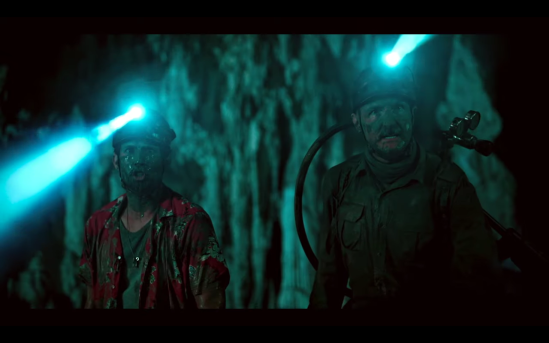
Brooklyn couple, Su and Jack, find their noses constantly buried in their devices as the relationship between them begins to stagnate with unfulfilled measures.  In an effort to reconnect with each other meaningfully and detach themselves from the wedging worldwide web, they accept a close friend’s offer to use his upstate cabin as a rekindling retreat getaway from the mundane routine, away from the bustling city, and away from their highly addictive technological devices, shutting themselves off from the numbing side of the world to focus on each other.  As they become acquainted with their isolated surroundings and truly work on themselves, an attack from an alien race of pouffe balls has invaded Earth.  When they finally figure what’s happening, the serenity cabin therapy has been abruptly severed by besieging extraterrestrial furballs from space and they must rely on their little know-how to survive.

To all the modern millennial couples living comfortably in urban stasis and experiencing the world vicariously through the internet, “Save Yourselves!” is a calling and an unlikely savior you didn’t even know you needed from the writing-directing team of Alex Huston Fischer and Eleanor Wilson.  The duo’s introductory feature length film is a satirical sci-fi side-splitter of the celestial kind that, frankly, exposes the rudimentary sustaining people like Su and Jack who we all know exist and wouldn’t know how to start a fire with the quick strike of a match let alone save themselves from an apocalyptical alien invasion, but much like Su and Jack’s understanding of their surroundings and also to their defense, what does anybody know about surviving creatures from another planet?  “Save Yourselves!” is produced by Peter Traugott and Adi Ezroni of the New York based Keshet Studios as the company’s sophomore feature, Eamon Downey and Philip Erdoes of Last Rodeo Studios (“Scare Me”), and Joshua Blum of Washington Square Films.

Internet obsessed couple Su and Jack can barely not fiddle with their phones, laptops, and even Alexia for more than a minute, scouring the limitless online resource for information and entertainment that even infiltrates into their livelihood of administrative assistant scheduling and online popup box retail services.  “Mr. Robot’s” Sunita Mani sits into the internet top 10 list fixated mindset of Su with a complimenting structure revolving around her character’s meticulous life layout constructed by internet page browser tabs.  Equally as reliant on the power of the internet is her beau Jack, played by “Stranger Things’” John Reynolds in a hipster blend of Crispin Glover with the voice comparisons to Hanna-Barbera’s The Funky Phantom.  Mani and Reynolds accorded a charmingly naïve pair of social media engulfed millennials on a path of monotonous self-implosion and take their characters’ arcs over the growth threshold as their thrust to survive without knowing nothing of the tangible (Jack’s own word) world.  “Save Yourselves” is essentially the Sunita Mani and John Reynolds’ show, but the cast rounds out with bit part performances from Ben Sinclair, John Early, and Johanna Day.

Su and Jack are extremely likeable characters with some real and some fantastical unlikeable problems of social media addiction and space beings snatching their planet right under their touchscreen pressed noses. “Save Yourselves” knits a palpable double meaning that not only conveys the impractical saving of themselves from the impending attack of furry aliens, isolated in a thick, unfamiliar wooded ecosystem, but also save themselves from their own social network debilitated selves who rely too much on the glitzy pyrite of the Gram (Instagram) and Facebook to rule their lives.  Directors Fischer and Wilson gamble with a good chunk of the story’s unresolved aspects the plot points build up so well that might leave audiences scratching their heads while a lip-curling complexity freezes their mouths agape in wondering next steps for hapless couple Su and Jack. For the defense of the unexplained, the Earth invasion is an, as we know it, impenetrable fact of pure science fiction, glimmered in 1960’s fashion with resemblance to the Shatner era Star Trek “Trouble with Tribbles” alien pouffe balls (the filmmakers must have been “Star Trek” fans) of various shapes and colors beleaguering an assault with Spider-Man-like bio-lash to get around, an unquenchable thirst for Ethanol, and sonic fluctuance. When you type it out loud it sounds ridiculous, but “Save Yourselves!” harps back on the classic Sci-Fi features with a contemporary wit toward the inept abilities of today’s modern young adults and their reliance on social media.

Going off the grid nonplusses city dwellers with formidable diurnal life routines in the indie science fiction comedy “Save Yourselves!” that has invaded theaters and at-home platforms this week, distributed Bleecker Street Media. The 93 minute, rated R social commentary satire is shot mainly in an unfiltered, natural light with a handheld and steady cam, grounding the filming within the wilderness of New York’s upper state with a sound staged to recreate the tuning fork of kooky otherworldly sound bites and soundtracks. Since this is a theatrical new release, there will be no review on the A/V aspects. There were no bonus material included or any bonus scenes during or after the credits. “Save Yourselves!” is an eye opening gag of real time, real world dependents forced to outlast the odds and grow individually, and collectively, as independent people valued more than thought.

Pre-orde “Save Yourselves!” on DVD ahead of it’s October 9th release.

Nurses’ Put Up With All Kinds of EVIL in a “12 Hour Shift” reviewed! (Magnet Releasing / Digital Screener)

In the dwindling days leading up to the turn of the century, Mandy is about to start a 12 hour nursing shift at an Arkansas Hospital.  As a side gig, Mandy must supply fresh internal organs to her dimwitted cousin and organ mule, Regina, to earn a little extra cash to pay for her narcotic habit, a condition prolonged and sustained by a front desk colleague.  When Regina misplaces the bag full of internal organs and doesn’t deliver them to her ignoble black market boss, she returns to the hospital desperate and corners Mandy into coughing up more, even if that means killing a patient or two.   When Mandy profusely refuses, but reluctantly complies, Regina still takes matters into her own reckless hands and as the bodies begin to pile, Mandy has to stave off police interrogation and suspicion long enough to get through the long night shift of twisted circumstances and peculiar characters.

As if nurses didn’t already work tediously long hours on normal circumstances as it is, Brea Grant’s pitch black comedy, “12 Hour Shift,” is a cardiac inflamed melee of drug users, a convicted cop killer, and black market goons slaughtering it out with hapless patients caught in the middle.  “12 Hour Shift” is the sophomore film written and directed by Grant, released 7 years following her feature debut of the apocalyptic drama, “Best Friends Forever,” in 2013 as Grant also costars alongside Vera Miao as a pair of BFF journeywomen.  Now, Grant steps fully behind the camera, cherry picks real life headlines, and blends them with urban myths to inject cynicism right into our plump veins with pulpy anti-heroes and a graphic violence backdropped with a Y2K hyperbole.  Shot on location in Jonesboro, Arkansas, the film is produced by Matt Glass and Jordan Wayne of HCT Media and alongside actors, Tara Perry and David Arquette, and David’s wife, Christina McLarty Arquette. 

“May” star Angela Bettis jumps into scrubs as the steely junkie, Mandy, who teeters on benevolence after a streak of merciful killings of terminally ill patients for vital organs in exchange for addiction withdrawal averting cash. Mandy is stuck between a motley nursing staff, unpredictable cops, and a pair of bad guys as the coupling link scrambling to tread above water.  Bettis brings her harried eyed fortitude as a sarcastic and solitude-immersed nurse who is a jack of all trades contending internally with paper thin sympathetic motivations paralleling her self-preserving abilities.  Mandy’s calculating, on-the-fly smarts comes under threat by Regina’s halfwit, caution to the wind, sociopathy, housed under blonde teased hair sitting upon a model’s thin frame from the build of Chloe Farnsworth (“Crying Wolf 3D”) who dons crazy like a dunce cheerleader of a Renaissance slasher of an 80’s throw back, but instead of being the chest-baring victim killed while having prematernal sex in the woods, Regina is a scrappy and determined go-getter with more Cheeto dust on her fingers than braincells in her brain.  Grant paints a hefty list of colorful characters, written to ooze their own sanctimonious nature or Podunk refinement, a pair of inglorious splendor fallacies of small Southern townsfolk.  Dusty Warren plays one of those roles in the tactless ponytail wearing Mikey, the right hand muscle of the organ trafficker, and Mikey has nerveless feelings toward those that surround him except for his boss and, then, there’s Tara Perry’s Dorothy, a religious chatty-Cathy nurse who is essentially the most good, but less influential character of the whole rotten bunch.  “12 Hour Shift” cast rounds out with Kit Williamson as the cute, but hopelessly funny beat cop, Nikea Gamby-Turner as Mandy’s side hustling quasi-employer/colleague of drugs and organ, Brooke Seguin as the tireless nurse shift supervisor, and a pair of wrestlers, the only and only Mankind, Mick Foley, and the actor-turned-wrestler, David Arquette (“Scream”), who I must note is perhaps in the best shape of his life for this film.

“12 Hour Shift” comes off as like a big, crass joke on Southerners with a bloody knuckle one-two punch domino effect of disaster after disaster mayhem.  Grant satirically captures the hackneyed perceptions of a small Arkansas town from the late 1990s, complete with tube televisions and really bad hairstyles, that doesn’t the support the age old Southern mantra that is Southern Hospitality.  Every character touts an awful version of themselves.  Even Mandy, a junkie who commits unauthorized euthanasians with bleach in exchange for cash, crowns being perhaps the absolute worst of the entire character pool, but endeavors through the chaos as an anti-heroine we want to cheer for but is nowhere on the brink of amiability.  A strong point for Grant is giving every character, from scarce to principle, a once over and also touching on them periodically throughout to keep the minor parts existing in the back of the mind  Only David Arquette’s convicted death row inmate, emitted into the hospital due to self-harm, is the only role that feels half-heartedly fleshed out as a small story outlier or maverick whose dynamic is to only add another layer of obstacle fear without becoming too involved with the heart of the organ trafficking plotline.  The comedic air is dry, bloody, and not egregiously over the top in savoring enough plausibility of the abstracted truths to be told in a verse narrative that relies much on Matt Glass’ cymbal, bass, and snare drum soundtrack to provide an unique rhythm for a feminist story.  The two female leads absorb, react, and solve the issues on their own without male assistance; Mandy’s very own half-brother lies comatose for all of the duration and he’s even the reason for Mandy’s pounding addiction, but she still exhibits compassion for family, as we also see with her cousin by marriage, Regina, in the last act, and will do anything to guarantee his safety.  The attributes of the male characters are inversely heroic with qualities like whining, coquettish, uncouth, and gullible running rampant amongst the behaviors; ergo, female characters Mandy, Regina, and even Nikea Gamby-Turner’s Karen have room to grow in the timespan of Brea Grant’s “12 Hour Shift.”


Magnet Releasing and HCT Media in association with One Last Run presents “12 Hour Shift,” stat, releasing this Friday, October 2nd in theaters and video on demand.  The black comedy from the United States clocks in at 87 minutes of a shift from hell.  Since the screener provided was of a new theatrical release, there will be no A/V specs listed and critiqued.  The only bonus feature outside the any kind of physical release is an extended last scene after the principle credits role that encourages more hospital mayhem, but will alas leave open ended about the destruction that would ensue.   Aforesaid, Matt Glass serves as the composer on the film, but the multi-hatted filmmaker also serves as the director of photography, producing tactile scenes with a lot of rich, natural lighting on a slightly higher contrast scale and with pockets of brilliant, soft hues to exude more dastardly situations. “12 Hour Shift” goes to show you, in extreme measures and unpredictable circumstances, much like real life hospital scenarios, the rigors and pressures of nursing can be unfathomably taxing, but under the gun (literally in the movie), the nursing staff can overcome all obstacles and filmmaker Brea Grant, in her own style, honors with a gritty, black comedy for the profession that, in many instances, goes unappreciated and thankless.

EVIL Fillets Family Strife. “Broil” reviewed! (Well Go USA Entertainment / Blu-ray)

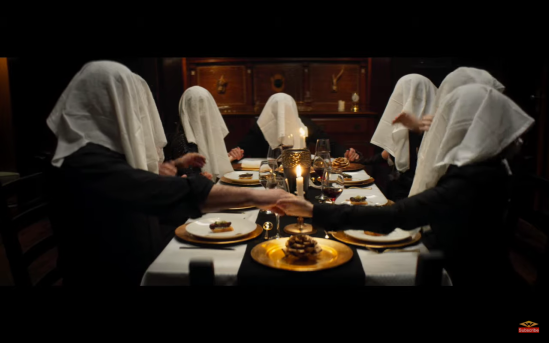
Chance Sinclair is a rebellious 17-year-old closeted lesbian and Catholic student.  After a couple of school related incidents she didn’t instigate, Chance’s parents send her to live with her despotic grandfather, August Sinclair, despite her parents’ reluctance.  August rules with an iron-fist not only with his grandchildren, but with his entire family of powerful elitists who have a dark secret – they’re actually soul harvesting demons preying on the malintents around the world and is headed by August.   When Chance’s parents want out of the family business and reclaim their daughter from August’s authoritative grip, they hire a culinary prodigy with a skill for assassinations for a grand dinner that’ll have the whole family in attendance.  Chance is ignorant of her family’s history and the balance of power is not the only stake served on the menu, but also Chance’s very soul hangs in the very midst of the Sinclair’s family game night of internal carnage. 

Like a Gothic storybook enclosed with deception, murder, and unhallowed demons at their last supper, “Broil” is a going to hell in a handbasket supernatural feast and an unholy coming-to-age sophomore feature from by the upcoming “Cosmic Sin” writer-director Edward Drake and co-written alongside Piper Mars.  The 2020 Canadian murder-for-hire thriller vies against the stylish similarities of the “Twilight” saga with well-groomed, well-off, and sophisticated groups of strangers bound as family from supernatural circumstances, but distills itself out the frivolous teeny-bop pulp and teen heartthrobs for a modestly R-rated cutthroat kindred melodrama by the netherworld’s most notorious soul-suckers, shot in Vancouver, British Columbia, Canada.  “Broil” Is produced by “Cabin Fever 2:  Spring Fever” executive producer, Corey Large, and first time producer Kashif Pasta with 308 Entertainment (“It Follows”) and Good Complex serving as production companies. 

“Broil” doesn’t denote a lead character at the heart of this story, but pinpoints principles along a chaptered structure, signifying their importance by following them with an objective point of view.  The whole setup begins with the granddaughter, Chance Sinclair, who a bit rough around the edge and doesn’t play with her schoolmates, especially having an affinity for the same sex while being a student in a Catholic school, but that factoid doesn’t blossom into thing though be noted a couple of times.  Instead, Chance, played by Avery Konrad in her first principle character role, struggles with her teenage angst and hormones like any more adolescent, but she finds her educational woes pale in comparison under her family’s archaic secret ruled by the patriarchal domination of August Sinclair, a ruthless enforcer and head of the family business brought to an autocratic fruition by Irish actor Timothy V. Murphy (“Snowpiercer” television series). While Chance and August strongly convey a presence in the first act, Jonathan Lipnicki reins in the latter acts in an unexpressed spectrum performance of Sydney “The Chef” Lawson, a calculating killer taking out the transgressional trash informed by a mentor and father-like man named Freddie Jones, “Jason vs. Freddy’s” Lochlyn Munro, who may or may not have ulterior motives in exploiting The Chef’s gift for murder. Lipnicki’s work is a culinary delight in as much as The Chef’s actually culinary expertise, braising the character to eventually be the mainstay character. There are other exigent roles that seem important, but are only keystones that hold more principles roles from crumbling, such as Chance’s parents, June (Annette Reilly “Chilling Adventures of Sabrina”) and December (Nels Lannarson “The Cabin in the Woods”) Sinclair, who initiate the murder-for-hire spark that set things in motion. Rounding out “Broil” is Corey Large, Megan Peta Hill, Abby Ross, Jenna Berman, Phoebe Miu, Alyson Bath, David Hennessey, John Cassini, and Kyra Zagorsky.

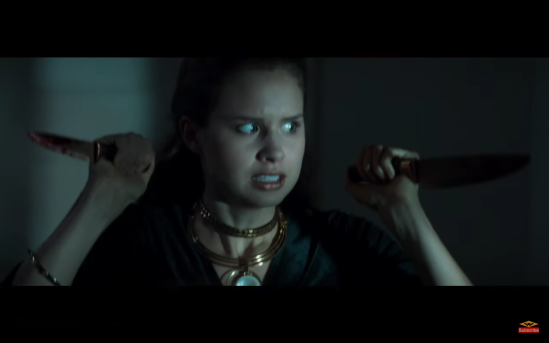
Playing out in chapters, “Broil” feels like a murder-mystery adapted from a on fleek novel written by a panache author from Switzerland, but from what I’ve researched, “Broil” is an original narrative only to be segmented to amass refined character details and redirect turn of events as they unfold. However, the chaptering aspect veers the narrative off course, careening “Broil” more toward edit oblivion that doesn’t layer the foundation properly causing as much confusion as the inhuman characters trying to decide whether the Sinclairs are either vampires, demons, witches, or some kind of incubus-succubus blend for a better part of the film. A theme that doesn’t withstand the pressures of Drake’s zigzag directional layout is the unholy atmosphere the Sinclair’s protrude into the world. Chance, who is ignorant of her lineage and of what she really is, turns crosses upside down, turns crucifix necklaces ablaze, and her family sends her unusual gifts like parceled decorated daggers as seen on sacrificial stones, but the satanic tropes cease to do little more than be hints bound to expose the Sinclair’s true selves and really nothing to do with Satan himself, leaving much of the Sinclair powers left unexplained, like their lightning speed and pulsating purple glow that illuminates in patches under the skin (another “Twilight” element?). The acting is palpable, even if it’s melodramatic and under a slew of unlikeable characters, and the story does throw a few notable curve balls, some wickedly diabolical knuckle curves involving eating a child, to intrigue an inch by inch progression of the story. “Broil” unsheathes moments of Gothic schadenfreude, but the moments are fleeting, too short and far in between, to swimmingly bask in the horror of demonic soul snatchers in the throes of a murderous coup d’état.

A delicacy unlike anything you’ve ever experienced, “Broil” is served onto a Blu-ray release as the plat de jour distributed by Well Go USA Entertainment. The unrated film is region A coded and presented in high-definition, 1080p, of a 16:9 widescreen format. Details on the image render very soft, undiscerning outlines that infuse where a person ends and the background begins, but as the lighting choices change from flared hues to more hard lighting, profiles are to take more shape. Director of photography Wai Sun Cheng, making his introduction into feature films, keeps the focus primary in the foreground, obscuring the backdrop just enough to make it still perceivable and mixes well in the extreme close ups with wide angled shots to not be a one trick cinematographer. The English language 5.1 DTS-HD Master Audio has severe troubles with Hugh Wielenga’s score tremendously overpowers everything else with a profound overlap. The composition is so unbalanced and loud that the resonating LFE completely drowns out the dialogue at times. “Broil” does not contain any feature specific special features other than a static menu containing upcoming previews of other Well Go USA films. Despite the title and the infernal nature, “Broil” is a dish served too cold with an unsavory plot of a young woman’s coming of age tribulations in midst of family squabbles and treachery that Edward Drake couldn’t quite fuse together.

Pre-order “Broil” at Amazon.com

Burt Gummer Neutralizes EVIL Graboids in “Tremors: Shrieker Island” reviewed! (Universal 1440 Entertainment / Digital Screener)

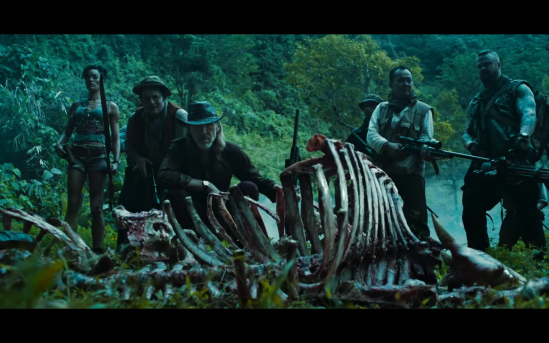
A wildlife preservation maintains categorizing and tracking of native elephants, but when one of the company’s philanthropist turns his private island, just across the water from the preservation campsite, into a game reserve for apex predators, nothing will stop him from wagering the thrill of the hunt on expensive, top-of-the-line game.  That is until the graboids he’s illegally bred and genetically modified starts to hunt the wealthy trophy gamers back, especially when the Precambrian lifeforms metamorphize into the fast-spawning shriekers.  With an island full of graboids and shriekers that contributed to already one death, graboid expert and arms enthusiast-survivalist, Burt Gummer, is tracked down and brought out of retirement to once again battle his longtime killing machine adversary.  With no munition weapons, an obstinate playboy’s maniacal urge to hunt the fierce predator, and the most powerful of the graboids bred on the island able to wriggle underneath the sea floor between land masses, Gummer and a team of preservationists must band together to stop the graboids from being an invasive and unstoppable species. 

From an icy Canadian landscape in “Tremors:  A Cold Day in Hell” to the tropical beaches of Thailand, “Tremors:  Shrieker Island” is the seventh feature film in the Tremor’s 30-year franchise.  Heading straight to video on Blu-ray, DVD, and Digital, including Streaming and VOD platforms come this October 2020, the subterranean monster action-comedy is steered by serial sequel director Don Michael Paul, who directed the last two “Tremors” installments, off a Paul script co-written with Brian Brightly that set sights on expanding the graboid footprint even farther East and surrounded by the seas of Thailand, further more distancing itself from the dust bowls of Perfection, Nevada and Mexico into new and unexplored terror-itories.  Universal Pictures’ off-shoot subsidiary banner, Universal 1440 Entertainment, and Living Films serves as the presiding production companies. 


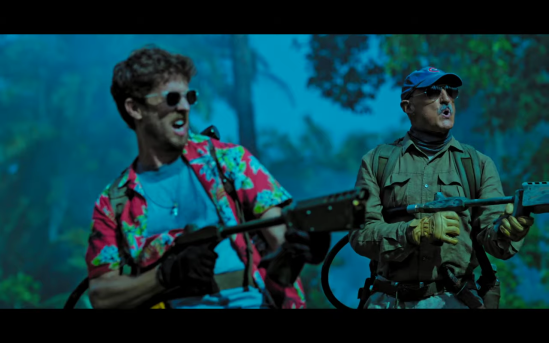
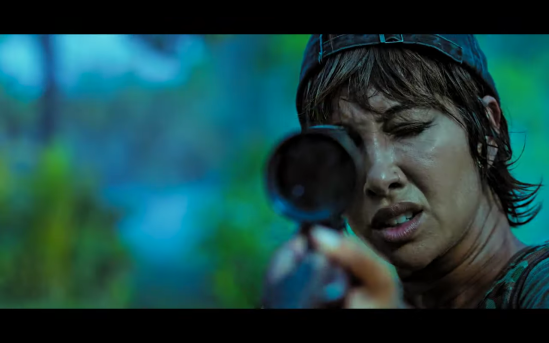
The smart-mouth, quick-wit, arms-toting Burt Gummer has become, dare I say it, the Ash Williams of the Tremors’ franchise as a perpetually dragged back hero into monstrous circumstances to battle graboids and their offspring on land, air, and in the pits of hell of the innate underground habitat.  Aside from Bruce Campbell, there are not too many heroes in a genre that usually has a villainous backbone and so Michael Gross is the longest lasting reoccurring actor, spanning now 30-years, to return as an original hero who first encountered and killed the bastard creature who “broke into the wrong God damn rec room” in Perfection, Nevada.  Gross, now gray with a few more wrinkles sporting his iconic Gummer mustache, fits into the military-esque attire under his ball cap to square off alongside a ragtag team of unprepared, unqualified, and novice graboid hunters in Jon Heder (“Napoleon Dynamite”), Jackie Cruz (“Orange is the New Black”), Caroline Langrishe, and Richard Brake (“31”).  Heder fills in for the Jamie Kennedy role of Burt Gummer’s son, Travis, from the two previous installments and though Travis is mentioned briefly, the character’s presence is extended through Caroline Langrishe as Travis’s mother and preservation camp leader.  Heder and Langrishe complete that entangled trio that has been a trope present in nearly all the Tremor Films, starting with Val McKee, Earl Basset, and Rhona LeBeck, battling side-by-side to overcome the odds.  Cruz and Brake offer a serious side dish of badass on a polar opposite spectrum.  Jackie Cruz as Freddie, an entrenched team member of elephant tracking, is the Latina MacGuyer and is a weapon in herself that only someone like Burt Gummer would fully appreciate while Richard Brake, with his trademark sinister smile as obsessed game hunter Bill, relishes the role, pulling a watered down, PG-13 version of his typical bad guy motif from the more violent-venomous Rob Zombie films.  However, a minority of characters fall through character development cracks, such as Anna played by the up and coming Cassie Clare (“Death Race 4:  Beyond Anarchy”).  The archery expert Clare is a pertinent show off with a bow and arrow and is Bill’s right hand, but the Anna, under Cassie’s muscular thin frame and ironclad persona direction, has an inclined built up that goes to naught as she’s snubbed-shoved to a lesser role without having a significant impact in the latter half.   The reverse can said for Heder’s Jimmy character with first impressions of a top class scientist with lower class ambitions; yet, in an instant, Jimmy becomes a battle-worn graboid and shrieker killer while more experienced hunters, especially one wielding a mini gun, have less of a handle on the situation. 

While it’s neat and cool and nostalgic to see graboids and Burt Gummer back in action, much like the disconnect with lopsided arch able characters left to be graboid-fodder, “Tremors:  Shrieker Island” falls short of earlier predecessors, replacing personal filmmaking style over story substance.  For one, graboids just haven’t been the same since going from practical applications to computer imagery since “Bloodlines” on that has radically evolved the creatures from a less-is-more model to a complete overhaul of their veneer, resembling the dark and slimy man-eating tentacles of “Deep Rising,” and as well an overhaul of the creature mechanics that lead graboids to leap out of the ground and into the air like a flying fish, spiraling and twisting back into their dirt environment.   The graboid burrowing irks me as well as the ground explodes 10-15 feet up into the air in a blatant uses of detonating charges by the effects team to create the earthworm moving effect instead of just a perpetual hump and collapse of the ground that’s more of a menacing effect. Nuances run amok, causing subtle points of frustration in how Paul’s direction is really more a passive glance than a serious absorption of the franchise. Meandering people on the ground when they fully well know graboids are attracted by movement, half the film scaled back to slow motion to accentuate big money explosions, and the mother of all graboids able to target Burt Gummer for a mano on monstro showdown are just more examples of the charmless details in, what is, a palpable comedy with Earth dwelling monsters. “Tremors: Shrieker Island” is the equivalent of “Jaws: The Revenge;” the story may not make sense, but watching gigantic monsters cause mortal destruction is pure creature feature bliss.

What may be Burt Gummer’s last ride (or so they said in the last film), “Tremors: Shrieker Island” tunnels onto Blu-ray, DVD, and VOD come October 20th, 2020 and soon to be streaming on Netflix shortly after. The BD50 Blu-ray will feature an anamorphic widescreen, 16:9 aspect ratio, with an English language DTIS-HD Master Audio 5.1 while the DVD9 is presented in a widescreen 16:9 with a Dolby Digital 5.1 surround mix. Both formats will include optional English Dolby Digital 2.0 as well as a dubbed French, and Spanish DTIS Digital Surround 5.1 with a slew of option subtitles: English SDH, French Canadian, French European, and Latin American Spanish. Since the film was reviewed on a digital screener, the A/V aspects will not be critiqued. The exclusive bonus features listed on all physical and VOD include a Burt Gummer narrated “The Monster of Tremors” that gives you everything you need know about the diabolical monsters, “Tremors Top 30 Moments” that hone in on 30 years worth of scenes that provide laughs, Burtisms, and some of the most gory moments in graboid history, and, lastly, “The Legend of the Burt Gummer” that focuses on the iconic graboid hunter character told by his persona creator himself, Michael Gross. Richard Brake, once again, nails the villain, Jackie Cruz stuns as a resourceful Gummer-ite, and Michael Gross fleshes out one more commando swashbuckling Burt Gummer in the zany seventh installment of the unstoppable “Tremors” franchise.

Pre-order Tremors: Shrieker Island on Blu-ray/DVD/Digital!

EVIL Does a Little Bathhouse Wet Work in “Melancholic” reviewed! (Third Window Films / Blu-ray Screener)

On nights when a humble Japanese bathhouse is supposed to be closed for business, the lights remain illuminated, gleaming off the crimson covered ceramic tiles of Mr. Azuma’s bathhouse floors as body’s soak in a pool of blood.  The proprietor, Mr. Azuma, is in severe financial debt to Yakuza boss Tanaka who turns his meager business into a nightly slaughter house to dispose of Yakuza opposition or those just on the syndicate’s bad side.  When Tokyo University graduate, Kazuhiko, applies for a job as an attendant to see a girl who regular attends the bathhouse, the reserved model employee becomes enthralled with the disposing and cleaning up of the corpses, working alongside a couple of professional hitmen, Matsumoto and Kodero, but when the job he’s so passionate about requires him to be more hands on with the assassination assignments and the endless pressure from the Yakuza bares down on his colleagues and friends, Kazuhiko’s radical plan to eradicate the woes of his newfangled position just might mean his very life. 

Seiji Tanaka’s self-esteem building and identity attaining crime drama, “Melancholic,” might not reside as absolute horror, but any film involving the Japanese Yakuza is an unpredictable, Machiavellian expo worthy of every second.  Originally titled in Japan as “Merankorikku” or “メランコリック,” writer-director Tanaka retains a bloody disposition of the historically violently depicted Yakuza-storied narrative, but is asymmetrical with a converging love affair, complementary conflicting the dark and light with clarity of the centric character’s unintended double life into the criminal enterprise of cleaning a bloody bathhouse.  Based off Seiji Tanaka’s short film of the same title, “Melancholic” mops up as an immersive black dramedy from Seiji Tanaka as the filmmaker’s first credited feature film produced by One Goose production in association with Uplink and JGMP.

The story concentrates most of the effort around Kazuhiko, a graduate of the prestigious Tokyo University who doesn’t have a good job and lives with his pampering parents, fitted by Yoji Minagawa as a social misfit living on the outskirts of the Japanese mantra of diligence and integrity.  Minagawa bores out Kazuhiko’s diffidence, chocking up his damp disposition to the indecisions toward his future, that forces other characters to influence his choices, such a former high school classmate in Yuri with an effervescent performance by “Tag’s” (“Riaru onigokko”) Mebuki Yoshida.  Yuri’s infectious affection for Kazuhiko and her regular attendance at the bathhouse encourages Kazuhiko to apply and become hired for a cleaning attendant position alongside a blonde, and undereducated in comparison, counterpart in Matsumoto (Yoshitomo Isozaki), but to Kazuhiko’s surprise, his overqualified ego is shattered when he discovers that the bathhouse is a Yakuza place of execution and those all around him are more experienced in that trade, detonating a plume of black comedy, work place haughtiness that Kazuhiko has to balance with his personal relationship growing with Yuri.  Most of the exchanges are straight forward and culturally inflection heavy, especially when dire moments rear their heads, but some more compassionate and delicate scenes rouse through the overt inflections with Minagawa and Yoshida at the helm of their blossoming onscreen romance, adding to the stark contrast to the opposing narrative. Stefanie Arianne, Makoto Hada, Yasuyuki Hamaya, Takanori Kamachi, Hiroko Shinkai, Masanobu Yada, Keiji Yamashita, and Yuti Okubo fill out “Melancholic’s” cast.

“Melancholic” is a rather odd title integrated into the briefly pensive struggles of Kazuhiko to an intrinsic network of assassination gunplay and backstabbing knavery, offering little profound sadness and despair and more shrewd hostility when those in charge ask for an inch but take a mile out of the personnel pool. For a Yakuza film, Tanaka’s bath and butcher story has barely a budget to entertain technical action sequences in tight spaces, but the action is kept taut and intense and despite the lack of a Yakuza presence, with only one single boss representing an entire faction, the transposing of Kazuhiko’s personal and professional stations washes away much of budgetary concerns down the drainpipe as an irresistible curiosity to see how our hero softly stumbles through a sudden confluence of the two repelling paths will play out. Most audiences will overlook the comedy for a countless reasons as “Melancholic” up plays into the satirical rigors of the Japanese sullen humor. The fact that that the subject matter is also about mercilessly murder people in a bathhouse will undoubtedly pigeonhole the film with pre-labeled genre. Tanaka slips in gallons of subdued irony ripe for the complex circumstances hazardous to all bathhouse employees and their pryingly oppressive management.

The award winning Japanese film (aggregated wins from multiple Eastern Asian film festivals) “Melancholic” arrives onto a dual format DVD/Blu-ray from UK distributor Third Window Films, a loyal provider of extreme Asian cult and horror. Since the Blu-ray was a screener, the A/V aspects won’t be reviewed in it’s entirety and the specifications weren’t provided with the screener. Ryô Takahashi’s cinematic vision brings out the beauty in simplification without being ostentatious with camera angles or relying heavily on tint boxes; yet, the blend of steady cam and handheld tilts to the one side with the jitteriness of the handheld seizing the stage. Bonus features were included on the screener, including a behind-the-scenes of a documentary-style shot look at moments before, during, and after takes, a Q and A panel with the cast and crew, and the “Melancholic” short film. Seiji Tanaka’s breakthrough bloodbath, “Melancholic,” sounds more despondent than the dismal thought of a cold shower on a freezing day, but the heated ferocity rite into adulthood keeps this Japanese dramedy warm with tension and cozy with vortex humor.v

Purchase “Melancholic” on Blu-ray / DVD!