EVIL Presses the Reset Button For Killer Results! “To Your Last Death” reviewed! (Quiver Distribution / Blu-ray)

Miriam DeKalb has just survived a bloodbath inside her tycoon father’s high-rise, walking out shaken, bloodied, and carrying an axe.  When the police detain her in the hospital, construing a case against her for the death of her siblings and father based off her previously unhinged mental state inside a psychiatric institute, Miriam is visited by an otherworldly being known as the Gamemaster.  Miriam is given two choices:  stay at the hospital to be pursued as the murderous villain in her harrowing escape from near death or restart her traumatizing experience to save her siblings in an intergalactic wager by infinite being gamblers eager for amusement, blood, and a clear winner.  Miriam’s foreknowledge of how the events play out should give her an edge in saving her family, but the restart is the Gamemaster’s game with the Gamemaster’s rules as timelines and outcomes are determined limitless. 

“To Your Last Death” is a science fictional brawl of Darwinism in this eviscerating adult animated survival horror from director Jason Axinn.  Originally titled as “The Malevolent” during the crowd-funded Indiegogo campaign, which raised 114% above film’s budget, “To Your Last Death” is Axinn’s first full length feature from a script co-written by Jim Cirile (writer of horror-comedy “Banned”) and is the first credited work of Tanya C. Klein, both who’ve previously collaborated on the superhero short “Liberator” in 2016 starring the original Hulk himself, Lou Ferrigno  With an animated direction similar to that of FX’s “Archer,” Cartoon Network’s “Metalocalypse,” or an even slightly more advanced version of “Space Ghost Coast to Coast,” but, in fact, the hand-drawn, puppetry style animation is the first ever 2-D animated horror under the meticulous art direction of Carl Frank along with lead artists Luca Romano and Vicente Saldivar, who interned on “Metalocalypse,” that keeps in tune with the adult themed animation trend, but levels up the explicit nature that kisses the sordid substance of “Heavy Metal” with strong bloody violence and some nudity.  “To Your Last Death” is the first feature film of Jim Cirile and Tanya C. Klien’s Coverage Ink Films, a subsidiary of the screenplay analysis and development service group, Coverage Ink, and Quiver Distribution (“Becky”) with Cindi Rice, Paige Barnett and Jason Axinn taking on a producer role. 

The voice work is comprised of some of the most distinguishable voices in genre land; voices that carry the unparalleled weight in intensity, tenor, and madness to their darkly depicted illustrated characters.  You can almost feel the veins throbbing out of Ray Wise’s neck when spewing the murderous insanity of warfare kingpin and diabolical businessman, Cyrus DeKalb.  The “Dead End” and “Jeepers Creepers 2” actor’s inhumane avatar, who looks just like him, devises a plan to solidify his company’s legacy by eliminating his four children who, if banding together, can derail his egomaniacal runaway train.  His children are distinct individuals themselves, beginning with the BDS&M buff and death metal rocker, Ethan (Damein C. Haas), a pill-popping wrist cutter, Kelsy (Florence Hartigan “Phoenix Forgotten”), and a mirror-image disappointment and homosexual, Collin (Benjamin Siemon “Thankskilling 3”).  The fourth child, Miriam, is the principle lead.  Voiced with perpetual mixed reactions by Dani Lennon, a regular from the videogame-themed horror comedy and zombie apocalypse television series, “Bite Me,” Miriam’s complexities stem from a web of junctures that lead her to being a control freak amongst her siblings, an obsessive activist against her father, and a certified schizophrenic, but Miriam is also pragmatic with the strongest will to see through and survive her maniacal father’s abhorrence.  While everyone’s voice work is solid, Steve Geiger’s Eastern European accent replicated for the sadistic, warmongering henchman, Jurek, imprints a nightmare man unabashed by his decadent desires.  You wouldn’t think just be reading this review, but Bill Moseley (“Devil’s Rejects”) and William Shatner (“Star Trek” franchise) also have voice roles that are more cameo resembling as Moseley voices a short lived, facially disfigured hired gun and Shatner is the narrating voice in between the void as the Overseer, filling in with cryptic exposition of the Gamemaster’s existence, much like his narrative work on the reboot of the children’s show, “The Clangers.”   Mark Whitten, Bill Mishap, Rom Lommel, Paige Barnnet, Jim Cirile, Tanya C. Klein, Ruairi Douglas, Jason Axinn, and “Deadpool’s” Morena Baccarin as the Gamemaster round out the cast.

The way “To Your Last Death’s” story is structured runs along the same quivering line that’s equal to pure madness and this narrative path of unstoppable carnage is purposefully trekked to dislodge any judgements about what we, the viewer, think we know about the Gamemaster’s macabre game for galactic gambling.  Is the whole “Saw”-like designed bloodbath really a part of Cyrus DeKalb’s hatred and vindictiveness toward his children or is the lucid experience just a figment of Miriam’s break from reality?  Remember, Miriam was depicted to an ex-committed, living with and within the pressures of her father’s ever present, looming shadow. Miriam finds herself repeating moments but blueprinted differently than before or is manipulated by the Gamemaster’s gamer’s high for the adrenaline voyeurs betting on the outcome. The story’s effervescently fluid in pivots, tactics, and style; yet, the constant modify and rebuild was, perhaps, done one or two many times as staleness begins to set in and I eventually find himself anxious for a more linear goal for Miriam and her siblings to be out of limbo, out of being hacked to pieces on the fourth or fifth go-around, and reach the final stage, the final boss, to not be jerked back (or jerked around) to the beginning or midpoint like in unendurable game of chutes and ladders. Soon after that sensation of being uninterested in another rewind, the feeling immediately washes away as the story finally did progress, climax, finish, end, close, and put to sleep a rotunda of violence engendered by cosmic sadists that is “To Your Last Death.”

Like some warped version of “Clash of the Titans,” the insouciant Gods in “To Your Last Death” are not generous or kind in their gamble of human entertainment on this Blu-ray release distributed by Quiver Distribution. The feature is presented in a windscreen 1.78:1 aspect ratio with rich colors through but favor toward scenes splotched of dark red or saturated in full tints of blue. The animation can be a little jagged at times but tolerable and only one scenes stood out compromised with two character stuck still for a few seconds too long and color banding rear its little ugly head on their animated faces. The English Dolby Digital 5.1 surround sound renders equally gratifying that includes a pulsating and terror riddled soundtrack by Rene G. Boscio. Typical with animation, ambience is generally underused as the filmmakers control much of what’s in the frame and the same can be said with this film, but with the much of action stationary inside the building, the confinement fills in the auditory gaps in conjunction with lucrative and well timed effects, such as a ripping roar of gas guzzling chainsaw, the squirting sounds of blood sprays, and even with the lossless details of minor necessities, such as Jurek whistling, to build upon character development. Dialogue is prominent, clear, and syncs okay with the marionette animation. The Blu-ray case is sheathed in a cardboard slipcover, both arranged with the same front and back cover image and layout. The bonus features are lack as the bare bones release only comes with a high definition trailer of the film. “To Your Last Death” is this year’s cinematic graphic novel to knock back and lap up, loaded with transcendent selfish twists and second-chance carnage with dysfunctional family issues spot lit on center stage.


Pre-Order “To Your Last Death” for a October 6th release!

Nurses’ Put Up With All Kinds of EVIL in a “12 Hour Shift” reviewed! (Magnet Releasing / Digital Screener)

In the dwindling days leading up to the turn of the century, Mandy is about to start a 12 hour nursing shift at an Arkansas Hospital.  As a side gig, Mandy must supply fresh internal organs to her dimwitted cousin and organ mule, Regina, to earn a little extra cash to pay for her narcotic habit, a condition prolonged and sustained by a front desk colleague.  When Regina misplaces the bag full of internal organs and doesn’t deliver them to her ignoble black market boss, she returns to the hospital desperate and corners Mandy into coughing up more, even if that means killing a patient or two.   When Mandy profusely refuses, but reluctantly complies, Regina still takes matters into her own reckless hands and as the bodies begin to pile, Mandy has to stave off police interrogation and suspicion long enough to get through the long night shift of twisted circumstances and peculiar characters.

As if nurses didn’t already work tediously long hours on normal circumstances as it is, Brea Grant’s pitch black comedy, “12 Hour Shift,” is a cardiac inflamed melee of drug users, a convicted cop killer, and black market goons slaughtering it out with hapless patients caught in the middle.  “12 Hour Shift” is the sophomore film written and directed by Grant, released 7 years following her feature debut of the apocalyptic drama, “Best Friends Forever,” in 2013 as Grant also costars alongside Vera Miao as a pair of BFF journeywomen.  Now, Grant steps fully behind the camera, cherry picks real life headlines, and blends them with urban myths to inject cynicism right into our plump veins with pulpy anti-heroes and a graphic violence backdropped with a Y2K hyperbole.  Shot on location in Jonesboro, Arkansas, the film is produced by Matt Glass and Jordan Wayne of HCT Media and alongside actors, Tara Perry and David Arquette, and David’s wife, Christina McLarty Arquette. 

“May” star Angela Bettis jumps into scrubs as the steely junkie, Mandy, who teeters on benevolence after a streak of merciful killings of terminally ill patients for vital organs in exchange for addiction withdrawal averting cash. Mandy is stuck between a motley nursing staff, unpredictable cops, and a pair of bad guys as the coupling link scrambling to tread above water.  Bettis brings her harried eyed fortitude as a sarcastic and solitude-immersed nurse who is a jack of all trades contending internally with paper thin sympathetic motivations paralleling her self-preserving abilities.  Mandy’s calculating, on-the-fly smarts comes under threat by Regina’s halfwit, caution to the wind, sociopathy, housed under blonde teased hair sitting upon a model’s thin frame from the build of Chloe Farnsworth (“Crying Wolf 3D”) who dons crazy like a dunce cheerleader of a Renaissance slasher of an 80’s throw back, but instead of being the chest-baring victim killed while having prematernal sex in the woods, Regina is a scrappy and determined go-getter with more Cheeto dust on her fingers than braincells in her brain.  Grant paints a hefty list of colorful characters, written to ooze their own sanctimonious nature or Podunk refinement, a pair of inglorious splendor fallacies of small Southern townsfolk.  Dusty Warren plays one of those roles in the tactless ponytail wearing Mikey, the right hand muscle of the organ trafficker, and Mikey has nerveless feelings toward those that surround him except for his boss and, then, there’s Tara Perry’s Dorothy, a religious chatty-Cathy nurse who is essentially the most good, but less influential character of the whole rotten bunch.  “12 Hour Shift” cast rounds out with Kit Williamson as the cute, but hopelessly funny beat cop, Nikea Gamby-Turner as Mandy’s side hustling quasi-employer/colleague of drugs and organ, Brooke Seguin as the tireless nurse shift supervisor, and a pair of wrestlers, the only and only Mankind, Mick Foley, and the actor-turned-wrestler, David Arquette (“Scream”), who I must note is perhaps in the best shape of his life for this film.

“12 Hour Shift” comes off as like a big, crass joke on Southerners with a bloody knuckle one-two punch domino effect of disaster after disaster mayhem.  Grant satirically captures the hackneyed perceptions of a small Arkansas town from the late 1990s, complete with tube televisions and really bad hairstyles, that doesn’t the support the age old Southern mantra that is Southern Hospitality.  Every character touts an awful version of themselves.  Even Mandy, a junkie who commits unauthorized euthanasians with bleach in exchange for cash, crowns being perhaps the absolute worst of the entire character pool, but endeavors through the chaos as an anti-heroine we want to cheer for but is nowhere on the brink of amiability.  A strong point for Grant is giving every character, from scarce to principle, a once over and also touching on them periodically throughout to keep the minor parts existing in the back of the mind  Only David Arquette’s convicted death row inmate, emitted into the hospital due to self-harm, is the only role that feels half-heartedly fleshed out as a small story outlier or maverick whose dynamic is to only add another layer of obstacle fear without becoming too involved with the heart of the organ trafficking plotline.  The comedic air is dry, bloody, and not egregiously over the top in savoring enough plausibility of the abstracted truths to be told in a verse narrative that relies much on Matt Glass’ cymbal, bass, and snare drum soundtrack to provide an unique rhythm for a feminist story.  The two female leads absorb, react, and solve the issues on their own without male assistance; Mandy’s very own half-brother lies comatose for all of the duration and he’s even the reason for Mandy’s pounding addiction, but she still exhibits compassion for family, as we also see with her cousin by marriage, Regina, in the last act, and will do anything to guarantee his safety.  The attributes of the male characters are inversely heroic with qualities like whining, coquettish, uncouth, and gullible running rampant amongst the behaviors; ergo, female characters Mandy, Regina, and even Nikea Gamby-Turner’s Karen have room to grow in the timespan of Brea Grant’s “12 Hour Shift.”


Magnet Releasing and HCT Media in association with One Last Run presents “12 Hour Shift,” stat, releasing this Friday, October 2nd in theaters and video on demand.  The black comedy from the United States clocks in at 87 minutes of a shift from hell.  Since the screener provided was of a new theatrical release, there will be no A/V specs listed and critiqued.  The only bonus feature outside the any kind of physical release is an extended last scene after the principle credits role that encourages more hospital mayhem, but will alas leave open ended about the destruction that would ensue.   Aforesaid, Matt Glass serves as the composer on the film, but the multi-hatted filmmaker also serves as the director of photography, producing tactile scenes with a lot of rich, natural lighting on a slightly higher contrast scale and with pockets of brilliant, soft hues to exude more dastardly situations. “12 Hour Shift” goes to show you, in extreme measures and unpredictable circumstances, much like real life hospital scenarios, the rigors and pressures of nursing can be unfathomably taxing, but under the gun (literally in the movie), the nursing staff can overcome all obstacles and filmmaker Brea Grant, in her own style, honors with a gritty, black comedy for the profession that, in many instances, goes unappreciated and thankless.

EVIL Fillets Family Strife. “Broil” reviewed! (Well Go USA Entertainment / Blu-ray)

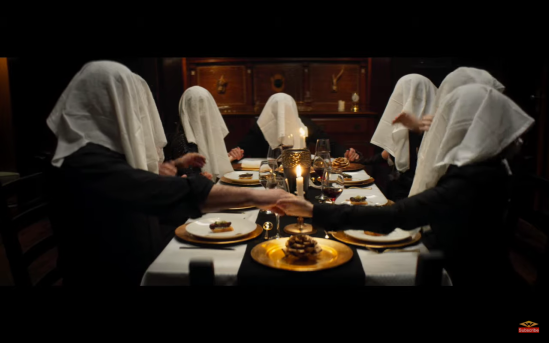
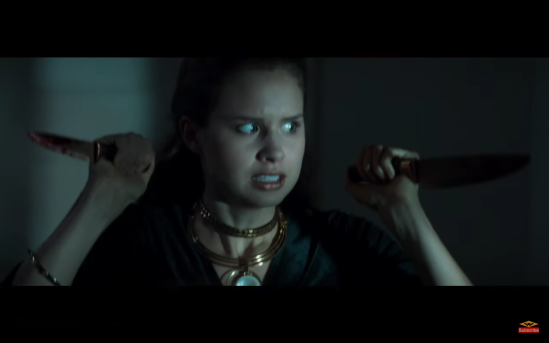
Chance Sinclair is a rebellious 17-year-old closeted lesbian and Catholic student.  After a couple of school related incidents she didn’t instigate, Chance’s parents send her to live with her despotic grandfather, August Sinclair, despite her parents’ reluctance.  August rules with an iron-fist not only with his grandchildren, but with his entire family of powerful elitists who have a dark secret – they’re actually soul harvesting demons preying on the malintents around the world and is headed by August.   When Chance’s parents want out of the family business and reclaim their daughter from August’s authoritative grip, they hire a culinary prodigy with a skill for assassinations for a grand dinner that’ll have the whole family in attendance.  Chance is ignorant of her family’s history and the balance of power is not the only stake served on the menu, but also Chance’s very soul hangs in the very midst of the Sinclair’s family game night of internal carnage. 

Like a Gothic storybook enclosed with deception, murder, and unhallowed demons at their last supper, “Broil” is a going to hell in a handbasket supernatural feast and an unholy coming-to-age sophomore feature from by the upcoming “Cosmic Sin” writer-director Edward Drake and co-written alongside Piper Mars.  The 2020 Canadian murder-for-hire thriller vies against the stylish similarities of the “Twilight” saga with well-groomed, well-off, and sophisticated groups of strangers bound as family from supernatural circumstances, but distills itself out the frivolous teeny-bop pulp and teen heartthrobs for a modestly R-rated cutthroat kindred melodrama by the netherworld’s most notorious soul-suckers, shot in Vancouver, British Columbia, Canada.  “Broil” Is produced by “Cabin Fever 2:  Spring Fever” executive producer, Corey Large, and first time producer Kashif Pasta with 308 Entertainment (“It Follows”) and Good Complex serving as production companies. 

“Broil” doesn’t denote a lead character at the heart of this story, but pinpoints principles along a chaptered structure, signifying their importance by following them with an objective point of view.  The whole setup begins with the granddaughter, Chance Sinclair, who a bit rough around the edge and doesn’t play with her schoolmates, especially having an affinity for the same sex while being a student in a Catholic school, but that factoid doesn’t blossom into thing though be noted a couple of times.  Instead, Chance, played by Avery Konrad in her first principle character role, struggles with her teenage angst and hormones like any more adolescent, but she finds her educational woes pale in comparison under her family’s archaic secret ruled by the patriarchal domination of August Sinclair, a ruthless enforcer and head of the family business brought to an autocratic fruition by Irish actor Timothy V. Murphy (“Snowpiercer” television series). While Chance and August strongly convey a presence in the first act, Jonathan Lipnicki reins in the latter acts in an unexpressed spectrum performance of Sydney “The Chef” Lawson, a calculating killer taking out the transgressional trash informed by a mentor and father-like man named Freddie Jones, “Jason vs. Freddy’s” Lochlyn Munro, who may or may not have ulterior motives in exploiting The Chef’s gift for murder. Lipnicki’s work is a culinary delight in as much as The Chef’s actually culinary expertise, braising the character to eventually be the mainstay character. There are other exigent roles that seem important, but are only keystones that hold more principles roles from crumbling, such as Chance’s parents, June (Annette Reilly “Chilling Adventures of Sabrina”) and December (Nels Lannarson “The Cabin in the Woods”) Sinclair, who initiate the murder-for-hire spark that set things in motion. Rounding out “Broil” is Corey Large, Megan Peta Hill, Abby Ross, Jenna Berman, Phoebe Miu, Alyson Bath, David Hennessey, John Cassini, and Kyra Zagorsky.

Playing out in chapters, “Broil” feels like a murder-mystery adapted from a on fleek novel written by a panache author from Switzerland, but from what I’ve researched, “Broil” is an original narrative only to be segmented to amass refined character details and redirect turn of events as they unfold. However, the chaptering aspect veers the narrative off course, careening “Broil” more toward edit oblivion that doesn’t layer the foundation properly causing as much confusion as the inhuman characters trying to decide whether the Sinclairs are either vampires, demons, witches, or some kind of incubus-succubus blend for a better part of the film. A theme that doesn’t withstand the pressures of Drake’s zigzag directional layout is the unholy atmosphere the Sinclair’s protrude into the world. Chance, who is ignorant of her lineage and of what she really is, turns crosses upside down, turns crucifix necklaces ablaze, and her family sends her unusual gifts like parceled decorated daggers as seen on sacrificial stones, but the satanic tropes cease to do little more than be hints bound to expose the Sinclair’s true selves and really nothing to do with Satan himself, leaving much of the Sinclair powers left unexplained, like their lightning speed and pulsating purple glow that illuminates in patches under the skin (another “Twilight” element?). The acting is palpable, even if it’s melodramatic and under a slew of unlikeable characters, and the story does throw a few notable curve balls, some wickedly diabolical knuckle curves involving eating a child, to intrigue an inch by inch progression of the story. “Broil” unsheathes moments of Gothic schadenfreude, but the moments are fleeting, too short and far in between, to swimmingly bask in the horror of demonic soul snatchers in the throes of a murderous coup d’état.

A delicacy unlike anything you’ve ever experienced, “Broil” is served onto a Blu-ray release as the plat de jour distributed by Well Go USA Entertainment. The unrated film is region A coded and presented in high-definition, 1080p, of a 16:9 widescreen format. Details on the image render very soft, undiscerning outlines that infuse where a person ends and the background begins, but as the lighting choices change from flared hues to more hard lighting, profiles are to take more shape. Director of photography Wai Sun Cheng, making his introduction into feature films, keeps the focus primary in the foreground, obscuring the backdrop just enough to make it still perceivable and mixes well in the extreme close ups with wide angled shots to not be a one trick cinematographer. The English language 5.1 DTS-HD Master Audio has severe troubles with Hugh Wielenga’s score tremendously overpowers everything else with a profound overlap. The composition is so unbalanced and loud that the resonating LFE completely drowns out the dialogue at times. “Broil” does not contain any feature specific special features other than a static menu containing upcoming previews of other Well Go USA films. Despite the title and the infernal nature, “Broil” is a dish served too cold with an unsavory plot of a young woman’s coming of age tribulations in midst of family squabbles and treachery that Edward Drake couldn’t quite fuse together.

Pre-order “Broil” at Amazon.com

See Through the Eyes of EVIL. “Dahmer” reviewed! (MVDVisual / Blu-ray)

On February 15th, 2992, Jeffrey Dahmer was convicted on murder, dismemberment, and sexual offenses on 17 young males.  Before then, Dahmer preyed on the desperate and the unsuspecting males living undisclosed in the then tabooed gay culture between 1978 and 1991.  Drugging, raping, killing, and then sometimes raping his victims posthumously became the Wisconsin serial killer’s unhinged obsession for companionship while working auspiciously as a chocolate factory warehouse worker.  Dahmer’s mind blossoms through the graphic dual prose narrative of events that circle around his lonely existence from a novice outcast drawn to kill to a calculating cold-blooded manhunter with deviant tendencies. 

Jeffrey Dahmer is one of those cerebral oddities you wish had a sight tube or a port hole to gape into and absorb the torrent of deranged thoughts in order to get a better understanding of how a serial killer’s mind functions and rationalizes vice and death as a sustainable life style.  Writer-director David Jacobson attempts to explain that very concept that sordid Dahmer’s visceral vision of the world around him in the 2002 interpretational blend of fact and fiction film, “Dahmer.”  Based on real events with some tweaks to protect the identities of real people, Jacobson’s crime biopic forces the uncomfortable measure of a bedeviled seduction, placing viewers in both the objective and subjective hot seat of Dahmer’s beginnings to his submersed praxis of his warped theoretical longings.  “Dahmer” is a production of a Peninsula Films, Inc., the same production company behind another serial killer biopic, Clive Saunders’ “Gacy,” a year later.

Surrounding the film, it’s been rumored that many actors don’t want anything to do with playing the titular sociopath; perhaps, Dahmer’s past scruples the filling of his size 10 shoes smeared with blood or, perhaps, exploring the dark caverns of his mind was too treacherous to traverse and come out unscathed from a crippling, crestfallen place of trauma.  Then, there’s Jeremy Renner.  Before his fame and fandom from “The Avengers” franchise, even before his breakout role in the pro-cop action blockbuster, SWAT, Jeremy Renner filled those monstrous size 10 shoes in the most quietest of ways, but the Hawkeye star’s skin-crawling version of a notorious killer he eerily takes a resemblance of provided that much more of a tactile insight into Dahmer’s inhuman nature.  Renner carries the film through two stages in Dahmer’s life, one being as an adolescent with homoerotic obsessions and deranged peculiarities whose living with his parents and grandmother while the other is paved by his own hands as an emotionless and manipulative rapist and murderer.  The distinct development is brilliantly illuminated by Renner’s understanding of Dahmer at certain stages of life.  Rounding out “Dahmer’s” cast is a fellow cinematic Marvel comics movie actor in Bruce Davison (“X-Men”) as Dahmer’s father, Lionel, Artel Great whose character is derived from real life Dahmer victim escapee, Tracey Edwards, and with Matt Newton, Dionysio Basco, and the late Kate Williamson adding their supportive performances.

Director David Jacobson didn’t want to explore and exploit the gory side of Jeffrey Dahmer’s tucked away carnage; instead, Jacobson dives into the psyche of Dahmer, molding human emotions around the sociopath who felt inadequate, if not also frightened, of his yearnings that propelled him to do the unspeakable acts of meticulous violence.  “Dahmer” obviously isn’t a true-to-fact biopic, regaling with colorful discourse and captivating with uncomfortable actions as filler to a near Hollywoodize stitching, but Jacobson did sprinkle with truth to fill in the mental gaps with interpretations of Dahmer’s connections with others, from family to victims.  Director of photography, Chris Manley, is able to capture the intensity with contrast lighting between young Dahmer and old Dahmer.  In Dahmer’s young life, the lighting is very natural, very bright, and very normal in a showcase of Dahmer’s mental space and, if we were not already enlightened about the serial killer’s, Dahmer would be just an usual misfit or a closeted homosexual with an obscure inkling to do more malevolency.  Only during scenes of mature Dahmer is the lighting saturated with hazy primary colors of blue, green, yellow, etc. that heighten madness and mark an ominous, dangerous presence inside the gay club or Dahmer’s apartment while everywhere else is in natural lighting.  A good companion piece to “Dahmer” is “My Friend Dahmer” directed by Marc Meyers that sought to visualize High Schooler Jeffrey Dahmer as an outlier spaz who desired attention to the point of making ruckuses in public places with other practical jokers and dived more into his obsession with eviscerating the local wildlife for curiosity and disolving them with his father’s chemistry concoctions, a nice little connective tissue between the two films. Watch Meyers’ “My Friend Dahmer” and Jacobson’s “Dahmer” in said order and while the two films are veritably different in style, each depiction captures a loner at heart with a minacious defense to feel, the very least, something by overpowering-to-death the unsuspecting prey.

Jeffrey Dahmer’s tactics were gruesome, perverse, and unsavory without question, but David Jacobson attempts the impossible of detaching the human from the monster in “Dahmer” that’s now being distributed onto Blu-ray by FilmRise and MVDVisual under their Marquee Collection. The High-Def, 1080p picture is presented in a widescreen, 1.85:1 aspect ratio, from the original 35mm negative film. While the upscaling looks fairly well achieved that seizes to put more life into the coloring, especially with those rich colorful shots in Dahmer’s later years, a good portion of 35mm negative sheens through with hairline scratches and the occasional blip of a cigarette burn. The overall delineation renders nicely with little-to-not soft edges and there doesn’t seem to be any cropping or edge enhancing. The English language DTS 5.1 Surround sound is as equally competent with clarity throughout the vocal track. There was too much depth or range to paint a picture, gaining a win by default with the conversing being held in tightly packed rooms or in extreme closeups of conversating duos. The musical score by Christina Agamanolis, Mariana Bernoski, and Willow Williamson haunts mostly like the caressing sounds of viper’s mellifluous tongue with breathy moans, irregular percussions, and a whisking uneasiness tune that sinks its teeth into you. The soundtrack is mixed with some monotonous club beats, doo-wop, and soft and classical alternative rock that include Patsy Cline, Gladys Knight and the Pips, and Freddie Cannon. Bonus materials are a little antiquated with a making of featurette from back when the film was closer being first released, a behind-the-scenes photo gallery, story boards, a red band and theatrical trailer, and an audio commentary by director David Jacobson and actors Jeremy Renner and Artel Kayaru. “Dahmer” doesn’t need to sell us on the diabolical nature of Jeffrey Dahmer, but what the film does do is formulate a systemic idea of who Dahmer disposes to be, as a loner, as a sufferer, and as a killer, underneath the skin of an average young white male.

Order “Dahmer” on Blu-ray!

The Apocalypse is Four EVIL Active Shooters and the Hell They Create in “The Dead Ones” reveiwed! (Artsploitation Films / Blu-ray)

Four errant students are ordered to do a summer cleaning of their high school after a terrible tragedy that has left the hallways and classrooms in shambles.  As they meander around the closed school doing more chatting than they are cleaning, a masked and armed group calling themselves The Four Horsemen chain the doors and windows, barring every means of escape, and snake through the school’s layout setting a plan in motion to deliver a macabre message to the campus grounds.  Something just doesn’t feel right when the students try to track down the masqueraders who move around more like specters with an eerie clamor of theatrics that’s becoming more and more eternally harmful the longer they remain inside the school. 

“The Attic Expeditions” and “All Souls Day:  Dia de la Muertos” director, Jeremy Kasten, has a new ghoulish, outcast teen horror on the verge of release with the American made, calamity surrounding “The Dead Ones,” entailing a theme of choice on the wrong side of deviancy when influentially steered by the negative forces of the besieging cruel society.  The script is penned by Zach Chassler on his fourth collaboration with director Kasten, following their efforts on the vampiric allegory for drug use “The Thirst,” “The Wizard of Gore” remake, and “The Theater Bizarre,” a horror anthology, in over a span of a decade’s time.  “The Dead Ones” presents a two-timeline parable with an inciting, yet disturbing, core involving every parents’ worst nightmare and America’s most disgraceful statistic, a high school shooting.  Sick-O-Scope Motion Pictures serves as the listed production company behind the film.

Detention attendees is comprised of four teenage outcasts who are also quasi-friends that seem to know each other well, but are personally rough around the edge, denoting more distinct tensions amongst their insoluble secrets.  In an introduction with the teens, we’re glimpsed into flashes of a nightmare images inside one of the teens’ head as their driven together to the school by their principal, Ms. Persephone, played by “The Thirst’s” Clare Kramer who is just as stunning as her in-story goddess inspired moniker.  Ms. Persephone’s passengers include the “The Dead One’s” core characters with a victim of relative abuse in Alice “Mouse” Morley (Sarah Rose Harper), a bullied nonconformist in Scottie French (Brandon Thane Wilson), an unhinged self-cutter in Emily Davis (Katie Foster), and an aggressive sociopath in Louis Friend (Torey Garza).  Performances are heavily relied upon as the cast of four are called forth by the story’s dual timeline where various plot points from two individual paths are needed to be crucially achieved for the unfolding to be organically ambiguous for it to converge in a blend of reality and, possible, damnation.  “The Dead Ones” round out the cast with Amelia Talbot, Michael James Levy, Shane Tunny, and “Dusk Till Dawn 2: Texas Blood Money’s” Muse Watson whose always a nice addition to any horror character set in an eviscerated and sleazy father figure role.

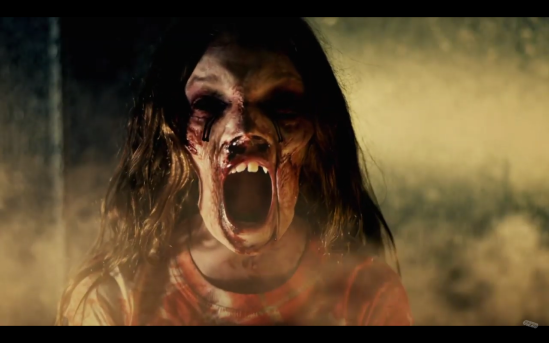
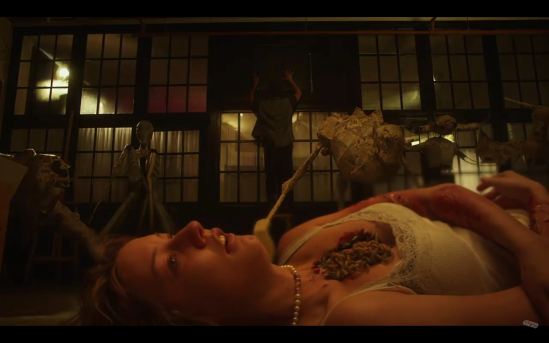
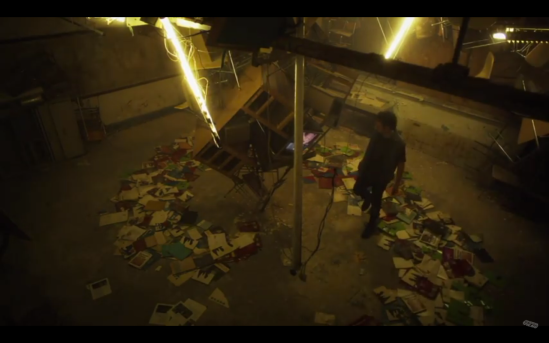
“The Dead Ones” is a film that’s always in a temporal flux, weaving back and forth between utter chaos of an active shooter situation in the normal light and the near totalitarian order saturated with an infernal hue inside a dislodged environment.  As the band of misfits reflect on their battered existence, one mentions, multiple times, his stint in Juvey while another can envisage the patterns to cut into her flesh, a bread crumb trail of hints and past misgivings lead them down a path of self-awareness, of remembering exactly how they landed into the ruined capillaries of the school in the first place.  Yet, “the Dead Ones” isn’t solely about paying for one’s sins, honing in toward more of a cause and effect choice for redemption, which begs an essential question, that goes slightly under the radar of Kasten’s direction, on whether the two timelines are rather parallel to each other instead of rendering past and present events?  It’s certainly one of those open ending conversations about what perils our souls could be fatefully curtailed under the corporeal spectrum by the choices we make while still living and breathing.  For myself, connecting with Kasten’s carnivalesque and ultra-sleek horror panache has been difficult to digest and become accustom to, especially with my own personal dissatisfaction with the remake of “Wizard the Gore” that starred one of my favorite eccentric actors, Chrispin Glover, but Kasten relishes an unorthodox methodology that goes against the traditional grain of filmmaking and while that usually isn’t the problem for him, or any director, to be discouraged from,  “The Dead Ones” ultimately tips over into the same disheartened gray area for one main reason – the editing.  “The Dead Ones” is edited by Maxx Gillman whose chief credits are on short films and documentaries, marking Kasten’s film Gillman’s debut into feature film market, but as like a good documentary editor, “The Dead Ones” is overtly choppy that cuts up the scenes in an egregious way, thwarting any sense of conveying emotions and shortening them to near nauseating back-and-forth cuts.  With a 73 minute runtime, the potential for lingering on the morose rhetoric or teetering compassion of the teens is lost and could have been stirred into their affixed affliction for a more targeted approach to their limbo circumstances. While timing might be less than desirable, Jeremy Kasten summons judgement for “The Dead Ones” to be convicted of unnerving decorum and executes psychological absolution with the tenderness of a Satan himself.

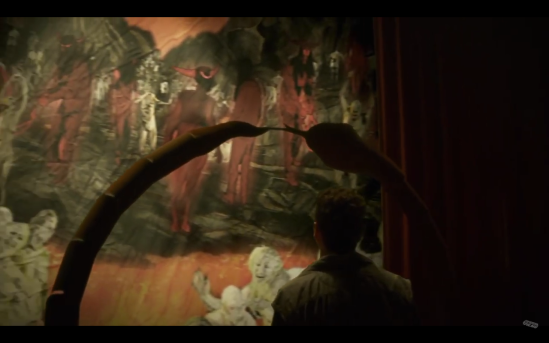
Surreal with a hard, open-hand slap of realism, the metaphysics of “The Dead Ones” shoots for an otherworldly life sentence as the September 29th release day for the Blu-ray and DVD is on the horizon courtesy of Artsploitation Films in association with Raven Banner. The Blu-ray was reviewed and is presented in high-def, 1080p with a 2.39:1, anamorphic widescreen, aspect ratio. The digitally recorded image is packed with visually popping nightmares under a slightly greenish warm tint while still propelling range into heavy fog, a seamless composite of scene transitions and matted visual effects, and copious amounts of rich shadows and shadowy characters. The overall tone of the “The Dead Ones” has a strong 90’s grunge manifestation with some CCTV black and white moments that would fit rightfully in before the turn of the century teen horror collective. The English language 5.1 DTS-HD master audio maintains clear dialogue pathways and a resounding, almost mechanical, score resembling that of an infernal machine at work. The ambient range and even a good chunk of the dialogue has a softer demeanor that sidesteps to the incessant score that would have rung about in Virgil’s Dante Inferno, as the school auditorium playbill show that’s transparent through the film. There is also optional Dolby Digital 2.0 audio. The bonus features include a special effects featurette of the special effects work by the late Elvis Jones, on one of his works with “The Dead Ones,” and his intern Jax Smith, a set tour with production designer Jeffrey Pratt Gordon to showoff his vision of hell, and two commentary tracks alongside the film with commentaries by the director, producer, and crew. Saving a soul damned to hell sounds like an enormous feat of only divinity interaction can accomplish, but Jeremy Kasten finds virtue in sinful acts, imbedding a safety net in the guise of a forked path, and opens an ingress to a putrid perdition for those under more severe scrutiny than just “The Dead Ones.”

Pre-Order “The Dead Ones” By Clicking the Poster!