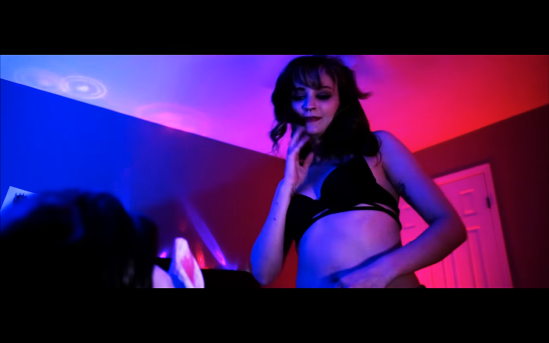
Evil Sows With Others’ Body Fluids! “DIS” review!


Ariel Konk, A former soldier fleeing from his regrettable past, seeks refuge in an isolate cabin located deep in the forest, adjacent to a lagoon. Struggling to live off the land and coping with loneliness, the soldier marches on, exploring his new, secluded surroundings. His loneliness comes to an end when investigating the ruins of a dilapidating building structure, spotting a masked half naked female and as he pursues her, Ariel witnesses her voluntarily jump from the highest level of the opened air building. Wrought with anguish, Ariel attempts suicide only to be knocked out before he could pull the trigger on his rifle. He wakes up being chained to the wall with a mute, mask figure drugging him and extracting his blood and semen fluids as necessary nutrients for a nearby Mandrake garden. A practice that has been executed many times before Ariel’s arrival.

“DIS” is a bordering arthouse horror film from writer-director Adrian Corona (“Nariz Ioca”). A blend from a horror influenced literary poem and a mythological folkore, Corona crafts a lurid, hyperbolic story that pulls, as Cornoa describes as a prefix of sorts, from Dante Alighieri’s epic journey through hell told in Dante’s Inferno, using the City of Dis that’s described as a lower hell for sinners who’ve committed violent and fraudulent transgressions, and interlocks that inspiration with the archaic lore surrounding the Mandrake plant that involves superstitiously condemning those to hell after reaping the intensely narcotic plant with the human shaped root and that would, also superstitiously, scream when pulled. “DIS” is full of interpretative terror through the 61 minute runtime that’s virtually expressive. Corona provides little dialogue to his script, keeping most of the dialect scribal incased within flashback confines, and let his actors’ raw emotions and visceral eloquence provide the tale that’s peppered with moments of visual shock and cathartic abhorrence.

I’ve said it once and I’ll say it again, Bill Oberst Jr. is one hell of an actor. The upcoming Rob Zombie “3 from Hell” actor has become a prominent staple professional in the indie horror film circuit, tackling the bizarre, the inexplicable, and the most difficult of roles with such vigor and passion that his motivation is seemingly inhuman. Right up there with “Deadly Revisions,” “DIS’ tops or equals being one of the best performances of his career, from the perspective of this reviewers’ cache of Bill Oberst Jr films. There’s quite a bit of difficulty catching up to the man who roughly does, whether as a lead or as support, 10 films a year! As Ariel Konk, Oberst captures the essence of pain and anger that saturates the character’s own personal delirium and hell with his past mistake catching up to his self-battered soul. The faceless figure who opposites Ariel feeds off the ex-soldiers repugnant and guilt-riddled past actions in a seemingly perverse mission that’s actually mandated by the suspected demon’s Mandrake lot. The plants are held in a nursery for engendering creatures, but what kind of creatures exactly? Other demons from the seed of murdered vehement people?
Remaining cast include Peter Gonzales Falcon, “Prison Heat’s” Lori Jo Hendrix, Manuel Dominguez, and Anne Voitsekhova.

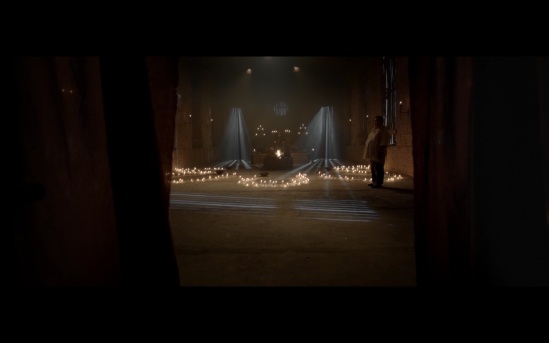
The casual viewer will inherently disavow the hour spent watching “DIS” due to a number of reasons, whether it’s Ariel wandering the forest for more than half the film, or dialogue is fairly infrequent, or the chaptered sequence of events don’t perfectly describe just what the hell is going, or, just perhaps, the motif of genital masturbation and mutilation is just too much to stomach. Either way, “DIS’s” traction will slip and only a few are willing to get dirty and push the story forward with open mindedness and artistic appreciation. Speaking of artistic appreciation, Rocco Rodriguez’s cinematography is a character upon itself. The top of a Cofre de Perote volcano in Perote, Veracruz, Mexico during principal photography has breathtaking visuals that Rodriguez captures exquisitely and becomes a backdrop against the coarse material. Outside is vivid, bright, full of life, but when in the belly of the rundown structure, the manmade confines are claustrophobic and crummy, infernally ablaze for ritual, much to the akin of Dante’s Inferno. Rodriguez, again, depicts lustrous imagery that assists in telling Corona’s nightmarish story and that’s a skill all can recognize.

MVD Visual and Unearthed Films present Adrian Corona’s enigmatic and surreal “DIS” from 1922 Films onto high definition Blu-ray. The region A release is presented in a widescreen, 1.85:1 aspect ratio, and has the near epitome of perfect with, again, Rocco Rodriguez stunning photography. The lighting really comes to the fold that upheaves the brilliancy in the textures, such as in the building’s illustrious graffiti, and dares to switch to black and white when appropriate. Skin tones are fresh looking and natural in colored scenes. Only a minor aliasing issue around Obsert flared up momentarily, but ceased going forward. The Dolby Digital 5.1 surround sound has forefront dialogue, but not a bit soft, especially with Peter Gonzales, that made following difficult. There was not enough examples of range or depth to necessarily comment as Oberst was essentially alone for much of the film. Bonus features include an explanation introduction by writer-director Adrian Corona, a behind-the-scenes featurette that exhibits three takes of two scenes, a wonky static menu Q&A formatted interview with Bill Oberst Jr., a short film entitled “Portrait,” still gallery, and Unearthed Films trailers. Bill Oberst Jr. is, basically, a one man show knitted into an Adrian Corona allegory of unknown terror through conduits of literary works and medieval folklore, making “DIS” prime real estate for viewers seeking a film as an open book toward abstract gardening.

Like Indie Horror and Want to Support Bloggers! Please Consider Purchasing this title from Amazon by Clicking Here! Thank you!!

Evil Shall Not Steal! “Purgatory Road” review!

The Kirby brothers, Vincent and Michael, witness the attempted suicide of his father who placed a snub-nosed barrel shotgun underneath his chin and pulls the trigger. As adult, the brothers process the trauma in their own ways with Michael unable to jumpstart his life that has been exploited by his brother who has joined the priesthood. Now as exonerated Catholic priest, Father Vincent continues his crusade in absolving confessional patrons of their sins, but with a twist. Hell bent on exacting death through absolving upon those who steal in any capacity, Father Vincent travels the rural areas of Mississippi in a beat up congregational and confessional mobile camper to soapbox his wrath sermons and to rid the world of those who surface his childhood trauma. When another psychotic killer ascertains Father Vincent’s radical cause and wants to join devious purposes, the aversely complicate Michael can no longer abide by his brother’s carnage of guilt path and isn’t keen on spending his life with another heartless killer, urging himself to exit the threesome and starting a life of his own with Ruby, a diner waitress who has taken a shine to him, but Father Vincent and his newfound accomplice won’t let him go that easily.

Just what the Catholic Church needs… one more film depicting a priest using God to benefit his own greed! Mark Savage co-writes and directs the damnation of thieves film, “Purgatory Road,” with a post-viewing requiring a penance of one Our Father and ten Hail Mary’s! Co-written with “Stressed to Kill’” Tom Parnell, “Purgatory Road” is a horrific hallmark of adverse Americanisms such as religious fanaticisms, self-indulgence, mental instability, corruption, and narcissism. All these qualities can potentially lead to one common bond that Savage makes centerpiece and that would be murder. Savage’s extreme vision isn’t all that far from today’s reality where cases of the mentally and the spiritually unstable and religious acolytes plan, stage, and carry out killing sprees almost weekly, corrupt politicians and the uppermost devout pocket secrets and bribes, and egotistical maniacs pick and choose basic civilities to divide groups against each other. I don’t see “Purgatory Road” as shocking and taboo, but rather as 98 minute revelation, not in a Almighty sense, but as a break in the opaque lens that is today.

Father Vincent firmly believe in his actions, without doubt and without shame, and uses any tool, or person, to fatally smite thieves, but has no absolute joy in the way he responds to pilferage acts. The guilt over his father’s attempted suicide drives him, sucking the vibrancy, the energy, and the happiness from him, and the fact that his father still lives, as a basement dwelling, cannibalistic creature, makes the matter even more dire to Vincent. The fraught priest ended up being an ideal performance for Gary Cairns (“Malignant”) who noted in the behind-the-scenes interview that his personal issues at the time brought out the all-around worst in Father Vincent and despite the character written as a fire-breathing, wrath of God man of the cloth, Cairns is able to weather his role as a seemingly idyllic Catholic priest with something to hide from credits-to-credits. Michael Kirby might be complicit, but isn’t wholeheartedly on-board with his brother’s blood shedding that drives another relevant nail into a Cain and Abel type tale. Michael’s longing to part from his brother is difficult for him, whether he also feels guilt for his father’s misfortune or an attempt to try and steer Vincent from complete and utter chaos, and even with a chance to escape the madness, Michael unintentionally flounders the attempt that ultimately becomes his climax to kill. Luke Albright (“Devil’s Pass”) engrosses himself as the black sheep amongst wolves in sheep clothing. Though his character is scribed as conflicted, Michael has downplayed emotional trauma that extremely binds him to his brother and makes him just as equally disturbed when disposing of his brother’s victims. Savage and Parnell’s narrative angle might not focus on the emotional level of Michael, but Albright flourishes the angst that internally rips him apart within the confines of every contentious scene that involves Cairns’ character. The brothers are driven further apart when Mary Francis, a sadistic and cannibalistic serial killer, discovers their undertaking, forces herself to join them in the cause, and catches the eye of Father Vincent, who displays some physical touch withdrawals and loneliness with the vulnerability of his corpses. Mary Francis is easy on the eyes, casual in her affairs, and empowering with a high sex drive that would make any man weak at the knees in a normal world, but Mary Francis is far from normal and Trista Robinson (“Jurassic City”) offers her short build, cutesy voice, and piercing eyes that favorably compliment Mary Francis’s dark features and equally dark soul. The character is an unsuspecting brut heart whose well-written as she describes to a radio talk show host her boy or girl fascinations as a drab hunting sport where spilling their blood and robbing them is the last great and excitable moment of the relationship, signified and sealed with a single kiss. The rest of the cast rounds out with Sylvia Grace Crim (“Happy Death Day 2U”), Geoff Falk (“The Livingston Gardener”), Chace Beck (“Meltdown”), and Douglas Cunningham.

Shot on location in Mississippi, “Purgatory Road” offers a really cool story that’s not produced on a studio lot and is kept out of the rural areas of California and any other locations that bear no resemblance to the deeply Southern pious roots of the 20th state of the U.S. Savage was able to obtain raw locations that best fit the delusional and fanatic tendencies of Father Vincent and with the gruesomely beautiful special effects and makeup by “American Guinea Pig: Bloodshock’s” Marcus Koch and Cat Bernier, the murderous role of not only Father Vincent but also Mary Francis are furnished to frightful fruition of two fiends you just don’t mess with in the devout South. Koch and Bernier texturize severed body parts and provide a wide diameter for blood splatter as an intensifying tool, but don’t overly exaggerate the gory garnishes that might re-direct attention from the story.

Unearthed Films and MVDVisual’s Blu-ray of Delirium’s “Purgatory Road” has Unchristian values worth indulging that includes a widescreen 1.85:! aspect ratio. The digital shot film uses a Canon EOS C300 Mark ll in a full HD setting and the image quality has phenomenal sharpness with natural skin coloring and excellent details that come to focus on the outside faded, dirty paneling of the rustic RV and in the fleshy, blood wet limbs of the Koch and Bernier gory special. Cinematographer Andrew Giannetta has a working eye for the horror element of “Purgatory Road’s” red-light district familiar frame work with appropriate fog and tint to augment the gothic murkiness and dread. The Dolby Digital 2.0 audio track is favorably well-balanced with no kickback or unintelligible miscues. “Purgatory Road” might have an RV kill room, but the RV isn’t involved in high speed chases or fiery explosions, so the dual channel works well for this type of low-key thriller. There are bonus features aplenty with a commentary with writer-director Mark Savage, a gallery slideshow entitled “The Grisly Art of Marcus Koch and Cat Bernier,” writer Tom Parnell speaking about his experience as a screenwriter behind his main profession as a lawyer, a lengthy featurette of the three lead actors speaking about their involvement, how they came to the project, and what the film and/or story means to them personally, and a Purgatory Road Q&A featuring Mark Savage. Impenitent swindlers beware! “Purgatory Road” is all fire and brimstone braced with a strong cast of compelling talent and a horrifically transfixing tale of blood is stronger than holy water.

Take A Magical, Evil Ride on the “Caroushell” review!


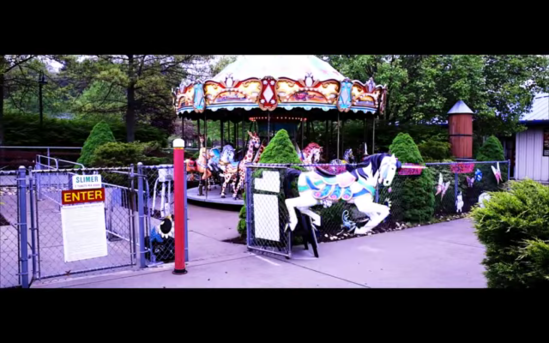
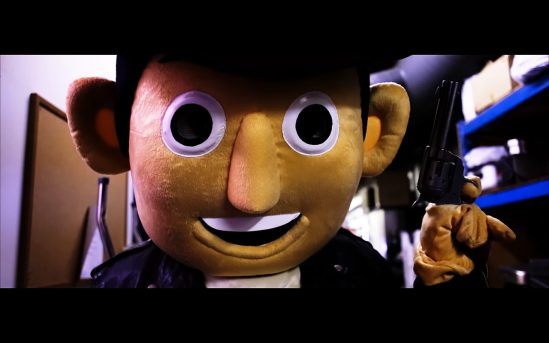
Extremely frustrated with the lack of respect from snot nose kids and the monotonous, round-the-loopy-loop that is his life existence, Duke, the carousel unicorn, has finally had enough the moment after a fat kid mounts him for a ride, smacks him like a giddy-up horse, and wiping his snot onto Duke’s glossy wooden eyeballs. The latter being the final straw that broke the unicorn’s back. Duke breaks free from the amusement park ride in search for a better quality of life when he happens to discover that killing makes him feel good, real good. With a newfound purpose, Duke vows to hunt down and end that fat brat, slaughtering anyone and everyone in his path of carnival-esque carnage that leads the unicorn not to water, but to a house party where the kid stuffs his chubby face full of cake and other goodies while his older sister and her friends order pizza and hit hard the alcohol as they discuss a love and hate for a popular kids show, My Tiny Unicorn. When Duke shows up at the front door, his statue-like presence is a big party hit amongst unicorn show fanatics who are unsuspecting of his murderous desires. The only person capable of stopping the mayhem is the amusement park mascot, a jovial warden cowboy named Cowboy Cool with his trusty, evil unicorn stopping six-shooter.

Step right up! Step right up! Behold and be amazed by the stupendous and the downright bonkers horror-comedy, “CarousHELL,” about a killer carousel unicorn from big top maestro, writer-director Steve Rudzinski. The “Everyone Must Die!” filmmaker helms a satirical slasher co-written by Aleen Isley in her first credited treatment. “CarousHELL,” a whimsical play on carousel and hell if you somehow couldn’t figure that out, inexplicably sprints with the inanimate killer concept that visually livens an old “Family Guy” wisecrack about the latest Stephen King novel being about a killer lamp! Instead of a bright bulb shining blood red and using the electrical cord as a noose, Rudzinski and Isley explore the macabre qualities of an inorganic unicorn by extending its cache of weapons beyond the obvious long, pointy horn to also being able to wield a machete without opposable thumbs, sharp shoot with a bow-and-arrow with hooves, and even have the capability to kill with ninja stars despite the sloping shoulder conformation. Impressive…

Rudzinski also co-stars as Joe, a diehard pizza delivery guy and passionate dog lover who is desperately trying to earn money for his ill-stricken four legged friend. Rudzinski, sustaining both roles as a director and a performer, solicitously molding Joe as an oblivious nice guy just looking to do his job and even though he’s a bit of an impatient spaz, Joe’s not the biggest spaz swimming in the character pool. Rudzinski could be considered the lead male in the one of many boisterous roles of “CarousHELL” who certainly manages to get the girl without having to lift an finger. That girl being the self-indulgent Laurie, big sister to the unicorn pissing off brother. With her face glued to her social media phone and being a spoiled brat herself, Laurie has little-to-no attachments to anything: she’s not tied down to one boy, weighs social media clicks heavily in life, and finds disrespect the choice of attitude even toward her pole–strapping stripper of a MILF mother. Pittsburgh, PA born Sé Marie (“Cryptids”) does bitchy well, finding a nice niche to nest in with this harebrained, but light-hearted slasher with bite. Joe and Laurie have excessive personalities, but nothing can top Preston who sets the field bar. The house party co-host starts off as a complete douchebag complete with popped collar and an unquenchable thirst for bare chests and the introduction of Chris Proud really makes a first impression in a truly unbearable, over-the-top role, but believe it or not, Preston is one of the few characters of the film to have what could be construed as an arch storyline. Preston, by the end, transforms into a likable character with penchant expertise for the My Tiny Unicorn universe (a spoof toward Hasboro’s “My Little Pony”) and is the only character to perceive the first hand danger from the infiltrating and evil unicorn from hell. Duke is hands down the best scribed character of the entire film. Voiced by veteran voice actor, Steve Rimpici, Duke can literally stand inanimate and still be a vital part of the story. The versatile Rimpici is like the movie trailer voiceover guy with an uncanny Duke Nukem-type voice who has movie credits including the Dustin Mills’ directed features, “The Puppet Monster Massacre” and “Easter Casket,” as well as stints in video games such as “Red Dead Redemption” and “Mafia III.” The cast rounds out with Sarah Brunner, P.J. Gaynard, Judy H.R. Kirby, Josh Miller (“Amityville” No Escape”), Teague Shaw, Haley Madison (“Haunted House on Sorority Row”), Cindy Fernandez-Nixon, Shawn Shelpman (“Red Christmas”), Corella Waring and Michael Mawhinney.

With a film like “CarousHELL,” killer special effects need to be a must as marketing an inanimate villain will be hard sell. Yeah, “CarousHELL” has catchy dialogue, witty enough banter, and gratuitous and non-gratuitous nudity. There’s even multi-positional sex with the unicorn. Thanks for that searing image Steve Rudzinski and Haley Madison! However, a slasher requires good kill moments and the special effects work by Cody Ruch meets the demand with a brutal that include a beautiful gored unicorn horn kill to the neck, a double impale followed by a goopy string entrails, and an Ronald Lacy melting scene with charring laser eyes! Even with a high body count and delectable moments of insanity at it’s peak, “CarousHELL” will undeniably find a general audience outside the scope of genre fans who will understand the context behind fashioning a unicorn slasher, those who are just easily entertained, and maybe a slither of fans of westerns.

MVDVisual and Wild Eye Releasing delivers the hell raising attraction, “CarousHELL,” onto DVD home video presented region free, unrated, and in widescreen format. The digitally shot video has a pleasing standard of quality. A few moments of brief aliasing but nothing to specifically note that matters. The dual-channel audio was the most disconcerting issue that’s affecting the release. More so with the exaggeration of performances with the screaming and the screeching, the feedback distortion is pesky and jarring. Dialogue is prevalent and forefront, but lacks range and depth and so the verbal tracks tend to blend together. The bonus features are a welcoming site with a commentary track, cast interviews that explain how the film came to fruition and that better explains what the “CarousHELL” they were thinking when creating this fun flick, a few deleted scenes that explain the disappearance of minor characters, bloopers, and Wild Eye Releasing trailers. Just like “JAWS” did with ocean, “CarousHELL” will cause hesitation when deliberating if riding a unicorn will endanger your mortality. “CarousHELL” is fun, campy, and a whole bunch of nonsense that has our full 100% support in the horror community.

Evil Rips through the Whitechapel District. “Jack the Ripper” review!


On the streets of London’s Whitechapel district, women are afraid to walk the streets alone at night and angry mobs have begun to turn their backs on the police’s ineptness on catching a killer. Jack the Ripper is what the people of London label the maniacal murderer who, with surgical precisions, guts his victims and leaves their lifeless bodies on the dark, dank cobblestone streets. Scotland Yard Inspector O’Neill is joined by his friend and American counterpart, a New York police officer named Sam Lowry, to hunt down and stop Jack the Ripper’s killing spree. Deeper into the investigation, the officers are informed that the suspect they track would have medical background with a skilled blade hand, but even with that information, Jack the Ripper alludes authorities. Lowry’s romantic involvement with a young woman named Anne Ford, whose under the ward of the notable Dr. Tranter, might be very connective tissue between the constabularies and the secretive medical society needed to crack the case of the notorious Jack the Ripper before he strikes again!

Jack the Ripper is a real and iconic villain that not only terrorized the streets of London, but had later graced the screen many times over from Bob Clack’s 1979 thriller “Murder by Decree” to the 2001 Allen and Albert Hughes gothic and graphic “From Hell,” starring Johnny Depp. Before the production of those films, before Jack the Ripper really had any kind of footprint in cinema, Robert S. Baker and Monty Berman directed the 1959 mystery-thriller “Jack the Ripper” from a screenplay by Jimmy Sangster and Peter Hammond based off the theory that Jack the Ripper had a medical practice history. Baker and Berman’s film hit the controversial market from right out of the gate with grisly and ghastly murders, for the circa 1950s, and bared topless actress frivolously to insinuate the lady drunkards, the showgirl dancers, and the lone walking women as ladies of the night. Prostitutes would have been burden the selling of an already certifiable X film from the BBFC and the MPAA. However, the filmmakers constructed alternate cuts, shorting the grisliness to just grim and sheathing bare breasts with articles of clothing in shot for shot censorship. Only on the continental, aka French, version does a truly uncut and complete film live to excite, but instead a complete feature, the unmolested scenes are only available on the bonus features of the Severin Films’ release. That’s not to say that the U.S. and British versions are a complete waste of time. The classic time is utterly timeless and gripping that offers up immense amounts of whodunit suspense, implied sensationalisms, and an adequate take on how incompetent law officials can be exhibited when politics and women are afoot. Plus, the U.S. version, bought and presented by legendary producer Joseph E. Levine, comes with a brassy score by Jimmy McHugh and Pete Rugolo. The British version, also known as more of the approved director’s cut of the film, is scored by Stanley Black.

Tall, handsome, and walking into another country like he owns the land, detective Sam Lowry is introduced at about 10 minutes in, standing at a bar and reluctant to be rough and tough with a mob ready to lynch him for potentially being the Ripper because of his inquiries. Lowry’s charming persona with the women, like the bar maiden and Anne Ford, are only offset by his complete incompetence to be a police detective. Lowry does absolute zilch investigation and, instead, goes out on a date with Dr. Tranter’s niece and makes snarky comments at a merciless, ready to judge horde of scared Whitechapel residents. American hunk Lee Patterson stands out amongst the gothic rich atmosphere to the point where’s he, like his character, is an outcast and Patterson’s talents could only take him so far into a gloomy, morbid narrative that was unwilling to accept his chiseled chin and starry eyes. Eddie Byrne fit the mold better than Petterson as the Scotland Yard Inspector at rope’s end with not only Scotland Yard, but also the rest of London. As Inspector O’Niell, Byrne, who went on to star in “Island of Terror” and “Devil’s Darkness,” humbly accepts his restraint as the Irish born actor takes a wallop from all sides and still remains calm, collective, and ever present on the task at hand with a character being beat from all ends of the spectrum. Anne Ford opposites Lowry as the potential love interest who has come of age, as she notes a few times, to takeover temporary responsibilities at the hospital where her uncle performs dire surgeries. Being oppressed by her own family and seeing London being ripped a part by its own people, Anne latches onto Lowry, an outsider, to find a connection or a release from sullen cloud that hangs over Whitechapel. Unfortunately, Betty McDowall is sorely overshadowed by many of “Jack the Ripper’s” formidable characters and that Anne is not wholeheartedly written though her character is important to the story. Even the showgirls sizzle in more ways than one than does McDowall whose kept in check by Lowry, doused with someone’s problems, and only given an allusion of her worth in a moment of fright. Ewen Solon (“The Curse of the Werewolf”), John Le Mesurier (“The Jabberwocky”), Barbara Burke (“Blood of the Vampire”), Denis Shaw (“Curse of the Werewolf”), Bill Shine (“Burke & Hare”), and Anne Sharp (“Murder on the Campus”) round out the cast.

“Jack the Ripper” is a classic, literally and physically. The scaled down sets of the Whitechapel area bring to life the tenebrous soil of 19-century London. The elegantly painted backdrops of tall mast ships enshrouded by synthetic fog paint an archaic picture of how movie magic has progressed over the decades. Attention to detail in the set construction and the flavor of time period customers brought a sense of authenticity that nostalgically harps on the once was that now only exists as recorded cinema history. “Jack the Ripper” casts a forgotten beauty in the barbarism. By today’s standards, “Jack the Ripper” would be written off as banal and uninspired by critics and audiences, but if you can imagine yourself in 1959-1960, Robert Baker and Monty Berman just blew your mind with onscreen taboos and in America, Joseph Levine’s technicolor blood scene, with a duration of only a few seconds, would be the viral talk of the town.

Severin Films presents “Jack the Ripper” onto a region free, 1080p Blu-ray for the very first time anywhere! Complete with two cuts of the film, the British and American version, Severin presents both in their released aspect ratios of a lossy standard 1:33:1 in the British version and 1.66:1 in the American version, both in B&W with a pop of technicolor in one scene in the American version. Severin’s transfer is perhaps the best we’ll see from an original print that’s laced with scratches, but a bit more light, or some brighter contrast, sheds some light in the inky corners while managing a rich appearance that’s not monochrome or sepia. The English 2.0 audio track maintains an equal quality with some static in dialogue and ambient tracks. Jimmy McHugh and Pete Rugolo’s brass-heavy score thunderously pack the scene that surely takes the lead amongst the tracks. Bonus features include snippets of the continental versions with the extended violence and nudity and the audio commentary with Robert S. Baker, screenwriter Jimmy Sangster, assistant director Peter Manloy is extracting and interesting helmed by horror historian Marcus Hearn. Also included is an interview with the author of “Jack the Ripper” The Murders of the Movies” Denis Meikle, “The Real Jack the Ripper” featurette, theatrical trailer, and poster and stills gallery. Exposed and disclosed, the various faces of Robert S. Baker and Monty Berman’s “Jack the Ripper” now have a hi-def upgrade and though a full continental version eludes this release, Severin provides the cliff notes in order to not overcook the same story a third time.

Two Evil Guys Stick to the Script! “Snowflake” review!


Tan and Javid go on a killing spree in anarchy-riddled Germany after their families were killed in a house fire in which emergency services were purposefully withheld. After slaying bystanders at a diner, they happen upon a script in a stolen car; the script reads line-by-line, word-for-word on everything the two men say and do. Simultaneously, the wealthy Eliana is hunting them down, seeking revenge for the death of her parents by collaborating with her parents’ former bodyguard to hire cold-blooded serial killers to kill the men. As Tan and Javid try desperately to not follow script, the two men seemingly can’t avoid their fate along with circumventing a variety of dangerous people crossing their path. Only a couple of people from the script can possibly save them, an Angel named Snowflake, and, possibly, the screenwriter himself.

Adolfo Kolmerer’s “Snowflake” has maybe little-to-no relevance to the derogatory term commonly used by right-winged conservatives when describing the assumed liberal millennial with a heightened sense of uniqueness and having a knack of being overly offended by, well basically, everything. Kolmerer’s “Snowflake” also has no correlation with the concept of winter, snow, or even Christmas. So, the question is, what the hell is “Snowflake” about? The 2017 shocker, also known originally as Schneeflockchen in the German language, is as cold and as unique as any snowflake mother nature can cruelly reign upon down a person and methodically compounds the series of gritty events, from two sets of characters, through a head-bearing funnel that’s supernaturally poised and brutally executed. From writer Arend Remmers, the script itself is smartly constructed as a narrative character, woven to become a pivotal motivator that not only churns out characters’ supposedly ill-fated destinies, but also a metaphysically, arch-able player in the grand scheme of gruesome revenge and absolute atonement that within the bookend pages of the treatment has unorthodox religious themes and a radical, almost anti-hero like quality of rising against the powers of racially insensitive autocratic and populist agendas. The film’s location of Berlin isn’t the only thing that’s anarchical driven as Kolmere and Remmers bends cinema conventional rules to enthrall one punch to the gut movie.

Erkan Acar and Reza Brojerdi play the brothers in arms, Tan and Javid. As they venture on nihilistically slaughtering quest to come face-to-face with their maker, Tan and Javid have nothing more to lose and Acar and Brojerdi depict themselves in that predicament while maintaining their characters’ seamless, longtime friendship, like watching two sets of personalities move as a single unit. Tan and Javid are hunted down by another character seeking vengeance for her parents are the wrong place, at the wrong time. Eliana has money, status, and all that she could ever want, but when she befriends her family’s bodyguard who is then let go from the position, she loses sight of the meaning of uncoupled protection in Berlin’s anarchy state and also loses sight of what’s truly important to her – her folks. When they’re slaughtered, Eliana, played by Xenia Assenza, is hellbent on exacting retribution. Assenza clearly proceeds with a cold, drafty personality for Eliana with unrelenting ambition. The character is scribed as ultimately over flawed if not even expressly obvious and Assenza does a fine job bubbling those flaws ever so delicately to the surface in every loss Eliana sustains. Tan, Javid, and Eliana have a very grounded reality about them when contrasted with other characters such as the superhero-esque Hyper Electro Man (Mathis Landwehr) with the steampunk power backpack of electrical power, a blind man named Fumo (Eskindir Tesfay) with fits of fury, and a madman named Caleb (“Braveheart’s” David Gant) who could very possibly be God himself. Electrifying, mysterious, and powerful can be their only descriptive adjectives that steer “Snowflake” into the graphic novel universe. David Masterson (“German Angst”), Gedeon Burkhard (“Inglourious Basterds”), Selam Tadese, Adrian Topol, Judith Hoersch, Alexander Shubert, and Antonio Wannek, Bruno Eyron, Martin Gores, Mehmek Kurtulus round out this amazing, eclectic cast.

On a single read through of the synopsis on the Artsploitation’s Blu-ray back cover, trying to process the quickly summed up tale might also quickly scorch and burn off invaluable brain cells, but “Snowflake” has an immensely alluring nature once reviewed on a second read. Might not be a tearjerking romantic comedy and can be stupendously offensive with hints of barbarism, but the fantasy element, infused with Western composition at times, is stone strong with this film that’s more than just a Tarantino or Coen brothers’ akin film as the summary impresses to potential viewers. I’d toss in their some steampunk aspects of early Terry Gilliam or the delicate fable-isms of Marc Forster. It’s also a little razor blunt like Takashi Miike and perhaps could have surrealistically lobotomized and strenuous dreamlike sequences that speak to the likes of David Lynch, in choice scenes. Adolfo Kolmerer can be considered an equivalent to not one, but all of these visual icons and mega storytelling filmmakers.

Truly unique like an ice crystal falling from the winter sky, “Snowflake” falls onto Blu-ray home video courtesy of Artsploitation Films. Presented in 1080 and in a widescreen format, “Snowflake” vividly impresses with a broad color palette and a sleek, crisp digital picture. Hyper Electro Man has vibrant electrical currents snaking around his body and arms that aren’t just blurry blobs, but maintain two-tones of color and depth. Various decrepit buildings have the details pop out to bring an anarchy German to life. The German-English-Polish Dolby Digital 5.1 audio track has range, balance, and fortitude with a clarity and prominence in all spoken dialects. English subtitles are available. Bonus features included a behind-the-scenes look at “Snowflake” that clocks in just under a hour and trailers of other Artsploitation films. “Snowflake” has an original frame that’s built to sustain the broken westernized violence and is tightly glued together with likable berserk characters and an engaging labyrinthine story that ultimately feels genuine, versatile, and thematically relevant in, nearly, a not-so-abstract vision.