With E3 starting this week, developers and publishers have been giving us glimpses at their new games. One of them happens to be a cool looking new horror game based on one of Lovecraft’s most famous stories.
Call of Cthulhu is an upcoming Horror/RPG based on H.P. Lovecraft’s ”Call of Cthulhu”. Players take the role of an investigator who must uncover the truth behind a mysterious town called ”Dark Water”. This is not a sequel to the 2005 game ”Call of Cthulhu: Dark Corners of the Earth” but rather a reboot of the game series. The game is being developed by Cyanide Studios.
I’m sure we will be seeing more information on this game this week, since E3 starts this Sunday. I am so excited to see what horror games will be announced, there have been some heavy rumors about a new Resident Evil and a sequel to The Evil Within being revealed. Looks like horror might make a return to mainstream gaming once more.
High school classmates Pierre and Damien have just murdered a street woman inside her own apartment days before their French placement examinations. After hearing of the gruesome news, Zoe, a young optician working on the same street, recalls the two boys bumping into her, dropping a black glove on the sidewalk, and she begins to formulate her own radical theory, putting two-and-two together that the teens could be the very culprits fleeing calmly from the scene. Meanwhile, Pierre and Damien continue on with their examination studies over the Easter holiday, believing their heinous crime was not personal but of chance, making the offense not a crime at all. Zoe continues her pursuit of curiosity toward the murderers by not informing the authorities of her suspicions; instead, Zoe uses the crime to become self-aware of her fragile and stagnant relationship with her long time boyfriend while the two teens perverse over the concept of committing another murder.
Leave it to the French to make a bloodless and non-violent crime drama that’s more arthouse than conventional. Based on the Leslie Kaplan 2005 novel, “Fever” is the 2014 freshman film from writer-director Raphael Neal that dives sharply from the murderous act and into the internal struggles that lead Damien, Pierre, and Zoe into a turmoil path. Pierre and Damien think they both won’t be affected by their crime and that their moral conscious will remain clean on the philosophical notion that chance doesn’t warrant being unethical, immoral, or lawfully wrong. Damien basks in this belief more than Pierre, but still succumbs to the inevitable intrinsic battle. Yet, the two boys face separate inner warfare: Pierre’s frightened he’ll be caught by Damien’s nonchalant cockiness, looking over his shoulder constantly and fretting the off chance a witness has already spilled their dastardly secret to authorities whereas Damien fears that his chance theory is being blown to smithereens due in part of his ancestral legacy where his grandfather had cooperatively slain hundreds, if not thousands, of Jews during World War II because the Nazi’s ordered him.
Neal’s envisioning, as a director and a writer, flounders with a wishy-washy, by the waste side, telling when trying to convey the character centric story. From the beginning, Pierre and Damien’s sociopathic nature weakens from time to time with an invading moral conscience, like with in Pierre, but Damien’s difference lies with him questioning his justification of murder, but Pierre and Damien’s quiescent state about their family’s issues spots the story like a dirty window unable to view through clearly, leaving a vague and murky background and present state of mind for both characters. The twosomes’ up-and-down state of minds displays no consistence in their behaviors as they’re friends one instance, squabbling and bickering the next, then back to friends shortly after. Issues with angry and abandoning fathers, lustful mothers, and, apparently, genocidal grandfathers have deeply rooted themselves into the boys’ psyche like poisonous mushrooms kept in the dark to thrive to be eaten by mistake. Neal never relays that sense of foreboding wickedness. The same goes with Zoe as a character with really no background whose starting to go through a metamorphous, reforming her position in an unexciting relationship and developing, through subtle hints, a strangling desire after learning about to incident across from her shop. Yet, her full transformation never completes itself, placing her character, and the teens, into a volatile decline of shortcomings.
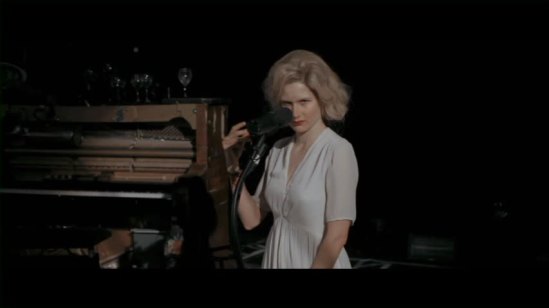
Though not too familiar with the actors themselves, their performances overshadow the film’s overall divergent plots. I was very struck by Martin Loizillon’s portrayal of Damien with the cold-heartedness that completely blankets his façade and his exerting of unorthodox spontaneity that doesn’t shy away from creating an uncomfortable scene. Pierre Moure contrasts Loizillon appropriately with a shyly frigidity, secretly yearning for more blood, Pierre Simonet. The red-headed Julie-Marie Parmentier displays the same kind of coldness reflected by the Pierre and Damien, but in actress’s own style of curiosity and intrigue with a minuscule hankering for sexual fetishes or self-morbidity. Then there’s duo lingo French singer Camille playing a role of non-fictional popular song artist Alice Snow whose hit English single, “Fever,” serves not only as the title of Neal’s film, but also symbolizes the foundation of the characters’ conflicts.
Artsploitation Films courteously distributes the Strutt Films’ production of “Fever” onto an unrated DVD with a sleek widescreen presentation with a 2.35:1 aspect ratio. The video’s clean with bright, Spring-like colors opposite the more customary, French influenced film noir that’s more common toward crime thrillers. The French 5.1 surround sound mix comes with English subtitles. While the soundtracks and the dialogue tracks are distinct and lively, there’s a slight error involving omitted subtitles, but the flaw only affects a petite portion of the dialogue, if you’re not tuned into French dialogues. “Fever” displays a mixture of psychological drama that mirrors the infamous Chicago crime of Leopold and Loeb of 1920 and Fyodor Dostoyevsky’s pathologic philosophical novel “Crime and Punishment.”
Vividly haunted by the nightmares of her childhood, Grace Walker struggles with recouping from the brutal suicidal death of her father that has plagued her into adulthood. Her boyfriend Jim plans a romantic getaway for just the two them in the remote region of the Smokey Mountains. After a horrific accident fatally strikes down Jim, Grace is alone and lost in the thicket without her coping medication and without a basic knowledge of survival skills. Battling with starvation, unequipped with survival supplies, and besieged with a mental breakdown, Grace combats against her inner and outer demons in order to stay alive.
Eight years have passed since writer-director Jeremy Benson’s last film, the carnal exploitive “Live Animals,” and the filmmaker comes back strong with the upcoming deeply psychological horror “Girl in Woods.” While the title seems unoriginally simple, the character Grace is anything but simple; however, primitive is a more suitable description of both title and character in the end. Benson sets up the character by writing Grace as a woodsy no-nothing on the brink of insanity. As Grace hikes behind Jim, whose carrying a rifle, she’s complaining about the possible dangers of bears and snakes while attempting to use her pink incased cellphone in a kill signal area to gossip about Jim’s engagement proposal the night before. Immediately, Benson places an unstable, and the creature of comfort, Grace into panic and peril, the starting line of her laundry list of troubles. From then on, the director relentlessly pounds Grace with hallucinations set within the Tennessee backwoods, torturing her from the mind with mental deterioration stemmed by hunger and onset psychosis to her body with physical pain from a deep gash wound in her hand.
And who is this actress to which Benson mercilessly puts through the meat grinder? Veteran actress Juliet Reeves (“Automaton Transfusion”) fills Grace’s disturbed shoes with a formidable solo performance for much of the duration. The then 36 year old actress was pregnant with her second child during various filming shoots. The father of the child is with none other than her co-star, now husband, Jeremy London (“Alien Opponent”) who portrays Jim. Reeves is able to maintain a convincing lunatic lost in the woods despite the non-liner storyline where dream sequences and, supposedly, flashbacks intercut to build upon Grace’s tragic and unfortunate background. Reeves commits herself to the stages of psychosis, slowly transforming from a manageable, calm medicated state to severely severing all ties from external reality. Even when performing with her angel and devil conscious in the form of herself, Reeves doesn’t flinch, fashioning a frightening internal dynamic that’s damn realistic.
“Girl in Woods” ultimately becomes a collaboration between the subgenres of psychological horror and man versus nature. Benson’s story explores the possibilities of what might happen if a mental case like Grace is put into a dire predicament and the non-linear narrative simultaneously attempts to display how Grace is destined to be molded. Interestingly enough as a tidbit of analytical comparisons, “Girl in Woods” marginally parallels with a few popular scenes from the 1987 John McTiernan film “Predator.” When Mac, played by Bill Duke, chases down the extraterrestrial game hunter, he notes to Carl Weather’s Dillion, whispering, “I see you” toward the cloaked alien, which feels similar to when Grace spots the forest “demon” and chases after it, yelling, “I saw you” over and over. Other scenes sport the same similar inkling from Grace whittling makeshift weapons to going full blown guerilla attack commando on the “demon,” who oddly enough also makes similar vocal gutturals like the Predator.
As far as production value is concerned, “Girl in Woods” has an ambitious approach with a infinitely engulfing forest that lurks like an antagonistic villain and an in-your-face motif of self-inflicted suicides that’s extremely graphic and hard to absorb with the brain-splattering, wrist-slashing overdose potency. The CGI is kept at a minimum, but have one hell of a nasty bite that spurs the heart to a sudden pounding. The practical effects reign supreme over CGI and within the confines of a warped mind, the possibilities are endless and Benson exploits the potentials. Overall, fine performances by the rest of the cast: Jeremy London, John Still (“Live Animals”), Lee Perkins (Slime City Massacre), and the stunning Charisma Carpenter (“Angel” television series) as Grace’s mother.
Produced by GIW in association with Yield Entertainment and distributed by Candy Factory Films, “Girl in Woods” is an upcoming film you don’t want to skip over. Jeremy Benson has the talented eye of capture beauty within the horror and has the talented pen to wield craziness on paper. I’m not at liberty to critique the audio and video quality as I was provided an online screener, but “Girl in Woods” is being released on iTunes, VOD, DirectTV, Cable, Dish, Amazon Instant, Google Play, and Vudu so there are plenty of formats to choose from on June 3rd.
Aspiring screenplay writer Wesley Pennington obtains the position of a runner for a low-budget zombie film. Being at the bottom rung, Wesley is commanded to do everything without hesitation or question no matter how big or small the task. With the production already plagued with a slew of problems, the film’s cast and crew come under attack from real life zombies that swarm the forest location. Wesley, along with a handful of lucky survivors, rely on their zombie film knowledge to flee from the flesh feasting fiends, living in their very own zombie apocalypse movie.
Rare is it to come across New Zealand horror now-a-days and when the opportunity presents itself, one must jump at a viewing with great enthusiasm. New Zealand horror has been known to be eccentric and fun, while also being gory and smartly scripted. From the early prevalent work of Peter Jackson (“Brain Dead,” “Bad Taste”) to lesser known cult favorites (“The Locals,” “Black Sheep”), the tiny New Zealand horror catalogue has made an everlasting mark in a heavily saturated American and European market. Guy Pigden’s written and directed 2014 horror-comedy “I Survived a Zombie Holocaust” takes it’s place rightfully so next to niche brethren, elucidating that horror and comedy in an extremely over saturated genre can and will still be an effective and entertaining movie.
Simply taking the premise of a horror movie being overwritten by another horror movie and using it’s tropes to poke at itself, while also jabbing at the film industry’s detached reality that ultimately devours itself, conquers being just another run-of-the-mill zombie comedy. Pidgen sharply appoints an ensemble cast to go along with the wanton story, working side by side again with Harley Neville in the socially awkward Wesley Pennington role. The rest of the main characters are purposefully stereotypical, fine tuned by Jocelyn Christian, Ben Baker, Reanin Johannink, Mike Edward, Andrew Laing, and Simon Ward. The character comedy mimics Peter Jackson’s “Brain Dead” with developing persona’s through various types of characters such as Wesley’s nerdy-awkwardness, Reanin as the prissy spoiled actress in Jessica, Mike Edward as an egotistical and closeted gay body builder actor in Adam, and the overbearing, frustrated, and desperate SMP played insanely intense by Andrew Laing.
The gore is very similar to Jackson’s early nineties splatterfest film. Lead special effects supervisor Timothy Munro had worked under the modern era thumb of Peter Jackson, including box office blockbusters films like 2005’s “King Kong” and 2012’s “The Hobbit: An Unexpected Journey.” Did this influence the effects team to explore the gore written in the screenplay pages in “I Survived a Zombie Holocaust?” I would say so. We’re talking about splitting heads in half, viscera spilling out from the waist side, limb detachments, and more sanguinary bits and pieces. The gore is sound and not as exploitive, as maybe “Brain Dead” comes across, smoothing out and around a well-balanced zombie comedy.
“I Survived a Zombie Holocaust” has faint issues of pacing that slow down between scenes, toning down a smidgen of my praise for Pidgen’s film. But the 38 Production’s freshman film goes above and beyond of being just another likable zombie comedy. The jest upon the horror community is well played and well received while also being a gory homage to an established horror community in New Zealand. “I Survived A Zombie Holocaust” has been released in the UK courtesy of distributor Matchbox films. However, I can’t comment technically on the audio and video quality due to the screener being a streaming link and nor can I comment on the extras as there are none. What I can comment on is that “I Survived a Zombie Holocaust” makes a killer first impression in the new era of Kiwi horror and will be at the top of the list for one of my favorite at home feature releases of the year!
Local geologist Kristian, of the small lake side town of Geiranger, and his family pack for their start of a new life in the big city where Kristian has offered a new job. But when seemingly insignificant activity in the Åkerneset mountain that surrounds the nestled Geiranger displays on first alert’s monitors, Kristian fears that his beloved town will be washed away by the possibility of an 80ft tsunami created by a mountain landslide. Unable to leave town, Kristian stays one more night; a night in which a landslide occurs, creating a massive Tsunami heading straight for the heart of Geiranger and Kristian only has 10 minutes before impact to alert the town and escape with his family.
Norwegian’s 2015 natural disaster-thriller “The Wave” aka “Bølgen” is a landslide victory for director Roar Uthaug. “The Wave” funnels disaster into a single locality where as Hollywood tends to doll up and glossy disasters films, Roland Emmerich’s “2012,” Steve Quate’s “Into the Storm,” Brad Petyon’s 2015 “San Andreas” starring Dwayne Johnson just to name a few, that hyper peril the catastrophes into a global event. The focus becomes too spread out and the parlous state is diluted amongst the characters if the catastrophe is affecting everyone in the world. To pinpoint an area or a region isolates the drama and the thrills resulting in more of an impact upon the characters. On a global scale, characters can escape with ease because the space is vast and non-constricting, but in Geiranger (which is also a real place with the same very real threat), a fortress of mountains loom over the town, higher elevation is safe haven, and the possibility of escape is not so easily achievable.
Academy Award winning The Revenant star Kristoffer Joner plays the heroic lead in Kristian who fights and claws his way through disaster and destruction. Joner isn’t bulky like Dwayne Johnson, but has a more down to earth appeal that’s more appreciated than Hollywood’s grander is better ideal. But like the “San Andreas” conquerer, Kristian is a family man trying to save his wife and two children. Joner’s Kristian reminisces a much older disaster film involving a small town with a Mount St. Helens explosion. “The Wave” story has Kristian with inklings of forthcoming disaster and his fears are put aside in the interest of tourism. The 1997 Roger Donaldson film “Dante’s Peak” compares very similar with Pierce Bronson’s Harry Dolton has the same concerns, but the town leadership ignores the facts and only has dollar signs on the mind. When disaster strikes, both Kristian and Harry stay behind to save whomever they can.
The cast rounds out with a enormously talented cast in “Dead Snow’s” Ane Dahl Torp, Jonas Hoff Oftebro, and Fridtjov Såheim. Their working dynamics are accomplished by their individual challenges due in part of the threatening tsunami wave and the second half of obstacles that comes post-event to where Kristian and his wife Idun must now stay alive to find each other through a girth of destruction from high elevation to sea level. The script is penned by John Kåre Raake and Harald Rosenløw-Eeg and I praise their storytelling in creating worthy characters and developing the plausible cataclysm on paper.
The special effects rival the big boisterous effects of Hollywood. The menacing tsunami means business on screen was created under the supervision of Pål Morten Hverven and splayed on the natural blue hue heavy and tone setting cinematography of John Christian Rosenlund. Usually, giant waves in Hollywood just can’t cut that CGI feel. Uthaug’s wave crests with such realism it’s frightening and to experience our characters at the moment of impact makes you never want to go in the water again – forget about giant man-eating sharks, its giant killer waves you have to worry about. Uthaug puts the viewer right in the path of an immense wave, capturing all the fear and intensity and the breathtaking aspects of simulating a dire situation.
Magnolia Entertainment releases the Norwegian disaster flick in Theaters and On Demand. Magnolia courtesy sent me a screener link so I am unable to comment on the video and audio quality. Also, there were no extras included in the screener as it’s solely a feature. “The Wave” washes over Hollywood’s big budgeted calamity films that’s been released over the past decade and will have you holding your breath from start to finish and long after the wave has subsided.







 It's Bloggin Evil!