

An insane asylum located in the North West region of the United States attempts an experimental test to root out Vietnam soldiers faking signs of psychosis. A new commanding officer, a military psychiatrist named Colonel Kane, will take the lead of the experiment. But Kane’s methods are unorthodox and Kane himself seems distant from what’s expected from him, leaving the military patients, and even some of the personnel, wondering about his state of mind. Kane lets the committed soldiers live out their most outrageous fantasies and the further his practice plays out, the more that there might actually be something terribly wrong with the new commanding colonel.

“The Ninth Configuration” is the big screen adapted version of William Peter Blatty’s novel entitled “Twinkle Twinkle Killer Kane.” Blatty, who wrote the screenplay and directed the film, dives back into motion pictures once again after the success of another previous adapted novel; a little piece of work you may be familiar with called “The Exorcist.” In the span of seven years, Blatty was able to cast again the versatile Jason Miller, who had portrayed a much more serious Father Karras in “The Exorcist,” as one of the leading asylum inmates in “The Night Configuration.” From then on, the hired case was forming into a formidable force of method actors including Stacy Keach (“Slave of the Cannibal God”), Scott Wilson (The Walking Dead), Ed Flanders (“The Exorcist III”), Robert Loggia (“Scarface”), Neville Brand (“Eaten Alive”), George DiCenzo (“The Exorcist III”), Moses Gunn (“Rollerball”), Joe Spinell (“Maniac”), Tom Atkins (“The Fog”), Richard Lynch (“Invasion U.S.A.”), and Steve Sander (“Stryker”). This cast is a wet dream of talent.

What’s unique about Blatty’s direction of this film is the non-displaying of action and dialogue off screen. Whether it’s character narration, dialogue track overlay, or slightly off camera view, the spectator, for more about half the film or perhaps even more, isn’t being directed to focus on the current action or dialogue and this creates the illusion of hearing bodiless voices or activities, as if you’re part of the ranks in the mentally insane roster. Only until the truth or catalyst is reveal is when more traditional means of camera focus is applied.
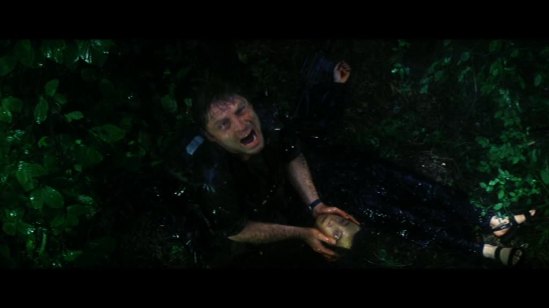
To make this technique work and to make it not become tiresome to the viewer, Blatty had to write some amazing dialogue and with him being a novelist and all, the dialogue was absolutely, 100 percent brilliant. Lets not also neglect to mention that with unrivaled dialogue, out of this world thespians must be accompanied to breathe life into the black printed words that are simply laying upon white pages. Scott Wilson’s and Jason Miller’s craziness is unparalleled while, on the other side of the spectrum, Stacy Keach delivers a melancholic performance that balances out the tone of the film from what could have been considered an anti-Vietnam war comedy at first glance that spun quickly with an unforeseen morph into a suspenseful thriller about the consequences of war PTSD and the affect it has on those surrounding.

Gerry Fisher’s cinematography encompasses the Gothicism of the remote Germanic castle to where every ghastly statue and crypt-like stone comes alive like in a horror movie. The setting couldn’t be any of an antonym for a loony-bin set. Even though the film is suppose to be set in North West America, the location used was actually in Wierschem, Rhineland-Palatinate, Germany at the medieval Castle Eltz and the story subtly explains how the castle came to be in “America.” To the opposition of such a barbarically beautiful castle, the score by Barry De Vorzon (The Warriors) in the first act into the second is playful, lighthearted, and childish in an appropriate story tone, but turns quickly sinister and angry during progression, building upon the revealing climax.
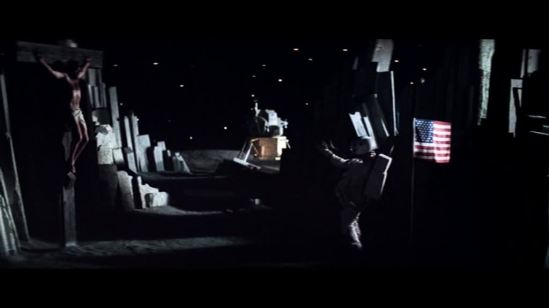
Classic film and TV distributor Second Sight brings this cult classic onto DVD and Blu-ray in the UK. Since this was a screener copy of the DVD, I’m unable to provide any audio or video technical comments, but the screener did include the generous amount of bonus material including interviews with writer-director William Peter Blatty, and individual interviews with Stacy Keach, Tom Atkins and Stephen Powers, composer Barry De Vorzon, production designer William Malley and art director J. Dennis Washington. There are also deleted scenes and outtakes and a Mark Kermode introduction. A substantial release for Second Sight and a fine film for any collection so make sure you pick up or order this Second Sight release today!
Category Archives: Evil Reviews
It’s Not Eezzee Being Evil! “The Hoarder” review!

Ella suspects her handsome fiance is having an affair and strongly insists on breaking into his outer city storage unit to find proof. Ella’s felonious friend Molly tags along to aid in the break-in, but deep down in the basement level of EEZZEE storage, Ella and Molly release a terrifying secret that’s now running loose and causing a murderous campaign in the maze-like structure of the storage facility. Along with a handful of other unfortunate storage unit renters, Ella finds herself trapped in the facility’s after hours lockdown and in the bloody nightmare path of the Hoarder, who won’t stop seeking to stock his very own unique “collection” back in the belly of the dark basement.

Writer-director Matt Winn’s sophomore feature film “The Hoarder” stars Mischa Barton of “The O.C.” fame and Barton portrays the seemingly suspicious and risk-taker Ella. Barton has been through a string of B-horror and other B-movie films that’s far from more of her previous popular works, yet seeing her name headline a film simply entitled “The Hoarder” feels unexplainably awkward. If you’re not familiar with Mischa Barton, Amy Smart (“Mirrors,” “The Butterfly Effect”) is another one of those relatively known actresses that hang onto the B-horror and Hollywood horror fringe line and not securely rooting a place amongst the two very different planes. But Barton is surrounded by a formidable B-movie cast or an ensemble of television actors to where they’ve received their popularity and recognition. “Prison Break’s” Robert Knepper, “The Tudors” Charlotte Salt, and “The Fall’s” Valene Kane co-star alongside Barton. However, Andrew Buckley, as the EEZZEE storage unit manager, is the most entertaining and interesting character with his non-threatening physique, his deadpan comedy, and sheer intensity when provoked. Even though they’re storage units of talent, collectively the actors don’t play well off each other and don’t share the situation as a whole. Rather, each character tries to go into their own personal demons and not into the evil their neck deep at the current moment.

The Matt Winn script, co-written by Chris Denne and James Handel, and direction are well-paced for timing, are attentively consuming from the beginning to end, and are structured soundly to withstand a pretty good and unexpected finale twist. However, the script doesn’t come without its flaws, developing plot holes through the duration that are not explained well enough to extinguish post-viewing questions. Also, a few of the minor characters needed their story to be explored more to give them more worth. I wanted to care more about the character Willow and her drug addiction and the character Vince and his undisclosed corrupt cop business, but couldn’t quite grasp their backstories and their motivations, leaving Willow and Vince as inessential dust particulars instead of full-bodied hair ball critters that one can’t help by notice. The finale successfully satisfies the B-Horror mold that puts that welcoming final stake into “The Hoarder” of ever being a thought of a Hollywood production. And that’s a solid quality to obtain.

I did expect more of a gory display from special effects supervisor Scott McIntyre. While whatever effects made the film’s final cut were well executed, such as mouths being sewn or stapled shut, much of McIntyre’s talent wasn’t exhibited or perhaps even used. With big time feature credits such as “Enemy at the Gates,” “Mindhunters,” and a more under the radar credit in the more recent “Cockneys Vs Zombies,” “The Hoarder” could have been far more gruesome and unpleasant in a tasteful expo. Aside from the squandering of McIntyre’s talents, the Eben Bolter’s dull cinematography on a well made storage unit set and the Andrew Pearce and Xavier Russell repetitive and cheap soundtrack score blandly conveys menacing “The Hoarder” rightfully deserves.

RLJ Entertainment adds to their collection with the not rated DVD release of “The Hoarder.” Beneath the embossed DVD sleeve and casing, the DVD video quality is comprised of a sleek 2.40:1 widescreen presentation with a Dolby Digital 5.1 track. No flaws detected in either audio or video during the 86 minute runtime. Dialogue, soundtrack, and ambient tracks were appropriately balanced and clear and the video quality is sharp with natural skin tones and prevalent ominous yellow and blue hues. The only bonus feature is “The Making of The Hoarder” which consists of the cast and crew reliving their experience on set and how the feature became to be developed. Overall, “The Hoarder” concept has a strong story attraction, but the resulting film can’t seem to fully shake the teeter-totting performances and the sizable plot holes that water down the finer portions of the film.
How About Some New Zealand Evil! “I Survived A Zombie Holocaust” review

Aspiring screenplay writer Wesley Pennington obtains the position of a runner for a low-budget zombie film. Being at the bottom rung, Wesley is commanded to do everything without hesitation or question no matter how big or small the task. With the production already plagued with a slew of problems, the film’s cast and crew come under attack from real life zombies that swarm the forest location. Wesley, along with a handful of lucky survivors, rely on their zombie film knowledge to flee from the flesh feasting fiends, living in their very own zombie apocalypse movie.

Rare is it to come across New Zealand horror now-a-days and when the opportunity presents itself, one must jump at a viewing with great enthusiasm. New Zealand horror has been known to be eccentric and fun, while also being gory and smartly scripted. From the early prevalent work of Peter Jackson (“Brain Dead,” “Bad Taste”) to lesser known cult favorites (“The Locals,” “Black Sheep”), the tiny New Zealand horror catalogue has made an everlasting mark in a heavily saturated American and European market. Guy Pigden’s written and directed 2014 horror-comedy “I Survived a Zombie Holocaust” takes it’s place rightfully so next to niche brethren, elucidating that horror and comedy in an extremely over saturated genre can and will still be an effective and entertaining movie.

Simply taking the premise of a horror movie being overwritten by another horror movie and using it’s tropes to poke at itself, while also jabbing at the film industry’s detached reality that ultimately devours itself, conquers being just another run-of-the-mill zombie comedy. Pidgen sharply appoints an ensemble cast to go along with the wanton story, working side by side again with Harley Neville in the socially awkward Wesley Pennington role. The rest of the main characters are purposefully stereotypical, fine tuned by Jocelyn Christian, Ben Baker, Reanin Johannink, Mike Edward, Andrew Laing, and Simon Ward. The character comedy mimics Peter Jackson’s “Brain Dead” with developing persona’s through various types of characters such as Wesley’s nerdy-awkwardness, Reanin as the prissy spoiled actress in Jessica, Mike Edward as an egotistical and closeted gay body builder actor in Adam, and the overbearing, frustrated, and desperate SMP played insanely intense by Andrew Laing.

The gore is very similar to Jackson’s early nineties splatterfest film. Lead special effects supervisor Timothy Munro had worked under the modern era thumb of Peter Jackson, including box office blockbusters films like 2005’s “King Kong” and 2012’s “The Hobbit: An Unexpected Journey.” Did this influence the effects team to explore the gore written in the screenplay pages in “I Survived a Zombie Holocaust?” I would say so. We’re talking about splitting heads in half, viscera spilling out from the waist side, limb detachments, and more sanguinary bits and pieces. The gore is sound and not as exploitive, as maybe “Brain Dead” comes across, smoothing out and around a well-balanced zombie comedy.

“I Survived a Zombie Holocaust” has faint issues of pacing that slow down between scenes, toning down a smidgen of my praise for Pidgen’s film. But the 38 Production’s freshman film goes above and beyond of being just another likable zombie comedy. The jest upon the horror community is well played and well received while also being a gory homage to an established horror community in New Zealand. “I Survived A Zombie Holocaust” has been released in the UK courtesy of distributor Matchbox films. However, I can’t comment technically on the audio and video quality due to the screener being a streaming link and nor can I comment on the extras as there are none. What I can comment on is that “I Survived a Zombie Holocaust” makes a killer first impression in the new era of Kiwi horror and will be at the top of the list for one of my favorite at home feature releases of the year!
Evil Roars as a Monster Tsunami! “The Wave” review!

Local geologist Kristian, of the small lake side town of Geiranger, and his family pack for their start of a new life in the big city where Kristian has offered a new job. But when seemingly insignificant activity in the Åkerneset mountain that surrounds the nestled Geiranger displays on first alert’s monitors, Kristian fears that his beloved town will be washed away by the possibility of an 80ft tsunami created by a mountain landslide. Unable to leave town, Kristian stays one more night; a night in which a landslide occurs, creating a massive Tsunami heading straight for the heart of Geiranger and Kristian only has 10 minutes before impact to alert the town and escape with his family.

Norwegian’s 2015 natural disaster-thriller “The Wave” aka “Bølgen” is a landslide victory for director Roar Uthaug. “The Wave” funnels disaster into a single locality where as Hollywood tends to doll up and glossy disasters films, Roland Emmerich’s “2012,” Steve Quate’s “Into the Storm,” Brad Petyon’s 2015 “San Andreas” starring Dwayne Johnson just to name a few, that hyper peril the catastrophes into a global event. The focus becomes too spread out and the parlous state is diluted amongst the characters if the catastrophe is affecting everyone in the world. To pinpoint an area or a region isolates the drama and the thrills resulting in more of an impact upon the characters. On a global scale, characters can escape with ease because the space is vast and non-constricting, but in Geiranger (which is also a real place with the same very real threat), a fortress of mountains loom over the town, higher elevation is safe haven, and the possibility of escape is not so easily achievable.
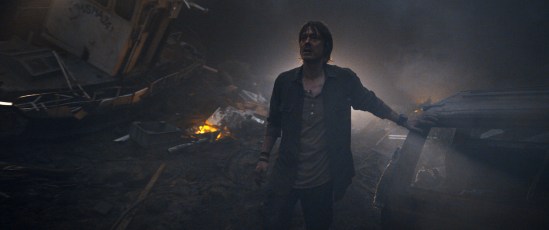
Academy Award winning The Revenant star Kristoffer Joner plays the heroic lead in Kristian who fights and claws his way through disaster and destruction. Joner isn’t bulky like Dwayne Johnson, but has a more down to earth appeal that’s more appreciated than Hollywood’s grander is better ideal. But like the “San Andreas” conquerer, Kristian is a family man trying to save his wife and two children. Joner’s Kristian reminisces a much older disaster film involving a small town with a Mount St. Helens explosion. “The Wave” story has Kristian with inklings of forthcoming disaster and his fears are put aside in the interest of tourism. The 1997 Roger Donaldson film “Dante’s Peak” compares very similar with Pierce Bronson’s Harry Dolton has the same concerns, but the town leadership ignores the facts and only has dollar signs on the mind. When disaster strikes, both Kristian and Harry stay behind to save whomever they can.

The cast rounds out with a enormously talented cast in “Dead Snow’s” Ane Dahl Torp, Jonas Hoff Oftebro, and Fridtjov Såheim. Their working dynamics are accomplished by their individual challenges due in part of the threatening tsunami wave and the second half of obstacles that comes post-event to where Kristian and his wife Idun must now stay alive to find each other through a girth of destruction from high elevation to sea level. The script is penned by John Kåre Raake and Harald Rosenløw-Eeg and I praise their storytelling in creating worthy characters and developing the plausible cataclysm on paper.

The special effects rival the big boisterous effects of Hollywood. The menacing tsunami means business on screen was created under the supervision of Pål Morten Hverven and splayed on the natural blue hue heavy and tone setting cinematography of John Christian Rosenlund. Usually, giant waves in Hollywood just can’t cut that CGI feel. Uthaug’s wave crests with such realism it’s frightening and to experience our characters at the moment of impact makes you never want to go in the water again – forget about giant man-eating sharks, its giant killer waves you have to worry about. Uthaug puts the viewer right in the path of an immense wave, capturing all the fear and intensity and the breathtaking aspects of simulating a dire situation.
Magnolia Entertainment releases the Norwegian disaster flick in Theaters and On Demand. Magnolia courtesy sent me a screener link so I am unable to comment on the video and audio quality. Also, there were no extras included in the screener as it’s solely a feature. “The Wave” washes over Hollywood’s big budgeted calamity films that’s been released over the past decade and will have you holding your breath from start to finish and long after the wave has subsided.
No Escape from Evil’s Spell. “Rows” review!

After serving an eviction notice to a strange old woman, with a grisly rumor in her past, for her realtor mogul father, Rose becomes drugged and bound against her will by the old woman who injects Rose with something. When Rose awakes, she finds her self caught in a repetitive cycle of murder, betrayal, and mystery brought upon by a spell conjured upon Rose by the old enchantress woman. The key to breaking the spell is the enchantress’s family home and it’s up to Rose to whether destroying the home or not will save her father who also falls victim to the old woman’s bewitching power.

“Rows” is the fantasy-horror brainchild of writer-director David Warfield and stars “Feast” actress Hannah Schick along side “House with 100 Eyes’s” Lauren Lakis, Kenneth Hughes, Joe Basile, and Nancy Murray as the enchantress or the witch, which I like to title the character. The overall small casts’ performance achieves the toned-down, nearly expressionless portrayal of characters stuck in the confines of a hex; the “something-doesn’t-feel-right” notion is hyped up without the idea constantly up in your face and is more downplayed to let the viewer interpret Rose’s beyond twisted “Alice in Wonderland” experience. Instead of a world full of giant smoking caterpillars and tea drinking mad hatters, Warfield writes about the relatively unknown horrors of corn fields, an endless maze with rows and rows of high stalks that traps Rose and Greta.

But the corn rows go to the back burner when the nature of the house comes to the forefront. The house’s claim to be the smoking gun to all of Rose’s obstacles is undervalued by the poor written construction of the southern belle style home in the script. The house doesn’t loom, isn’t very menacing, and just can’t seem to ever get on it’s feet to become a character wroth being frightened over. Warfield should have stuck with the corn rows which creates a surface murkiness, goes beyond our heroine’s ability to see or hear, shreds any hope for escape, and looks more ominous during the night; the house was always kept in the daytime. However, the old witch’s power stems from the house and for whatever reason, aside from the extended family history under their thumb, there is this unsatisfied, unknown conclusion for the viewer and the finale is up for personal interpretation.

In making the ending open, Warfield’s “Rows” eases onto the border of experimental. Act one and two weren’t exactly straight forward either, but the understanding was clear and present enough. Once the transition, or the epiphany if you will, into the third act begins, a struggle to grasp Rose’s direction and, in the end, destination becomes more difficult. I can only go on my own interpretation of Rose’s journey and, much like that of the fantasy-ridden “Labyrinth” starring David Bowie, I felt like actress Hannah Schick was the Jennifer Connelly character in the sense that Rose has to grow up, leave the comforts of home, and be responsible and this whole event with the enchantress and the spell is an internal mental battle that ultimately is decided by a choice. In Hannah’s case, her inner, warped conflict is to fight her father’s will or embrace it.

Indie Rights Films and MVDVisual distributes the StorySolver Film Lab production to DVD in a stunning 2.35:1 anamorphic widescreen presentation. Details look fantastic from the farm landscapes to the skin tones with no sign of touch up enhancements such as cropping, sharpening, or smoothing. The English Dolby Digital 5.1 audio track clearly balanced and diversifies all sub-tracks, especially the ambient sounds of the rural atmosphere to set an looming setting. There are no subtitle or settings options, nor do extras exist. Only “play” or “chapters” line the menu title. “Rows” has a sizable underlining gloom about it, setting a rightfully impassive mood through the spell world Rose is thrusted into combating.
 It's Bloggin Evil!