Don’t be Afraid of an Unstoppable EVIL Killer on Your Fishing Trip. Do be Afraid of the Very Pregnant Wife You Left to Go on that Fishing Trip! “Sweetie, You Won’t Believe It” reviewed! (101 Films / Blu-ray)

Now On Bluray from 101 Films – “Sweetie, You Won’t Believe It!”

Dastan is about to be a new father, but he is over his head with debt and can no longer withstand the verbal abuse of his headstrong, ready-to-pop wife, Zhanna.  When an opportunity opens up go fishing with his best friends Murat and Arman, he whisks away before she can sink her nagging teeth into him again and tries to enjoy the relaxation of catching fish by floating down the river.  That’s until he and his friends stumble upon an execution by a crime boss and his goons.  Frantically trying to escape, they run into a strange man with a burnt face living out in the wilderness.  The three friends and the gangsters are targeted by the maniacal, murderous stranger with an apparent unkillable survival instinct and supernatural abilities. 

Who would have thought one of the best action-comedy horrors would have come out of Kazakhstan and come to think of it, this 2021 Yernar Nurgaliyev film “Sweetie, You Won’t Believe It” is probably the only Kazakhstan film come across this desk.  Natively titled “Zhanym, ty ne poverish,” Nurgaliyev’s genre blending zany is bursting with dark comedy, gore, and a framework that tests the sturdiness of friendships as well as the clear-cut recognition for the things you have in life because the world isn’t always greener on the other side.  In fact, the world is actually dusty and partway arid in an isolated Kazakhstan landscape that resides with antisocial individuals – mob transgressions, deranged psychopaths, and even those who just want to get away from their wives.  The regular comedy helming Nurgaliyev cowrites the script with first time screenwriters Zhandos Aibassov and Daniyar Soltanbayev under Art Dealers productions in association with the international action company, Nomad Stunts, that delivers the film’s amazing fight choreography.

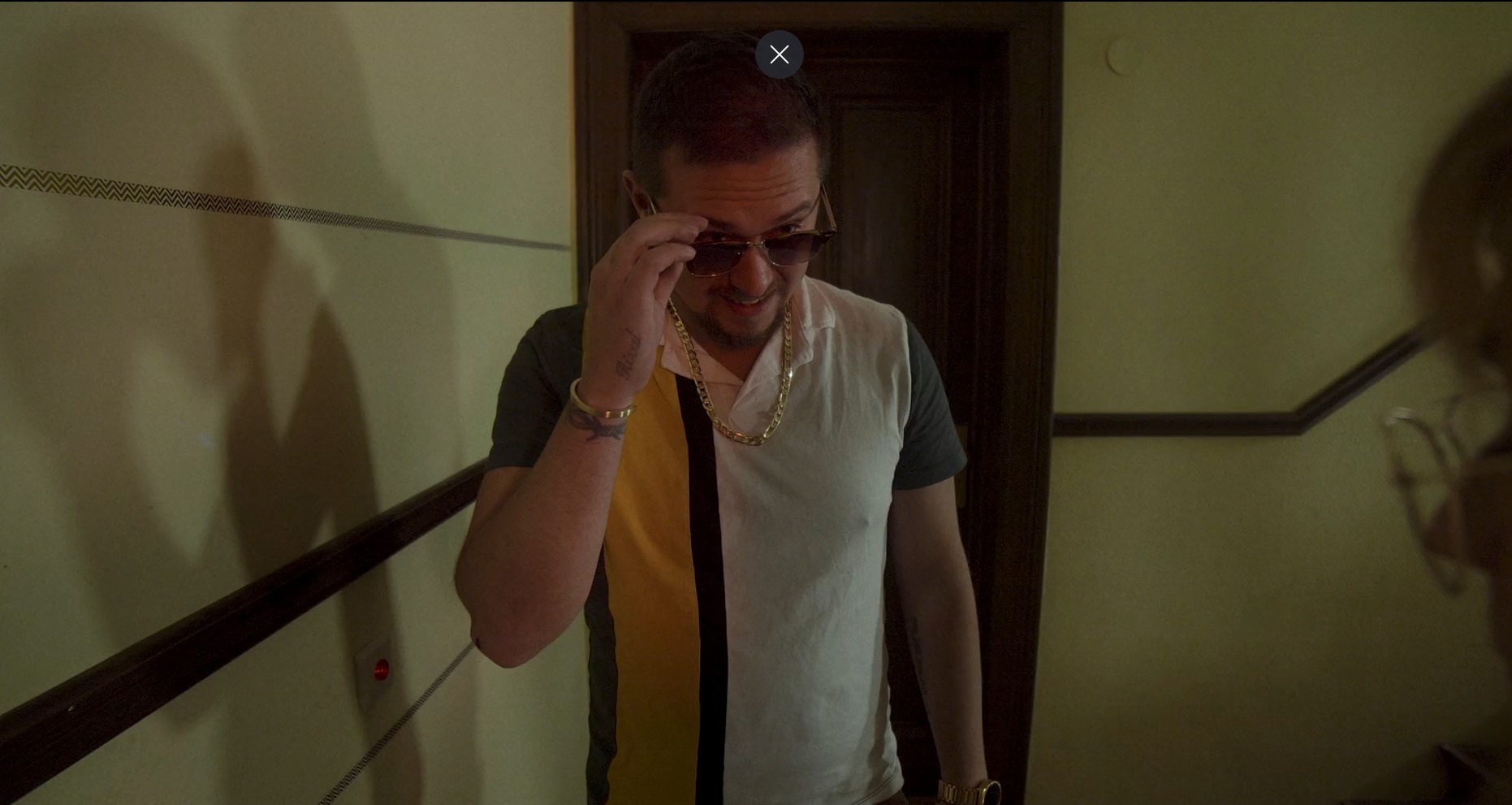
An ensemble cast of character actors construct a living, breathing dark comedy worth the time and effort. Plenty of unsuspecting twists and turns keep the preposterous party going beginning with an opening of a very black and white passive aggressive quarrel involving principal character Daston (Daniar Alshinov, “A Dark, Dark Man”) who, from this male reviewer’s perspective, takes a relentless verbal whip in emasculation. Alshinov expresses so clearly the biting-tongue frustration in a hilarious montage of on rage’s edge with wife Zhanna (Asel Kaliyeva) dishing out the third degree on all his husbandry failures. Avoiding his wife’s warpath behavior, aggravated by being on the verge of giving birth at any time, Daston’s quickly sneaks in his desires and hightails it on a last getaway before he becomes a father or dies of incessant verbal abuse, whichever comes first. Community school officer Murat (Yerlan Primbetov) and sex-toy dealer Arman (Azamat Marklenov) finally are able to steal away Daston in a little time for themselves. The acting trio leading up to the fishing spot are naturally conversive that gives into their characters longstanding friendship with quippy jabs at each other and overselling their less-than-satisfactory positions in life, but not until the friends stumble haplessly while floating down the river into being witnesses of a murder by low-end horse gangsters and run into a stoic one-eyed, burnt face bald man intent on spilling blood for vengeance because the gang killed his dog does Daston and his friends need to go to Hell and back to realize how special their friendship means to each other. “Sweetie, You Won’t Believe It” is a bro movie (and I mean the characters say bro a lot) with an orchestrated series of unfortunate, yet very funny, gruesome events to resolidify a tattered friendship and to reexamine life. The film costars Almat Sakatov, Rustem Zhanyamanov, Yerkebulan Daiyrov, Bekaris Akhetov, Kadirgali Kobentay, and Gauhar Sagingalieva.

Nurgaliyev develops a physical comedy based around a plan gone awry collision course between four groups destined to intertwine in battle royal.  “Sweetie, You Won’t Believe It” lands the slapstick one, two, three combination of action, comedy, and notes of horror well outside infantility and outdated material in a smartly laid path of events unfolding to a brawling showdown of those left standing.  I believe the imbalance between physicality and the humorless, if not slightly bothersome, subtitled dialogue stems from the lost in translation.  Subtitles can only convey a literal account of the Kazakhstani reflection and regionalism mayhem often blown to unrecognizable smithereens during a crude translation, but being a foreign film with grossly simplified subtitles shouldn’t be a cause for total write off as there’s much to enjoy from the funneling, concentrated, ever-twisting storyline to the outrageous action stuffed tightly in cramped houses to the perfectly spectacular blend of practical and CGI violence and gore fabricated nearly seamlessly by special effects duo Juliya Levitskaya and Elde Shibanov. Heads role, jaws detached, and plenty of eviscerating shotgun blasts crest above as the cherry on top of the Dastan and his friends’ misadventure through Kazakhstan countryside in a story that’s as ruthless as “Deliverance” and as magnetically dark and eccentric as “Kiss Kiss Bang Bang.”

101 Films brings what is called an “insane, violent, and hilarious” fun from Kazakhstan (and we couldn’t agree more) to a UK Blu-ray home video. The region B, high definition, 1080p Blu-ray features a widescreen 16:9 aspect ratio of the short 74-minute film, certified UK 15 for strong gory injury detail, violence, threat, and language. Image quality is quite good of rendering mostly the grassy desert-like Kazakhstan landscape and the framing prompts greatly what to expect through either Azamat Dulatov’s harness cam strapped to the actors for closeup reactions or perfectly timed pan when needed to express off-center comedy. What’s really sensational about the film is the localized soundtrack. Nurgaliyev doesn’t buy, beg, borrow, or steal popular westernized tracks to broaden his film’s release and, instead, the soundtrack has a plethoric range of native music from lounge pop to hip hop. The Kazakhstani PCM stereo has more than enough ample timbre and offers a suitable range and depth despite being a dual channel. There are no dub tracks (in case you were wondering) and the English subtitles are forced (for those of few who don’t like to read during the film). Though bonus features would have been nice to root into and explore more of the behind-the-scenes aspect of the country’s film industry, the only bonus material on this 101 Films’ release is the theatrical trailer. As far as fiasco films go, “Sweetie, You Won’t Believe It” ranks high this side of the 21st century as a humorous, violent, and perspective redirecting genre-bending film that needs be in everyone with a black sense of taste’s library.

Now On Bluray from 101 Films – “Sweetie, You Won’t Believe It!”

When That Sexy Roommate Turns Out to be an EVIL Hexing Hag! “Don’t Let her In” reviewed! (Full Moon / Blu-ray)

“Don’t Let Her In” on Blu-ray from Full Moon Features and Distributed by MVD Visual

Young artist couple Amber and Ben live downtown in a spacious single floor loft.  To afford rent and earn a little extra cash on the side, they decide to sublet a portion to Serena, a beautiful, and recently single, new age jewelry bowl artist who crafts old age product.  Some would say Serena’s craft is witchcraft as the alluring artist is actually being inhabited by an ancient, malevolent demon.  As she settles into her new abode, Serena slowly works her way between Amber and Ben, seducing and bedding both for her reasons to prolong a legacy on Earth.  When Ben is suddenly whisked away for an unexpected rock tour, Amber finds herself cornered by the demon in human skin and, to her on the pill surprise, pregnant because of Serena’s daily bewitching manipulation and incessant satanic chanting.

As a part of the new Full Moon lineup of 2022, principal Full Moon filmmaker Ted Nicolaou, the mastermind behind “TerrorVision” and the longstanding director of the “Subspecies” franchise, returns with another vision of terror, a beautifully demonic roommate from Hell, in “Don’t Let her In.”  Shot entirely on location at the historic Nate Starkman and Sons Building in Los Angeles, home to an array of productions from inside Paddy’s Bar of “Always Sunny in Philadelphia” to appearing in a handful of iconic horror series, such as “Candyman:  Day of the Dead” and “Wishmaster 2:  Evil Never Dies,” the 1908 erected factory is said itself to be haunted, adding to the miscreant charm of a shapeshifting fiend plaguing the innocence of a young couple.  Charles Band, like all of his productions, serves as chief producer and executive producer with the cannabis friendly Nakai Nelson, this side of the century Full Moon Feature producer with credits such as the “Evil Bong,” “Weedjies,” and a pair of more recent “Puppet Master” films to her name. 

“Don’t Let Her In” has an intimate cast comprised of four actors who have to pull in different, varying levels of character dynamics and frames of mind depending on how Serena’s orchestrating of the strings upon her marionette subjects favor in or from her dastardly ambition.  At the center is first time Full Moon actress Lorin Doctor as the pleasantly chic but unpleasantly succubus-like Serena who wants more than just a place to sojourn from an ex-boyfriend.  Serena is the kind of role where you have to applaud Doctor for not only pulling off grimacing in the shadows and being able to keep up the rhythms and beats of complex chanting but also be comfortable in the facial prosthetic makeup and make like a troll for a creepy crouch walk in a backwards reel speedup effect.  Kelly Curran and Cole Pendery are also newcomers to Full Moon’s world of strange and unusual T&A horror as the loft-residing couple Amber and Ben.  Curran and Pendery make up for an okay, downtown twosome with hints toward a checkered past of philandering that’s irritated by Serena’s provocative presence, but that’s doesn’t quite blossom into more of an issue as Amber is quickly eager to just go with the flow without being too bothered by the prospect that Serena and Amber did the bedsheet whoopee next to Amber as she slept.  The four and last character Elias Lambe is by far the most lacking in development and substance as an important piece of Serena’s puzzle that quickly becomes shoved under the rug.  Austin James Parker plays the part that’s mostly standing outside the building on the street corner looking gothically mirthless rather than ominous and before realizing how Lambe fits into the narrative, the long haired, trench coat-cladded, vampire-esque backstory is quickly snatched away with not a morsel left of his bigger part as suggested.

“Don’t Let Her In” is a refreshing addition to the Full Moon feature line that maintains a lot of hallmarks of the company, such as heavy use of body prosthetics, an expensive veneer on an indie budget, and, of course, nudity.  Though many other audiences draw comparisons to “Rosemary’s Baby,” Nicolaou relates only a smidgen in the story alone without the Roman Polanski pin drop suspense of subjective narration.  Instead, Nicolaou embodies Full Moon’s quirky and special effects greased terror fried to a familiar taste all fans have known from the past 40 years and that’s not terribly a bad thing.  “Don’t Let Her In” feels like an original piece of storytelling, much like “Castle Freak” or  “The Dead Hate the Living,” that detaches itself from Charles Band’s obsession with miniature maniacs, but Full Moon has no shame in telling us we’re still watching one of their films, gratuitously plopping easter eggs of their films all throughout “Don’t Let Her In” (i.e. Poster artist Amber’s current project, a rendering of “Corona Zombies,” and “Castle Freak” playing on the television set as Amber and Serena spend an evening as a pair of winos).  Serena’s demoness rat-faced makeup does appear stiff and inane at times, but the way Nicolaou mostly presents Serena in true form is through a blend of quick-sufficient editing, a manipulation of lens and pace, and the to-and-fro from the human façade that ultimately makes rodent Serena become scary Serena when accompanied by Charles Band’s strike of forte notes when not being melodiously carnivalesque.

Lesson here, kids, is to always background check you potential roommates because they might end up being a demon. Happens all the time. Fortunately, Full Moon Features delivers the entertainingly sapid “Don’t Let Her In” onto Blu-ray home video, presented in region free and a widescreen 1.78:1 aspect ratio. Full high-definition and 1080p resolution, this release has a strong, robust presentation in favor of Nicolaou’s often in your face with evil style despite the single loft location. The fact that this Full Moon feature is toned down from the usual moody, tenebrous gothic style shows a bit of range can be good for the collection. There are two available audio options: a 5.1 surround sound and a dual channel 2.0 stereo. If you want more fluff to your sound design, the 5.1 offers extra street ambiance while characters converse, sawing through the dialogue with car horns, traffic, and other urban outdoor racket as if they’re living right in the middle of Times Square. Yet, all outdoor scenes show little car or foot traffic that makes this fluff foolish. The dialogue is otherwise clean and Charles Band’s soundtrack interposes pizzazz and dread in this brawny audio output. Bonus features include a “Don’t Let Her In” behind-the scenes with snippet interviews from director Ted Nicolaou, actresses Lorin Doctor and Kelly Curran, and producer Nakai Nelson and rounding out with an array of Full Moon trailers. “Don’t Let Her In” has vim and vigor for an indie guise horror that’s erotic as it is fun surrounding a small cast and single location; yet there is also an evoking pathos in its decimation of young, naive artists and couples with career ending consequences.

“Don’t Let Her In” on Blu-ray from Full Moon Features and Distributed by MVD Visual

Hear That? That’s EVIL Bamboolzing You! “Ultrasound” reviewed! (Magnet Releasing / Digital Screener)


Driving home from a wedding reception, Glenn’s car suffers a flat tire in the pouring rain.  He finds refuge in the home of married couple, Art and Cyndi, with an extended offer to him to wait out the rain and spend the night, spending the night in bed with Cyndi at the pleading request of Art.    The next morning, Glenn wakes up and Art and Cyndi are gone.  Months later, Art shows up at Glenn’s apartment and shows him a videotape of a pregnant Cyndi.  Unable to make sense how of his role within Art and Cyndi’s lives, Glenn agrees to meet with Cyndi to discuss future plans and wind up a romantic relationship, but when they suddenly wake up in a hospital and kept separated, they believe they lost the baby as well as the use of Glenn’s legs due to an assumed accident.  What unfolds for the couple from then on is bizarre reality that doesn’t make much sense with only a few familiar chords being struck in their mind and every step of their life is being controlled by manipulators with various agendas. 

A gyrating wool over the eyes suspense thriller is set to release this Friday, March 11th. That film is “Ultrasound,” the first feature film helmed by Rob Schroeder, the producer of “Sun Choke” and “Beyond the Gates,” both films starring Barbara Crampton.  Unfortunately, “Ultrasound” doesn’t star the iconic scream queen but the Conor Stechschulte script, based off the Stechschute’s erotic psychological graphic novel series, “Generous Bosom,” produces the high intense frequencies from off the illustrated pages and into the subjected characters and audiences with disorienting loops of truths and falsities.  The U.S. production is a product of the Los Angeles based Lodger Films, cofounded by Schroeder and Georg Kallert, and with co-producers Brock Bodell and Spencer Jazewski.

“Ultrasound’s” narrative is a latticework of character arcs divided into two stories that only merge when Glenn and Cyndi are involved in an unusual (some could say almost magical) scheme connived by hypnotist The Amazing Art, played with sure hand nervousness by Bob Stephenson (“Lady Bird”) whose very good at the soft touch of persuasion with his innocent demeanor.  Stephenson works tirelessly his Jedi mind tricks on Glenn, “My Friend Dahmer’s” Vincent Kartheiser, and Cyndi, “Phoenix Forgotten’s” Chelsea Lopez. Kartheiser and Lopez relish in their own deceptions as two strangers being joined by unintended, radical means to fulfill not one but two devious plans. Between political scandal coverups and government sanctioned alternative military tactics, Chris Gartin (“Tremors II: Aftershocks”) and Tunde Adebimpe (“She Dies Tomorrow”) couldn’t be any more different in character engrained into their repelling tangential tales sourced from the same spoiled spring but both actors root deep into the same antithesis garden as a pair of well-informed and completely in control power hungry and idealistic men in idol roles, driving Schroeder’s message right into the heart of public figure facade versus public figure character and both Gartin and Adebimpe nurture that perspective all too well. Then, you throw in a monkey wrench named Breeda Wool (“Mr. Mercedes“) into the well-oiled machine of exploitation to be the controlled outlier only to have the veil lifted for truth. Wool, probably not intendedly punned toward “Ultrasound’s” theme of pulling the wool over one’s eyes or a wolf in sheep’s clothing, casts rightful doubt as Shannon, an innocent associate being kept in the dark, much like Cyndi and Glenn. While the cast is great in roles, none of them stand out in a singular performance and are all a cog in Schroeder’s contrivance. “Ultrasound’s” cast fills in with Megan Fox lookalike Rainey Qualley (“Shut In”), Porter Duong, and Mark Burnham who dons the fleshy mask of Leatherface in this year’s Netflix original and legacy sequel “Texas Chainsaw Massacre.”

Tapping from the same virtual reality vein of Christopher Nolan and David Cronenberg, the idiosyncrasies of perception are no longer our own as audio, visual, and thoughts become the duped fool in “Ultrasound’s” underhanded exploitation.  The concept, high in twist and turns working backwards to unfold what befuddles the hapless into a life believed depressingly real, parallelly touches upon the real-life issue of sleight of hand corruption and scandal.  Because this person is an upstanding politician with a beautiful family or this other person has an advanced medical degree and is respected in the science community, we are supposed to take them at their word when in actuality, they’re pulling the metaphorical rug from under our sensorial feet to the extreme point where everything they have said and done that has crumbled down to a lie has a flummoxing and deafening aftershock effect that almost can’t be believed.  The two-tale narrative connects with Art and his mismanaging of one plan that tosses his subjects into the hands of another group for what’s to become of Glenn and Cyndi and that transfer, much like the disintegrating hypnosis effect at times, is not tight enough and becomes lost in translation inside Schroeder’s illusive imagery and harsh editing to keep in story in line until a point.  “Ultrasound” plagues with hot, intense colors under a low-key lighting, like a deep blue or an intense red, to often relay reality outside the confines of normality.  Even though the word “Ultrasound” revolves around the manipulative use of ultrasonic frequencies, I do find the irony in Stechschulte’s story that at the center of much of the tumultuous misperception, there’s a baby often represented as there or not there depending on how we should perceive the characters and it’s like the filmmakers wanted to plug in, perhaps, the nuisances with scanning technology or dip their toes into body horror with body image.

“Ultrasound” is a great low-level, high-tech Sci-fi brainteaser ready to mess with your mind being released this Friday, March 11th, in theaters and on demand from Magnet Releasing, a subsidiary label of Magnolia Pictures that offers innovative tales of horror and science fiction from new, creative filmmaking talent.  Since a digital screener was provided, we will not delve into any audio or video evaluations, but Mathew Rudenberg, whose worked in the past with Schroeder as DP on “Sun Choke,” has come a long way since his image work on the 2008 alien-driven-zombie film “Evilution” with keeping the frame tight during medium and closeup shots to never expose to much at one time, leaving a little to imagination when the time comes to open up the room, so to speak.  Zak Engel’s analogue and digital synth-score with tangible instrumental highlights from Piano and violin and Bob Borito’s dial and knob sound design swishing static and low-frequency humming sends this soundtrack into a futuristic guise on contemporary grounds that insidiously works into the grand scheme low-tech yet terrifying Sci-Fi. The 103-minute film does not include any bonus scenes during or after the credits. I keep throwing around key descriptors like low-tech for “Ultrasound” and by no means do mean that as a criticism as I speak about the simplest of tech, the original mechanism, of our body and our sensory nodes that receives data input, processes it, and transmits signals to our outputting areas and “Ultrasound” looks at disrupting the supply of data and, just like in today’s pandemic and war climate, a break in the chain can cause unforeseen turmoil that upends lives when cranked up.

EVIL Rap-A-Tap-Taps on its Little Drum. “Caveat” reviewed! (Acorn International Media / Blu-ray)

You’ve Been Warned to Watch “Caveat” on Blu-ray from Acorn Media!

Recently discharged from the hospital after an experience with a nasty fall, Isaac suffers from severe memory loss.  In need of money, he reluctantly accepts a caretaker job from his landlord Barrett who hires him to oversee a traumatized and catatonic spell-ridden niece Olga living in a ramshackle island house.  When Isaac arrives for his five day, $200 per night stay, he’s convinced by Barret to wear a chained harness that limits his access to certain rooms of the house.  Before long, on the very first night, memories of his past begin to flood back when Olga tells him he’s been at this house before, cascading an overwhelming sense of danger over him when the thought of Olga and Barret scheming together at his expense.  As past contracts boil to the surface and the fight for survival extends into the next day, a long thought vanished player lies and waits for the perfect opportunity to resurrect. 

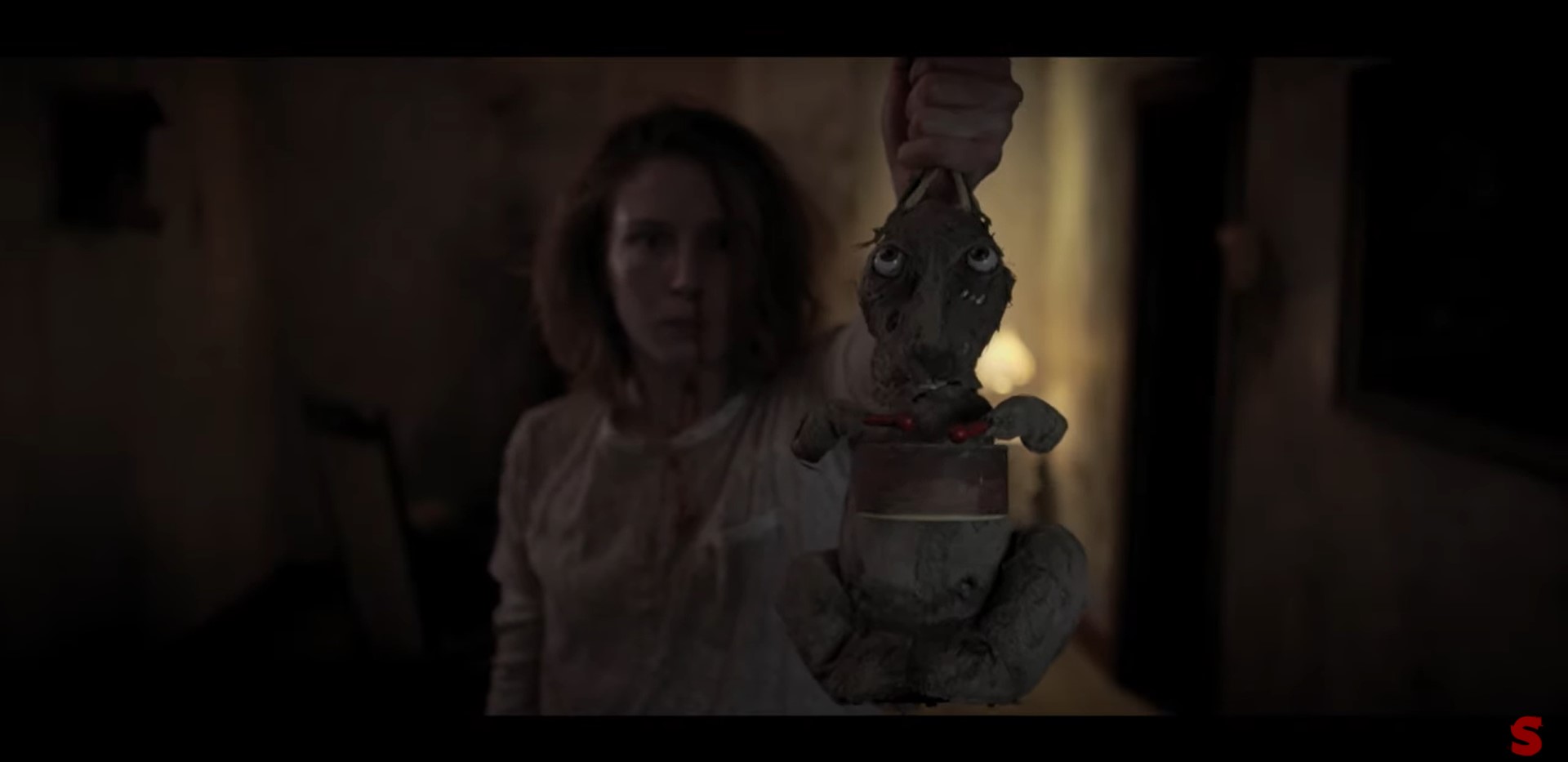
If offered to be the sole caretaker of an unstable teenager four five days the suicidal death of her father and the disappearance of her crazy mother, located on isolated island surrounded by a deep lake only traversable by rowboat, strapped inside a chest harness with a long chain stretching into the basement where its tethered, having brought no food or clothing, and the house is a complete rundown disaster filled with austere essentials and a filthy, menacing rabbit toy that rap-a-tats on a drum when the air is thick of a supernatural presence, would you take the job?  If the answer is yes, then Damian McCarthy’s “Caveat” is the right film for you and you also might want to see a psychotherapist, immediately.  McCarthy debut feature film directorial, as well as the writer is, a supernatural-psychological thriller of existential context about who we really are as a person.  The UK film is released as the first production by the independent filmmaking studio HyneSight Fims, produced by Justin Hyne, and credits executive producers in Tom Black and Mirella Reznic.

A person would have to be out of their right mind to agree to every single warning flag about this situational premise.  In fact, Isaac, a character recovering from head trauma that resulted in short term memory loss, would seem to be the ideal candidate.  Irish actor Jonathan French plays the scruffy-looking Isaac and with little backstory to go upon first meet, we’re stuck with French’s face splayed stuck lost and confused for most of the duration that’s a simultaneous ride for the audience who jump right into first talks of caretaking agreement without living, experience, and visualizing much of anything else before then but in the first instance meeting the man with a radical beard, Isaac is obviously not a long-shore fisherman and is also seems to be mindfully altogether and rational, if not very acute, about with what’s happening around him.   French doesn’t play a brain damaged invalid; instead, Isaac goes reluctantly with the flow as a rather poorly written gawk who thinks giving into another man’s intention of being strapped into a S&M vest is okay and left to rightfully care for a more true-to-form mental case on any level. The further the introduction is into Isaac’s odd assignment, the more we wonder why the hell isn’t he about facing and running across that barrier lake like Christ himself. That other man is Moe Barrett (Ben Caplan, “Band of Brothers“) who also strolls onto the scene in the beginnings of conversing with Isaac as if old pals and though Caplan is very good at Barrett’s normal and persuasive spiels without a hint of abhorrent creepiness behavior, Isaac’s so gullible to a fault that it kills that need for deliverance from protagonists to try their best to avoid an unfavorable situation when they see one. Leila Sykes fills out the main trio as Olga, the on-and-off catatonic teenage niece of Barrett. Again, something’s missing from the character development much in the same way as Isaac. Olga’s just living, if you can call it that, out of her absent parents’ house. Each one of these characters feels abstract, much like the narrative’s story and structure, to offer only incremental oddities one grain at a time to be not too invested in whatever else that might distract from “Caveat’s” mystery.

“Caveat,” by the way, is a warning and is the catch that makes Barrett’s deal of $200 per day for five days to watch over his nice seem too good to be true and, honestly, the rabbit hole Isaac doesn’t heed and scuttles down into as being the loose end saw tied up by a transgressor’s flimsy, kooky plan would have been enough to suffice. McCarthy adds another element to the already rough patch of this malicious thriller with an unnecessary, but highly effective, supernatural elements involving a menacing in appearance, drum-rapping, toy rabbit (or is it a hare?) that acts like a bizarro-Toys’R’Us PKE meter and a smiling dead body that has its grand jump moment near the end of the film. These devices are uncomfortably odd, undoubtedly scary, and sorely used too little despite the drumming rabbit’s home release front cover spread. There’s also this perfect circle motif present throughout the story – a front door port hole, a hole cut in dry wall that becomes an important barrier see-through, and Olga’s crazy mother draws white circles on black paper, plus other examples – which, to me, indicates the proverb what comes around, goes around with who commits evil, receives it in the end and visa-versa. McCarthy’s suspense building moments within the gloomy rundown house can leave one peak through the slithered opening between a pair of hands over the eyes. However, McCarthy leans more into the Isaac’s dire dilemma and keystone past which I think comes back to easily. The entire time he wanders the premises, nothing strikes him with familiarity, nothing invokes a recollection, and yet, as soon as it’s mentioned he’s been the house before – circa 1 year ago – a rush of linear memory comes crashing back into flashback frames and everything up to this point is explained during a Mexican standoff with Olga. “Caveat’s” second act dredges slowly along, disinterring up backstory to quickly wrap up Isaac into a neat little package.

Briming with darkness and wrenching with fear, “Caveat” is this strange and unusual angle of reading the signs more carefully, but also stirs in anamnesis to help reign in who we really are and to distance ourselves from the person we were previously. Acorn Media International and Shudder deliver “Caveat” onto a PAL encoded, region B Blu-ray home video in full high definition,1080p resolution, presented in a cinemascope anamorphic widescreen 2.35:1 aspect ratio. McCarthy and cinematographer Kieran Fitzgerald reel in the wider resolution for tighter shots, keeping the quality contained and detailed within the house’s decrepit interiors and the characters’ textural contrasting between skin and clothing. McCarthy opts out of gel use for night sequences, casting a real stark darkness over everything with only thin outline to express action. Audio is lively enough for the ow level action on “Caveat’s” English language DTS-HD Master Audio 5.1 sound mix.  “Caveat” relies heavily on the combination of dead silence and the building instrumentation that resonates reverberations in a soundtrack composed Richard G. Mitchell who knows a thing or two about elevating intensity through his diverse career.  Sound design plays into perfectly the silence as timed precise ambient noise, such as creaking wood under footsteps or the mechanical movements of the bunny, add to “Caveat’s” chilling charm.  The film is UK certified 15 for strong horror, violence injury detail, and domestic abuse with a runtime of 88 minutes.  The Blu-ray is accompanied with two audio commentaries in the special features – a director’s commentary and a producer’s commentary – as well as a split screen between the crude storyboards and the scenes they represent.  There are no bonus scenes during or after the credits.  Frankly, and I hate to say this, but the direction “Caveat” went was a bit of a letdown as the hope to extend upon Olga’s mother, a possible practitioner of black magic, but that’s not to say Damian McCarthy’s first feature crashed and burned in the utmost of failures.  “Caveat” is still very much a well-made, you’ve-been-warned, harrowing scare tale that raises every single small hair on the back of your neck.

You’ve Been Warned to Watch “Caveat” on Blu-ray from Acorn Media!

EVIL Spam E-Mail Wants to Play a Game! “Planet Zee” reviewed! (Darkside Releasing / Blu-ray)

Land onto “Planet Zee” now on Blu-ray! 

Struggling woman filmmaker Zee Bronson is trying to make what she loves a supportive career. Smoking pot, drinking beer, and living with her grandmother Sam mellows out Bronson’s anxiety of potentially landing a writer-director’s gig one day. When her sleazy producer, Serge, closes a deal with an investor interested in her script, Zee eyes widen with excitement, but her premature celebration quickly turns sour when Serge notes the financer wants someone else to direct her screenplay. A vexed Zee turns to a weird email spam virus that has seemingly appropriated her computer to propose a game of life with superpowers or death. Convincing Serge into joining her, the two unwittingly open a diabolical portal that traps them inside the apartment, subjecting them to battling a demon and persuading them to kill one another. As their relationship dissolves slowly throughout the night, lines a drawn between friend and foe in order to escape the grip of a computer-commanding Game of Power.

There is bottom-of-the-barrel independent schlock done with very half-hearted inspiration and then there’s bottom-of-the-barrel independent film done with A for effort around a difficult to sell single-locale story that includes witty dialogue and humble homemade effects. Some of these mighty, homegrown indies stem from one ultra-eccentric Berlin, Germany physics and prehistoric archeology studied-turned-artful filmmaker Zetkin Yikilmis in her second written and directed feature, “Planet Zee.” Her B-movie, or should I say Z-movie, is the epitome of independent filmmaking in knowing the production’s limits and how to make the most of a film with what little material is available to use, such as a deluging cash flow for big budget grandstanding that’ll get your name on marquees, posters, and regional commercials. Instead, “Planet Zee” is very much meta love and confidence concept toward Zetkin Yikilmis herself, as the title implies, being a woman in a typically projected masculine dominated industry. Yikilmis follows up her sophomore film from an array of micro shorts and her 2019 released debut feature, “Some Smoke and a Red Locker,” incorporating elements of the stoner horror-comedy into her 2021 film that’s self-produced by Yikilmis and her cinematographer husband, Dominic, as well as longtime collaborator S.B. Goldberg.

Zetkin Yikilmis, obviously, stars as Zee Bronson, a bohemian screenwriter attempting her hand at filmic success while having her grandmother live with her in a small apartment. Having surveyed Yikilmis’s micro shorts, her droll act as stoner-chic Zee Bronson imitates far from her other self-applied roles with a sluggish repartee and often tinkering with slapstick with fellow costar Alexander Tsypilev as squalid producer Serge. Yikilmis and Tsypilev’s reconnection after “Some Smoke and a Red Locker” gives way to a natural onscreen dynamic that has experience role reversal, gender role reversal, and to test their association connection. With a tight-fitting shirt that flirts with exposing his slightly protruding belly, Serge fits swimmingly into the cesspool of sexist producers with Tyspilev crafting Serge’s slimy mold with little pinches of details toward the producers first-rate me-first attitude. While Bronson and Serge are the two chief residents of “Planet Zee,” there is often a forgotten third wheel who bookends the narrative. Sam, Zee’s elderly only in looks grandmother played by Trish Osmond who had a small role in Zack Snyder’s “Army of Thieves.” The 1944 born English actress bloomed late in her career that begin in 2014, but that doesn’t stop Osmond from being a dominating player of goodwill toward bizarre films and roles, especially playing ones involving an usually vigorous old woman with underlying uncanniness probably important to the story. Minor characters fill in the rest with small brushes with minor scenes from Roland Bialke and Michael Tietz.

Through the veneer of bare budget and puerile comedy, “Planet Zee” puts together a couple of ugly statements well versed like a stain amongst the film industry but only brought up more recently during the #MeToo movement and seen as ingrained into industry as par for the course. Yikilmis mentions in the dialogue that as a woman filmmaker she fears oppressive struggles in forming a passionate career in creating art, her art being satirical comedy-horror motion-pictures, insinuating female-driven aspirations are often squashed by misogynistic viewpoints akin to the British journalist and author Christopher Hutchinson’s claim that women are not funny because they are pretty and do not need to appeal to men through humor. Yikilmin writes pitting herself, as Zee Bronson, against a sleazy and dismissive producer who exploits her with pretense friendship, mirroring the real-life exploitation of certain long-standing, fundamental moguls who instead of being held responsible for distasteful chauvinistic corruption, held women’s careers in the palms of their hands with a conniving, convincing promise of blacklisted ruinous slander or unfounded gossip if unethical compliance to their advances were denied. In lighter terms of the film’s satire, Yikilmis uses the situation as an allegorical parallel of who really has control over the story – the creator or the producer. As the creator, Zee Bronson yearns to maintain creative rights in telling her tale whereas the producer gives into the meddling whims of the highest bidder, reaching for the dollar signs that illuminate over their eyes. Serge’s me-first persona during the game offers no collaboration as he literally pushes down Zee for the faint prospect of survival and causes more harm than beneficial good. Look past the stock electricity effect visuals, polished lens flares, and the cheaply made demon getups and you’ll see inside “Planet Zee’s” fiery core, a passively seething call to overcome the darker side of a biased film industry.

Explore the terrain of Zetkin Yikilmis’s “Planet Zee” now on Blu-ray home video a part of the Darkside Releasing, as feature #24 on their Darkside Collection line, and distributed by MVD Visual. Shot and released in an aspect ratio of 1.78:1 widescreen, “Planet Zee” isn’t breathtaking with nearly the full 97-minute runtime inside Zee’s tight apartment living room, aka Yikilmis apartment where many of her shorts were filmed, and so the 1.78:1 aspect ratio is overkill or wasted on nothing spectacular aside from the trippy wallpaper or the bone-curtain that linger the background. In truth, “Planet Zee” could have been shot in a 4:3 for better framing inside a vertical inclined ratio. The full high definition, 1080p output does look good in the details. The trippy-cladded apartment and warm toned outfits pop with robust color. Though not labeled on the Blu-ray back cover, the release offers a DTS-HD 5.1 surround mix and despite being produced in Germany with Germany actors, the original language track is in English thick with a dialect accent but overall adequate and clean in delivering dialogue. Ambient effects often feel just as distant or separated from the visual trunk as their digitally rotoscoped onto the frame. Special features include a behind-the-scenes that actually isn’t anything relevant to behind-the-scenes material with a couple of rehearsed statements on set from Alexander Tsypilev pretending to be scared of Zetkin Yikilmis’s feigned dictator-like direction. Other bonus content includes a string through of Zetkin Yikilmis’s micro-shorts with Yikilmis serving as a host in between and a woman in horror trailer reel. “Planet Zee” is an unpretentious good time. Small, yes. Limited in budget, yes. Unknown cast, yes. Yet, where the film lacks with high dollar density it makes up for in free reign creativity and breezy humor that becomes a middle finger to inequality and duplicity.

Land onto “Planet Zee” now on Blu-ray!