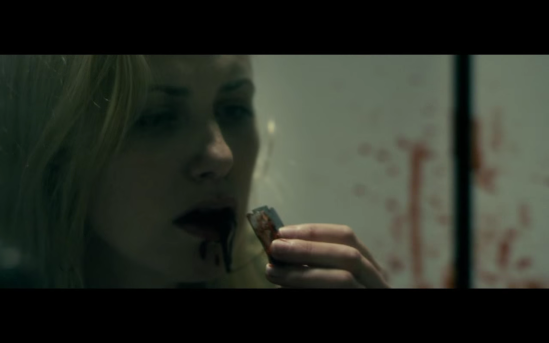
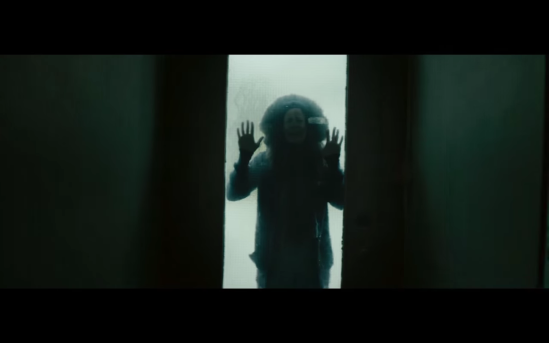
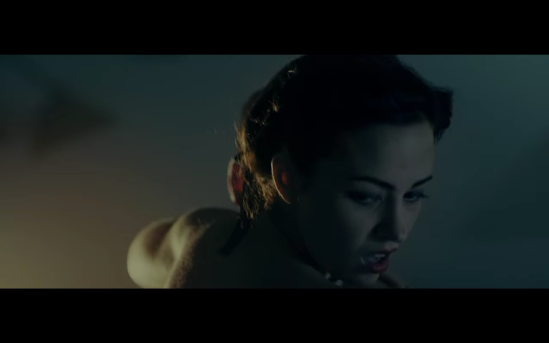
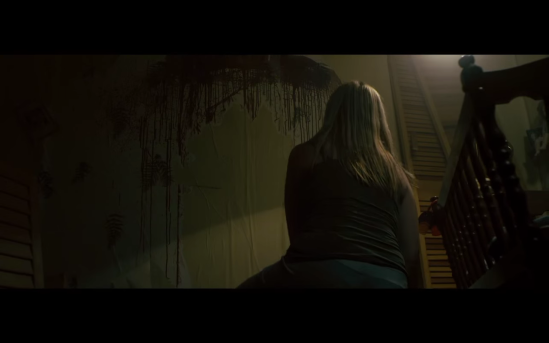
Sara, a desperate young mother, infiltrates a secret facility workplace under the false pretentions of becoming an employee of the critical janitorial department. After losing custody of her adolescent daughter Jenny in court, the child becomes misplaced when her custody awarded father, an employee, loses Jenny in the facility that’s conducting unusual activity involving the building’s light energy source. With everyone on constant edge and under the powerful and dangerous influence of the light, including her very organized and unstable employer, Sara is able to find a sympathizer in the head janitor and by exploiting his mental map and valuable knowledge of the building, Sara goes deeper into the structural bones of a nightmarish reality where evil lurks in the shadows and not everything is what it seems.

“Feed the Light” is a H.P. Lovecraft inspired sci-fi horror directed and co-written by indie filmmaker Henrik Möller with Martin Jirhamn sharing the co-write. The gothic tale stems from the Lovecraft short story “The Colour Out of Space” that tells the tale of a meteor crash landing in the hills near Arkham, Massachusetts, poisoning and deforming all the living creatures nearby that creates chaos amongst the locals. The light, that never dulls, becomes the driving force of everything malevolent and that carries over into Möller’s film, but isolates the setting to a dilapidated building instead of a natural landscape and focusing more on the people inside rather than vegetation or livestock as the Lovecraft short story builds upon. Originally shot in color, Möller thought best to suck the color out from the reel and produce a mostly black and white film, sprinkled with color at strategic moments, that would convey the importance of the ever-present light and interpret a far more dramatic effect to play out; a decision I whole-heartedly agree because if laced with color, much of the abandoned warehouse setting would be a monotonous eye-sore. Instead, black and white enhances the light’s presence, makes it almost seem to stand out amongst the greyscale, and give way to more inspirationally vibrant hues when they are revealed.

For Henrik Möller, this is the director’s first dive into feature films and for the filmmaker whose better known for his shocking shorts, “Feed the Light” doesn’t water down the deranged, creative machine that just steam-plows through a 75-minute runtime and still managing to be mechanically sound to comprehend the Lovecraftian tone. Lina Sundén fills the lead shoes as Sara and Sundén embodies complete innocence and bewilderment when her characters goes forth into this strange facility, but doesn’t show much fear as if a mother’s determination is her driving force to go beyond being what frightens her. Alongside Sundén is Martin Jirhamn, who you might remember me saying he co-wrote the script, as the sympathizing janitor. Jirhamn has collaborated on many of Möller’s shorts, feeling comfortable taking on the challenge of a full length feature by taking on more of a scripted role that has a face with two sides. Rounding out the cast of memorizing characters are “Not Like Others'” Jenny Lampa as an authoritarian boss of the facility who tries to keep Sara from going on Indian Jones and the Raiders of the Lost Ark in the basement and Patrik Karlson otherwise known as the VHS-Man and Jenny’s father in the film.

“Feed the Light” has undertones beyond that of Lovecraft. The story feels nearly anti-establishment, a surreal and extreme look at how doing the same job, in the same office, staring at the same fluorescent lights can make one loose one’s humanity. The boss is a strict enforcer of the rules and doesn’t shrug at the thought of one of her employee’s burning out as long as the job gets done, but it’s not burning out that’s the problem. The light symbolizes obedience and control, turning those with a soul into mindless workers. There’s an unseen power embodying them such as with the dog man, played by Morgan Schagerberg, who, literally, sounds and acts like a canine that just happens to have glittery dust goo ooze out of it’s anus. Yup, weird. “Feed the Light” is jarringly weird, but also laminates into the prospect of hidden doom that’s very similar to the truth is out there concept reveled in the “X-Files.”

The Severin sub-label, Intervision Picture Corp., usually subjects us to older projects, but embraces newer indie films such as Henrik Möller’s “Feed the Light” and with the help of CAV Distributing, Möller and “Feed the Light” can be exposed to every house hold on Earth as a region free Blu-ray in 1080p full Hi-Def. The full frame is a staple of Intervision and doesn’t necessary cause any distress over cropped images. There is a fair amount of interference, but again, only enhances the indie labels reputation. Other than that, the image is fine laid under a Swedish language dual channel audio track that’s well balanced with a brooding industrial soundtrack by Testbild, a Möller familiarity. There are two extras accompanying the feature: one is a making of featurette and the other is an interview with the director, Henrik Möller. “Feed the Light” is a science fiction oddity chocked full with surreal depictions and nightmare creatures with a Lovecraft base and a passionate director’s otherworldly view of how light and color powerfully dictate our everyday lives.
Category Archives: psychological horror
In a Seemingly Fresh Corpose Lies a Legendary Evil. “The Autopsy of Jane Doe” Review!

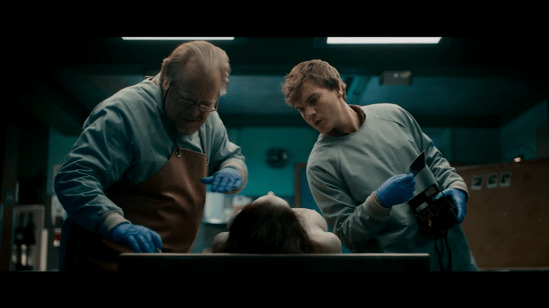
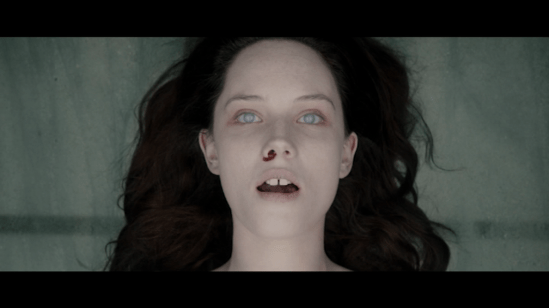
An unknown corpse of a young woman, found naked and half-buried in the basement of a home involved in a gruesome crime scene, is strolled into a small town family morgue and crematorium by a puzzled local sheriff. Without any idea who this woman is and how to explain the her presence at the scene, the sheriff wants a cause of death on his Jane Doe as soon as possible and it’s up to Tommy and his son, Austin, to investigate what caused her demise and to determine her involvement in the grand scheme of the grisly events. When the medical examiners begin to peel back the layers, each segment of the autopsy reveals impossible and unspeakable horrors underneath her cold flesh that go against their combined years of medical experience and the deeper they dig into her body, the more the autopsy room becomes a spine-tingling area as strange occurrences begin to happen to the father and son. Their only hope in stopping the ominous terrorizing presence and surviving the hell-bent stormy night is to continue the examination in order to unravel the enigma that surrounds Jane Doe.

“Troll Hunter” director André Øvredal helms a contemporary horror masterpiece with the Americana horror film,”The Autopsy of Jane Doe, that can be described as American folklore lit ablaze with modern day macabre that plays like a gruesome adult version of the children’s game Operation. Øvredal pulls inspiration from present day classical horror, including such films as the widely popular James Wan franchise, “The Conjuring,” by not embarking on an overkill journey of heavy duty effects or relying on gallons upon gallons of fake blood to sell his film. Instead, André Øvredal’s “The Autopsy of Jane Doe” is patient, subtle, and massively creepy, utilizing the dated morgue and crematorium basement setting to construct a dreadful, despairing dungeon atmosphere and focus on being very particular with every scene having a function to take advantage of the overwhelming brooding aurora and pop scare moments that can scare the pants off a mannequin. Øvredal heightens moments of complete pin-drop silence to amplify the terror and plays with camera angles that linger longer to leave an unsettling residue pooled in a spine-tingled soul.

Not only is the Ian Goldberg and Richard Naing script palm-sweaty frightening, tack on A-list actors like Brian Cox (“Manhunter”) and Emile Hirsch (“Killer Joe”) as a father and son team pitted against a dead body and “The Autopsy of Jane Doe” jumps up by tenfold as a must-see. Brian Cox is masterful as the widowed mortician whose numb to the pain of life and shock of work, making him a dedicated professional at uncovering the truth inside corpses, and he’s well companioned with Emile Hirsch, the mortician’s eagerly loving son and apprentice to the family business. The only problem is Austin doesn’t want to be a part of the family legacy, but is rooted by his continuously cloaked grieving father and you can see the struggle in Hirsch’s wish-washy character. The pair of veteran actors play off each other well being a medical super duo by conducting examination procedures and digging right into the corpse of dead, disfigured bodies like it’s just another day at the office. The gorgeous Olwen Catherine Kelly is dead on being a dead body. Though Kelly literally doesn’t move an inch for the entire runtime, her slim frame and blank facial expressions are truly haunting, if not also alluring to behold.

Immediately, my first impression of André Øvredal’s film had me stroll back to the past, nearly a decade a go to 2008, with the Marcel Sarmiento and Gadi Harel thriller “Deadgirl.” The premise of the film told the story of two high school aged boys discovering a seemingly near dead young woman in an abandoned asylum; the dead girl being played by Jenny Spain. Whereas each film have their separate horrific identities, their end games bare supernatural similarities. What also separates André Øvredal’s film from Sarmiento and Harel’s “Deadgirl” are the two protagonists; instead of two teen boys pulling hormonal hijinks on a motionless attractive female body, Tommy and Austin are strictly professional, focused on their task to answer the riddle lying inside the very fabric and bones of Jane Doe. The only gripe I can bottom barrel scrape out is how Tommy and Austin had this big ‘what if’ epiphany that becomes the very basis of the entire film and, in my opinion, felt that scene was extremely chintzy and a cop out.

Lionsgate Home Entertainment delivers “The Autopsy of Jane Doe” from production companies 42, Impostor Pictures, and IM Global onto UK DVD and Blu-ray. Unfortunately, a DVD-R screener was sent to me, resulting in no true examination of the audio and video qualities and the only extra on the disc was a Q&A with directorAndré Øvredal. Even if viewers might be able to guess the nature of the corpse – I did about halfway through – “The Autopsy of Jane Doe” is still way ahead of it’s genre brethren in being the best horror film of 2017 with an unlimited amount of sinister wretchedness that tugs at your soul strings and weighs heavy in your mind’s cache as soon as the lights go out for bedtime. I would recommend this title to anyone seeking an unadulterated horror experience.
Visions of Evil From a Disturbed Mind. “Lung” review!

An unidentified man, wearing medical scrubs and gloves, wanders through town, encountering hellishly gruesome scenes of death. He wanders barefoot through a ghastly journey that might figuratively expresses his back story of how he came to witness such visions and be relatively undisturbed by the horror they represent. The filthy, gory, and ill-fated moments might also be hallucinations brought upon by a traumatic occurrence that wrenches him out of reality and into grisly purgatory. Either way, the nameless man is a lost soul with no ambition, no emotion, and no direction to guide him through an inner conflict of blood-soaked entombment.

Unearthed Films’ 2-disc collector’s edition of “Lung I” and “Lung II” continues with the distribution company’s legacy of delivering the best underground cinema to the forefront of home entertainment. Phil Stevens, director of positive-reviewed “Flowers,” writes, stars, and directs both feature films about the wandering man in a foggy, distorted haze, but “Lung II” is not a sequel to “Lung I.” Instead, “Lung I” is the softcore version of events whereas “Lung II” is a hardcore redux – think along the lines of “The Evil Dead” and “Evil Dead II” – that’s much more detached from rationality and by collaborating with “American Guinea Pig: Bloodshock’s” Marcus Koch seizing upon the special effects, you can damn well count on “Lung II,” and certainly “Lung I” as well, being bare-faced dark, violent, and twisted. In more a sequential reality, “Lung” is part of the Phil Stevens’ proposed trilogy entitled the Violence of Dawn with “Flowers” leading the horrific charge. This review will focus more on “Lung II.”

Stevens stars as the unnamed lead, waking up lost under a creek bridge, dressed in medical scrubs, and haunted by unspeakable, bloody post-violence mayhem while continuously battling his evil doppelgänger self. Is this just a strange nightmare or a telltale sign of this man’s troubled past? Then, again, Stevens’ impassive take feels more like wandering through one hell of a dream, an endless journey into one’s post-traumatic warped mind rather than spelunking into one of a murderous soul’s, even if one of the moments of trauma could be his wife – or girlfriend – cheating on him and he catches her in the act with ill-fated consequences. Characters also related to the medical profession, such as a psychologist (David Copping) and quick flashes of a nurse (Angela Jane), are a part of this visceral vision quest. Finally, we come to The Exile character. The Exile might sound familiar if you’ve read my review on “Flowers” as he’s the only character, portrayed once again by Bryan W. Lohr Sr., that connects the two films. The Exile continues to mystify us about his presence, an extremely large and intimating brute with a deathly blank stare and a “don’t fuck with me” attitude.

Unlike “Flowers,” Stevens went the devoid of color route, constructing a black and white feature that, like “Flowers, goes without as much as a sentence of dialogue. Actions, expressions, and every sense of the word “art” tell the story. Non-linear editing and brutally realistic scenes of savagery in the confines of special effects exercise and sparks your brain’s neurons to try spitfire pieces together to cement a coherent narrative. Stevens is almost able to re-tap into and revitalize the silent film genre with “Flowers” and “Lung”, and with the help of a vehement brooding score by Mark Kueffner, I believe this type of experimental horror story telling can fascinate just about anyone without a weak stomach.

Unearthed Films and MVDVisual’s 2-disc DVD collector’s set a beautifully monochrome piece of art with roached infested severed heads, a halfway decomposed homeless man, and a pile of refrigerated sexual organs meshed together like something out of Brian Yuzna’s “Society,” but more gnarly. Im interested to see how Paradis, aka Paradis III, comes to conclude the trilogy and see how Unearthed FIlms releases Phil Stevens’ visionary tales. The Borderline Cinema and Extreme Horror Cinema “Lung” is comprised of two discs that entail “Lung I” Feature Film, “Lung II” Feature Film, Directors Commentary, Editors Commentary, Isolated Sound FX Track, Making of Lung 2 (which is very informative and fun to watch underground cinema come to the fold), Mark Kueffner: Lung Composer Featurette, Martin Trafford: Artwork Featurette, “Cats” Short Film, “Descent” Short Film, and Unearthed Trailers. “Lung” will not tickle everybody’s taste; surely sick and part of a niche network of darkly persuaded and humored people will most likely get it, but there’s still very much to appreciate here from director Phil Stevens and his eye for detail and disturbia. This gore and shock is worth a look and worth a chance.
”The only way out is in.” The Evil Within 2 announced.

Well E3 has definitely started off great. I was already excited after watching the awesome Xbox conference, that I thought to myself how can this get any better? Well Bethesda came out and made my night even better with the announcement to ”The Evil Within 2.”
”The Evil Within 2” takes place 3 years after the first game. Players reprise the role of Detective Sebastian Castellanos as he must go back into STEM to rescue his daughter, who he thought had died years ago.
”The Evil Within 2” will be released on Octobar 13th, 2017 for Xbox One, Playstation 4, and PC.
Subletting Manager is an Evil Shrew! “The Resident”review!

Joanna and her fiance, Geoff, enter a sublet agreement sight unseen. With her fiance being a struggling actor with gigs teetering on the line and domineering most of his time, Joanna struggles to find ways to pass the day alone in her apartment on unpaid maternity leave. The creepy, unwelcoming apartment doesn’t feel like home when Joanna has yet see another living soul in the building, but hears footsteps on the next floor above, violent wall banging thumps next door, and extremely unpleasant dreams that seem to cause her to lose time in reality. When Geoff neglects her pleads to leave the sublet, Joanna becomes enthralled with a newfound journal from an off limits room and as soon as she starts to read from the pages, her life in the apartment strangely follows a parallel path of the journal’s previous owner, a house wife named Margaret, that leads to jeopardizing everything Joanna knows: her sanity, her husband, and her baby.

“The Resident,” aka “The Sublet” as known in other parts of the world, is the debut psychological horror directed by the writer of “Jack Brooks: Monster Slayer,” John Ainslie, who also co-wrote the script with Alyson Richards. The 2015 film is also produced by Chad Archibald, whose name might sound familiar if you’re a regular reader of this review website where you can read about interesting horror feature films like “The Resident.” Archibald helmed the body horror delicacy “Bite” the same year. Together, the qualified credential crew steps up to a challenge with “The Resident” that, on the surface, appears to be another run-of-the-mill tired premise of a young couple coping with a malevolent presence and with a common subplot involving a stay-at-home mom being the unfortunate victim. Ainslie and Richards, obviously, go through the stages of that realm, knocking down the expected pillars of conventionalism, but the duo do touch upon a couple of things. For one, they make “The Resident” very interesting and entertaining by seriously messing with Joanna’s state of mind, forcing her to question every little aspect of her mundane existence in that small sublet. The second thing is is that the whole story can be seen a metaphor for postpartum depression that’s driving psychosis right into the thick of Joanna’s unhappiness. More than once, Joanna mentions how ugly she feels and she becomes overly jealous of Geoff’s ex-girlfriend, even if rightfully so.

“Bite’s” Tianna Nori gluttonously takes on Joanna’s dwelling punishment. Nori’s par performance sells sufficiently, but doesn’t completely enthrall Joanna into the depths of madness, leaving a rather tame aftertaste. The same can be said for Mark Matechuk, who plays opposite to Nori with Geoff. His struggling actor shoes fit his two-bit stiff and starchy outfit, but Matechuk and Nori do work well together even if some scenes feel forced and scripted. By far, Rachel Sellan was my least favorite of the three main actors with her portrayal of a snobby, yet beautiful, ex-girlfriend of Geoff’s. A world built solely on the inner walls of the apartment, literally 95% of the film is inside this constructed sublet, has more personality and life than the organic material composing an orchestrated dialogue and I personally don’t blame the cast. I believe the sublet, the construed presence, subversively overshadows the intended characters. Krista Madison, James Murray, Mark Ettlinger, and Jeff Sinasac make up the supporting cast.

“The Resident” has modest effects that spur mostly off screen, but on the rate instance when mise-en-scene effects happened, they didn’t go unnoticed. “The Resident” brought and delivered the appropriate psychological nightmares associated with brain-warping spirits, shelling out an introverted dreaminess in Joanna that only she could experience with those unfortunate family and foes surrounding her witnessing only the outer chaos. Sometimes the story gets lost in itself when attempting to further Joanna’s skewed circumstances. Is Joanna dead already? The answer is possibly. Every external scene of the apartment building or even the brief scenes of Joanna with the stroller sets the moments in dreary rain and when going further into the film, Joanna is no longer able to leave the apartment. She even becomes a part of her own missing person’s investigation conducted by two belligerent cops, played venomously by Mark Ettlinger and Jeff Sinasac, who inform Joanna that her family hasn’t heard from her in days. It’s the final scene that sets the whole rest of the film in stone, that solidifies Joanna’s mental state, and yet the simple moment still leaves questions and reflection. That’s a considerable tall tell sign of good story telling from Ainslie and Richards.

Canadian production company, Black Fawn Films, headed by Chad Archibald have another successful odious anecdote in their arsenal of horror and the company has quickly gained momentum in becoming a juggernaut in sustainable low-budget horror. Second Sight will be heading the home distribution portion of the title with a May 22nd release onto DVD and On Demand. Unfortunately, a press DVD-R was provided and the audio and video qualities can’t be commented on nor can any critique on the bonus material. John Anislie has the tools and the means to labor a chilling trap of supernatural spookiness. With a cast of similar caliber, “The Resident” would have made it higher on the list, but manages to keep a solid bleep on the radar when the next scene always begged the question – what’s going to happen next?